

Kiel Castle's Concert Hall Finds a New Voice
gmp Architects and bbp:architekten transform a heritage castle annex into a purpose-built orchestral hall on Germany's Baltic coast.


Germany has no shortage of concert halls, yet many of its mid-tier cities still struggle to house their resident orchestras in acoustically adequate spaces. Kiel, the state capital of Schleswig-Holstein and a city defined by its relationship to the Baltic Sea, has long faced exactly that problem. The Concert Hall at Kiel Castle, completed in 2025 by gmp Architects in collaboration with bbp:architekten, addresses it head-on by renovating and converting an existing structure adjacent to the castle grounds into a contemporary orchestral venue.
What makes this project worth studying is its refusal to treat heritage context as either a constraint to grudgingly accept or a backdrop against which to perform architectural theatrics. The design team instead operated with a cool restraint, inserting a hexagonal auditorium volume into the existing shell and wrapping public circulation in materials that quietly assert their modernity. The result is a building that reads as both institutional and inviting, a civic landmark that feels earned rather than imposed.
A Civic Facade That Earns Its Keep


The glazed facade facing the public plaza does most of the building's social work. At dusk, the hall becomes a lantern, its interior life visible from the surrounding urban grid. This is a deliberate civic gesture: the concert hall announces itself not through monumental scale but through transparency. You see people inside, ascending stairs, gathering in the foyer, and the building's cultural function becomes legible to passersby.
At ground level, a dark steel entrance canopy frames the glass doors with a precision that borders on industrial. It is a necessary threshold, marking the transition from the paved plaza into the world of the performance, but it does so without the overwrought symbolism that afflicts so many cultural buildings. The canopy is simply well-proportioned and functional, and that is enough.
Foyer as Social Engine


The real drama of this building happens before anyone takes a seat. The double-height foyer, anchored by a wide staircase and punctuated by tiered crystal chandeliers, is designed to slow people down and draw them into a shared social experience. The chandeliers are a nod to classical concert hall tradition, but their repetition and the clean white paneling around them prevent the space from tipping into pastiche.
At the reception desk, dark stone paneling creates a grounding counterpoint to all that luminous white. A mezzanine level hovers above, and the chandelier above the desk becomes a kind of vertical anchor that stitches the two levels together visually. These are the small compositional moves that separate a well-designed foyer from a mere lobby: every element has a spatial role beyond its functional one.
The Auditorium: Hexagonal Logic
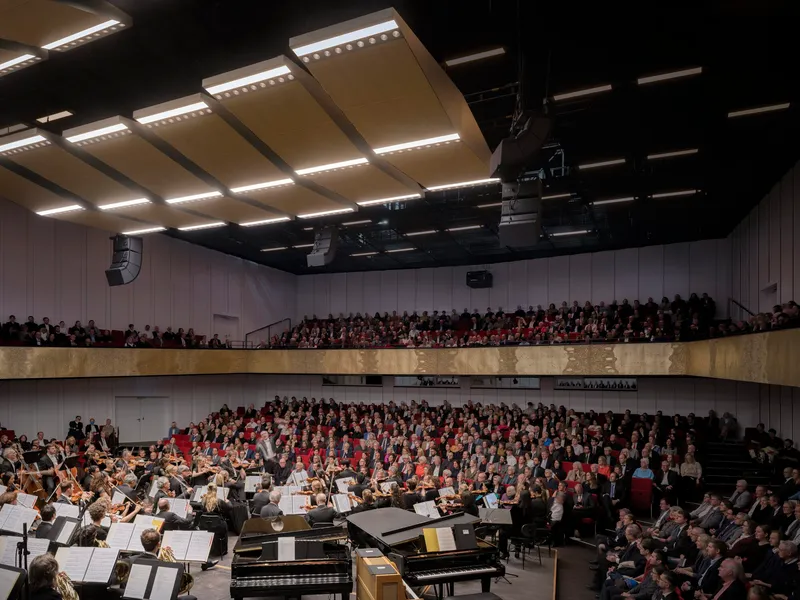

The auditorium itself is the project's core argument. A hexagonal plan allows for steeply tiered seating that wraps around the stage, bringing a large number of audience members into close proximity with the performers. This is vineyard-style seating geometry applied with geometric discipline: the angled walls create acoustic surfaces that can be tuned to the room's needs while also establishing a visual intensity that focuses attention on the orchestra.
The cutaway section rendering reveals how the warm ceiling lighting and structural frame work together. The ceiling is not merely a surface but an acoustic instrument, shaped to distribute sound evenly across the tiered seating. What is striking in the filled-house photograph is the intimacy of the room despite its capacity. Every seat appears to have a clear sightline, and the room feels compressed in the best possible way, charged with the collective anticipation that a well-designed hall amplifies.
Corridors, Lounges, and the In-Between
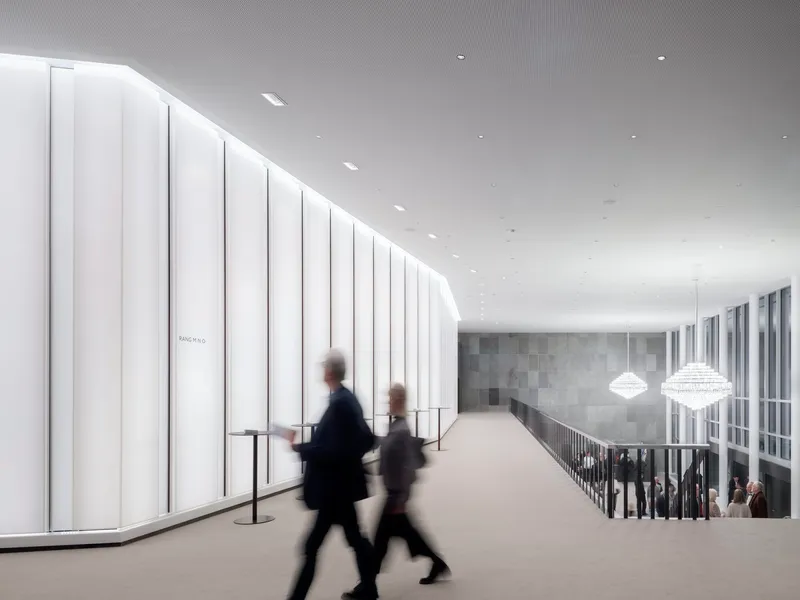


The secondary spaces in a concert hall often reveal more about the architects' ambitions than the auditorium itself. Here, the upper-level corridor features a wall of vertical white panels that function as both acoustic treatment and spatial texture. The corridor is generous enough to breathe, and the rhythm of the panels gives it a quiet musicality that reinforces the building's program without being literal about it.
The standout secondary space is the lounge with floor-to-ceiling windows overlooking the industrial waterfront. Black leather chairs face a panorama of harbor cranes, and the juxtaposition is intentional: this is a building that does not turn its back on Kiel's working port identity. The view during intermission becomes a kind of second performance, grounding the evening's cultural experience in the city's physical reality.
Elsewhere, the double-height lobby with its black metal railing balcony and grey tiled walls strikes a more austere note. These transitional spaces collectively build the experiential arc of a concert evening, from arrival through anticipation to reflection.
Plans and Drawings


The site plan confirms the building's strategic placement adjacent to the waterfront, plugged into the existing urban grid rather than set apart from it. This is a concert hall that belongs to its neighborhood. The ground and upper floor plans make the hexagonal auditorium geometry legible: the central volume is surrounded by generous circulation and service spaces that absorb the complexity of backstage operations without compromising the clarity of the public sequence.
The section drawing is perhaps the most revealing document. The auditorium volume, with its sloped seating and vertical exterior louvers, is partially set into a hillside with trees, suggesting that the building's relationship to landscape was as carefully considered as its interior acoustics. The louvers serve double duty as solar control and as an architectural screen that mediates between the hall's interior world and the surrounding parkland.
Why This Project Matters
The Concert Hall at Kiel Castle matters because it demonstrates that a renovation and conversion project can produce a world-class performance space without the budget or the spectacle of a ground-up icon. gmp Architects and bbp:architekten worked within constraints, and the constraints made the architecture better. The hexagonal auditorium is not a novelty; it is a disciplined response to acoustic and social requirements. The foyer sequence is not extravagant; it is precisely calibrated to elevate an evening out.
For cities like Kiel, where cultural infrastructure must justify its existence to a public that rightly asks what they are getting in return, this building offers a compelling answer. It gives Kiel an orchestral hall that feels both worthy of the music played inside it and rooted in the specific character of a Baltic port city. That is not a small achievement. It is, in fact, exactly the kind of architecture that makes civic culture possible.
Concert Hall at Kiel Castle Renovation and Conversion by gmp Architects + bbp:architekten. Lead architects: Stephan Schütz, Nicolas Pomränke, Christian Hellmund, Björn Bergfeldt, Christine Slomski, Britta Stange. Kiel, Germany, 2025. Photography by Marcus Bredt.
About the Studio
Share Your Own Work on uni.xyz
If projects like this are the kind of work you want to make, uni.xyz is a place to publish your own, find collaborators, and enter design competitions.


Popular Articles
Popular articles from the community

Opera by the Sea Estonia: Three Shells Dissolving Architecture into Tallinn's Coastline
A winning opera house proposal replaces monumental form with interconnected shells that blur the boundary between building, park and Baltic Sea.

Manzana Morphosis: Stretching Barcelona's Grid into a Living Landscape for 2050
A radical reworking of the Eixample manzana turns density into a tool for generous public space, vertical ecology, and environmental performance.
Extended Shell: Retrofitting Kolkata's Balconies as Living Urban Thresholds
A modular retrofit system recovers the social and environmental intelligence of Kolkata's historic verandas for contemporary Park Street residents.
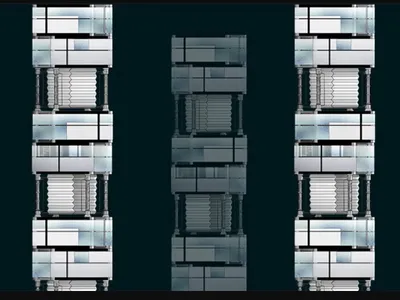
Tsunami Convergenics: Turning Catastrophic Ocean Forces into Underwater Housing Infrastructure
A speculative underwater settlement off the coast of Onagawa, Japan, treats tsunamis and typhoons as energy sources rather than threats.

Similar Reads
You might also enjoy these articles

Pixel Gardens: One Repeated Module Stacked Into a Terraced Social Housing Tower for Famagusta
Salem Bader's shortlisted housing tower builds a vertical neighbourhood from one repeated module, offsetting units to carve terraces, light and air.

Bao Huynh Watercolor Atelier: A Serene Art Retreat in Hội An
Bao Huynh Watercolor Atelier in Hội An blends multifunctional art spaces, sustainable design, local materials, and family-friendly living in a serene environment.

Atelier Macri Concept Store Interior Design by CASE-REAL
Atelier Macri store features a "ko" counter, walnut wood details, cork displays, blending retail, gallery, and seamless customer experiences.

Manuel Vargas Izquierdo Stadium and High-Performance Sports Center: Architectural Excellence in Jalpa de Méndez
The Manuel Vargas Izquierdo Stadium blends sustainable design, inclusive sports facilities, and cultural-inspired architecture, revitalizing Jalpa de Méndez’s public spaces.

Explore Concert Hall Competitions
Discover active competitions in this discipline

Challenge to design mud housing for contemporary communities

Bring back Drive In's
Comments (0)
Please login or sign up to add comments
No comments yet. Be the first to comment!