

EYRC Partners Paint Their Mar Vista Ranch House Black and Turn It into a Frame for the Garden
In Mar Vista, Los Angeles, Takashi Yanai and Patti Rhee recast a 1,500 ft² bungalow as a matte-black frame for a Terremoto garden.


Architects rarely get to be their own clients. When they do, the result usually tells you more about their convictions than any commissioned work. The Kingsland Residence is the family home of Takashi Yanai and Patti Rhee, partners at Ehrlich Yanai Rhee Chaney Architects. It is a 1,500 ft² renovation of an existing house in Mar Vista, a Westside Los Angeles neighborhood made up mostly of ranch houses, a short drive from the firm's Culver City studio. EYRC served as both architect and interior designer, the budget was modest, and the work was completed in 2019.
The project is worth studying because of how little it does. EYRC did not add volume or rework the structure. The team made a handful of decisive moves instead: they painted the exterior matte black, installed a glass door that pockets fully into the wall, re-clad one partition in plywood, stripped the oak floors and removed fittings the house did not need. Yanai was born in Japan, raised in California, lived in Japan for years and edited GA Houses. The house draws on both places without imitating either. We think it makes a sharp case that restraint is a design method and not simply a way to save money.
A Coat of Paint Instead of a New Building
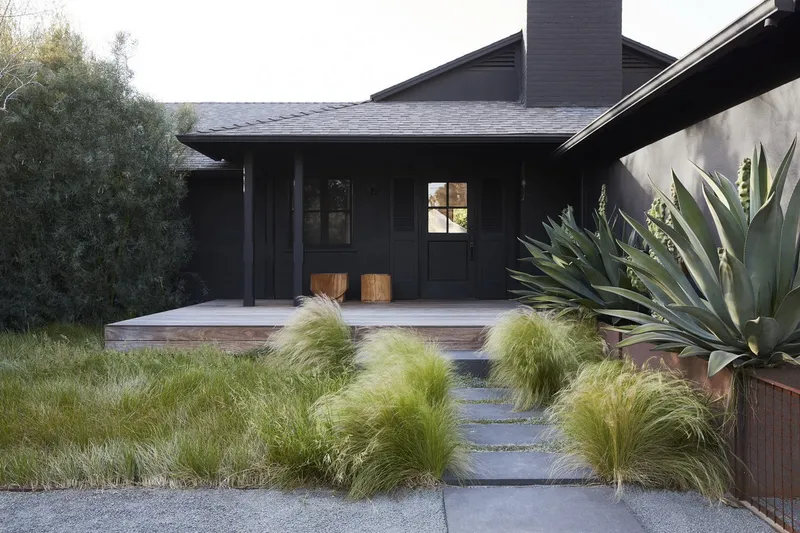
The black exterior is the most visible decision and the most practical one. It recalls shou sugi ban, the Japanese technique of charring timber cladding, but this is paint, not burnt wood. Some will call that a shortcut. We read it as candor. EYRC wanted the look of the tradition for one purpose: to make the house recede. A matte dark surface absorbs the eye, so the agave, the tufted grasses and the timber porch posts step forward.
On a street of pastel and beige ranch houses, the dark facade stands out, yet it never shouts. It carries no new ornament or profile, and nothing about the massing changes. The house still reads as a single-story bungalow. Its role has simply changed from main subject to backdrop.
The Pocketing Door Does the Heavy Lifting
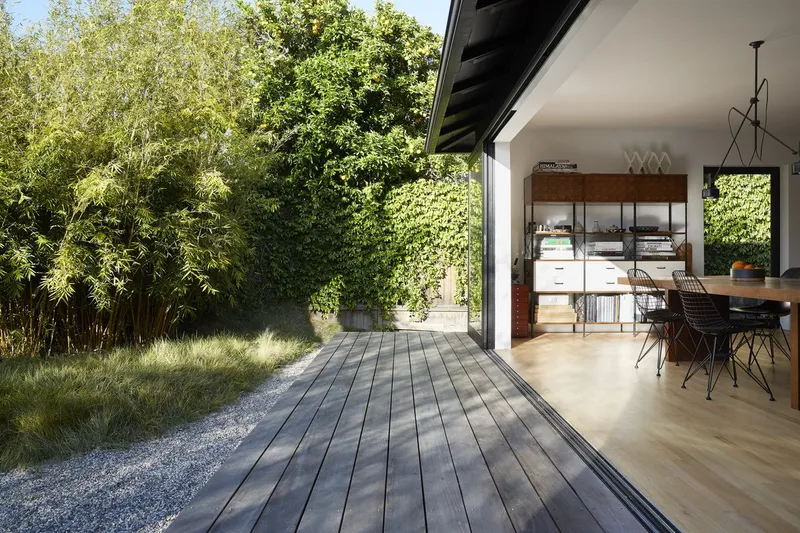
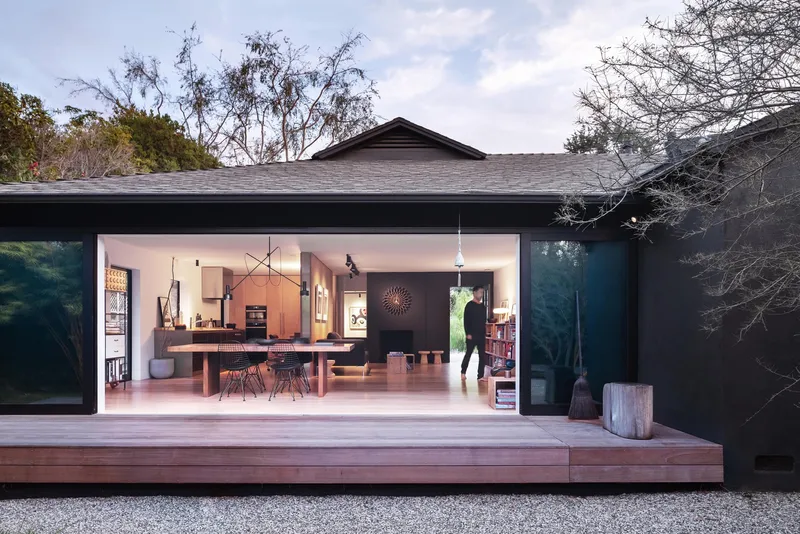
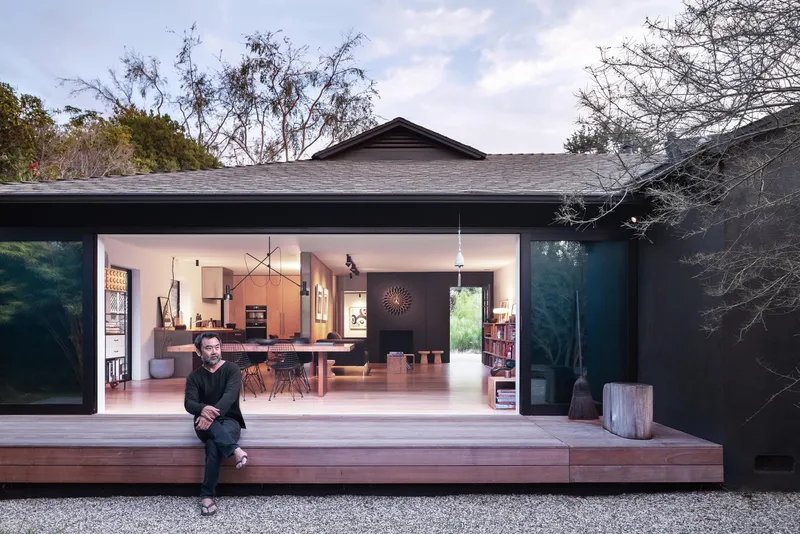
Most of the house's spatial ambition rests on one element: a large sliding glass door that slides completely into the wall. With it open, the living area and the timber deck become one continuous floor. The frame is gone rather than merely thinned. This is the single passive-design move the project documents, and it accounts for most of the house's character.
In the dusk views the logic is plain. The black volume becomes a dark proscenium, and the lit interior reads as a stage set facing the garden. The deck, set close to grade, is easy to sit on and easy to step off. It works as a threshold you occupy, not a platform you look down from.
Putting the Dining Table at the Threshold
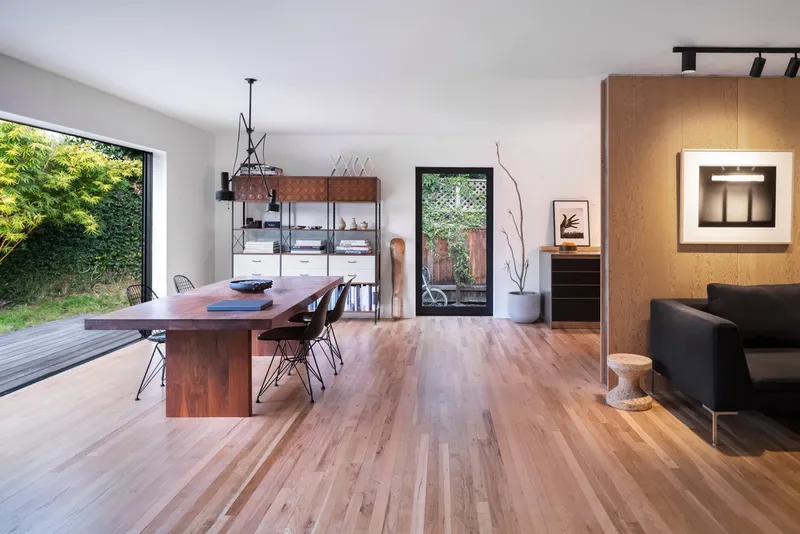
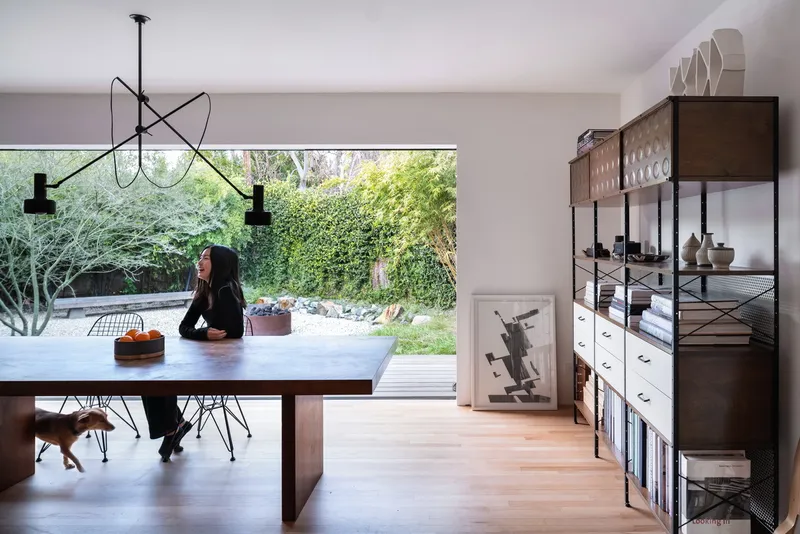
EYRC set the dining table right beside the pocketing opening, and that placement shapes daily life more than any finish does. Meals take place at the edge of the gravel garden and its hedges, so the most routine family activity is also the one most connected to the outdoors. The long wooden table and the steel-framed shelving behind it are quiet enough to leave the view uncontested.
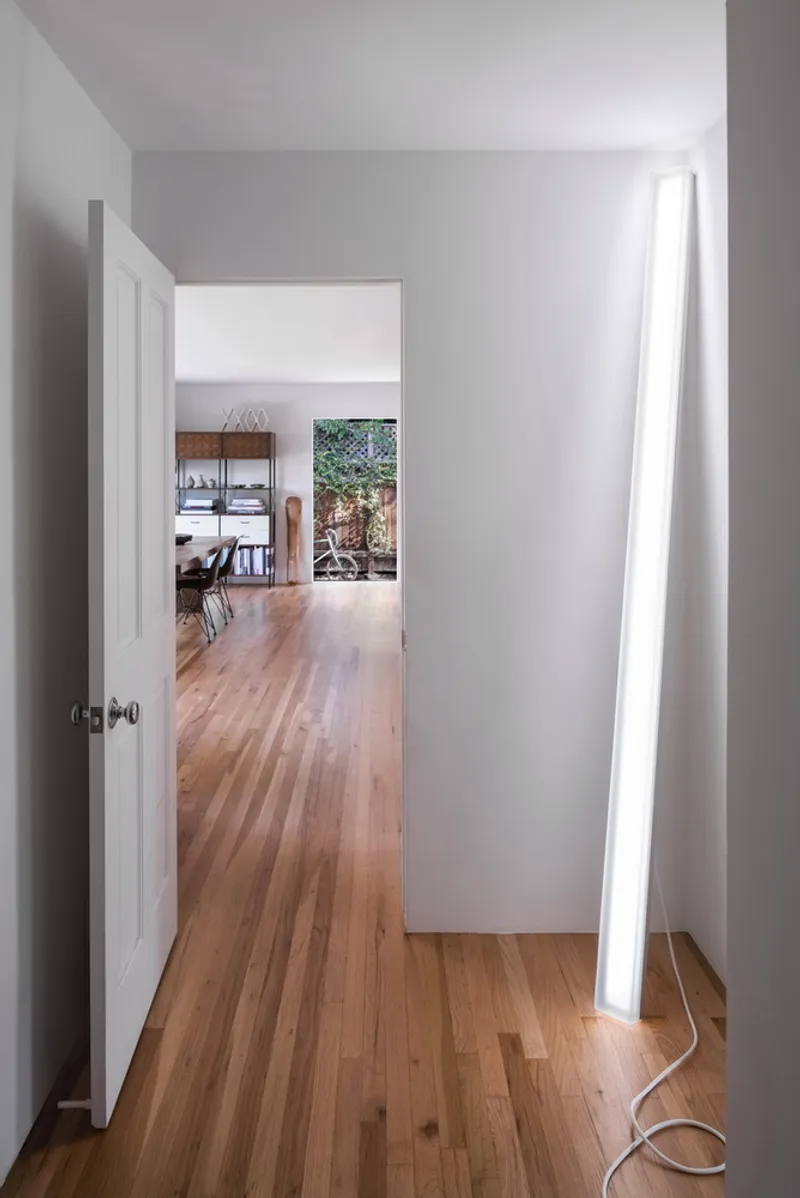
The hallway view shows how the axis carries through the house. From the bedrooms you look past an open door and a leaning light tube to the table and the green beyond. In a 1,500 ft² plan, a long view like this does more to make the house feel generous than any added square footage could.
Plywood, Oak and What Was Left Out


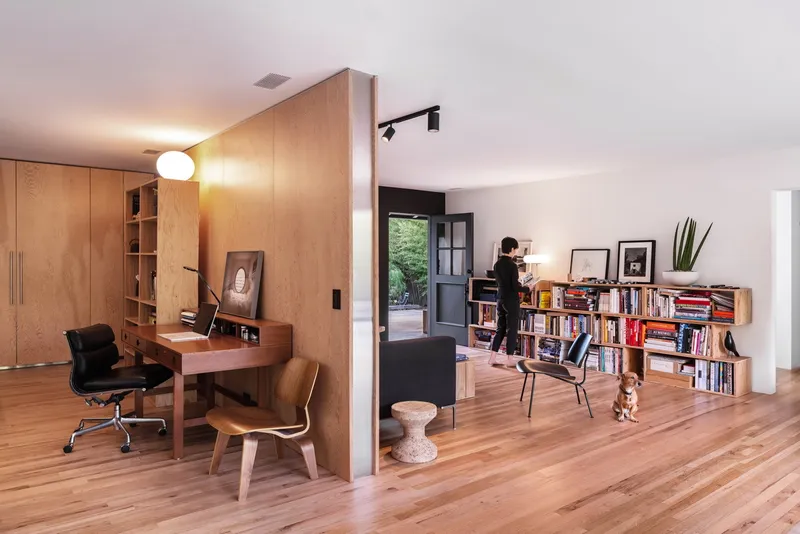
The material palette is short by design. The original red oak floors were kept, stripped and finished with a matte sealer, so they look raw instead of polished. The partition between the living room and the Bulthaup galley kitchen was re-clad in plywood. One face serves as a wall for photography, and on the other side it shelters a desk nook. Storage is limited mainly to open plywood box shelving for books, objects and games.
The subtractions matter as much as the additions. Recessed lighting was removed, and the light comes instead from track fixtures and lamps that read as objects rather than holes in the ceiling. Midcentury Danish furniture and works by Hiroshi Sugimoto, Daido Moriyama and Johannes Girardoni occupy rooms that are plain on purpose. The interior works less like a decorated home and more like a calm container that can absorb a family's life without looking cluttered.
Terremoto's Garden Becomes the Main Room

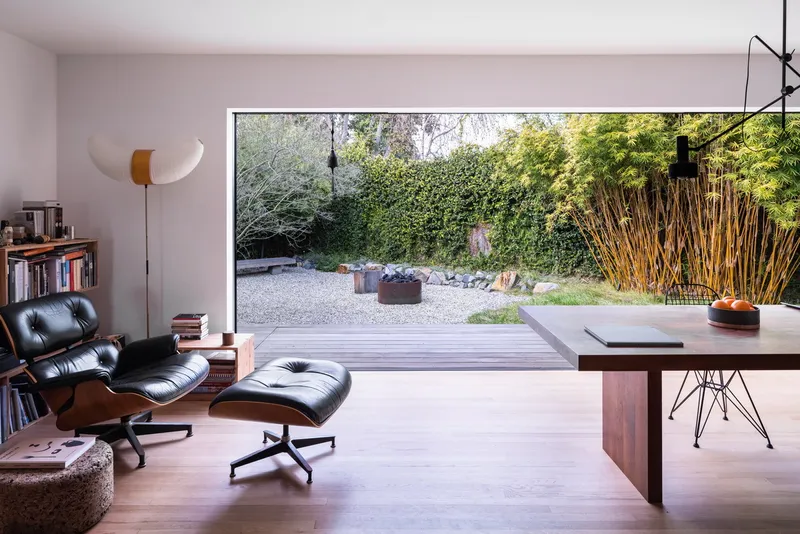
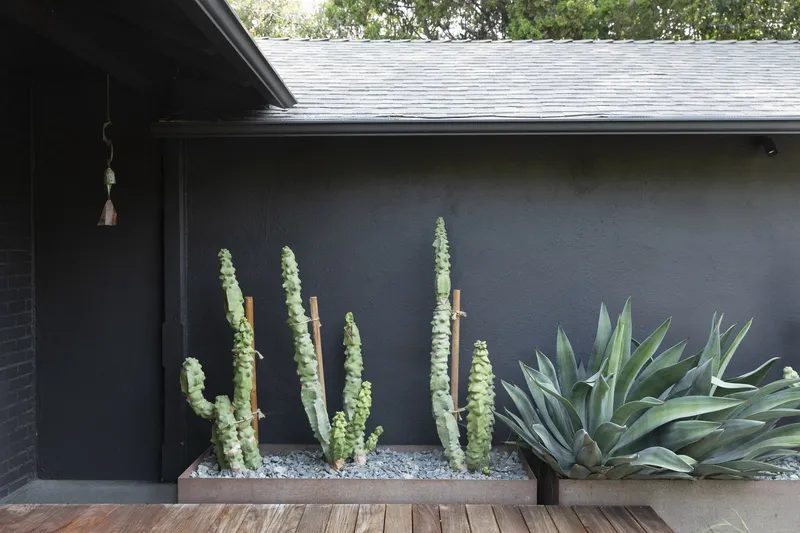
The landscape is by Terremoto, and it is fair to call it the house's main room. Golden bamboo, gravel, a steel fire bowl, citrus, and totem pole cacti staked in a steel planter of gravel all read clearly against the charcoal walls. The planting has Japanese undertones in its framing and composition, yet the species are unmistakably Californian. Sources describe the outdoor spaces as Japanese in nuance and entirely Californian in character, and the photographs back that up.
The lounge chair placements reveal the design priority. Seats face outward, toward the framed garden view, and the low bookshelves stay below the sightline. The garden was designed to be seen from inside as much as used outside, and the interior arrangement admits as much.
Why This Project Matters
Los Angeles has thousands of postwar ranch houses, and most renovations treat them as raw material for expansion. Kingsland shows a different path. It keeps the footprint and the structure, then spends its limited budget on perception: a dark exterior, one wall of glass that disappears entirely, honest floors and a serious garden. The result feels much larger and calmer than the square footage suggests, and that approach can be repeated on almost any lot in the neighborhood.
The project also offers a useful lesson about cultural fusion. Yanai and Rhee do not quote Japanese architecture through screens, tatami or imported details. They borrow attitudes instead: subtraction, framed views and the house as a quiet backdrop to nature. They then apply those attitudes to a Californian building type and climate. The painted stand-in for shou sugi ban captures the whole approach. It keeps the idea, adapts the method and does not pretend otherwise.
Kingsland Residence by Ehrlich Yanai Rhee Chaney Architects, Mar Vista, Los Angeles, California, USA. Area: 1,500 ft². Completed: 2019. Landscape design by Terremoto. General contractor: Architectural Construction. Photography by Stephen Schauer.
About the Studio
Share Your Own Work on uni.xyz
If projects like this are the kind of work you want to make, uni.xyz is a place to publish your own, find collaborators, and enter design competitions.


Popular Articles
Popular articles from the community

Extended Shell: Retrofitting Kolkata's Balconies as Living Urban Thresholds
A modular retrofit system recovers the social and environmental intelligence of Kolkata's historic verandas for contemporary Park Street residents.

Cloaked Colonization: A Mobile Underwater Habitat That Moves Like a Fish
Micah Abaya's shortlisted EHC Pacific entry reimagines ocean settlement as a dispersed network of self-sustaining architectural organisms.

Temporary Home for Dogs: A Reversed Zoo Rethinks Animal Shelter Architecture
In Bucharest, a sinuous corridor and freed landscape flip the logic of containment, designing a shelter that works to make itself unnecessary.

The Amber Palace Opera: A Geological Fiction Surfaces on Tallinn's Baltic Waterfront
Pierre Brillard reimagines a Baltic legend as a public landscape, opera house, and waterfront promenade rooted in Tallinn's coastal identity.

Similar Reads
You might also enjoy these articles

Bamboo Housing Challenge 2026: Design Affordable, Sustainable Homes Using Bamboo
An international design competition by Bamboo U and IBUKU inviting architects and designers to reimagine affordable housing using bamboo — with the winning design built full-scale in Bali.

Computational Design & Education: Beegraphy Design Awards Introduces 7th Category (Featuring Jiyun's Innovative Approach)
Dive into Beegraphy’s 7th Design Awards category, where computational design meets education to create immersive, interactive learning tools, inspired by Jiyun’s work.

From Parametric Lighting to Urban Furniture: Join the 2nd Workshop in Beegraphy’s Computational Design Series
Dive into Cutting-Edge Design Techniques and Practical Applications with Industry Experts

Last Call: Unleash Your Architectural Genius in SHAK's Kindergarten Design Competition
Urgent call for architects to join SHAK's kindergarten design competition before the looming deadline

Explore Architecture Competitions
Discover active competitions in this discipline

Challenge to reimagine the Iron Throne

Photograph architecture without architects

Illustrate the lost glory of Angkor Wat - Render Challenge

Design challenge to reuse E-waste
Comments (0)
Please login or sign up to add comments
No comments yet. Be the first to comment!