
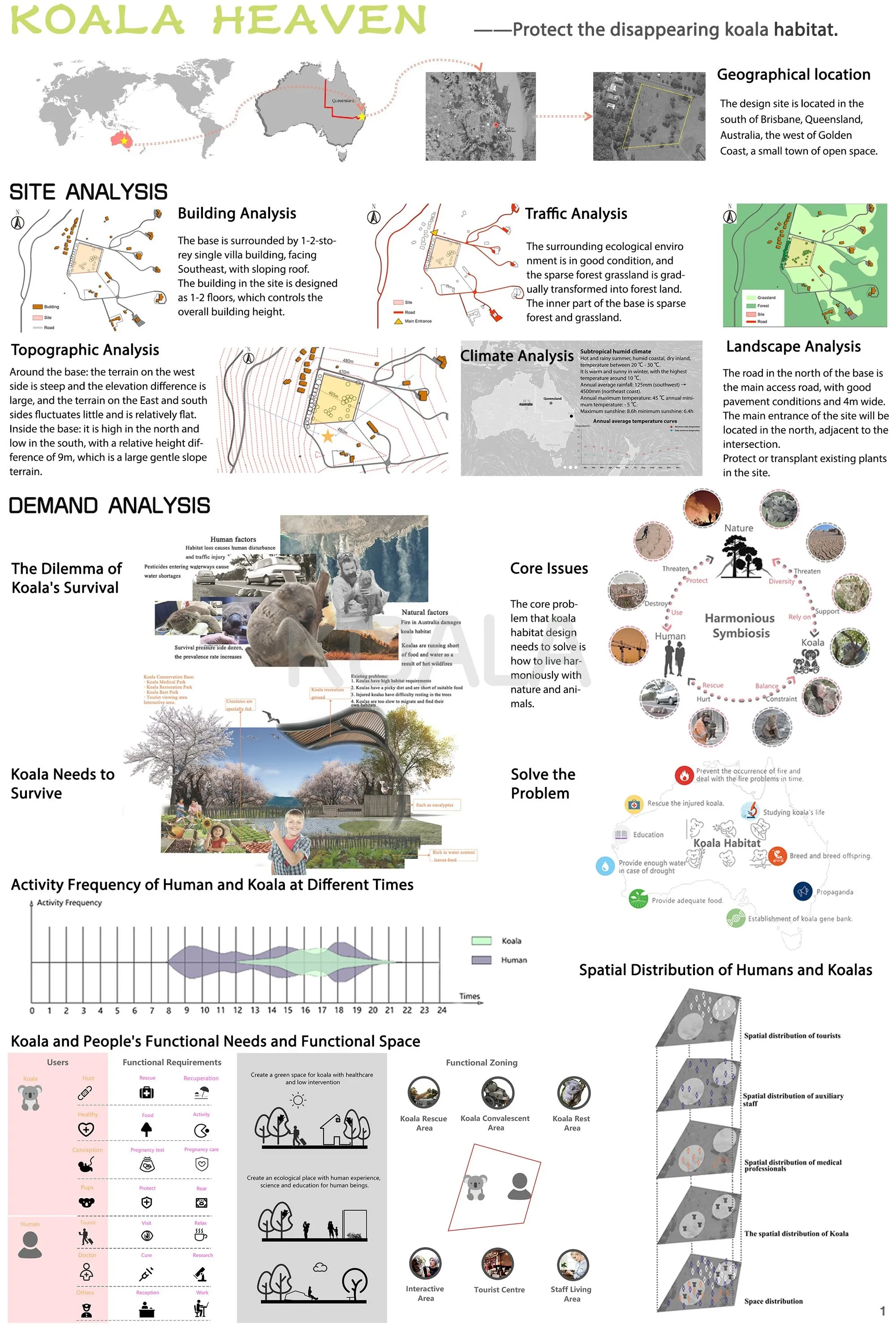
KOALA HEAVEN: Reimagining Wildlife Conservation Architecture Through Ecological Design
Wildlife Conservation Architecture reimagined through restorative landscapes, koala rehabilitation, and climate-responsive ecological design.


As climate disasters and habitat destruction continue to threaten biodiversity across Australia, architecture is increasingly being called upon to respond not only to human needs but also to the survival of vulnerable species. KOALA HEAVEN explores this urgent intersection between environmental restoration and wildlife conservation architecture through the creation of a sanctuary dedicated to the rehabilitation, recovery, and long-term protection of koalas.
Designed by Wenwen Liu, this visionary proposal was recognized as a Shortlisted entry of Haven 2020. The project presents an ecological masterplan where architecture, landscape, and wildlife coexist in a carefully balanced environment inspired directly by the natural habitat and behavioral needs of koalas.
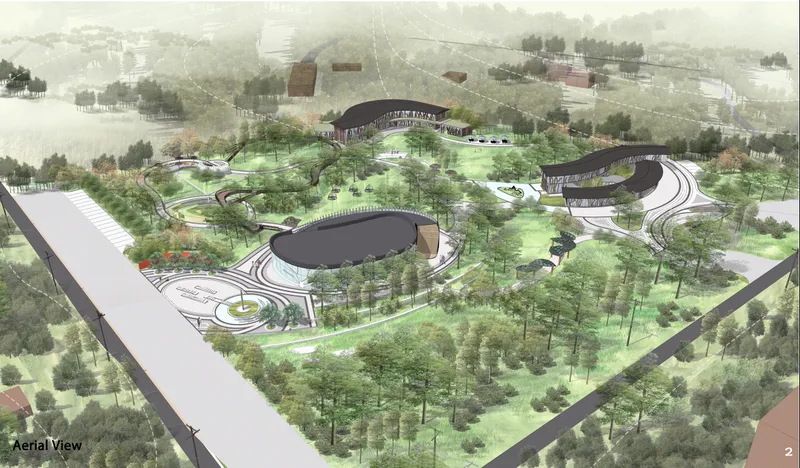
Rather than approaching architecture as an isolated built object, KOALA HEAVEN treats the entire site as a living ecosystem. The proposal combines koala rehabilitation facilities, tourist engagement spaces, educational environments, and staff accommodations within a restorative landscape shaped by eucalyptus forests, flowing pathways, and organic architectural forms.
Wildlife Conservation Architecture Rooted in Nature
The central idea behind KOALA HEAVEN emerges from the concept of a “koala paradise,” a sanctuary where injured and displaced koalas can gradually adapt back into a safe and ecologically balanced environment after wildfire destruction.
The design draws inspiration from eucalyptus leaves, the primary food source of koalas and a symbolic representation of their habitat. Through abstraction and transformation, the curves and linear geometries of eucalyptus foliage become the foundational language of the masterplan. These biomorphic forms guide circulation routes, building footprints, landscape contours, and facade articulation.
This strategy allows the project to blur the boundaries between architecture and landscape. Buildings no longer dominate the terrain. Instead, they emerge softly from the site, appearing as extensions of the natural ecosystem.
The result is a fluid and immersive environmental experience that prioritizes ecological sensitivity while creating meaningful spatial experiences for visitors and caretakers alike.
Designing a Guardian Base for Koalas
KOALA HEAVEN is conceived as a comprehensive rehabilitation and protection center that addresses the physical, ecological, and emotional recovery of koalas affected by environmental disasters.
The proposal is organized into several interconnected programmatic zones:
- Koala rehabilitation center
- Koala recovery area
- Visitor and exhibition center
- Tourist interaction spaces
- Staff dormitories
- Ecological landscape network
- Educational and memorial spaces
- Recreational open areas
Each component serves a specific purpose within the broader conservation framework while remaining visually and functionally integrated into the landscape.
The rehabilitation areas are designed to provide controlled environments for treatment, medical care, recovery, and gradual reintroduction into natural surroundings. At the same time, public engagement zones educate visitors about wildlife conservation, environmental restoration, and the ecological significance of koalas within Australian ecosystems.
This duality between protection and public awareness transforms the project into more than a sanctuary. It becomes a platform for ecological education and collective environmental responsibility.
Landscape as the Primary Architectural Element
One of the most compelling aspects of KOALA HEAVEN is its landscape-driven planning strategy. The project treats the site itself as an active participant in the healing process.
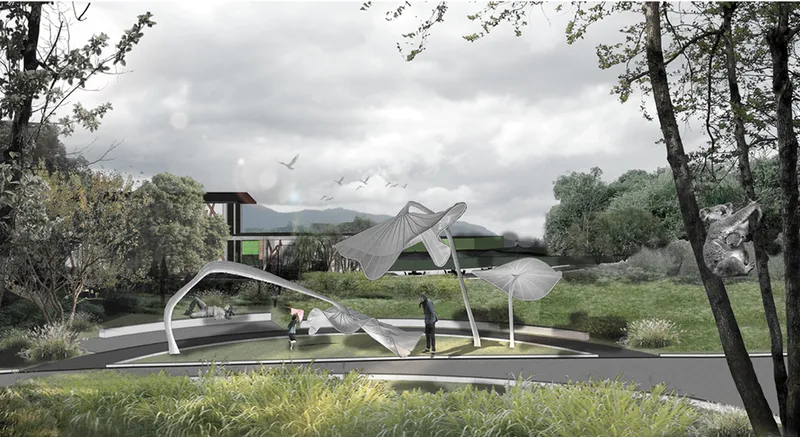
Curvilinear pathways weave through dense greenery, creating immersive experiences that mimic natural movement patterns within forests. Resting platforms, observation decks, wooden plank walkways, and open grassy spaces encourage visitors to engage with nature at a slower and more contemplative pace.
The landscape design also prioritizes ecological restoration. Native eucalyptus species are strategically integrated throughout the site based on studies of koala habitat requirements and post-fire ecological regeneration.
The project demonstrates how wildlife conservation architecture can move beyond symbolic sustainability and instead actively contribute to environmental recovery through planting strategies, habitat creation, and ecological infrastructure.
Biomimicry and Architectural Expression
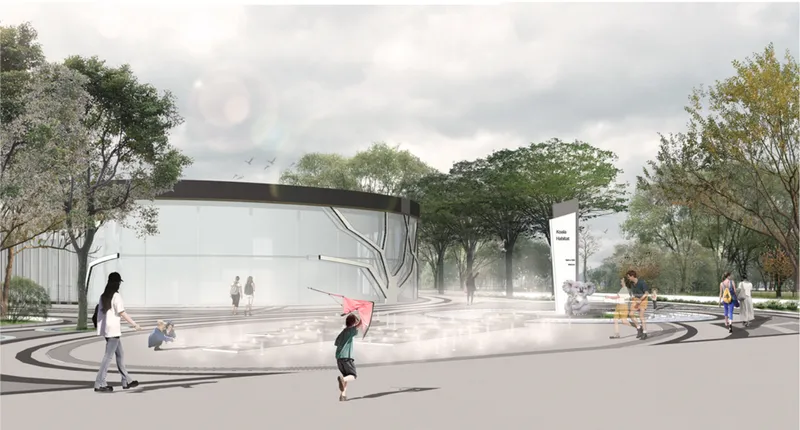
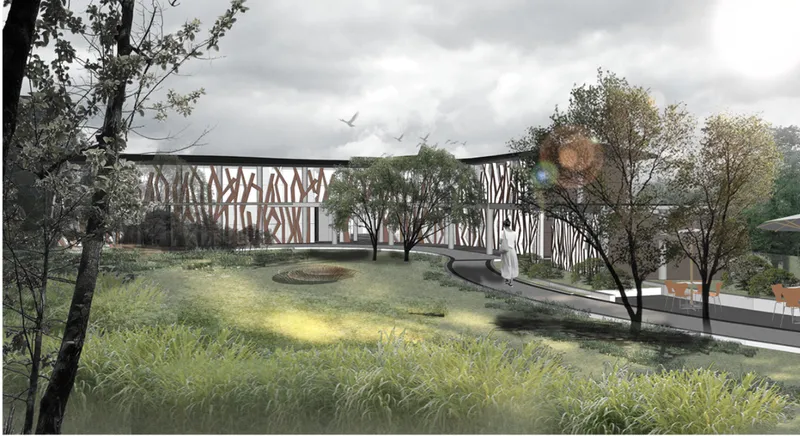
The architectural language of KOALA HEAVEN evolves directly from natural systems. Eucalyptus leaves and tree branches are abstracted into the geometry of building plans, facade systems, and structural articulation.
This biomimetic approach is particularly visible in the facade treatment, where dendritic patterns resembling tree branches create permeable screening systems around the buildings. These facades provide multiple environmental benefits:
- Solar shading
- Increased permeability
- Visual integration with the landscape
- Reduced heat gain
- Natural ventilation opportunities
The buildings also feature soft curvilinear forms and sloping roofs that echo the surrounding terrain and vegetation patterns. Instead of rigid geometries, the architecture adopts a fluid identity that feels embedded within the environment.
Glass curtain walls and floor-to-ceiling openings further dissolve the separation between interior and exterior spaces, allowing constant visual interaction with the surrounding landscape.
The Koala Rehabilitation Center
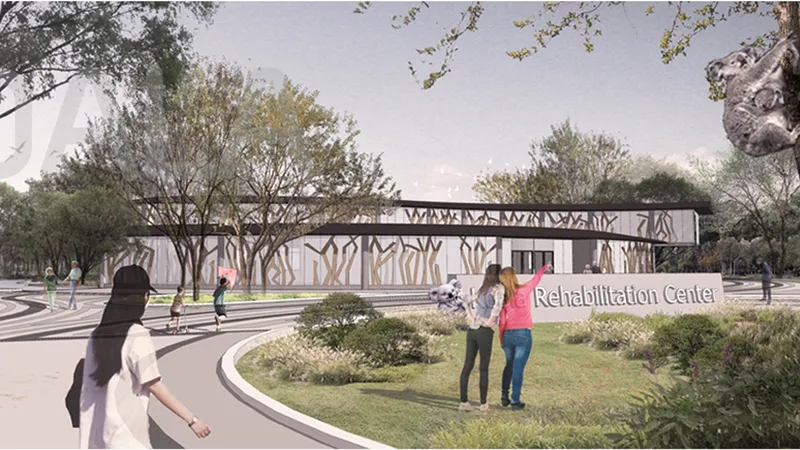
At the core of the proposal lies the Koala Rehabilitation Center, a specialized facility dedicated to medical treatment and recovery.
The building accommodates emergency rooms, X-ray facilities, operation rooms, laboratories, pharmacies, intensive care units, and recovery areas. The internal organization reflects a carefully planned circulation system that separates medical operations, staff movement, and animal care zones.
Despite its technical requirements, the rehabilitation center maintains a calm and nature-oriented atmosphere through open views, filtered daylight, and direct access to landscaped spaces.
The curved form of the building supports intuitive circulation while reinforcing the project’s biomorphic architectural identity. Rather than functioning as a sterile medical facility, the rehabilitation center becomes an extension of the restorative landscape itself.
Visitor Experience and Environmental Education
The Visitor’s Center introduces an important public dimension to the project. It creates opportunities for education, awareness, and controlled interaction between humans and wildlife conservation efforts.
The exhibition spaces, observation platforms, leisure areas, and studios encourage visitors to understand the environmental challenges facing koalas and the importance of habitat preservation.
Architecturally, the visitor center maintains the same ecological language established throughout the project. Transparent surfaces, shaded facades, and open circulation systems ensure minimal visual and environmental disruption.
The project carefully balances tourism and ecological protection. Visitors are invited into the environment without compromising the safety and recovery process of the animals.
This balance reflects an increasingly important direction within contemporary wildlife conservation architecture, where public engagement is integrated into environmental stewardship rather than positioned in opposition to it.
Sustainable Strategies and Climate Responsiveness
Sustainability within KOALA HEAVEN is deeply integrated into both the architectural and landscape systems.
The project incorporates several environmental strategies, including:
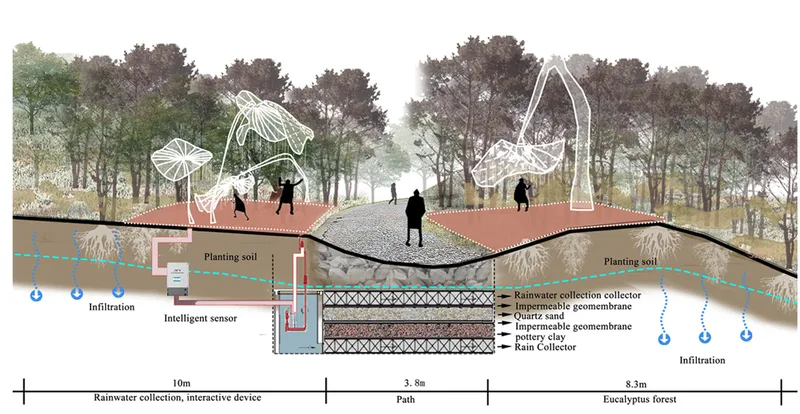
- Rainwater collection and reuse
- Sponge paving systems
- Fire-resistant materials
- Permeable ground surfaces
- Native vegetation restoration
- Passive environmental control systems
- Increased environmental humidity through landscape planning
Rainwater is collected and redirected into storage systems that support irrigation and emergency water supply needs. The permeable landscape design allows water to naturally infiltrate the soil, reducing runoff while improving ecological resilience.
Given Australia’s increasing vulnerability to wildfires, fire-resistant materials and vegetation strategies become essential components of the proposal. These measures strengthen the site’s long-term adaptability while protecting both wildlife and infrastructure.
The project ultimately demonstrates how architecture can become an ecological mediator capable of responding to climate realities through integrated environmental thinking.
A Sanctuary Between Architecture and Ecology
KOALA HEAVEN presents a powerful vision of architecture as environmental stewardship. Through its integration of landscape restoration, wildlife rehabilitation, biomimicry, and sustainable systems, the project redefines how built environments can support ecological recovery.
The proposal moves beyond conventional conservation facilities by creating a holistic environment where architecture, nature, animals, and people coexist within a shared ecological framework.
By transforming eucalyptus-inspired forms into immersive spatial experiences, Wenwen Liu develops a sensitive and forward-looking approach to wildlife conservation architecture that responds directly to contemporary environmental challenges.
In a time when habitat destruction and climate emergencies continue to reshape ecosystems globally, KOALA HEAVEN offers an important architectural model for restorative design, ecological resilience, and coexistence between human activity and the natural world.



Popular Articles
Popular articles from the community


Co-Life: Senior Housing Design That Reconnects Older Adults With the City
Co-Life reimagines senior housing design through healing gardens, shared streets, workshops, and a sustainable community across generations.

Riyadh For All: Intergenerational Urban Design for Active Aging in Rabat
Riyadh For All reimagines urban design in Rabat with intergenerational co-living, adaptive courtyards, and Moroccan cultural exchange today.

Co-life: Sustainable Architecture for Age-Friendly Community Living
Co-life reimagines sustainable architecture for seniors through courtyards, rammed earth, shared gardens, and spaces designed for belonging.

The Musturak Paradise: Senior Living Architecture for a Connected Future in Temara, Morocco
The Musturak Paradise reimagines senior living architecture in Temara via private homes, social spaces, culture, community, and shared care.

Similar Reads
You might also enjoy these articles

Eco Chapel: A Green Architecture Pavilion Designed in Symbiosis with the Forest
Eco Chapel uses green architecture to weave prayer, learning and reuse into a forest pavilion shaped by modular hexagonal canopies for life.
Kaffeebühnen: Coffee Shop Architecture Designed as a Civic Stage Between Vienna’s City and Park
Kaffeebühnen turns coffee shop architecture into a civic stage, linking Vienna’s park edge, urban life, warm timber yards, and coffee craft.
Healing Façade: Sustainable Architecture for Reforestation, Community, and Sacred Ecology in Ethiopia
Healing Façade reimagines sustainable architecture as a living wall that restores soil, catches water and renews Ethiopia's forest churches.


Urban Forest: A Vertical Ecosystem for 5,000 Workers in Singapore's Changi Business Park
Radially stacked pods and layered green decks turn a 7-acre plot into 47 acres of ecological workspace projected for 2040.


Explore Architecture Competitions
Discover active competitions in this discipline



Challenge to reimagine the Iron Throne


Photograph architecture without architects


Illustrate the lost glory of Angkor Wat - Render Challenge


Design challenge to reuse E-waste
Comments (0)
Please login or sign up to add comments
No comments yet. Be the first to comment!