

Kokaistudios Buries a Mall Beneath 42,000 Square Meters of Urban Parkland on Shanghai's Suzhou Creek
Shanghai Suhe MixC World folds commercial space, heritage buildings, and public green land into one continuous topographic gesture.


The reflex in most cities is to stack commerce on top of the ground plane, consuming public space in the process. Kokaistudios inverts that logic entirely at Shanghai Suhe MixC World, pushing 60,000 square meters of commercial program below grade and handing the surface back to the city as a sculpted park along the northern bank of Suzhou Creek. What visitors encounter at ground level are looping, ribbon-like pathways, concentric planted terraces, and six elliptical openings that allow light and air to pour into the retail world beneath. It is less a shopping center with a green roof than a piece of urban topography that happens to contain one.
The project's ambition goes beyond a single building type. The site is a convergence point for a 42-storey Foster+Partners tower, a metro transportation hub, the restored 1932 Shenyu Li lilong neighborhood, and the only official Thean Hou Temple in downtown Shanghai, originally built as a Mazu temple in 1884. Kokaistudios treats this collision of programs as an opportunity rather than a problem, stitching them together through what the studio calls an "urban valley" concept: stepped slopes and organic curves dissolve the boundary between above and below, between heritage and commerce, between the waterfront and its hinterland.
The Valley as Organizing Principle


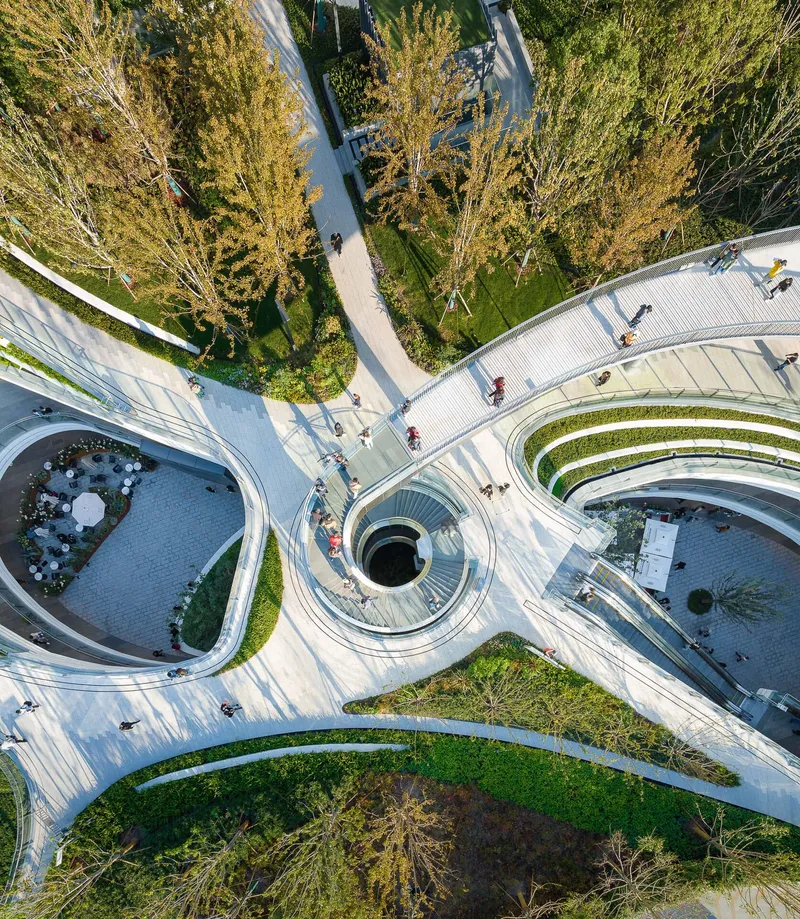
Seen from above, the site reads as a landscape rather than a building. Curving pedestrian pathways loop between planted berms that conceal the stepped access points descending into the subterranean commercial floors. The concentric terraces, radiating outward from circular skylight openings, function simultaneously as amphitheaters, informal seating, and light wells. The geometry is deliberately organic: no straight lines, no hard property edges separating mall from park.
The structural concept is a symmetrical triptych. Two four-storey structures flank a central glass-roofed void, extending horizontally and down to basement level. Two pillars support the glass canopy from top to bottom, keeping the central space column-free and flooded with daylight. This is the spine of the project, and every programmatic element connects back to it.
Sunken Courtyards and the Six Openings


Six overground openings punctuate the park surface, each one a portal connecting the green land to the commercial floors below. These are not utilitarian skylights. They are landscaped events: elliptical plazas ringed by striped grass terraces and curved glass balustrades, some large enough to frame views of the preserved brick buildings on adjacent blocks. At dusk, the spiraling pedestrian ramps that wrap around these voids become social spaces in their own right, with the glow of retail activity rising from below.
The design blurs the threshold between inside and outside so thoroughly that the notion of "entering" the mall barely applies. You descend through planted slopes, pass through glass-enclosed transition zones, and arrive at a retail level without ever encountering a conventional entrance door. The landscape does the work of architecture.
A Riverfront Reclaimed
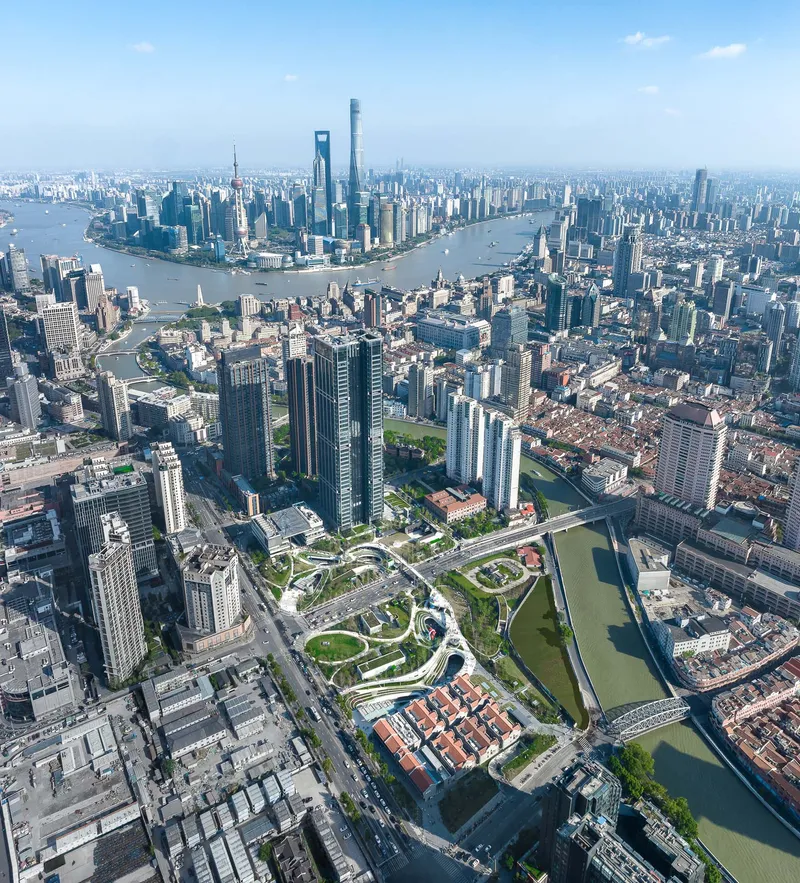
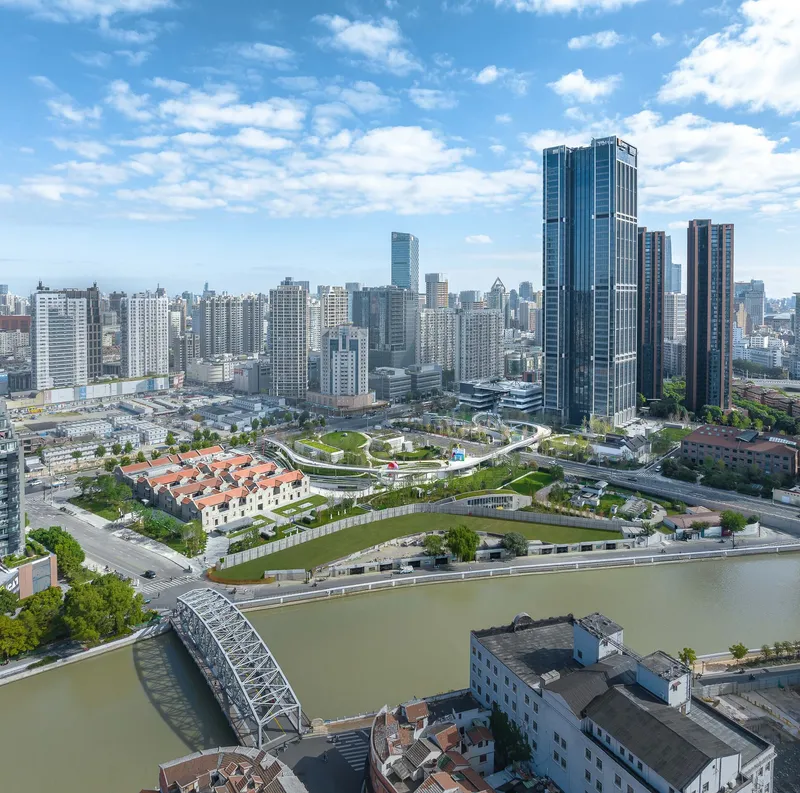

Suzhou Creek's northern bank has long been an area in transition, caught between Shanghai's industrial past and its commercial present. Kokaistudios positions the 42,000 square meters of urban green land as a civic gift that correlates waterfront and hinterland functions. The park is not ornamental: it is the connective tissue linking the river promenade to the metro station, the heritage quarter, and the office tower. The looping pathways ensure pedestrian movement flows continuously between these nodes without requiring anyone to cross at grade through traffic.
A footbridge across Fujian North Road stitches the two halves of the site together and provides a secondary access point to the underground mall, reinforcing the idea that this is infrastructure masquerading as landscape. Lab D+H handled the landscape design, and the collaboration shows: the planted terraces, water features, and berms feel integral to the architecture, not applied to it.
Heritage in Dialogue
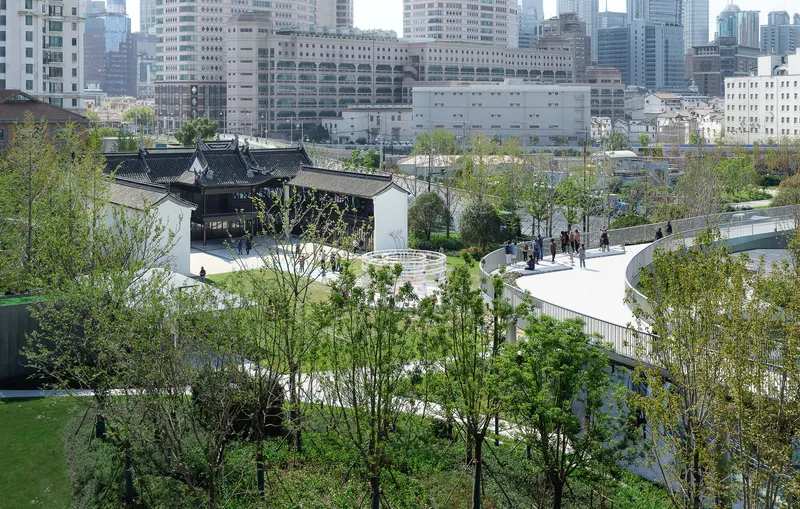


Shenyu Li, a 1932 lilong neighborhood built in the double-bay Shikumen layout, has been restored using its original blue bricks and careful detailing. The narrow lanes between grey brick walls are illuminated with glass floor panels that glow at dusk, transforming what could have been a museum piece into a living part of the commercial circuit. Nearby, the Tianhou Palace, originally constructed in 1884, has been rebuilt using traditional mortise and tenon joinery, a decision that signals real commitment to material authenticity rather than cosmetic preservation.
What makes the heritage strategy convincing is its spatial integration. The restored buildings sit within the same terraced landscape as the new commercial structures. Glazed link buildings and stepped water features mediate between old and new without attempting to disguise the gap in time. The lilong and the temple are not set apart in a heritage precinct; they are woven into the daily foot traffic of the park.
The Underground Retail Experience

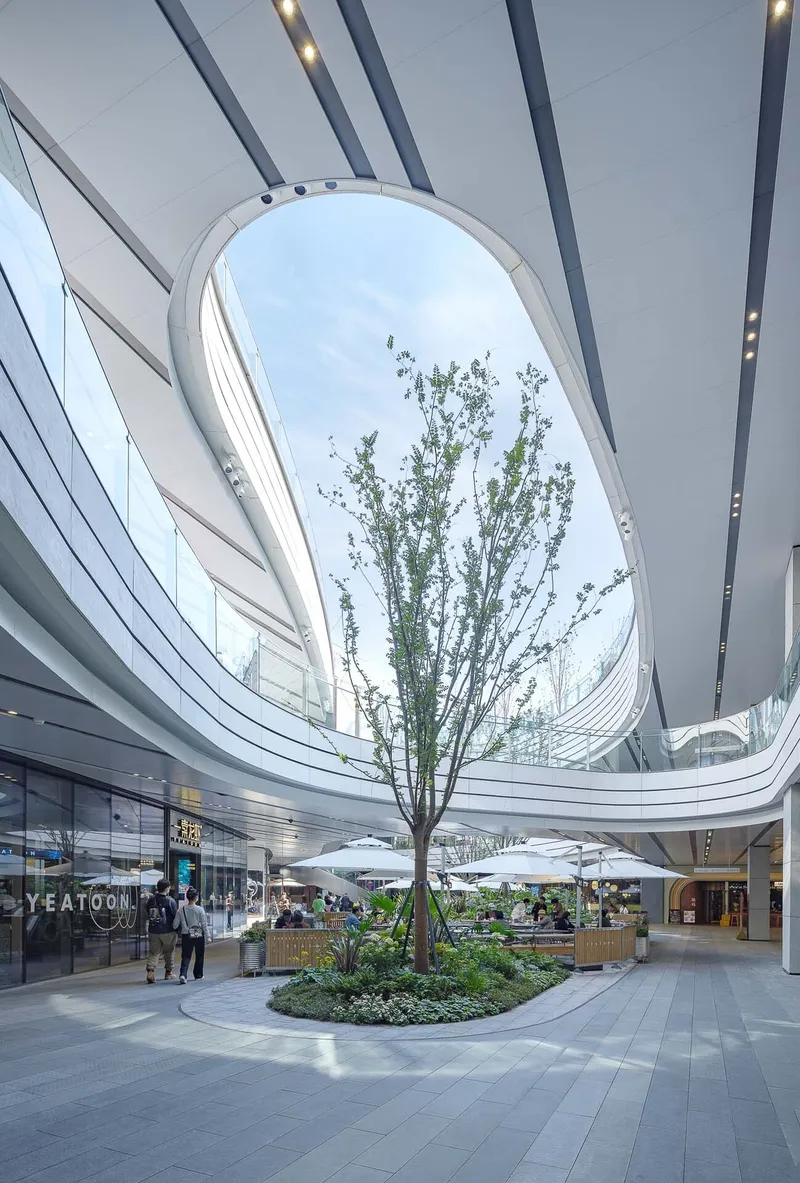

Below grade, the commercial space is organized around multilevel atriums with curved white balconies, glass railings, and escalators threading through planted terraces. The oval skylight openings from the park above become interior focal points, drawing eyes upward toward trees and sky. A central courtyard with a mature tree and dining tables reads more like an outdoor cafe than a basement food court, which is precisely the point.

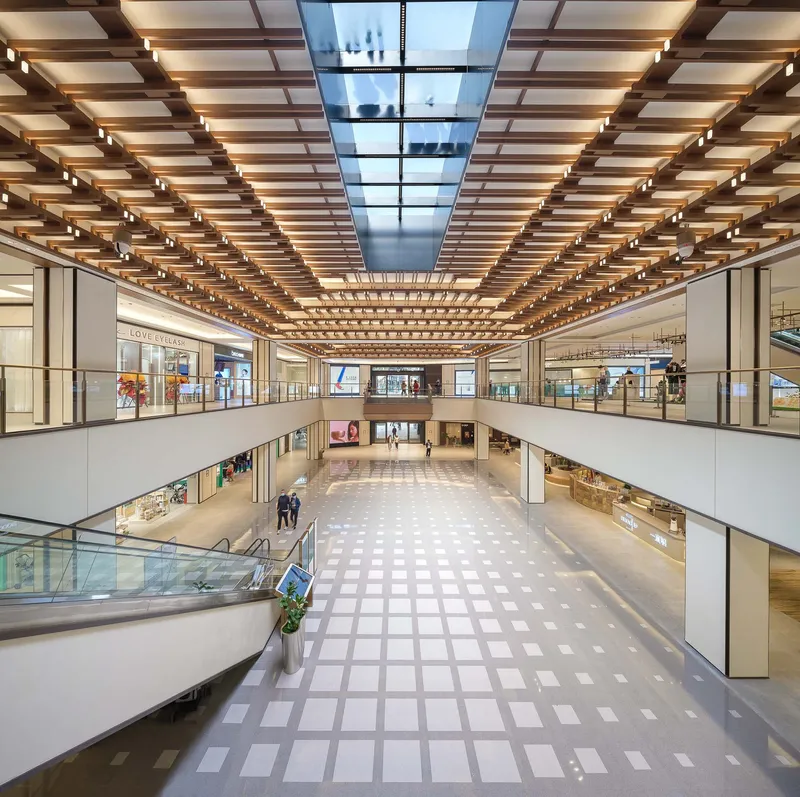

Two distinct ceiling treatments define the interior character. In some zones, a gridded timber slat system with lightweight wooden rafters creates warmth and acoustic absorption beneath linear skylights. In others, angular timber baffle planes intersect at dramatic angles, adding geometric tension to otherwise fluid floor plates. The material palette, light grey aluminum cladding on the exterior, timber and glass within, keeps the interiors legible despite their complexity.
Canopy, Light, and the In-Between


The glass roof canopy is the project's most consequential structural move. Supported by the two central pillars, it fills the main commercial void with natural light while reflective louvers on the ceiling structure bounce illumination deeper into the plan. The effect is that the underground floors never feel underground. At roof level, louvered solar canopies shade public terraces and cast crisp striped shadows across paving, turning structure into ornament.
At dusk, illuminated floor skylights stretching toward the timber roof structure create a reciprocal condition: the underground spaces glow upward, and the park above becomes a field of light. RFR, the facade consultant, deserves credit for the precision of the glass detailing, which achieves transparency without compromising weatherproofing on a site exposed to Shanghai's humid climate.
Art and Public Gesture


Scattered throughout the landscape and interior are colorful tubular sculptures and magenta loops that serve as wayfinding devices, photo opportunities, and scale markers. Beneath a highway overpass, a pink tubular sculpture reframes what would otherwise be dead infrastructure space as a place worth lingering. On the rooftop plaza, oversized sculptural loops arch over pedestrian pathways, signaling that this is public territory. These interventions are not subtle, but they do not need to be. In a 60,000 square meter subterranean complex, bold markers help people orient themselves.
The Podium and Tower Relationship

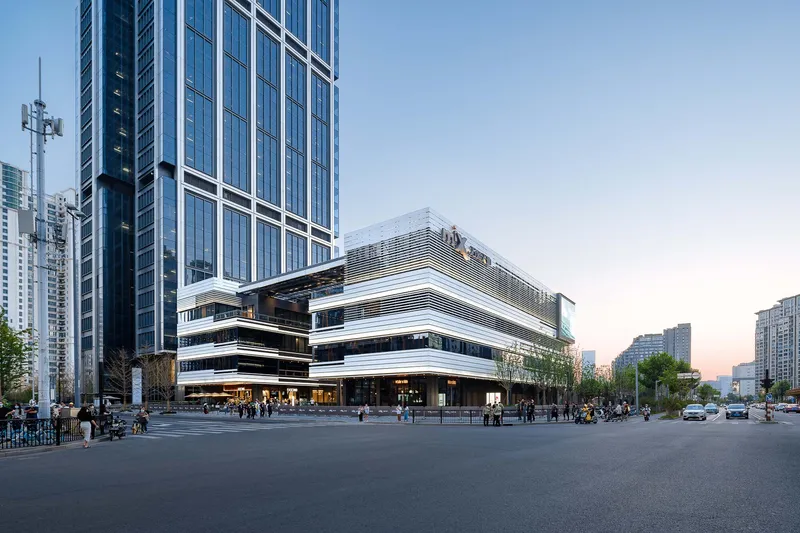

A 42-storey tower by Foster+Partners anchors the northeast corner, rising above a layered podium with planted terraces. The podium's horizontal banded facade, clad in light grey aluminum with deep overhangs, deliberately contrasts the tower's vertical glass curtain wall. Kokaistudios designed a four-storey gateway building in the northeast corner at 6,400 square meters, housing offices, retail, F&B outlets, and an equipment zone. The effect at street level is of a building that hugs the ground rather than launching from it.
Plans and Drawings


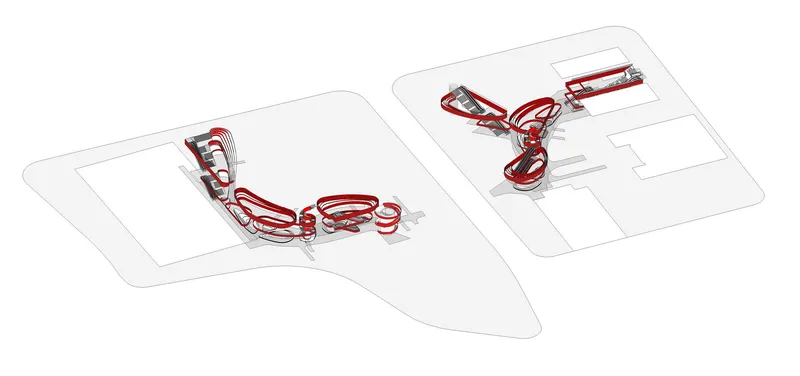
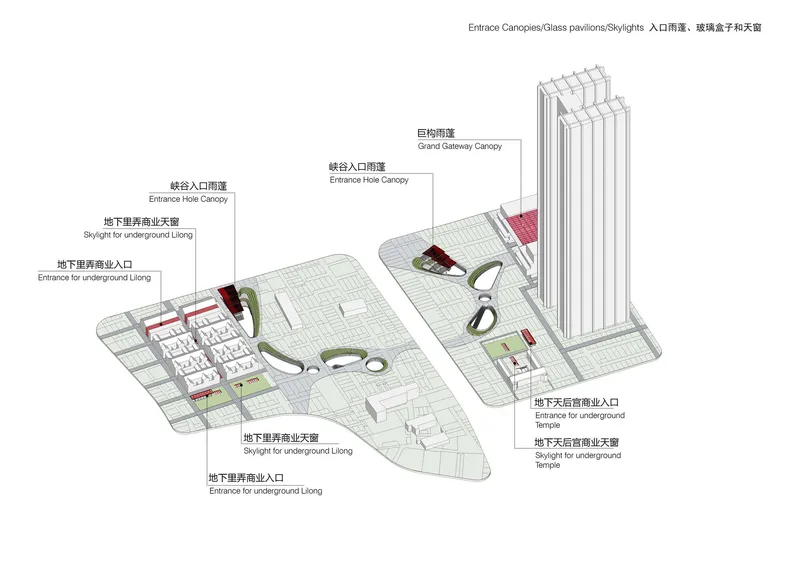


The drawings reveal the project's true complexity. The exploded axonometric separates underground commercial zones from ground-level public space, making legible what the finished project works hard to blur. Circulation diagrams show red loops threading through interconnected floor plates, confirming that movement, not program, is the generator of the plan. The site plan and master plan situate the project within its dense urban surroundings, illustrating how the curved waterway and existing street grid shaped the landscape's organic geometry. The isometric views detail the connections between the spiral staircases, entrance canopies, footbridge, and underground access points that make the whole system function as a single civic machine.
Why This Project Matters
The usual formula for mixed-use development places retail at the base, offices in the middle, and public space on whatever leftover ground remains. Shanghai Suhe MixC World rejects that hierarchy outright. By burying the commercial program and surfacing the park, Kokaistudios proposes that the most valuable thing a developer can build in a dense city is ground. Not tower floor area, not retail frontage, but actual open land where people can walk, sit, and breathe. That 42,000 square meters of green park sits on top of a profitable shopping center makes the argument hard to dismiss.
The project also demonstrates that heritage preservation and large-scale commercial development are not inherently antagonistic. The restored Shenyu Li lilong and Tianhou Palace gain new life precisely because they are embedded in a functioning commercial ecosystem rather than cordoned off behind velvet ropes. For cities across Asia grappling with how to reconcile rapid development with cultural memory, this is a genuine model: not preservation by isolation, but preservation through integration. The valley is both metaphor and method.
Shanghai Suhe MixC World by Kokaistudios, with landscape design by Lab D+H, structural consulting by Arup, and facade consulting by RFR. Shanghai, China. 60,000 m² commercial GFA. Completed 2022. Photography by Terrence Zhang.
About the Studio
Share Your Own Work on uni.xyz
If projects like this are the kind of work you want to make, uni.xyz is a place to publish your own, find collaborators, and enter design competitions.


Popular Articles
Popular articles from the community

Faces of the Soviet Avant-Garde: Turning Moscow's Street Names into an Open-Air Museum
A network of sculptural installations across a Moscow residential district transforms forgotten architect names into spatial encounters with cultural memor

Opera on the Sea: Driftwood Logic Shapes a Timber Opera House on Estonia's Coast
Trevor Orgill's opera house translates the entangled drift of floating timber into a civic building where wood, water, and music converge.

The Amber Palace Opera: A Geological Fiction Surfaces on Tallinn's Baltic Waterfront
Pierre Brillard reimagines a Baltic legend as a public landscape, opera house, and waterfront promenade rooted in Tallinn's coastal identity.

Tsunami Convergenics: Turning Catastrophic Ocean Forces into Underwater Housing Infrastructure
A speculative underwater settlement off the coast of Onagawa, Japan, treats tsunamis and typhoons as energy sources rather than threats.

Similar Reads
You might also enjoy these articles

Pixel Gardens: One Repeated Module Stacked Into a Terraced Social Housing Tower for Famagusta
Salem Bader's shortlisted housing tower builds a vertical neighbourhood from one repeated module, offsetting units to carve terraces, light and air.

Bao Huynh Watercolor Atelier: A Serene Art Retreat in Hội An
Bao Huynh Watercolor Atelier in Hội An blends multifunctional art spaces, sustainable design, local materials, and family-friendly living in a serene environment.

Atelier Macri Concept Store Interior Design by CASE-REAL
Atelier Macri store features a "ko" counter, walnut wood details, cork displays, blending retail, gallery, and seamless customer experiences.

Manuel Vargas Izquierdo Stadium and High-Performance Sports Center: Architectural Excellence in Jalpa de Méndez
The Manuel Vargas Izquierdo Stadium blends sustainable design, inclusive sports facilities, and cultural-inspired architecture, revitalizing Jalpa de Méndez’s public spaces.


Comments (0)
Please login or sign up to add comments
No comments yet. Be the first to comment!