
Kolberger 5: Chipperfield's Munich Masterclass
Studio Mark Randel and David Chipperfield deliver a residential building in Munich's Herzogpark that treats restraint as its most radical gesture.

Munich's Herzogpark neighborhood carries the weight of its own wealth with surprising grace. Its leafy streets, lined with villas and mansion blocks from the early twentieth century, resist the architectural posturing that afflicts most affluent enclaves. Into this context, Studio Mark Randel and David Chipperfield have placed a residential building that does something genuinely difficult: it belongs. Kolberger 5 is a 2,453 square meter residential project completed in 2022 that neither mimics the historicism around it nor asserts its own modernity with glass curtain walls and cantilevered slabs.
What makes the project interesting is not a single spectacular move but a sustained commitment to material intelligence and proportional discipline across every scale, from the massing of the street facade down to the radius of a recessed door handle. The building reads as a piece of civic architecture rather than a luxury product, which, in a neighborhood where square meter prices are astronomical, is itself a kind of provocation.
Street Presence Without Spectacle
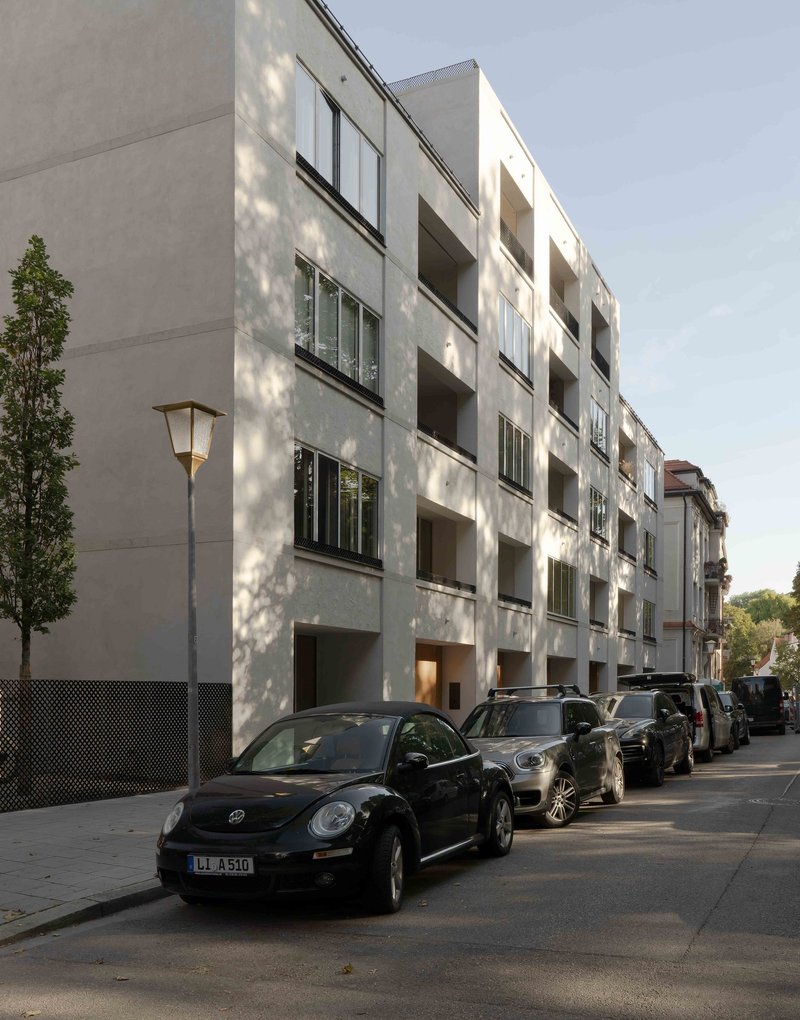
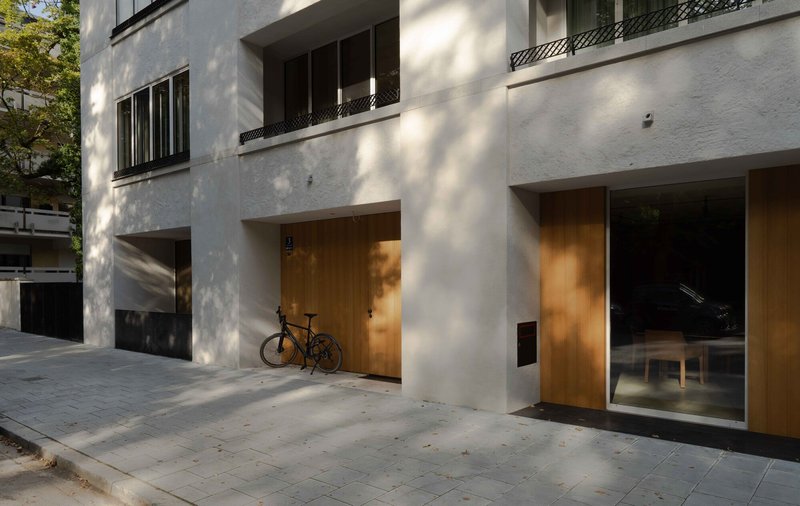
From the street, Kolberger 5 presents a pale stucco facade organized by recessed balconies and horizontal window bands across four stories, topped by what the elevations reveal as a mansard roof. The proportions are classically informed without quoting anything specific. Compared to the aggressive transparency of much contemporary residential architecture, the building's opacity feels deliberate: it shields domestic life while still registering as open and urbane. A ground floor of timber-clad entrances and glazed storefronts brings human scale to the base, and the dappled shade from mature street trees softens the geometry further.
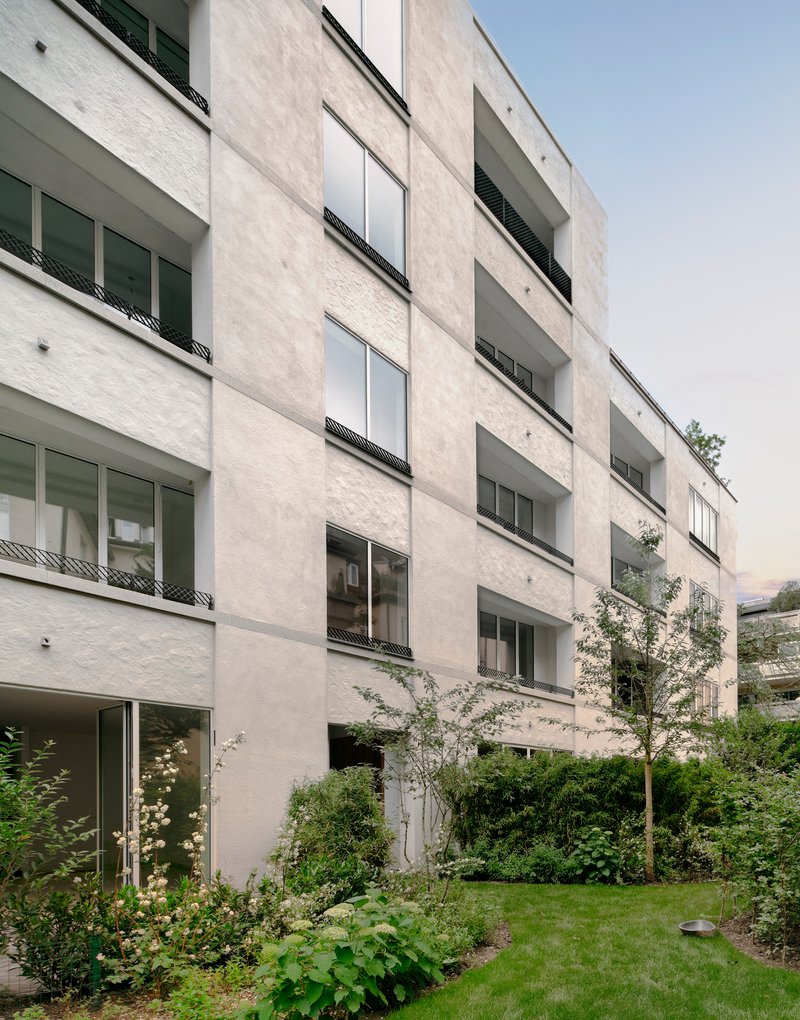
The facade's real trick is its balcony system. Recessed behind the primary wall plane, each balcony is framed in white and screened by a diamond mesh metal railing that catches light differently throughout the day. The effect is layered and tactile rather than flat. It gives the elevation depth without resorting to projecting volumes or elaborate fenestration patterns.
Material Conversations: Stone, Timber, Metal
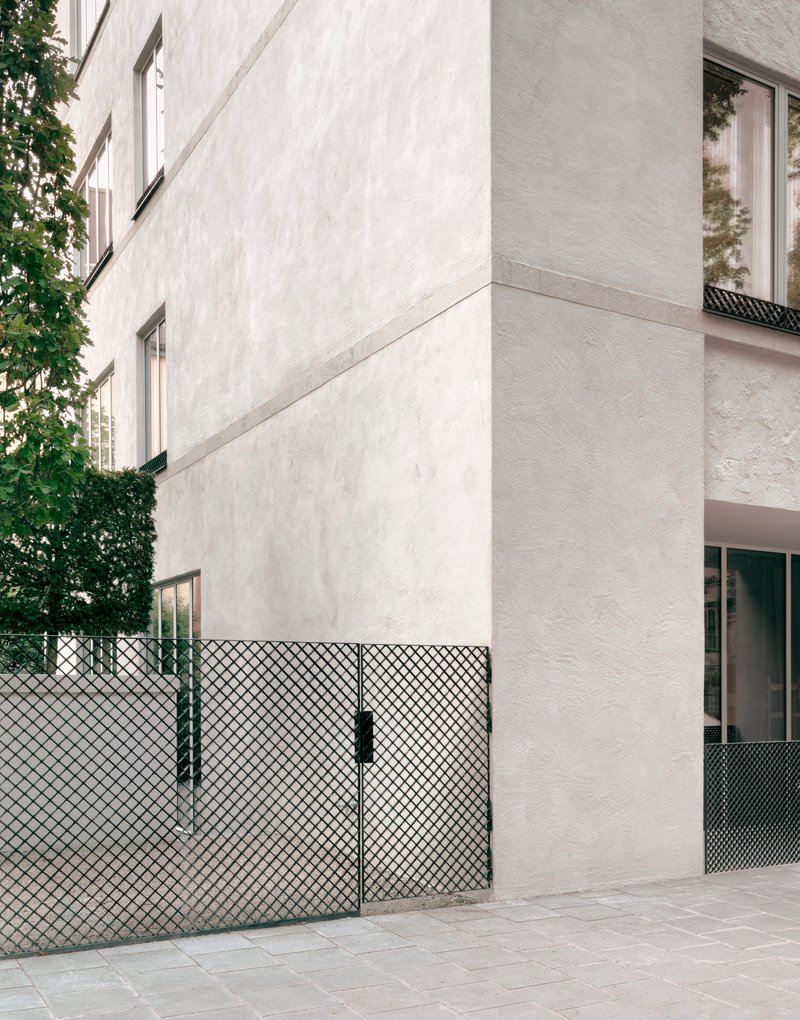
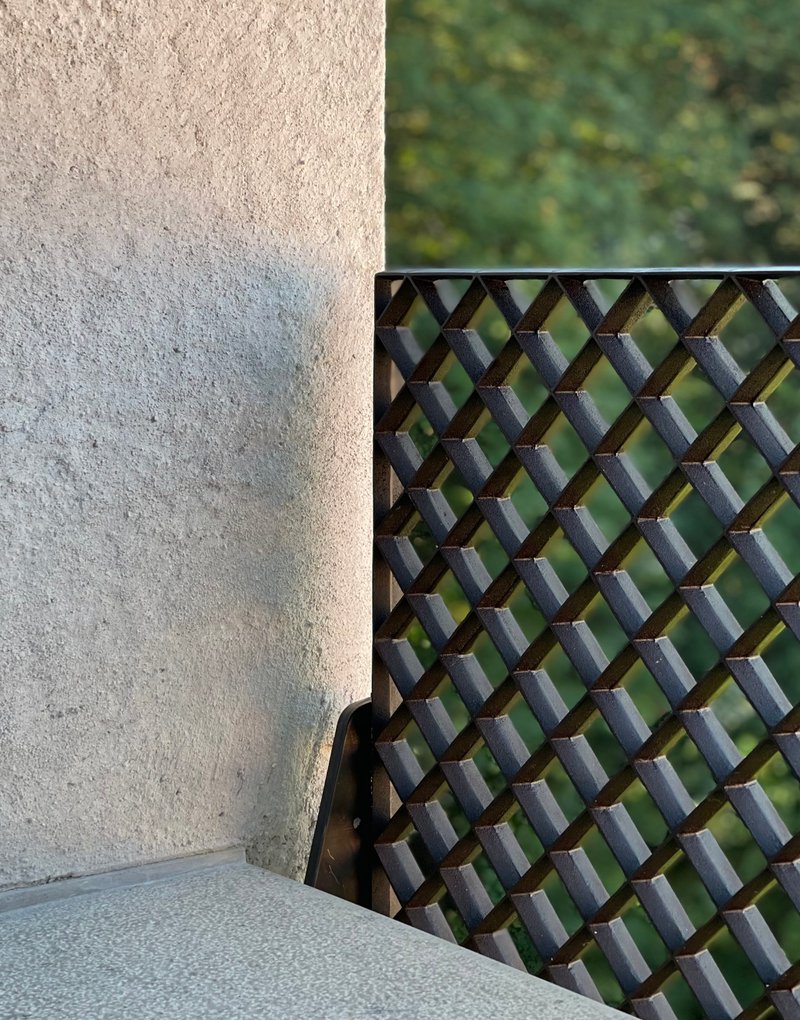
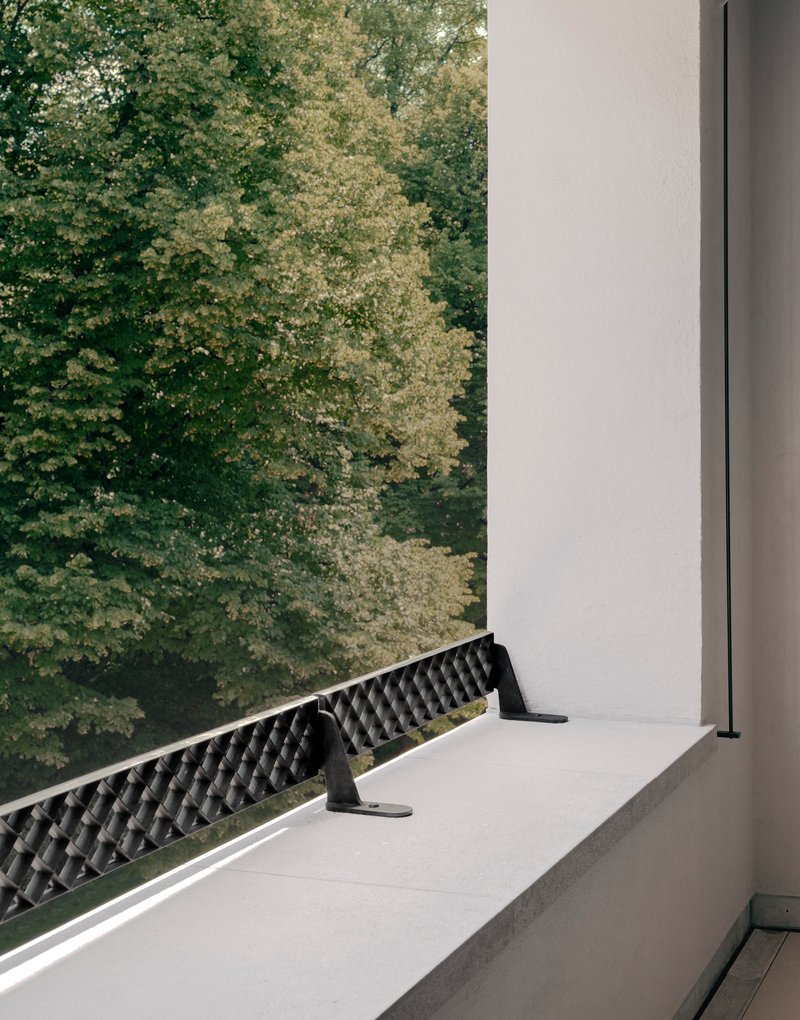
Chipperfield and Randel have always been architects who let materials do the talking, and Kolberger 5 is a fluent conversation between three primary elements: stone, timber, and woven metal. The exterior corner detail where white stucco meets diamond mesh balcony railing is a precise, almost Japanese moment of material transition. A woven metal screen beside textured plaster mediates between interior privacy and garden greenery. These are not decorative flourishes. They are structural and spatial decisions expressed through materiality.
The consistency of this material logic across the project, from large-scale facade moves to the smallest hardware detail, gives Kolberger 5 a coherence that many residential buildings of this scale struggle to achieve. Nothing is an afterthought.
The Entrance Sequence
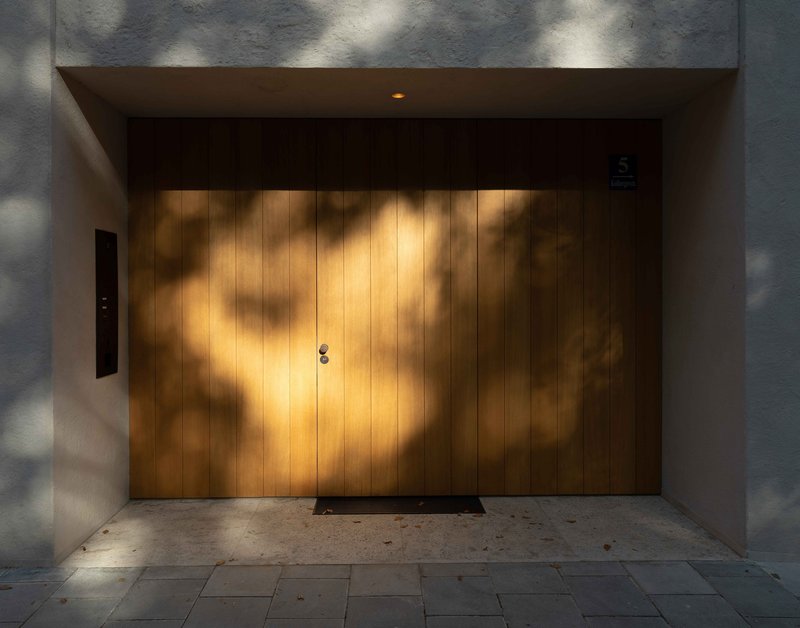
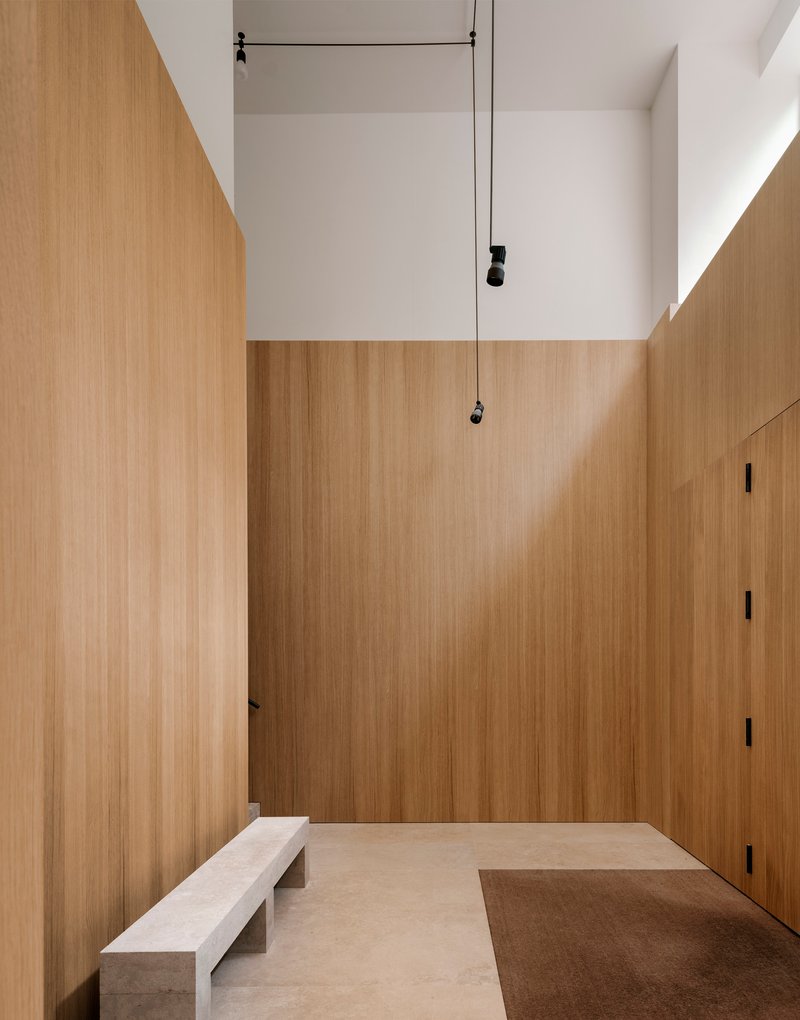
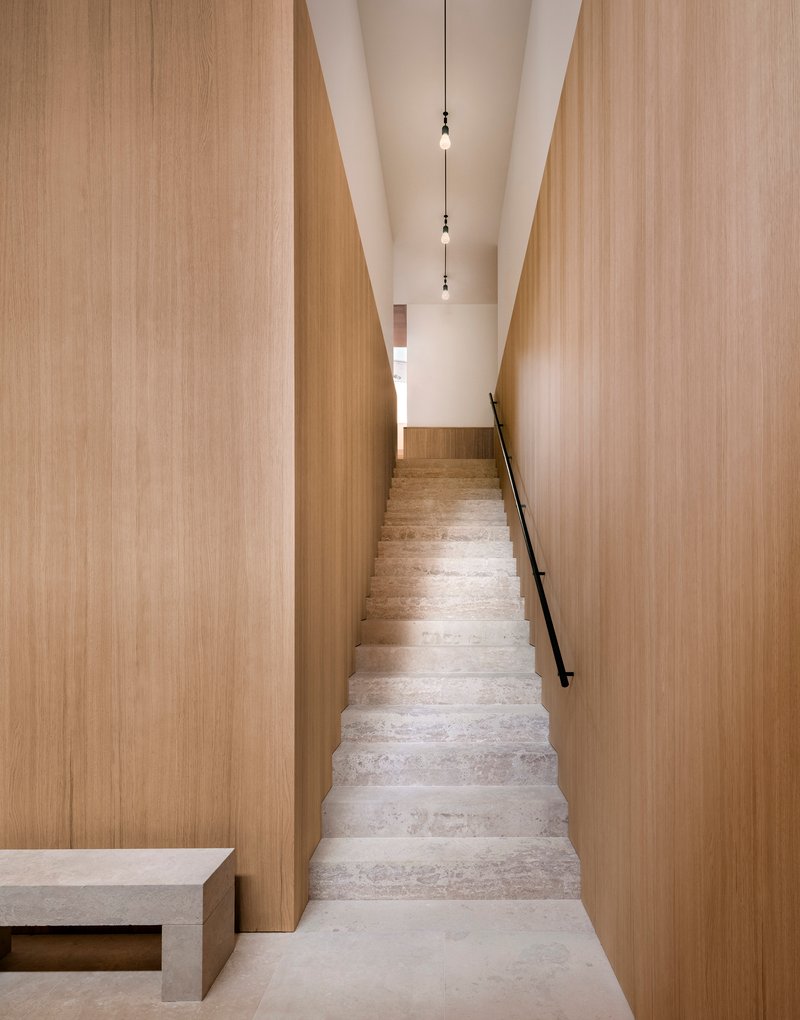
Arrival at Kolberger 5 is choreographed with care. Vertical timber door panels, dappled by leaf shadows in afternoon sun, give way to a double-height entrance hall clad entirely in oak. Pendant lights drop from the white ceiling, and a stone bench invites a pause. The scale shift from the compressed timber threshold to the tall, luminous hall is a classic Chipperfield move: spatial compression followed by release, executed with enough restraint that it never feels theatrical.
A narrow stone staircase, flanked by tall timber-clad walls, extends the arrival sequence vertically. The pendant lights reappear, establishing continuity between the horizontal and vertical circulation. The message is clear: movement through this building is not incidental. It is part of the architecture.
Vertical Circulation as Spatial Event
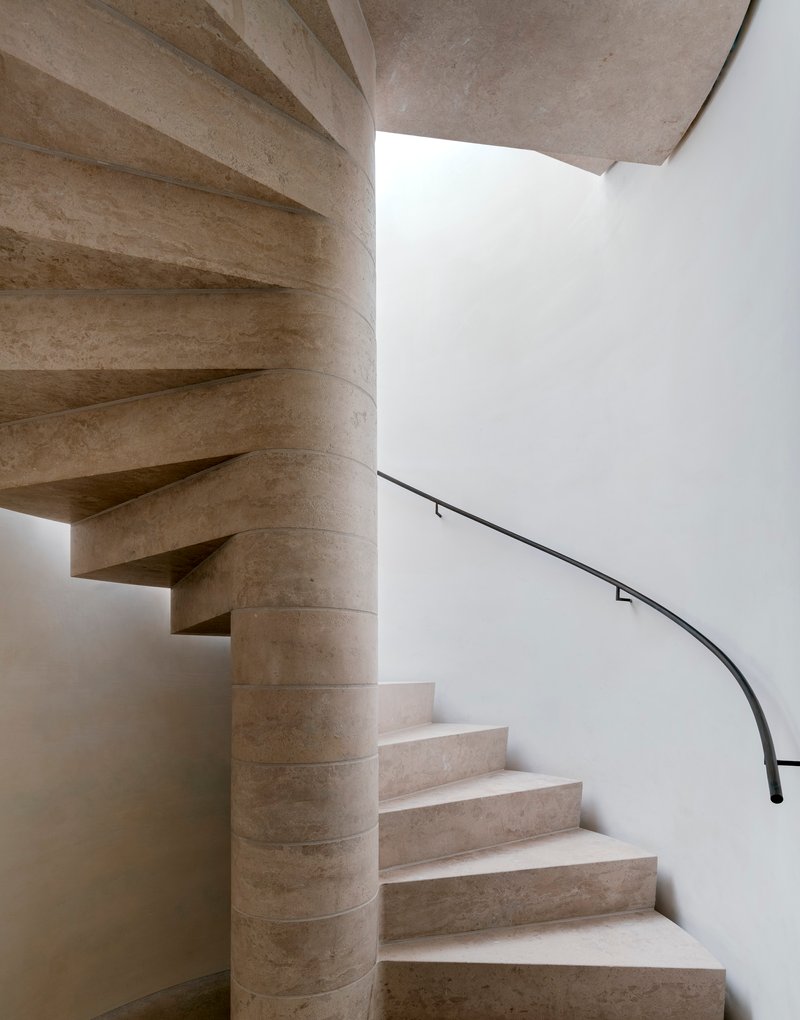
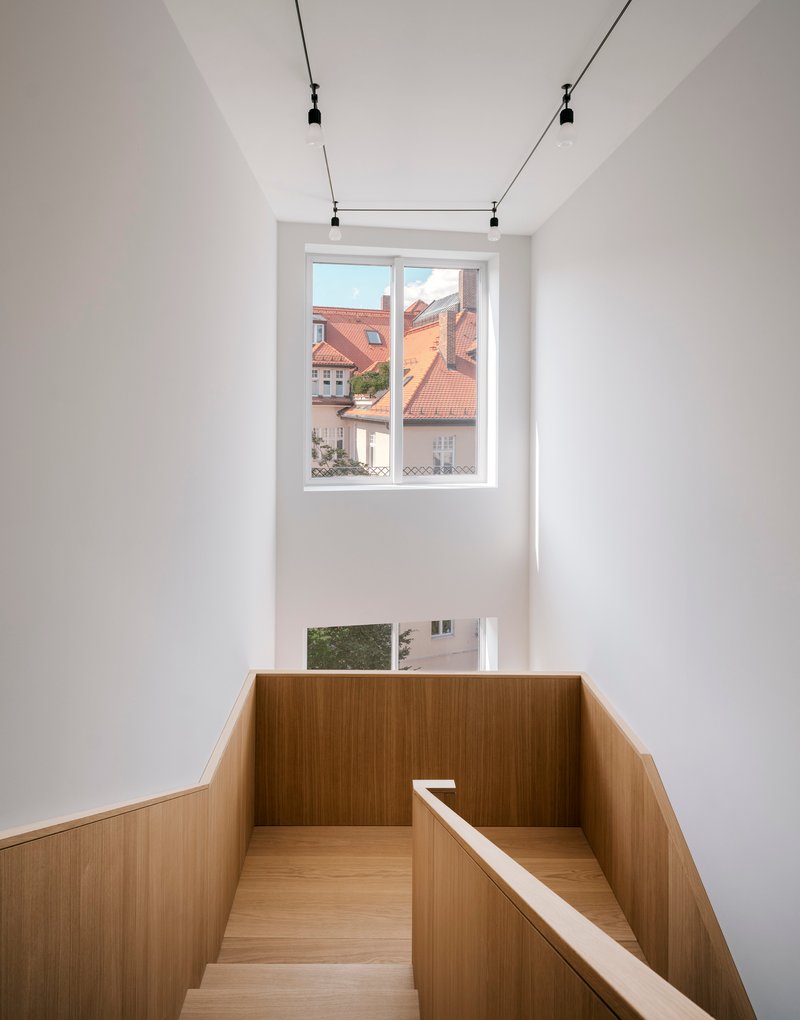
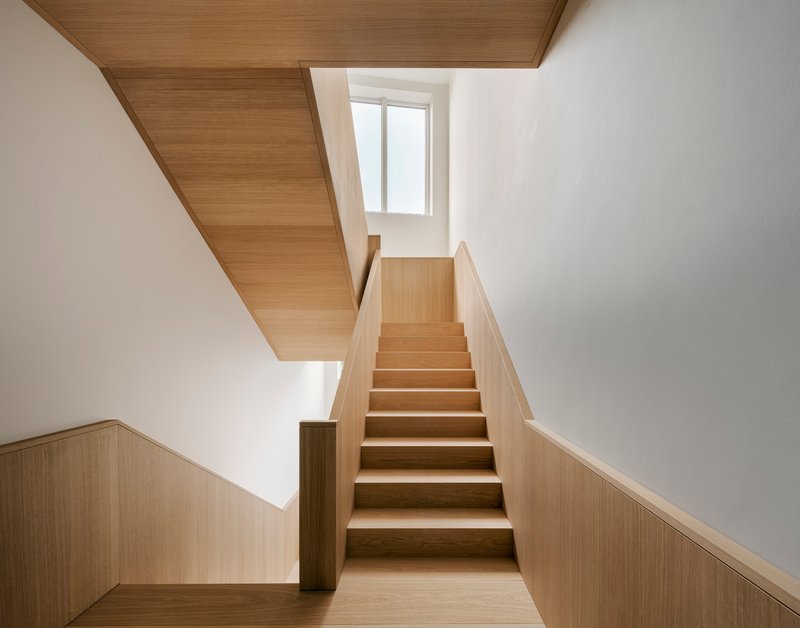
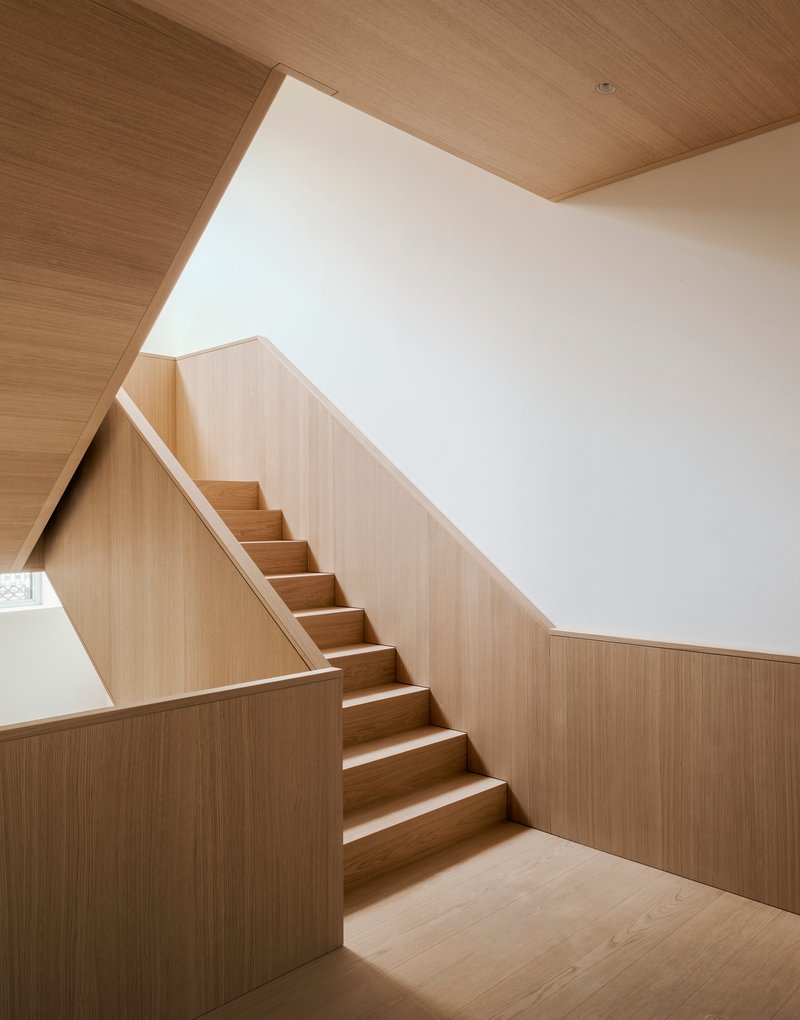
The staircases at Kolberger 5 deserve their own analysis. A curved stone staircase wraps around a cylindrical core, its slender black metal handrail tracing an elegant spiral. Elsewhere, a timber staircase with wood-paneled ceiling and half-height wainscoting leads to a landing where a window frames clay-tiled rooftops. A double-height stairwell with timber balustrade and tall window operates almost as a viewing room, framing the neighborhood's roofscape as a composed picture.
These are not service elements hidden behind fire doors. They are the most carefully designed spaces in the building, which tells you everything about the architects' priorities. Circulation is where residents encounter the building most often, and Chipperfield and Randel have treated it accordingly.
Living Spaces and the Garden Edge
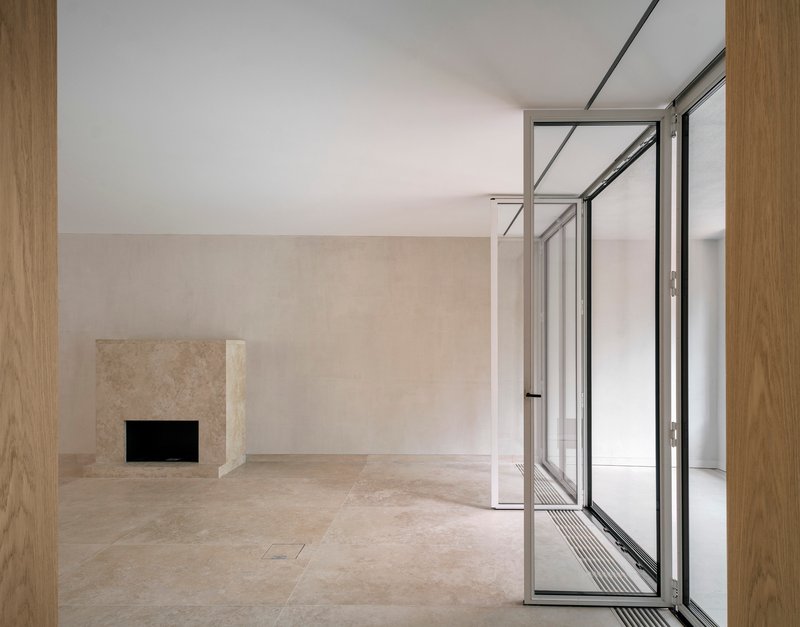
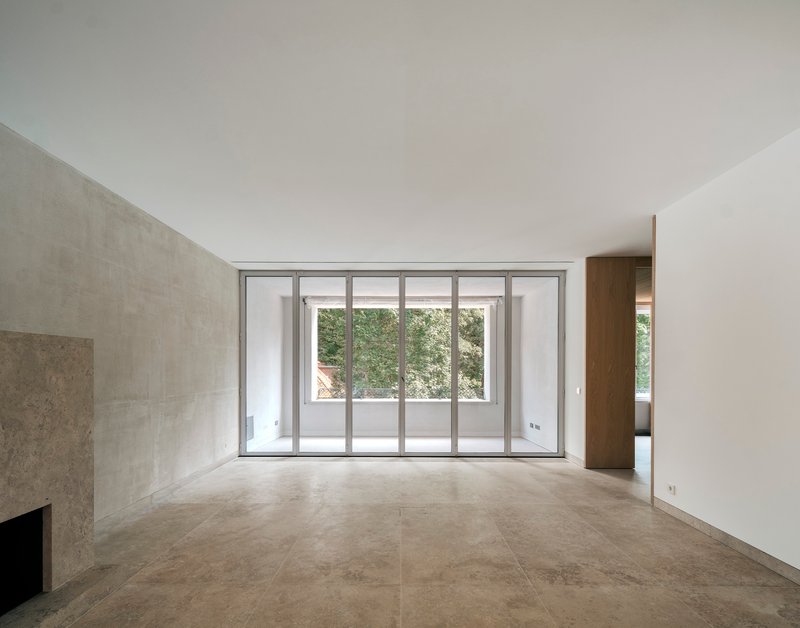
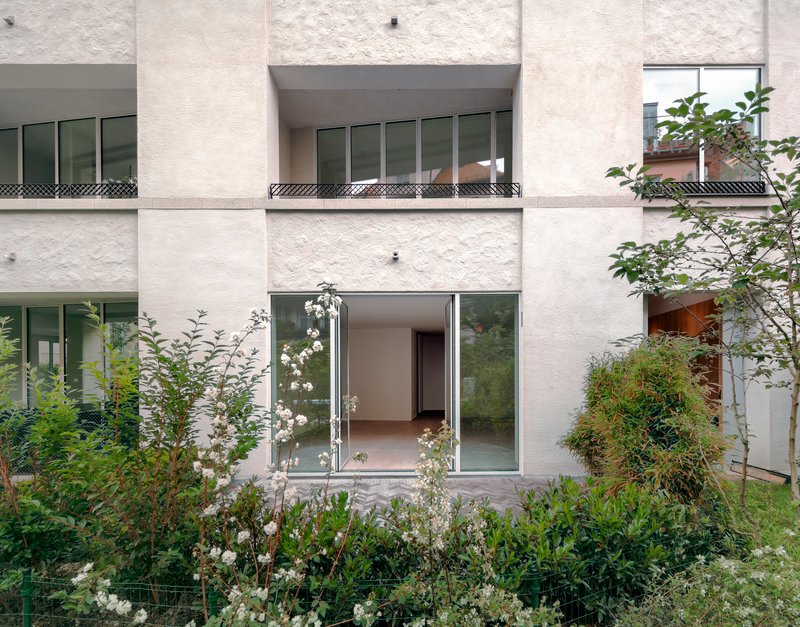
The residential interiors are exercises in deliberate simplicity. A living room features a limestone fireplace surround and open terrace doors framed by oak paneling. The palette is warm but not nostalgic, modern but not clinical. Large stone floor tiles and sliding glass doors establish a threshold between inside and out that is porous rather than abrupt. The ground floor terrace, with its flowering rose bushes and fully retractable glazing, collapses the boundary between garden and dwelling almost entirely.
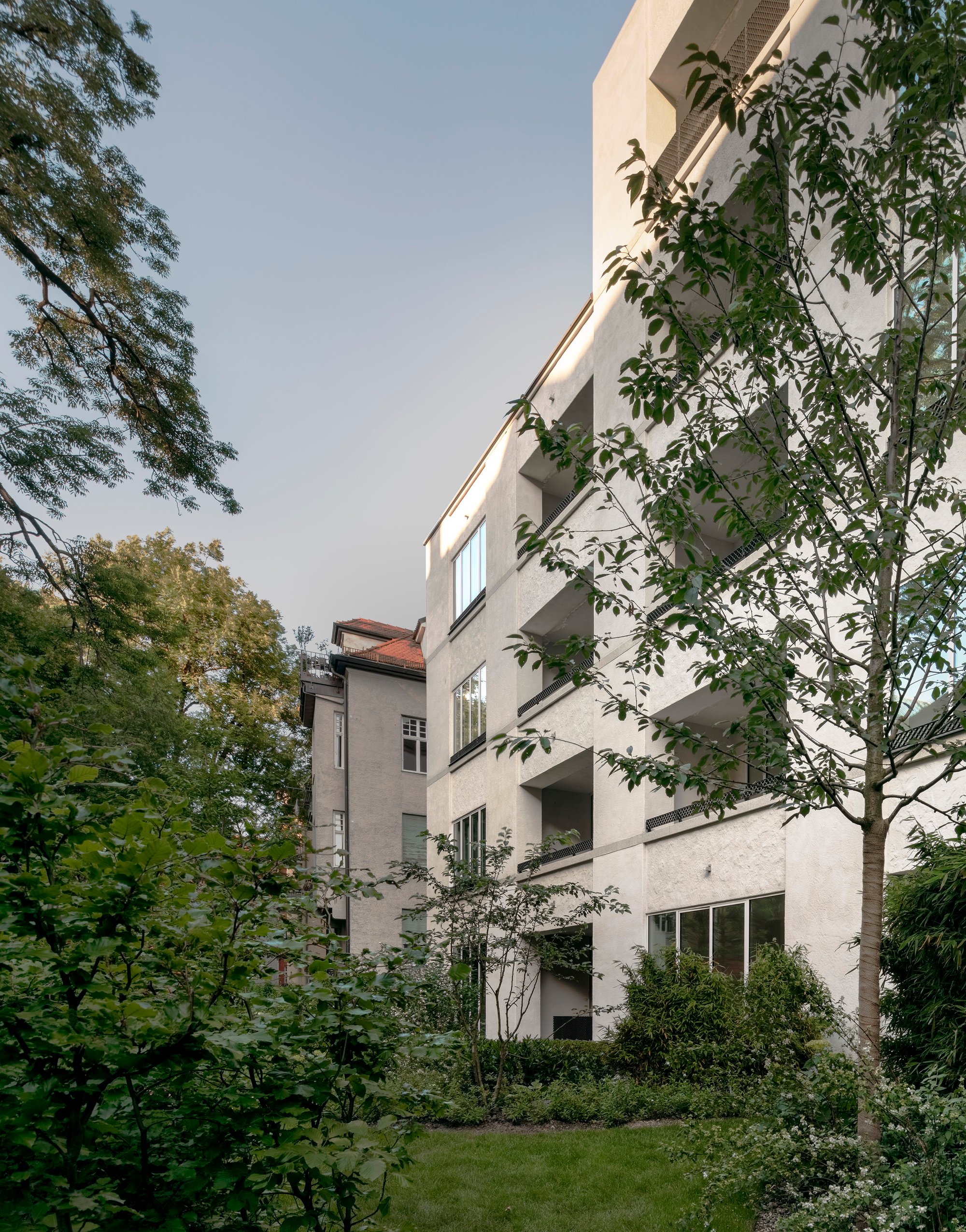
The rear elevation, viewed through garden trees at dusk, reveals the building's second life: a quieter, more domestic face with projecting balconies that step into the canopy. Where the street facade is composed and civic, the garden facade is looser, more intimate, responding to the landscape rather than the urban grid.
Bathrooms as Architecture
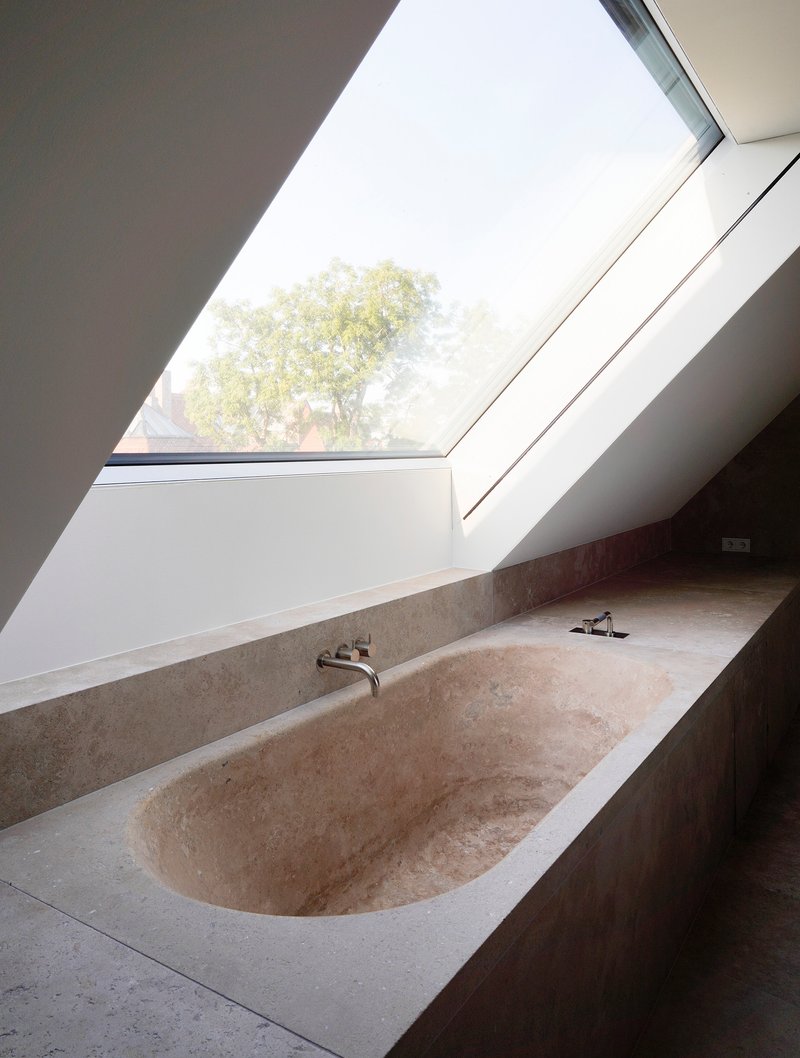
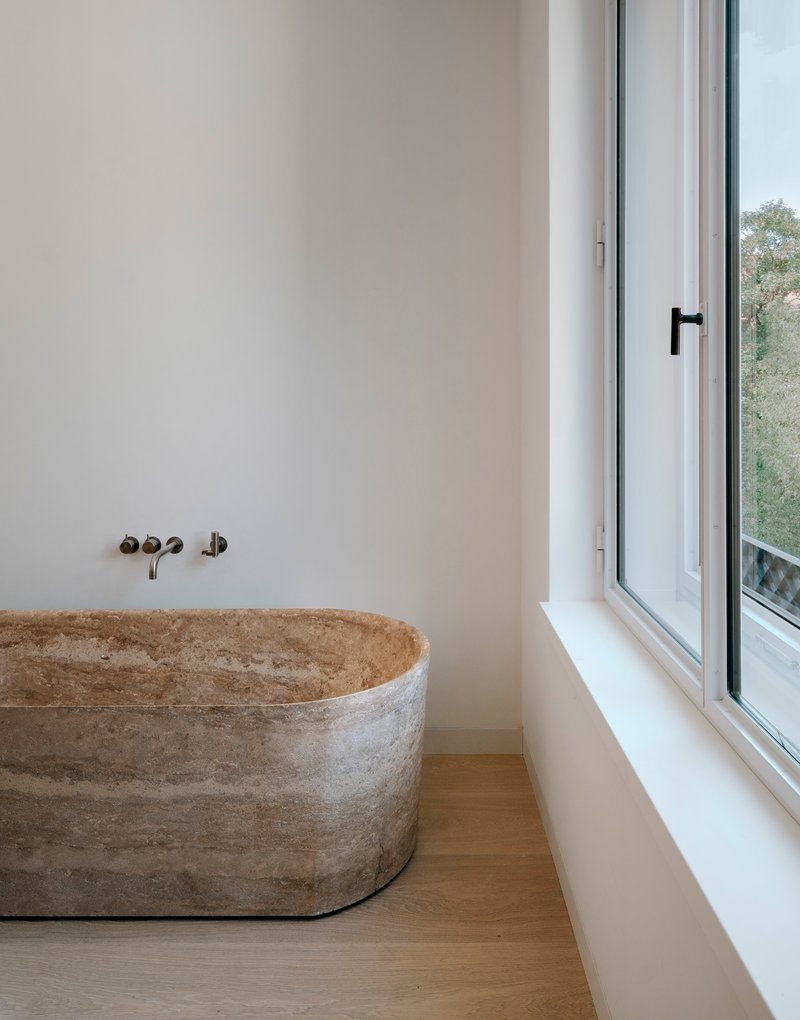
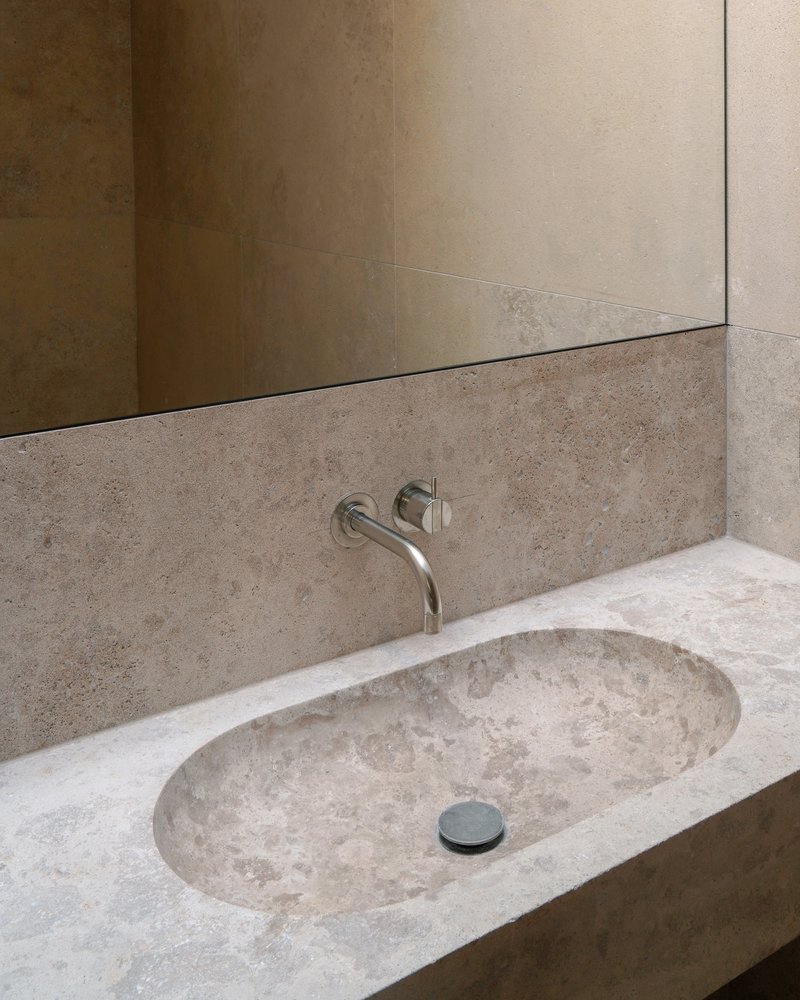
The bathrooms at Kolberger 5 are among the most architecturally resolved spaces in the project. A travertine bathtub sits beneath an angled skylight with a direct view to the tree canopy, turning a daily ritual into a contemplative experience. A freestanding concrete bathtub occupies a room defined by a narrow casement window and visible treetops. A travertine vanity with an integrated oval sink and wall-mounted faucet beneath a frameless mirror shows the level of integration between furniture, fixtures, and architecture.
These rooms are not decorated. They are designed, in the fullest sense: the materials, the light, the views, and the proportions all serve a single idea about what it means to inhabit a private space with dignity.
Details That Hold the Line
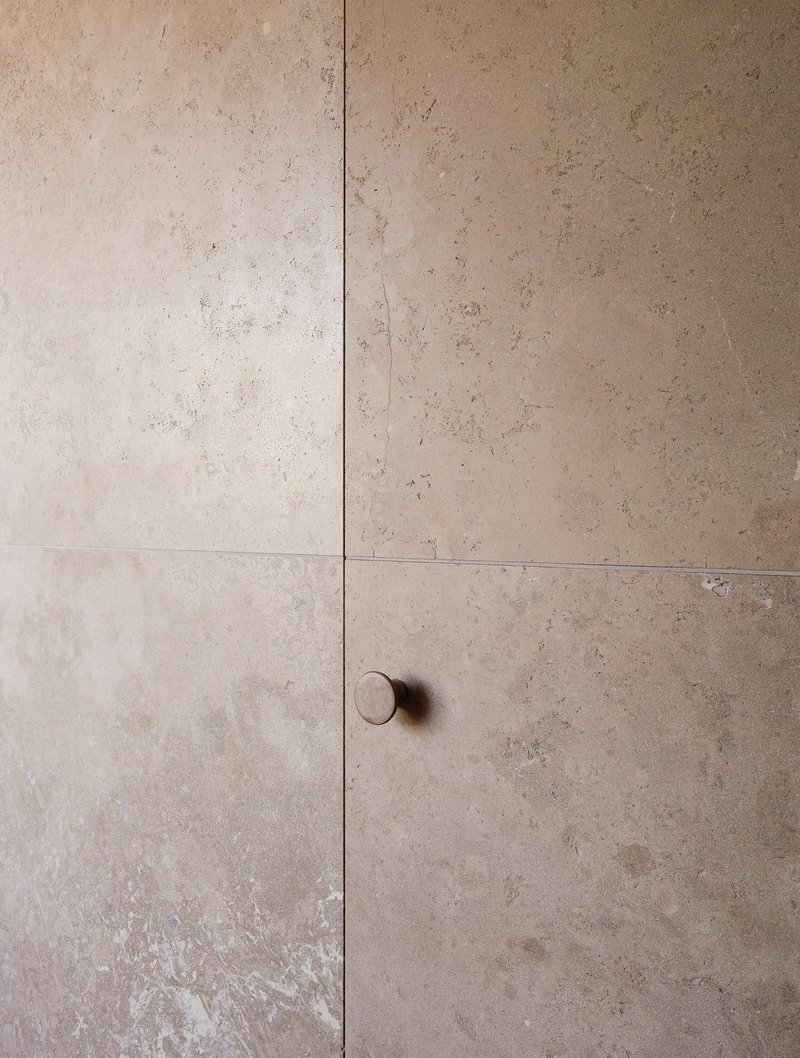
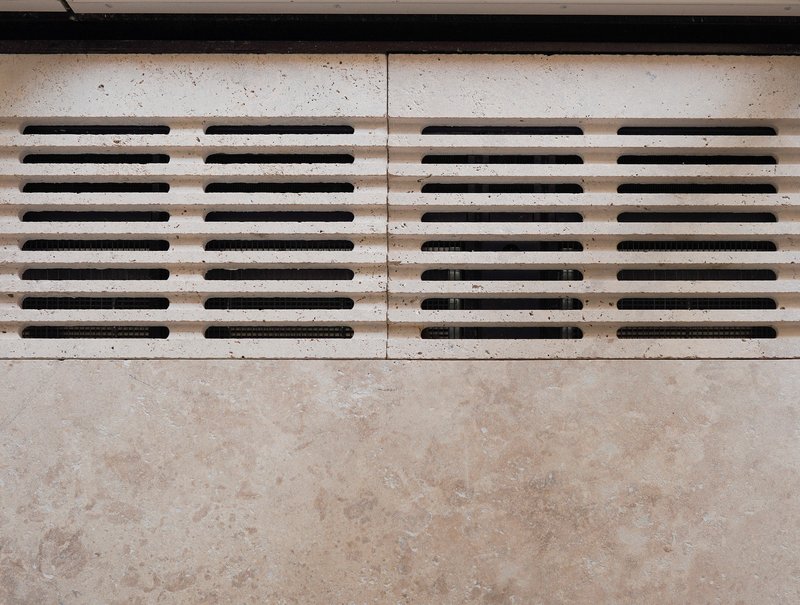
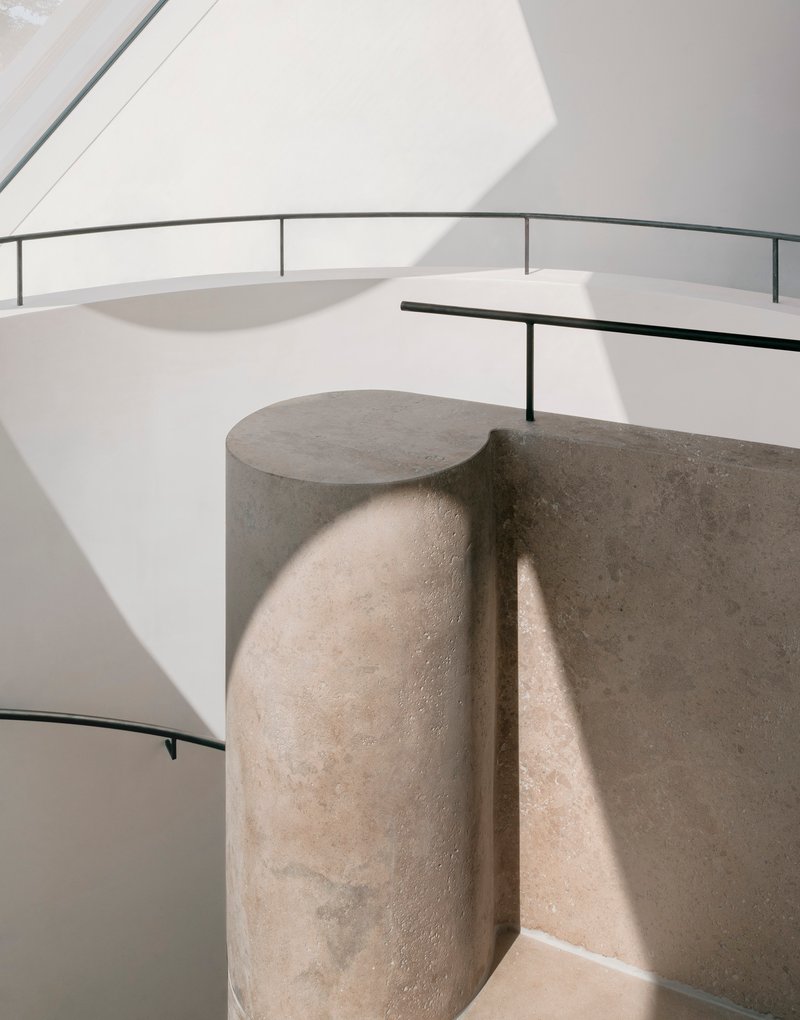
At the detail scale, Kolberger 5 never relents. Limestone wall panels with recessed circular door handles at panel joints demonstrate a commitment to flush, integrated hardware that many projects aspire to but few achieve. Horizontal black metal slat ventilation grilles, arranged in four panels, turn a mechanical requirement into a graphic element. A curved stone column with a cylindrical projection beside the white spiral staircase shows how sculptural ambition and structural logic can coexist without competing.
These details matter because they are the parts of a building that occupants actually touch and see every day. Getting them right is what separates architecture from real estate.
Plans and Drawings
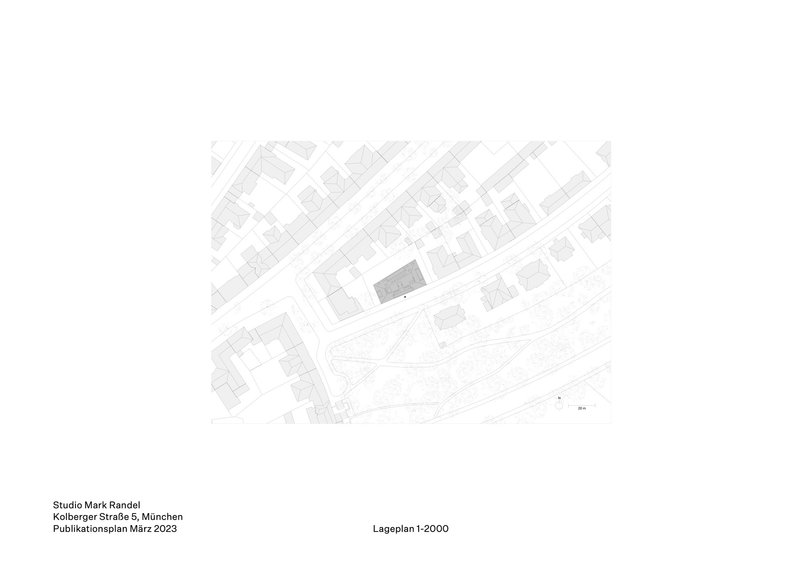
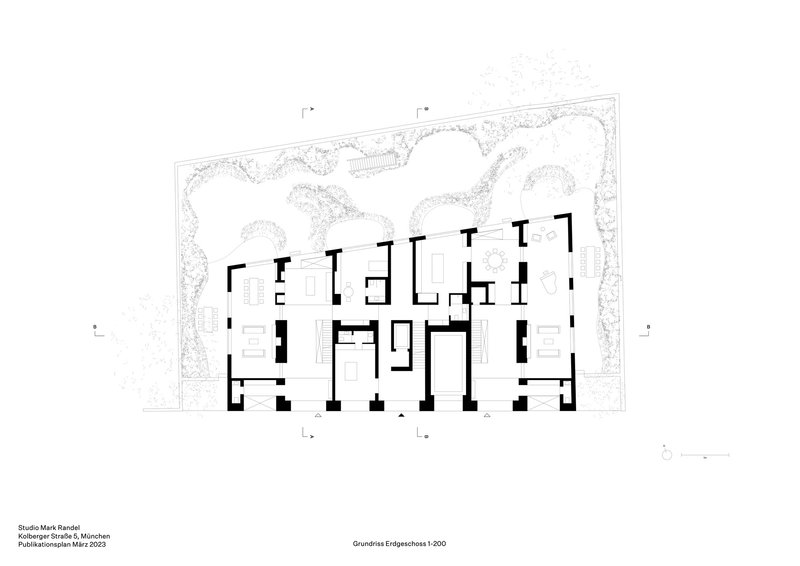
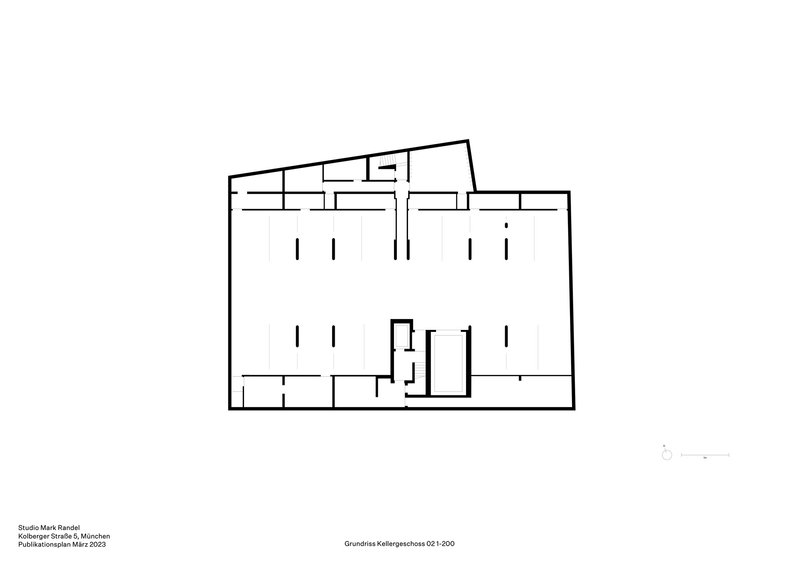
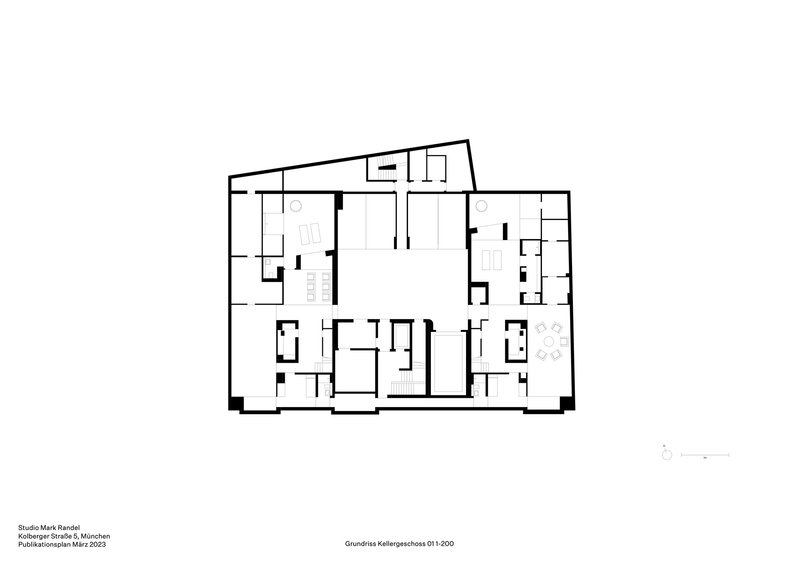
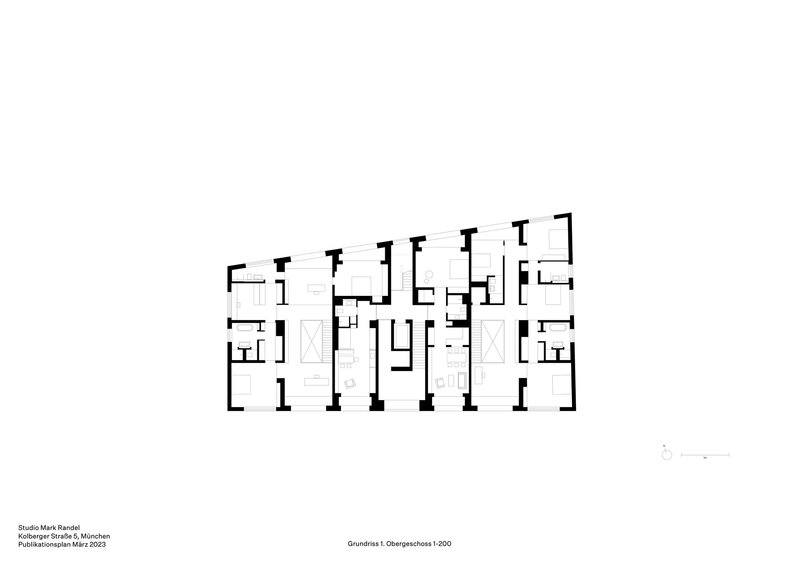
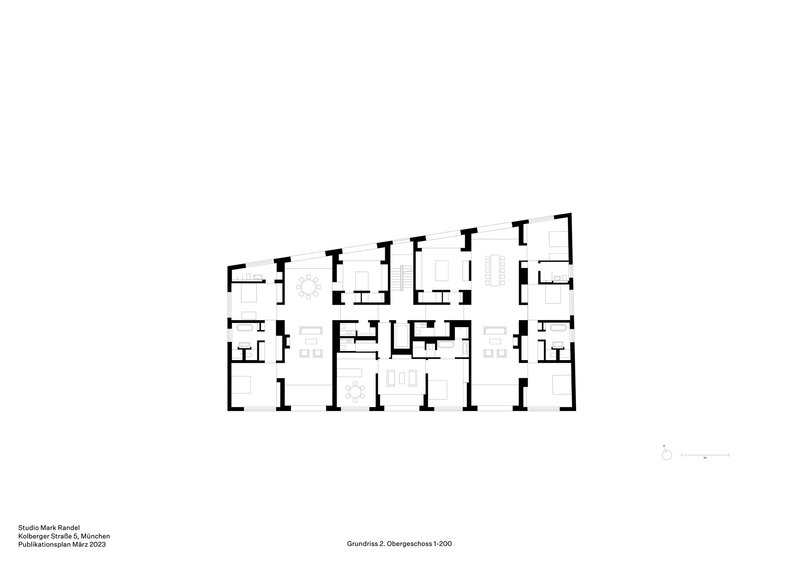
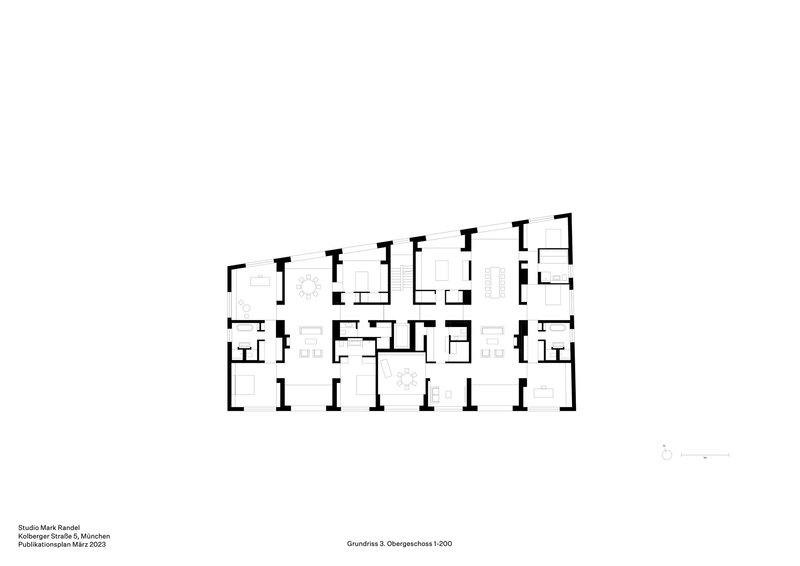
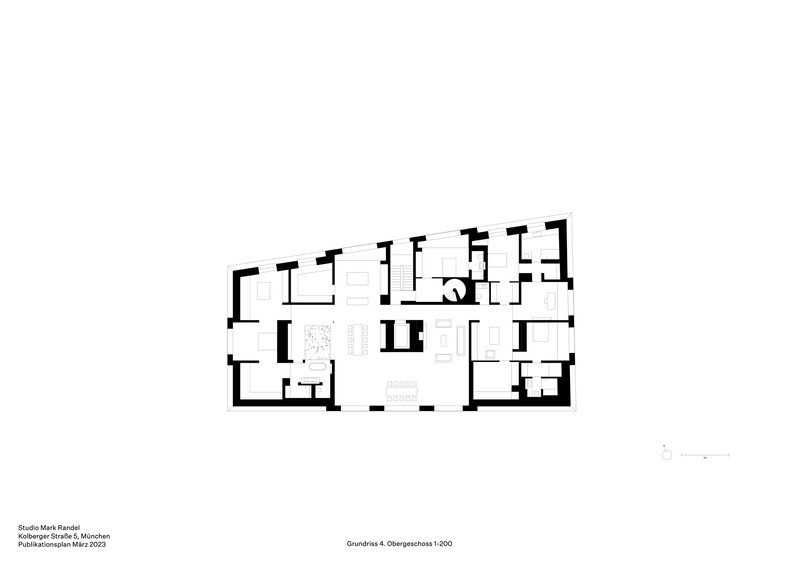
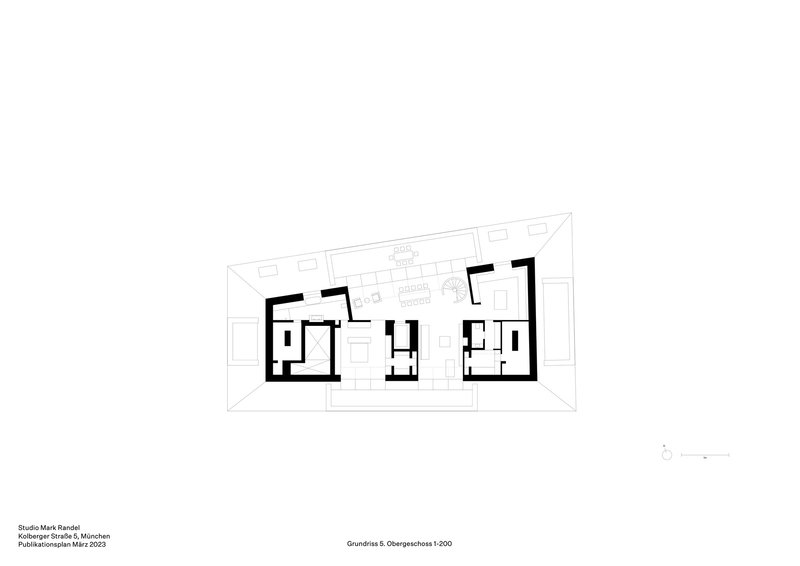
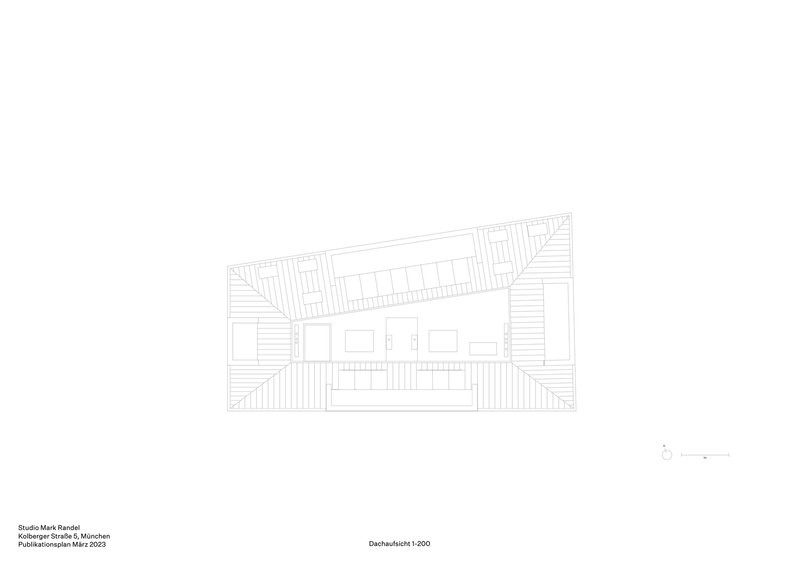
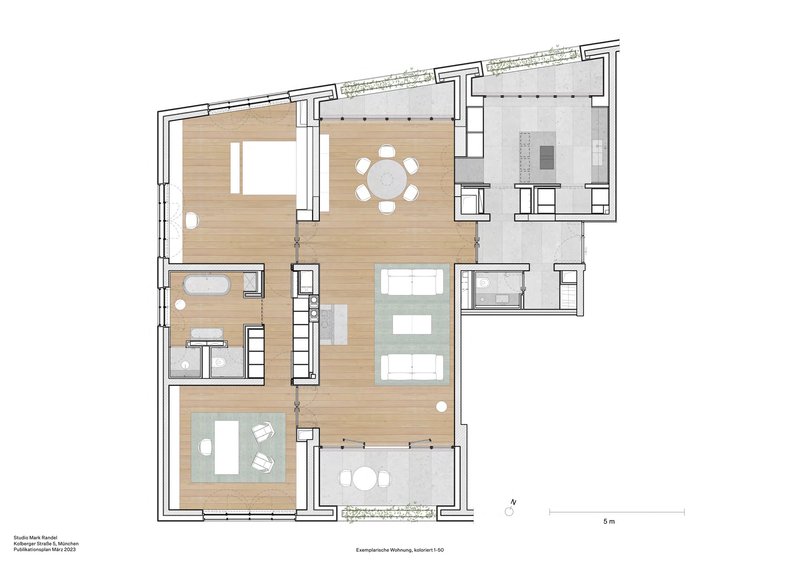
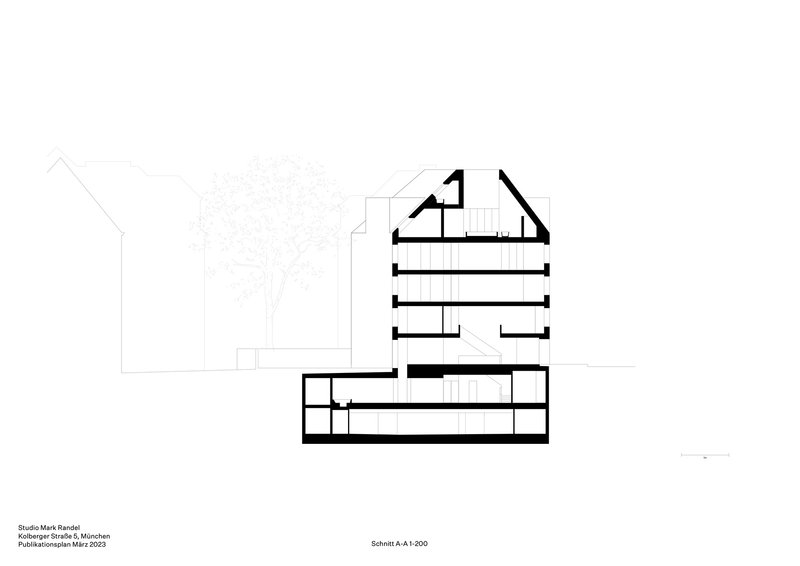
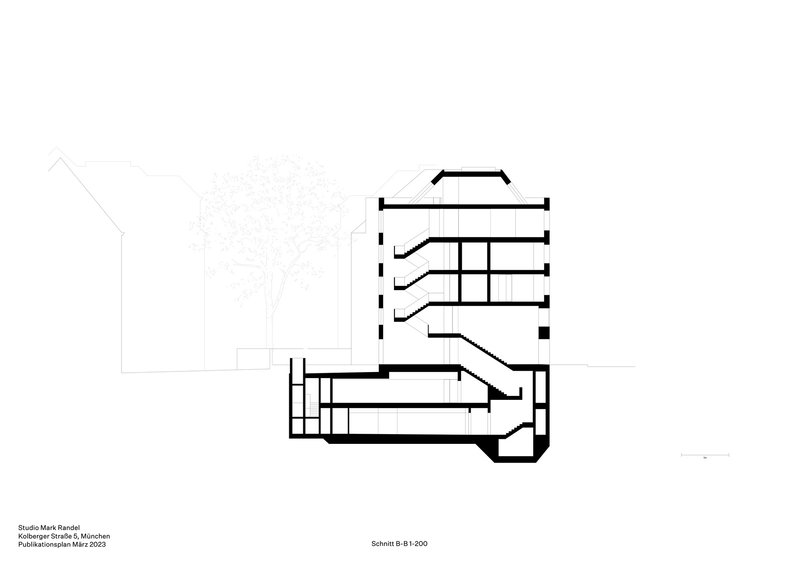
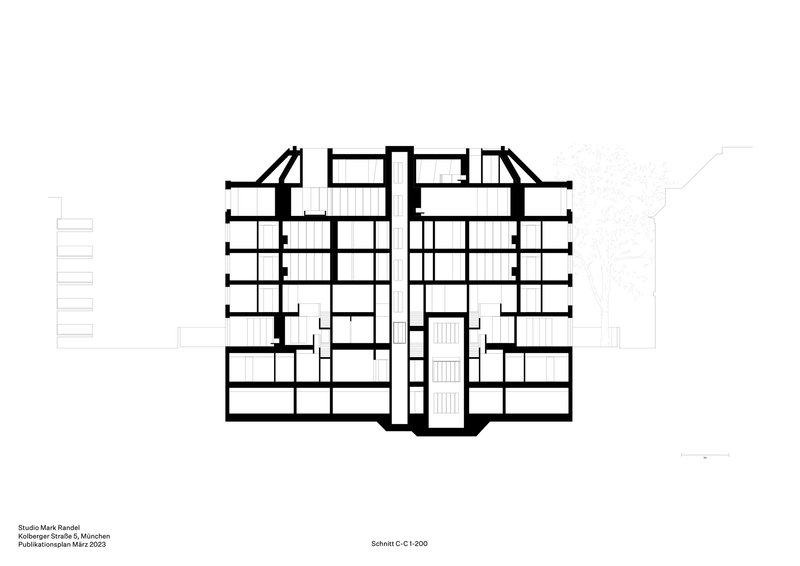
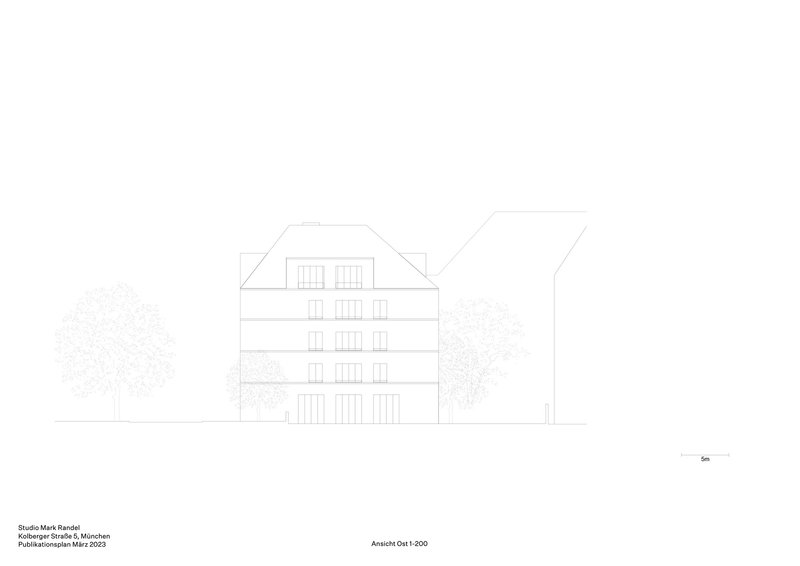
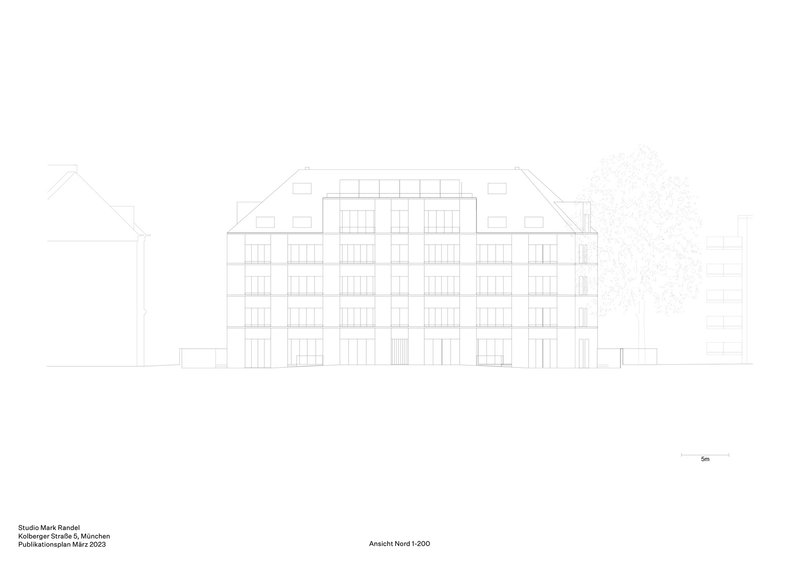
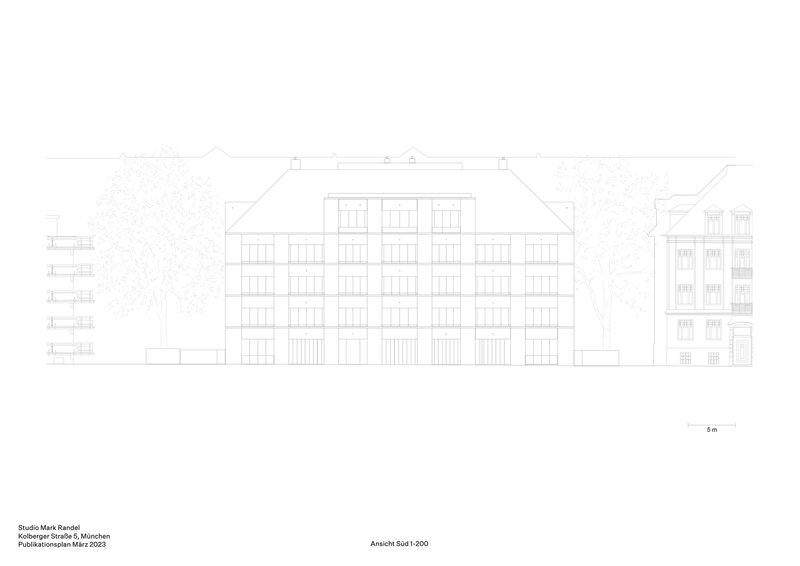
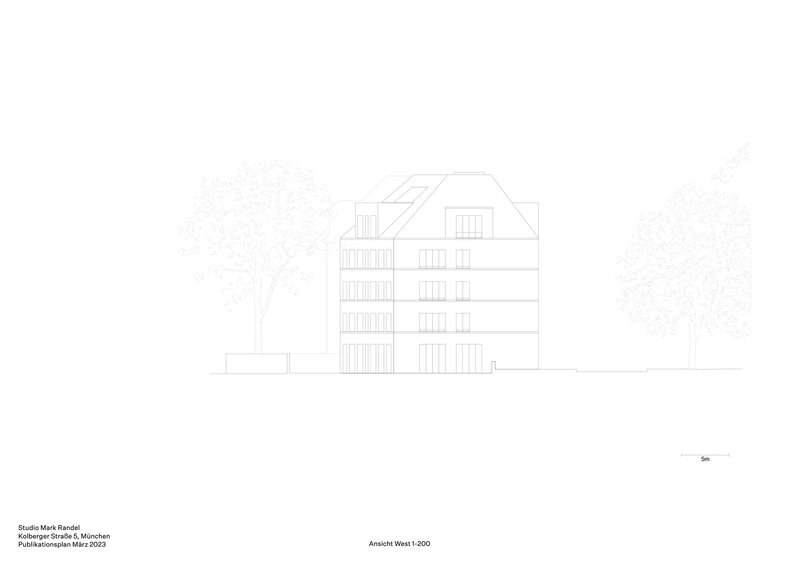
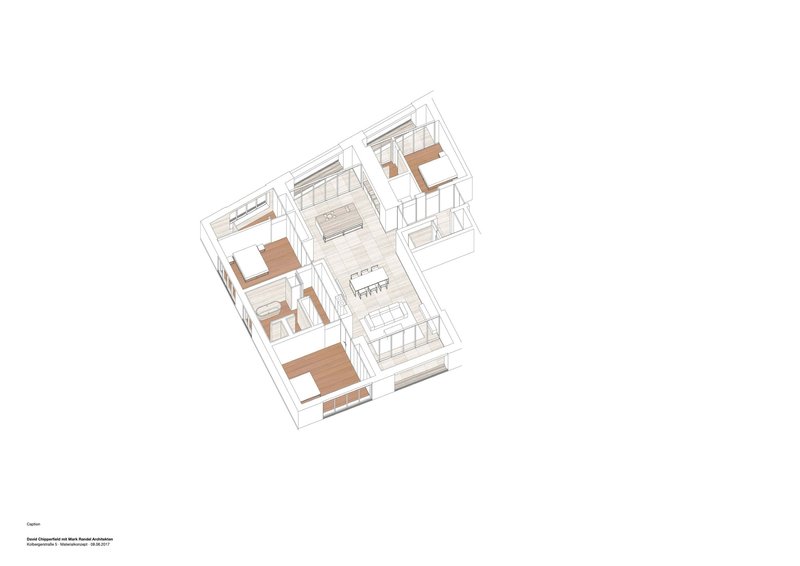
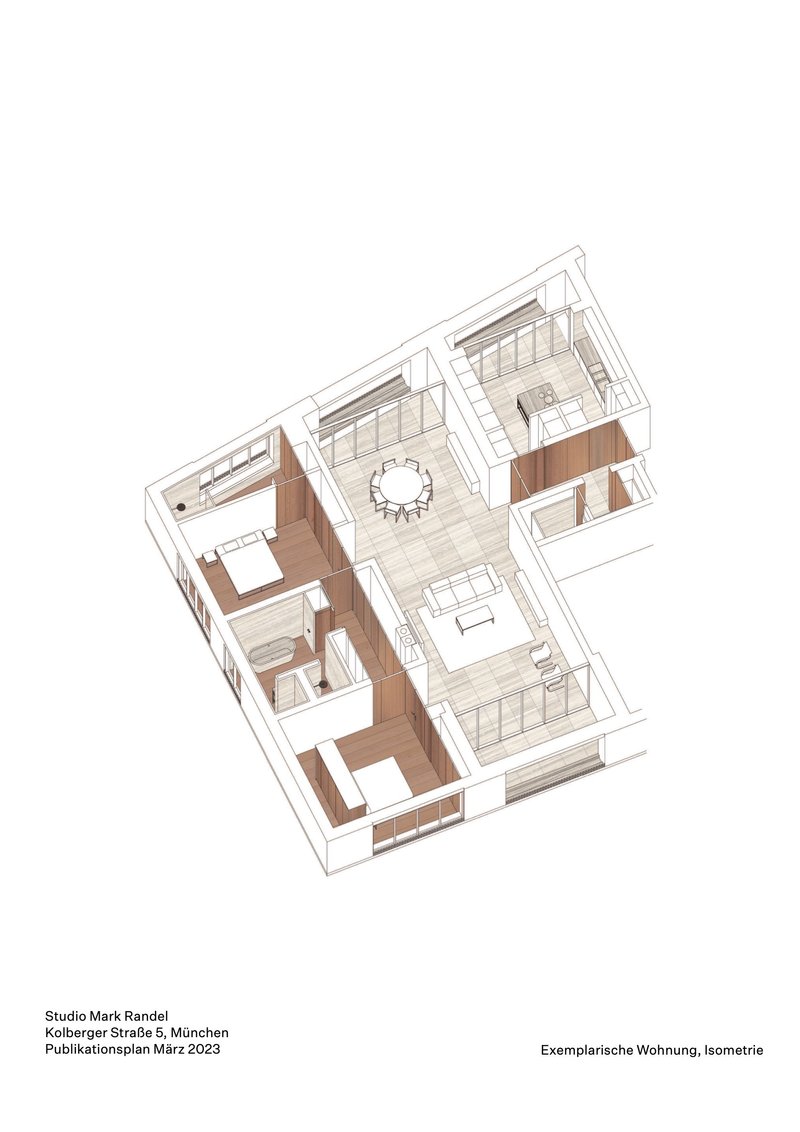
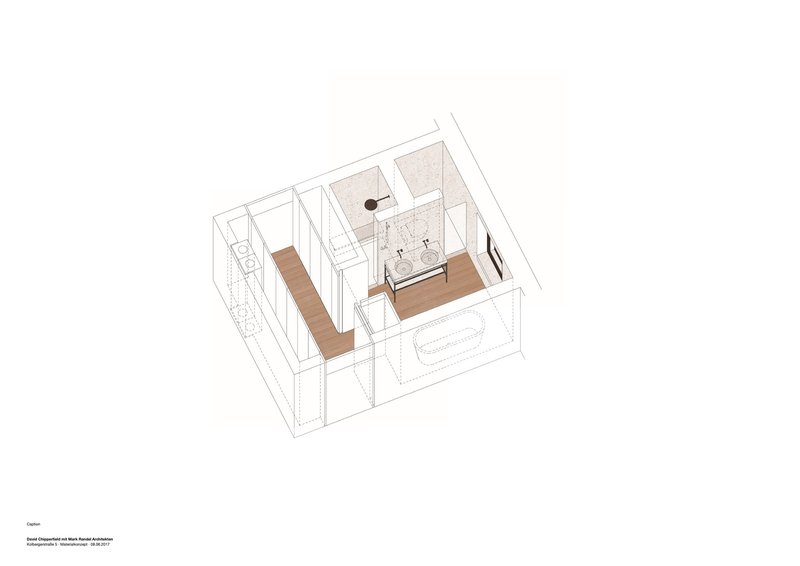
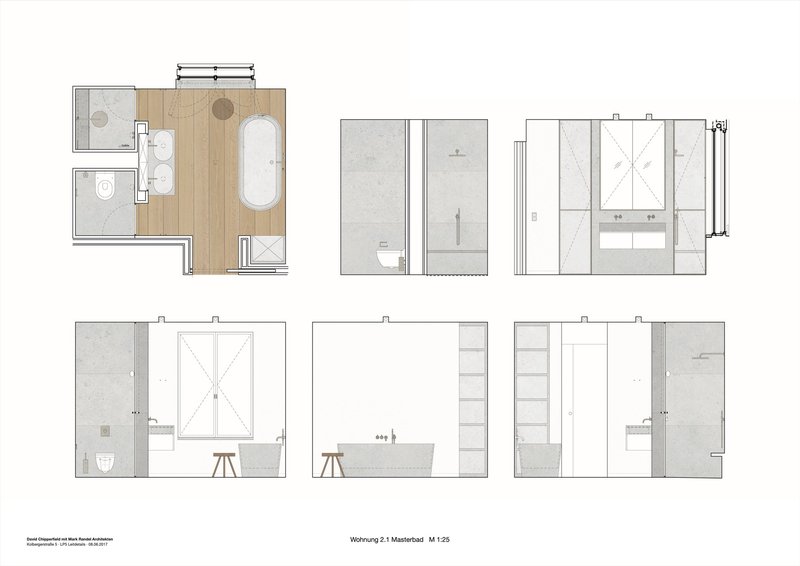
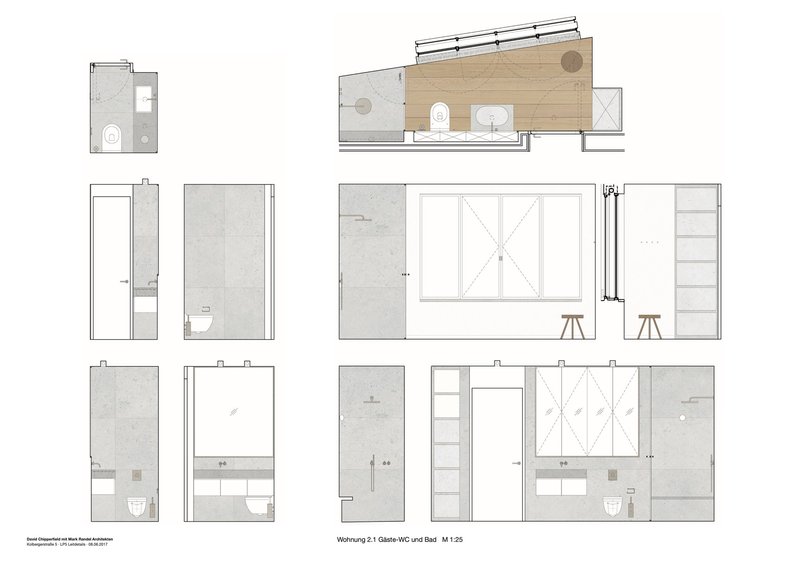
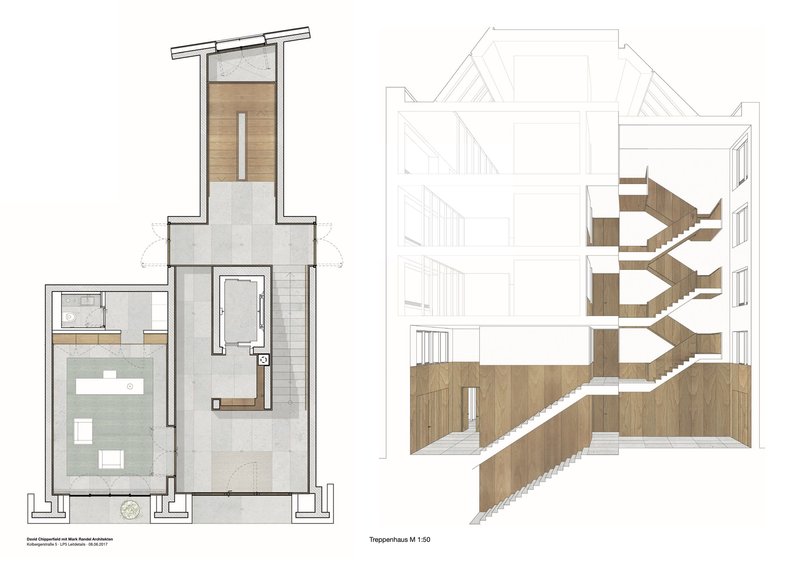
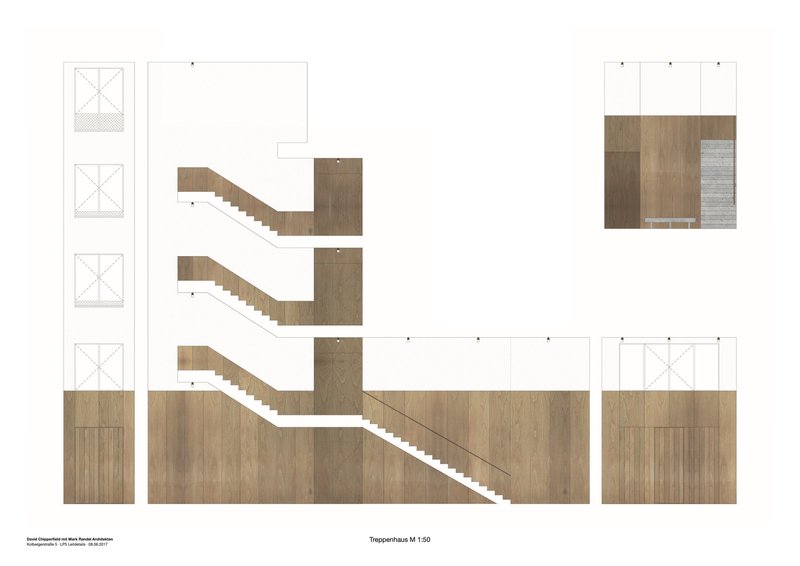
The drawing set reveals the organizational logic behind Kolberger 5's composed facades. The site plan shows the building occupying a full urban block edge, with residential units arranged around two central vertical circulation cores. Floor plans shift in configuration as they rise, with the ground floor incorporating landscaped edges and courtyard spaces, the upper floors organized as symmetrical residential units, and the roof plan showing timber decking radiating around a central recessed terrace.
The sections are particularly instructive. They reveal cascading interior levels connected by diagonal stair runs, and two towers linked by a central vertical core. The mansard roof, visible in the elevations, is not a stylistic concession but a volumetric strategy that adds usable space while keeping the building's profile consistent with the neighborhood's roofline. Detailed isometric and axonometric drawings of individual apartments show how freestanding bathtubs, timber flooring, and spatial sequences were resolved at the furniture scale before construction began. The bathroom sections and staircase details confirm that this project was drawn, and thought through, at every level.
Why This Project Matters
Kolberger 5 matters because it demonstrates that high-end residential architecture does not require spectacle to achieve significance. In a market saturated with glass towers and branded penthouses, Chipperfield and Randel have delivered a building that earns its place through proportion, material quality, and spatial intelligence rather than formal gymnastics. The project proves that contextual architecture, when practiced at this level, is not conservative. It is demanding.
For younger architects, the lesson is in the drawing set as much as the photographs. The resolution from site plan to door handle is continuous and rigorous. There are no gaps where the thinking stops and the styling begins. In Munich's Herzogpark, where the existing fabric sets a high bar, Kolberger 5 clears it quietly and convincingly. That is the hardest kind of architecture to do well, and the rarest.
Kolberger 5 Residence by Studio Mark Randel + David Chipperfield. Munich, Germany. 2,453 m². Completed 2022. Photography by Simon Menges and Mark Randel.
About the Studio
Share Your Own Work on uni.xyz
If projects like this are the kind of work you want to make, uni.xyz is a place to publish your own, find collaborators, and enter design competitions.




Popular Articles
Popular articles from the community

Inside a Timeless Mumbai Residence by Aether Studio
Aether Studio's 2,250 sq ft apartment in Malad, Mumbai uses marble, brass, boucle, and disciplined restraint to build a quiet retreat from the city.
Noue Studio Organizes a Swiss Restaurant Around a Single Concrete Wall
In Granges-Paccot, Switzerland, a 216-square-meter renovation turns raw materials and a central spine into a legible dining experience.
Cro&Co Architecture Builds a 150-Meter Tower on Top of a Seven-Lane Highway in La Défense
Trinity Tower reimagines the office high-rise as a bioclimatic organism threaded with terraces, trees, and public ground in Paris's business district.

The Flow: Coffee Shop Interior Design Where Time, People, and Process Intertwine
The Flow reimagines Viennese coffee culture through arched forms, warm interiors, music, reading, work, and social gathering.


Similar Reads
You might also enjoy these articles
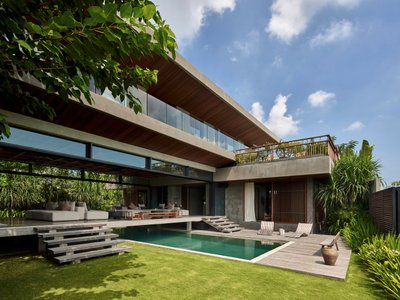
Freebird Residence by Alexis Dornier: A Tropical Modernist Sanctuary in Bali
Floating living pavilion above pool anchors H-shaped tropical villa, blending Japanese minimalism, sustainable strategies, lush landscape, and sculptural interiors.
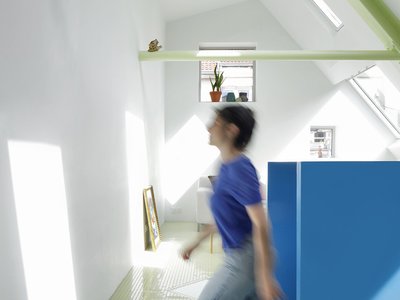
127af Flips a Tiny Bagnolet Rowhouse Upside Down with a Handcrafted Roof Extension
A 55-square-meter terraced house on the edge of Paris gains a luminous upper living floor through lightweight timber and steel.
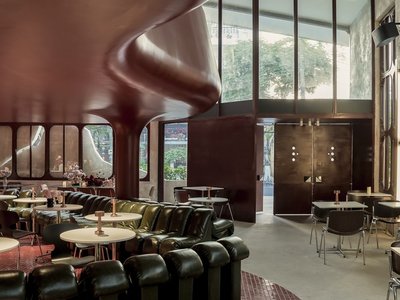
1.61 Design Workshop Wraps a 600-Square-Meter Café in Vietnam in Sculptural Burgundy Drama
Reden Café & Bistro pairs a helical staircase, mosaic floors, and deep red interiors to rethink Vietnamese hospitality space.

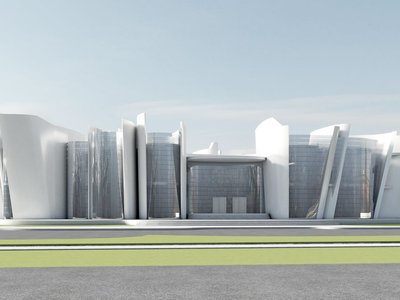
The Unbound Brain: A School Shaped by Cognitive Architecture
Cylindrical learning pods radiate like neurons from a central cortex, turning the floor plan into a spatial model of human thought.


Explore Residential Building Competitions
Discover active competitions in this discipline




The Global Benchmark for Architecture Dissertation Awards


Challenge to design locus for the upliftment of human rights


Challenge to design a learning and healing center


Challenge to re-imagine a department store in present times
Comments (0)
Please login or sign up to add comments
No comments yet. Be the first to comment!