
KPF Builds a 267-Acre University Campus in Guangzhou Designed Around Wind and Water
The Hong Kong University of Science and Technology's new Guangzhou campus trades academic silos for climate-responsive urbanism in the Pearl River Delta.


Building a university from scratch is rare enough. Building one that spans 6 million square feet, accommodates over 4,000 graduate students, and was planned, designed, and constructed in just three years is something else entirely. The Hong Kong University of Science and Technology (Guangzhou), designed by KPF and completed in 2022, occupies a 267-acre site in Nansha, a new innovation district positioned midway between Guangzhou and Shenzhen. The campus is the physical embodiment of a pedagogical gamble: replacing the traditional departmental structure with four interdisciplinary "Hubs" organized around Function, System, Information, and Society.
What makes the project genuinely interesting is not its scale but its obsession with airflow. Guangzhou is hot, humid, and prone to flooding. Rather than relying solely on mechanical systems, KPF used computational fluid dynamics modeling to shape building massing, orientation, and openings so that more than 40 percent of the core campus receives optimal average wind speeds of five to seven miles per hour. Three canals embrace the delta site, collecting and filtering rainwater while protecting against floods. The result is a campus that functions less like a collection of buildings and more like a calibrated microclimate.
Campus as City
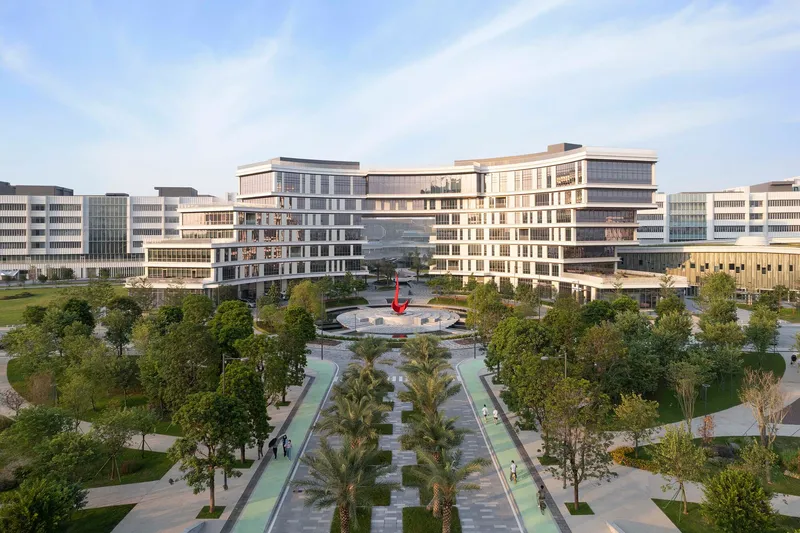
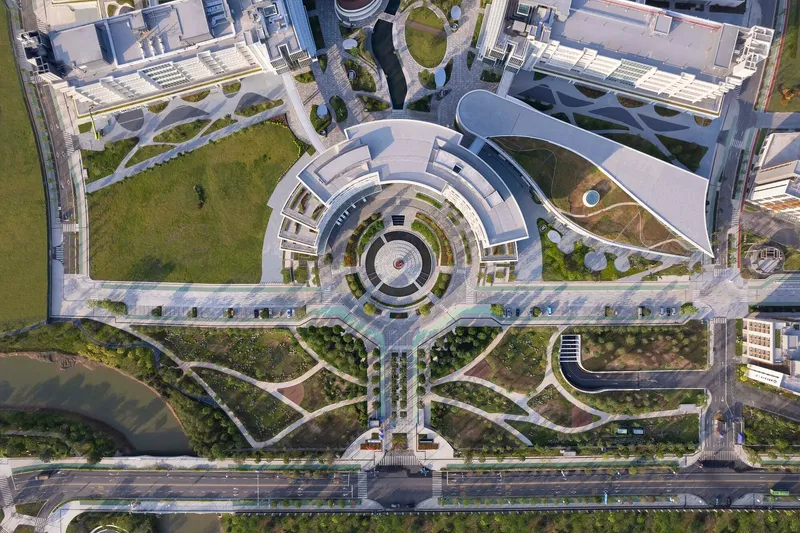
The masterplan reads like urban design rather than institutional planning. Eight research and lab buildings connect via shaded linear arcades that form the campus's primary urban space, organized on east-west and north-south axes. Seven distinct districts handle teaching, research, housing, athletics, leisure, and social interaction, each with its own spatial character. A "High Street" lined with cafes, shops, and public amenities creates the campus edge, giving the complex the grain and rhythm of a walkable neighborhood rather than a gated compound.
The central plaza, with its palm-lined pedestrian paths and fountain, establishes the civic scale of the project. Concentric paving patterns radiate outward from circular gathering points, creating legible nodes within a campus that could easily overwhelm its inhabitants with sheer size. KPF understood that at 11.6 million square feet at full buildout, wayfinding is not a detail but a design driver.
Living Roofscapes
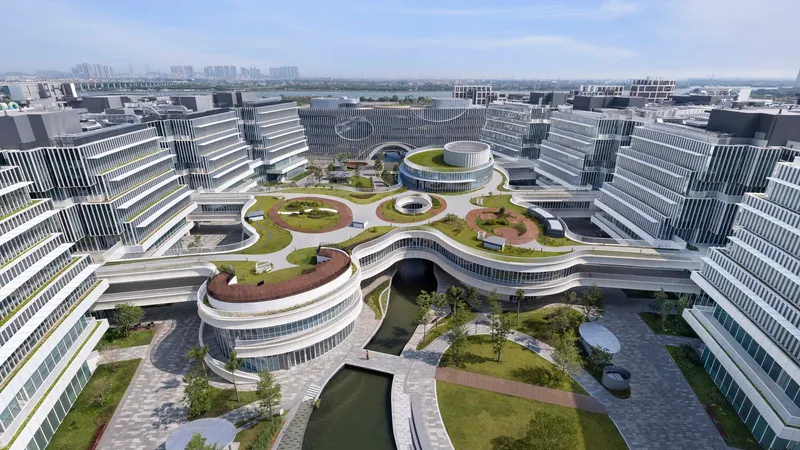
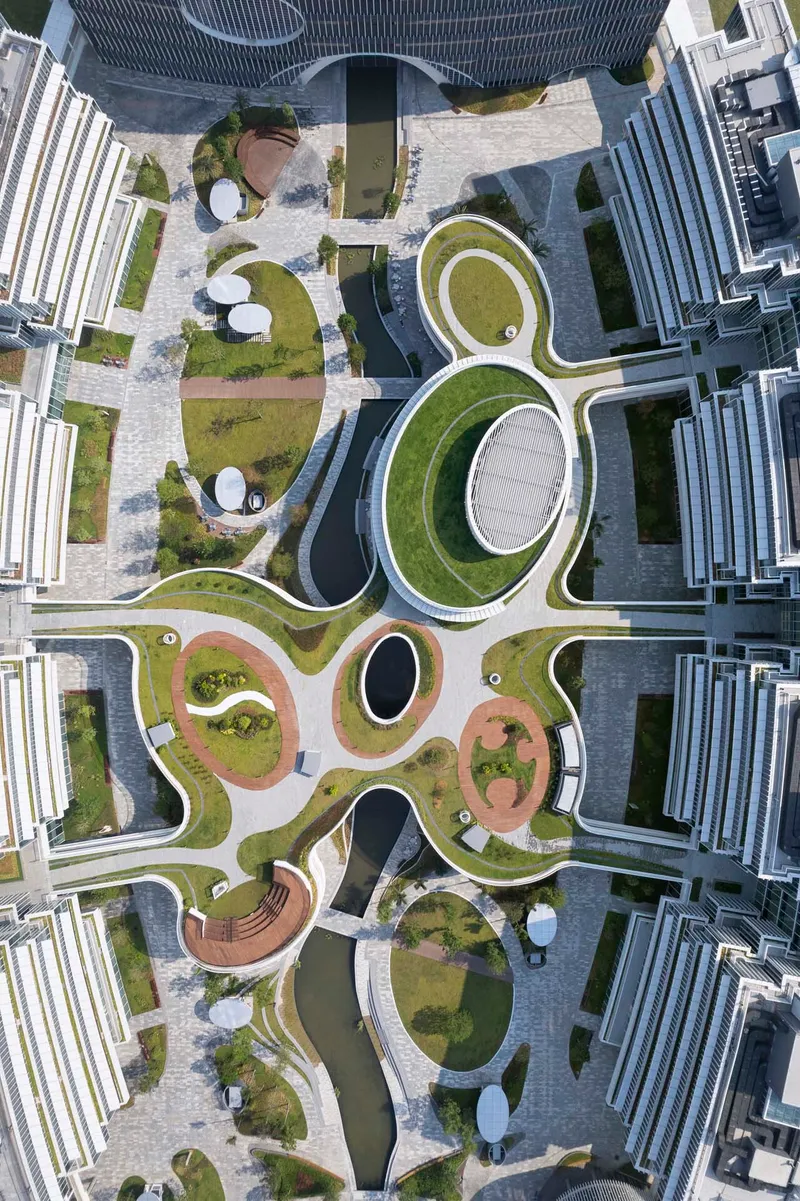
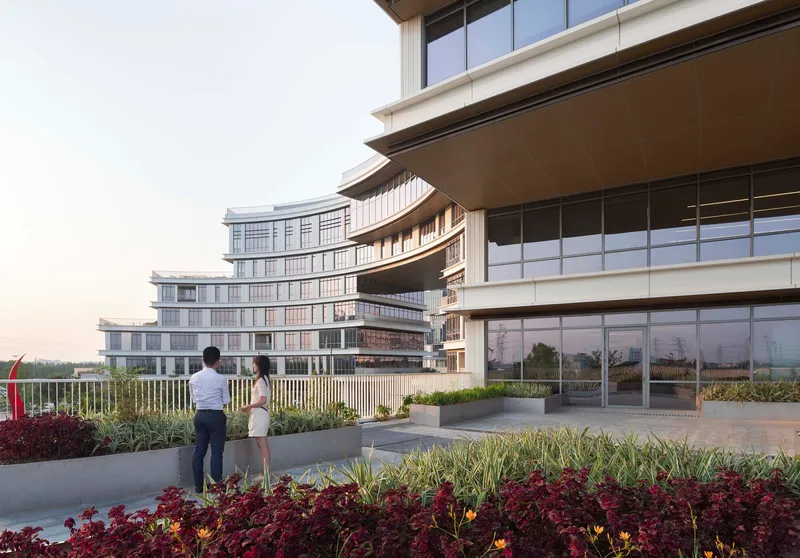
From above, the campus reveals its most distinctive move: looping planted roof terraces that weave between and over buildings, blurring the line between ground plane and roofscape. Circular skylights punctuate these green surfaces, pulling daylight into the volumes below while creating a topographic landscape at the upper level. The rooftop beds are not cosmetic. They are part of a vertical design methodology where the campus rises higher at its center and slopes toward its edges, directing road runoff into the canal system and realizing what Chinese planners call the "sponge city" concept.
At dusk, the rooftop terraces become inhabitable vantage points. The horizontal banding of the facades below creates a layered datum line, while the planted beds soften the concrete and steel structure into something approachable. It is infrastructure masquerading as landscape, and it works.
Facade Logic
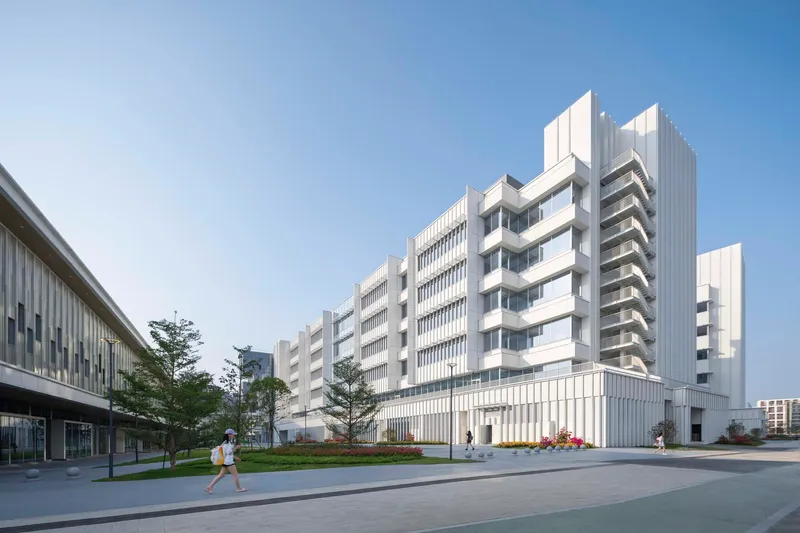
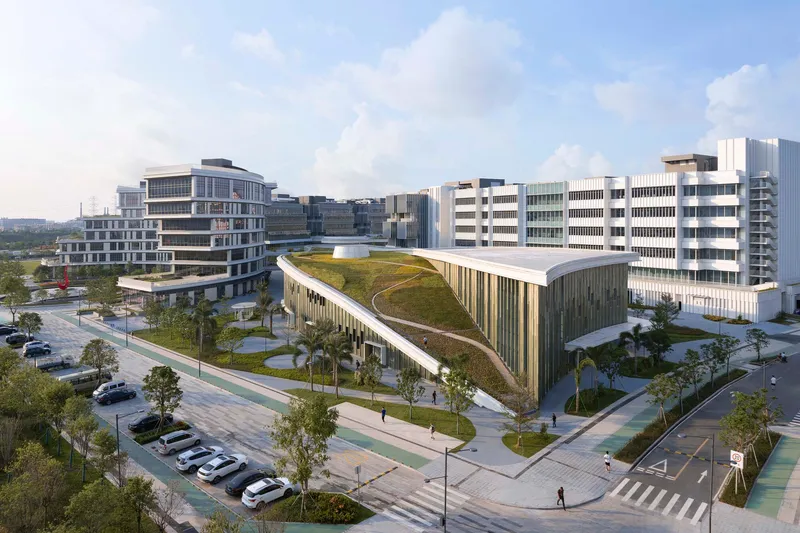
KPF deploys a family of facade strategies across the campus's 50-plus buildings, unified by a common material palette of glass, steel, concrete, and bamboo-inspired textured panels. The white vertically ribbed facades on the administration and teaching buildings give the massing a taut, almost textile quality. These fins are not merely decorative: their spacing and depth modulate sunlight penetration in Guangzhou's relentless subtropical climate.
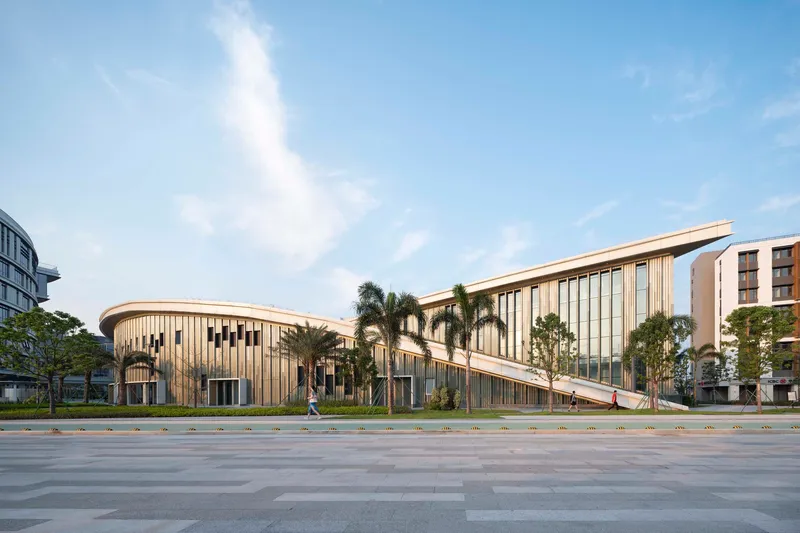
The curved two-story pavilion with its vertical metal fins is a particularly effective piece. Fronting a vast paved plaza, it reads as both gateway and threshold, its gentle curve directing movement while providing shade along the ground-floor arcade. Nearby, the green roof pavilion with vertical louvers at the campus edge demonstrates how even utilitarian structures receive the same tectonic attention, maintaining coherence across wildly different building types.
The Library Bridge and Campus Heart
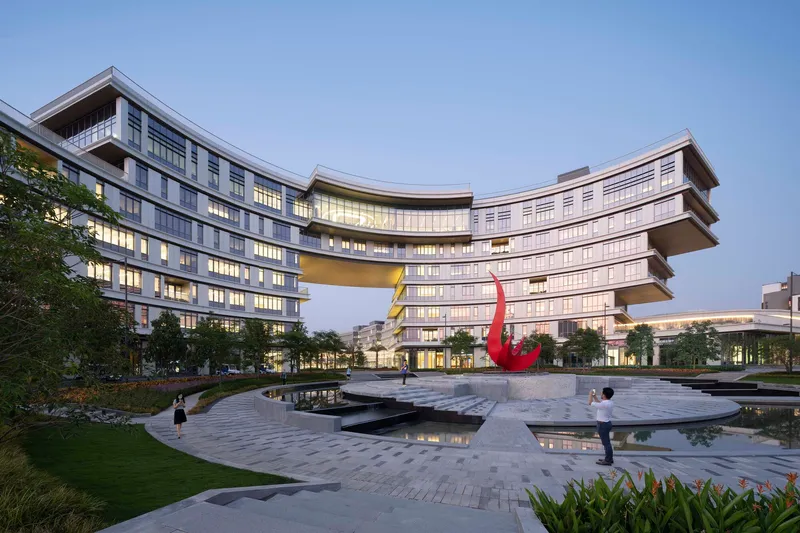
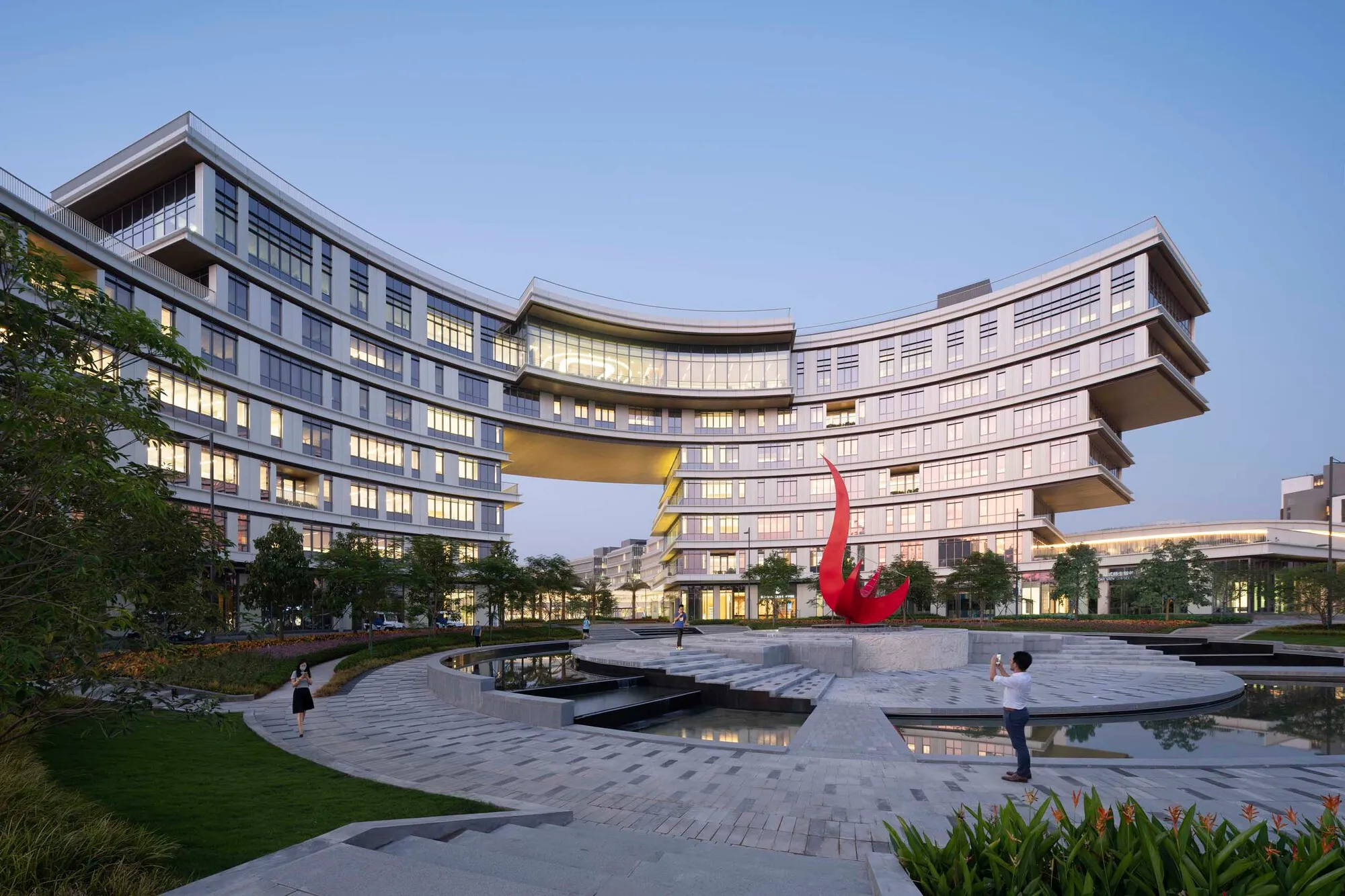
The library traverses one of the campus's three canals, physically connecting the east and west halves of the site. At dusk, its curving skybridge catches the last light, hovering above a courtyard of reflecting pools and a red sculpture that provides a focal accent against the surrounding neutrals. This is the campus's emotional center: the point where circulation, water, and program converge.
Long-span concrete arches, engineered by Arup, give the library and the adjacent natatorium their generous interior volumes without cluttering the floor plates with columns. The structural ambition is quiet but significant. These are the kind of spaces that make project-based, cross-disciplinary learning plausible rather than aspirational, because they allow large groups to gather, build, and test in configurations that a conventional classroom building simply cannot support.
Climate as Co-Designer
The sustainability strategy here goes beyond the usual checklist. Campus-wide electrification eliminates new fossil fuel infrastructure entirely, relying on heat pumps for all mechanical services and recovering waste heat from data centers through an integrated heating loop. The entire campus is designed to accommodate utility-scale rooftop solar meeting up to 7 percent of energy needs, while rainwater and light greywater are recycled through an on-site research program. KPF projects a 54 percent reduction in carbon emissions from day one, with a goal of carbon neutrality before 2060.
But the most convincing climate move is the one you feel rather than measure: trees planted for shade, arcades that channel breezes, building heights that vary to optimize airflow. The computational fluid dynamics work that KPF co-developed with Simscale is embedded in every corridor and courtyard. Wind is not an afterthought here. It is, alongside water, the organizing principle of the entire masterplan.
Why This Project Matters
Universities built at this speed and scale often feel generic, their ambitions outrunning their design intelligence. HKUST Guangzhou avoids that trap by anchoring every decision in two tangible realities: a subtropical climate that punishes lazy design, and a pedagogical model that demands flexible, interconnected space rather than isolated departmental buildings. The result is a campus that takes its environmental context as seriously as its academic mission.
KPF has delivered something that functions simultaneously as infrastructure, landscape, and small city. The canals filter water and prevent flooding. The rooftops generate energy and absorb rain. The arcades provide shade and social space. None of these systems exist in isolation, and that integration is the project's real achievement. In a region facing rising temperatures, sea-level change, and explosive urbanization, this campus offers a credible template for building at scale without building against the climate.
Hong Kong University of Science and Technology (Guangzhou) by KPF. Guangzhou, China. Approximately 550,000 square meters (first phase). Completed 2022. Photography by TAL.
About the Studio
Share Your Own Work on uni.xyz
If projects like this are the kind of work you want to make, uni.xyz is a place to publish your own, find collaborators, and enter design competitions.




Popular Articles
Popular articles from the community


Lunar Spiral: Space Architecture Shaped by the Mathematics of the Universe
Lunar Spiral reimagines space architecture through Fibonacci geometry, lunar regolith, levitating habitats, and self-sustaining Moon living.

The Musturak Paradise: Senior Living Architecture for a Connected Future in Temara, Morocco
The Musturak Paradise reimagines senior living architecture in Temara via private homes, social spaces, culture, community, and shared care.

Play: Fragments of Their World
Familiar architecture becomes modular playground design, creating safe spaces where displaced children can learn, connect, imagine and play.

Hill & Cross Opera: Sculptural Opera House Architecture Shaped by Tallinn’s Landscape and Identity
Hill & Cross Opera reimagines opera house architecture in Tallinn through its sculptural hill, civic plaza, glass wave and a luminous cross.


Similar Reads
You might also enjoy these articles

Bao Huynh Watercolor Atelier: A Serene Art Retreat in Hội An
Bao Huynh Watercolor Atelier in Hội An blends multifunctional art spaces, sustainable design, local materials, and family-friendly living in a serene environment.

Atelier Macri Concept Store Interior Design by CASE-REAL
Atelier Macri store features a "ko" counter, walnut wood details, cork displays, blending retail, gallery, and seamless customer experiences.

Manuel Vargas Izquierdo Stadium and High-Performance Sports Center: Architectural Excellence in Jalpa de Méndez
The Manuel Vargas Izquierdo Stadium blends sustainable design, inclusive sports facilities, and cultural-inspired architecture, revitalizing Jalpa de Méndez’s public spaces.

KAKR Buluh Awar Hall: Revitalizing Community and Ecology Through Bamboo Architecture
Community built bamboo hall revitalizes Buluh Awar village, empowering youth, restoring ecology, celebrating vernacular craftsmanship through sustainable architecture and culture.

Explore Zhejiang University Of Tech Competitions
Discover active competitions in this discipline



Challenge to design a portable theatre


Challenge to design a portable music platform


Challenge to design public laboratory

Challenge to design an open learning module for the elderly
Comments (0)
Please login or sign up to add comments
No comments yet. Be the first to comment!