
KPMB and Architecture49 Grow a Fibonacci-Spiral Conservatory in Winnipeg's Assiniboine Park
The Leaf replaces a century-old glass pavilion with one of Canada's largest ETFE structures, housing 12,000 plants under a column-free canopy.


Winnipeg is not the first city that comes to mind when you picture a lush tropical biome. The prairie capital endures some of the harshest winters on the continent, with temperatures that can sink below minus forty. And yet, since 1914, Assiniboine Park has maintained a glass conservatory as a public refuge of warmth and living greenery. When the 1969 rebuild of that original pavilion was deemed beyond repair, KPMB Architects and Architecture49 were tasked with designing its replacement: not merely a greenhouse, but a 21st-century horticultural institution spanning 84,400 square feet, housing four distinct biomes, and achieving LEED Gold certification. The result, completed in 2022, is The Leaf.
What makes The Leaf genuinely interesting is not just the spectacle of a 108-foot diagrid tower rising above the Manitoba flatlands. It is the structural logic underneath that spectacle. The entire roof is carried by a cable net radiating in a Fibonacci spiral from the central mast, leaving the garden floor completely free of columns. Every ETFE pillow terminates at the central core so that each biome receives a calibrated dose of solar radiation, while the visitor concourse is fritted to reduce heat gain. The building is, in effect, a climate machine tuned to grow palms and ferns in a place where the ground freezes hard for five months of the year.
A Tower, a Cable Net, and the Logic of the Nautilus
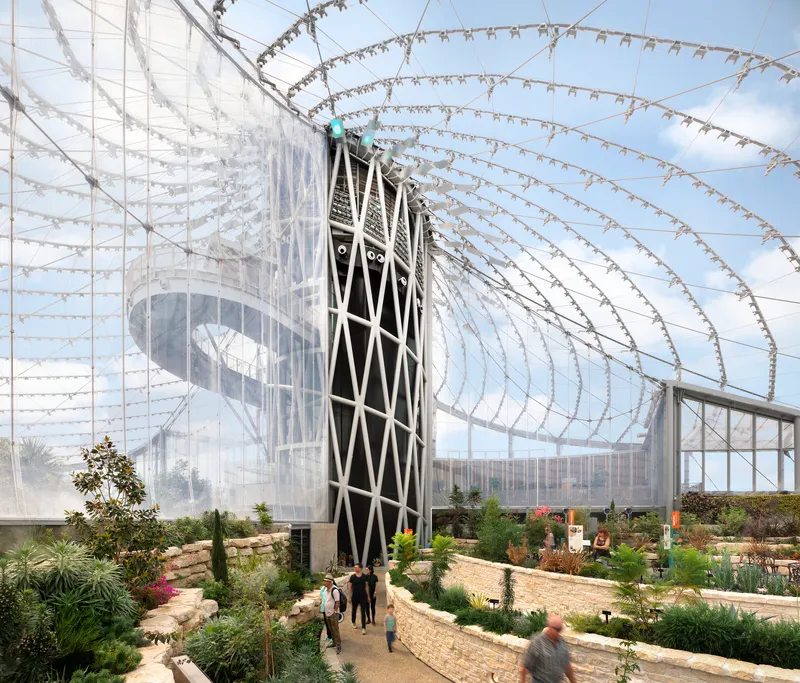
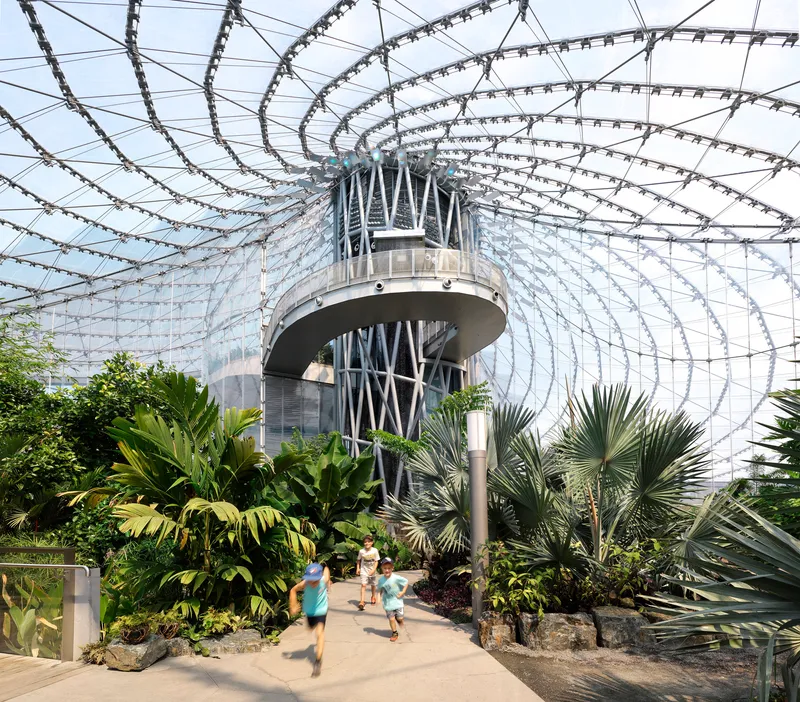
The design borrows its geometry from the Fibonacci sequence, specifically from the spiral patterns found in nautilus shells and sunflower heads. The 33-metre diagrid tower, built from round HSS and pipe elements joined by custom cast-steel nodes, anchors a cable net that spirals outward to the perimeter beam. Exterior outrigger cables pull the roof into tension the way guy lines stabilize a tent. The structural ambition is real: by keeping the cable spans relatively constant as they spiral outward, the architects maintain a manageable cushion size for the ETFE roof while eliminating every interior column and beam at garden level.
Stand beneath the tower, as the children in these photographs clearly enjoy doing, and the effect is both immense and legible. You can trace every cable back to the mast. You understand intuitively that the palms, the mist, the waterfall, and the open walkways exist because the structure has been lifted entirely overhead. It is a rare case where engineering ambition directly produces spatial generosity.
Four Biomes Under One Skin
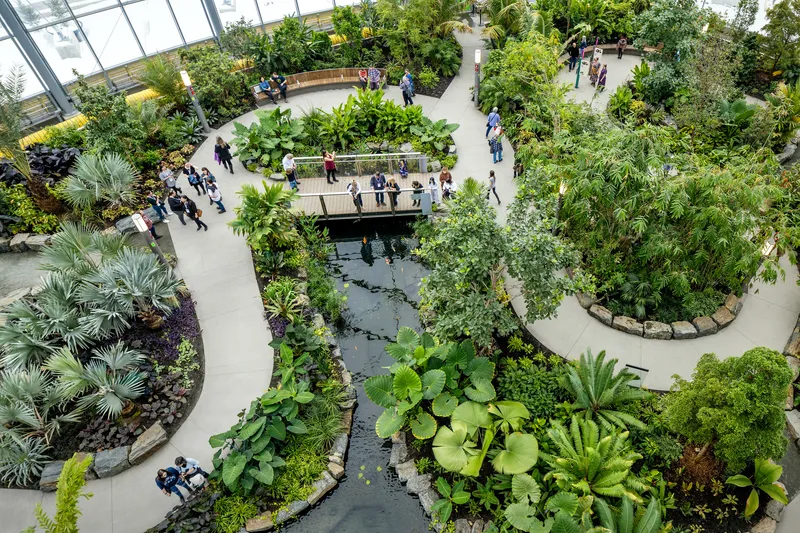
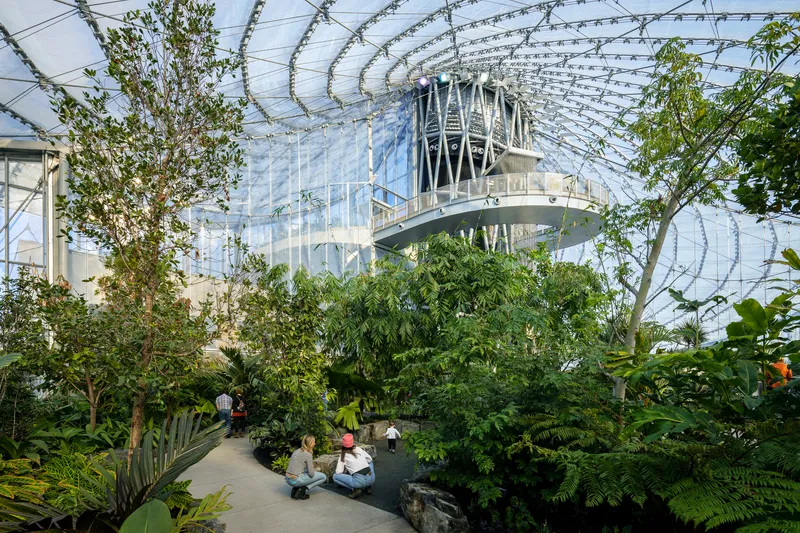
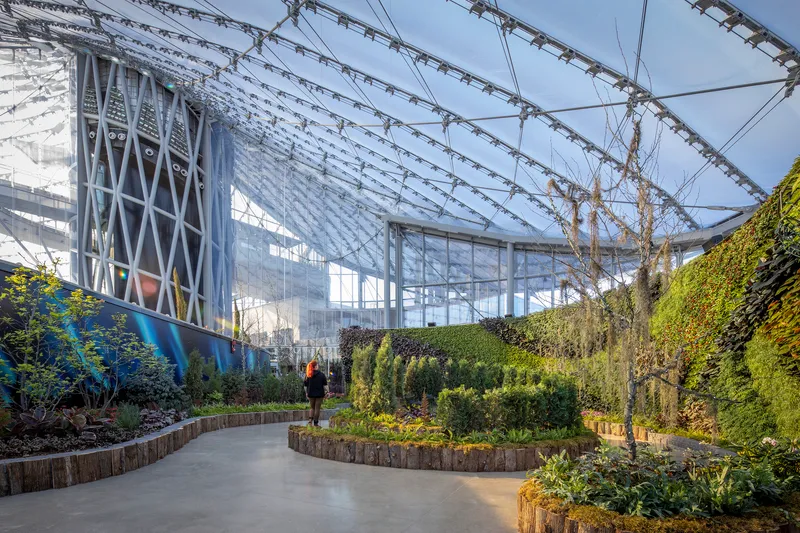
The Leaf's program is organized into four biomes, along with a classroom, restaurant, café, and banquet hall. Visitors enter through the tropical biome, which features Canada's tallest indoor waterfall and curving pathways that wind through 400 unique species. Elevated walkways offer a canopy-level perspective on the dense plantings below, collapsing the distance between public infrastructure and living landscape. Timber-edged raised planters and carefully graded paths give the interior a sense of topography rather than flatness.
The ETFE roof is the critical enabler. Chosen for its high UV transmissibility, ETFE reflects and absorbs only about five percent of incoming light, far less than conventional glass. Each biome section receives a different level of solar radiation based on how the roof is detailed: plant zones get non-fritted pillows for maximum photosynthetic input, while the central visitor concourse is fritted to keep temperatures comfortable. The result is a single enclosure that functions as four distinct climatic zones.
Climate Engineering for the Prairie
Growing tropical plants in Winnipeg demands more than a transparent roof. The Leaf deploys an array of passive and active systems that push it well beyond the conventional conservatory model. Earth tubes, buried concrete ducts that precondition outside air using the ground's stable temperature, feed the building before mechanical systems take over. An open-loop geothermal system taps subsurface water flow for heating and cooling. A hydronic system warms tree roots directly, allowing the ambient indoor temperature to be kept lower than it would otherwise need to be, saving energy while keeping the plants happy.
Humidity is managed through a fog system that also provides evaporative cooling. Each ETFE pillow requires a constant air supply to maintain its shape; rather than running distribution ducts across the garden, every pillow terminates at the central core, where mechanical equipment and inflation fans are housed. The LEED Gold scorecard confirms the strategy works: the project earned 16 out of 19 possible points for energy performance.
Landscape, Axis, and Indigenous Collaboration
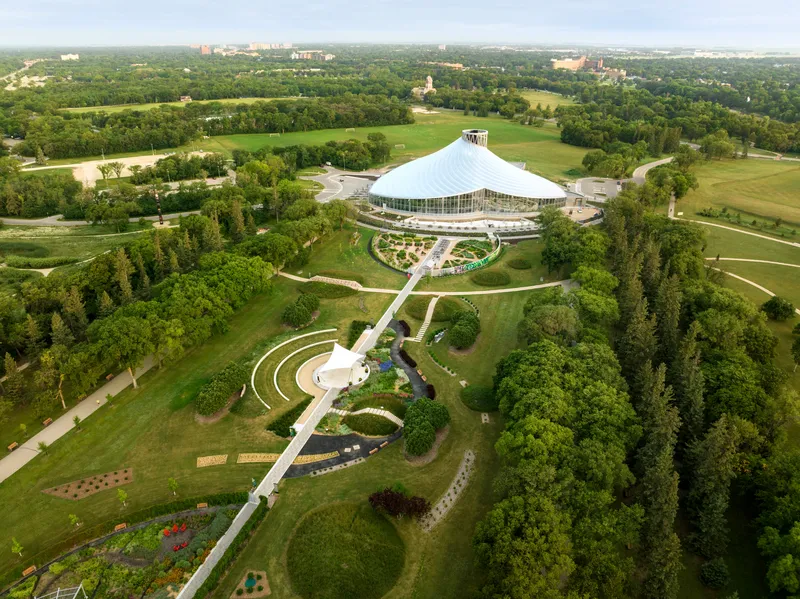
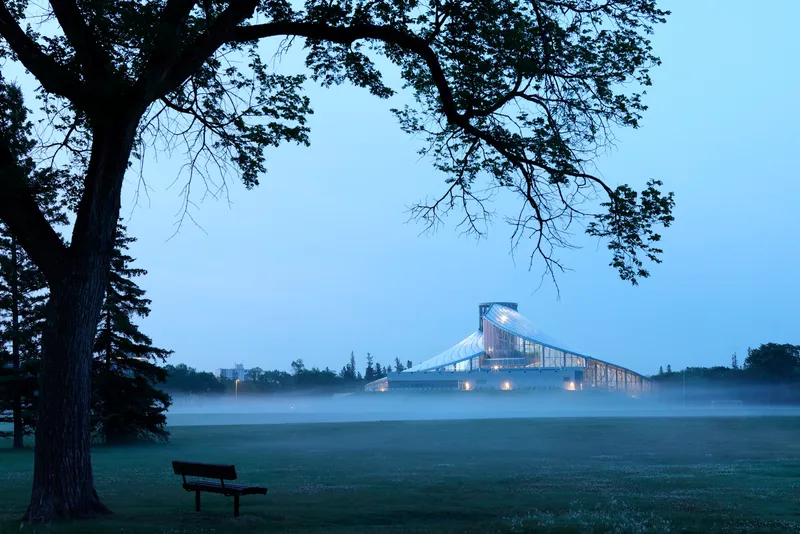
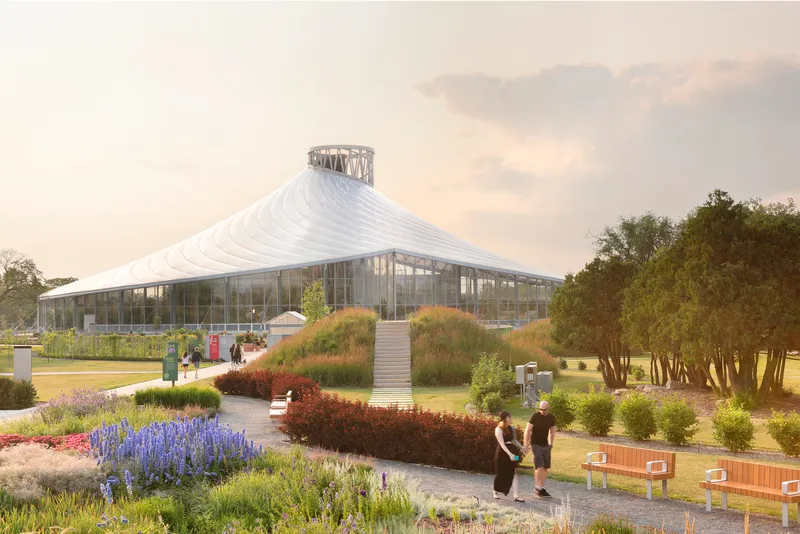
The Leaf sits at the head of Assiniboine Park's existing Formal Garden, a landscape first designed in 1904 by Frederick Todd, Canada's first registered landscape architect, in the Victorian City Beautiful tradition. The new building and its 30 acres of surrounding outdoor gardens are oriented toward the sun, with the south facade receiving the highest solar radiation. But the most pointed gesture is the main axis, which points southeast toward Naawi Oodena, a future 64-acre urban reserve less than a kilometre away.
The Indigenous People's Garden, developed with Anishinaabe and Dene consultants working alongside more than 30 Indigenous groups, reflects a broader ambition to make The Leaf a place of cultural convergence rather than a purely horticultural attraction. Trees removed during site clearing were repurposed into millwork and artisan pieces, and glass from the original 1914/1969 conservatory was crushed and incorporated into the second-floor concrete slab. The project treats its own history as material.
Dusk and the Diagrid
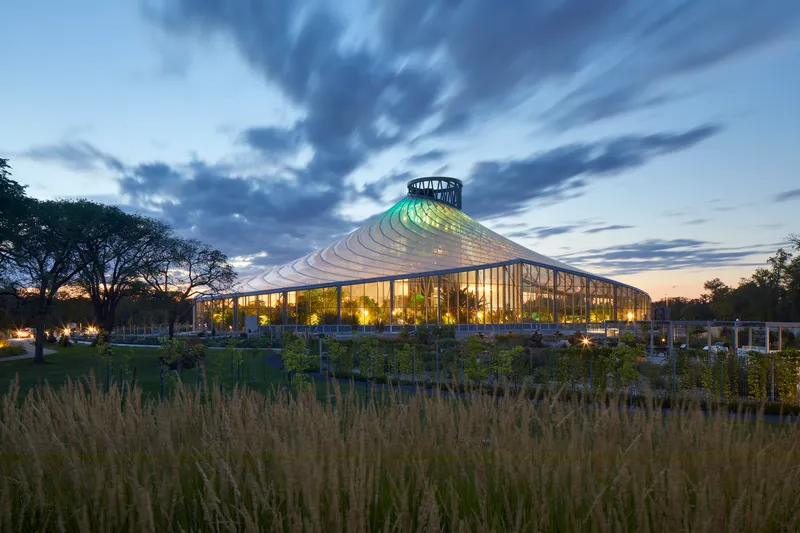
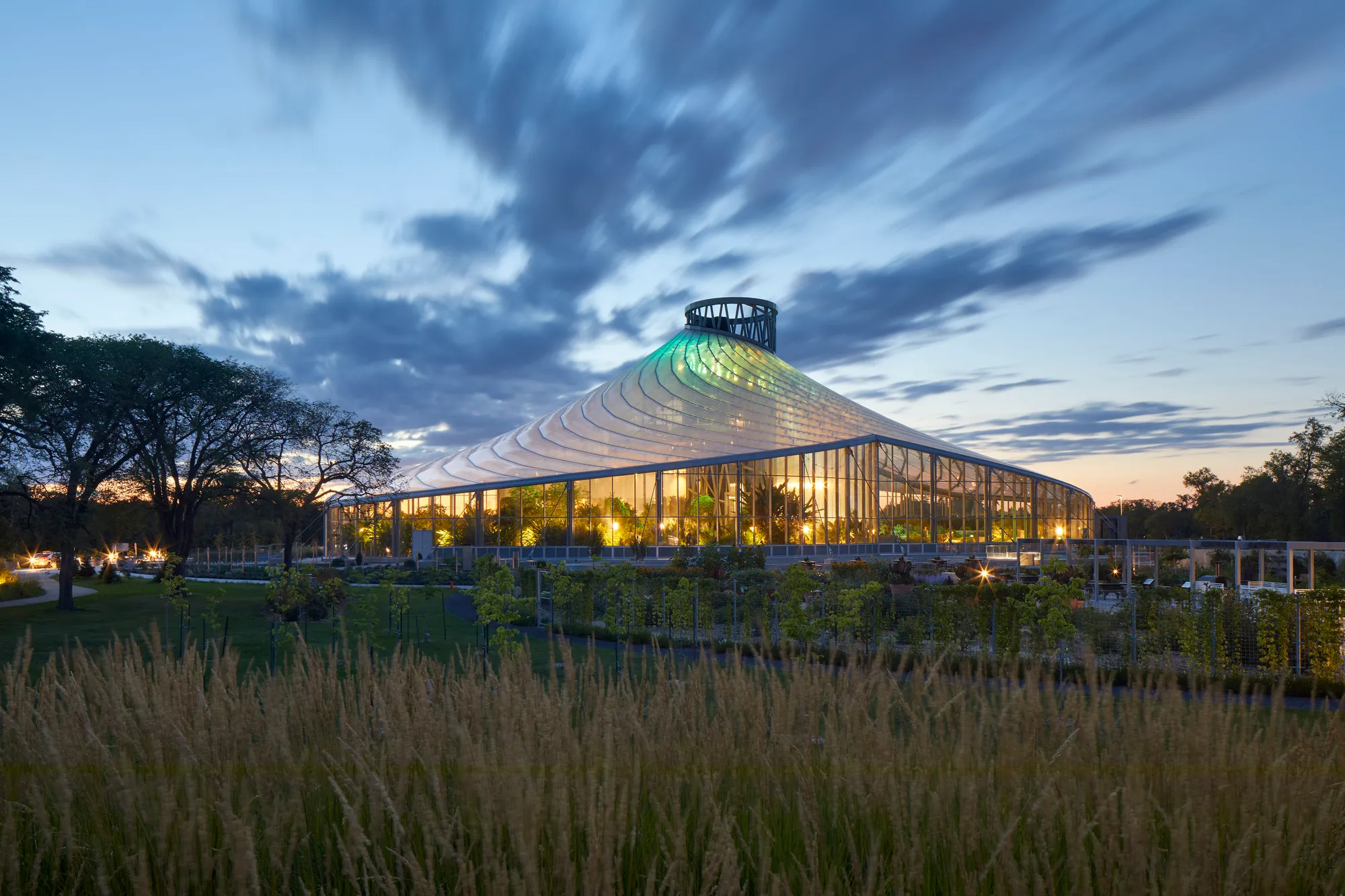
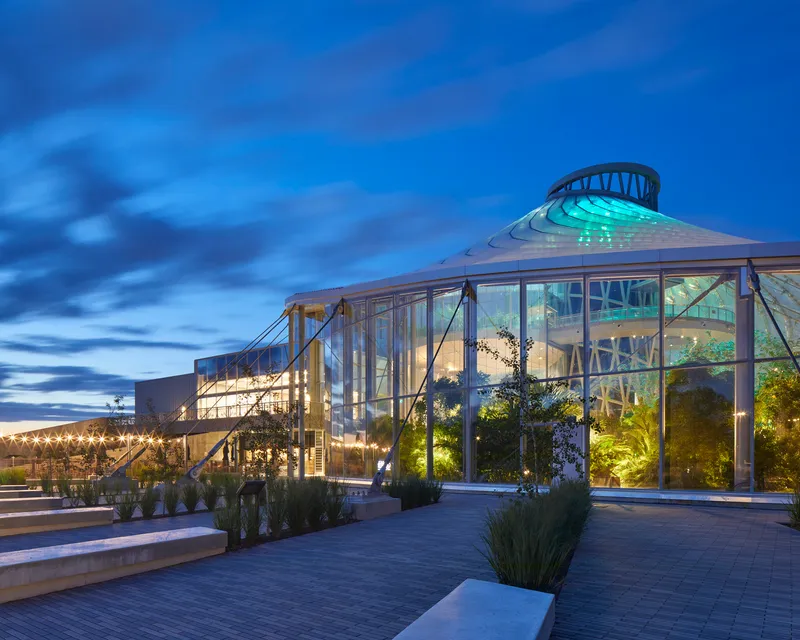
At night, LED lights embedded in the diagrid tower are aimed at aluminum reflectors to simulate the aurora borealis, sunsets, and moonlight. It is a theatrical gesture, but one grounded in a real phenomenon: Winnipeg's northern latitude means the aurora is visible here more often than in most Canadian cities. The illuminated tower becomes a kind of artificial beacon on the flat prairie, visible from the surrounding parkland and forest. The dusk photographs capture this well: the building reads as a warm, lantern-like form hovering above dry grasses, drawing visitors toward light and warmth in a landscape defined by cold and horizontal distance.
Plans and Drawings
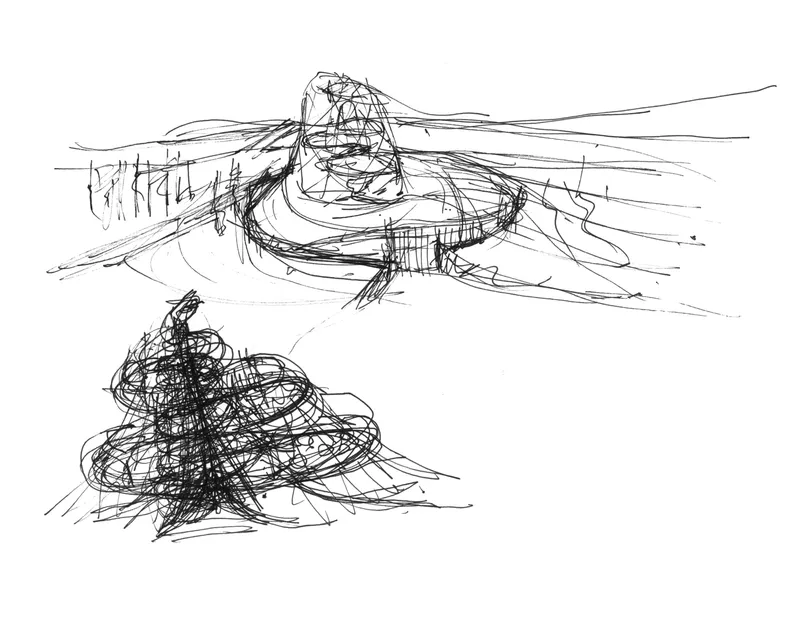
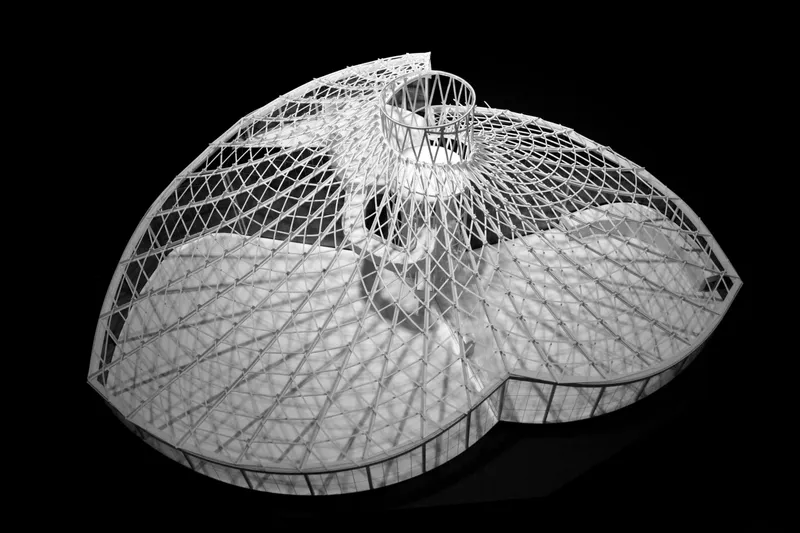
The concept sketch reveals how early the Fibonacci logic was embedded in the design: a freehand dome with landscape studies that already suggest the spiral plan. The axonometric drawing of the lattice steel structure makes the dual-dome configuration legible, showing how two intersecting curved volumes produce the plan's distinctive footprint. The structural drawing is especially useful for understanding how the cable net distributes loads from the ETFE pillows down through the tower and out to the perimeter, achieving the column-free garden floor that defines the visitor experience.
Why This Project Matters
The Leaf matters because it demonstrates that a botanical conservatory can be more than a climate-controlled display case. By integrating passive ventilation, geothermal systems, earth tubes, and a highly calibrated ETFE envelope, KPMB and Architecture49 have produced a building that earns its tropical interior through intelligence rather than brute-force energy consumption. The column-free garden floor is not merely a structural stunt; it creates a continuous landscape where pathways, waterfall, elevated walkways, and four distinct biomes coexist without spatial compromise.
More broadly, the project argues that cultural institutions in cold climates can embrace environmental ambition without abandoning spectacle. The Fibonacci geometry gives the building a legible formal identity, but it is the engineering beneath the spiral that delivers the performance. In a moment when many public buildings settle for sustainability theater, The Leaf puts the mechanics on display and trusts the public to appreciate them. That confidence is justified. The building works as architecture, as infrastructure, and as a civic gathering space, which is exactly the combination that mid-sized North American cities need more of.
The Leaf at Assiniboine Park, designed by KPMB Architects and Architecture49. Winnipeg, Canada. 84,400 ft². Completed 2022. Photography by Tom Arban, Ema Peter Photography, and Richard Seck.
About the Studio
Share Your Own Work on uni.xyz
If projects like this are the kind of work you want to make, uni.xyz is a place to publish your own, find collaborators, and enter design competitions.




Popular Articles
Popular articles from the community


Riyadh For All: Intergenerational Urban Design for Active Aging in Rabat
Riyadh For All reimagines urban design in Rabat with intergenerational co-living, adaptive courtyards, and Moroccan cultural exchange today.

Co-Life: Senior Housing Design That Reconnects Older Adults With the City
Co-Life reimagines senior housing design through healing gardens, shared streets, workshops, and a sustainable community across generations.

The Ocean Hive: Sustainable Architecture for a Self-Sufficient Civilization at Sea
The Ocean Hive imagines sustainable architecture at sea, where modular habitats, algae, wave power and ocean waste sustain a growing colony.

Lunar Spiral: Space Architecture Shaped by the Mathematics of the Universe
Lunar Spiral reimagines space architecture through Fibonacci geometry, lunar regolith, levitating habitats, and self-sustaining Moon living.


Similar Reads
You might also enjoy these articles

Bao Huynh Watercolor Atelier: A Serene Art Retreat in Hội An
Bao Huynh Watercolor Atelier in Hội An blends multifunctional art spaces, sustainable design, local materials, and family-friendly living in a serene environment.

Atelier Macri Concept Store Interior Design by CASE-REAL
Atelier Macri store features a "ko" counter, walnut wood details, cork displays, blending retail, gallery, and seamless customer experiences.

Manuel Vargas Izquierdo Stadium and High-Performance Sports Center: Architectural Excellence in Jalpa de Méndez
The Manuel Vargas Izquierdo Stadium blends sustainable design, inclusive sports facilities, and cultural-inspired architecture, revitalizing Jalpa de Méndez’s public spaces.

KAKR Buluh Awar Hall: Revitalizing Community and Ecology Through Bamboo Architecture
Community built bamboo hall revitalizes Buluh Awar village, empowering youth, restoring ecology, celebrating vernacular craftsmanship through sustainable architecture and culture.


Explore Landscape Design Competitions
Discover active competitions in this discipline


Challenge to design a portable theatre


Challenge to design a portable music platform


Challenge to design an open learning module for the elderly
Comments (0)
Please login or sign up to add comments
No comments yet. Be the first to comment!