

Kubo Tsushima Architects Scatters Three Villas Across a Plateau to Frame Mount Fuji
On the Asagiri Plateau in Fujikawaguchiko, a cluster of retreats explores floating, sinking, and enveloping space beneath a volcano.


A private compound on the western foot of Mount Fuji is not, in itself, a novel proposition. Japan's resort belt around Fujikawaguchiko is thick with boutique lodges and vacation rentals competing for the same iconic silhouette. What Kubo Tsushima Architects has done with THE THIRD PLACE Mt.Fuji is more deliberate and more strange: rather than designing one building that genuflects toward the volcano, the firm has distributed three architecturally distinct villas and a guest house across a rolling plateau, each embodying a fundamentally different spatial condition. One floats. One sinks. One envelops. The result is not a resort campus but a landscape argument, a claim that the experience of a singular natural landmark can be split into multiple, contradictory registers and that each deserves its own structure.
Situated on the Asagiri Plateau, a patchwork of farms and forests between 500 and 1,000 meters above sea level where summer temperatures rarely breach 30°C, the 374 square meter compound sits beyond a tunnel of pastures in a corner rarely visited by tourists. The buildings share a long east-west axis oriented toward Fuji's borrowed scenery, but their material and structural logics diverge sharply: wood and galvalume steel for the main villa, reinforced concrete for the cave-themed volume, timber again for the two-story guest house. The program, which can accommodate up to eighteen guests as a vacation rental when the owner is away, includes outdoor saunas, cold baths, bathing terraces, and bonfire spaces woven through a carefully graded garden. Completed in 2025, it is a project that refuses to settle on a single mood.
Three Buildings, Three Temperaments
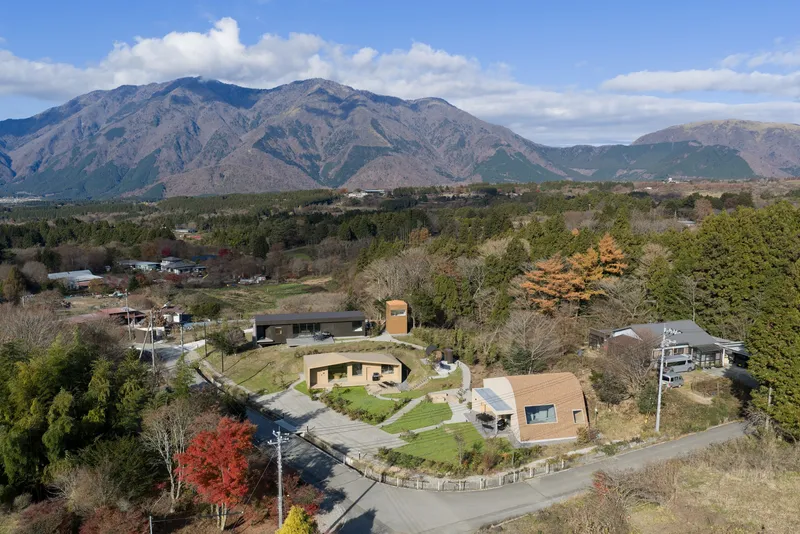
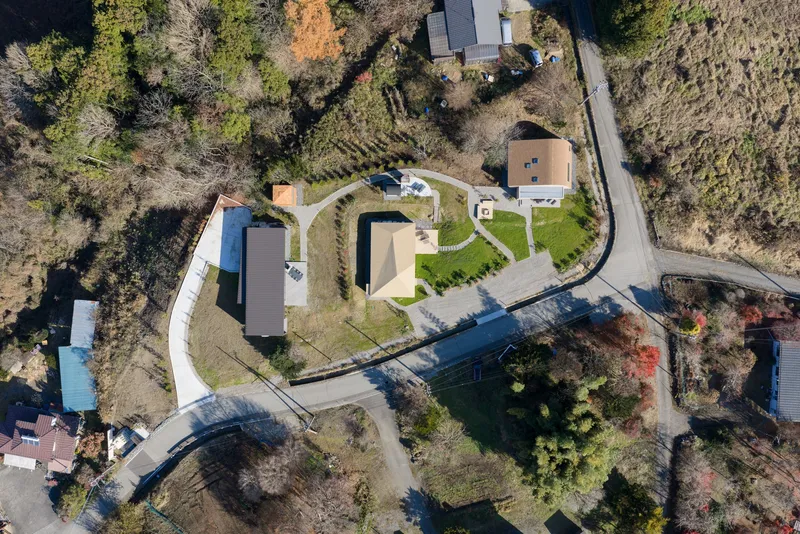
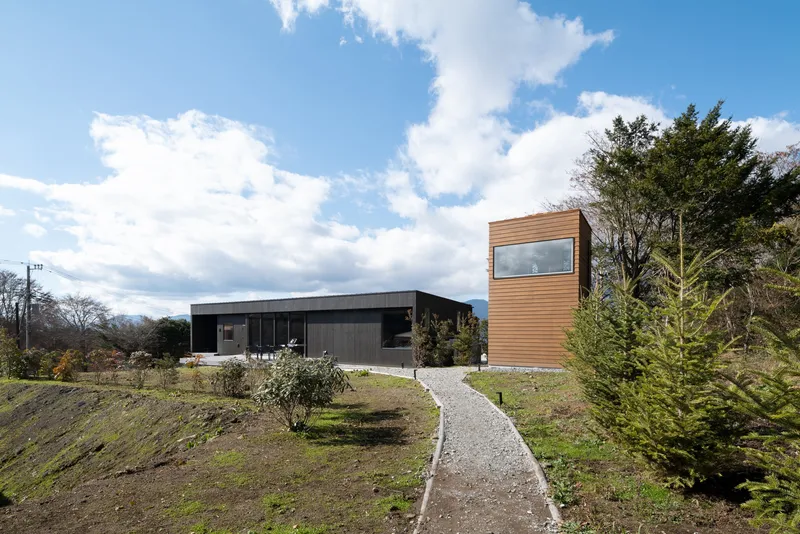
From the air, the compound reads as a loose constellation. The curving pale roof of the main villa dominates the western end of the site, its organic form a deliberate contrast to the angular, dark timber volume cantilevered over the slope to the east and the cedar-clad tower standing upright between them. The landscape strategy is additive rather than monumental: gravel pathways curve between planted beds, bare trees punctuate the lawns, and no single elevation announces itself as the front. Each villa occupies its own micro-topography, and the slight grade changes across the site become the organizing logic. You approach each building on different terms.
The decision to fragment the program into separate structures rather than consolidating it under one roof is the project's strongest conceptual move. It transforms the act of moving between spaces into an outdoor sequence, making the plateau itself a room. The cool highland climate encourages this: stepping outside to walk from your bedroom to the sauna or from dinner to the bonfire pit is not a hardship but a deliberate decompression, each threshold a reset.
The Floating Villa
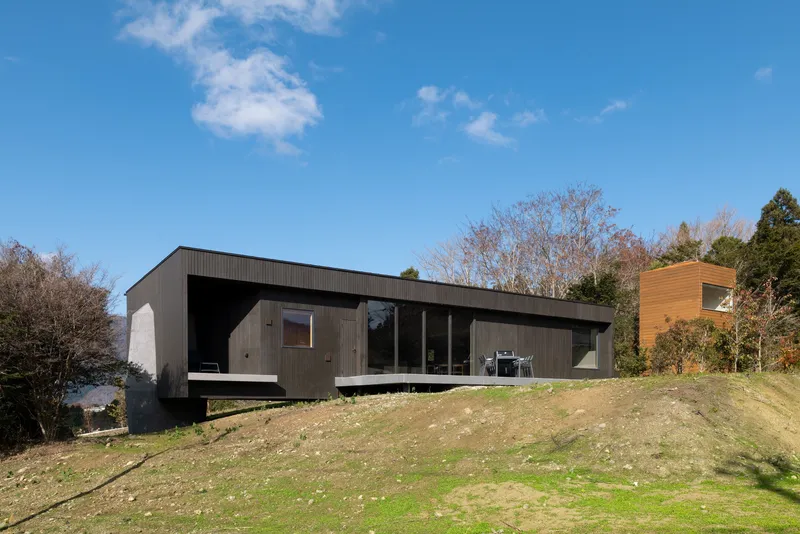
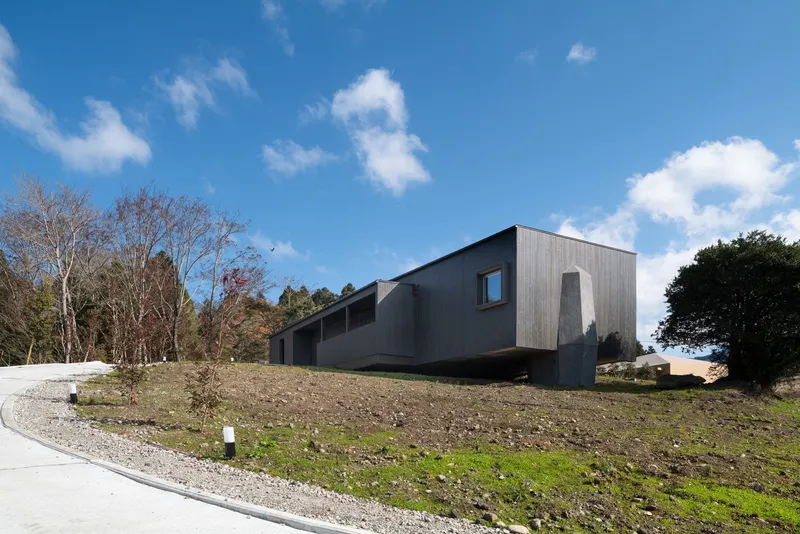
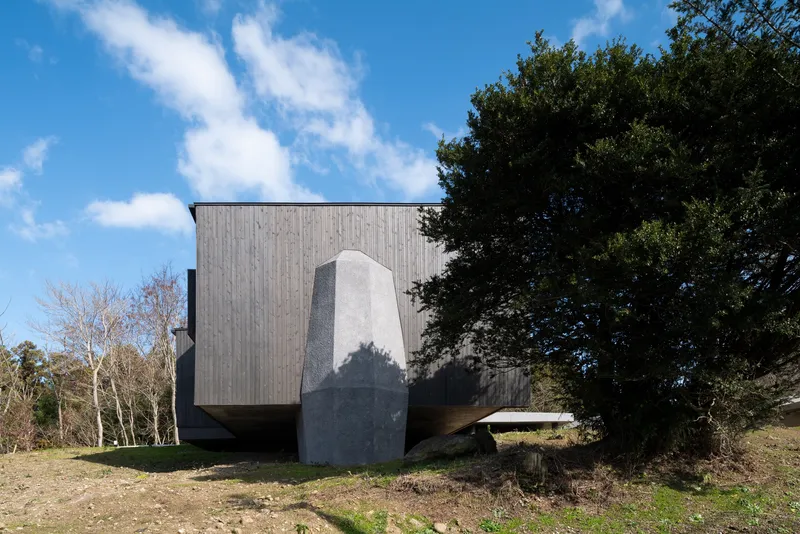
The cantilevered timber-clad volume is the most photographically dramatic of the three, and it earns the attention. Clad in dark wood and lifted off the sloped terrain on concrete fins, it hovers above the grassland with a terrace thrust outward into open air. The cantilever is not decorative; the site drops away beneath the building, and the structural gesture makes the slope legible from inside. You are aware, sitting at the dining table or standing at the horizontal window band, that the ground is falling away beneath your feet.
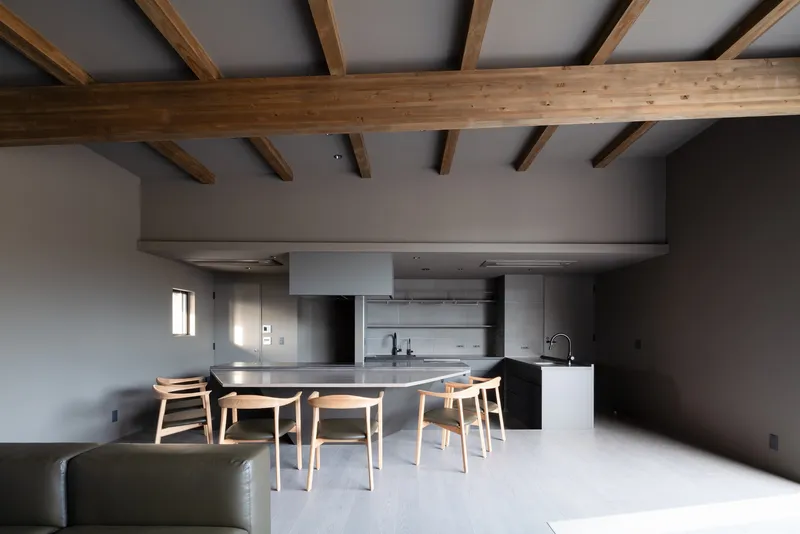
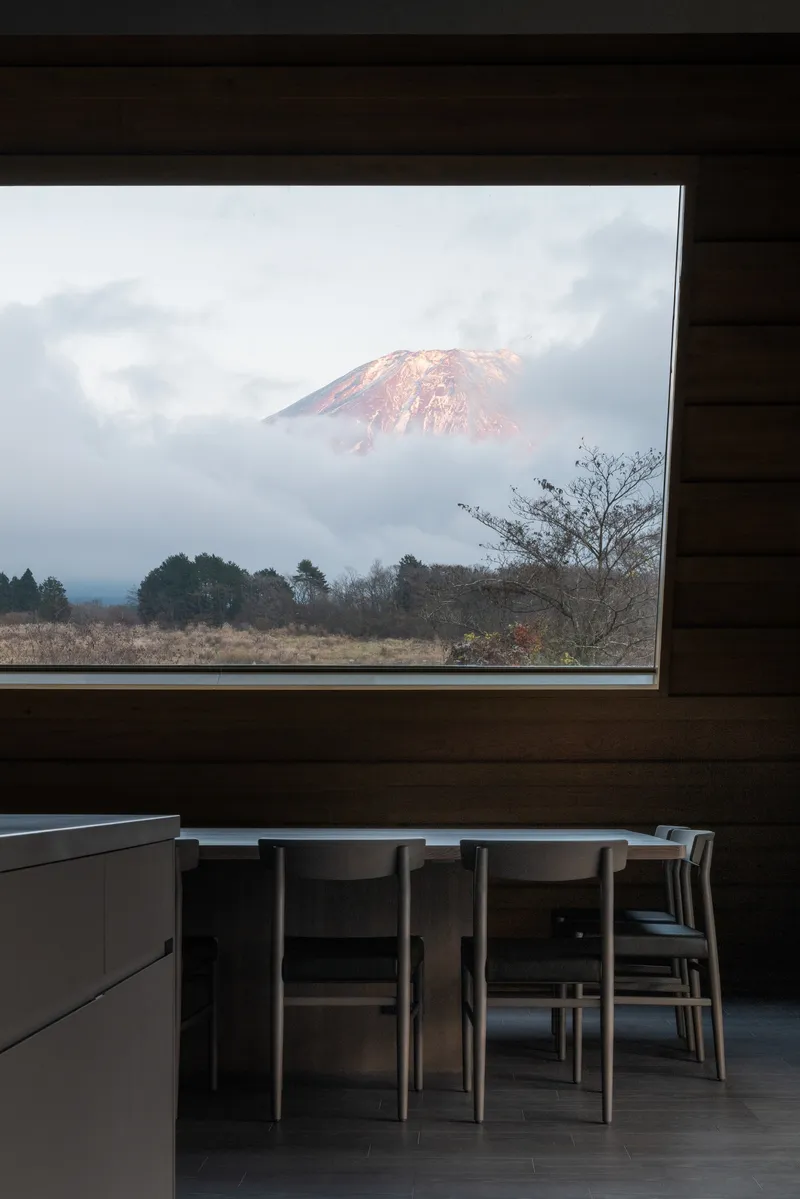
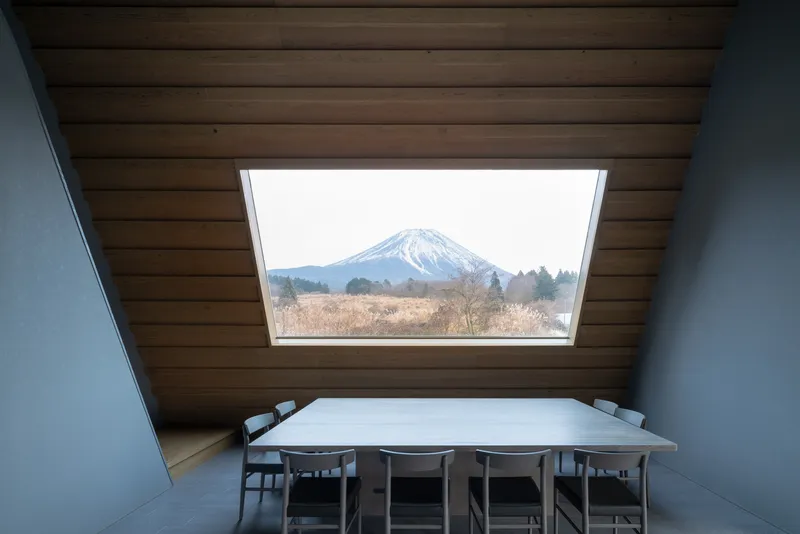
Inside, the palette shifts to exposed timber ceiling beams and grey plaster walls, kept deliberately restrained so the framed view of Fuji through the horizontal window does the heavy lifting. The kitchen and dining area are open-plan, with the beams running the length of the space to reinforce the directionality toward the mountain. It is a building that wants to feel suspended, and the interiors confirm it: no heavy furnishings, no dark corners, just a taut horizontal plane aimed at the peak.
The Enveloping Villa
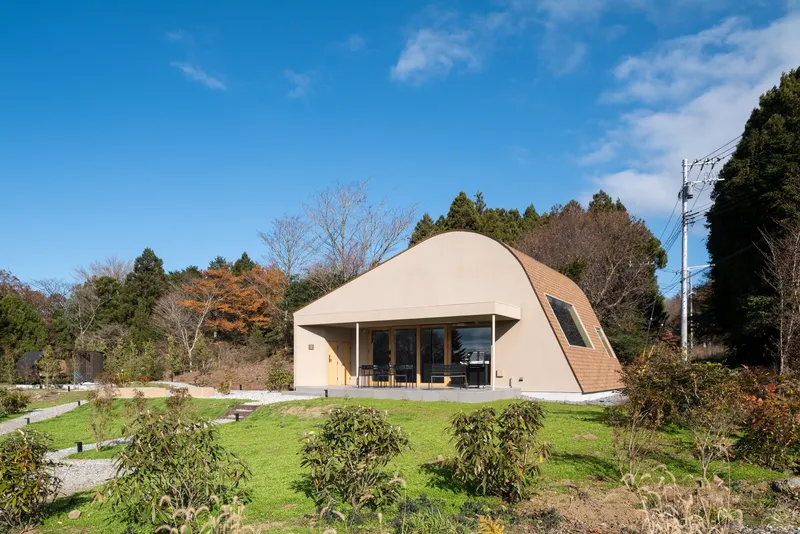
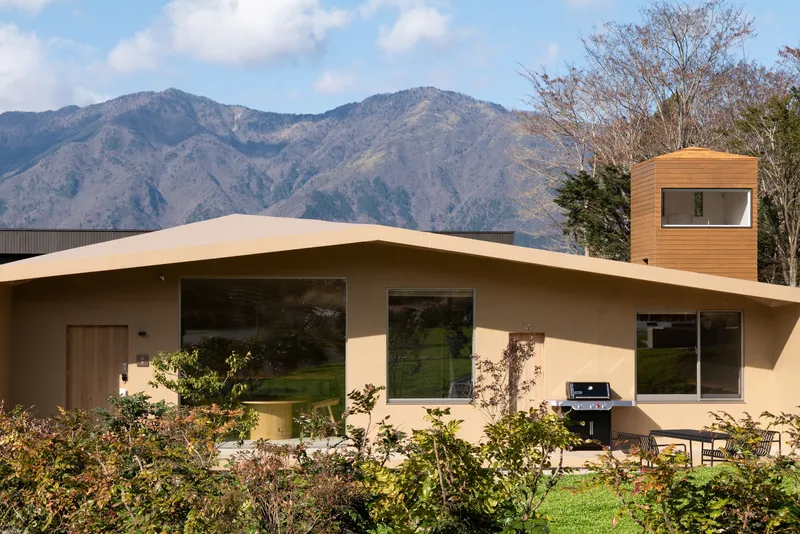
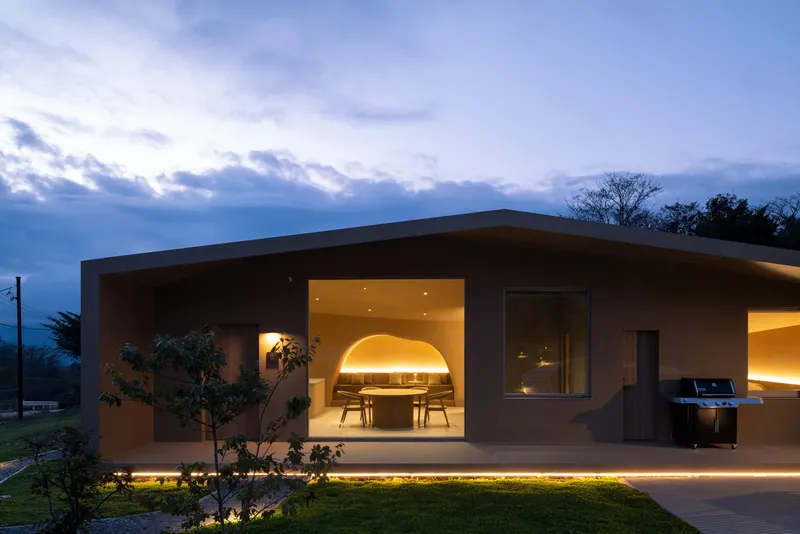
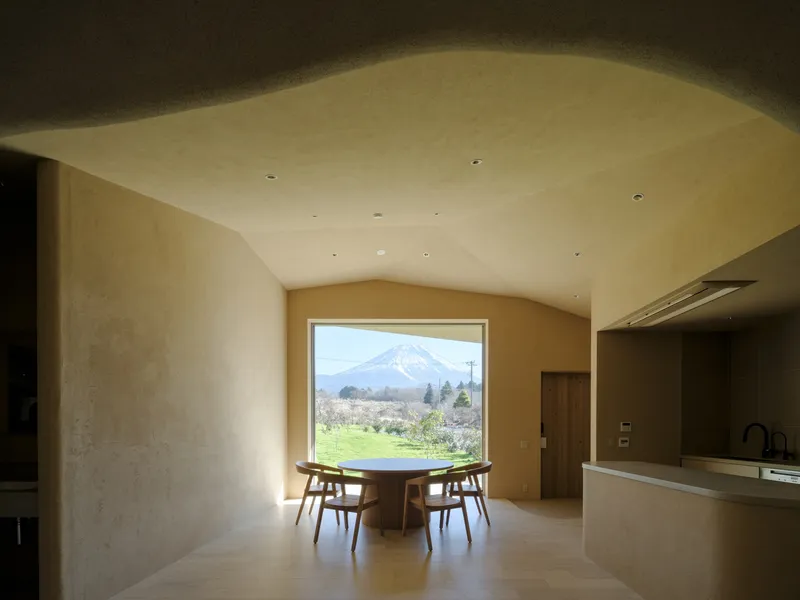
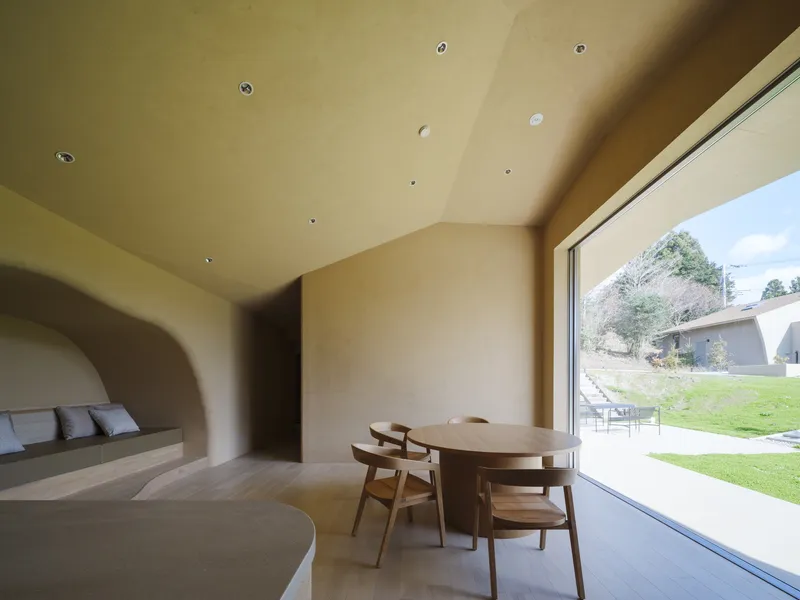
The curving pale roof structure is the largest and most formally expressive of the three villas. Its undulating roofline, rendered in galvalume steel over a wooden frame, creates a shell that wraps around the living spaces below without ever quite settling into a single geometry. At dusk, the roof overhang frames the illuminated arched interiors like a proscenium, compressing the boundary between architecture and landscape into a single threshold of warm light and cool air.
Inside, the curved plaster ceilings generate a series of vaulted rooms that feel almost ecclesiastical in their proportions but domestic in their details. The dining area sits beneath a rectangular skylight that frames Fuji's snow cap directly overhead, turning the mountain into a ceiling painting. Picture windows at the room's edge provide the horizontal counterpoint. The vaulted plywood ceiling in the living space, the arched alcoves for seating, and the concealed linear lighting above the platform bed all contribute to a sense of total enclosure: a space where the architecture curls around you, protecting you from the plateau's openness while still channeling its most important view.
The Cave
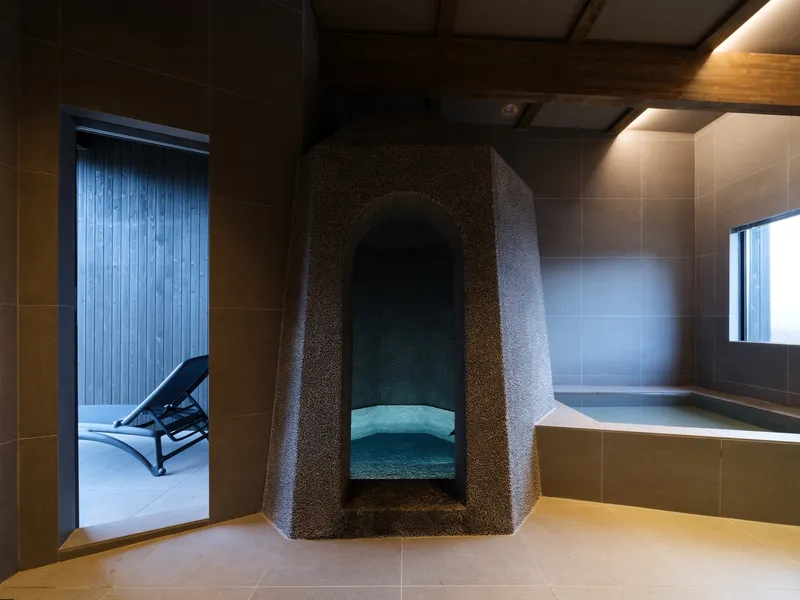
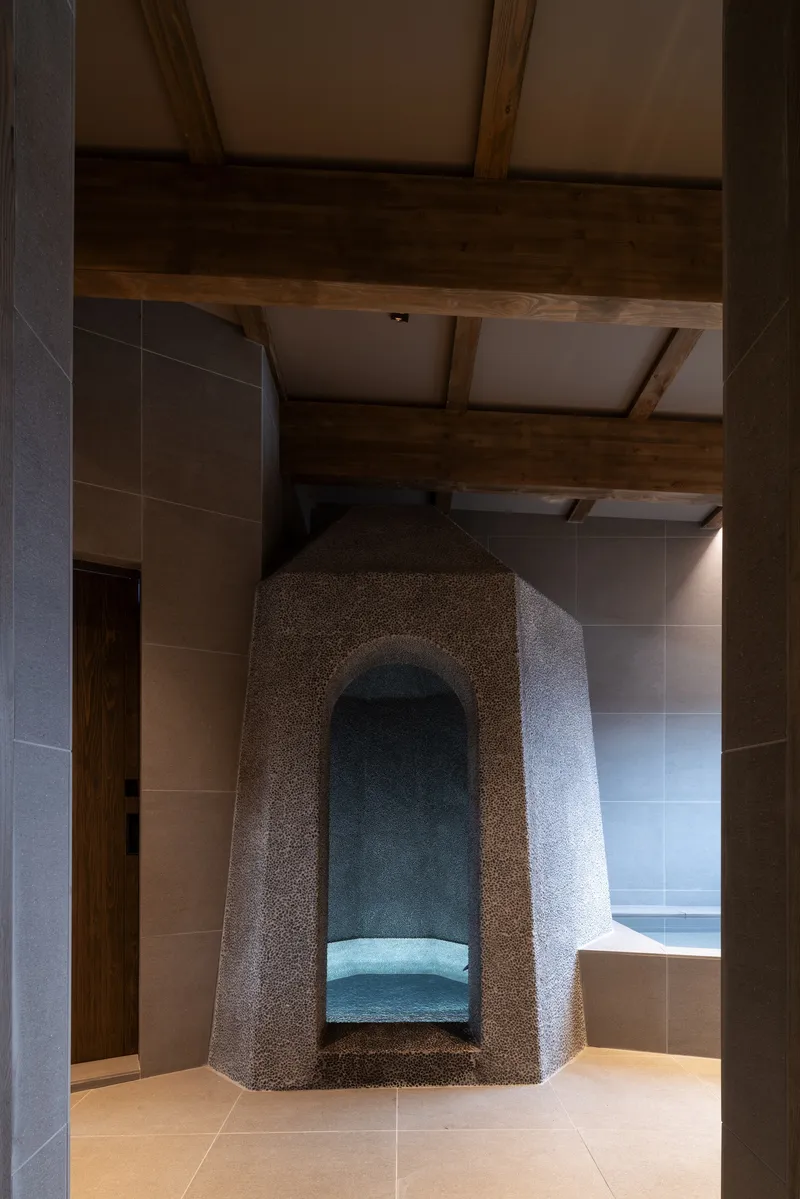
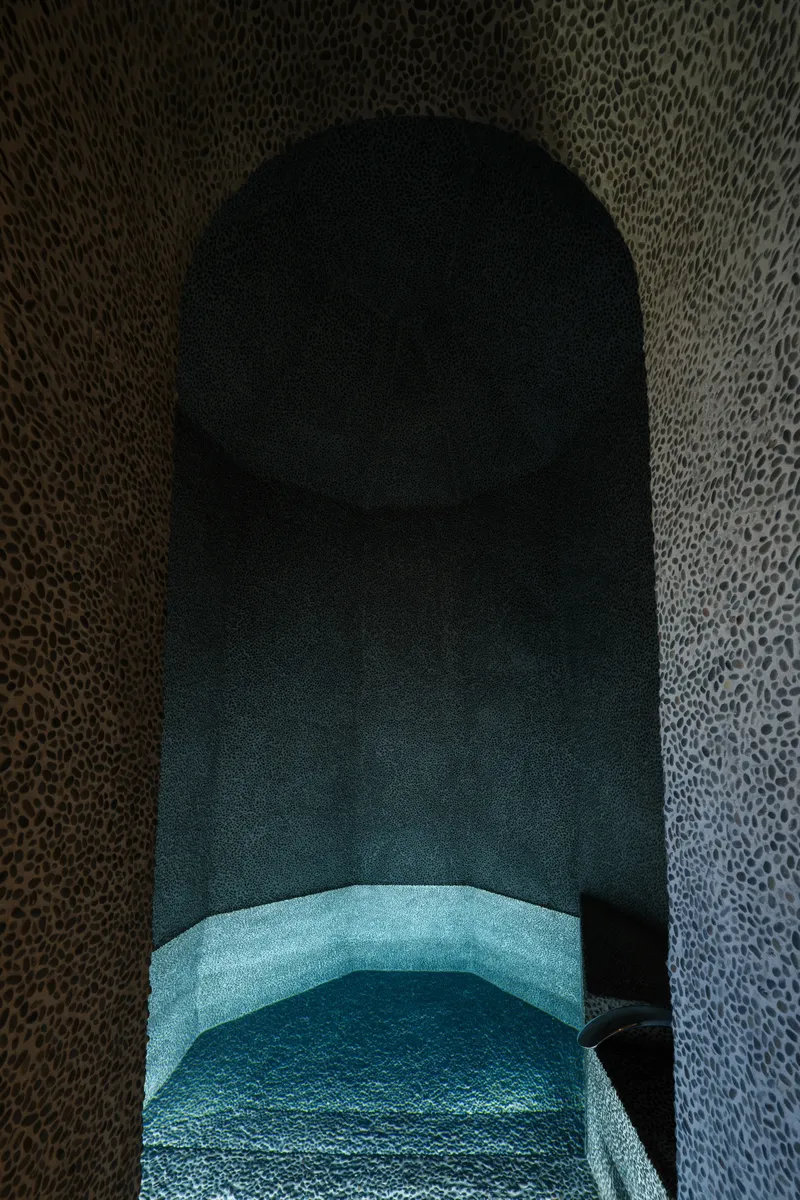
The reinforced concrete villa is the project's most primal gesture. Its polyhedral roof and rock-surface materiality evoke geological formation rather than architectural composition, and the interiors push this further: a textured stone alcove houses an integrated bench beside a soaking tub, the curved turquoise seat inside a vaulted niche reads like a carved grotto, and timber-framed ceiling beams provide the only visual warmth in an otherwise mineral palette. The space is designed for meditation, and the program confirms it: indoor sauna, cold bath, outdoor bathing terrace, and BBQ terrace, all calibrated for slow recovery.
Where the floating villa directs your gaze outward and the enveloping villa wraps you in a protective shell, the cave pulls your attention inward and downward. It is the most introverted of the three, and the contrast is essential. Without it, the compound would risk becoming a one-note celebration of the view. The cave insists that landscape experience is also about weight, darkness, and the feel of stone under your hand.
Living with the Mountain
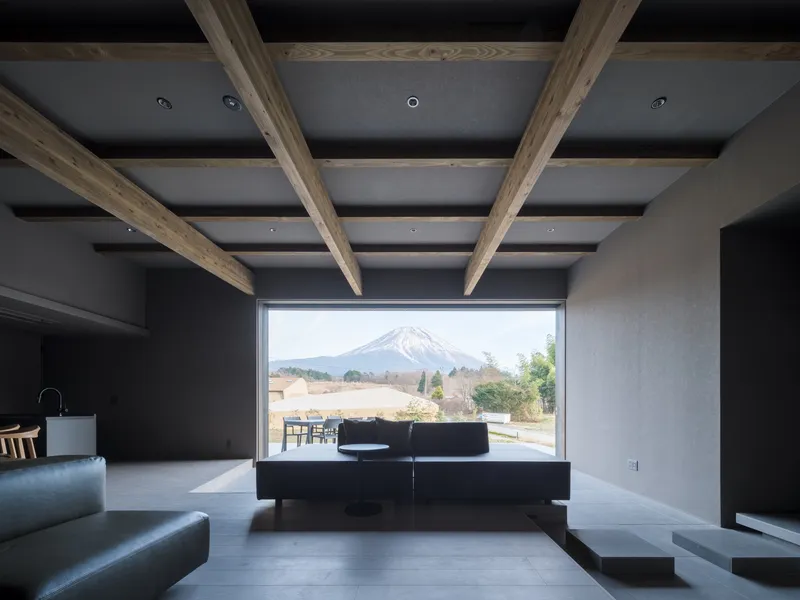
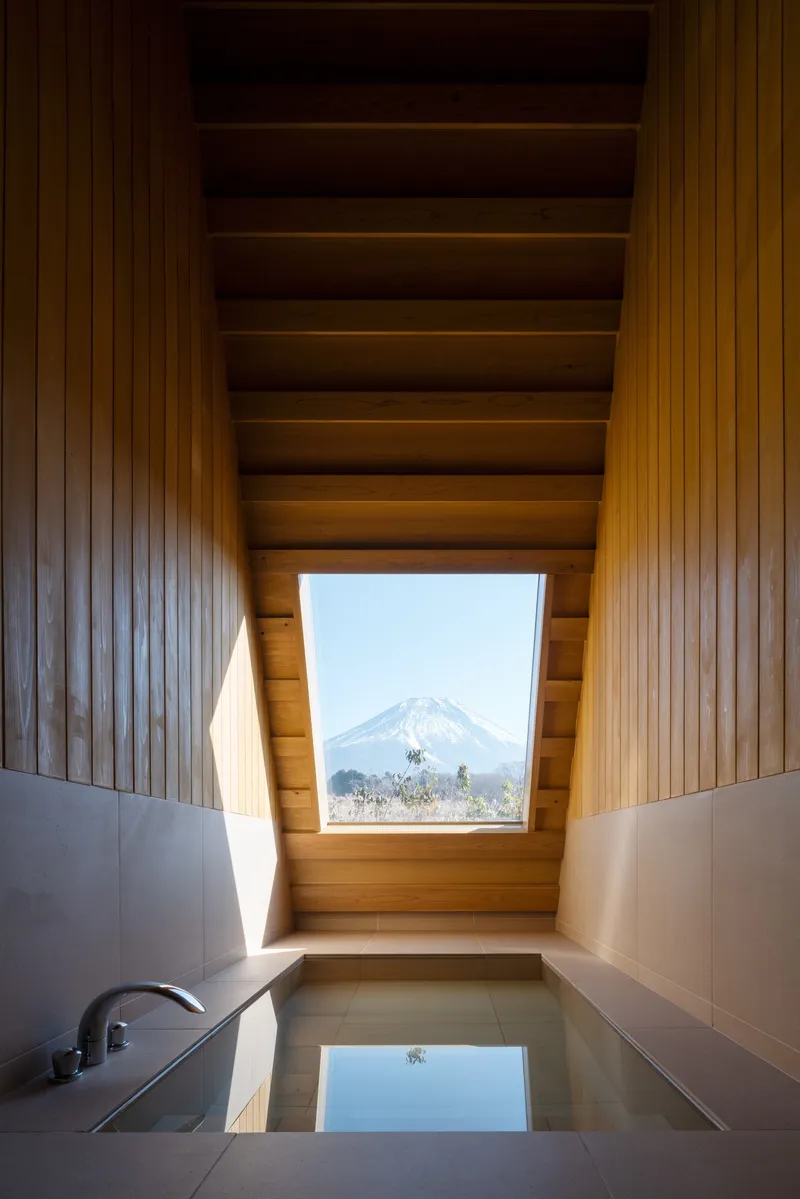
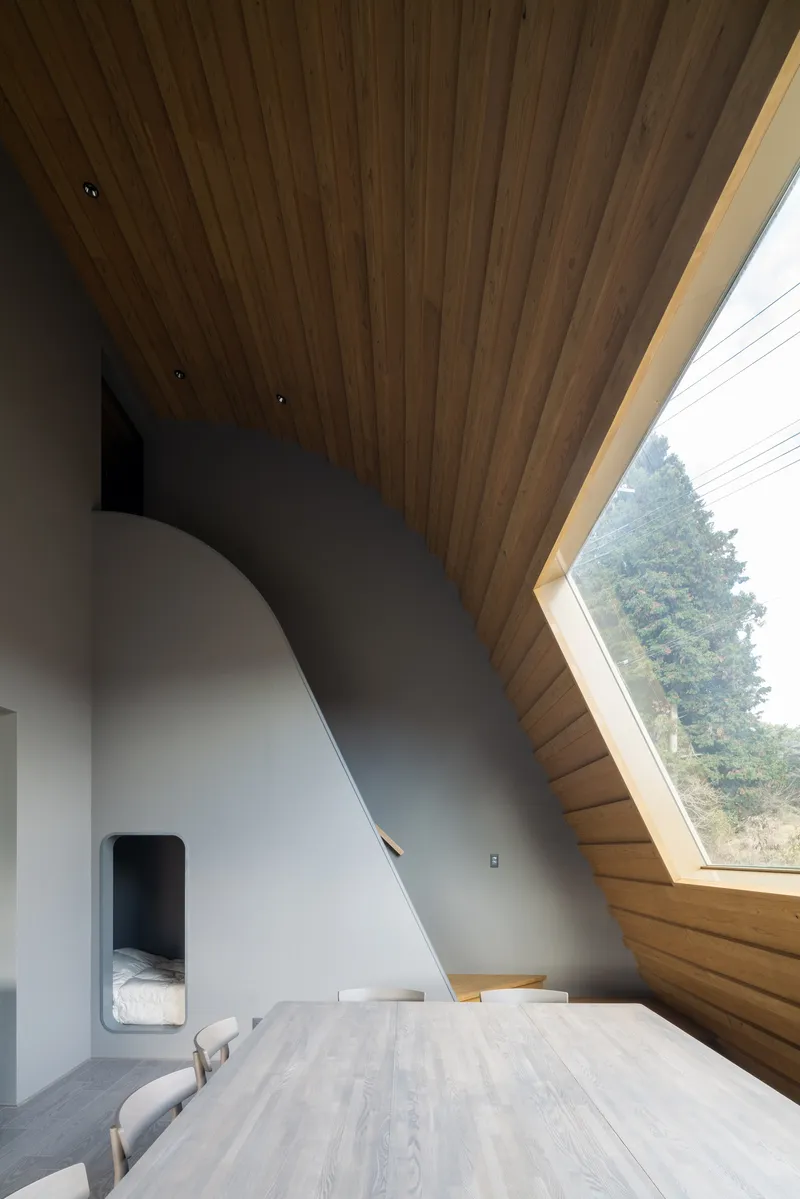
Every significant room in the compound has been calibrated to frame Mount Fuji through a different aperture. In the bedroom, an angled window slices through a sloped timber ceiling to reveal forest and the peak beyond. In the sunken soaking tub, a timber-lined ceiling and angled skylight create a narrow vertical slot aimed directly at the snow cap. In the living room, exposed beams and a long horizontal window flatten the mountain into a panoramic strip. The variety is the point: Fuji is never presented the same way twice.
This kind of obsessive view-framing can feel manipulative in lesser projects, reducing a landscape to a picture on a wall. Here it works because the buildings themselves are so different in character that the repeated subject, the same volcano seen from the same plateau, genuinely registers differently each time. The mountain seen from a floating timber cantilever is not the same mountain seen from a stone grotto. The architecture changes the seeing.
Thresholds and Outdoor Rooms
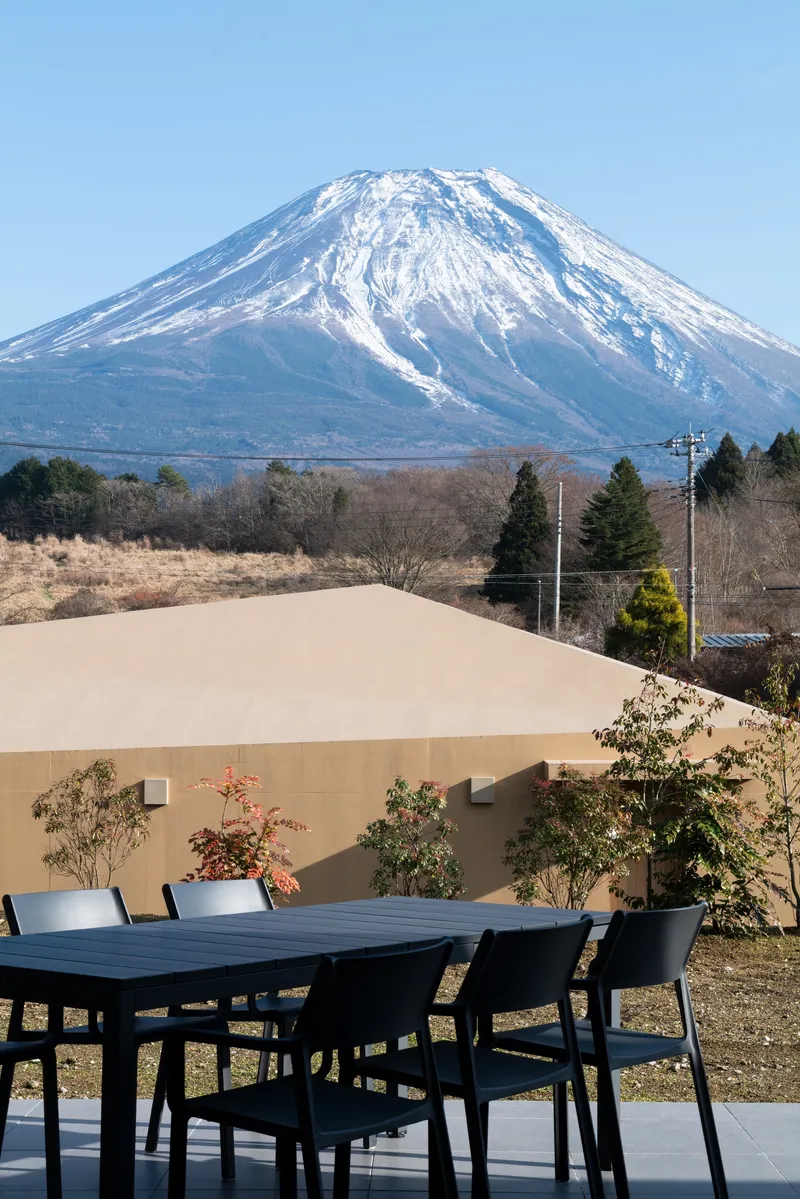
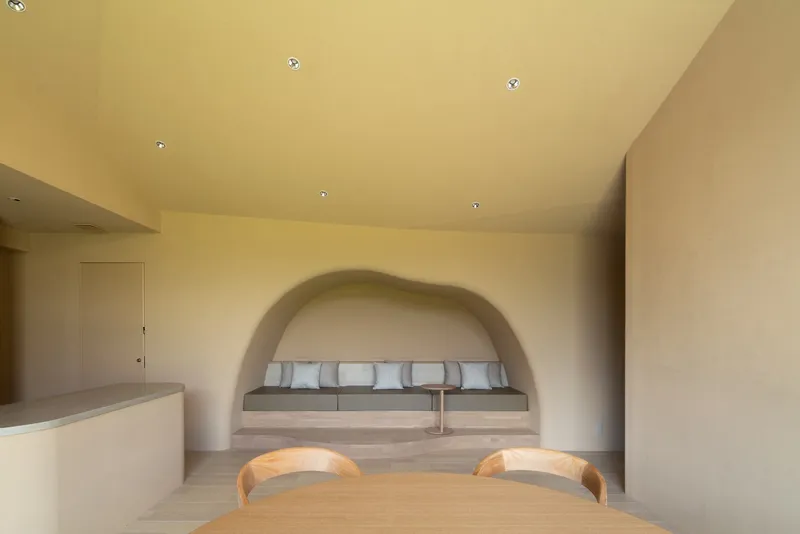
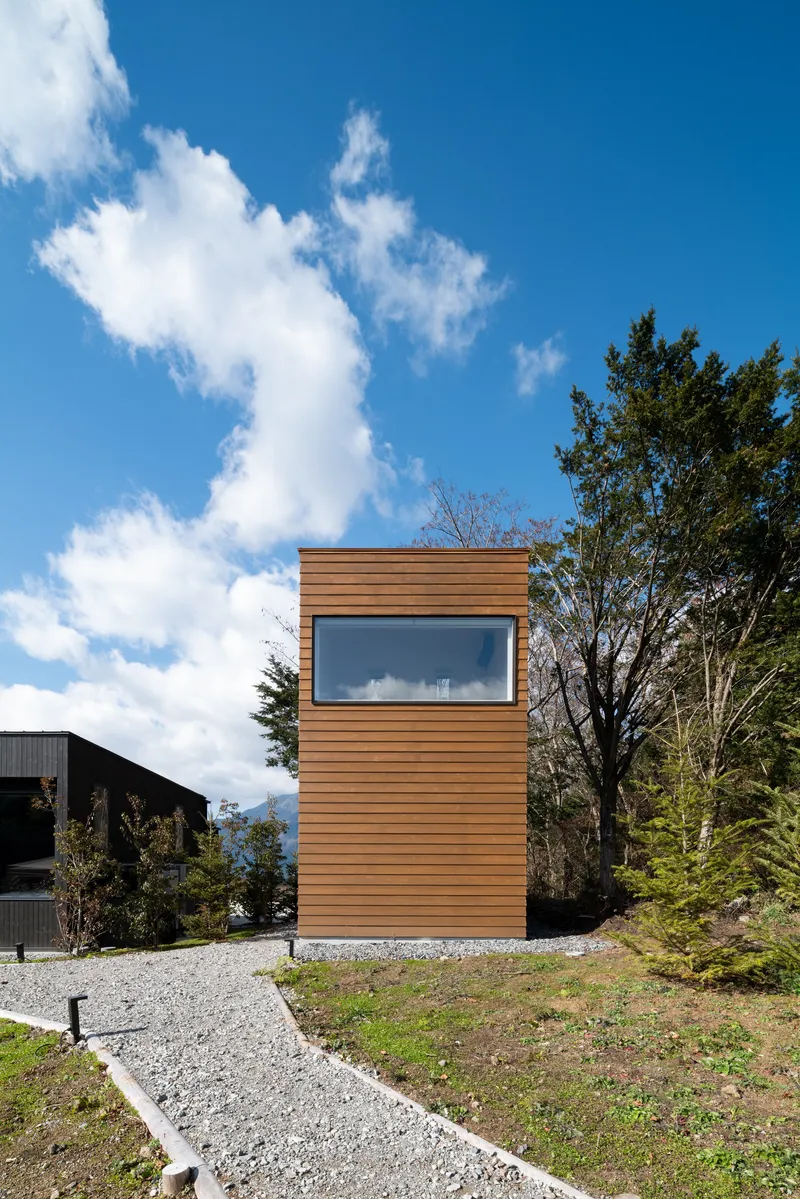
The outdoor dining terrace, where a stucco privacy wall frames Fuji's snow cap beyond, is one of the compound's most effective spaces precisely because it is so simple. A wall, a table, a view. The arched alcove behind it, with its built-in bench and plastered surfaces, blurs the line between interior and exterior, sheltered but open. The cedar-clad tower, standing alone on its gravel base with a horizontal window band, functions as a vertical punctuation mark in a predominantly horizontal landscape, housing the guest bedrooms while serving as a landmark within the compound's internal geography.
Kubo Tsushima's landscape strategy treats the spaces between buildings as programmatically loaded. The bonfire area, the gravel paths, the planted beds: these are not leftover space but choreographed transitions. In a project that could have been a single large villa with a great view, the decision to fragment the program turns every walk across the lawn into a sensory shift, from warm to cool, from enclosed to exposed, from stone to wood.
Arched Interiors and Material Warmth
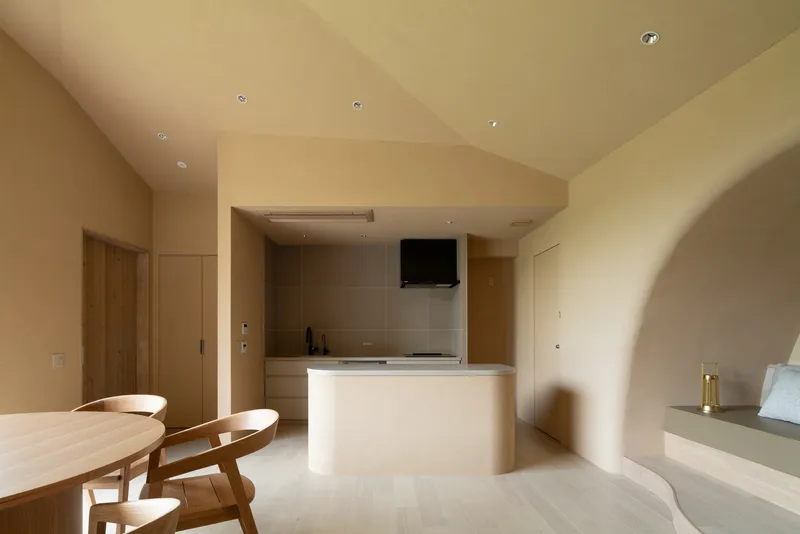
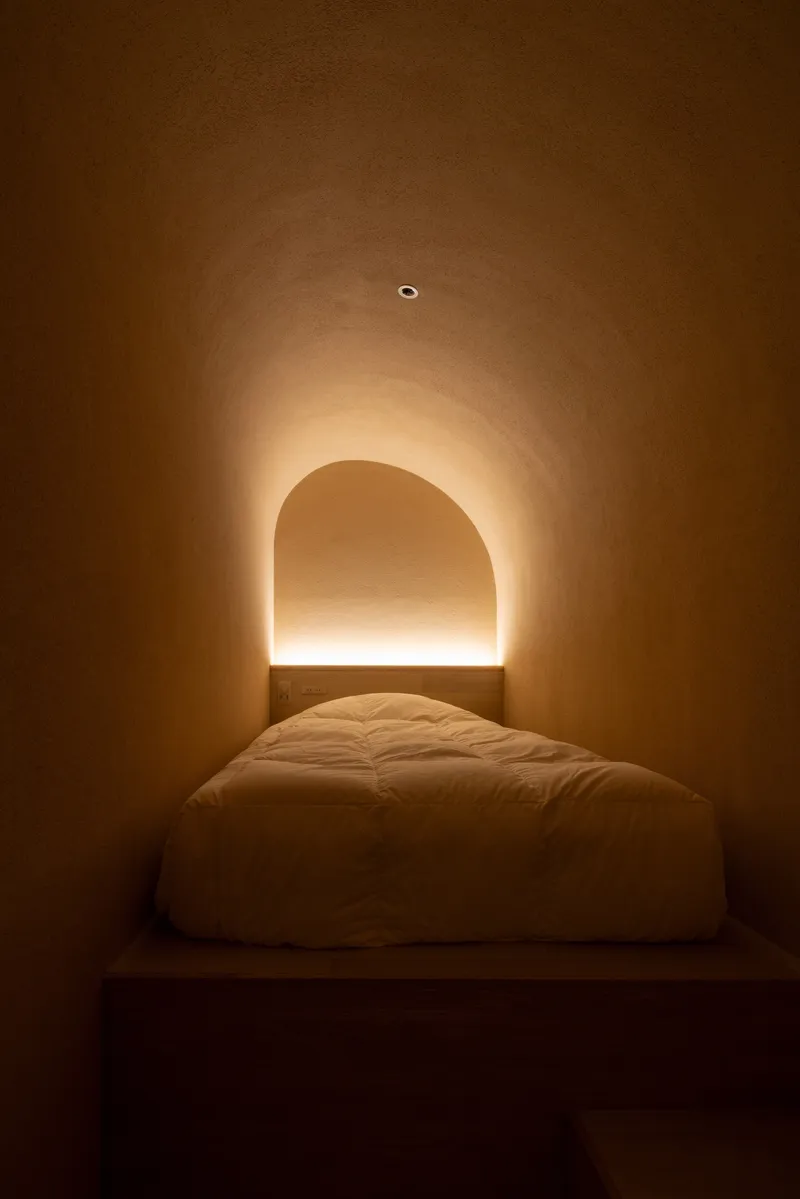
The interior language across the enveloping villa leans heavily on arched openings, vaulted ceilings, and concealed lighting that washes plaster surfaces with a soft glow. The arched niche in the bedroom, with its platform bed and linear light strip, turns a sleeping alcove into something closer to a chapel apse. The kitchen counter, glimpsed through an arched opening from the dining area, sits within a pale timber surround that softens the transition between rooms. These are spaces designed for rest, not stimulation, and the material palette, limited to plywood, plaster, and warm-toned stone, keeps the sensory register deliberately low.
Plans and Drawings
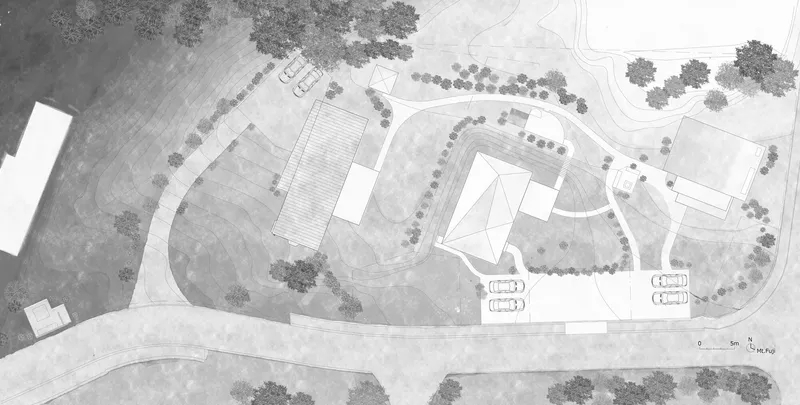
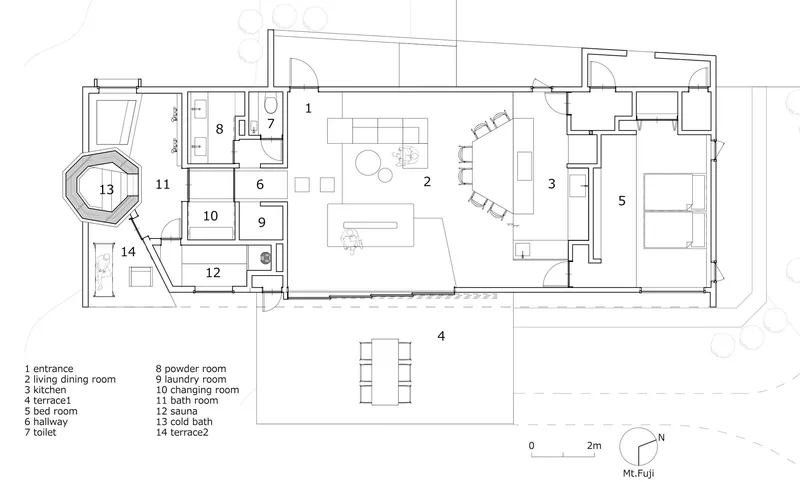
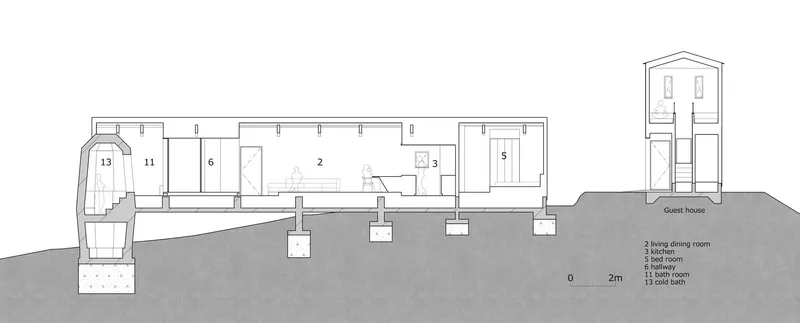
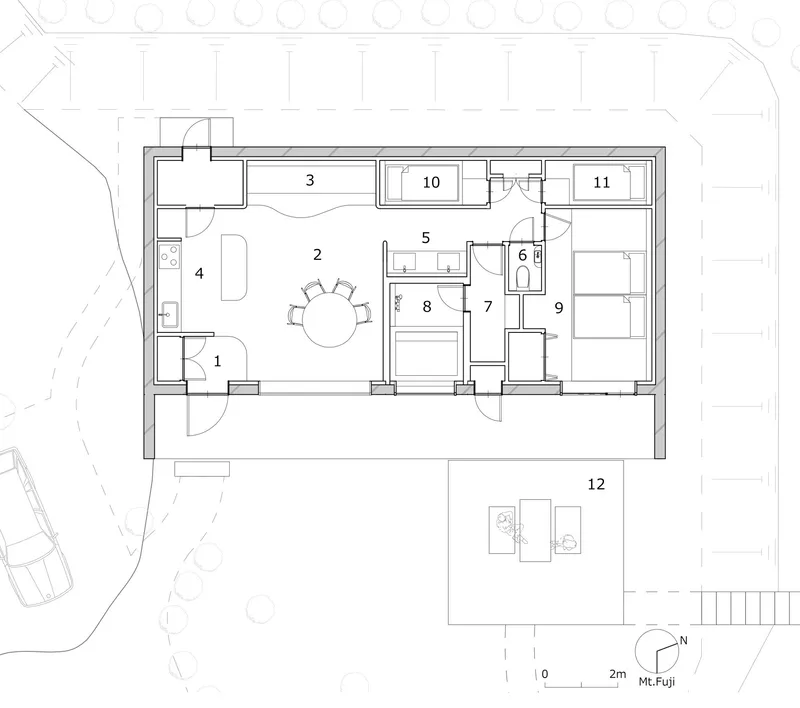
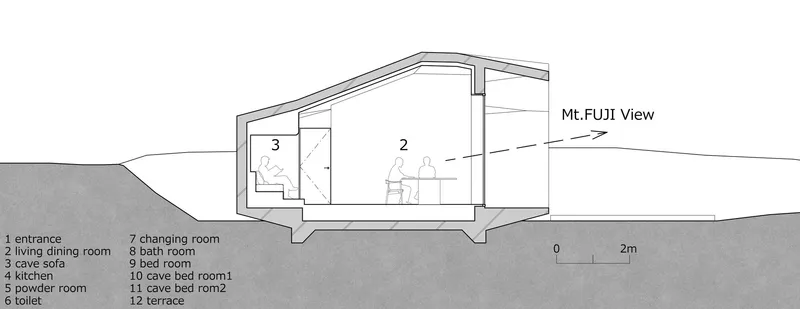
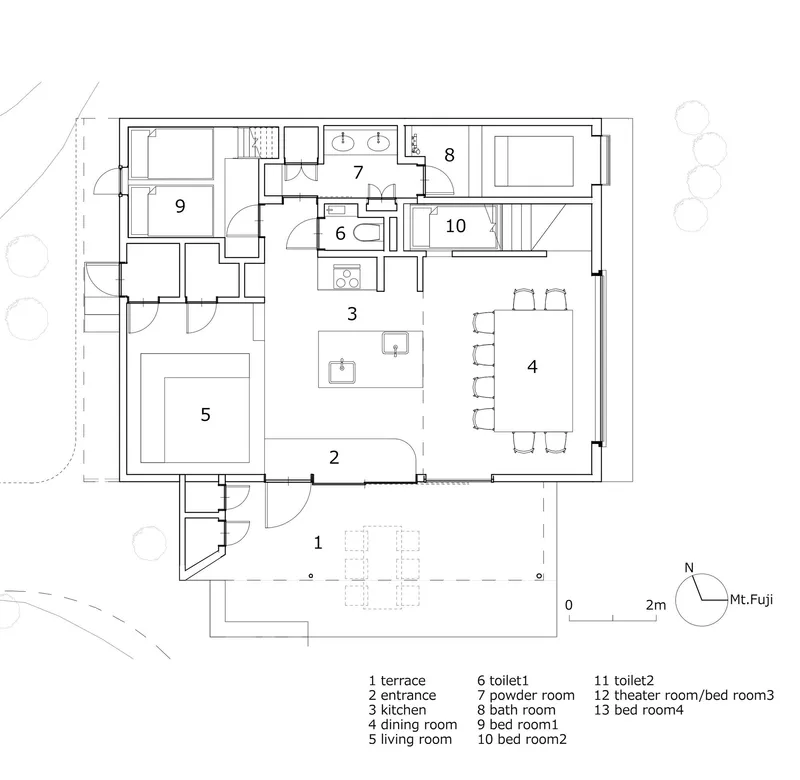
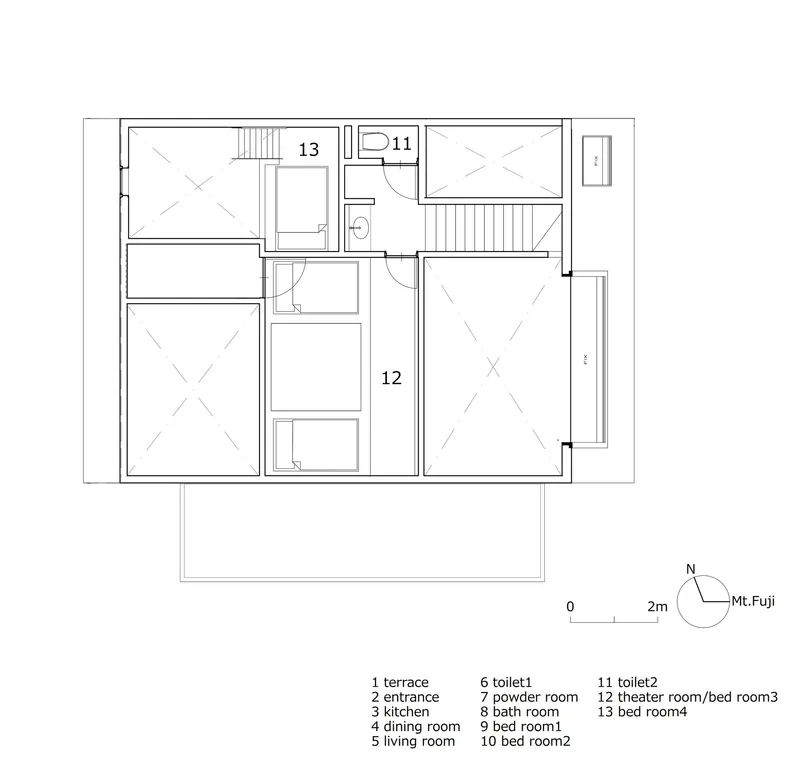
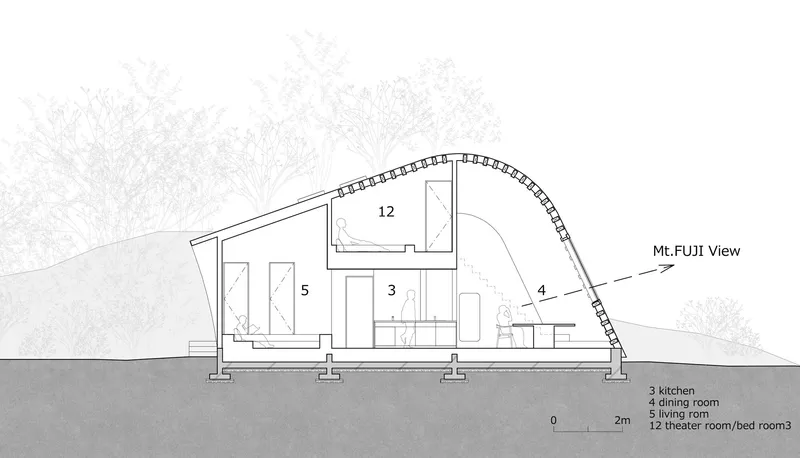
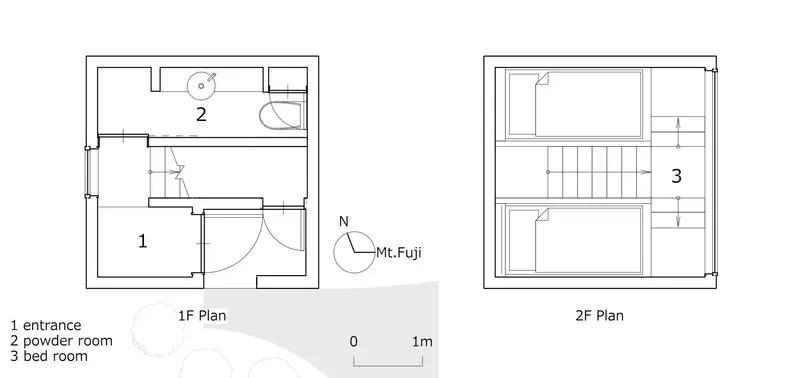
The site plan reveals the compound's organizational logic most clearly: three main buildings and shared facilities are dotted along a curved access road that traces the natural contour of the plateau. The long east-west axis is visible in every floor plan, with living spaces consistently oriented toward the mountain. The section drawings are particularly instructive: the sloped site allows the floating villa to cantilever dramatically while the cave villa's reinforced concrete mass digs into the terrain. The main villa's curved roof, seen in section, spans over the living and dining spaces with a generous clear height that the photographs suggest but only the drawing confirms. The guest house floor plans show a compact two-level arrangement with bedrooms above and entrance below, efficient and self-contained.
Why This Project Matters
THE THIRD PLACE Mt.Fuji matters because it takes a familiar brief, a luxury retreat with a famous view, and refuses the obvious solution. Instead of building one large house and aiming every window at the volcano, Kubo Tsushima Architects split the program into three structurally and materially distinct buildings, each proposing a different relationship to the same landscape. Floating, sinking, and enveloping are not marketing labels but genuine spatial strategies, legible in the construction systems (wood cantilever, reinforced concrete mass, curved shell) and in the bodily experience of moving between them. The compound makes the case that architecture's job is not just to frame a view but to shape the terms under which that view is received.
There is also something worth noting about the dual-use model: a private retreat that converts into an eighteen-guest vacation rental when the owner is absent. This kind of operational flexibility is becoming increasingly common in Japan's resort regions, where construction costs are high and seasonal occupancy is low. Kubo Tsushima's decision to give each villa its own architectural identity makes the compound more viable as a rental proposition, since guests can choose between radically different spatial experiences on the same site. The architecture does the work of brand differentiation, which is smarter than it sounds. When the building itself is the experience, you don't need much else.
THE THIRD PLACE Mt.Fuji by Kubo Tsushima Architects, Fujikawaguchiko, Japan. 374 m², completed 2025. Photography by Masao Nishikawa.
About the Studio
Share Your Own Work on uni.xyz
If projects like this are the kind of work you want to make, uni.xyz is a place to publish your own, find collaborators, and enter design competitions.


Popular Articles
Popular articles from the community


Architekt Andreas Gruber Scatters 23 Dark Timber Chalets Across a South Tyrolean Forest Edge
In Molini di Tures, Amonti Chalets breaks a resort into a hamlet of gabled timber houses, with parking, storage and services pushed into the slope.

Juan García Correa, John González and Claudia Rueda Sink a Circular Amphitheater into a Manizales Engineering Building
On the La Nubia campus in Manizales, Colombia, the S1 Building folds labs and offices into a hillside of ramped lawns that double as a campus route.

Cube Design Draws an Ecological Corridor Between Two Shenzhen Hills with the Nankai Building
Beside Shenzhen's container docks, the Nankai Building pairs stacked balconies with a climbing green screen to connect two hillsides across its height.

Jaramillo Van Sluys Arquitectura and Urbanismo Turn a Demolished Registry Lot in Quito into an Orchard Plaza
In Quito's Centro Histórico, a 2,800 m² plaza exposes the San Agustín convent wall and redraws its lost Augustinian orchard in volcanic stone.

Similar Reads
You might also enjoy these articles


LAVA Architecten Gives Vocational Education a Sawtooth-Roofed Face on a Mechelen School Campus
In Mechelen, Belgium, a 2,053 m² STEM school on a 6×6 m grid turns workshops and classrooms into rooms that can be rearranged as teaching changes.

KEMA Studio Turns a Derelict Marvila Attic into a 60 m² Lighthouse Apartment Above Lisbon
In Lisbon's Marvila district, a rebuilt roof, four skylights and two plywood volumes turn an unlivable attic into a bright home facing the Tagus.

Pixel Gardens: One Repeated Module Stacked Into a Terraced Social Housing Tower for Famagusta
Salem Bader's shortlisted housing tower builds a vertical neighbourhood from one repeated module, offsetting units to carve terraces, light and air.

Bao Huynh Watercolor Atelier: A Serene Art Retreat in Hội An
Bao Huynh Watercolor Atelier in Hội An blends multifunctional art spaces, sustainable design, local materials, and family-friendly living in a serene environment.

Explore Residential Building Competitions
Discover active competitions in this discipline

Challenge to design public laboratory

Challenge to design mud housing for contemporary communities
Comments (0)
Please login or sign up to add comments
No comments yet. Be the first to comment!