

Xushi Design Carves a Coffee Sanctuary from Raw Concrete Beneath a Chinese High-Rise Podium
KUDDO Coffee in China transforms an underused concrete undercroft into a moody, duct-canopied café that celebrates material honesty.


There is a familiar urban condition in Chinese cities where the podium levels of residential towers become afterthoughts: poured in concrete, left raw, and eventually colonized by small commercial tenants who tile over everything. KUDDO Coffee, designed by Xushi Design, refuses that trajectory. Instead of concealing the heavy concrete skeleton of its host structure, the project leans into it, treating exposed columns, board-formed walls, and weathered masonry as the interior's primary materials. The result is a café that feels excavated rather than built.
What makes the project genuinely interesting is its refusal to resolve the tension between industrial roughness and hospitality comfort. Curved ductwork becomes sculptural canopy. Strip lighting is embedded directly into distressed concrete. Banquettes sit against walls that look like they survived a demolition. The atmosphere owes more to brutalist infrastructure than to any specialty coffee aesthetic, and it works precisely because Xushi Design committed fully to that register instead of hedging with polished accents.
An Undercroft Reclaimed
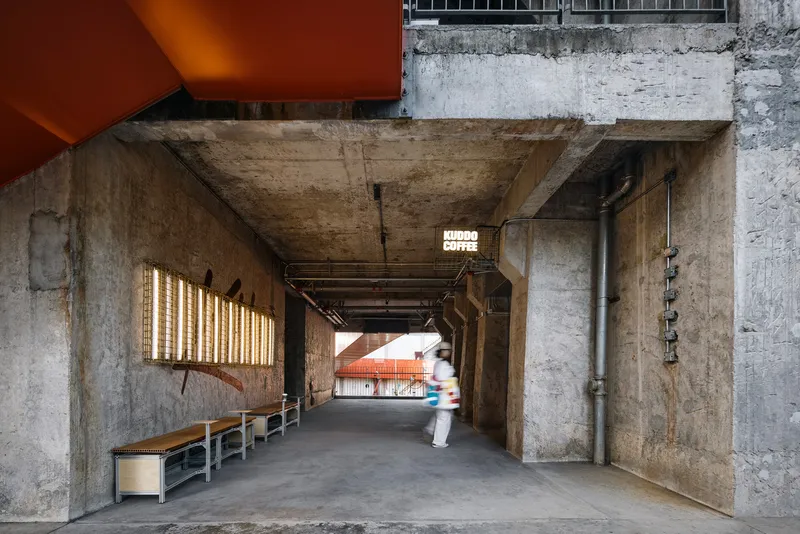
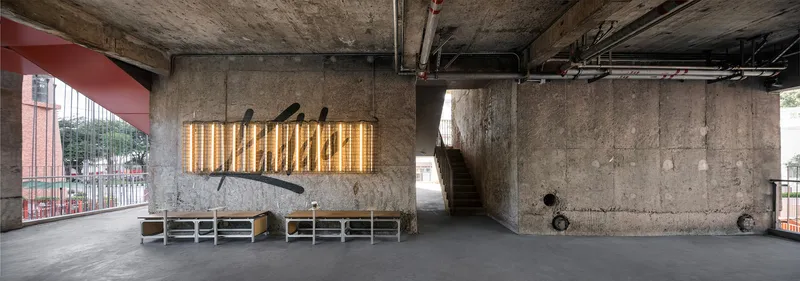
The café occupies the ground-level undercroft of what appears to be a mixed-use tower block. Wide structural columns march through the space at regular intervals, and an elevated slab presses down on the ceiling plane. Rather than fight these constraints, Xushi Design turned them into assets. A long timber-slat light installation runs along one passage, transforming the colonnade into a kind of lantern corridor. Benches line the wall beneath it, offering a sheltered outdoor zone that reads as both threshold and destination.
The proportions of the undercroft, low and wide, create a compression that heightens the sense of enclosure. When you step inside the café proper, the release into double-height volume feels earned rather than arbitrary.
Concrete Skin, Street Presence
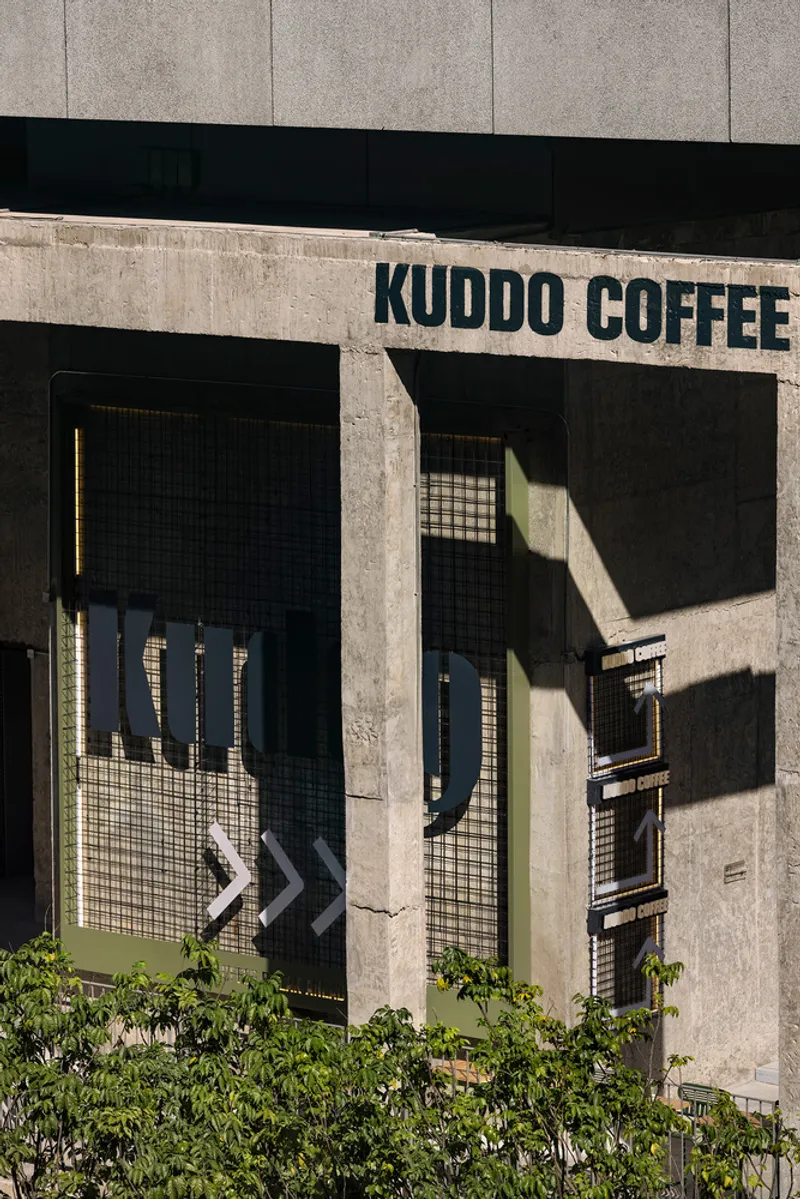
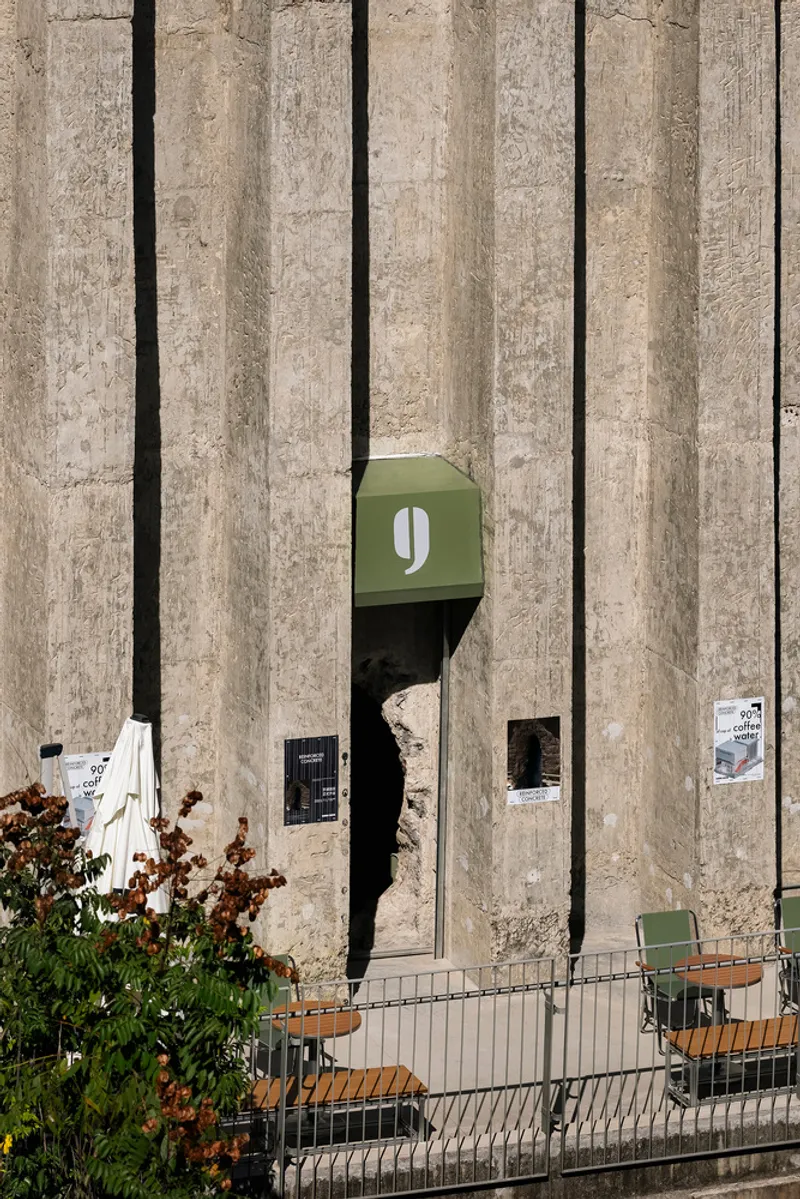
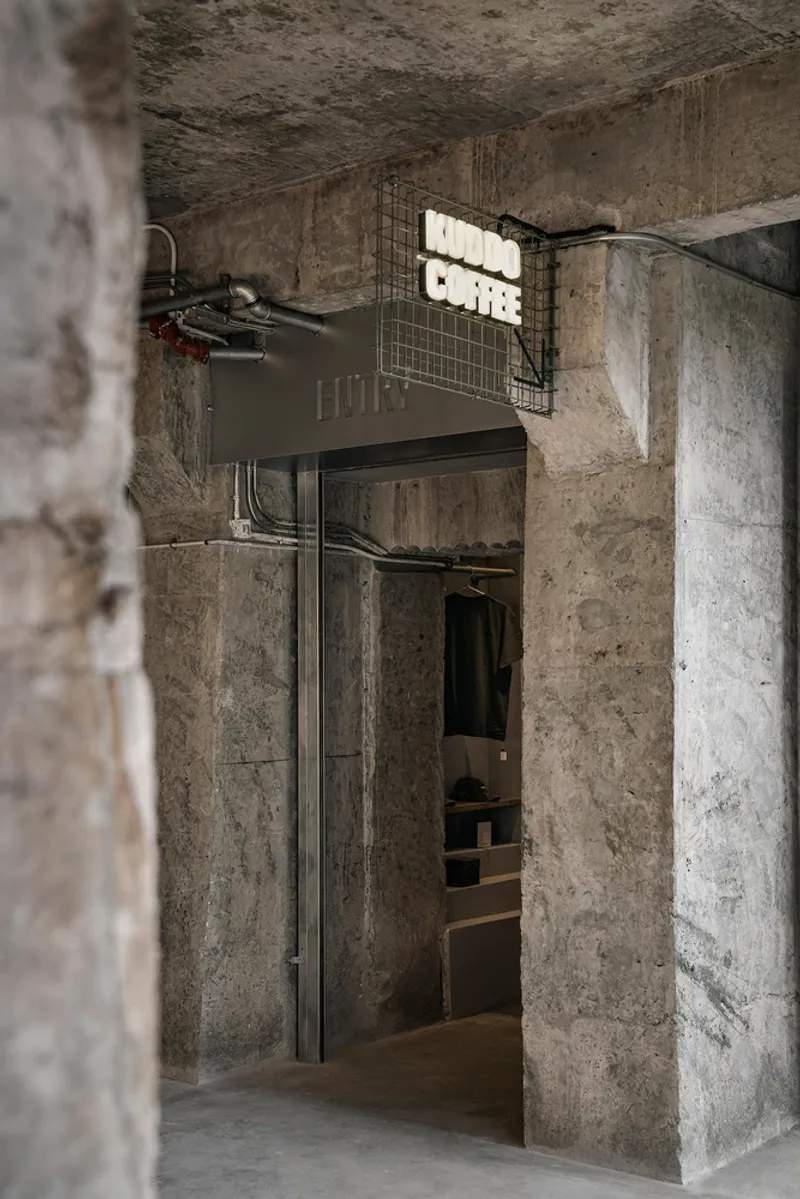
From the street, KUDDO Coffee announces itself through a façade of exposed concrete frames, vertical ribs, and mesh-screened openings. There is no conventional shopfront here, no plate glass curtain wall. Instead, the building reads as a fragment of infrastructure that happens to be inhabited. Low greenery at the base softens the encounter, and recessed openings beside outdoor seating create a series of apertures that hint at the interior without fully revealing it.
The doorway detail is worth noting: exposed conduit and illuminated signage sit within board-formed concrete walls as though the building's systems are proudly displayed rather than hidden. It is an honest gesture that sets expectations before you cross the threshold.
The Ductwork Canopy
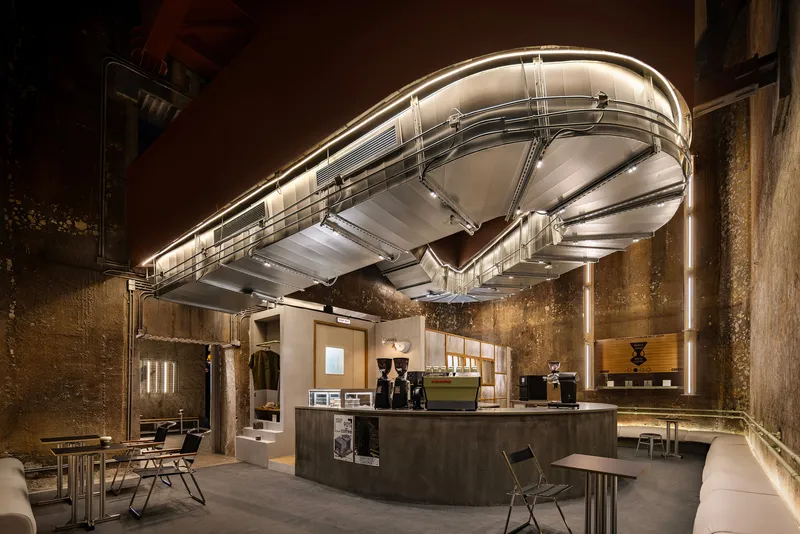
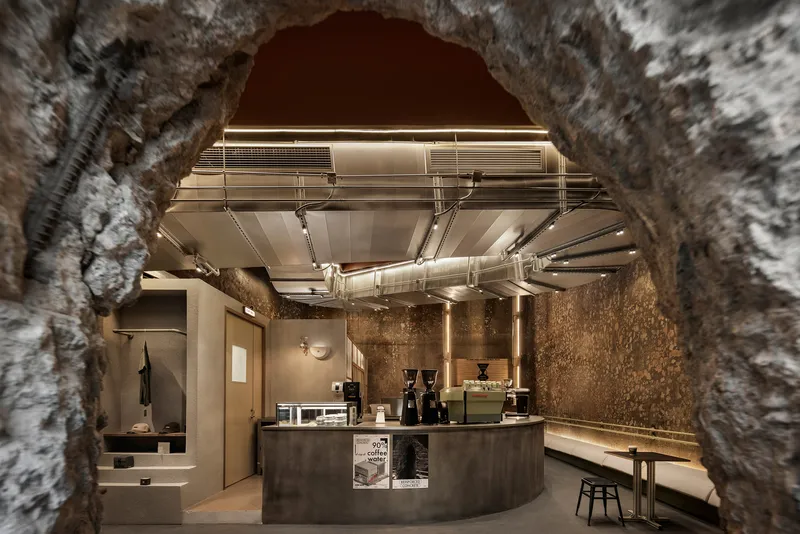
The centerpiece of the interior is a curved suspended ductwork assembly that drapes over the central counter like a metallic canopy. In most cafés, mechanical systems are either buried above a ceiling or left raw as a lazy aesthetic shortcut. Here, the ductwork is deliberately shaped, its curves contrasting with the angular masonry walls around it. At night, the warm lighting beneath the canopy turns the service counter into a glowing focal point visible through the masonry arches.
The textured masonry walls that frame these views are themselves carefully composed. Arched openings borrow a tectonic language that feels almost archaeological, as if the café were carved out of a much older structure. The layering of new mechanical forms against aged-looking surfaces gives the space a temporal ambiguity that is both deliberate and effective.
Seating and Atmosphere
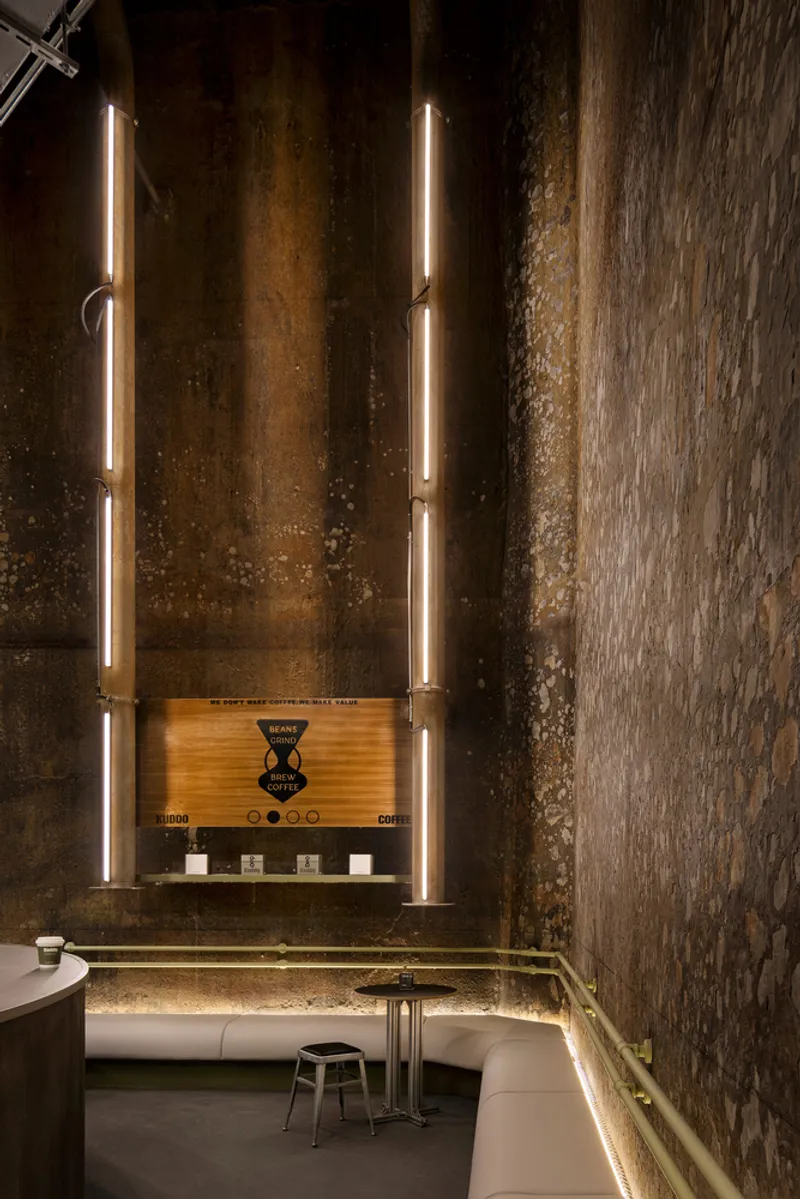
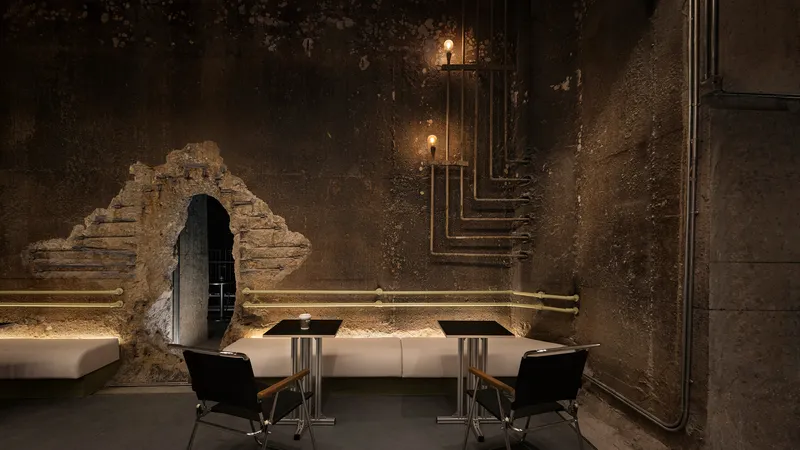
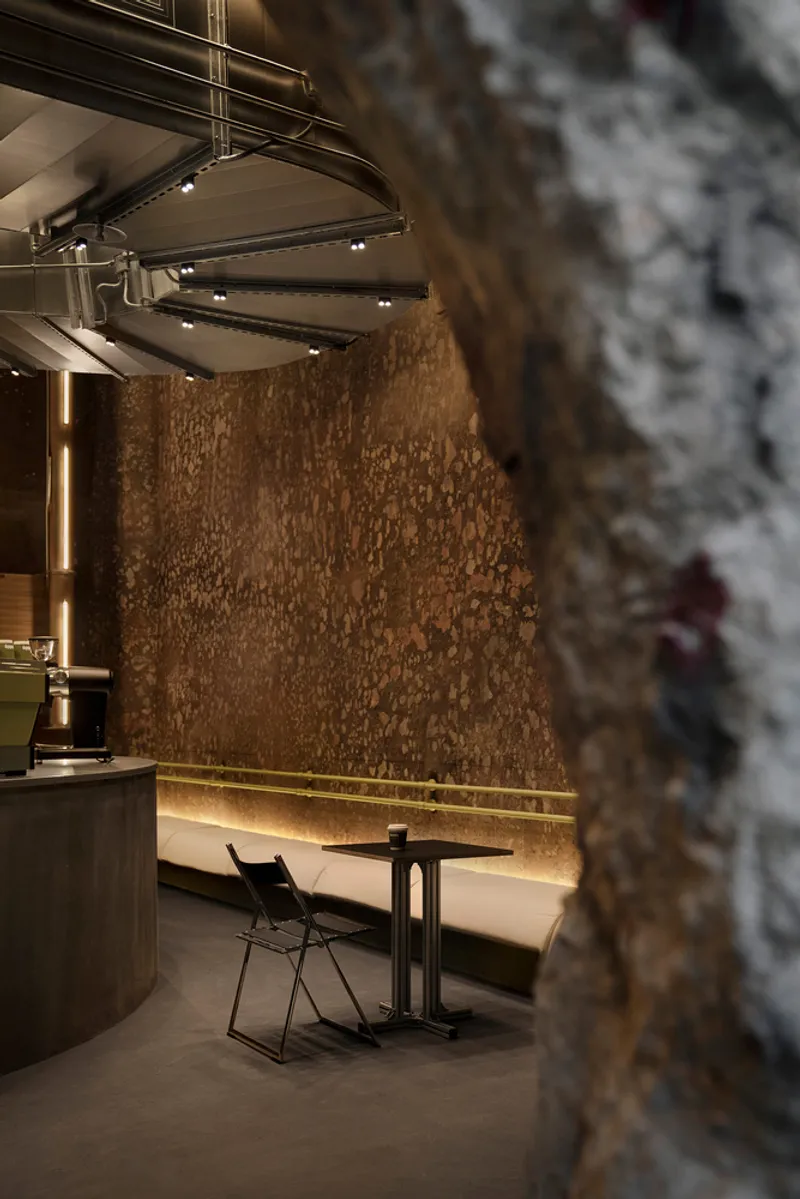
The seating strategy is organized around alcoves and edges rather than open floor area. Curved banquettes press against distressed concrete walls, with strip lighting tracing their contours. Vertical light channels flank a menu board in one nook, creating a focused, almost devotional quality. The palette remains consistent: raw concrete, exposed conduit, stainless steel accents, warm amber light.
A horizontal backlit bench seat against weathered masonry, with a stainless steel staircase rising above it, reveals the sectional complexity of the space. The café is not a single room but a sequence of interconnected volumes at different levels, each with its own character of light and enclosure. The effect is that a relatively compact footprint feels expansive because you are always discovering another pocket of space.
Vertical Volume
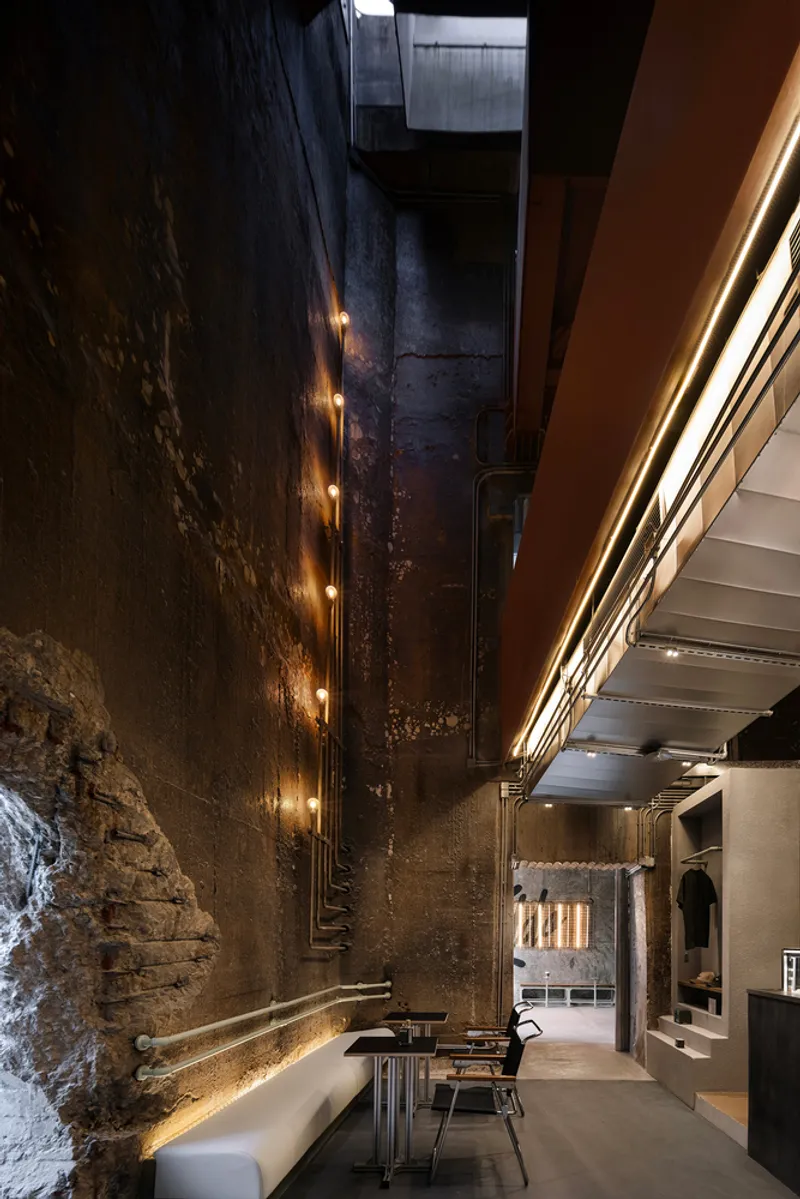
Looking upward from the interior reveals the double-height void that gives the café its vertical drama. Weathered concrete walls rise uninterrupted, punctuated only by small embedded lighting fixtures that dot the surface like constellations. The restraint here is notable: no murals, no applied texture, no color. The concrete itself, with its patina of age and formwork impressions, does all the work.
Plans and Drawings
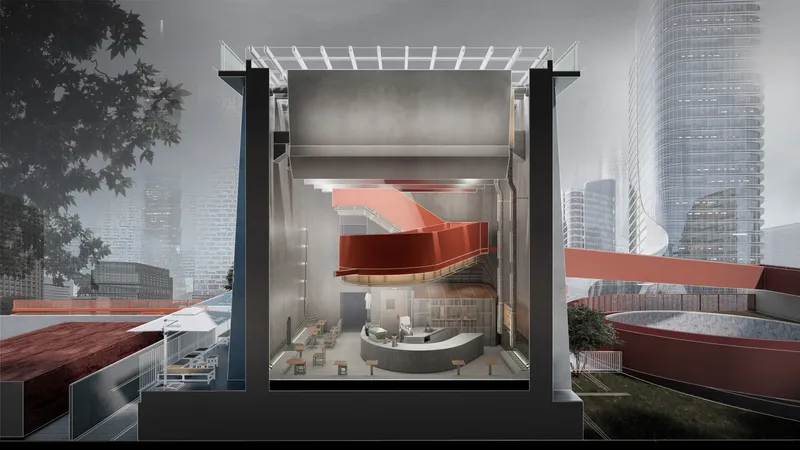
The section rendering clarifies the project's spatial logic. The café is nested beneath a pergola frame at the base of surrounding high-rise towers, visible in the background through atmospheric fog. The drawing shows how the multi-level interior fits within the structural grid, with mezzanine platforms and double-height zones creating the sectional variety that defines the visitor's experience. It also reveals the scale contrast at play: a deliberately intimate, cave-like interior set against towers that rise dozens of stories above.
Why This Project Matters
Specialty coffee culture has produced a staggering number of architect-designed cafés in recent years, many of them defaulting to either Scandinavian minimalism or maximalist eclecticism. KUDDO Coffee charts a third path. By treating the existing concrete infrastructure as a material worth celebrating rather than concealing, Xushi Design demonstrates that atmosphere does not require imported finishes or theatrical gestures. The building's own bones, properly lit and carefully composed, are enough.
The project also offers a replicable idea for dense Asian cities where tower podiums generate vast amounts of underused space. Rather than treating these zones as unavoidable compromises, architects can find real spatial potential in their constraints. KUDDO Coffee proves that the least glamorous piece of a high-rise development can become its most compelling public space, if someone is willing to look at raw concrete and see an opportunity instead of a problem.
KUDDO Coffee by Xushi Design. Photography by YUAN STUDIO.
About the Studio
Xushi Design
Share Your Own Work on uni.xyz
If projects like this are the kind of work you want to make, uni.xyz is a place to publish your own, find collaborators, and enter design competitions.


Popular Articles
Popular articles from the community


Co-life: Sustainable Architecture for Age-Friendly Community Living
Co-life reimagines sustainable architecture for seniors through courtyards, rammed earth, shared gardens, and spaces designed for belonging.

The Musturak Paradise: Senior Living Architecture for a Connected Future in Temara, Morocco
The Musturak Paradise reimagines senior living architecture in Temara via private homes, social spaces, culture, community, and shared care.

Co-Life: Senior Housing Design That Reconnects Older Adults With the City
Co-Life reimagines senior housing design through healing gardens, shared streets, workshops, and a sustainable community across generations.

Hill & Cross Opera: Sculptural Opera House Architecture Shaped by Tallinn’s Landscape and Identity
Hill & Cross Opera reimagines opera house architecture in Tallinn through its sculptural hill, civic plaza, glass wave and a luminous cross.

Similar Reads
You might also enjoy these articles


Hodi-Mandai Geram
Project Function: Preservation and revitalization of the Intangible heritage and socio-spatial identity of the Hodi by Housing, Cultural Memory Center, Sacred Grove, landscape, local tourism economy


Olio Towers: A Mid-Rise for Performers That Fuses Housing, Rehearsal, and Stage
Located blocks from Houston's Theater District, this modular tower stacks living units around a central performance atrium.

Oasis: Modular Green Housing Carved into Dhaka's Urban Fabric
A shortlisted Plugin Housing entry reclaims unauthorized settlements in Dhaka with stepped concrete volumes, green roofs, and ventilation-driven design.

Black Hole: A Floating Megastructure for the Post-Physical Era
Emiliano Mazzarotto envisions a spherical, self-scaling arena where e-sports, digital hotels, and holographic stadiums replace traditional public space.

Explore Coffee Shop Competitions
Discover active competitions in this discipline


Challenge to design luxury tourism on rails


Challenge to reimagine the Iron Throne


Photograph architecture without architects


VR headsets Storefront design competition
Comments (0)
Please login or sign up to add comments
No comments yet. Be the first to comment!