

Kumak Masurian Center for Biodiversity and Nature Education by Kwadratura
A circular, landscape-embedded research and education center in Poland, combining sustainable architecture, biodiversity protection, and public environmental learning.


Located in Urwitałt near the pristine shores of Łuknajno Lake in northeastern Poland, the Kumak Masurian Center for Biodiversity and Nature Education is a contemporary research and educational complex designed by Kwadratura. Completed in 2023, the 2,562-square-meter project serves as a new home for the University of Warsaw’s Field Station, which has operated on this ecologically sensitive site since 1973. Conceived as a dual-purpose facility combining scientific research with public education, the project exemplifies how sustainable architecture can actively support biodiversity conservation while opening scientific knowledge to a wider audience.
Architecture as a Tool for Biodiversity Protection and Environmental Education
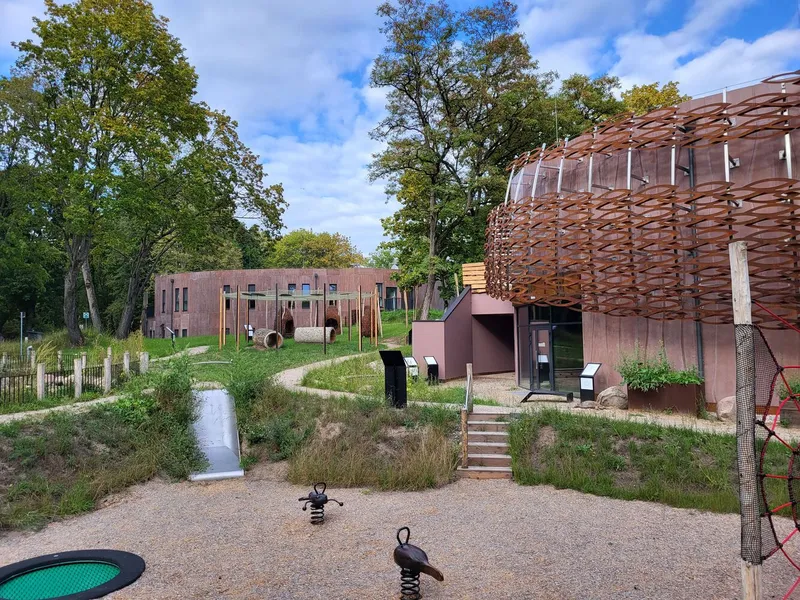
The primary objective of the Kumak Center is the protection of biodiversity, achieved largely through education and scientific research. While the site was previously reserved for students and researchers, the introduction of a dedicated Expo building transforms the complex into a public-facing institution. Visitors are introduced to the biology of small water reservoirs typical of the Masuria region through an interactive exhibition that seamlessly extends into the surrounding landscape. Outdoor educational zones and a nature-based playground further reinforce the connection between architecture, learning, and the natural environment.
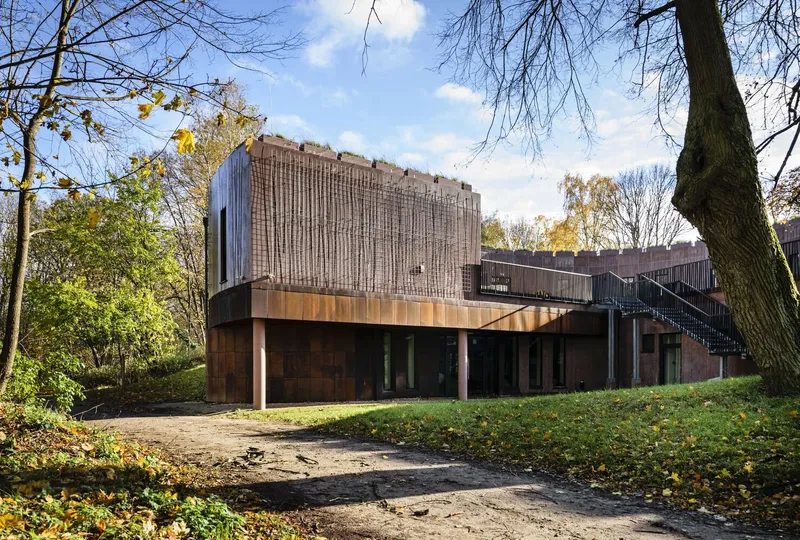
Two Buildings, One Integrated Ecological Vision
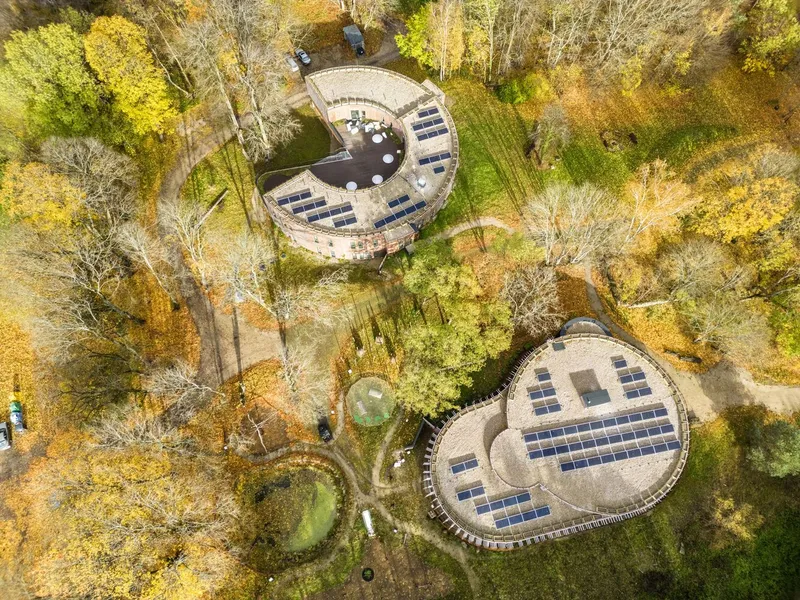
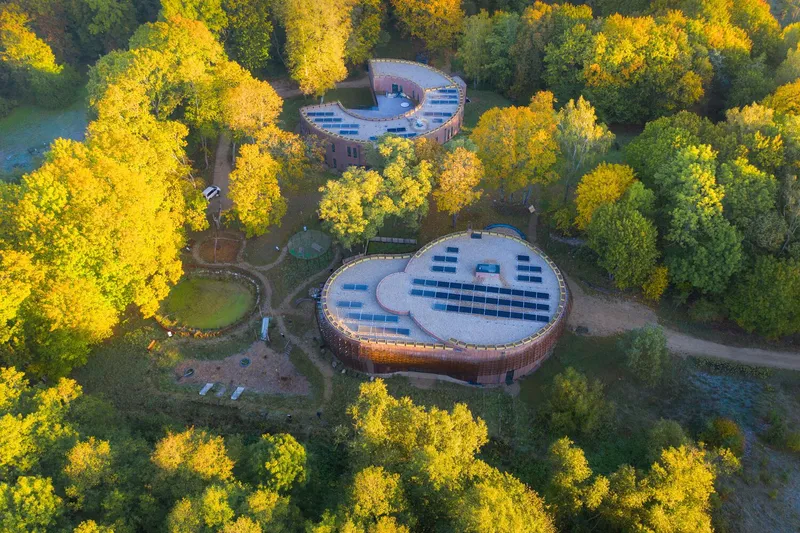
The complex consists of two complementary buildings: a Seminar and Research Building and an Expo and Education Building. Both structures are two stories high and partially embedded into the terrain, allowing them to visually dissolve into the forested landscape. Earth-covered roofs and subdued façade colors echo the tones of soil, bark, and vegetation, ensuring minimal visual impact on the surrounding Regional Park.
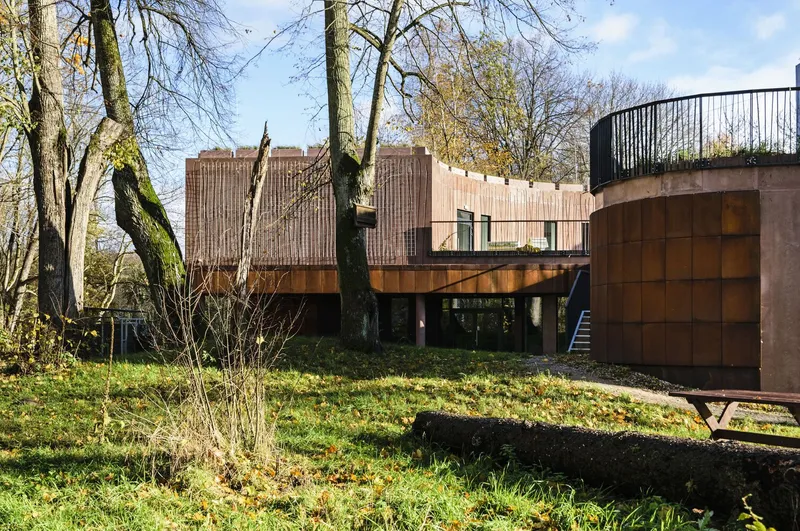
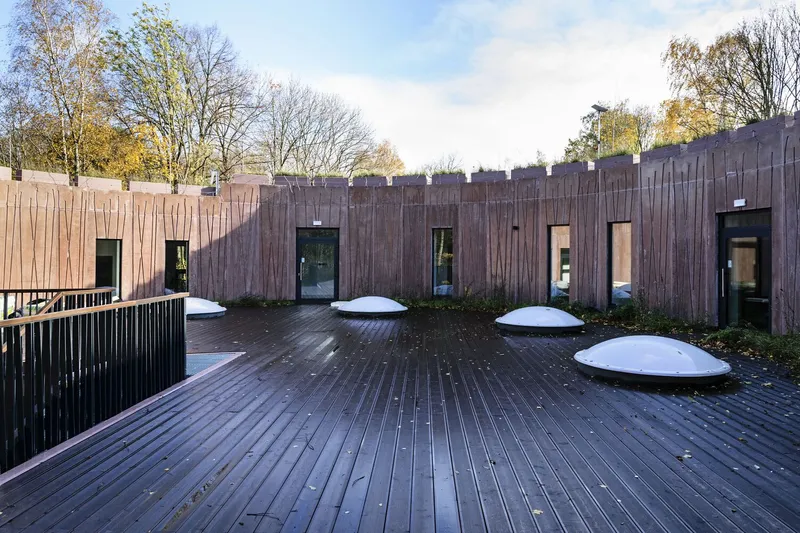
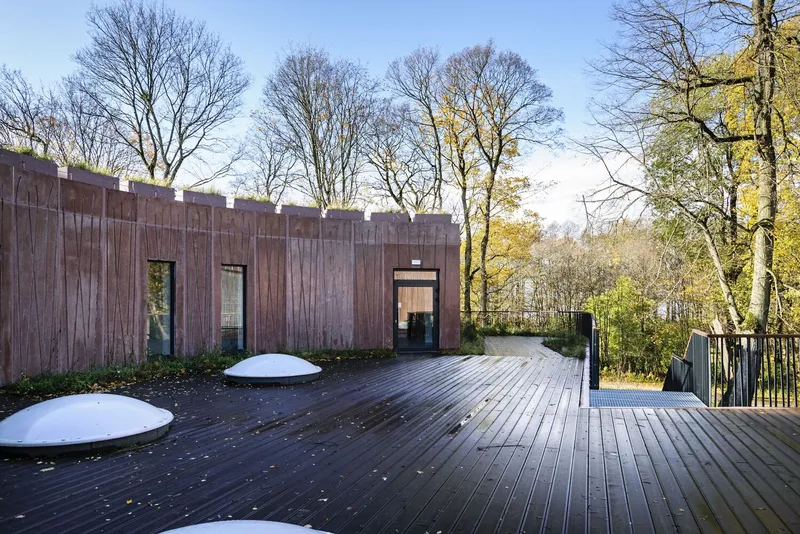
The seminar building follows a circular plan, housing laboratories, seminar rooms, communal spaces with catering facilities, accommodation for staff, and technical areas on the lower level. The upper floor accommodates student rooms arranged around a planted terrace, creating a shared outdoor space that promotes informal interaction and immersion in nature. The Expo building, composed of two interconnected circular volumes, organizes its functions vertically. The entrance and seminar spaces occupy the upper level, while the lower floor contains exhibition zones, workshop rooms, and laboratories designed for both scientists and educational activities.

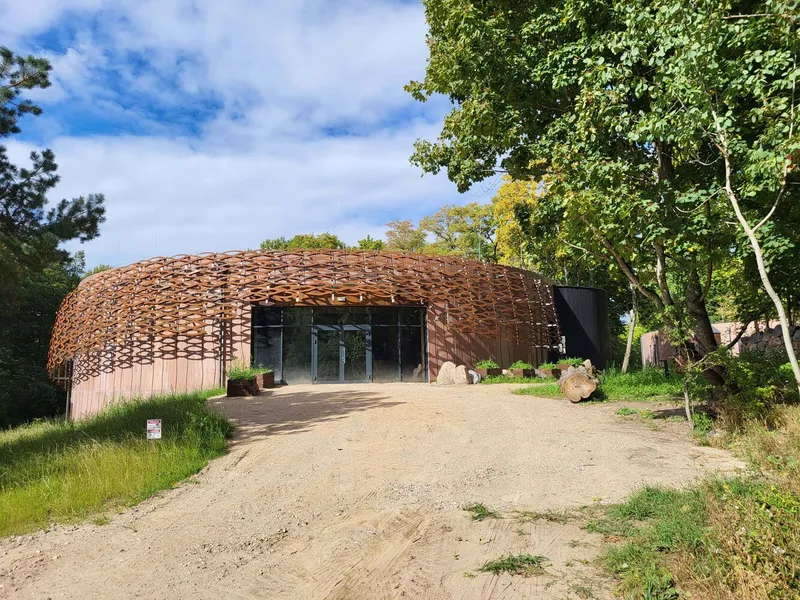
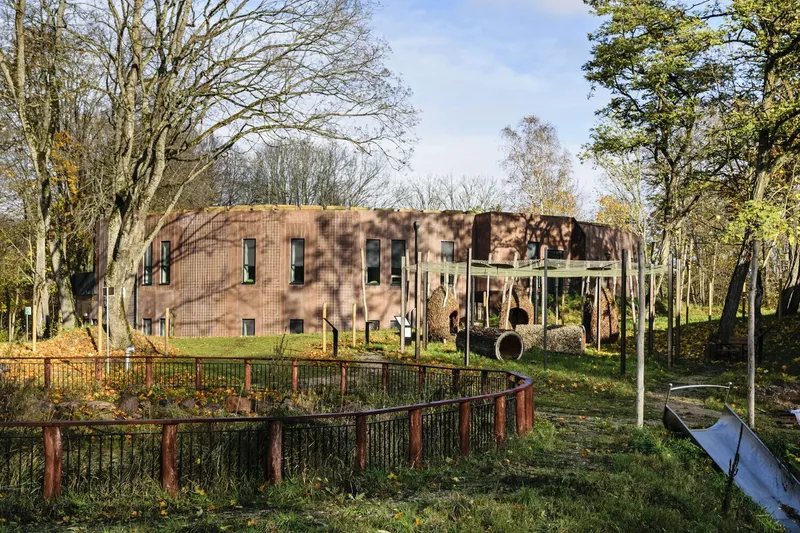
Circular Geometry and Layered Façade Design
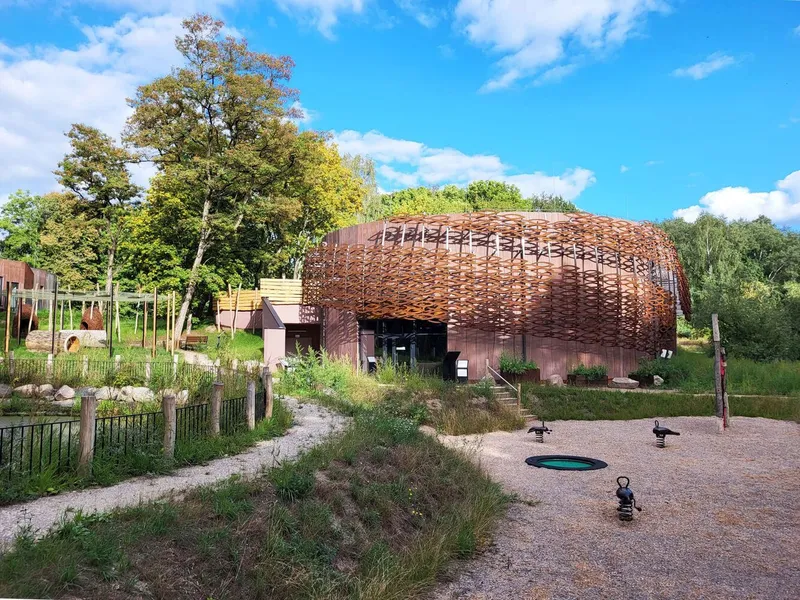
Circular geometry plays a central role in the architectural identity of the Kumak Center. The absence of a defined beginning or end in the buildings’ forms symbolically reflects natural cycles and ecological continuity. This concept is most clearly expressed in the Expo building’s façade, where an intricate 3D openwork installation composed of stainless steel and corten steel “leaves” wraps the structure. Approximately 1,500 corten elements form a porous outer layer that will gradually be colonized by climbing plants, adding a living, evolving dimension to the architecture.
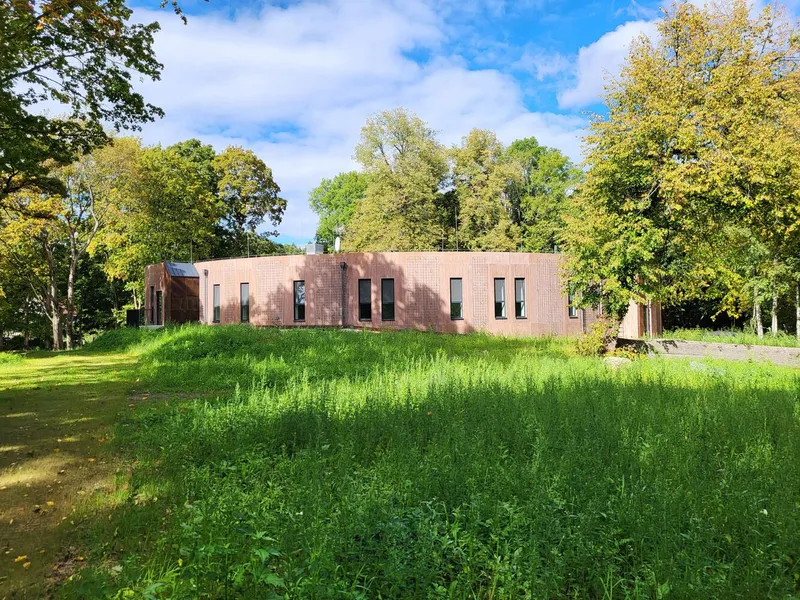

Behind this sculptural screen, prefabricated façade panels made of mass-colored concrete and corten steel feature irregular vertical engravings that introduce rhythm and texture. As seasons change, the surrounding mature trees become an inseparable part of the architectural composition, reinforcing the dialogue between built form and landscape.

Sustainable Construction and Low-Impact Building Technologies
Environmental responsibility guided every stage of the design and construction process. The buildings utilize advanced sustainable building systems, including ground-source heat pumps, capillary tube heating and cooling mats, photovoltaic panels, and greywater recycling systems. Prefabricated reinforced concrete elements were manufactured off-site, significantly reducing construction time and limiting environmental disturbance within the protected area. Notably, the project achieved its realization without cutting down a single tree.
Interior finishes further reflect the project’s ecological ethos. Reclaimed wood is used on selected walls, while natural linoleum flooring enhances durability and indoor environmental quality. These material choices reinforce the building’s long-term sustainability and educational mission by demonstrating responsible design practices in everyday use.


A Landmark of Contemporary Sustainable Architecture in Poland
Recognized by the National Institute for Architecture and Urban Planning as one of the most important and groundbreaking architectural realizations in Poland since 1989, the Kumak Masurian Center stands as a model for research architecture, educational buildings, and nature-integrated design. By combining scientific rigor, public engagement, and ecological sensitivity, the project demonstrates how architecture can function as an active participant in environmental protection rather than a passive observer.
All photographs are works of
Przemysław Andruk, Kwadratura, Jerz Łaźniewski, Leszek Hus Delta



Popular Articles
Popular articles from the community


Riyadh For All: Intergenerational Urban Design for Active Aging in Rabat
Riyadh For All reimagines urban design in Rabat with intergenerational co-living, adaptive courtyards, and Moroccan cultural exchange today.

Lunar Spiral: Space Architecture Shaped by the Mathematics of the Universe
Lunar Spiral reimagines space architecture through Fibonacci geometry, lunar regolith, levitating habitats, and self-sustaining Moon living.

Conexión: Biophilic Design Reimagines High-Rise Living in Hong Kong
Conexión reimagines high-rise living in Hong Kong through biophilic design, green facades, shared spaces, daylight, water and nature within.

Co-life: Sustainable Architecture for Age-Friendly Community Living
Co-life reimagines sustainable architecture for seniors through courtyards, rammed earth, shared gardens, and spaces designed for belonging.

Similar Reads
You might also enjoy these articles


Hodi-Mandai Geram
Project Function: Preservation and revitalization of the Intangible heritage and socio-spatial identity of the Hodi by Housing, Cultural Memory Center, Sacred Grove, landscape, local tourism economy


Olio Towers: A Mid-Rise for Performers That Fuses Housing, Rehearsal, and Stage
Located blocks from Houston's Theater District, this modular tower stacks living units around a central performance atrium.

Oasis: Modular Green Housing Carved into Dhaka's Urban Fabric
A shortlisted Plugin Housing entry reclaims unauthorized settlements in Dhaka with stepped concrete volumes, green roofs, and ventilation-driven design.

Black Hole: A Floating Megastructure for the Post-Physical Era
Emiliano Mazzarotto envisions a spherical, self-scaling arena where e-sports, digital hotels, and holographic stadiums replace traditional public space.
Explore Educational Building Competitions
Discover active competitions in this discipline



Challenge to design public laboratory


Challenge to reimagine the Iron Throne


Photograph architecture without architects


Illustrate the lost glory of Angkor Wat - Render Challenge
Comments (0)
Please login or sign up to add comments
No comments yet. Be the first to comment!