
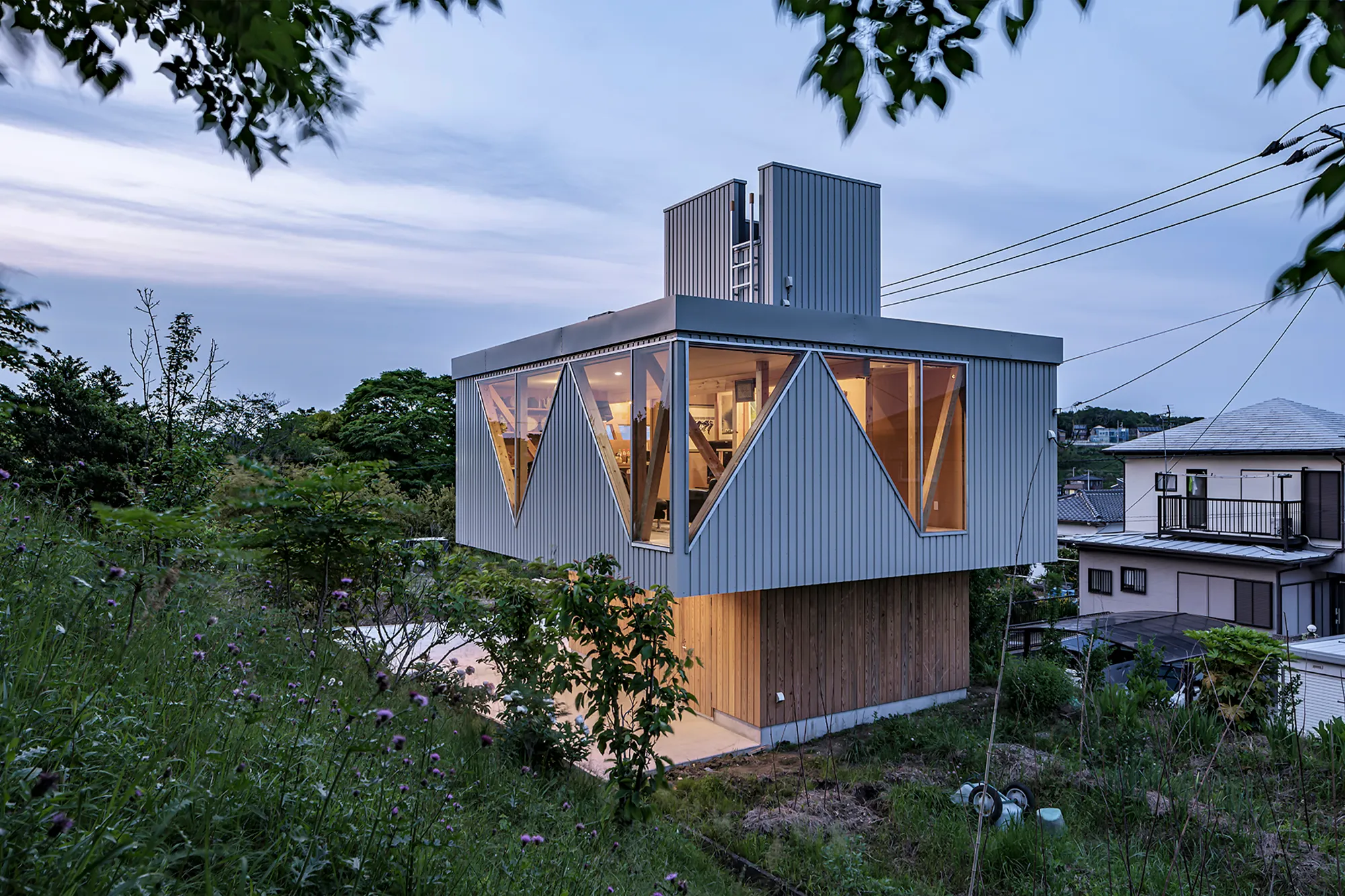
kurosawa kawara-ten Builds a Weekend House from Typhoon-Felled Timber on a Steep Suburban Slope
A 66-square-meter retreat in Kisarazu, Japan, cantilevers over a hillside garden tended for a decade before construction began.


For over a decade, an elderly couple drove to a steep plot at the edge of a suburban housing estate in Kisarazu, Japan, to garden, picnic, and light fires. They knew every tree and flower on the slope before they ever considered building on it. When they finally commissioned kurosawa kawara-ten to design a weekend house, the brief was less about what to put on the site and more about what to protect. House for G, completed in 2022 at just 66 square meters, is the result: a compact, cantilevered volume that touches the ground as lightly as possible and draws its structure from trees that were already dead.
The project's most striking quality is its resourcefulness. A massive typhoon struck the region in 2019, and the subsequent COVID-era timber supply crisis made imported lumber prohibitively expensive. kurosawa kawara-ten turned to the local forestry union, sourcing rare logs from storm-damaged and diseased trees that would otherwise have been discarded. These were cut into thick beams and assembled into heavy trusses that do double duty as structure, shelving, and spatial frame. The house is, in a very literal sense, built from the debris of its own landscape.
Cantilevering to Save a Garden


The fundamental move is a split: a compact ground floor holds the water equipment, bathroom, and bedroom, while the larger second floor cantilevers outward to claim living space without expanding the footprint below. The strategy is driven entirely by the existing vegetation. The couple's garden of flowers and plants dictated where the building could and could not land, and the cantilever lets the house occupy the air above rather than the soil beneath.
From the driveway, the volume reads as a metal box hovering over a timber base, the galvanized upper skin reflecting a muted gray light while the wooden ground floor anchors itself against the concrete retaining wall. The proportions are deliberately unusual, more vertical than horizontal, rejecting the low-slung domestic silhouette common in Japanese suburban development.
Triangular Windows and Truss Logic

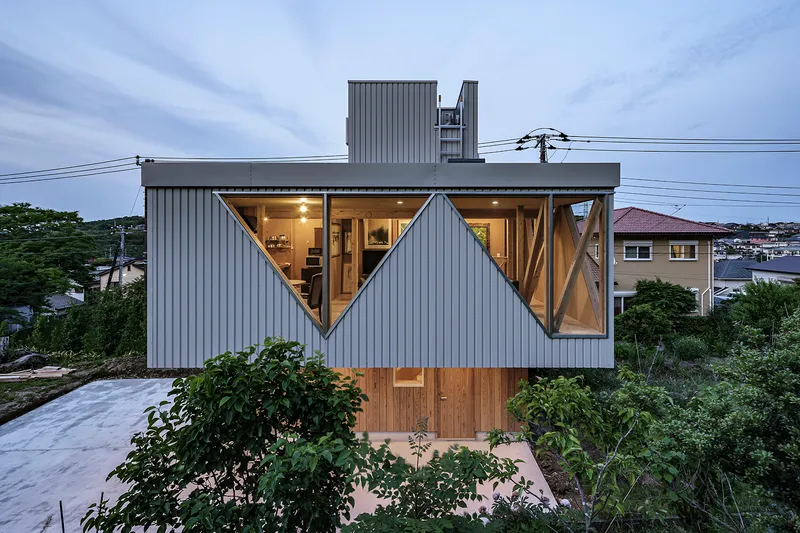
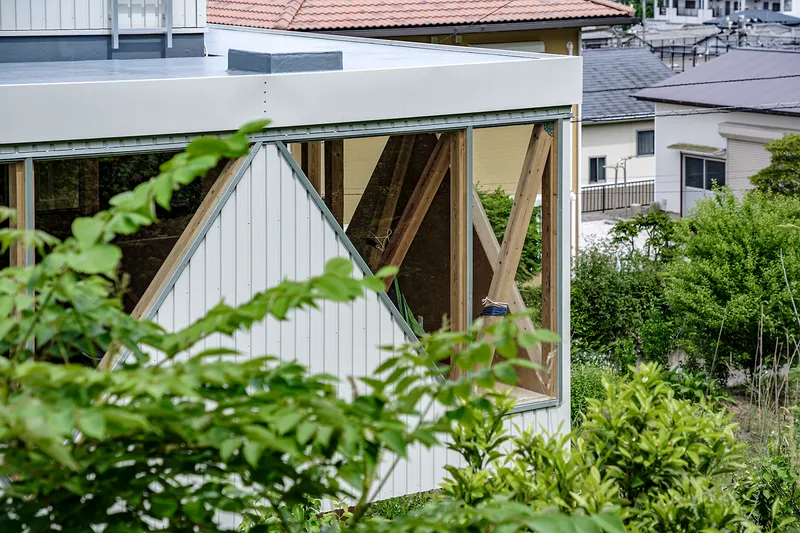
The most immediately recognizable detail is the triangular glazing cut into the corrugated facade. These openings are not decorative gestures. They are the natural consequence of the diagonal timber braces that stiffen the cantilevered structure on the slope side. Where the trusses cross, they create triangular voids, and kurosawa kawara-ten filled those voids with glass. The result is a series of framed views that shift in shape and angle as you move through the interior.
At dusk, the effect reverses. The illuminated trusses become visible from outside, turning the facade into a kind of x-ray of the building's structural logic. It is a house that wears its bones on the outside, not out of bravado but because the budget left no room to hide them.
Living Among the Trusses

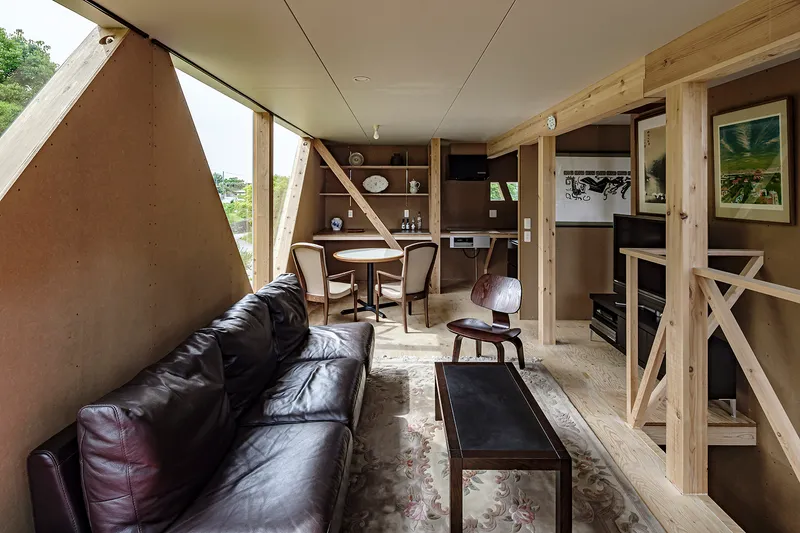

The second-floor living room is defined by its exposed timber framework. Thick diagonal braces divide the space into zones: a dining nook tucked under a sloping member, a kitchen where the trusses double as open shelving, a hammock slung from a beam. The structural members are close enough to touch and thick enough to feel monumental in such a small room. This is not the polished timber of a craft showcase. It is rough, local wood with visible grain, dried and cut by a regional mill.
Plywood walls and structural fiber boards are left exposed throughout, their warm tones unifying the interior palette. The owners' art collection hangs on the wall surfaces between the braces, and the architects clearly planned for this: flat panels are oriented to provide display area, while the angled members frame views outward to the green slope. Every surface either holds something or reveals something.
Staircase as Spine

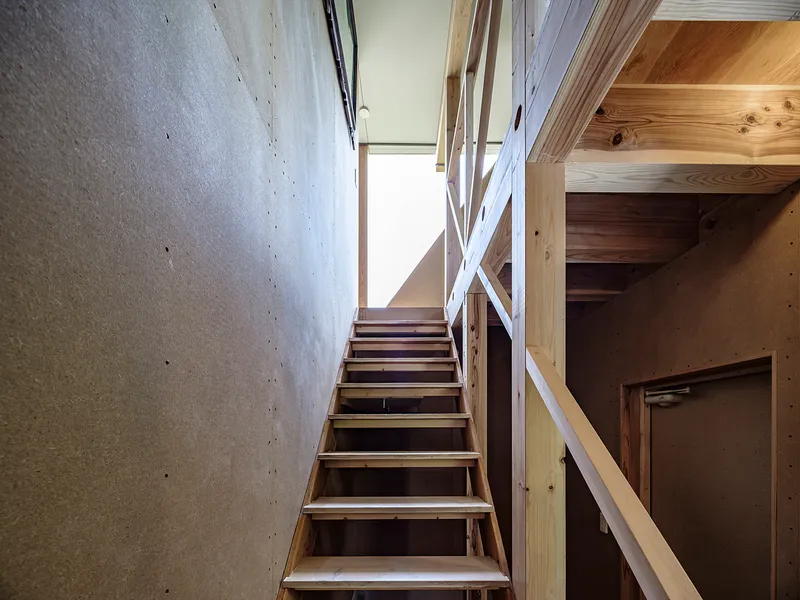

The stair is the vertical spine connecting the concrete-walled ground floor to the timber-framed living level above, and it treats the ascent as a material transition. You climb from poured concrete and plaster into a world of cross-braced wood and filtered daylight. The railings are not separate elements but extensions of the structural bracing, their diagonal members continuing the geometric language of the trusses above.
A skylight at the top of the stair pulls natural light down through the double-height volume, turning the climb into a gradual brightening. It is a compact vertical sequence, but the changing materials and light quality make it feel like more than a transition between floors.
Grounding in Concrete


The ground floor operates on a completely different register. Concrete walls and slab foundations establish a cool, hard base that contrasts sharply with the warmth upstairs. The corridor is narrow, the ceiling joists are exposed, and a diagonal timber brace punches through an open doorway as a reminder that the structural system does not respect the boundary between floors. The bedroom sits in this quieter zone, its horizontal plywood panels and high ribbon window creating a restrained sleeping space.
From the landing, a view past the diagonal balustrade extends out to the harbor beyond, a glimpse of Tokyo Bay that the rooftop terrace was specifically designed to capture. The house stacks its experiences vertically: earth and concrete at the base, timber and greenery in the middle, sky and water at the top.
Site and Suburban Context

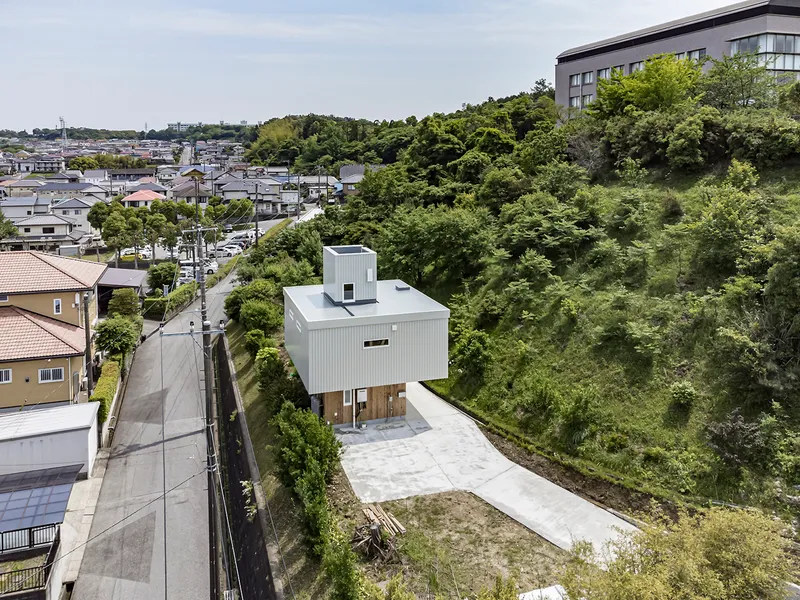

From the air, House for G is unmistakable: a white metal volume with a rooftop tower, set apart from the orderly rooflines of the surrounding suburban estate. The neighborhood is an older residential development, dense and gridded, but the site itself sits at the estate's edge where the terrain drops away and the vegetation thickens. This liminal position gives the house its dual character. On one side it faces driveways and neighboring rooftops; on the other, it overlooks a wild, green hillside.
The architects describe the area as an old suburban zone with "unusually rich nature," and the drone views confirm it. The steep slope that made building difficult also preserved the site from typical residential infill. kurosawa kawara-ten treated this difficulty as an asset, placing the house so precisely that the owners' existing garden could continue to grow around it.
Greenery as Interior Material
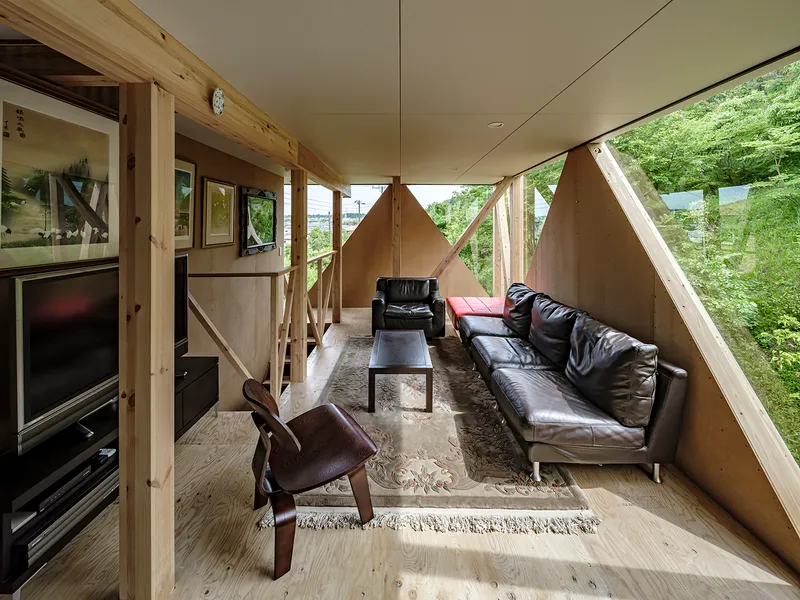
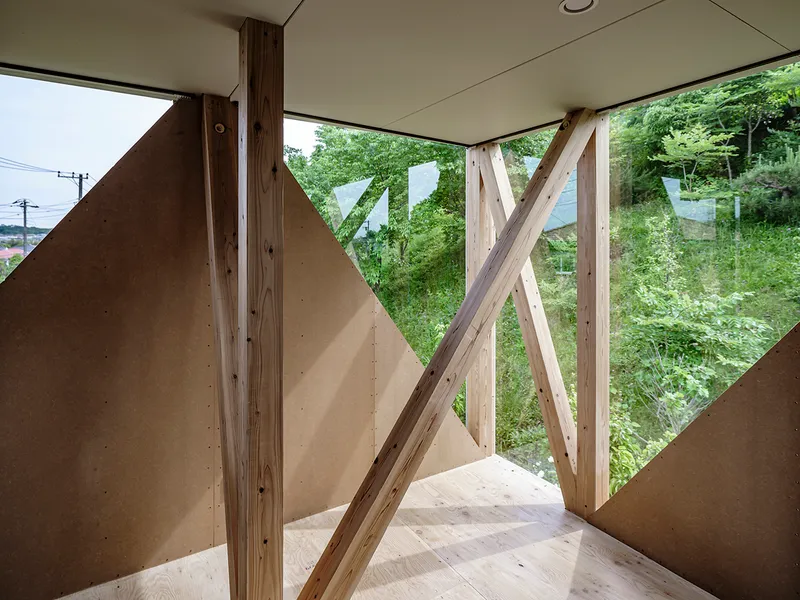

Through the triangular windows and the large openings at the truss intersections, the surrounding foliage becomes a kind of wallpaper, constantly shifting with the seasons and the light. The architects oriented the second-floor living room toward the green slope rather than the neighborhood, so the dominant view is of leaves and branches pressing close against the glass. In several frames, the boundary between interior and exterior dissolves entirely, with dense foliage visible through every opening.
The exterior panels age quietly among the vegetation. From ground level, the timber base merges with the undergrowth, while the galvanized upper volume floats above the canopy. The house is not camouflaged. It is conspicuous. But it coexists with the landscape in a way that suggests long familiarity rather than sudden intrusion.
Plans and Drawings
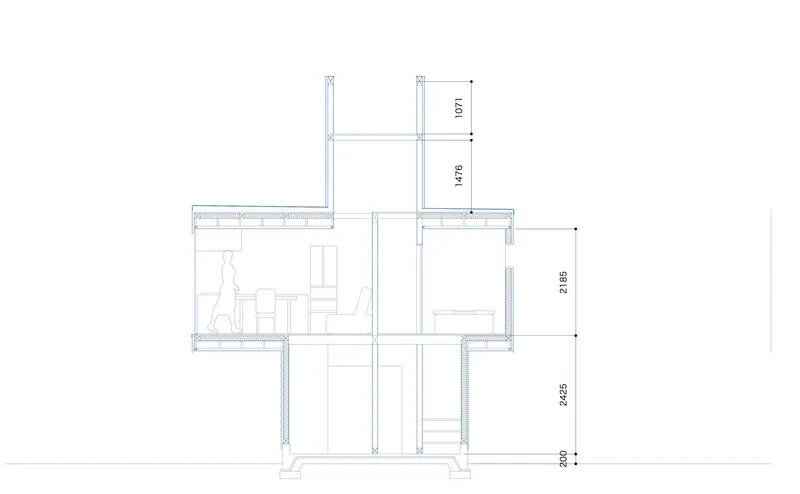

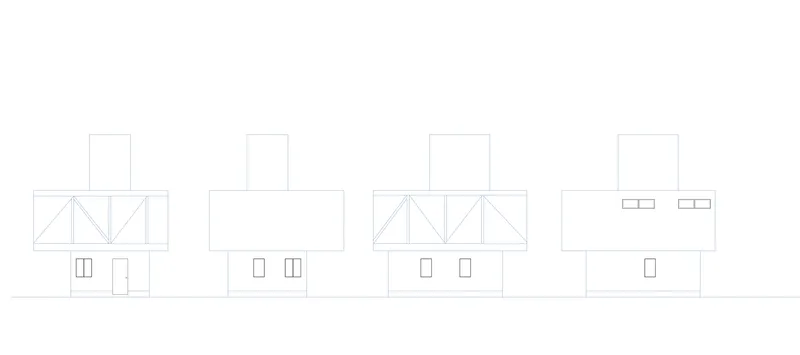
The section drawing reveals the staggered floor levels clearly: a concrete base hugging the slope, a cantilevered upper volume extending outward, and a rooftop terrace at the peak. The floor plan shows two separate volumes connected by the stair core, with the compact ground level housing bedrooms and bathrooms while the upper level opens into a single living space wrapped in trusses. The four-sided elevation study illustrates how the triangular window pattern and chimney element shift across each facade, confirming that the truss geometry generates a different composition on every face.
Why This Project Matters
House for G is a case study in turning constraints into architecture. A pandemic-era timber shortage led to a richer material story than imported lumber could ever have told. A steep, plant-covered slope produced a cantilever that gives the house its most distinctive spatial quality. A tight budget left the structure exposed, and the exposed structure became the defining interior experience. None of these outcomes were inevitable. They required an architect willing to follow the logic of each limitation rather than fight it.
There is also something genuinely moving about the timeline. The owners spent a decade tending this patch of ground before they built on it. The house arrives not as an imposition but as a late addition to an existing relationship between people and land. kurosawa kawara-ten understood that the garden was the client's real project, and designed a building that could share the slope without displacing it. In an era when weekend houses often treat nature as scenery, House for G treats it as a neighbor.
House for G by kurosawa kawara-ten, Kisarazu, Japan. 66 m², completed 2022. Photography by Chiba Masato.
About the Studio
Share Your Own Work on uni.xyz
If projects like this are the kind of work you want to make, uni.xyz is a place to publish your own, find collaborators, and enter design competitions.




Popular Articles
Popular articles from the community


Hill & Cross Opera: Sculptural Opera House Architecture Shaped by Tallinn’s Landscape and Identity
Hill & Cross Opera reimagines opera house architecture in Tallinn through its sculptural hill, civic plaza, glass wave and a luminous cross.

Co-Life: Senior Housing Design That Reconnects Older Adults With the City
Co-Life reimagines senior housing design through healing gardens, shared streets, workshops, and a sustainable community across generations.

Riyadh For All: Intergenerational Urban Design for Active Aging in Rabat
Riyadh For All reimagines urban design in Rabat with intergenerational co-living, adaptive courtyards, and Moroccan cultural exchange today.
EW PARK: Sustainable Architecture Reimagines the Future of Urban Parking
EW PARK reimagines city parking as a modular wooden tower combining automation, solar energy, electric mobility, and adaptable urban design.

Similar Reads
You might also enjoy these articles

Bao Huynh Watercolor Atelier: A Serene Art Retreat in Hội An
Bao Huynh Watercolor Atelier in Hội An blends multifunctional art spaces, sustainable design, local materials, and family-friendly living in a serene environment.

Atelier Macri Concept Store Interior Design by CASE-REAL
Atelier Macri store features a "ko" counter, walnut wood details, cork displays, blending retail, gallery, and seamless customer experiences.

Manuel Vargas Izquierdo Stadium and High-Performance Sports Center: Architectural Excellence in Jalpa de Méndez
The Manuel Vargas Izquierdo Stadium blends sustainable design, inclusive sports facilities, and cultural-inspired architecture, revitalizing Jalpa de Méndez’s public spaces.

KAKR Buluh Awar Hall: Revitalizing Community and Ecology Through Bamboo Architecture
Community built bamboo hall revitalizes Buluh Awar village, empowering youth, restoring ecology, celebrating vernacular craftsmanship through sustainable architecture and culture.
Explore House Competitions
Discover active competitions in this discipline


Challenge to design mud housing for contemporary communities


Challenge to reimagine the Iron Throne


Photograph architecture without architects


Illustrate the lost glory of Angkor Wat - Render Challenge
Comments (0)
Please login or sign up to add comments
No comments yet. Be the first to comment!