

Architrip Inc. Slots a Curved Retail Store Between Two Siblings in Central Fukushima
The LAB Store negotiates between organic and rectilinear neighbors on a tight 89-square-meter site in Fukushima City's commercial core.


Building between buildings is always a diplomatic act. When the neighbors are architecturally unrelated, one with an organic plan and the other a stark black box, the new arrival has to decide whether to pick a side or invent a third language entirely. Architrip Inc. chose the latter for LAB Store, a compact retail and office building completed in 2024 on an 89-square-meter plot in the center of Fukushima City. Rather than compete with or copy its flanking structures, the project recedes its outline, curving and pulling back until a form emerges that reads as something that could have always been there.
What makes this project worth studying is not its size but its negotiation strategy. The building's defining gesture, a curved exterior wall clad in 300mm-wide vertical siding, is not decorative whimsy. It is the physical record of a boundary negotiation: the wall bends where the neighboring geometries demand it, creating semi-exterior zones that tie all three buildings into a single streetscape. The result is a small commercial complex that reads as a family of distinct buildings rather than a collection of strangers.
Mediating Between Neighbors


The existing Shop No. 1 has an unusual structural form and a circular plan. Shop No. 2 is its opposite: a simple, linear volume in black siding. LAB Store sits between them, and its curved wall acts as a formal translator, bending toward the organic geometry of Shop No. 1 while its rectilinear office volume nods to Shop No. 2. Seen from the parking lot, the three buildings register as distinct but related, as if they grew from a shared set of design principles applied at different moments.
The semi-exterior spaces between the buildings are critical to this reading. Both existing shops already featured transitional zones between inside and out. Architrip repeated this motif in the new building, creating planted courtyards and covered thresholds that stitch the three structures together at ground level. It is a simple move, but it transforms a set of adjacent shops into a cohesive commercial campus.
The Curved Wall as Boundary and Beacon


The curved metal-panel facade is the building's most visible idea. Its 300mm-wide vertical siding catches light differently throughout the day, shifting from a matte grey in the morning to a warmer metallic tone at dusk. The curve is not arbitrary: it is the trace of the building pulling away from both neighbors, creating a gap wide enough for a planted courtyard on one side and a pedestrian passage on the other. Structurally, engineer Nobuyuki Morinaga of mono resolved the curve without heavy framing, keeping the interior column-free where it matters most.
Up close, the facade's material palette becomes more layered. Horizontal metal louvers screen portions of the upper floor, filtering light and providing privacy for the office while adding a secondary rhythm to the vertical siding. The junction between the smooth paneling and the louvers is handled with a precision that rewards close inspection, a quality often absent from retail architecture built to tight budgets.
Ground Floor Retail: Timber, Light, and Diatomaceous Earth


Inside, the ground-floor shop is a single open room defined by a waffle-shaped exposed timber beam ceiling at 3.5 meters. The beams are not merely structural: they establish a grid that organizes display zones without interior walls, giving the retail space maximum flexibility. High-side windows draw daylight deep into the plan, reducing dependence on artificial lighting during business hours and creating shifting light patterns across the diatomaceous earth walls.
The interior finish palette is deliberately restrained. Diatomaceous earth, a naturally porous material with moisture-regulating properties, covers the walls, lending a chalky softness that contrasts with the warm timber overhead. A small tree grows from a stone-lined planter near the entrance, blurring the line between the planted courtyard outside and the commercial interior. Even the reception counter, a curved timber piece, echoes the building's external geometry in miniature.
Courtyards and Thresholds at Dusk


The project's character changes dramatically after dark. Uplighting from the courtyard planters washes the underside of timber soffits, and the exposed waffle ceiling glows through full-height glazing, turning the shop into a lantern for the street. The narrow courtyard between the metal panel wall and the timber-clad neighbor transforms from a daytime passage into a theatrical slot of warm light and shadow.
These thresholds are where the project's urban ambition becomes clearest. Rather than treating the gaps between buildings as leftover space, Architrip planted them, lit them, and furnished them, converting what could be dead zones into the most atmospheric parts of the complex. The dusk photographs reveal a commercial cluster that feels almost residential in its intimacy, a rare quality in city-center retail.
The Second Floor: Office with a Vantage Point


The second floor is given over to an office and a private room, accessed by a compact stairwell tucked against the shared wall. A private balcony opens off the office, positioned to offer a view of the entire site. It is a clever programmatic inversion: the public function sits below, open and visible, while the private function rises above with a proprietary overview of the complex. The horizontal louvers that screen this level allow its occupants to observe the courtyard life below without being observed in return.
Plans and Drawings


The site plan confirms what the photographs suggest: LAB Store's footprint is shaped entirely by negotiation. The circular existing structure to one side and the rectangular block to the other define the available envelope, and the new building fills it with a form that is neither circle nor rectangle but a hybrid that maximizes usable area while maintaining generous gaps for planting and circulation. The first-floor plan reveals the waffle beam grid and a surprisingly open layout for such a constrained footprint: storage is pushed to the edges, and the retail floor is kept clear. Upstairs, the second-floor plan shows how the balcony captures the full courtyard view, with the private room positioned for acoustic separation from the shop below.
Why This Project Matters
Small commercial projects rarely get this level of design attention. Most infill retail is built to be noticed in isolation, competing with its neighbors for visual dominance. LAB Store does the opposite: it defines itself by how it relates to the buildings already there. The curved wall, the shared semi-exterior spaces, the deliberate material echoes, all of these are gestures of architectural civility that elevate the entire complex rather than just the new addition.
For architects working on tight urban sites, the project offers a transferable lesson. When the context is heterogeneous, the most powerful move may not be contrast or mimicry but a third condition that acknowledges both neighbors without imitating either. Architrip's approach, treating the building's outline as a negotiable boundary rather than a fixed perimeter, produces a form that is specific to its site in a way that a freestanding object never could be. That specificity, more than any material or structural trick, is what gives LAB Store its quiet authority.
LAB Store by Architrip Inc., Fukushima City, Japan. Site area: 89 square meters. Completed 2024. Structural engineer: mono / Nobuyuki Morinaga. General contractor: BONDS ARCHITECT Inc. Photography by Yoshiki Yokoyama.
About the Studio
Share Your Own Work on uni.xyz
If projects like this are the kind of work you want to make, uni.xyz is a place to publish your own, find collaborators, and enter design competitions.


Popular Articles
Popular articles from the community

Extended Shell: Retrofitting Kolkata's Balconies as Living Urban Thresholds
A modular retrofit system recovers the social and environmental intelligence of Kolkata's historic verandas for contemporary Park Street residents.
Cloaked Colonization: A Mobile Underwater Habitat That Moves Like a Fish
Micah Abaya's shortlisted EHC Pacific entry reimagines ocean settlement as a dispersed network of self-sustaining architectural organisms.
Opera by the Sea Estonia: Three Shells Dissolving Architecture into Tallinn's Coastline
A winning opera house proposal replaces monumental form with interconnected shells that blur the boundary between building, park and Baltic Sea.
Tsunami Convergenics: Turning Catastrophic Ocean Forces into Underwater Housing Infrastructure
A speculative underwater settlement off the coast of Onagawa, Japan, treats tsunamis and typhoons as energy sources rather than threats.

Similar Reads
You might also enjoy these articles


Hodi-Mandai Geram
Project Function: Preservation and revitalization of the Intangible heritage and socio-spatial identity of the Hodi by Housing, Cultural Memory Center, Sacred Grove, landscape, local tourism economy

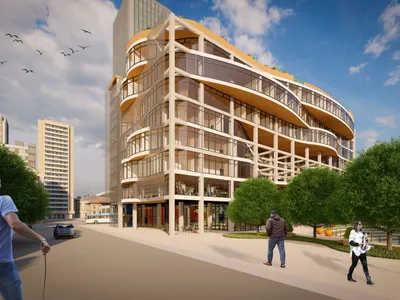
Olio Towers: A Mid-Rise for Performers That Fuses Housing, Rehearsal, and Stage
Located blocks from Houston's Theater District, this modular tower stacks living units around a central performance atrium.
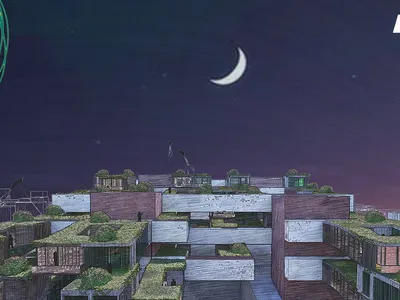
Oasis: Modular Green Housing Carved into Dhaka's Urban Fabric
A shortlisted Plugin Housing entry reclaims unauthorized settlements in Dhaka with stepped concrete volumes, green roofs, and ventilation-driven design.

Black Hole: A Floating Megastructure for the Post-Physical Era
Emiliano Mazzarotto envisions a spherical, self-scaling arena where e-sports, digital hotels, and holographic stadiums replace traditional public space.

Explore Architecture Competitions
Discover active competitions in this discipline

Challenge to reimagine the Iron Throne

Photograph architecture without architects

Illustrate the lost glory of Angkor Wat - Render Challenge

Design challenge to reuse E-waste
Comments (0)
Please login or sign up to add comments
No comments yet. Be the first to comment!