

LABAK: Bamboo-Concrete Stilts That Keep Flood-Prone Communities Above Water
A stilt-based housing strategy for India's flood zones pairs bamboo-concrete legs with vegetation buffers and ordered street grids.


Every monsoon season, communities across India brace for floodwaters that swallow homes, displace families, and erase years of incremental progress. The typical response is temporary shelter: tarpaulin roofs, relief camps, promises of reconstruction. LABAK rejects that cycle. Named after its defining structural element, bamboo-concrete legs that lift entire houses above anticipated flood levels, the project proposes a permanent housing typology that treats flooding not as a disaster to survive but as a seasonal condition to design around.
Designed by Endre Jovan, Eszter Nagy, and Árnika Horváth, LABAK was a shortlisted entry in the HEAL+ competition, which called for regenerative housing solutions for Kerala. The team's response goes well beyond the individual dwelling: it outlines a complete settlement strategy, from vegetation buffers at the island's perimeter to a network of raised footpaths that double as emergency escape routes.
Vegetation Rings and Layered Protection Within 100 Meters
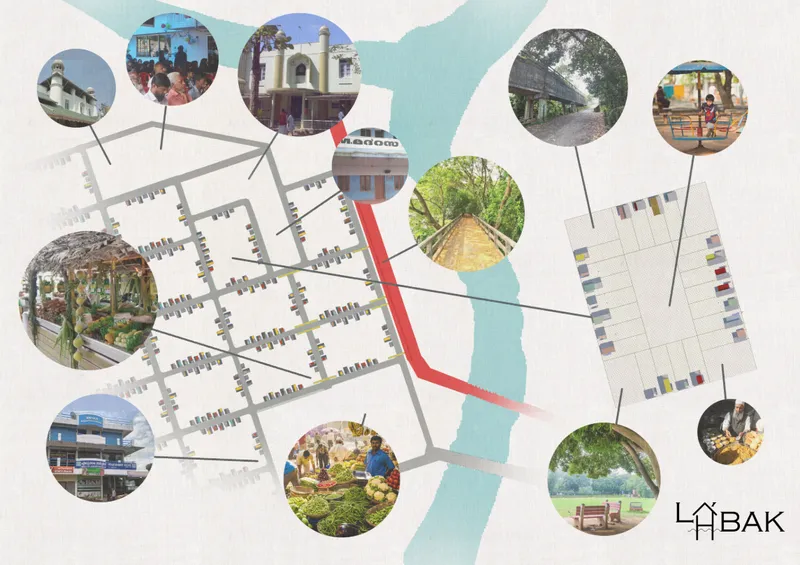
The site plan reveals a settlement organized in concentric layers of defense. Within 100 meters of the island's edge, trees and dense plantings form a vegetation buffer that slows incoming floodwater, absorbs excess volume, and reduces the kinetic energy that would otherwise slam into built structures. Circular photograph insets embedded in the diagram show the actual local context: modest community buildings, narrow pathways, palm groves. The plan doesn't impose a foreign grid onto this landscape. Instead, it reads the existing scatter of irregularly placed houses as a vulnerability and reorganizes it into a more legible pattern without erasing the material character of the place.
Three public squares anchor the interior of the settlement, each serving a distinct programme. One clusters schools and mosques, linking education and worship. Another forms a marketplace for commerce. The third functions as a gathering space. These are not afterthoughts; they are positioned along raised footpaths that connect every neighborhood plot, ensuring that even during a flood event, residents can navigate the settlement safely. The dual function of circulation as both daily infrastructure and emergency escape is one of LABAK's smartest moves.
Bamboo-Concrete Legs and the Anatomy of an Elevated Home
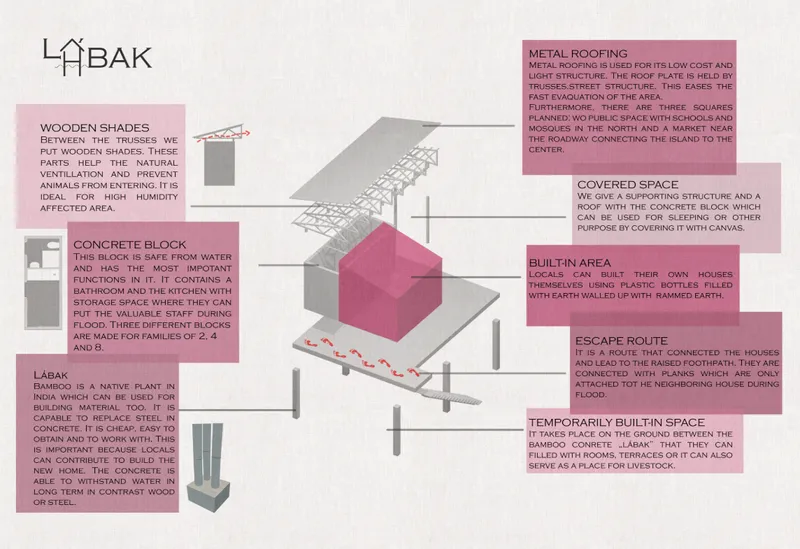
The axonometric drawing annotated in pink breaks down the construction logic. Bamboo-concrete composite columns form the stilts, combining bamboo's tensile flexibility with concrete's compressive strength to create legs that can absorb both static loads and the lateral forces of moving floodwater. The annotated callouts explain how each building component contributes to the system: wall panels, roofing, floor platforms, and the stilts themselves are detailed as discrete assemblies that local builders can fabricate and erect. This is critical. The design team explicitly frames the construction process as something communities can own, not something imposed by outside contractors.
The elevated platform creates usable space beneath the dwelling. Rather than treating the ground plane as dead zone, the design anticipates that residents will use the shaded area under their homes for storage, livestock, or informal gathering during dry months. When floodwaters arrive, this void absorbs the surge without compromising the living quarters above. It is a simple inversion of the typical relationship between house and ground, but it changes everything about how the building performs under stress.
Living Above the Flood Line, Beneath the Palm Canopy
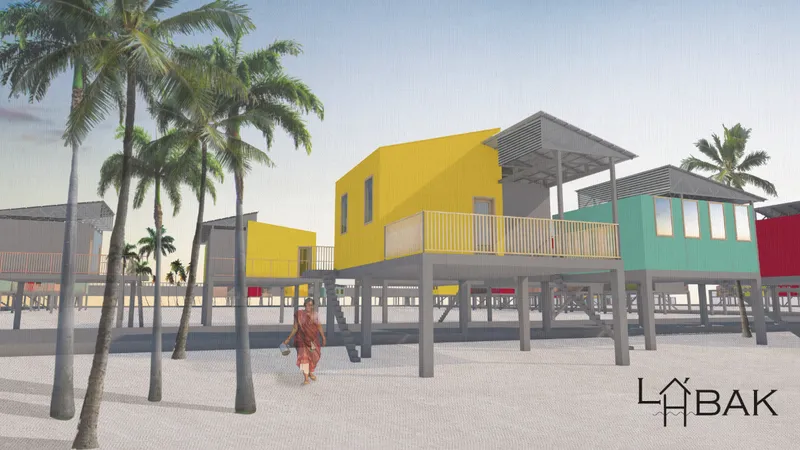
The rendering puts occupants into the scene. Elevated homes with yellow and teal walls sit comfortably among palm trees, their stilts clearly visible, their platforms well above grade. The color palette feels local rather than imposed, and the scale of each unit is modest, suggesting single-family dwellings with room to expand. That expandability is intentional: the designers specify that plots are sized to allow families to add rooms or adjust layouts as their needs evolve, giving residents long-term autonomy over the architecture they inhabit.
What the rendering also communicates is the relationship between the built environment and the existing ecology. The palm canopy is not cleared to make room for houses; the houses are threaded into it. Combined with the perimeter vegetation buffer, this creates a settlement that reads as an extension of its landscape rather than a scar on it. Playgrounds, parks, and open areas for small-scale farming are distributed across the neighborhood plan, reinforcing a model where housing is not just shelter but a framework for community self-sufficiency.
Why This Project Matters
Flood-resilient housing in India is frequently discussed in policy documents and rarely delivered in a form that communities can actually build and maintain. LABAK's strength lies in its refusal to separate the structural solution from the social one. The bamboo-concrete stilts are only effective because they sit within a larger system: vegetation buffers that slow water before it reaches buildings, raised footpaths that keep people moving during emergencies, public squares that give the settlement a civic life worth protecting. Remove any single layer, and the others still function. Together, they create genuine redundancy.
Jovan, Nagy, and Horváth have proposed a housing typology that treats flood-prone terrain not as a problem to be engineered away but as a condition to be inhabited intelligently. The expandable plots, the community-driven construction process, and the ecological integration all point toward a model that could replicate across India's vast floodplains. For a shortlisted competition entry, LABAK carries the clarity and conviction of a project ready to be tested in the field.
View the Full Project
About the Designers
Designers: Endre Jovan, Eszter Nagy, Árnika Horváth
Enter a Design Competition on uni.xyz
uni.xyz runs architecture and design competitions year-round that reward proposals with spatial conviction and real site intelligence.
Project credits: LABAK by Endre Jovan, Eszter Nagy, Árnika Horváth HEAL+ (uni.xyz).


Popular Articles
Popular articles from the community


The Amber Palace Opera: A Geological Fiction Surfaces on Tallinn's Baltic Waterfront
Pierre Brillard reimagines a Baltic legend as a public landscape, opera house, and waterfront promenade rooted in Tallinn's coastal identity.


ETEH Reworks the Shared Spaces of São Domingos School in Brazil Around Timber, Color and Hanging Plants
At São Domingos School in Brazil, 436 m² of hall, refectory and library are recast with timber joinery, a yellow and blue code and trailing greenery.

graciastudio Turns a Viewless Tijuana Lot Inward Around a Courtyard of Concrete, Timber and Trees
In Tijuana, Jorge Gracia's GA2 House stacks a timber-clad private floor over exposed concrete and replaces a missing view with a planted interior patio.

Opera on the Sea: Driftwood Logic Shapes a Timber Opera House on Estonia's Coast
Trevor Orgill's opera house translates the entangled drift of floating timber into a civic building where wood, water, and music converge.

Similar Reads
You might also enjoy these articles

Cube Design Draws an Ecological Corridor Between Two Shenzhen Hills with the Nankai Building
Beside Shenzhen's container docks, the Nankai Building pairs stacked balconies with a climbing green screen to connect two hillsides across its height.

Praksis A and Studio Sted Bend a Red Timber Cabin Across the Granite of Norway's Southern Coast
On the southern Norwegian coast, a 105 m² cabin follows the rock on slender posts, pairing red cladding outside with pine, brick and plywood within.

David Ortega Stacks a Two-Story Mexico City Penthouse Around a Steel Stair and a Pergola-Shaded Roof Terrace
In Colonia Roma, a 300 m² penthouse uses oak joinery, a planted steel stair and a slatted roof pergola to make a new-build apartment feel like a house.

PARALELA and LB2 Thread a Public Walkway Through the Base of a Las Condes Residential Tower
In Las Condes, Santiago, the Hamlet Building gives its fenceless ground floor to a 70-metre wooded passage linking two streets and the metro.

Comments (0)
Please login or sign up to add comments
No comments yet. Be the first to comment!