
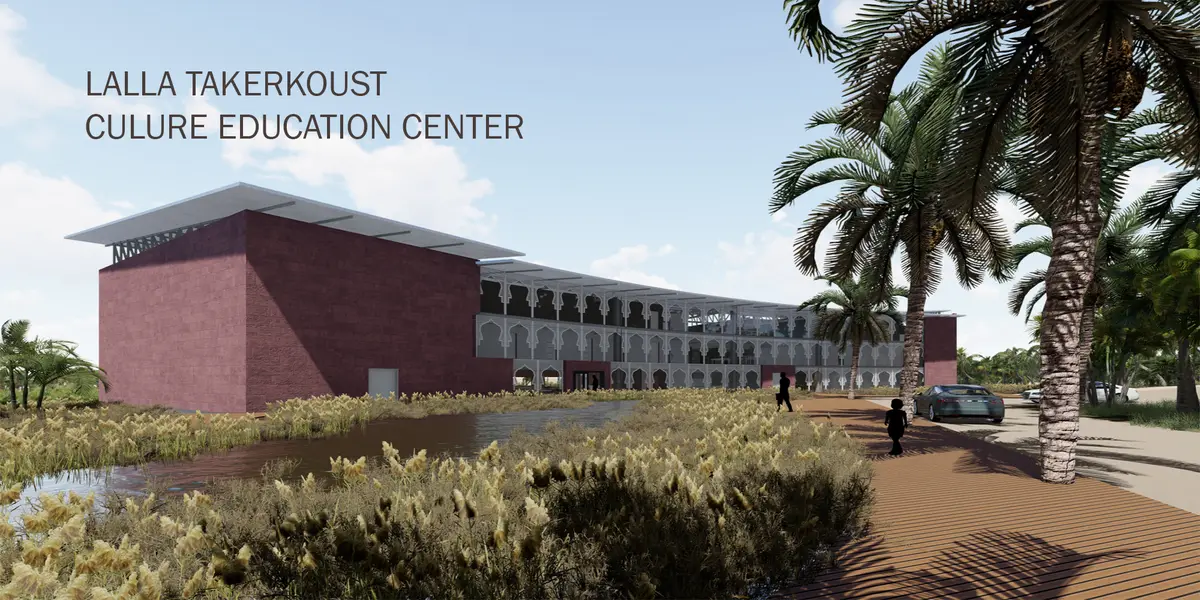
LALLA TAKERKOUST CULURE EDUCATION CENTER
Culture oasis center

1 Why did you design a cultural education center?
Morocco's oasis is disappearing 5 ~ 8 percent each year. There are three major reasons why the oasis disappears; the development of arable land, the increase of population in Marrakesh, and the lack of education for people about saving water. Hence, lack of education, the government is struggling to carry out the water deficit solution policy. So I designed Wadiz Cultural Center to awaken awareness of the water deficit problem. Wadi is an Arabic word that describes [dry river bed]. My cultural center is also named Wadiz Cultural Center to protect nature as a big river like this.
2 What was the concept behind the project?
My concept is a wetland where helps and harmonizes nature, people, and animals. Wetlands function as natural filters to regenerate the contamination of nature. It is a place of ecological learning for people to experience and study various species and natural ecosystems. Also, Wetlands become the home of wild animals. These multi-functional wetlands help and bring them together at the same place. So I create a wetland in my cultural center to co-exist with nature and humans.
3 What was the intent behind the organization of elements across various levels(Architectural, site, urban)
As a site, The architecture mass was placed in consideration of the contours, and wetlands were created around it. As an urban, I place a parking lot and guest room in culture center for long-distance travelers. The first floor was filled with experience and relaxation, the second floor with cultural experience, and the third floor with research and academy.
4 How did your culture center express the culture of Marrakesh?
To express the culture of Marrakesh, I put Arabic traditional patterns on the facade. The arched pattern is placed on the north and repeated patterns were placed in the south.
5 What/how were the materials chosen?
The reason why I choose 'Tadalakt' has both symbolic meaning and function. It is used in both interior and exterior. It is used from toilets to the royal palace, and its distinctive deep red color represents Morocco’s history and culture. Tadelakt is labor-intensive to install but durable. Since it is applied as a paste, Tadelakt has a soft, undulating character, it can form curves, and it is seamless. So I could design a curved wall and facade. Also, it is a waterproof plaster that protects the walls from the moist of the wetlands.
6 What efforts did you make for eco-friendly design??
The culture center is in the middle of the desert, where the temperature rises to 40 degrees celsius. To protect the building from the heat, the culture center use a natural ventilation system. Natural ventilation is the wind-driven system that creates air movement in and out of the building. The benefits of natural ventilation include air quality improvement and energy efficiency. Through the natural ventilation system, the cultural center has created an eco-friendly and sustainably designed building.


Popular Articles
Popular articles from the community


Singing Woman: Contemporary Architecture Inspired by Estonia’s Voice and the Sea
Singing Woman turns Estonia’s song culture into flowing opera house architecture, blending public life, landscape, sea, and national memory.

Tsunami Convergenics: Turning Catastrophic Ocean Forces into Underwater Housing Infrastructure
A speculative underwater settlement off the coast of Onagawa, Japan, treats tsunamis and typhoons as energy sources rather than threats.

The Amber Palace Opera: A Geological Fiction Surfaces on Tallinn's Baltic Waterfront
Pierre Brillard reimagines a Baltic legend as a public landscape, opera house, and waterfront promenade rooted in Tallinn's coastal identity.

Temporary Home for Dogs: A Reversed Zoo Rethinks Animal Shelter Architecture
In Bucharest, a sinuous corridor and freed landscape flip the logic of containment, designing a shelter that works to make itself unnecessary.

Similar Reads
You might also enjoy these articles

Day and Night Park: A Time-Based Urban Newsstand in Beijing
A temporary urban newsstand in Beijing blending travel, light, and reading through poetic colors, compact form, and community-focused design.

Modernist Patio Renovation in El Masnou, Barcelona by Oliver Segura Arquitectura + Cebrià Arquitectura
Modernist patio renovation blending tradition and innovation with a movable pool, leveled floors, and Catalan materials in El Masnou.

Alto Residencial Coop: Cooperative Housing Development in Santiago de Compostela by Carbajo Barrios Arquitectos
A linear cooperative housing complex blending white volumes and perforated metal façades, enhancing community living, natural light, privacy, and urban integration.

Vil Genis School by BPA ARCHITECTURE – Massy, France
Vil Genis School in Massy, France, features sustainable design, south-facing classrooms, community integration, accessible spaces, and modern educational architecture.


Comments (0)
Please login or sign up to add comments
No comments yet. Be the first to comment!