
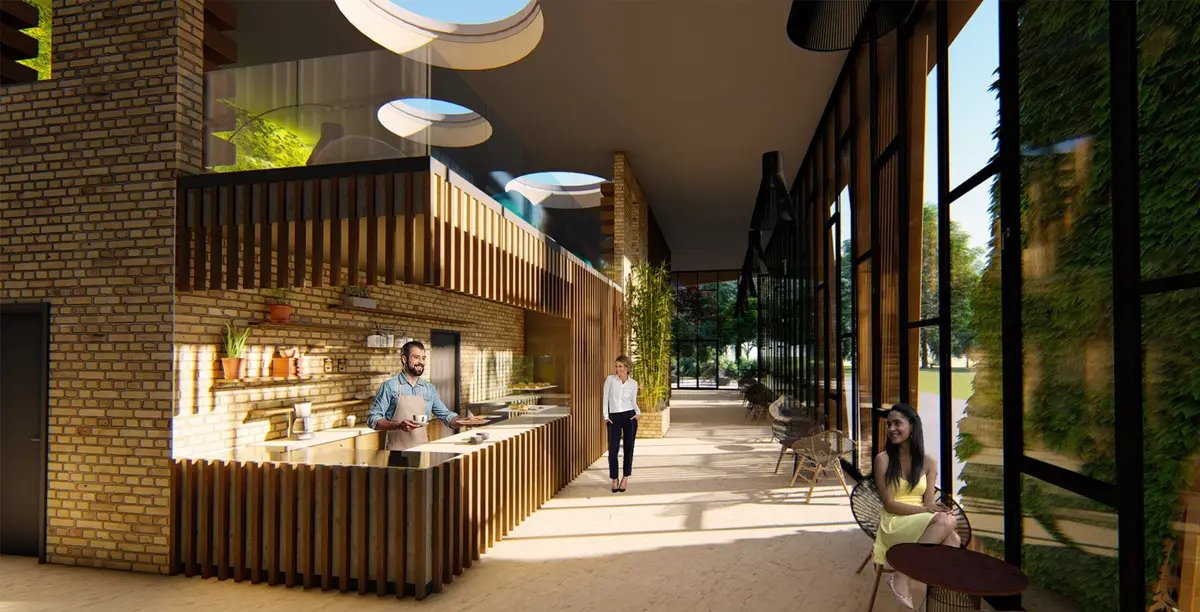
Lamela Café: A Timber-Slatted Pavilion Mediating Between Vienna's Towers and Its Park
Angled timber lamellas, ivy walls and round skylights turn a compact Vienna café into a calm threshold between residential towers and a park.


Most cafés sell a pause. Lamela Café builds one. It sits on a site in Vienna where high-rise residential towers face an open green park. The project does not side with either condition. Instead, it places itself between them as a small piece of architecture that filters the city through timber, foliage and light. Its core argument is that nature in a dense neighbourhood should do real work: shading, softening sound and pacing how people move. Planting is not there just to decorate a room.
Designed by Anna Gráner, Dániel Varga, Hajba Bianka and Beáta Darcsi, the project was a Shortlisted entry in Brewed 2020. The team treats the café as a micro-urban oasis. It is a place for brief escape that never asks visitors to leave the city. The plan is compact, but it supports solitary reading, social gathering and small performances. It does this through careful vertical layering rather than extra floor area.
An Ivy Wall, Round Skylights and a Room That Slows Down
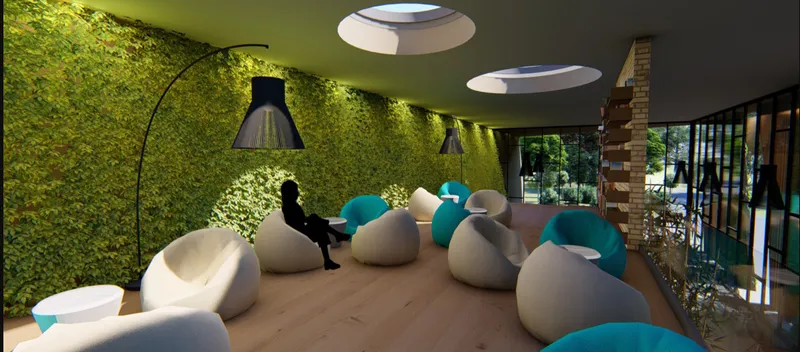
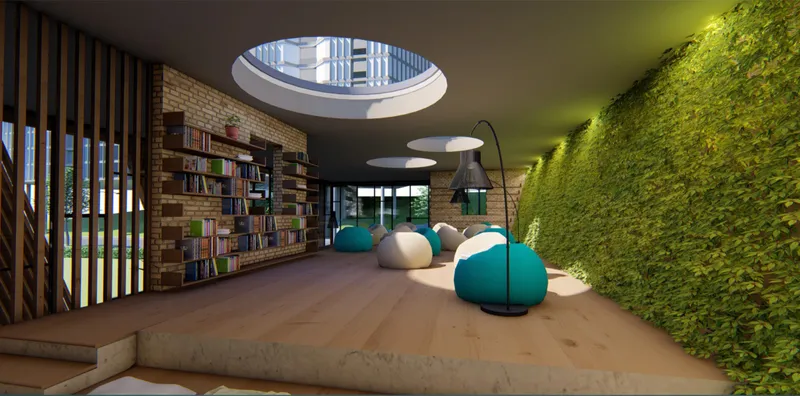
The interiors show the biophilic intent most directly. In the lounge, low round poufs cluster beside a wall covered in ivy. Circular skylights wash the space from above, and arc floor lamps pick up the light after dark. Next door, the reading lounge sets a brick bookshelf wall against timber slats. Teal poufs sit beneath another round skylight. The palette is restrained: brick, wood and living green. Each material has a clear job. The masonry gives weight, the timber gives warmth and the planting gives movement.
These rooms belong to the quieter upper level, which the designers dedicate to reading and relaxation. Soft seating, lower noise levels and diffused light encourage people to stay longer. A small stage adds flexibility, so the same room can host intimate readings or community events. Light falling from overhead discs, rather than through wide windows, turns attention inward. That inward focus is exactly what a retreat from the street needs.
Stepped Seating as a Sectional Device
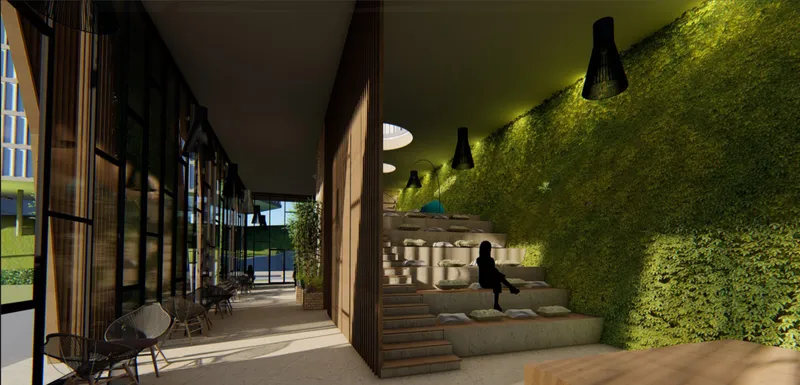
This stepped timber seating, lined with cushions along a green wall, captures the project's sectional thinking in a single move. The steps can be furniture, circulation or an informal auditorium, depending on the hour. The figure seated in dappled light shows the scale: intimate, with room for one person to settle without feeling exposed.
The team says the café relies on vertical layering instead of horizontal expansion. This image shows why that matters. Changing levels give each zone its own height and view, so the interior feels larger than its footprint. On a constrained urban plot, the section becomes the main tool for generating spatial variety.
A Cantilevered Roof That Opens to Street and Park
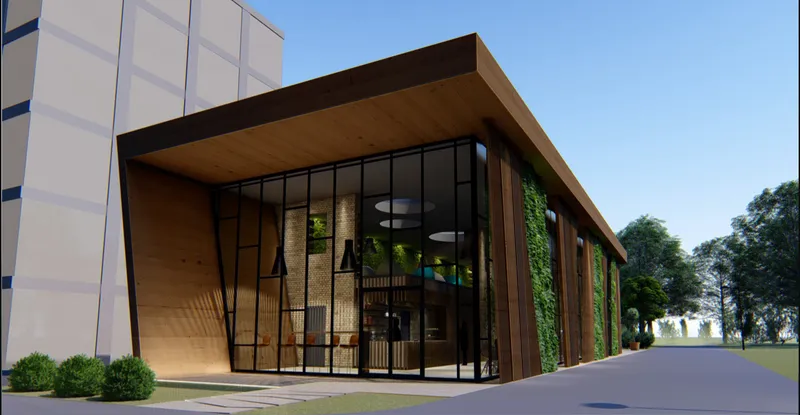
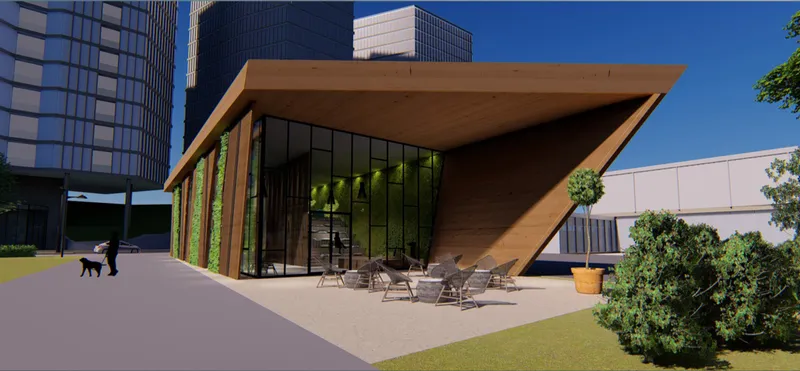
From outside, the building reads as a pavilion. A cantilevered timber roof extends over black-framed glazing, and the angled canopy reaches out across a gravel terrace. Wicker chairs and a potted tree sit beneath it. The person walking a dog through the frame is telling. This is a building that expects passers-by and makes room for neighbourhood routines.
The ground floor works as the primary public interface. It is open enough to be entered from both the street and the park. That double access matters more than any single detail. It turns the café into a connector within the local network of routes, not an object parked on the edge of the green. The roof overhang extends that welcome outdoors, giving the terrace shade and a sense of enclosure without walls.
Lamellas and Vines Along the Glazed Edge
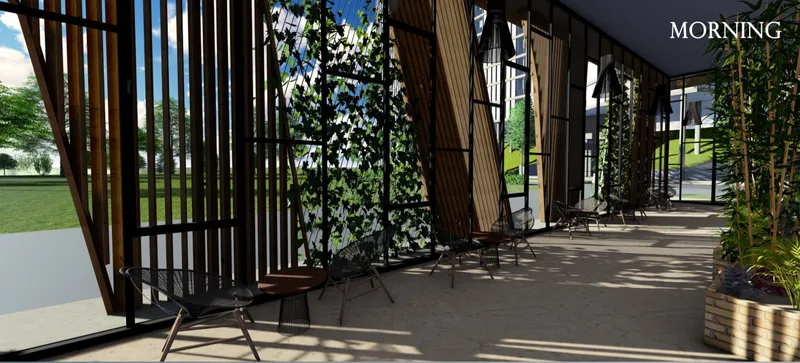
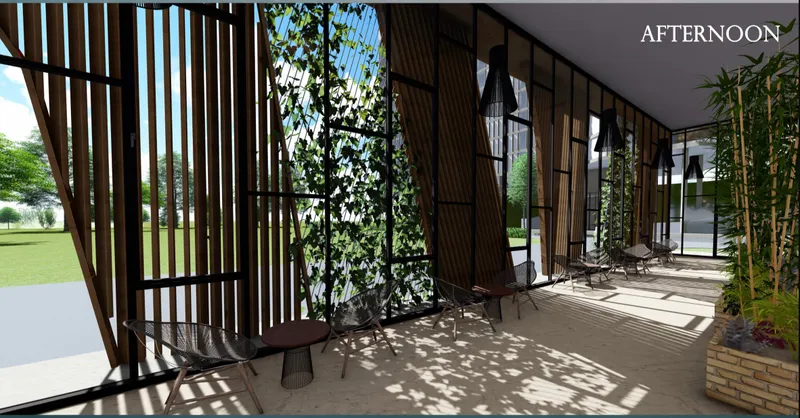
The lamella system gives the project its name and its most distinctive feature. Vertical timber slats and fins line a covered walkway and a glazed corridor. Climbing vines and ivy wind between them, while bamboo planters and wire or black chairs furnish the edge. The designers angle the lamellas in response to sun orientation. As a result, morning and afternoon light reach the floor broken into patterns rather than arriving as glare.
This is where the biophilic idea becomes measurable. The fins moderate interior comfort, give the façade a recognisable rhythm and act as a frame for planting to grow on. Over time, the vines would thicken the screen and blur the line between building and landscape. That gradual softening suits a project positioned between a tower block and a park.
Why This Project Matters
Lamela Café shows that a small building can take a clear position on a contested edge. Many biophilic proposals simply add greenery to a conventional box. This one uses a single element, the angled timber lamella, to handle shading, identity and a structure for planting all at once. The two-sided ground floor and the quieter upper level build a gradient from public to private that matches the site's own shift from density to landscape.
For a competition centred on coffee, the entry makes a useful point. The atmosphere of a café depends less on its bar than on how it handles light, sound and threshold. The project keeps its palette modest and its moves legible. It also lets the section, rather than the footprint, generate richness. These lessons transfer easily to any urban site where land is scarce and calm is in short supply.
View the Full Project
About the Designers
Designers: Anna Gráner, Dániel Varga, Hajba Bianka, Beáta Darcsi
Enter a Design Competition on uni.xyz
uni.xyz runs architecture and design competitions year-round that reward proposals with spatial conviction and real site intelligence.
Project credits: Lamela Café by Anna Gráner, Dániel Varga, Hajba Bianka, Beáta Darcsi Brewed 2020 (uni.xyz).


Popular Articles
Popular articles from the community


GROUP A Strips a 1969 Rotterdam Harbor Headquarters to Its Frame and Wraps It in Timber Louvers
In Rotterdam's M4H harbor district, Ferro Offices reuses a 1969 frame, adds one timber storey and reaches BREEAM-NL Outstanding.

U.GA Architects Wraps an Oval Rooftop Pool in Curved Board-Formed Concrete on Busan's Jeollidan-gil
In Busan's Jeonpo-dong, a 454 m² mixed-use block stacks a neighborhood facility, guest rooms and an oval rooftop pool inside spiraling concrete walls.

Architekt Andreas Gruber Scatters 23 Dark Timber Chalets Across a South Tyrolean Forest Edge
In Molini di Tures, Amonti Chalets breaks a resort into a hamlet of gabled timber houses, with parking, storage and services pushed into the slope.

LT2A and OPEN Architectes Thread a Brick and Glass High School Through a Wooded Belgian Campus
In Braine-l'Alleud, a 3,000 m² wing for Collège Cardinal Mercier pairs pale brick with a glazed colonnade, deferring to a small chapel and a dense wood.

Similar Reads
You might also enjoy these articles
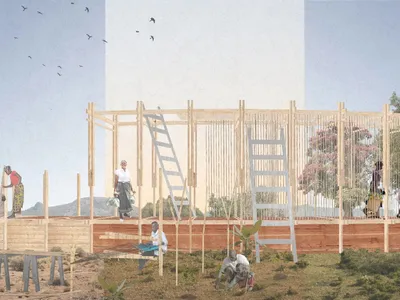
Healing Façade: A Modular Chapel System That Restores Ethiopia's Sacred Forests
Winner of the Eco-Chapel competition, this circular timber façade collects water from air to rebuild soil and reforest degraded Ethiopian landscapes.
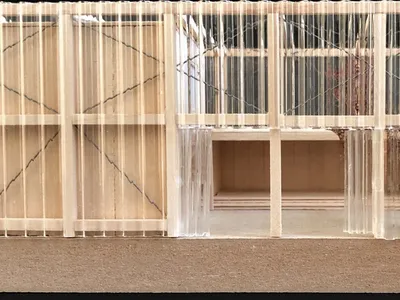
Kaffeebühnen: Where Coffee Shop Architecture Becomes a Civic Stage in Vienna
A linear sequence of timber boxes, transparent shells, and open yards turns the Viennese café tradition into a public performance space.
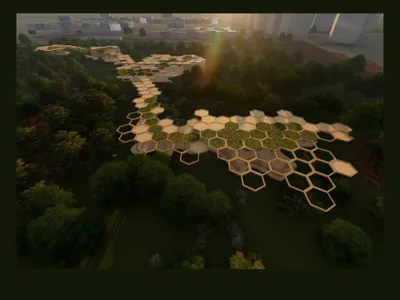
Eco Chapel: A Modular Forest Pavilion That Grows Like the Landscape It Protects
Hexagonal timber modules weave through existing trees, turning a chapel into a living system for prayer, education, and reforestation.


Urban Forest: A Vertical Ecosystem for 5,000 Workers in Singapore's Changi Business Park
Radially stacked pods and layered green decks turn a 7-acre plot into 47 acres of ecological workspace projected for 2040.

Explore Interior Design Competitions
Discover active competitions in this discipline

Challenge to design luxury tourism on rails

VR headsets Storefront design competition

Designing a staircase for a client
Comments (0)
Please login or sign up to add comments
No comments yet. Be the first to comment!