
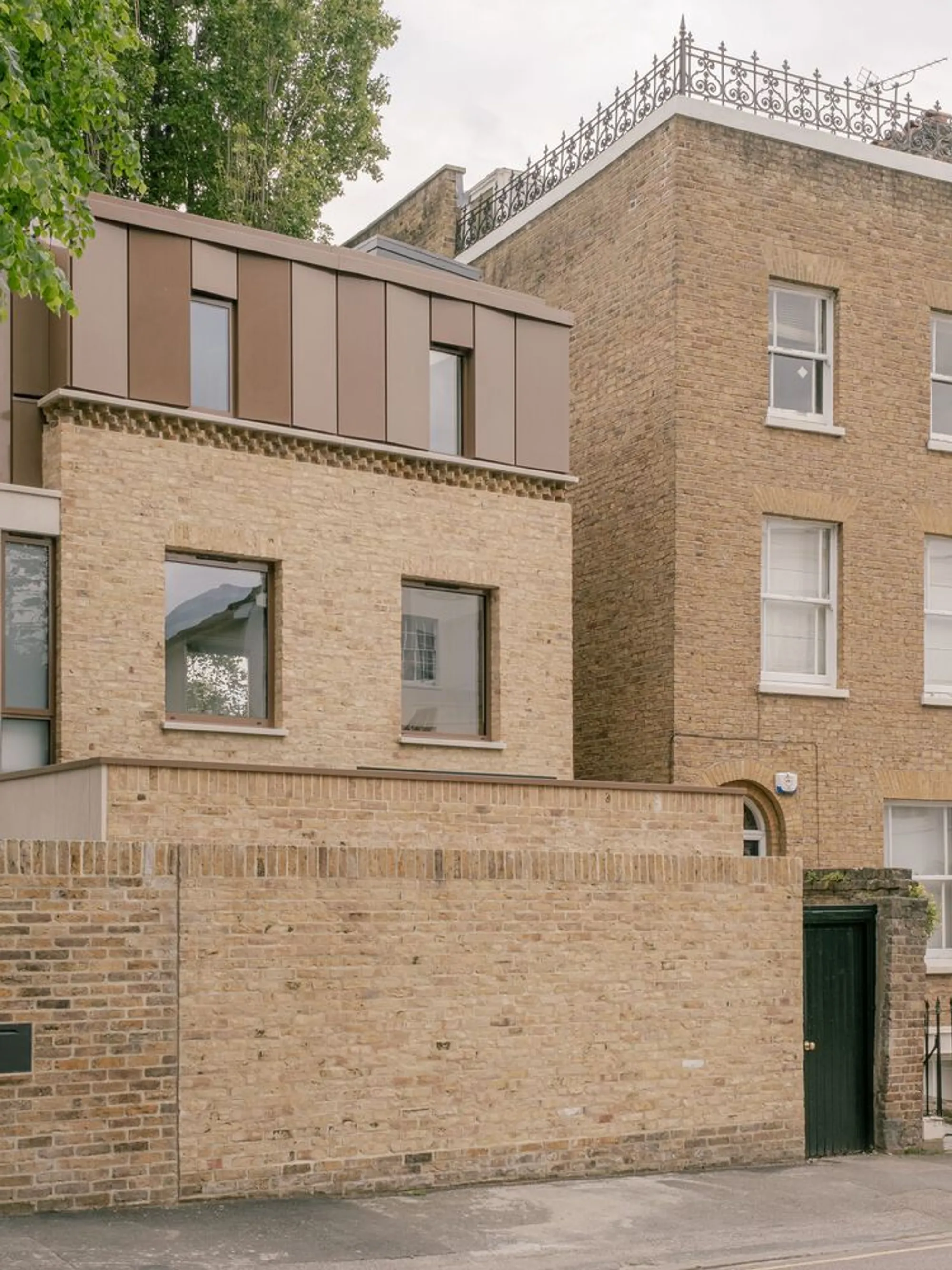
Mailen Design Tucks a Mews House into a Blackheath Conservation Area on a Former Garage Plot
A 114-square-metre infill home in southeast London reinterprets the mews typology with reclaimed brick, bronze panels, and a fabric-first energy strategy.


Slotting a new house into the Blackheath Conservation Area, surrounded by Grade II-listed Victorian villas built for Greenwich's merchant class, is not a casual undertaking. The site, a triple-garage infill plot at the end of a long garden attached to a listed villa on Lee Terrace, had been derelict for years. Mailen Design saw it not as a leftover but as a chance to revive the mews typology: the modest service building that once sat behind a grander terrace, reworked here as a three-storey, three-bedroom family home of just 114 square metres.
What makes the project genuinely interesting is its refusal to treat conservation context and environmental performance as competing priorities. The house steps back at its upper levels to align with its neighbours, wraps itself in reclaimed London stock brick, and tops out with a bronze-finished aluminium volume that reads as both deferential and unmistakably new. Beneath that careful streetscape diplomacy sits a fabric-first envelope, an air-source heat pump, green roofs, and a foundation strategy rethought entirely to protect two mature trees. It is a compact building that carries a lot of ideas without any of them feeling forced.
Reading the Street
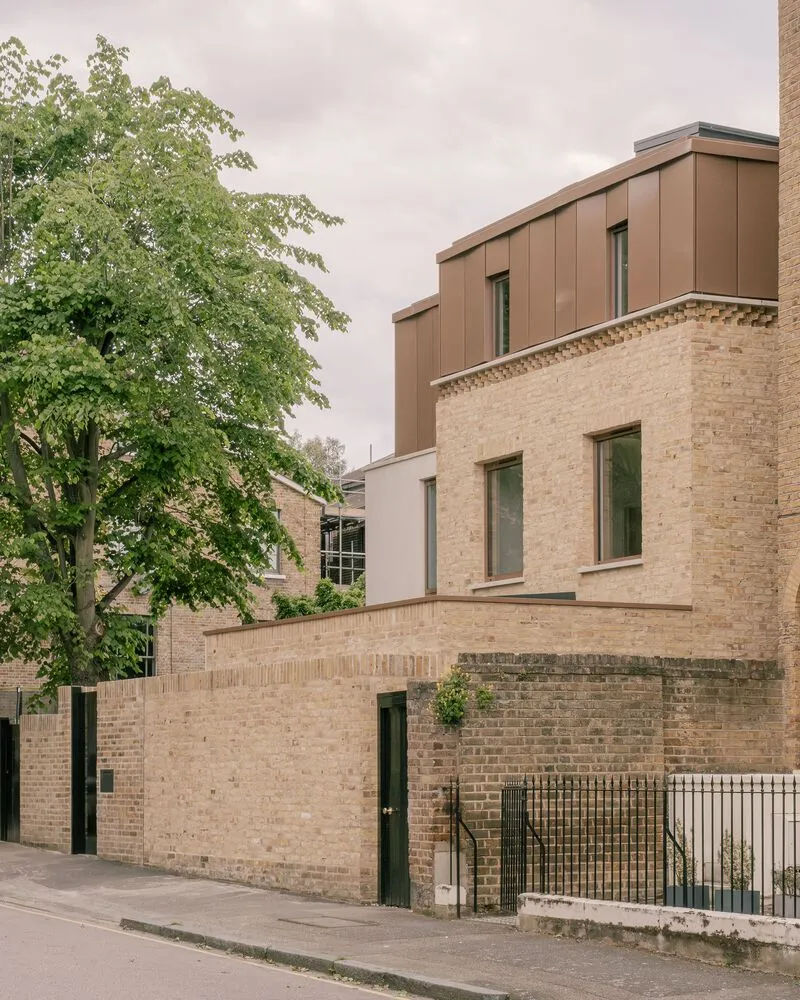
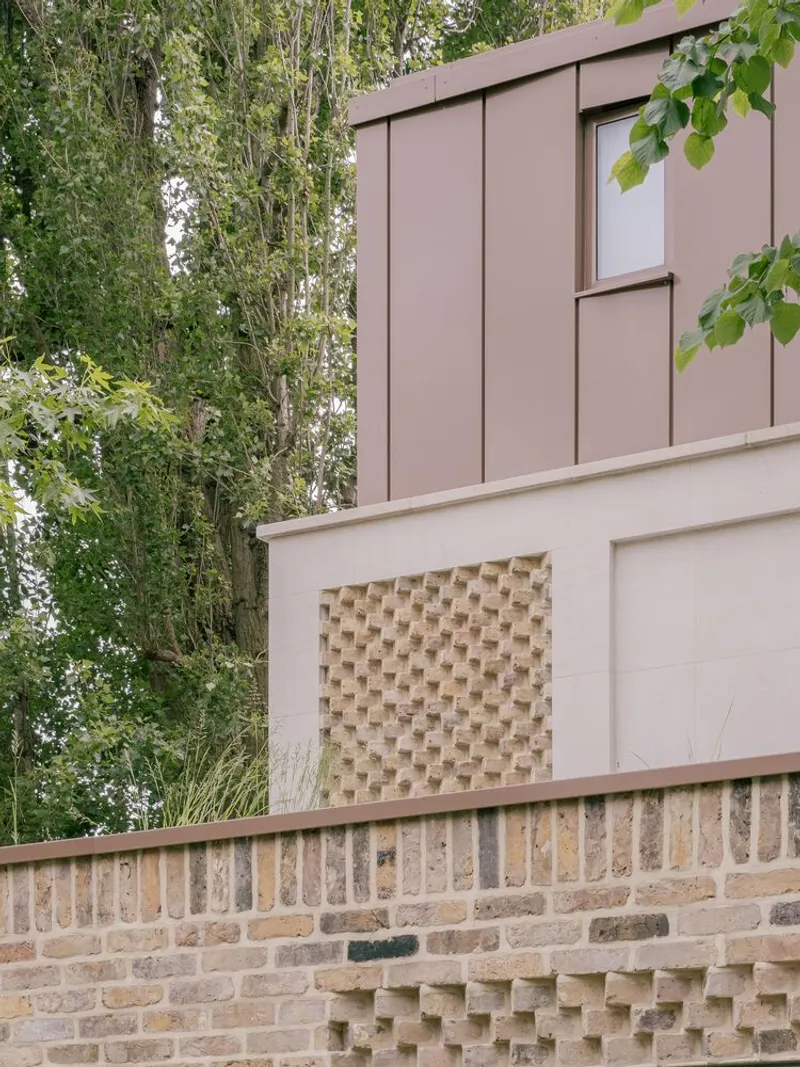
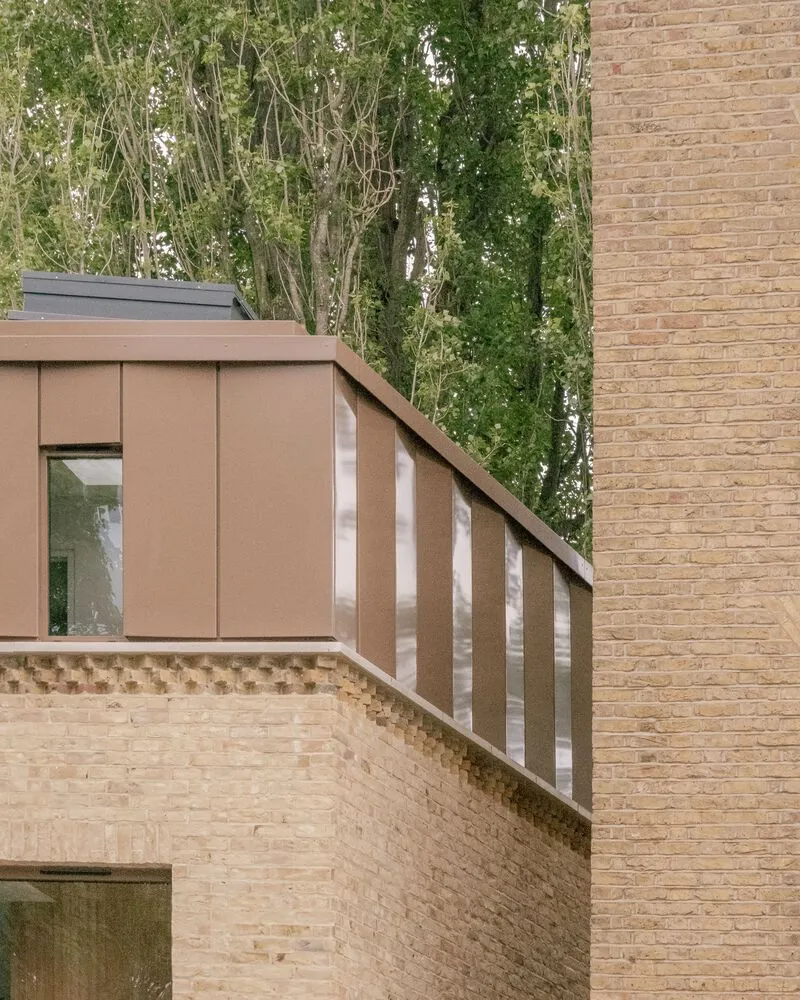
The front facade is a lesson in calibrated assertion. At ground level, London stock brick and pre-cast stone establish a material kinship with the neighbourhood's 19th-century buildings, their solidity and detailing echoed rather than copied. Above, a basketweave brick panel adds textural depth, a contemporary nod to the ornamental cornicing found on adjacent terraces. The angled brickwork catches raking light differently throughout the day, giving the facade a quiet animation that flat surfaces cannot achieve.
The bronze-clad upper storey is the deliberate departure. Its subtle undulating surface reads as almost textile in certain light, pulling the eye upward while the recessed massing ensures the volume stays within the envelope of its neighbours. The first and second storeys step back to align with the front elevations of the adjacent listed terraces, a strategy that earns the new building its place in the conservation streetscape without pretending to be old.
Threshold and Arrival
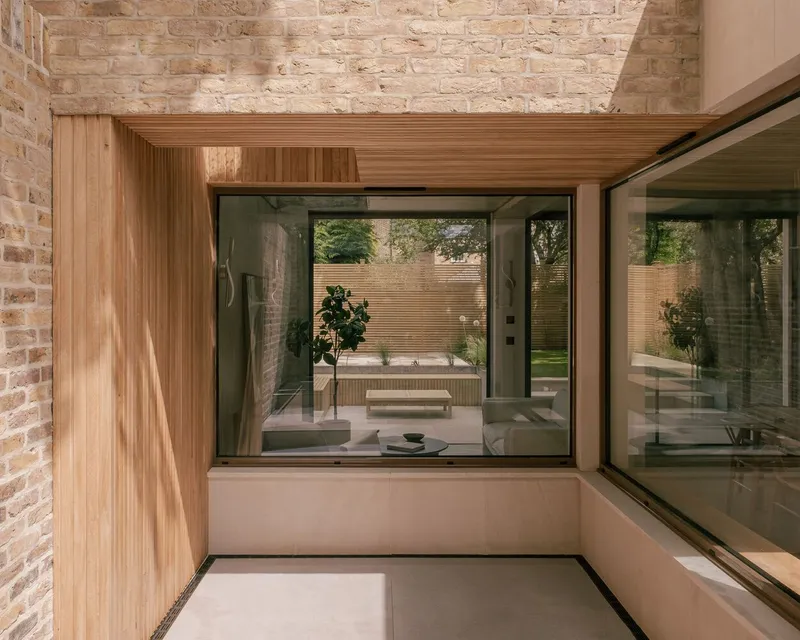
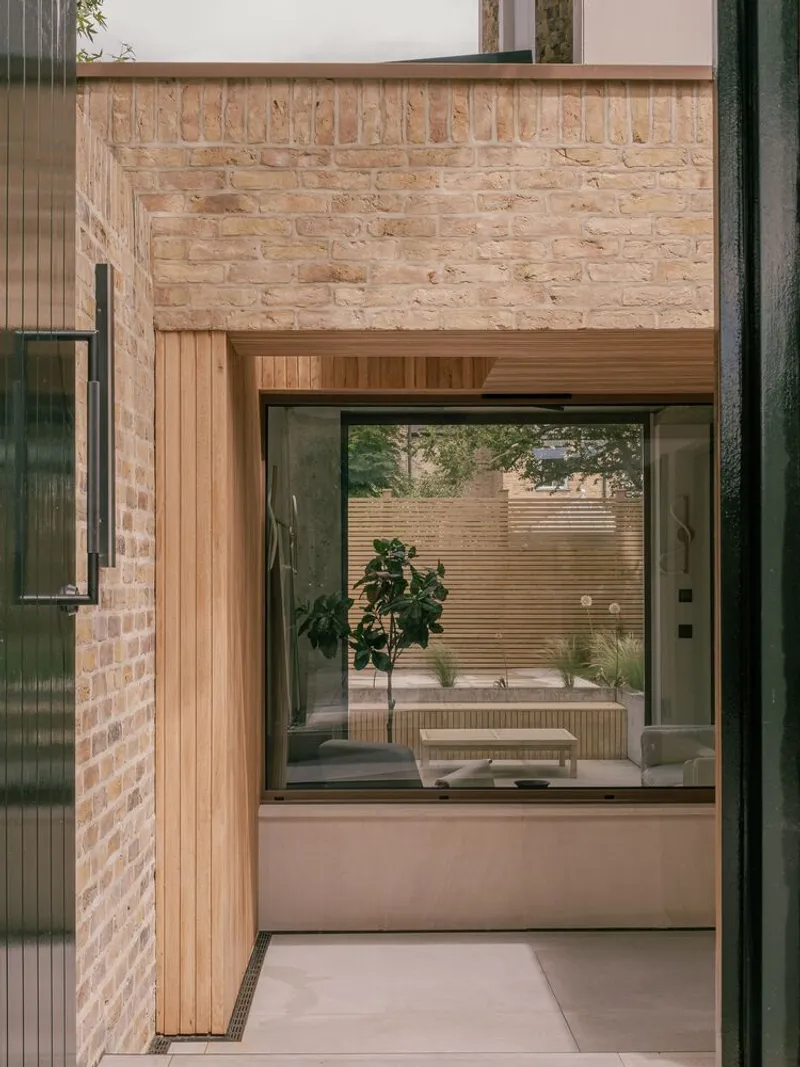
A retained garden wall screens the entrance from the street, so arrival happens in stages. Behind a black timber door, a compact courtyard paved in large ceramic tiles introduces soft landscaping and a potted fig tree. The front courtyard recesses deliberately to leave room for the branches of a mature lime tree in the adjoining garden, a detail that reveals how closely the design was shaped by what was already there.
Stone paving flows from the courtyard directly into the double-height entryway, dissolving the threshold between outside and in. A timber-framed bay window looks back toward the courtyard, framed by brick and concrete. The effect is of compression and release: the tight courtyard gives way to a generous interior volume lit from above by operable skylights.
Ground Floor: Concrete, Green, and Garden
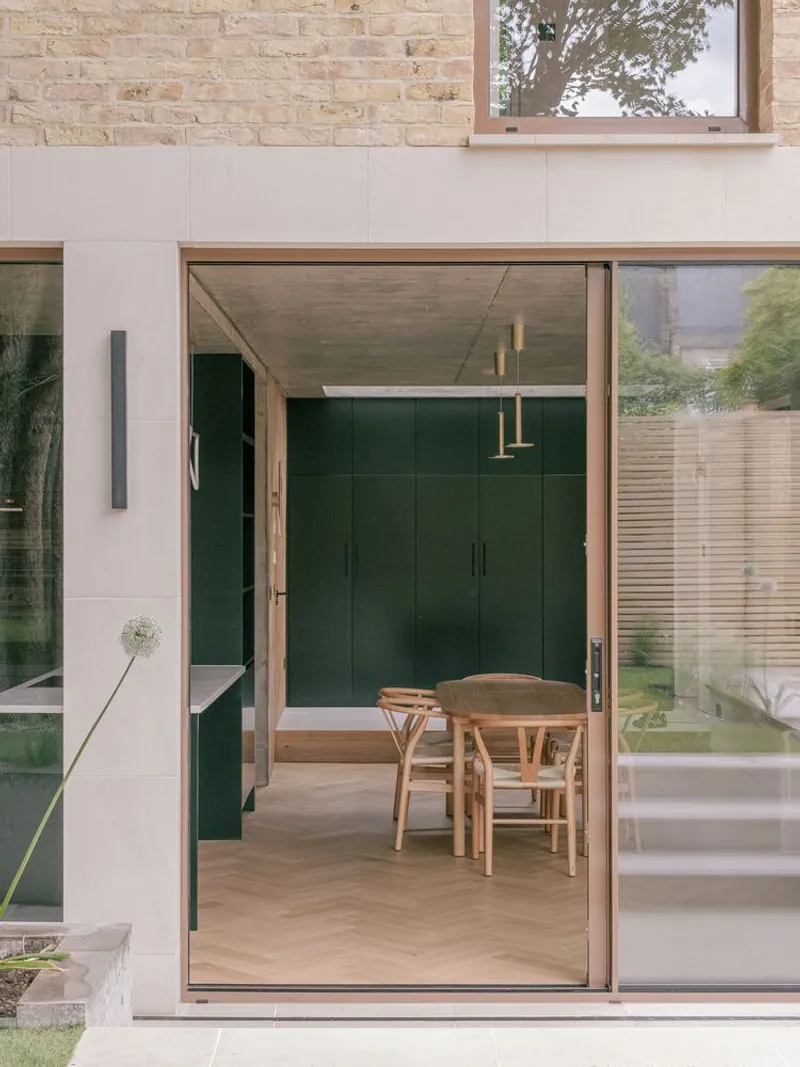

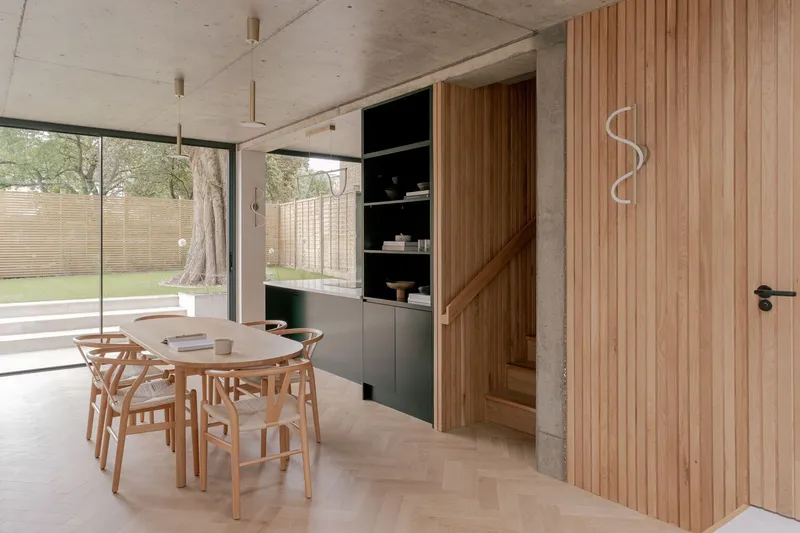
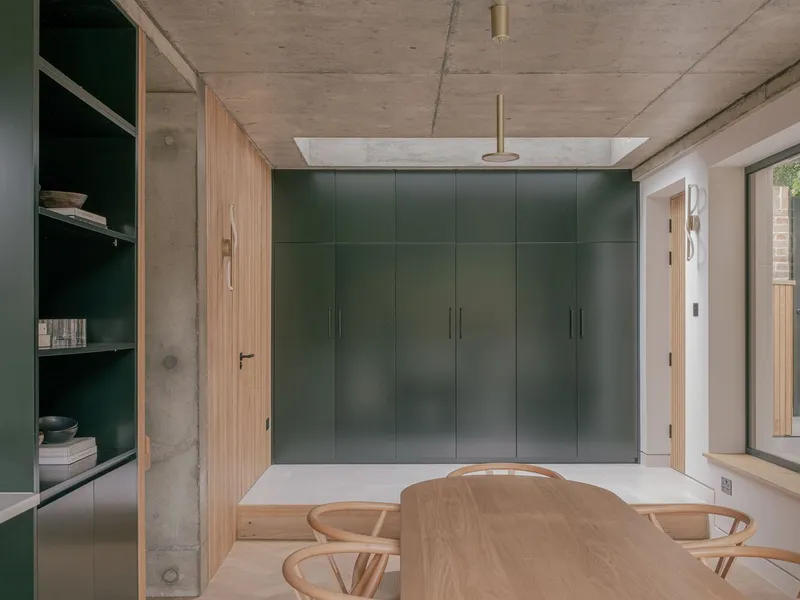
The open-plan ground floor is the social core of the house. Exposed concrete ceilings span the kitchen, dining, and living areas, their raw texture offset by dark green cabinetry with a pale marble backsplash. The concrete is not decorative posturing; it contributes thermal mass, absorbing heat during the day and releasing it slowly, helping stabilise internal temperatures as part of the passive solar strategy.
Floor-to-ceiling sliding glass doors along the rear wall open the entire ground floor to a tiered garden. A sunken patio gives way to a paved terrace, then a turfed section with built-in seating, all framed by a mature poplar tree. The layering is deliberate: each tier offers a different degree of enclosure and sun exposure, making a small garden feel like multiple outdoor rooms.
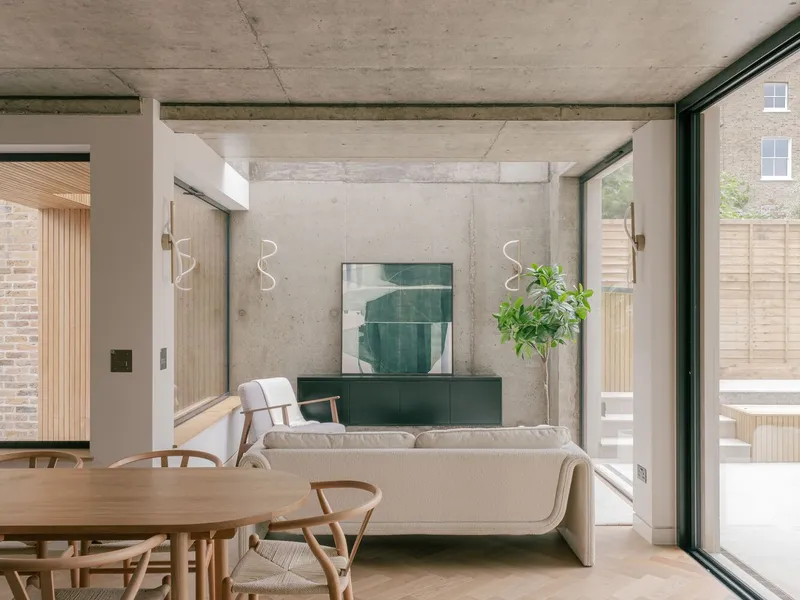
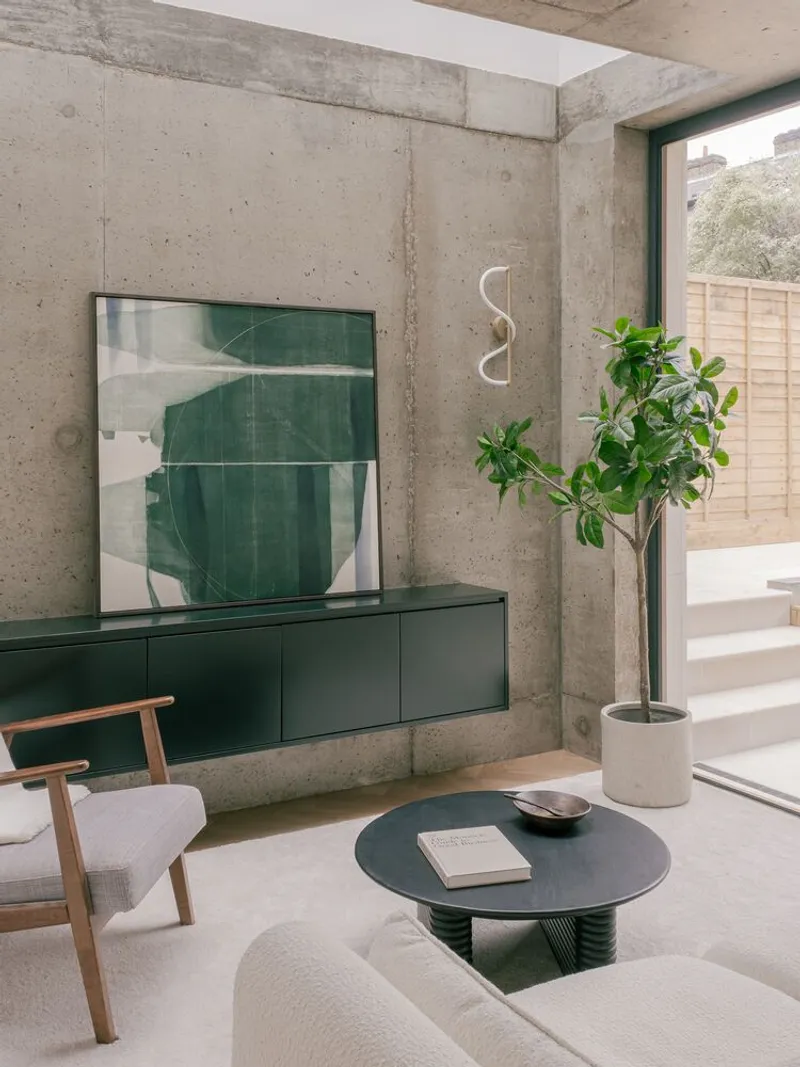

Green runs through the interior like a leitmotif. The cabinetry, the media console, the built-in shelving displaying ceramics and books: all share the same deep green tone. Against the grey concrete and warm oak, it creates a palette that feels specific to this house rather than borrowed from a trend board. Herringbone parquet flooring introduces a finer grain underfoot, a tactile counterpoint to the industrial ceiling above.
The Staircase as Joiners' Piece
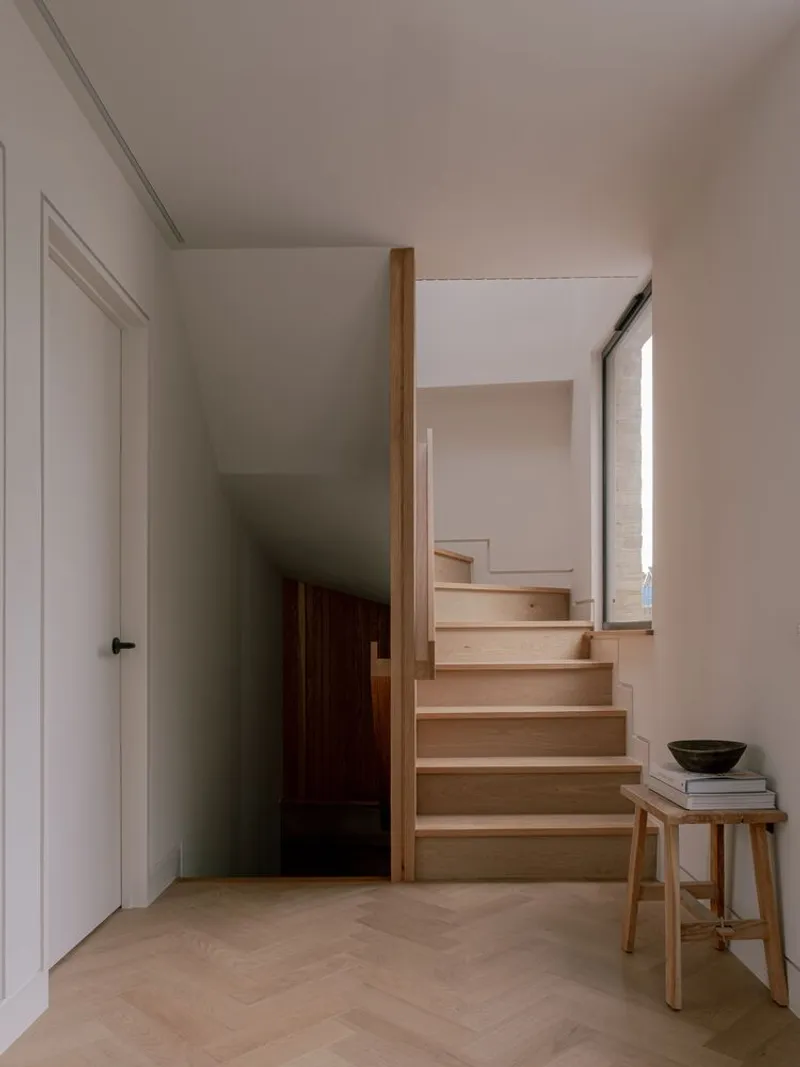

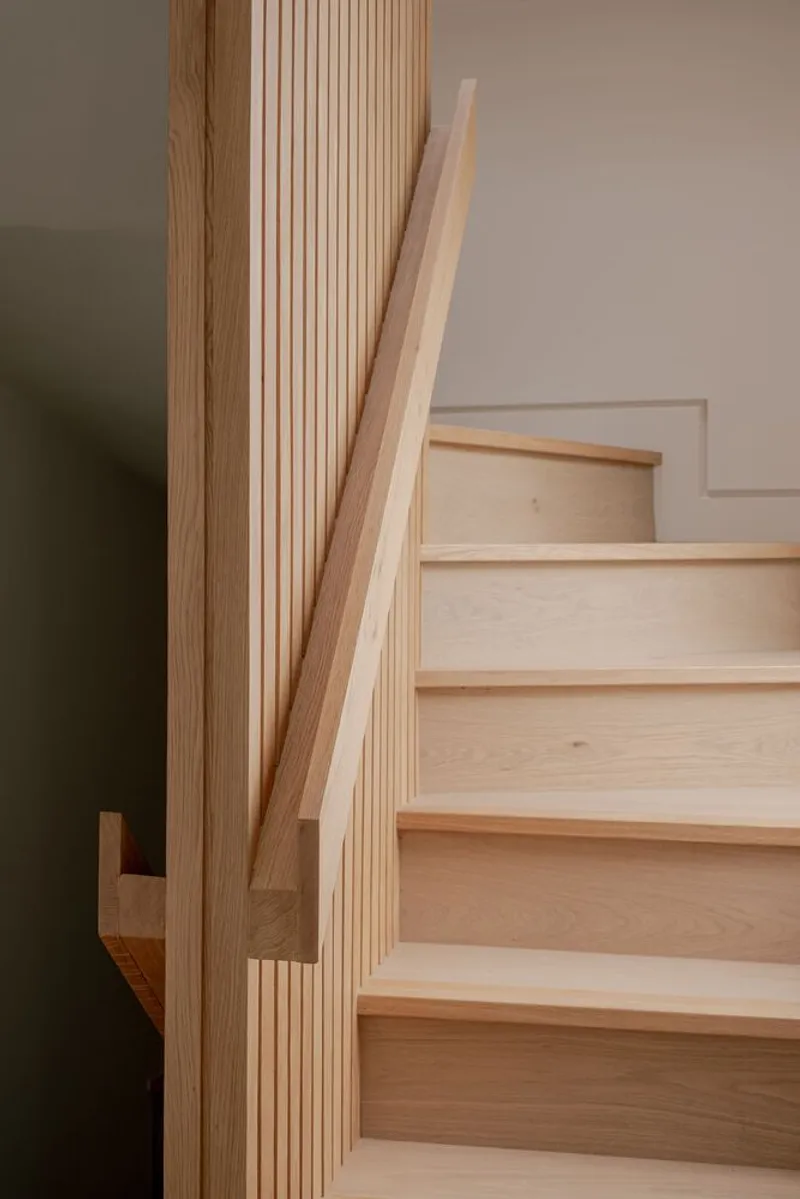
Two oak staircases connect the three floors, and they deserve attention as pieces of craft. The fluted timber cladding on the newel posts and stair enclosures gives each flight a sculptural presence without consuming floor area. Open risers allow light to filter through, while shadow-gap skirting details keep the junction between stair and wall clean. These are not grand gestures; they are the kind of careful joinery decisions that distinguish a well-made house from a merely well-planned one.
The transition between floors mirrors a shift in material character. Exposed concrete and oak dominate the ground floor; white painted plaster takes over on the upper levels, where the rooms become quieter and more private. It is a simple gradient, but it reinforces the mews logic: communal and robust below, intimate and refined above.
Private Rooms Above
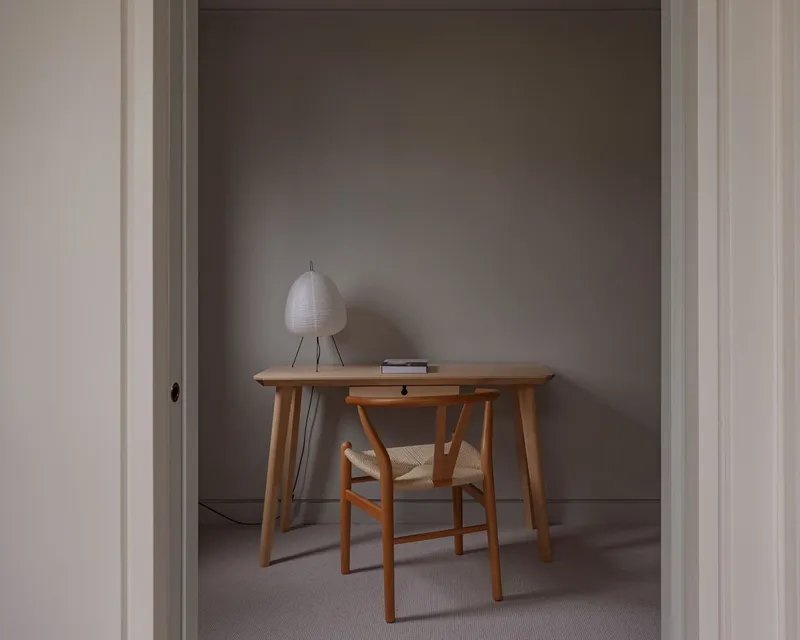
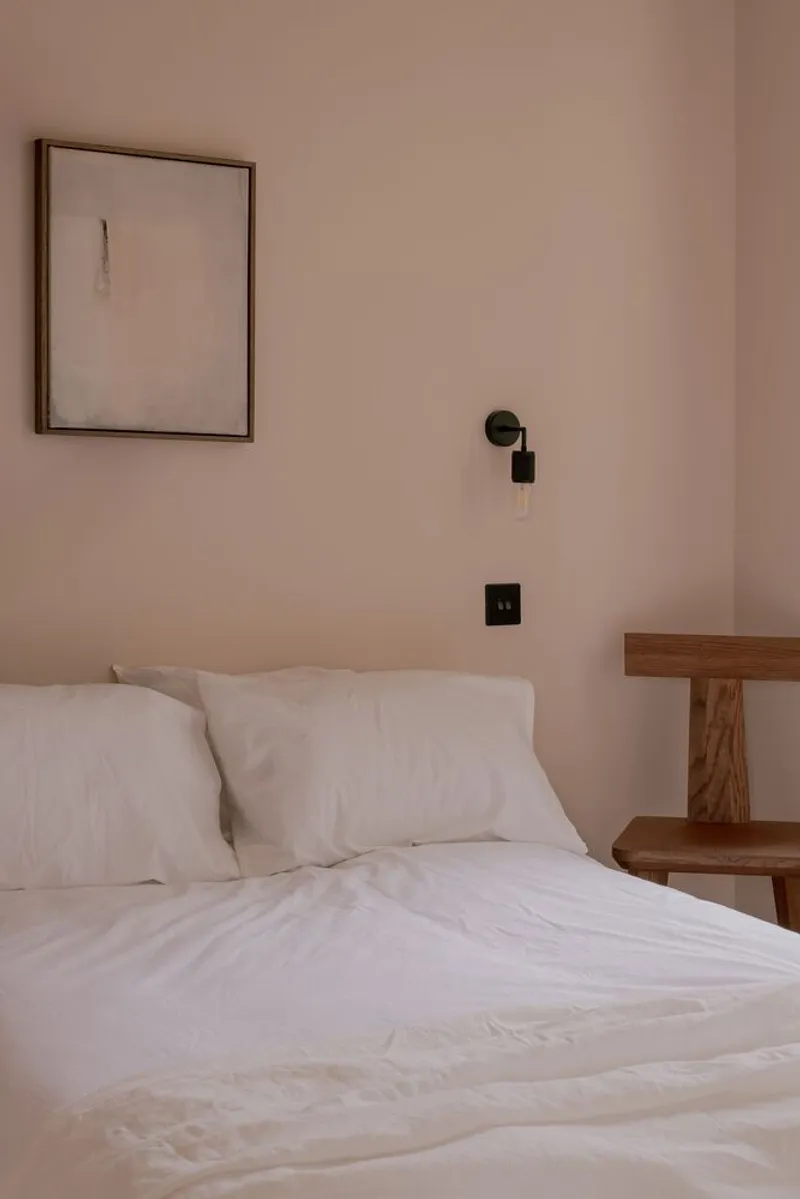
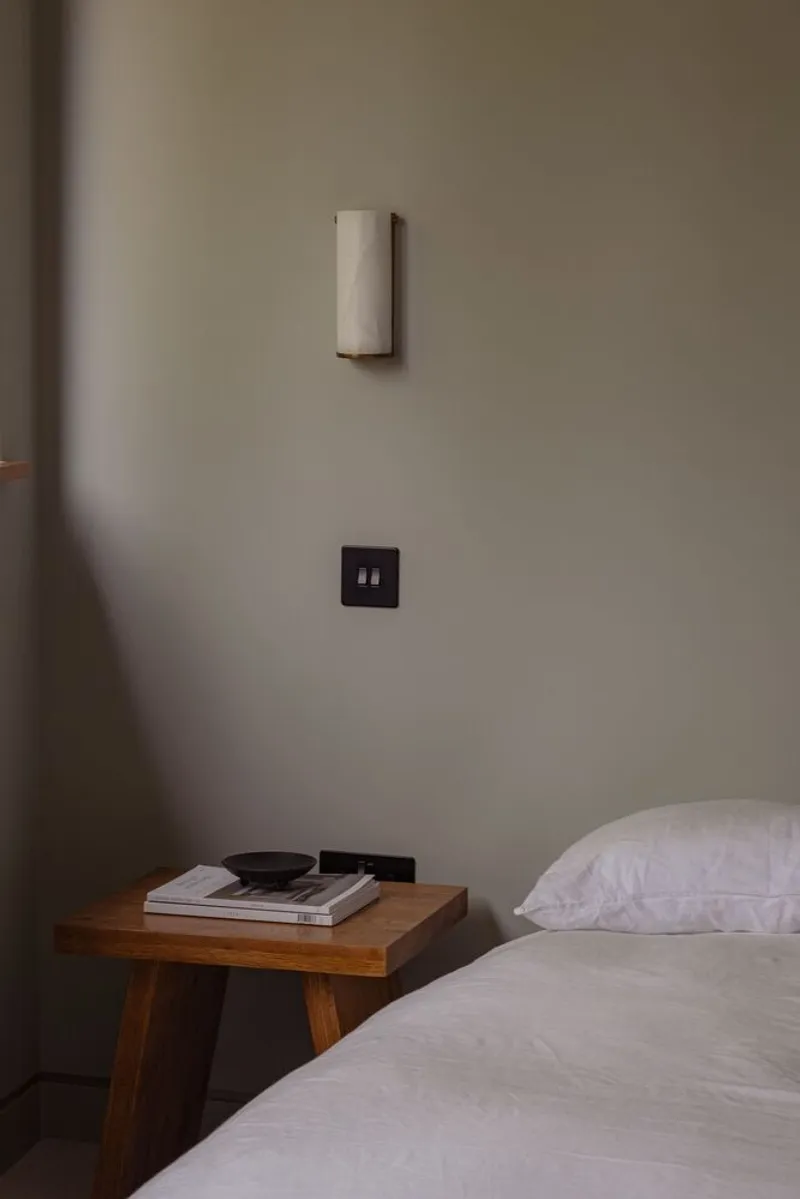
The first floor holds two bedrooms and a family bathroom; the second floor is given entirely to the master suite, with a walk-in wardrobe and en-suite. Bedrooms are kept intentionally calm. Pink plaster walls, white linen, a cylindrical black wall sconce, and a timber nightstand compose a room that trusts restraint over spectacle. The deep-set glazing that characterises the facade also serves the bedrooms well, allowing windows to be opened for natural ventilation without sacrificing privacy from the street.
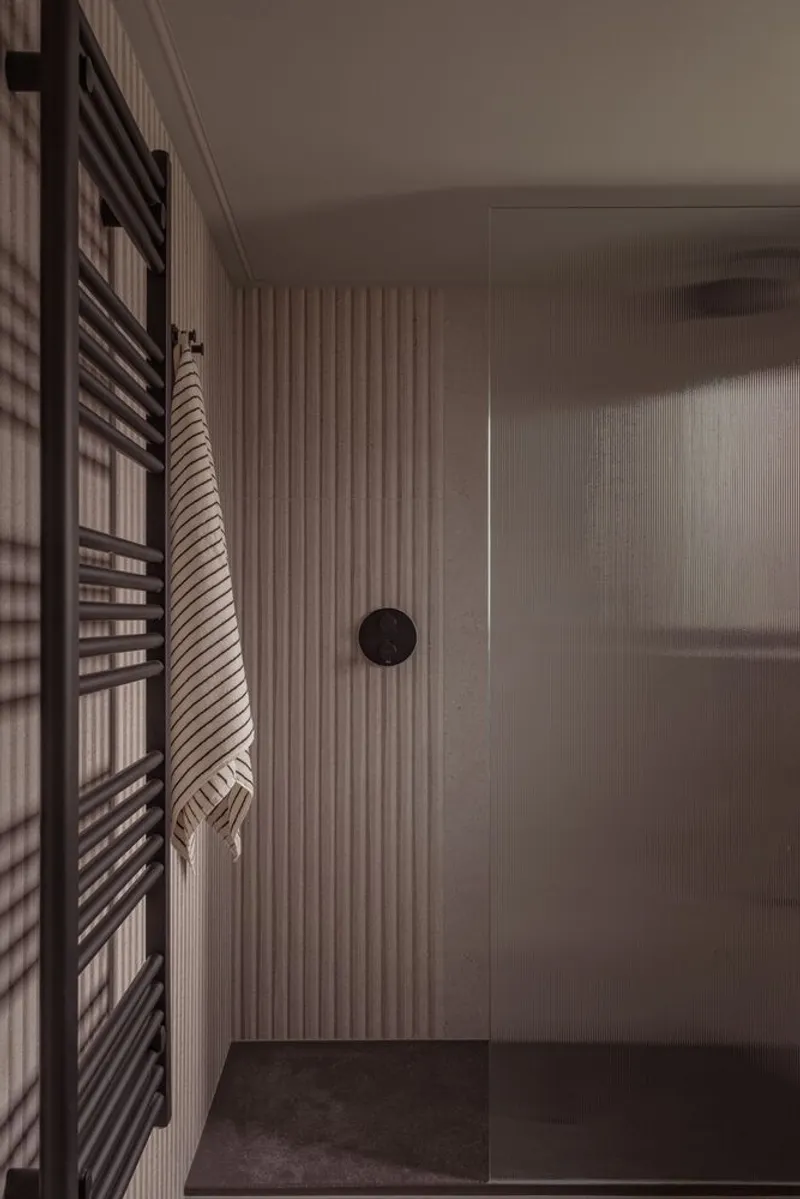
The bathroom introduces vertical timber slats as a screen element alongside a frosted glass shower partition and a black towel radiator. Materials are consistent with the rest of the house: oak, concrete, black ironmongery. Nothing arrives from a different project. The discipline of a small footprint, 114 square metres across three storeys, means every surface decision compounds, and Mailen Design understood that consistency would do more for spatial generosity than any single dramatic moment.
The Garden Facade and Landscape


From the garden, the house presents a different character. The brick upper level with its decorative corbelling sits above a nearly full-width glass wall, and a mature tree rises in close proximity, its canopy brushing the facade. The architects worked with arboricultural specialists to redesign the foundation strategy, ensuring root systems remained undisturbed. The front courtyard was shaped around the neighbouring lime tree for the same reason. In a city where developers routinely fell mature trees to simplify construction logistics, this kind of accommodation deserves notice.
Green roofs cap the building, contributing to stormwater management and adding a layer of insulation. Combined with high airtightness, optimised glazing placement to balance solar gain against overheating risk, and an air-source heat pump, the house achieves its sustainability targets through an accumulation of sensible measures rather than any single technological showpiece.
Detail and Materiality
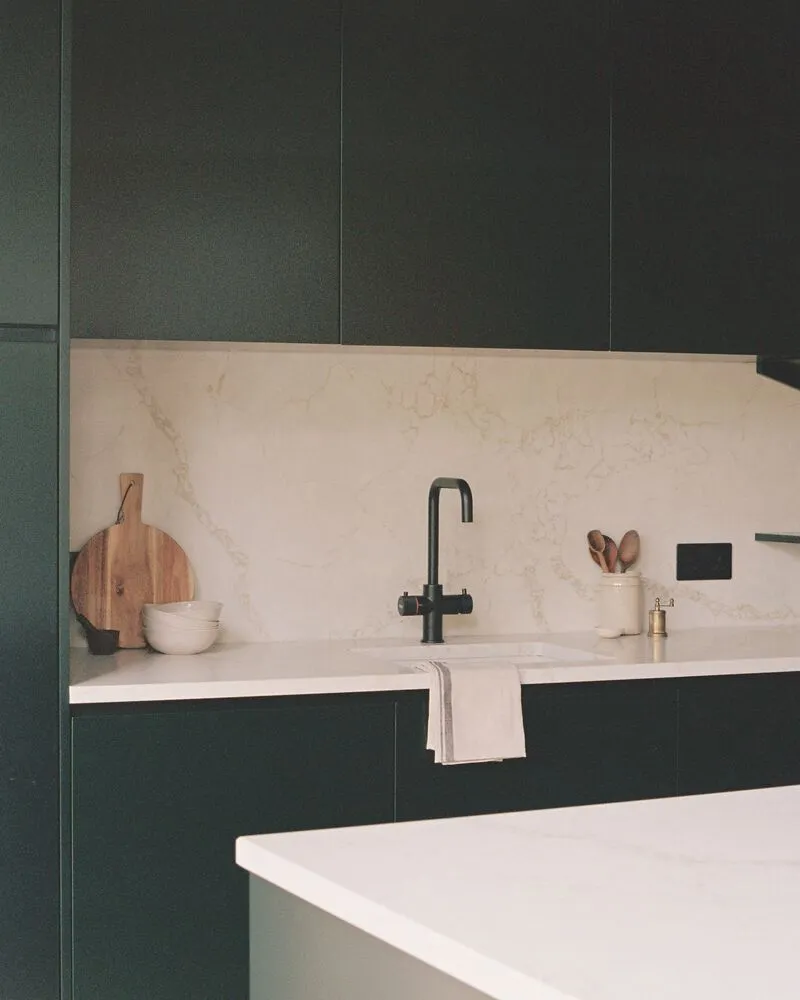
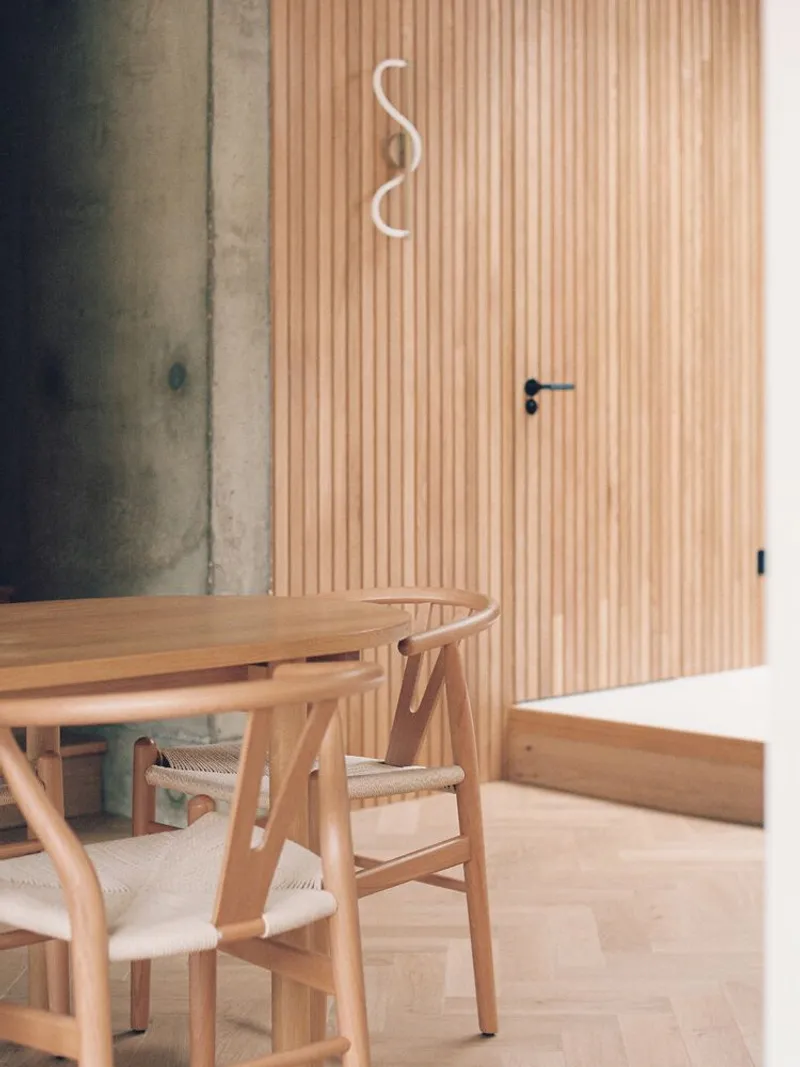
Close up, the interior reveals the care that went into its making. The kitchen's dark green cabinets meet the marble backsplash with a precision that speaks to bespoke fabrication. Black tapware and timber cutting boards sit on the counter as though they have always been there. Elsewhere, a curved neon light fixture hangs above the dining table beside a slatted timber wall and an exposed concrete column, a composition that feels considered down to the last cable route.
The reclaimed London stock bricks, each measuring 68mm by 230mm by 20mm, are mounted as slips onto a timber frame rather than laid as full structural masonry. This technique allows the house to read as a brick building while maintaining the insulated timber-frame construction behind. It is the kind of pragmatic hybrid that conservation-area projects increasingly require: authentic material expression coupled with the thermal performance that period construction could never deliver.
Plans and Drawings


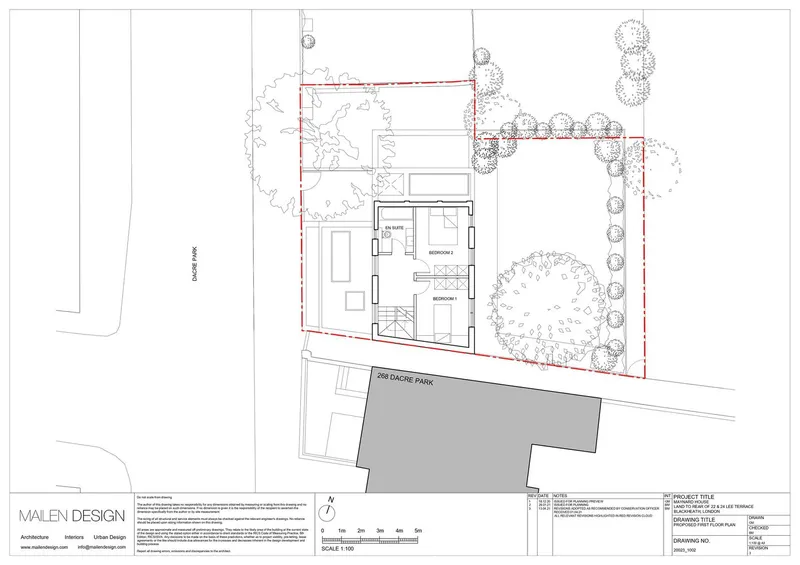
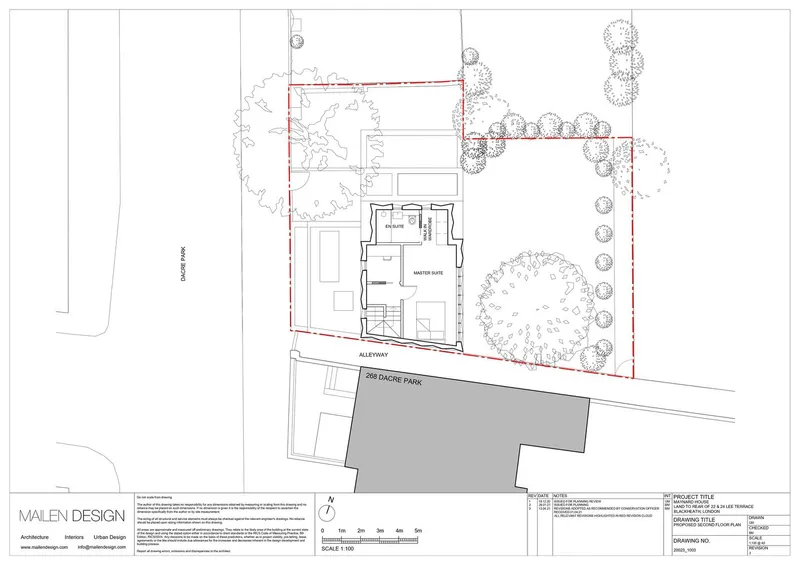
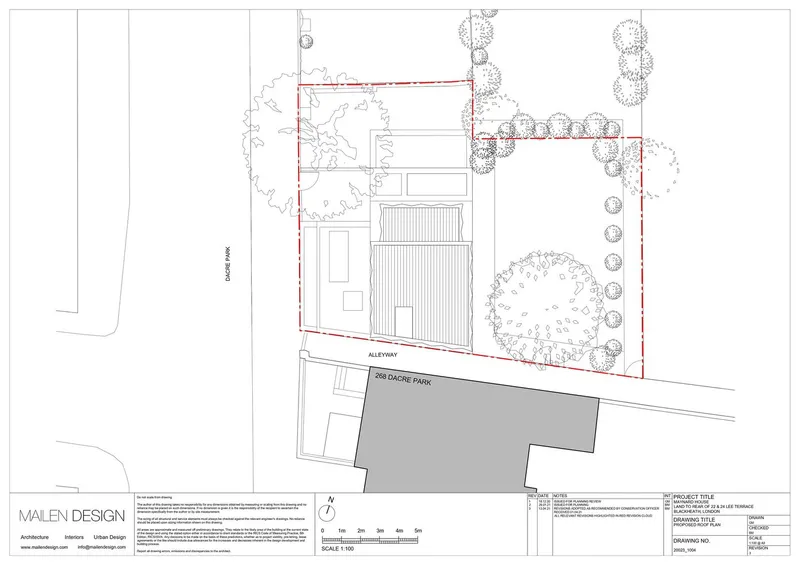

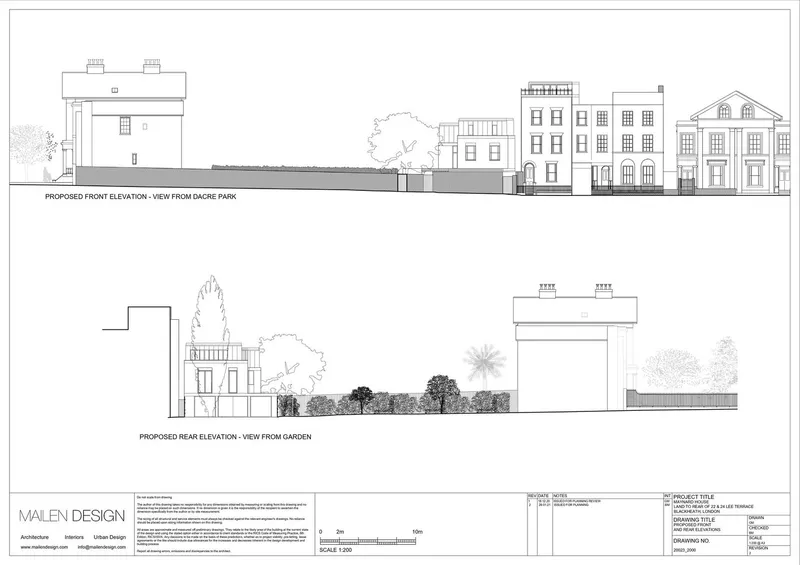

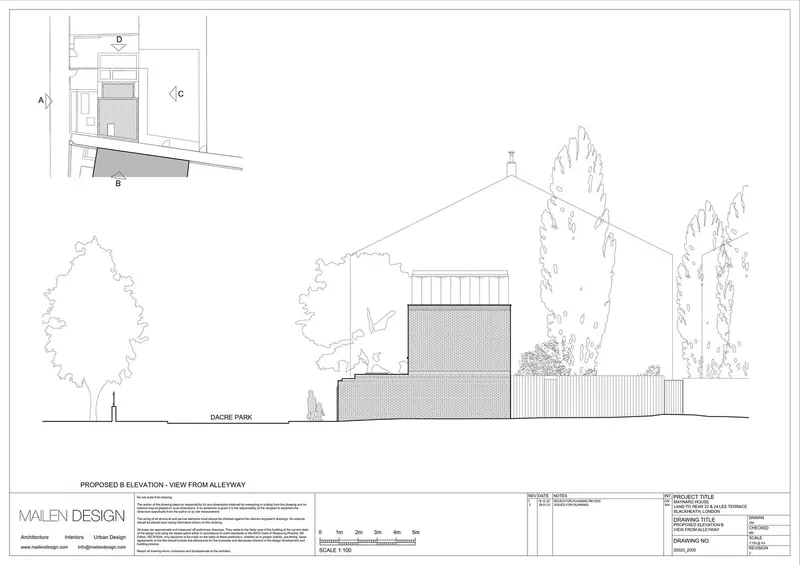

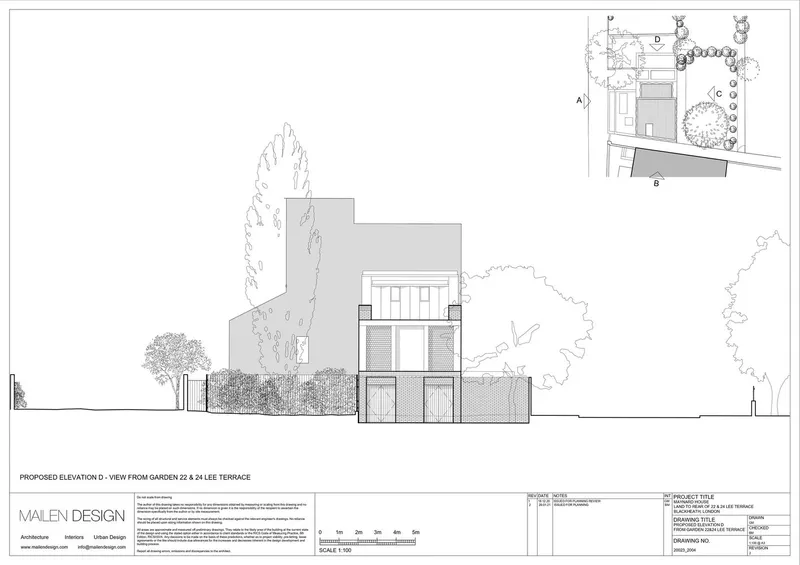
The site plan makes the infill condition immediately legible: the house slots into the gap between established gardens and a park edge, its footprint shaped by the trees it was designed to protect. Floor plans reveal how the 114 square metres are distributed across three levels, with communal space concentrated at the ground floor and bedrooms stacked above. The section drawing is the most telling: it shows the stepped massing strategy in profile, each storey pulling back from the one below, and the mature trees towering above the roofline. Elevation drawings confirm the dual identity of the facades, solid and historically sympathetic from the street, open and garden-facing at the rear.
Why This Project Matters
London's conservation areas contain thousands of underused plots, garages, and infill sites that could accommodate new housing without demolishing anything of value. Lee Terrace Home demonstrates that this kind of densification can be done with genuine architectural ambition. It does not resort to pastiche, nor does it treat its listed neighbours as obstacles. The mews typology, once a pragmatic response to the spatial hierarchy of the Georgian and Victorian city, is shown here to have real relevance as a model for compact urban living.
More broadly, the project is evidence that sustainability and heritage sensitivity are not separate agendas requiring separate compromises. A fabric-first envelope, an air-source heat pump, preserved trees, green roofs, and passive ventilation coexist with reclaimed brick, bespoke oak joinery, and a stepped massing strategy developed in close dialogue with the conservation context. For practices working on constrained urban sites across the UK and beyond, Mailen Design's approach here is worth studying closely: not as a template, but as a demonstration that the constraints themselves can generate the design.
Lee Terrace Home by Mailen Design, Blackheath Conservation Area, London, United Kingdom. 114 square metres. Photography by Alex Dormon Photography.
About the Studio
Share Your Own Work on uni.xyz
If projects like this are the kind of work you want to make, uni.xyz is a place to publish your own, find collaborators, and enter design competitions.




Popular Articles
Popular articles from the community


Hill & Cross Opera: Sculptural Opera House Architecture Shaped by Tallinn’s Landscape and Identity
Hill & Cross Opera reimagines opera house architecture in Tallinn through its sculptural hill, civic plaza, glass wave and a luminous cross.

Co-Life: Senior Housing Design That Reconnects Older Adults With the City
Co-Life reimagines senior housing design through healing gardens, shared streets, workshops, and a sustainable community across generations.

Co-life: Sustainable Architecture for Age-Friendly Community Living
Co-life reimagines sustainable architecture for seniors through courtyards, rammed earth, shared gardens, and spaces designed for belonging.

Riyadh For All: Intergenerational Urban Design for Active Aging in Rabat
Riyadh For All reimagines urban design in Rabat with intergenerational co-living, adaptive courtyards, and Moroccan cultural exchange today.


Similar Reads
You might also enjoy these articles


Bamboo Housing Challenge 2026: Design Affordable, Sustainable Homes Using Bamboo
An international design competition by Bamboo U and IBUKU inviting architects and designers to reimagine affordable housing using bamboo — with the winning design built full-scale in Bali.

Computational Design & Education: Beegraphy Design Awards Introduces 7th Category (Featuring Jiyun's Innovative Approach)
Dive into Beegraphy’s 7th Design Awards category, where computational design meets education to create immersive, interactive learning tools, inspired by Jiyun’s work.

From Parametric Lighting to Urban Furniture: Join the 2nd Workshop in Beegraphy’s Computational Design Series
Dive into Cutting-Edge Design Techniques and Practical Applications with Industry Experts

Last Call: Unleash Your Architectural Genius in SHAK's Kindergarten Design Competition
Urgent call for architects to join SHAK's kindergarten design competition before the looming deadline


Explore Architecture Competitions
Discover active competitions in this discipline



Challenge to reimagine the Iron Throne


Photograph architecture without architects


Illustrate the lost glory of Angkor Wat - Render Challenge


Design challenge to reuse E-waste
Comments (0)
Please login or sign up to add comments
No comments yet. Be the first to comment!