
Ley Line Echoes: Where Sound Waves Become Architecture Along the Waterfront
A suspended walkway translates pedestrian movement into luminous sound-wave patterns, turning infrastructure into a responsive urban instrument.


What if a bridge could listen? Ley Line Echoes proposes a piece of urban infrastructure that does exactly that: a suspended walkway that detects the movement of pedestrians and translates their presence into undulating fields of colored light and sound. The structure doesn't just connect two points across a waterfront; it performs the city back to itself, converting foot traffic into a real-time audiovisual landscape that pulses beneath a structural grid like a nervous system made visible.
Designed by Alfredo Zuniga, Cameron Nowell, and Tyler Payne, the project was submitted to the Beacon competition on uni.xyz. The brief called for designs that rethink how architecture can signal, attract, and engage in the public realm. This team responded not with a static monument but with a kinetic environment, a span between waterfront buildings that draws people in by making their own presence the spectacle.
A Tunnel of Concentric Light Rings
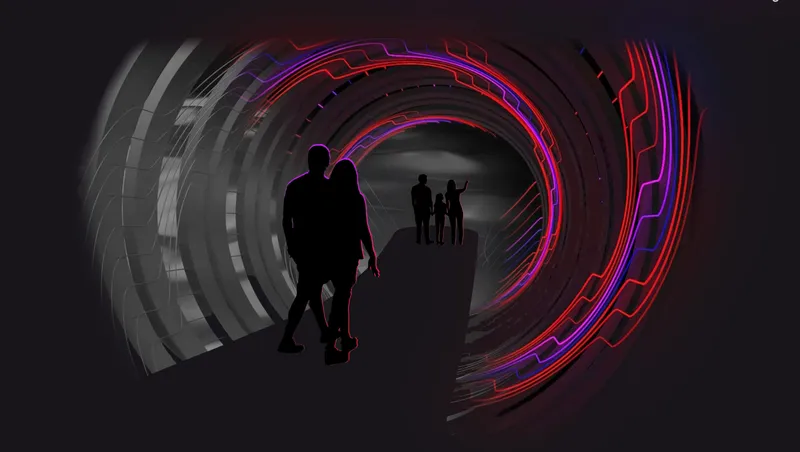
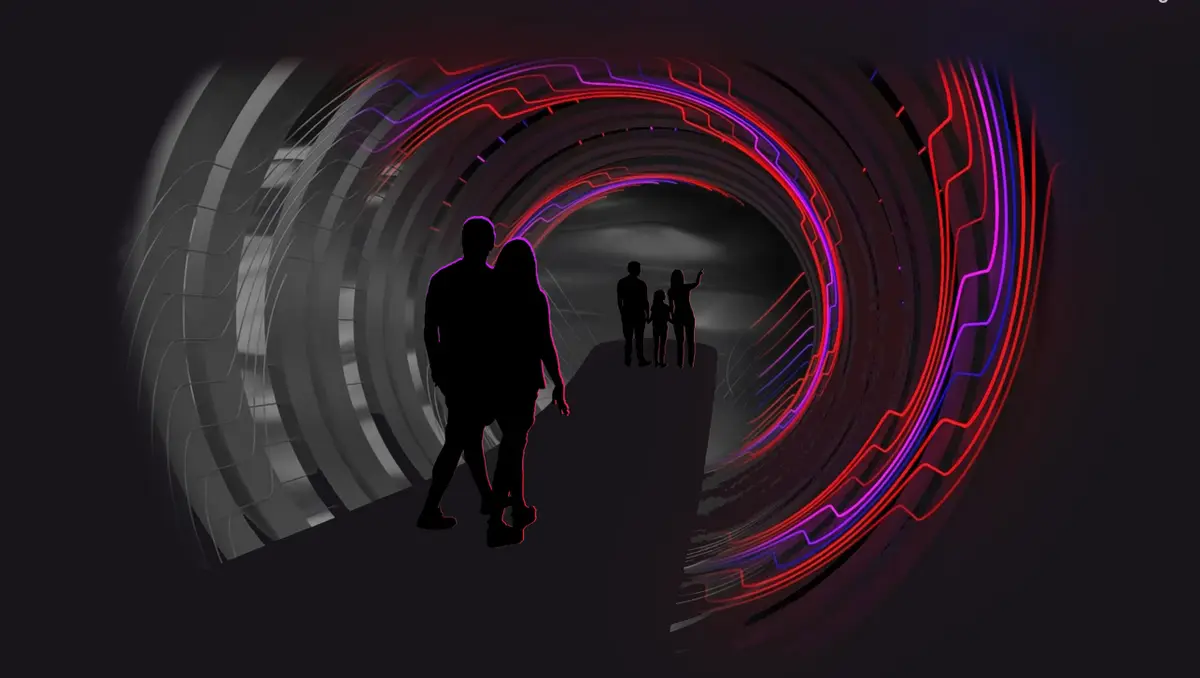
The most striking image of the project shows the interior experience: a tunnel defined by concentric rings that glow in gradients of purple and red. Silhouetted figures walk through what feels less like a corridor and more like the interior of a resonating instrument. The rings tighten and expand depending on proximity and density of movement, creating a spatial rhythm that shifts throughout the day. It is architecture as atmosphere, where enclosure is achieved not through walls but through fields of light.
Sound Waves Rendered as Spatial Section
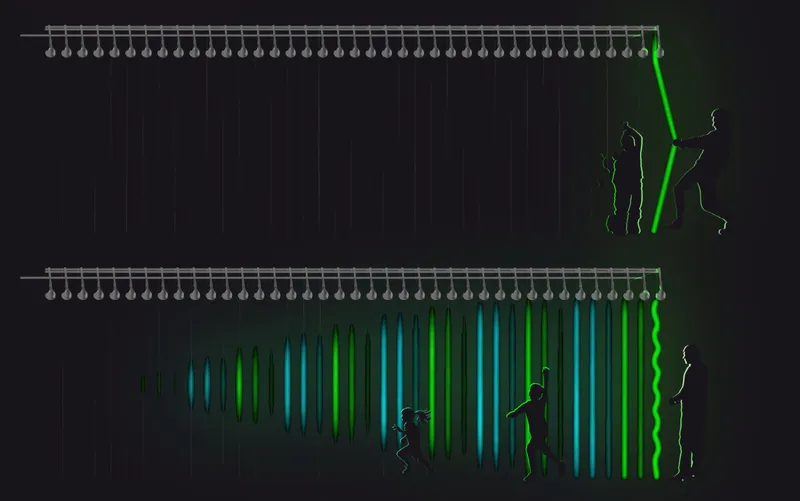
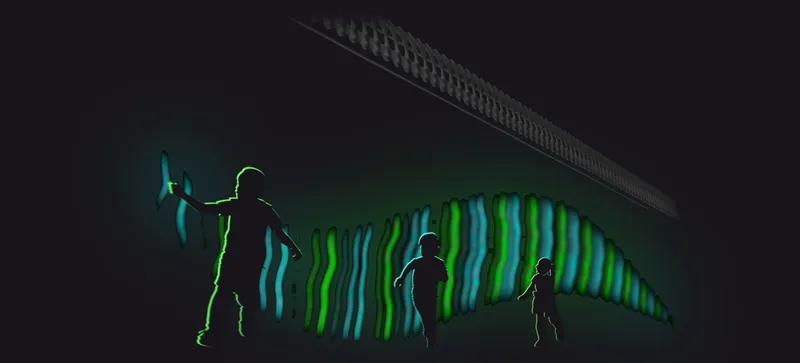
Two section drawings reveal the conceptual engine of the project. In one, color-coded sound wave patterns radiate outward from a suspended walkway, with silhouetted figures below caught in the wash of acoustic energy. In the other, undulating waves of green and blue light roll beneath a structural grid, turning the underside of the bridge into a luminous ceiling for the ground plane below. These sections make clear that the design operates on two scales simultaneously: the intimate experience of walking through the structure, and the broader urban impact of a glowing, humming presence visible from the surrounding context.
What works here is the refusal to treat responsiveness as a gimmick. The wave patterns aren't decorative overlays; they are the spatial logic of the project. The structure organizes itself around the propagation of energy, and the sections communicate that with real clarity.
Spirals and Curves as Structural DNA
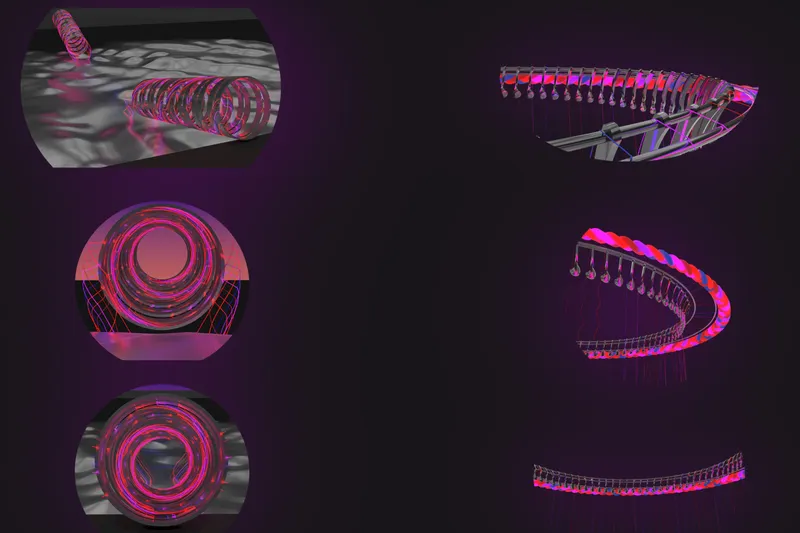
The axonometric drawings peel back the formal logic to expose two intertwined structural systems: a spiral element and a series of curved ribs highlighted in pink and purple. These are not arbitrary geometries. The spiral acts as a vertical circulation and focal point, while the curved ribs distribute loads and define the walkway's profile. Shown in exploded view, the drawings reveal a project that has been carefully resolved at the tectonic level, even as its experiential ambitions lean toward the immaterial.
Spanning the Waterfront with a Curved Bridge
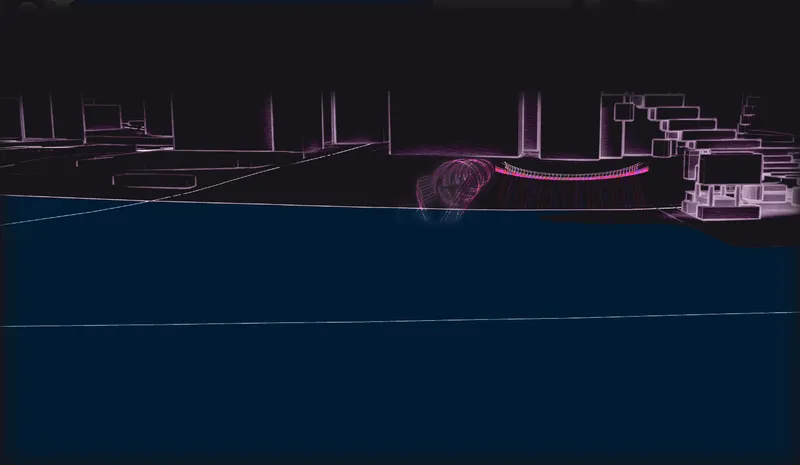
The elevation drawing grounds the project in its site, showing how the curved bridge structure and its signature spiral element span between existing waterfront buildings. Contextually, the form reads as both an invitation and an interruption: its sweeping profile draws the eye and the foot, while its departure from the orthogonal grid of the surrounding architecture marks it unmistakably as a threshold to something different. The elevation also suggests that the designers understood scale; the bridge holds its own against the neighboring buildings without overwhelming them.
Why This Project Matters
Interactive architecture often falls into one of two traps: it either reduces responsiveness to a surface-level LED display, or it becomes so technically complex that the spatial experience gets lost in the engineering. Ley Line Echoes manages to avoid both. The sound-wave concept is threaded through every scale of the project, from the macro profile of the bridge to the micro experience of walking through rings of light. The result is a proposal where the interactivity feels architecturally motivated rather than bolted on.
Zuniga, Nowell, and Payne have produced a competition entry that takes the Beacon brief seriously: architecture as signal, as attractor, as a reason to cross the street and step inside. The strongest move here is treating the human body not as a passive occupant but as the trigger for the building's primary experience. In a moment when so much public space is designed to be looked at rather than participated in, that inversion feels genuinely urgent.
View the Full Project
About the Designers
Designers: Alfredo Zuniga, Cameron Nowell, Tyler Payne
Enter a Design Competition on uni.xyz
uni.xyz runs architecture and design competitions year-round that reward proposals with spatial conviction and real site intelligence.
Project credits: Ley Line Echoes by Alfredo Zuniga, Cameron Nowell, Tyler Payne Beacon (uni.xyz).


Popular Articles
Popular articles from the community


Cube Design Draws an Ecological Corridor Between Two Shenzhen Hills with the Nankai Building
Beside Shenzhen's container docks, the Nankai Building pairs stacked balconies with a climbing green screen to connect two hillsides across its height.

U.GA Architects Wraps an Oval Rooftop Pool in Curved Board-Formed Concrete on Busan's Jeollidan-gil
In Busan's Jeonpo-dong, a 454 m² mixed-use block stacks a neighborhood facility, guest rooms and an oval rooftop pool inside spiraling concrete walls.

GROUP A Strips a 1969 Rotterdam Harbor Headquarters to Its Frame and Wraps It in Timber Louvers
In Rotterdam's M4H harbor district, Ferro Offices reuses a 1969 frame, adds one timber storey and reaches BREEAM-NL Outstanding.

Jaramillo Van Sluys Arquitectura and Urbanismo Turn a Demolished Registry Lot in Quito into an Orchard Plaza
In Quito's Centro Histórico, a 2,800 m² plaza exposes the San Agustín convent wall and redraws its lost Augustinian orchard in volcanic stone.

Similar Reads
You might also enjoy these articles


Vereda Arquitetos Renovates a 40-Square-Meter Apartment Inside Niemeyer's Copan Building
A compact unit in São Paulo's most iconic residential tower gets a material overhaul that pairs exposed concrete with bold blue Formica.

Shakur's House: Exposed Brick as an Interior Organiser in a 168 m² Mashhad Residence
Brick moves indoors in this Mashhad residence, where masonry walls, glass partitions and teal planes sequence a compact home without closing it off.

Day and Night Park: A Time-Based Urban Newsstand in Beijing
A temporary urban newsstand in Beijing blending travel, light, and reading through poetic colors, compact form, and community-focused design.

Modernist Patio Renovation in El Masnou, Barcelona by Oliver Segura Arquitectura + Cebrià Arquitectura
Modernist patio renovation blending tradition and innovation with a movable pool, leveled floors, and Catalan materials in El Masnou.


Comments (0)
Please login or sign up to add comments
No comments yet. Be the first to comment!