
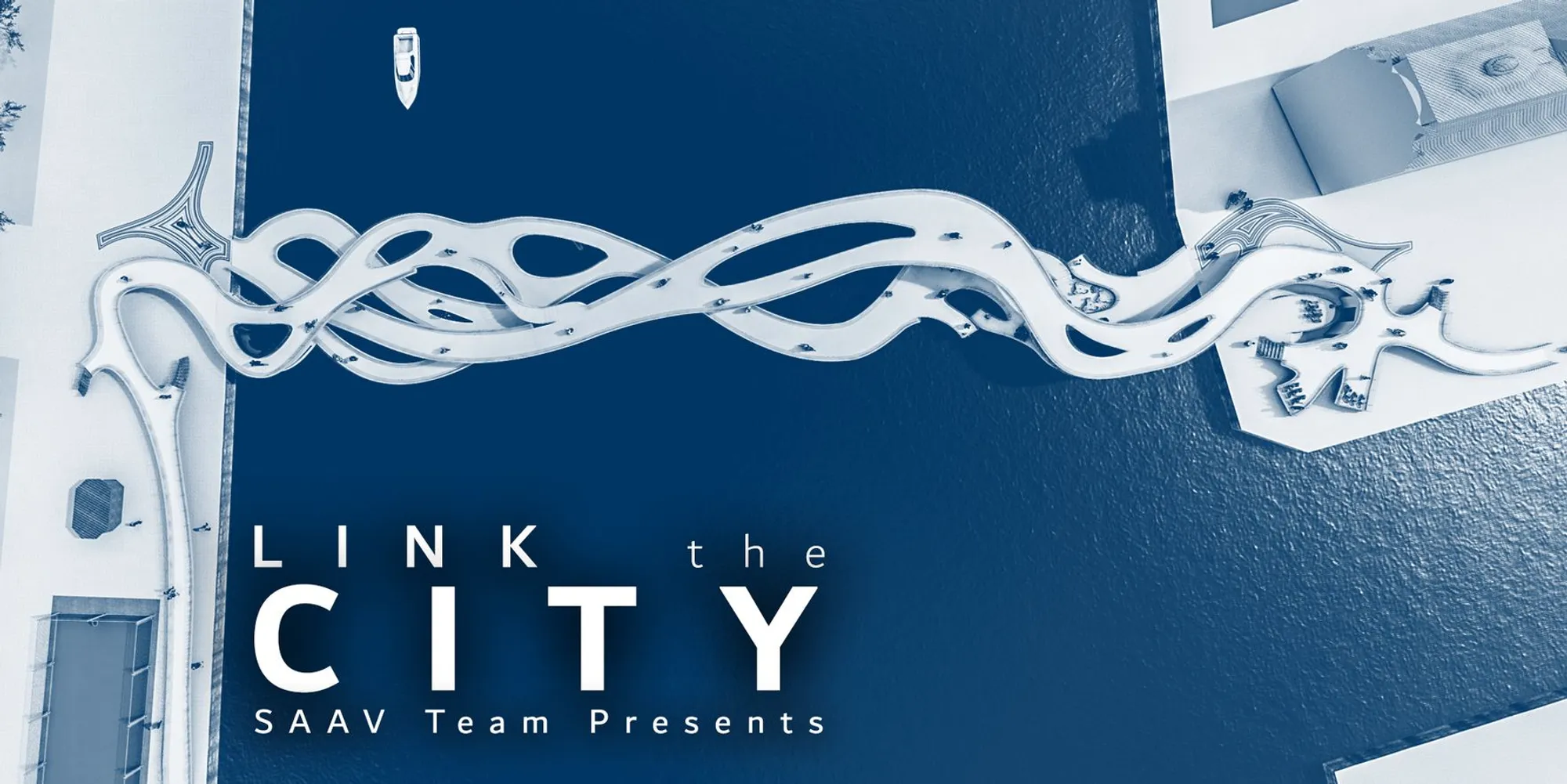
Link the City: A Pedestrian Bridge Modeled on Veins and GPS Traces
Three intertwined levels of walkways, bike paths, and public program replace rigid bridge geometry with fluid, arterial circulation.


What if a bridge refused to tell you where to walk? Most pedestrian crossings funnel bodies along predetermined lanes, but "Link the City" does the opposite: it treats movement as something closer to blood coursing through veins, irregular and self-directed, shaped by impulse rather than instruction. The result is a sculptural infrastructure of looping, intertwined pathways that span a harbor without a single straight line, offering cyclists and pedestrians the freedom to choose their own route across the water.
The project was designed by Mahsa Javadi, Amir Hossein Rezaei, and Mounes Sherafati. Their starting point was deceptively simple: GPS tracking data from real pedestrian and cycling routes, which revealed that people rarely move in straight lines. Rather than imposing rigid geometry onto that reality, the team embraced the irregularity, translating those unpredictable traces into a three-dimensional network of curving decks and ramps. The bridge sits in an Iranian waterfront context where cycling, despite its environmental promise, remains underutilized as a legal mode of transport, making the project both a spatial proposition and a quiet act of advocacy for sustainable mobility.
Sculptural Loops Over the Harbor
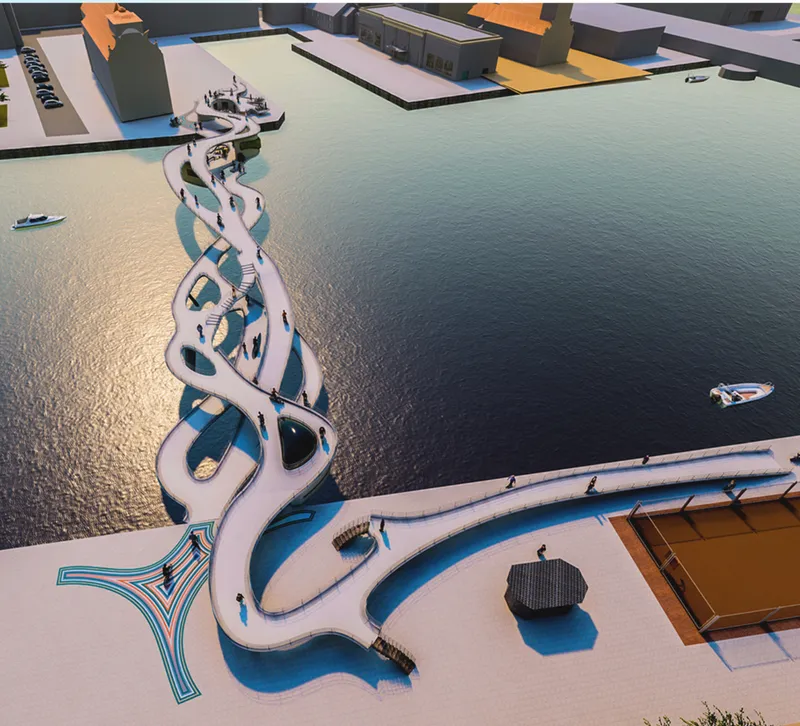
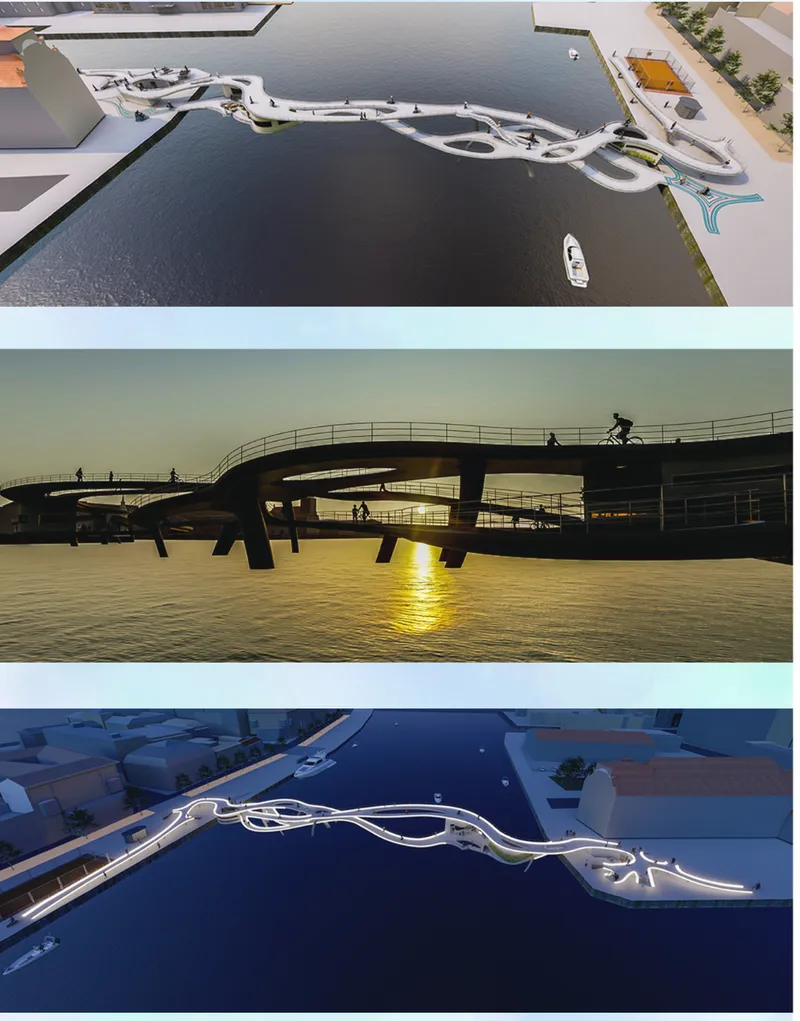
Seen from above, the bridge reads less like infrastructure and more like a vascular system unfurled across the water. Ribbons of pathway split, weave around each other, and reconverge, creating pockets of enclosure and moments of openness along their length. There are no designated lanes, no dominant direction. Instead, the aerial view reveals a network of possibilities: a cyclist might sweep along one outer loop while a pedestrian meanders through a tighter interior curve. The sunset rendering makes the kinetic quality tangible, with a lone cyclist traversing one of the elevated decks while the structure's undulating profile catches the low light. Visual transparency is key here; the open edges and gaps between pathways maintain continuous contact with water, sky, and the surrounding streetscape.
Three Stacked Levels of Program, Not Just Passage
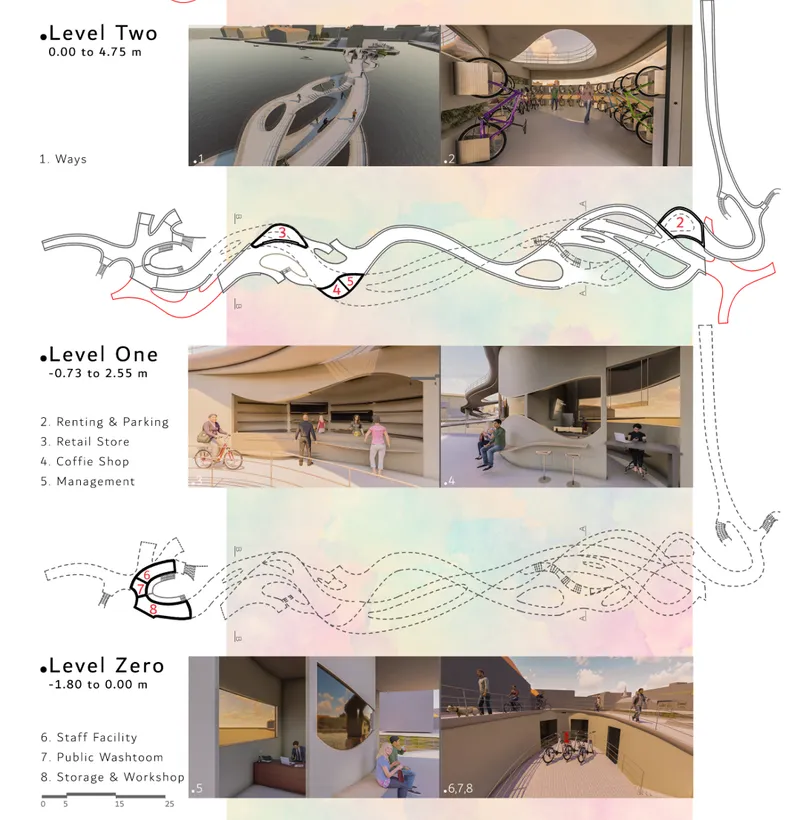
The sectional diagram reveals how much the designers packed into the bridge's undulating profile. Level Two, spanning from 0.00 to 4.75 meters, is dedicated to movement: the fluid walkways and bike paths that define the public experience. Level One, between negative 0.73 and 2.55 meters, houses active program, including a bike rental station, retail spaces, a coffee shop, and management offices. Level Zero, from negative 1.80 to 0.00 meters, tucks back-of-house functions like staff areas, public restrooms, and workshops out of sight to preserve the visual coherence of the structure above.
The layering is what transforms the bridge from a thoroughfare into a destination. Cafes are designed for takeaway, encouraging social activity to spill out onto the curved decks. Retail pockets blend commerce with leisure. The architecture dissolves the usual boundary between transit and pause, making it plausible that someone might cross the bridge to get somewhere and end up staying for an hour.
Dusk on the Curved Decks
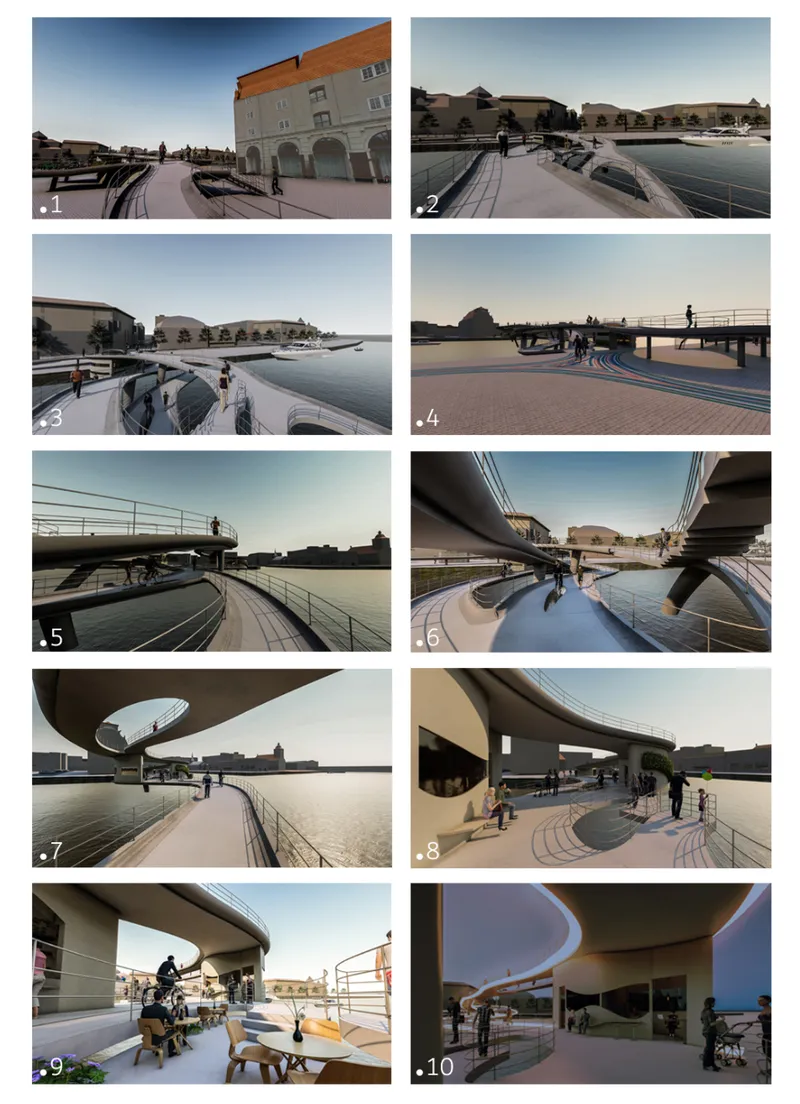
The sequence of dusk renderings captures what the designers mean by "social infrastructure." People walk, cycle, and linger along the curving surfaces without any apparent hierarchy among them. Seating areas tucked into the curves invite chance encounters. The absence of rigid lane markings means pedestrians and cyclists negotiate space informally, the way they would in a park or a plaza rather than on a conventional bridge. Curved ramps and open platforms create natural pauses, moments where a person might stop, lean on a railing, and register the water below or the skyline beyond.
Kinetic Structure and Sectional Logic
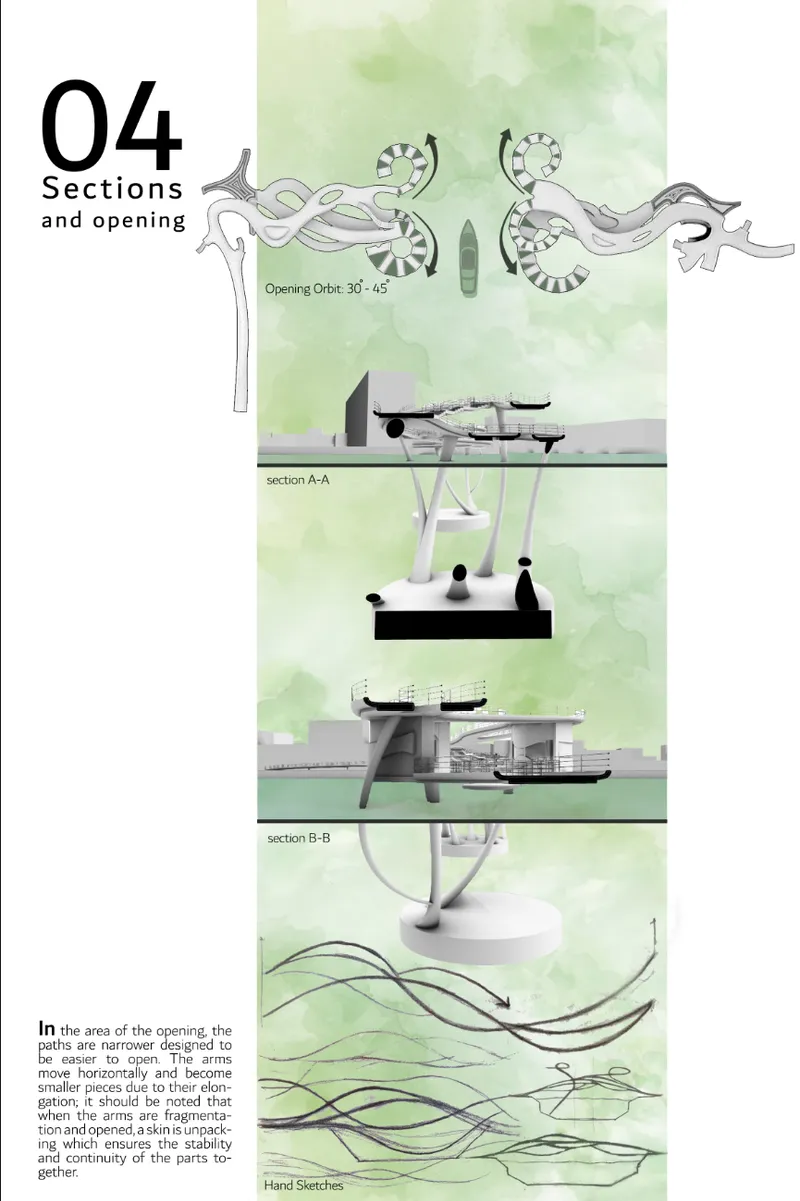
The section drawings and hand sketches expose the structural ambition beneath the organic form. Sections of the bridge are designed to retract, with a motion the designers liken to unfolding skin or muscle, allowing marine traffic to pass while preserving the visual unity of the whole. This kinetic element ensures the bridge is not a static object imposed on the harbor but a responsive one, adapting to the rhythms of both land and water use. The hand sketches reveal the iterative process behind the final geometry, showing how the team moved from loose gestural studies to the precise, multi-layered profiles visible in the finished sections.
Why This Project Matters
"Link the City" makes a compelling case that infrastructure need not be neutral. By grounding its form in the actual messiness of human movement, the project avoids the sterile efficiency that characterizes most bridge design and proposes something richer: a connective tissue that encourages exploration, supports community life, and quietly champions cycling as a sustainable mode of transport in a context where it has yet to gain full institutional support.
The deeper argument is about agency. Rather than prescribing routes and behaviors, Javadi, Rezaei, and Sherafati designed a spatial framework that trusts its users to navigate on their own terms. In a discipline that often defaults to control, that trust is both refreshing and radical. The bridge becomes a prototype not just for a single waterfront crossing but for a broader urban ethos: one that values intuition over instruction and flexibility over formality.
View the Full Project
About the Designers
Designers: Mahsa Javadi, Amir Hossein Rezaei, Mounes Sherafati
Enter a Design Competition on uni.xyz
uni.xyz runs architecture and design competitions year-round that reward proposals with spatial conviction and real site intelligence.
Project credits: Link the City, by Mahsa Javadi, Amir Hossein Rezaei, Mounes Sherafati.



Popular Articles
Popular articles from the community


Conexión: Biophilic Design Reimagines High-Rise Living in Hong Kong
Conexión reimagines high-rise living in Hong Kong through biophilic design, green facades, shared spaces, daylight, water and nature within.

Co-life: Sustainable Architecture for Age-Friendly Community Living
Co-life reimagines sustainable architecture for seniors through courtyards, rammed earth, shared gardens, and spaces designed for belonging.

Hill & Cross Opera: Sculptural Opera House Architecture Shaped by Tallinn’s Landscape and Identity
Hill & Cross Opera reimagines opera house architecture in Tallinn through its sculptural hill, civic plaza, glass wave and a luminous cross.

The Ocean Hive: Sustainable Architecture for a Self-Sufficient Civilization at Sea
The Ocean Hive imagines sustainable architecture at sea, where modular habitats, algae, wave power and ocean waste sustain a growing colony.


Similar Reads
You might also enjoy these articles

Day and Night Park: A Time-Based Urban Newsstand in Beijing
A temporary urban newsstand in Beijing blending travel, light, and reading through poetic colors, compact form, and community-focused design.

Modernist Patio Renovation in El Masnou, Barcelona by Oliver Segura Arquitectura + Cebrià Arquitectura
Modernist patio renovation blending tradition and innovation with a movable pool, leveled floors, and Catalan materials in El Masnou.
Alto Residencial Coop: Cooperative Housing Development in Santiago de Compostela by Carbajo Barrios Arquitectos
A linear cooperative housing complex blending white volumes and perforated metal façades, enhancing community living, natural light, privacy, and urban integration.
Vil Genis School by BPA ARCHITECTURE – Massy, France
Vil Genis School in Massy, France, features sustainable design, south-facing classrooms, community integration, accessible spaces, and modern educational architecture.
Comments (0)
Please login or sign up to add comments
No comments yet. Be the first to comment!