
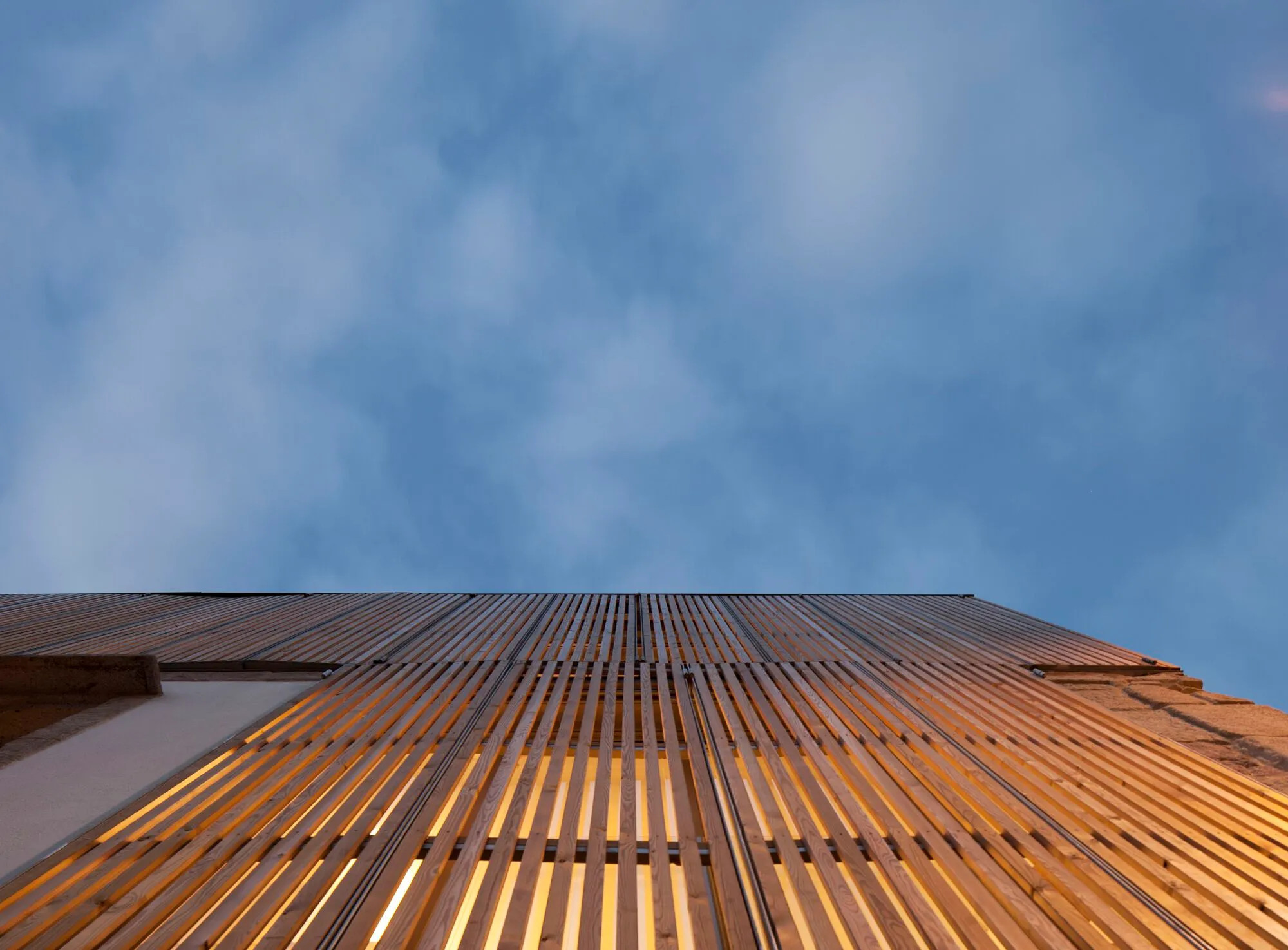
LIQE arquitectura Wraps a Vigo Old Town Housing Reform in Folding Pine Screens
Perched between castle walls and the historic center, a timber-clad renovation filters estuary light through autoclave-treated slats.


Vigo's Casco Vello Alto is a neighborhood caught between two scales: the tight, stone-walled domestic fabric of the historic center below and the monumental defensive ramparts of the castle above. LIQE arquitectura found their site right on that seam, a sliver of land where the street pitches upward and the roofline of the old town drops away to reveal the Ría de Vigo. Their response, a 291-square-meter housing renovation completed in 2022, does not try to resolve the tension between those two conditions. It inhabits the tension, stacking new timber volumes on old stone retaining walls and turning the entire western facade into a kinetic filter of Scots pine slats.
What makes this project worth studying is not simply its material palette, though the interplay of galvanized steel, autoclave-treated pine, and granite is handled with real precision. The more compelling move is the folding shutter system: a continuous screen of vertical slats mounted on steel frames that residents can open, close, and angle throughout the day. The facade becomes a register of inhabitation, its pattern shifting with the hours. Privacy, solar control, and views of the estuary are all negotiated through the same device. It is architecture as daily choreography.
Between Castle and Town


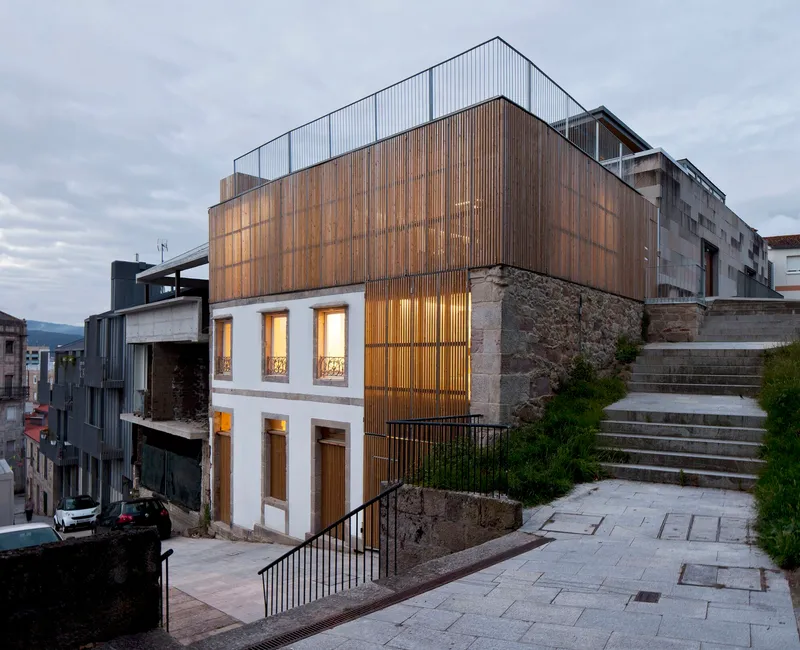
From the street, the building reads as a hybrid: timber-clad volumes rise above granite and concrete base walls that follow the steep topography of the hill. The stone retaining wall is not decorative backdrop; it is the literal foundation of the project, linking the new construction to the geological and infrastructural logic of the Casco Vello. At dusk, the illuminated windows reveal the depth behind the pine cladding, and the corrugated metal panels alongside the timber give the roofline a quietly industrial character that suits the rough, working port town below.
LIQE's decision to clad the upper volumes entirely in vertical timber slats gives the addition a visual coherence that the fragmented site plan would otherwise resist. The building steps and shifts as it climbs, but the wood holds it together as a single object. That unity is important: it signals that this is not a piecemeal infill but a considered architectural act inserted into a delicate historic context.
The Folding Facade
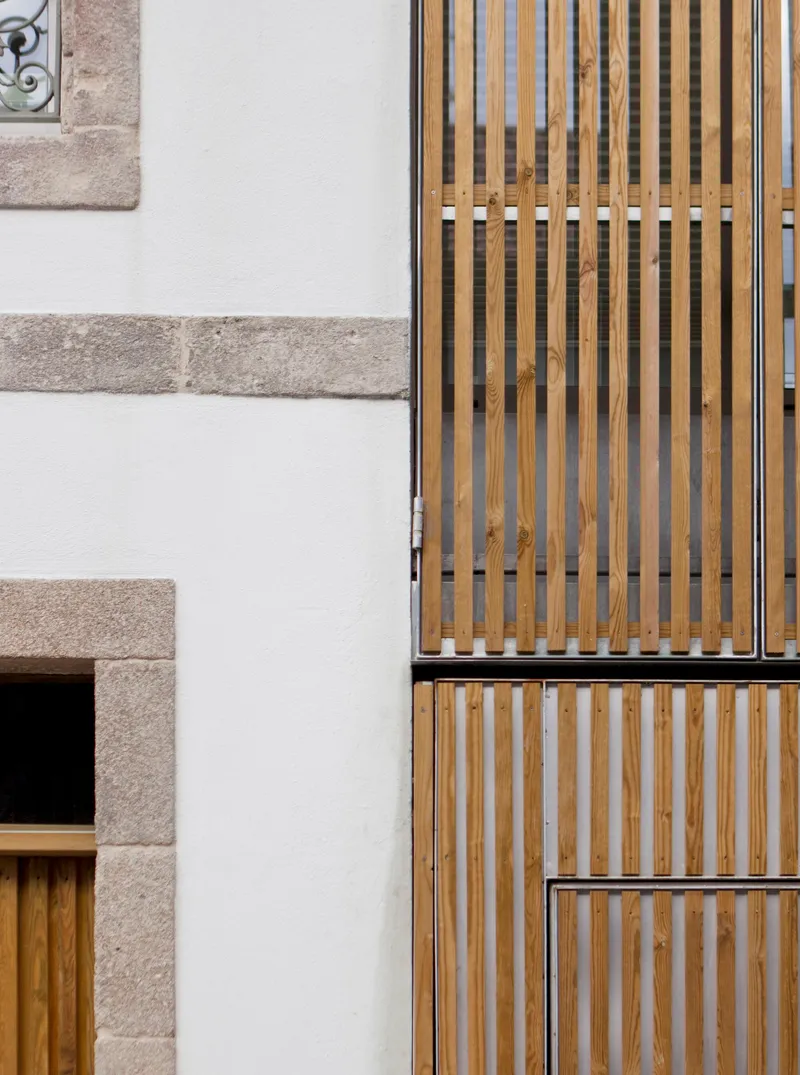
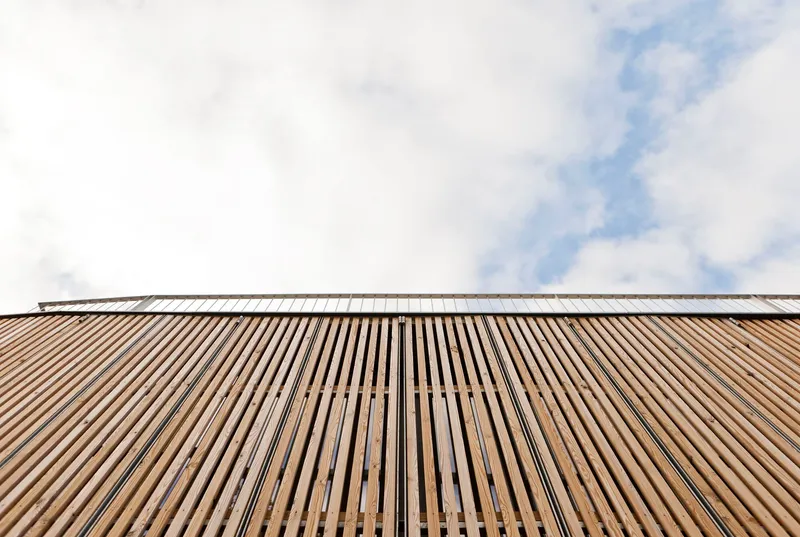
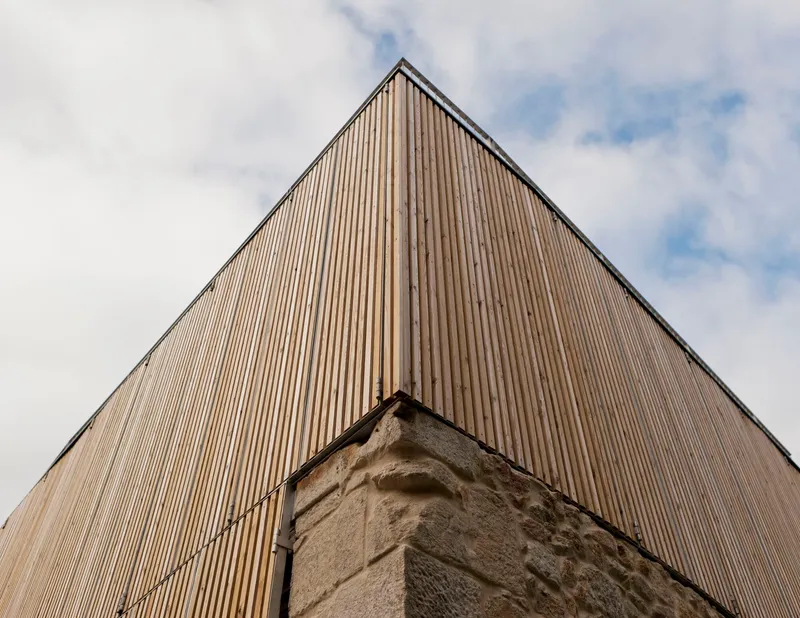
Seen from below, the vertical pine slat screens read as a single textured surface, their grain and shadow shifting with the angle of view. Where they meet the original granite quoins, the contrast is sharp and intentional: new wood against centuries-old stone, precision-cut against hand-dressed. The detail at those junctions is clean, with no fussy transition pieces, just the honest collision of two construction logics.
The slats are Scots pine treated in autoclave, a practical choice for the damp Atlantic climate of Galicia. Galvanized steel frames support the folding mechanism, allowing entire panels to swing open or closed. The system gives residents direct, tactile control over their environment. There is no motorized apparatus, no app. You walk to the window and push the screen to where you want it. In an era of parametric facades that perform for the camera but cannot be touched, this simplicity is refreshing.
Light as Material

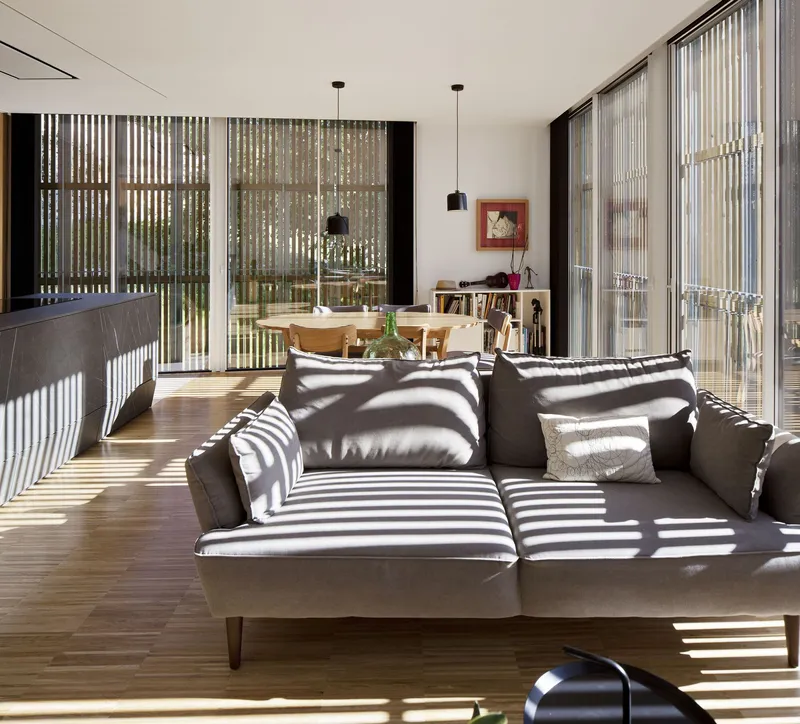
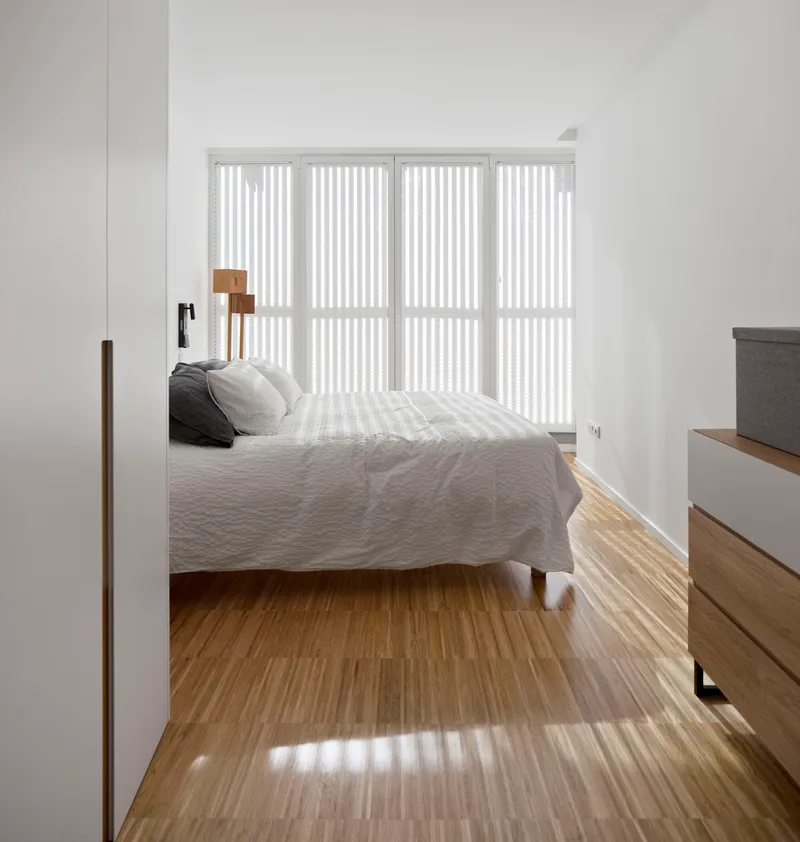
Inside, the slat screens transform sunlight into a graphic element. Striped shadows fall across floors, walls, and furniture, moving through the rooms as the sun tracks westward toward the estuary. The effect is at once dramatic and domestic: the living spaces feel theatrical in their light quality but entirely comfortable in their proportions and finishes. Oak veneer, white walls, and concrete floors provide a deliberately neutral backdrop so the shadows can do the work.
The day zones of each dwelling are oriented toward the western view, which means they receive the strongest afternoon and evening light. By placing the living rooms behind the folding screens rather than behind fixed glass, LIQE gives residents the ability to modulate that intensity. In July, the screens close to cut the heat. In November, they open wide to pull low sun deep into the plan. The architecture does not prescribe a single optimal condition; it offers a range.
Circulation and Interior Texture
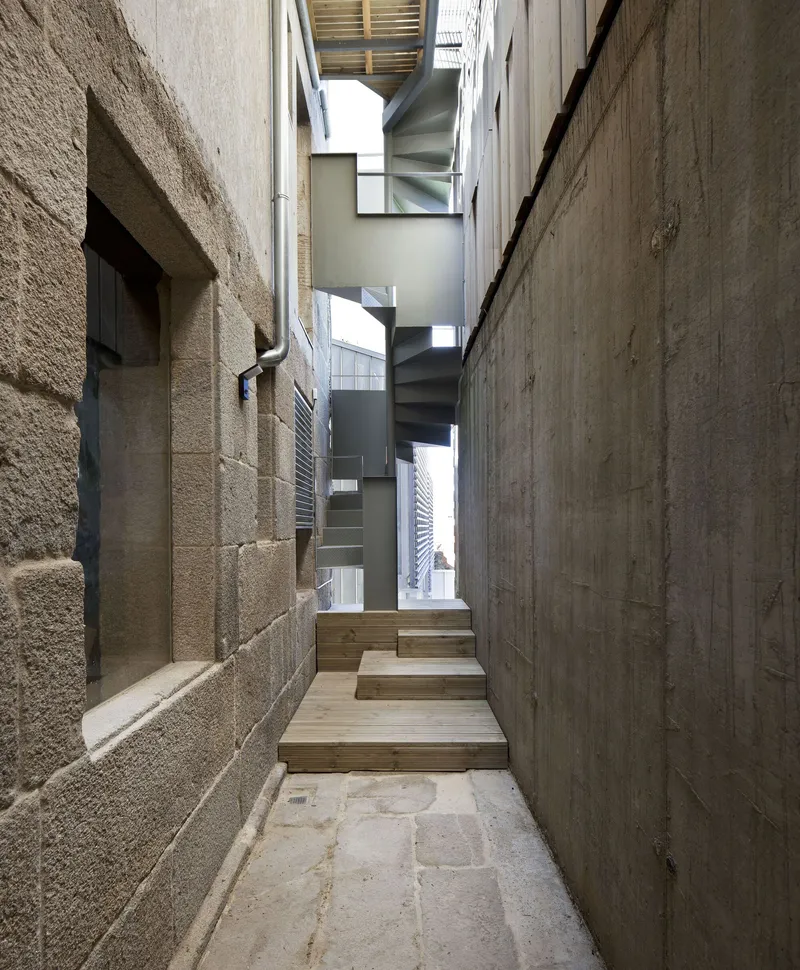
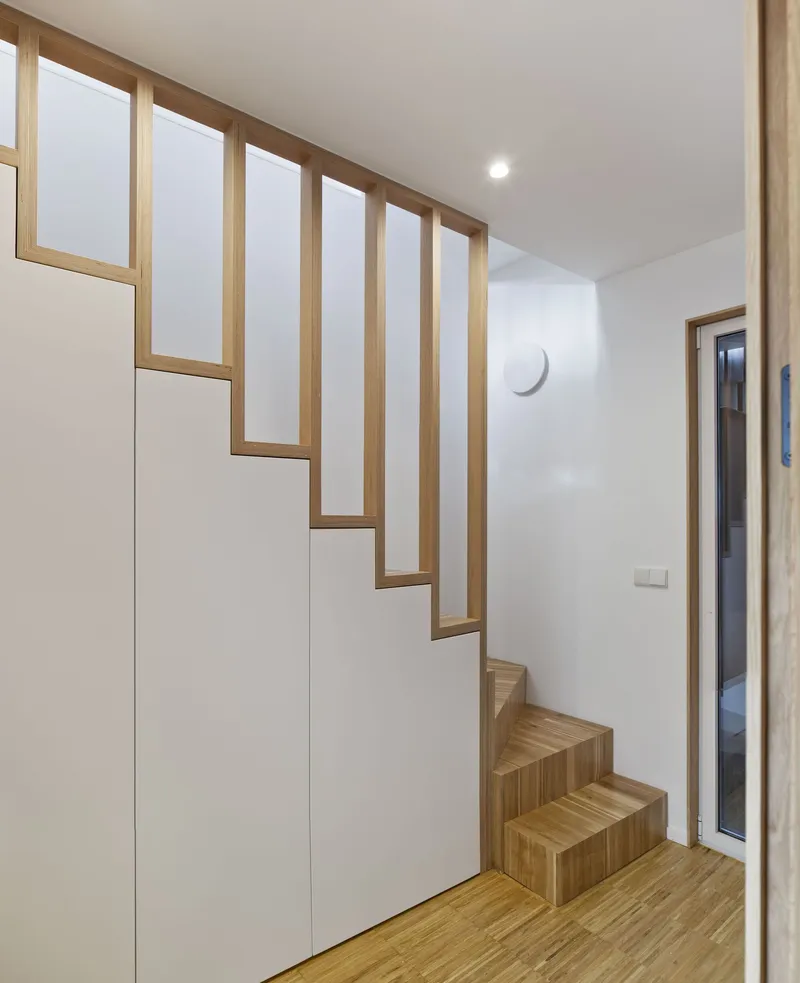
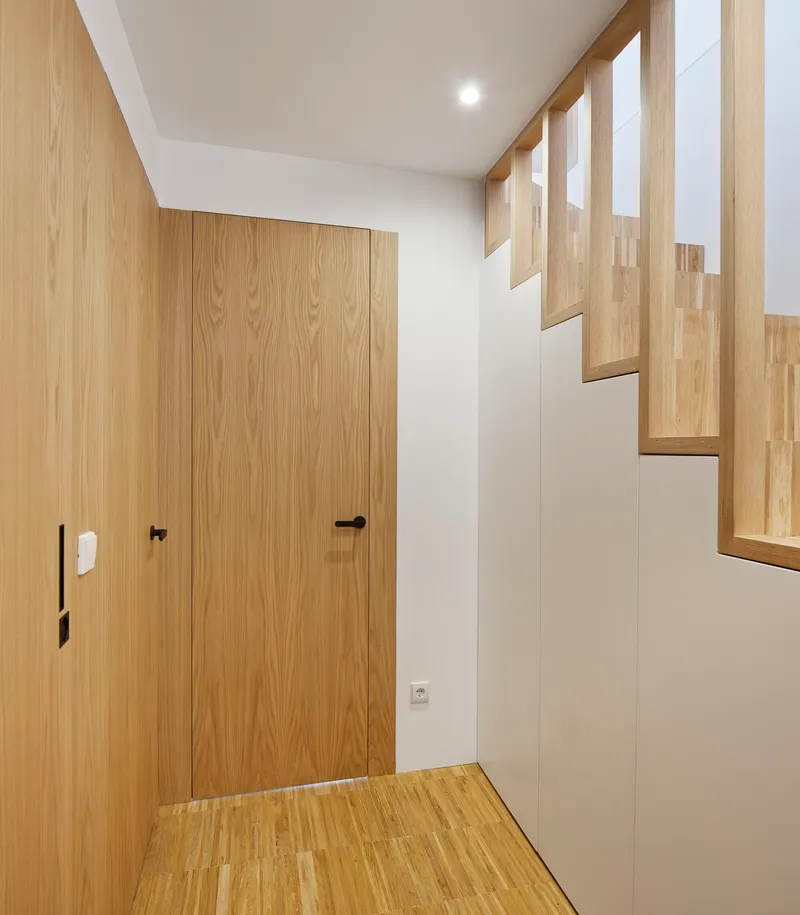
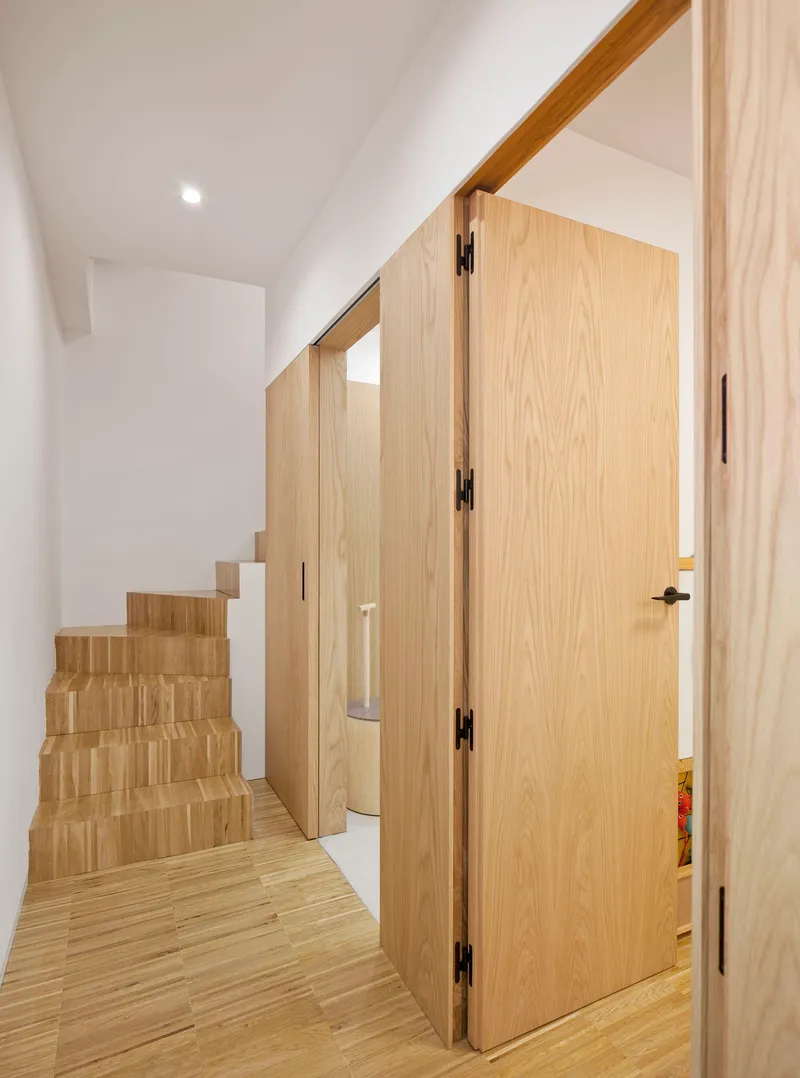
The vertical circulation is compressed and inventive, as it must be on a site this steep and narrow. Concrete-walled passages lead upward through the building's core, with timber stairs introducing warmth into what could easily feel like a bunker. Open risers allow light to pass between levels, and integrated storage cabinets make use of the dead space beside the stair runs. Nothing is wasted.
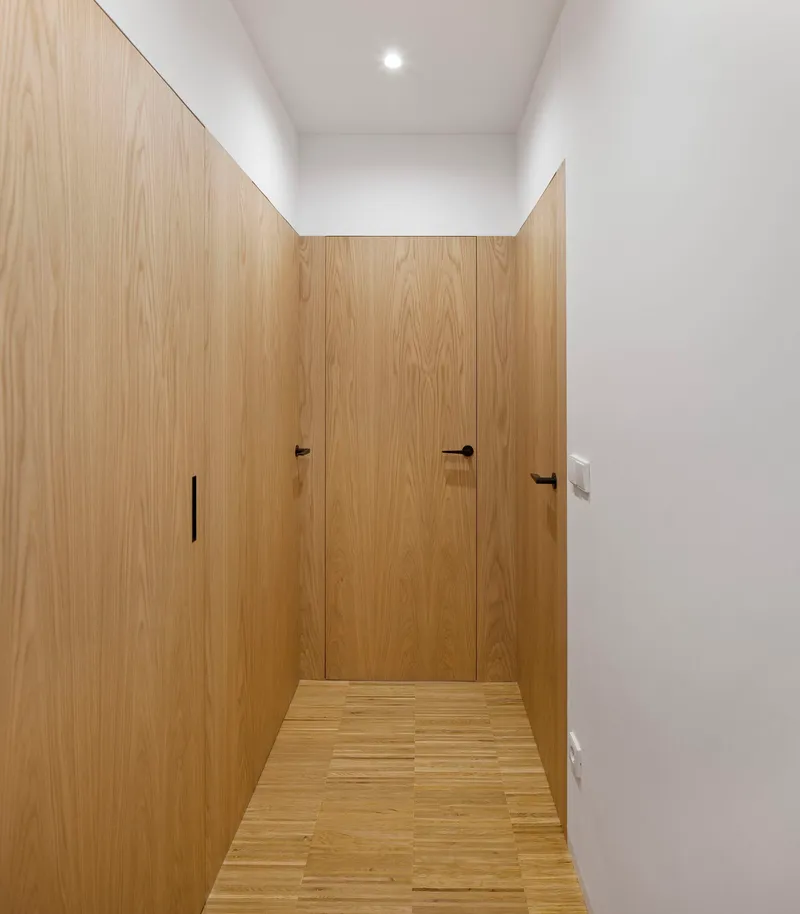
The oak-clad entry vestibule sets the tone immediately: flush panels conceal doors and services, creating a calm, uncluttered threshold. It is a small gesture, but it signals the level of care that runs through the project. The corridors are tight, but the material consistency, light oak against white plaster, prevents them from feeling oppressive.
Thresholds and Terraces
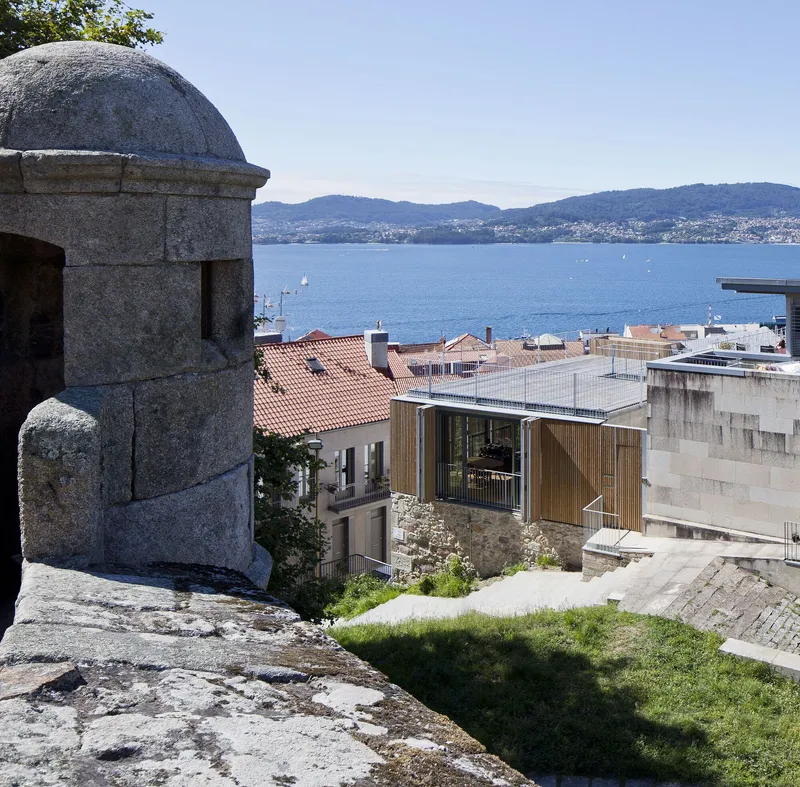
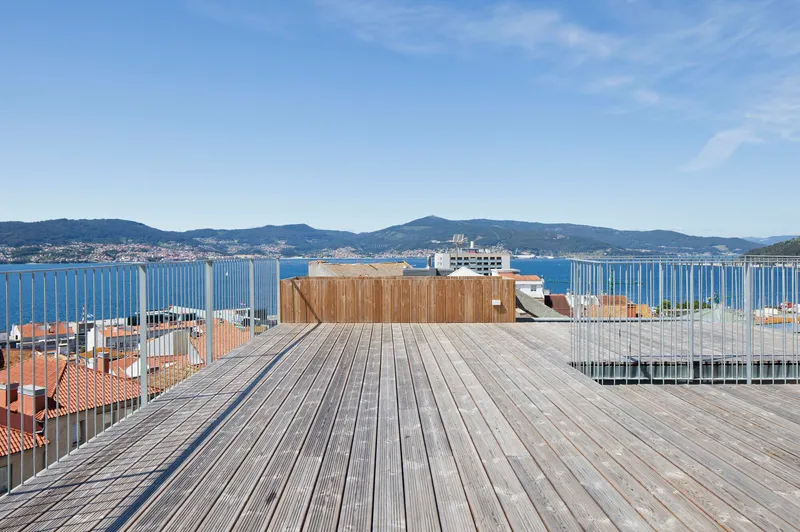
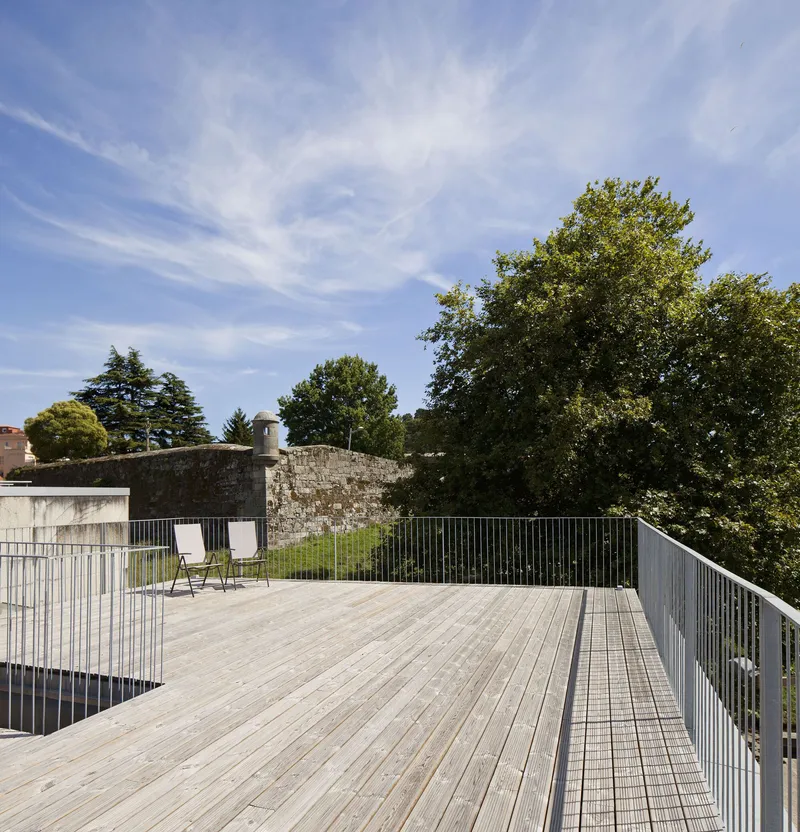
The rooftop and intermediate terraces are where the project's relationship to its landscape becomes most vivid. A timber deck with vertical slat railings frames the bay and the distant hills beyond, giving each dwelling an outdoor room scaled to the panorama. The view past the granite turret of the old fortification walls, down through the pine-screened balconies toward the water, collapses centuries of construction history into a single glance.
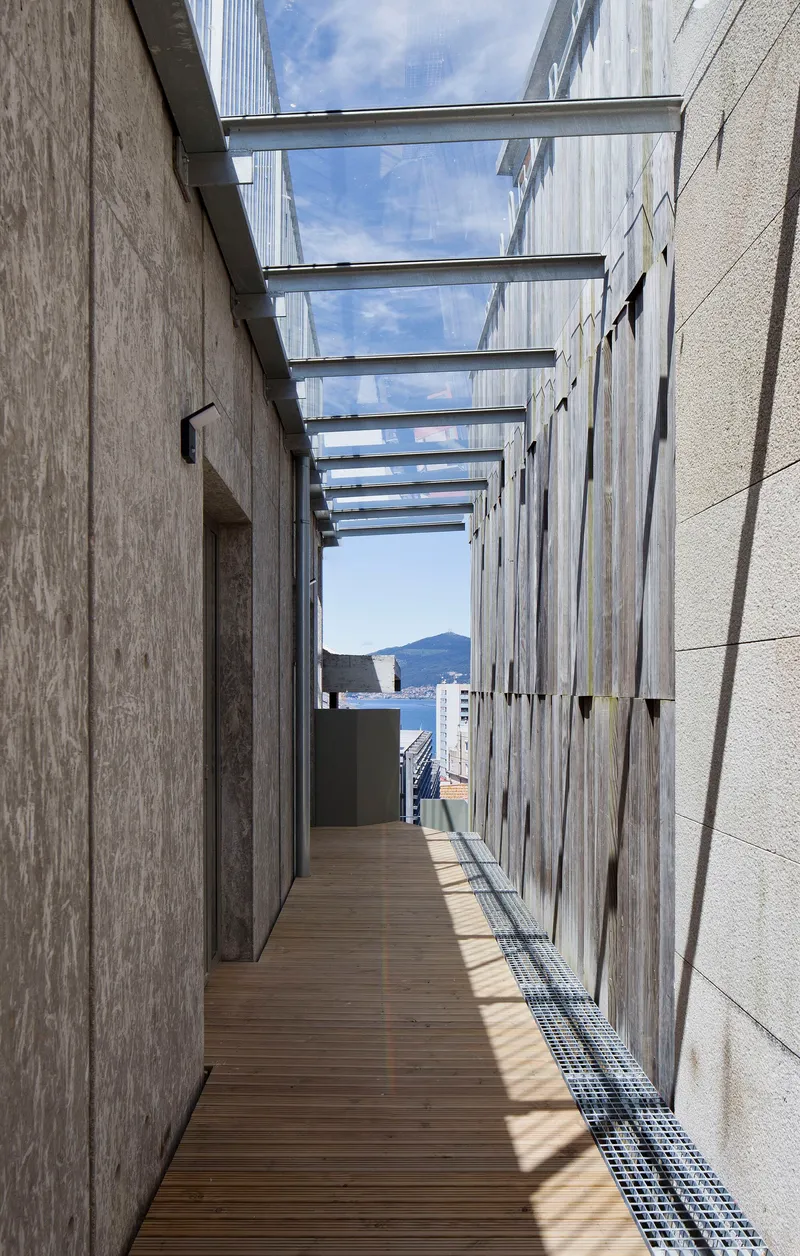
A glazed canopy over one of the intermediate corridors creates a covered passage between the timber-clad volume and the concrete walls of the adjacent structure, framing a harbor view at its far end. It is a generous detail: practical rain protection in Galicia's wet climate, but also a deliberate moment of visual decompression between the tight interiors and the open sky.
Quiet Rooms

The bedrooms and service spaces occupy the quieter, more protected faces of the building. Windows here are smaller, framing views of clay tile roofs and the textured grain of the surrounding historic fabric rather than the wide estuary panorama. Built-in shelving and flush cabinetry keep these rooms spare. The material palette stays consistent: light oak, white plaster, occasional concrete.
One bedroom in particular captures the duality of the project. Its timber-framed doorway opens toward a room washed in the striped shadow of the slat screens, but the room itself is oriented inward, toward the old town. Day and night, public and private, estuary and stone: the thresholds inside the building carry the same negotiation as the facade outside.
The Facade at Night
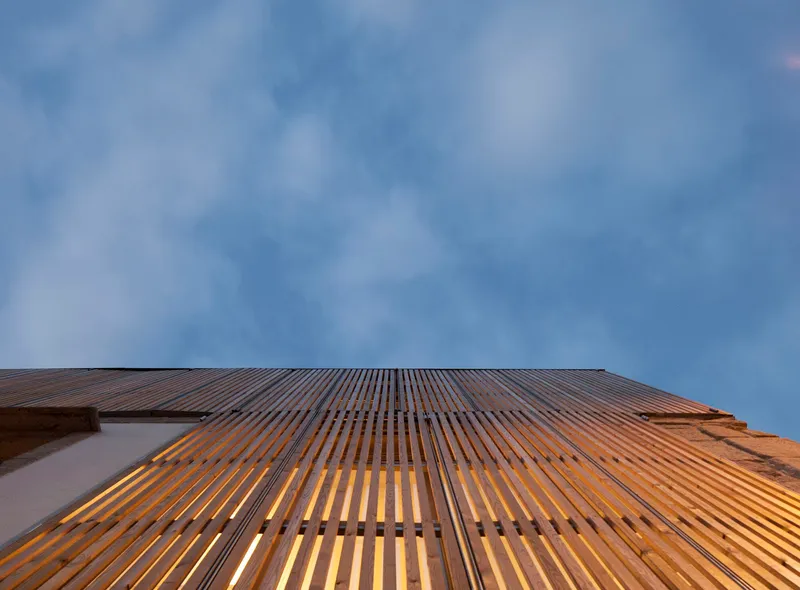
At dusk and into the evening, the building reverses its daytime logic. Where the screens filter sunlight inward during the day, at night they filter interior light outward, turning the facade into a lantern. The pattern of illumination changes as residents move through their rooms, open and close shutters, switch lights on and off. Photographed by Roi Alonso under stormy clouds, the building glows against the hillside with an intensity that is theatrical without being forced.
Plans and Drawings
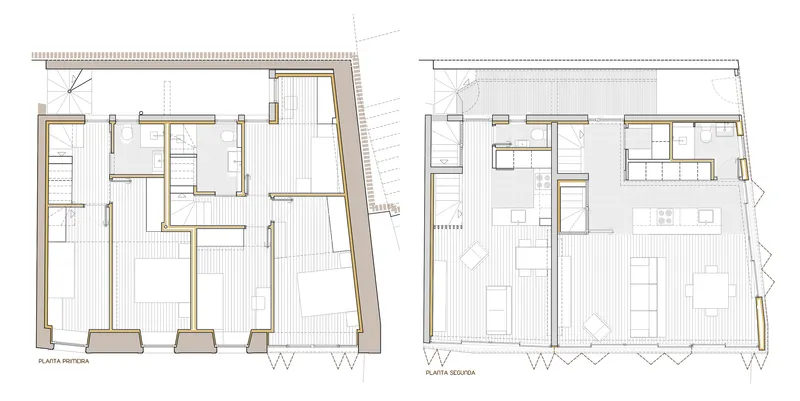


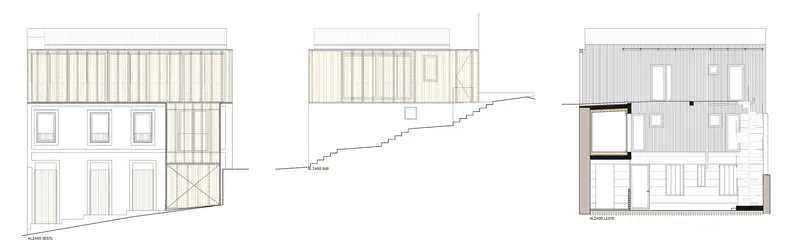
The floor plans reveal the irregularity of the site: perimeter walls follow no orthogonal logic, responding instead to the inherited geometry of the historic plot boundaries and the castle wall above. The section drawings are especially instructive, showing how four stacked levels negotiate a significant change in grade. Parking occupies the lowest level, with the terrace and stair access above establishing the transition to the domestic floors. The elevation drawings make the fenestration pattern legible: the folding shutter bays are precisely located to maximize the western exposure while respecting the rhythm of the existing stone structure.
Why This Project Matters
The renovation of housing in historic European centers is often trapped between two bad options: conservative pastiche that embalms the past, or willful contrast that treats context as a backdrop for architectural ego. LIQE arquitectura's work at Subida ao Castelo avoids both. The pine screens are unmistakably contemporary, but their material warmth and vertical grain echo the timber traditions of Galician vernacular construction. The building is new and old at the same time, not because it blends them, but because it holds them in productive tension.
The deeper lesson here is about user agency. In a profession increasingly drawn to fixed, optimized envelopes, this project gives its residents a facade they can physically reconfigure every day. That is not a gimmick; it is a fundamental position about how buildings should relate to the people who live in them. Architecture that moves with its inhabitants, that wears the evidence of their choices on its face, is architecture that stays alive long after the construction team leaves.
Subida ao Castelo Reform by LIQE arquitectura, Casco Vello Alto, Vigo, Spain. 291 m². Completed 2022. Photography by Roi Alonso.
About the Studio
Share Your Own Work on uni.xyz
If projects like this are the kind of work you want to make, uni.xyz is a place to publish your own, find collaborators, and enter design competitions.


Popular Articles
Popular articles from the community


Riyadh For All: Intergenerational Urban Design for Active Aging in Rabat
Riyadh For All reimagines urban design in Rabat with intergenerational co-living, adaptive courtyards, and Moroccan cultural exchange today.
AL-JANNAH: Sustainable Architecture and Permaculture for Afghan Widows
AL-JANNAH uses sustainable architecture and permaculture to create resilient oasis of housing, learning, work and renewal for Afghan widows.

The Earth Pod: 3D Printed Homes for Resilient Refugee Communities
The Earth Pod reimagines refugee housing through 3D printed homes made from clay, combining resilience, self-sufficiency, and rapid shelter.
EW PARK: Sustainable Architecture Reimagines the Future of Urban Parking
EW PARK reimagines city parking as a modular wooden tower combining automation, solar energy, electric mobility, and adaptable urban design.


Similar Reads
You might also enjoy these articles

Bao Huynh Watercolor Atelier: A Serene Art Retreat in Hội An
Bao Huynh Watercolor Atelier in Hội An blends multifunctional art spaces, sustainable design, local materials, and family-friendly living in a serene environment.

Atelier Macri Concept Store Interior Design by CASE-REAL
Atelier Macri store features a "ko" counter, walnut wood details, cork displays, blending retail, gallery, and seamless customer experiences.

Manuel Vargas Izquierdo Stadium and High-Performance Sports Center: Architectural Excellence in Jalpa de Méndez
The Manuel Vargas Izquierdo Stadium blends sustainable design, inclusive sports facilities, and cultural-inspired architecture, revitalizing Jalpa de Méndez’s public spaces.
KAKR Buluh Awar Hall: Revitalizing Community and Ecology Through Bamboo Architecture
Community built bamboo hall revitalizes Buluh Awar village, empowering youth, restoring ecology, celebrating vernacular craftsmanship through sustainable architecture and culture.
Explore Architecture Competitions
Discover active competitions in this discipline



Challenge to reimagine the Iron Throne


Photograph architecture without architects


Illustrate the lost glory of Angkor Wat - Render Challenge


Design challenge to reuse E-waste
Comments (0)
Please login or sign up to add comments
No comments yet. Be the first to comment!