
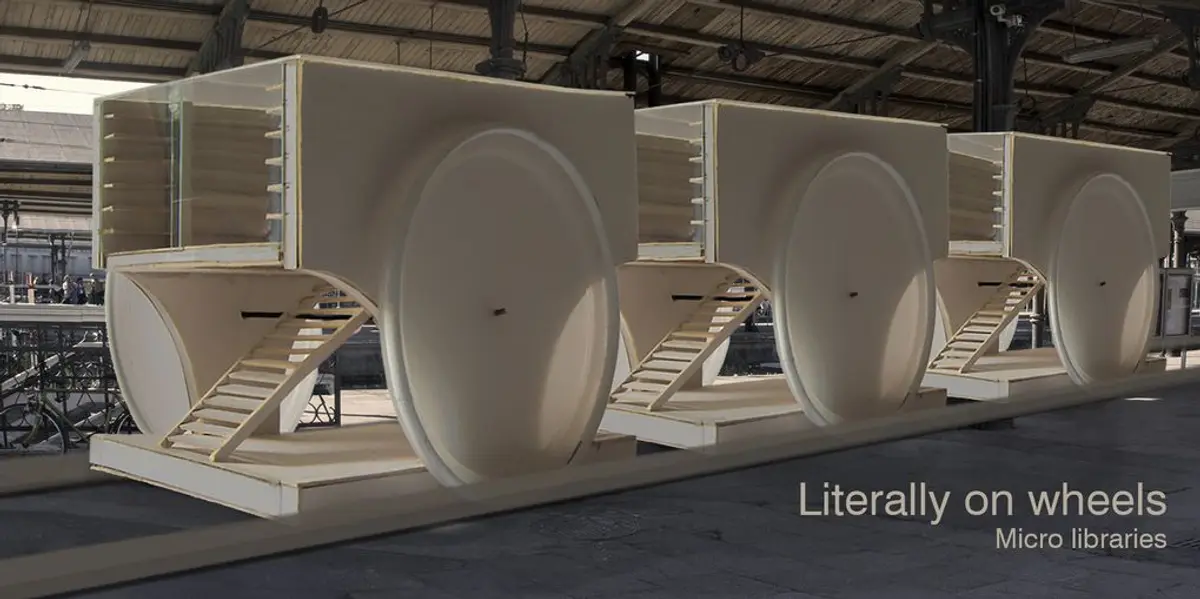
Literally on Wheels - Micro Libraries journal
A group of movable buildings was our first idea for the project to which we fully committed ourselves, however finding the right way to execute this idea was quite challenging. At first, we thought about making the modules autonomous and independent from one another, but we quickly noticed that if we allowed for the option to combine them, the possibilities for our library grew exponentially. We tried to use this insight with the design of a circular, tall chamber divided into four quarters that could be pulled away from each other. While the cross-section of this structure looked good, the actual object looked too convoluted when the segments were apart and too bland when connected. Even though we abandoned this concept, we still managed to learn something in the process: It was in this stage of our work that we conceived the idea of putting the objects on rails and settled on every capsule being identical. We also concluded what we shouldn't do: the shape we picked was troublesome since only four or fewer elements could be connected at once, and the placement of stairs was also an issue. Because of this, we went for a linear structure later in the design process. We also noticed that the separated segments were exposed to the elements so we decided that our modules would have to be sealed from all sides. With those insights, we were quite close to the final project however there still were problems to be solved. Our first "linear" capsule didn't have a lot of space for shelves since one of the walls had a large window. We fixed the issue by replacing it with a skylight panning the entire roof. It also occurred to us that our library was missing something crucial, something that would immediately strike the viewer and add more personality to our object. The almost comically large wheels were the perfect answer, not only do they serve an aesthetic purpose, but they are also quite practical: their large radius means that the modules are easier to move and their axis is just above the head level of the ground floor. In order to suit this new development, we modified the walls on the first floor to mirror the arc of the wheels. At this point, all we needed to do to complete our project was to add small stabilizing wheels, shelves, lightweight stairs and glass doors at both ends of the capsules.


Popular Articles
Popular articles from the community


Play: Fragments of Their World
Familiar architecture becomes modular playground design, creating safe spaces where displaced children can learn, connect, imagine and play.

Co-Life: Senior Housing Design That Reconnects Older Adults With the City
Co-Life reimagines senior housing design through healing gardens, shared streets, workshops, and a sustainable community across generations.

Conexión: Biophilic Design Reimagines High-Rise Living in Hong Kong
Conexión reimagines high-rise living in Hong Kong through biophilic design, green facades, shared spaces, daylight, water and nature within.

Little Red Riding Hood: Architectural Design as a Journey Through Fear, Light, and Storytelling
Little Red Riding Hood reimagines the fairy tale through architectural design shaped by fear, light, scale, memory, uncertainty, and choice.

Similar Reads
You might also enjoy these articles

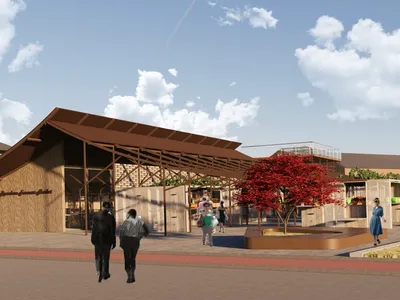
The Rhythm of Seasons
A Farmers' Market Connecting Nature and the City
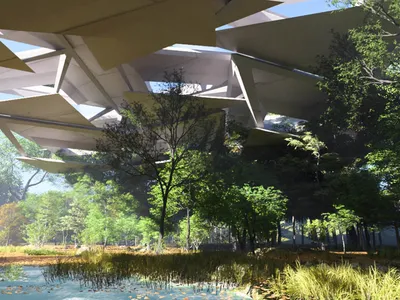

More Than a Building-Designing a Living System
More Than a Building-Designing a Living System
Base Beyond
DESERT COMPOUND ARID: TOURISM OF ABSENCE AND ABUNDANCE


Comments (0)
Please login or sign up to add comments
No comments yet. Be the first to comment!