

Little Bali - A Classic Rendition
Café design - Brewed Bali

Bali is a land of rich culture and heritage which ranges from beautiful architecture to the traditional dance and food. The aim of the café design is to capture the spirit of Balinese culture for the tourists as well as for the locals. The ideology revolves on multiple concepts that include ecology, tradition, functionality and vernacular architecture.
What was the concept behind the project?
Concept:
The concept of the café design concentrates on spatial organization based on functionality and aesthetics keeping the climatic and contextual aspects in mind. The Balinese architecture, tradition, cultural art and art forms are given importance by introducing activities and artefacts in micro planning of spaces.
Ecology: Natural elements like water, air, land and light have been given importance by introducing water bodies, Balinese plants and landscape along with view oriented spatial arrangement.
Heritage: spaces for Balinese art and art forms have been allocated for interactions with the visitors. Along with dance forms and art, handicrafts, shadow art, puppet shows have been introduced in an eye-catching manner.
Materials: Balinese architecture is famous for the use of vernacular materials like bamboo, teak wood and stone which have been used in the designing of the café.
Climate: the tropical climate of Bali results in high humidity and requires air movement and ventilation for reaching a thermal comfort zone. Ventilation is achieved by maximizing open spaces within the café and introducing small water bodies to create a cool micro climate.
FORM DEVELOPMENT
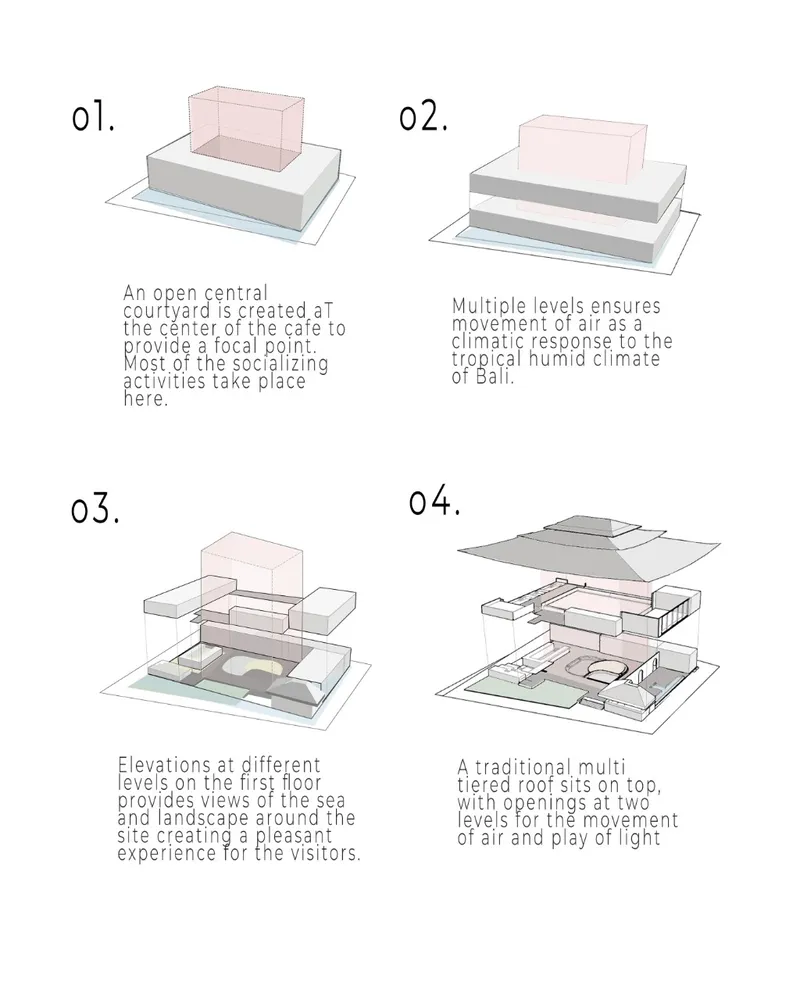
What are the connections between the interior and the exterior of the project?
Café:
The entrance is placed at the north of the site, to its right is a shop and to its left is a waiting area. The shop is used to sell traditional crafts, art and handicrafts of Bali that is made locally to promote and spread awareness about Balinese craftsmanship. The waiting area flows into the ‘Jepun Garden’ which is a little area with Frangipani or Plumeria plants lined up to create a buffer zone that separates the café from the main road. It is a transformable space that can be used to as an extended seating area or an outdoor gathering space.

Courtyard:
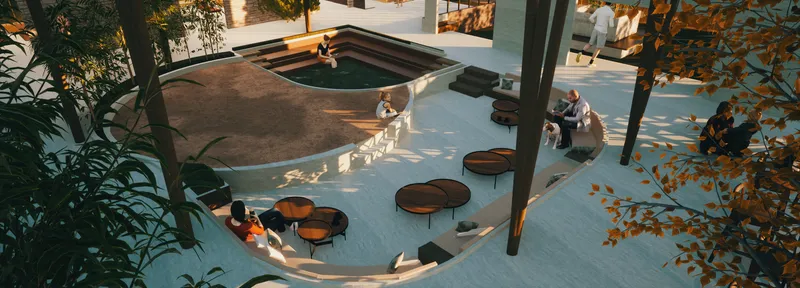
An open courtyard is placed at the center; it is the main socializing area of the café. The courtyard concept is chosen as a climatic response to Bali’s tropical climate. The courtyard consists of a performance area and a seating area. Tourists from all over the world visit Bali to watch the famous dance form, Kecak. In the time of fast changing lifestyle of people, conserving the cultural heritage is given importance in Bali. The performance area is dedicated for Kecak dance performances and involving the visitors by teaching them.
A koi fish pond is placed at a corner of the courtyard in order to cool down the micro climate within the café. It consists of the traditional Balinese Lotus and water lily flowers. Surrounding the pond is a row of seating which also act as an extended waiting area.
Coffee Bar:
Surrounding the courtyard on the East, is a coffee bar with seating on either sides -one for the visitors from inside the café and the other facing the beach that can be accessed from the outside. As the beach is at a walkable distance visitor from the beach also enter the café through an entrance next to the coffee bar. Adjacent to the coffee bar is an OAT where informal stepped seating area with a view towards the ocean is place. On the West, is an arched entrance to a seating area placed adjacent to a water body placed to produce a cooling effect and reduce temperature.
Kitchen and Services:
On the south is a kitchen placed. A service entry is provided at the back next to the coffee bar. Visitors from the beach can come to the café directly due to the close proximity. Changing rooms and washrooms are provided at South tucked away from the courtyard and seating.

Mezzanine:
A stairway from the ground floor connects to the mezzanine leading to long passage with a traditional art of shadow play area with puppets. Two different elevations are created to capture view of the landscape towards north and an ocean view towards the south. Both the spaces have private seating area with pleasant views. A viewing deck is placed at a corner next to the seating area on south with as an informal gathering space.
Roof:
The roof form is inspired by the traditional style used in Balinese architecture. It is a 3 tiered roof with openings at two levels to ensure air movement and play of light.
What/How were the materials chosen?
Balinese architecture is famous for the use of vernacular materials like bamboo, teak wood and stone which have been used in the designing of the café. The roof is a traditional thatch roof adhering to the vernacular choice for the climate. Bamboos are tied together to form columns that hold the thatch roof and the mezzanine. Flooring is done using teakwood. Louvers are used to control the wind movement in the humid climate. Lighting design is done in an interesting manner using the weaving crafts done in Bali like baskets and nets.
How was the program condensed into final?
All the spaces are tied together through design. Character of the structure and its concept is maintained throughout the café. The user group is inclusive of the tourists as well as the locals. An overall experience that is created in the café would be like a little Bali tour. It captures the little things that make Bali beautiful and unique. It is a place not just for tourists but also for the locals to be able to relax and enjoy.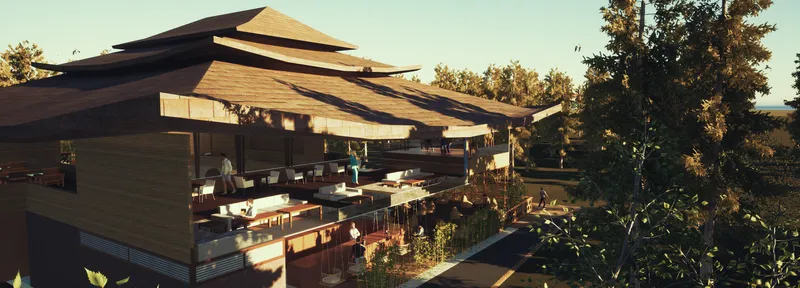

Popular Articles
Popular articles from the community


Juan García Correa, John González and Claudia Rueda Sink a Circular Amphitheater into a Manizales Engineering Building
On the La Nubia campus in Manizales, Colombia, the S1 Building folds labs and offices into a hillside of ramped lawns that double as a campus route.

David Macias Steps a Doorless Stone and Plaster House Down a Tropical Colombian Hillside
In the humid hills of Colombia, Threshold House replaces the front door with an open void and terraces its 850 m² down the slope instead of fighting it.

U.GA Architects Wraps an Oval Rooftop Pool in Curved Board-Formed Concrete on Busan's Jeollidan-gil
In Busan's Jeonpo-dong, a 454 m² mixed-use block stacks a neighborhood facility, guest rooms and an oval rooftop pool inside spiraling concrete walls.

Jaramillo Van Sluys Arquitectura and Urbanismo Turn a Demolished Registry Lot in Quito into an Orchard Plaza
In Quito's Centro Histórico, a 2,800 m² plaza exposes the San Agustín convent wall and redraws its lost Augustinian orchard in volcanic stone.

Similar Reads
You might also enjoy these articles


Vereda Arquitetos Renovates a 40-Square-Meter Apartment Inside Niemeyer's Copan Building
A compact unit in São Paulo's most iconic residential tower gets a material overhaul that pairs exposed concrete with bold blue Formica.

Shakur's House: Exposed Brick as an Interior Organiser in a 168 m² Mashhad Residence
Brick moves indoors in this Mashhad residence, where masonry walls, glass partitions and teal planes sequence a compact home without closing it off.

Day and Night Park: A Time-Based Urban Newsstand in Beijing
A temporary urban newsstand in Beijing blending travel, light, and reading through poetic colors, compact form, and community-focused design.

Modernist Patio Renovation in El Masnou, Barcelona by Oliver Segura Arquitectura + Cebrià Arquitectura
Modernist patio renovation blending tradition and innovation with a movable pool, leveled floors, and Catalan materials in El Masnou.


Comments (0)
Please login or sign up to add comments
No comments yet. Be the first to comment!