
HID Landscape Architecture Wraps a Mythical Tiger in a Water-Drop Ring Above Yichang's Liuquan Lake
A 15,000 square meter playground reconstructs degraded foothill terrain into a three-dimensional adventure landscape for Yichang's largest park.


Children's playgrounds rarely get the structural ambition of civic infrastructure, but HID Landscape Architecture treated the Liuquan Lake Children's Playground in Yichang, China, as both a landscape remediation project and a piece of topographic engineering. The site, a former foothill above a pond in Xiaoting District, had become unstable through decades of development: the mountain edge was fragmenting into landslides, the adjacent pond had been backfilled, and the transition zone between mountain and waterbank had lost its ecological logic. HID's response was to rebuild the terrain entirely, reshaping the ground into a sequence of hills, ridges, cols, and plains that serve as the structural foundation for 16 types of play equipment. The result, completed in 2024, is a 15,000 square meter playground that reads as a geological formation rather than a catalog of brightly colored apparatuses.
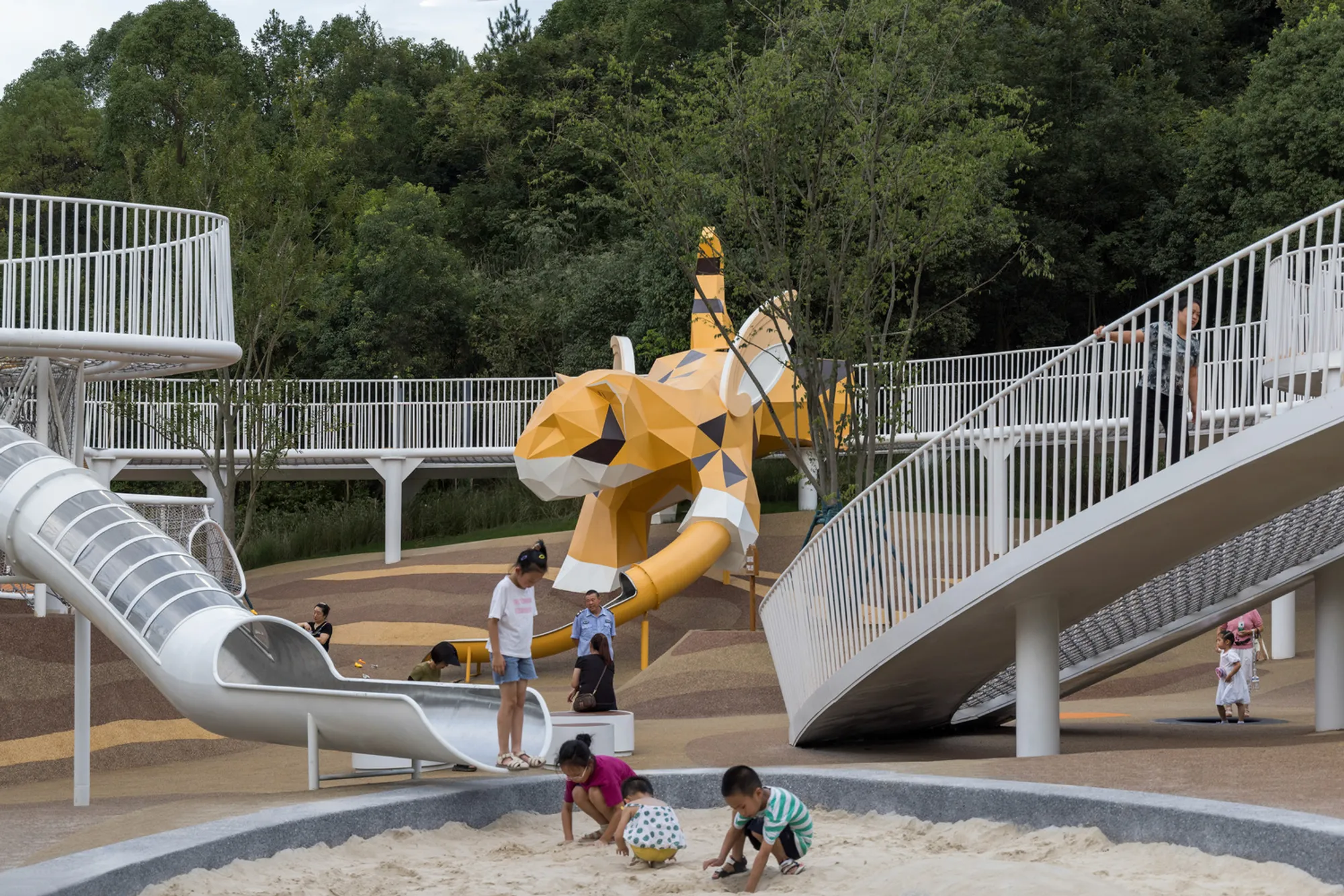
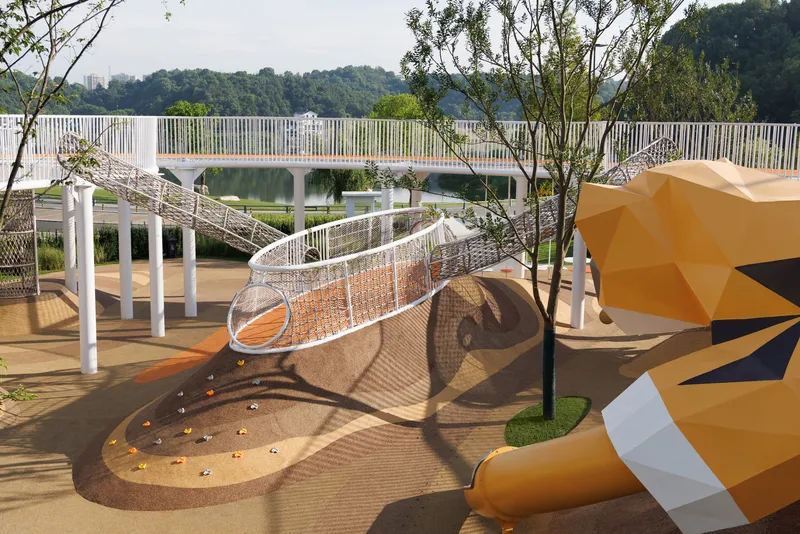
What makes the project genuinely interesting is its refusal to separate landscape from play structure. The adventure ring, a water-drop-shaped semi-web of exposed steel finished in white fluorocarbon paint, sits four meters above the lowest point of the col and functions simultaneously as a circulation spine, a climbing apparatus, and a visual datum that links the reconstructed ridgelines. Beneath and around it, the mythical beast Yu Xiao, a winged tiger from local folklore, materializes as a faceted yellow sculpture composed of triangular panels, its abstract geometry emerging from the sand like something half-excavated. The earthwork balance was achieved by using spoil from the foundation excavation and the adjacent grass skiing area, turning what would normally be a construction waste problem into the literal ground of the playground.
The Ring as Landscape Infrastructure
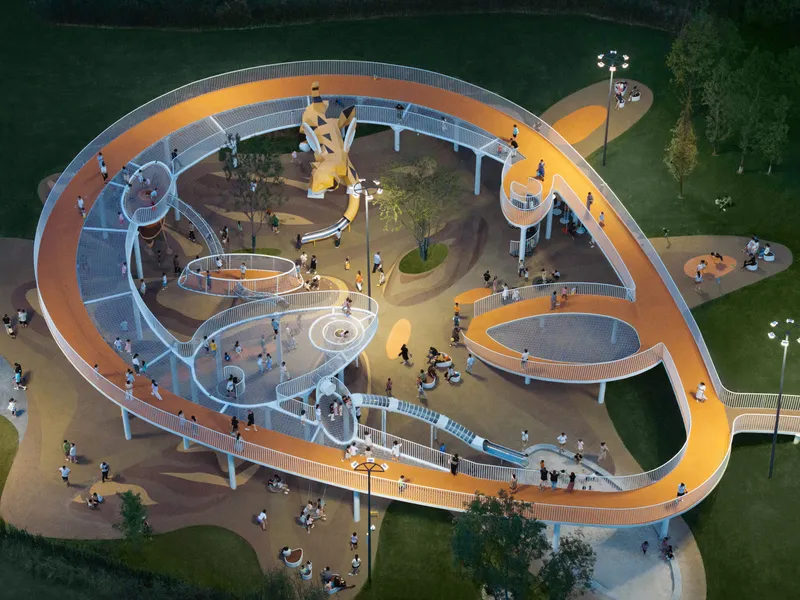
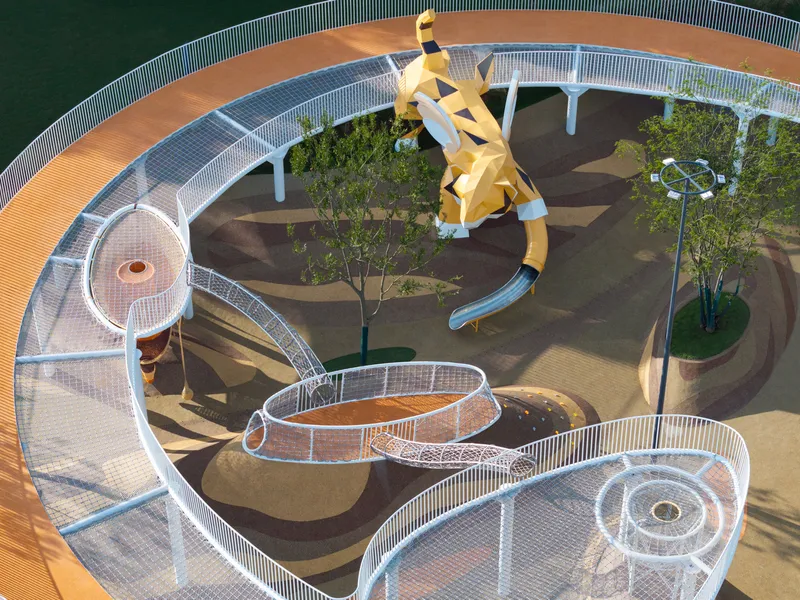
The elevated adventure ring is the project's organizational spine, and its looping form is legible even from aerial distance. Orange-surfaced pathways trace a continuous circuit above the reconstructed terrain, connecting climbing nets, slides, trampolines, and observation points into a single three-dimensional route. From above, the ring reads as a water droplet pressed into the hillside, its geometry responding to the contour lines rather than imposing a rigid plan. The raft foundations beneath each column required cushion replacement to address the site's poor geological stability, a detail that underscores how seriously the engineers took the ground conditions here.
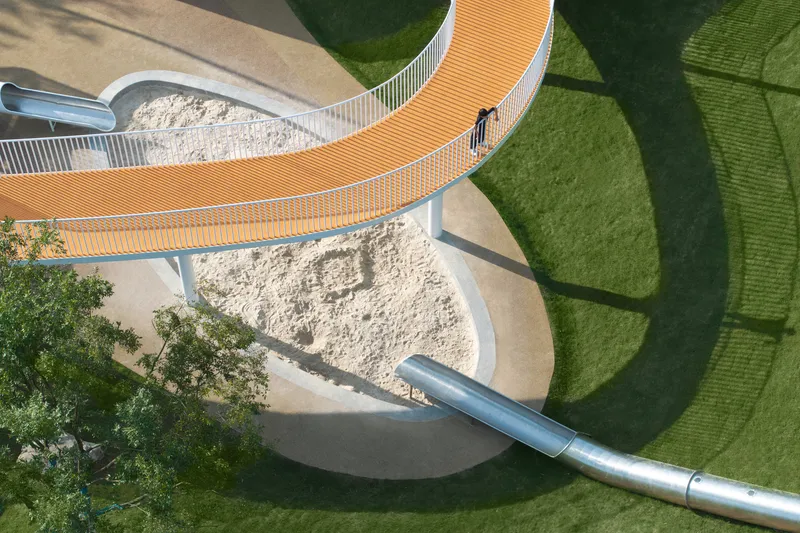
The curved orange bridge connecting sand play areas to lawn zones below demonstrates how HID used the ring not just as a play structure but as a connective tissue between different terrain types. Children move from hard surfaces to soft, from enclosed tunnels to open nets, without ever leaving the continuous loop. The altitude change of four meters across the ring's extent means gravity is always part of the game.
Yu Xiao: A Tiger Built from Triangles
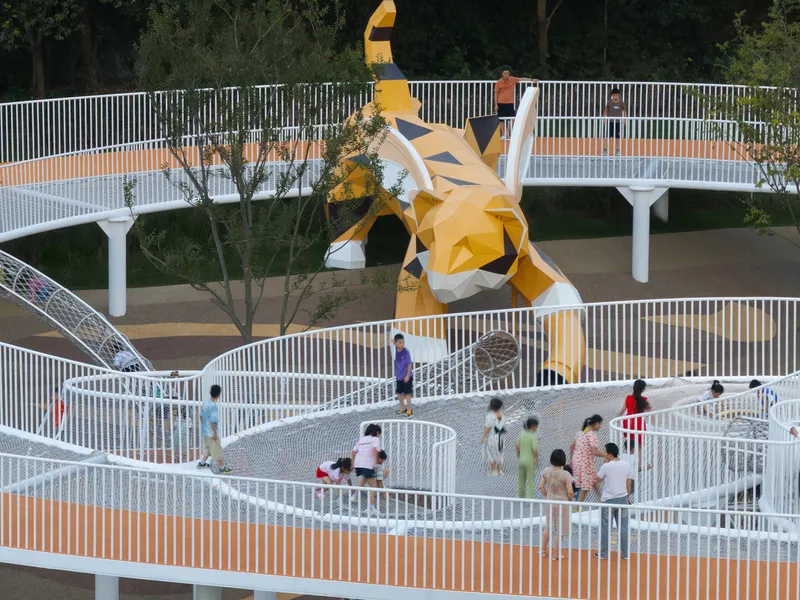
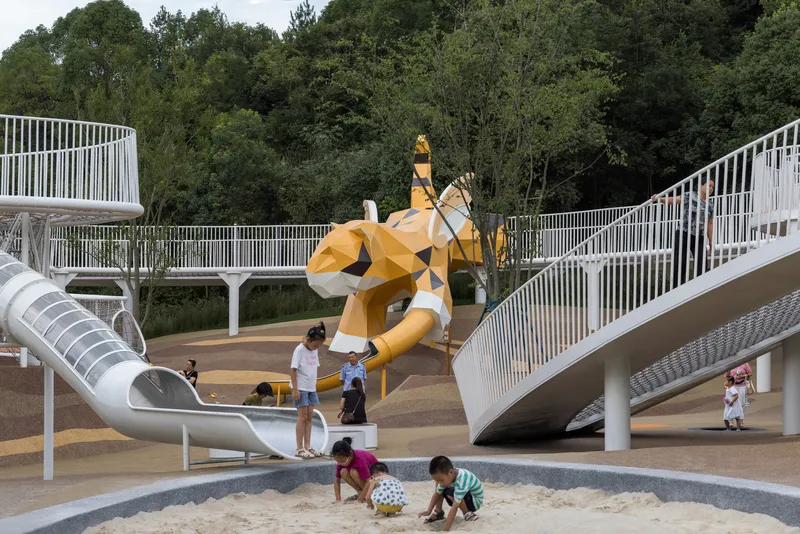
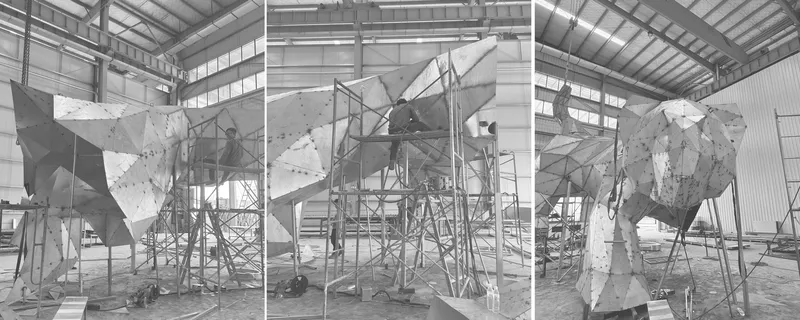
The faceted yellow sculpture anchoring the playground's center is an abstraction of Yu Xiao, a winged tiger from regional mythology. HID composed the form entirely from triangular surfaces, a deliberate strategy to avoid the fabrication complexity of hyperboloid geometry. The result is a creature that looks crystalline and geological rather than cartoonish, its angular planes catching light differently throughout the day. The fabrication photograph from the industrial warehouse reveals the steel scaffolding and panel assembly process, showing that the sculpture's visual lightness belies a substantial structural skeleton.
Tiger-patterned surface treatments extend across the surrounding terrain, turning the ground plane into an extension of the sculpture's identity. The sand pit beneath the converging white walkways becomes the beast's domain, and children interact with it at close range, climbing its flanks and sliding from its back. It is a landmark that works at two scales: from the lake, it registers as a golden marker against the forest; up close, it is climbable terrain.
Mesh, Net, and Woven Structure
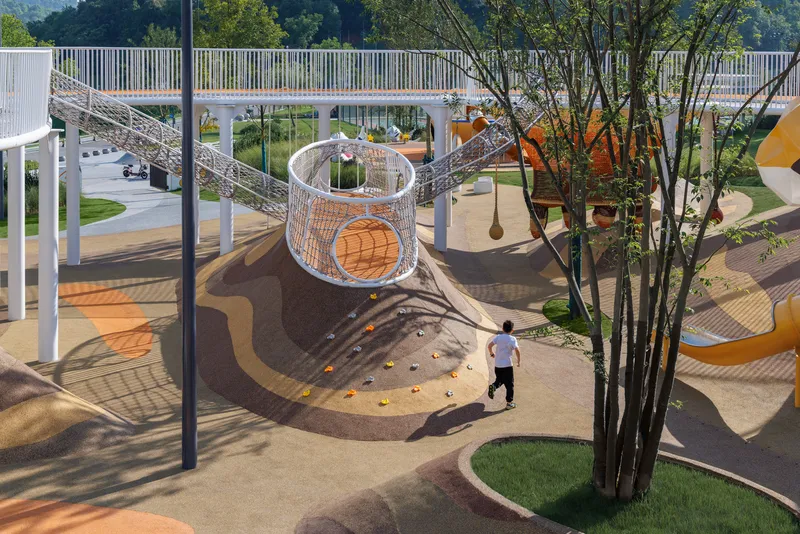
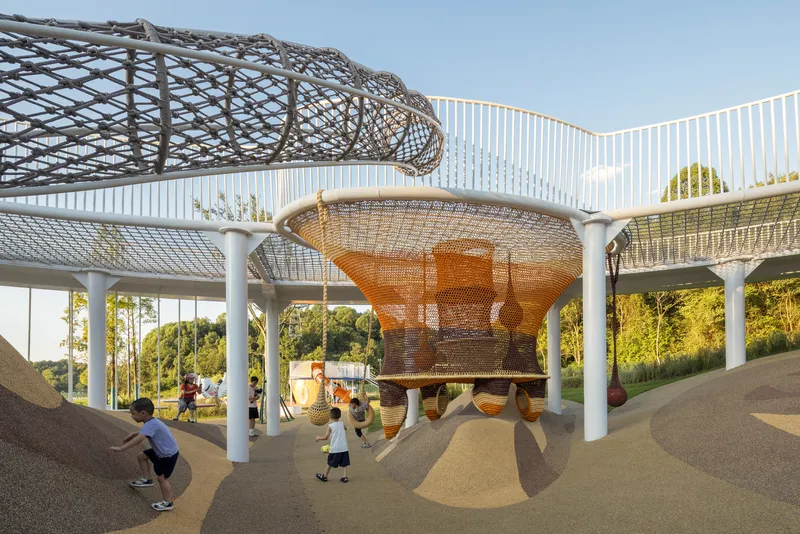
Woven metal mesh is the connective material throughout the playground, appearing as tunnel slides, climbing surfaces, suspended bridges, and layered canopies. HID used mesh to create semi-transparent enclosures where children remain visible to caregivers while experiencing the thrill of elevated, bouncing terrain. The rope net climbing structure supported by white columns, with the lake and mountains visible beyond, is perhaps the project's most photogenic moment: play equipment framing a landscape view rather than blocking it.
The layered mesh canopies and platforms create a stacked section of activity zones, with children occupying different levels simultaneously. White columns carry the loads cleanly, and the afternoon light filtering through the mesh produces shifting shadow patterns on the ground below. The material choice is pragmatic as well as aesthetic: mesh dries quickly, allows air circulation in Yichang's humid summers, and provides enough give to cushion falls without requiring additional safety surfacing.
Lakeside Context and Terrain Strategy
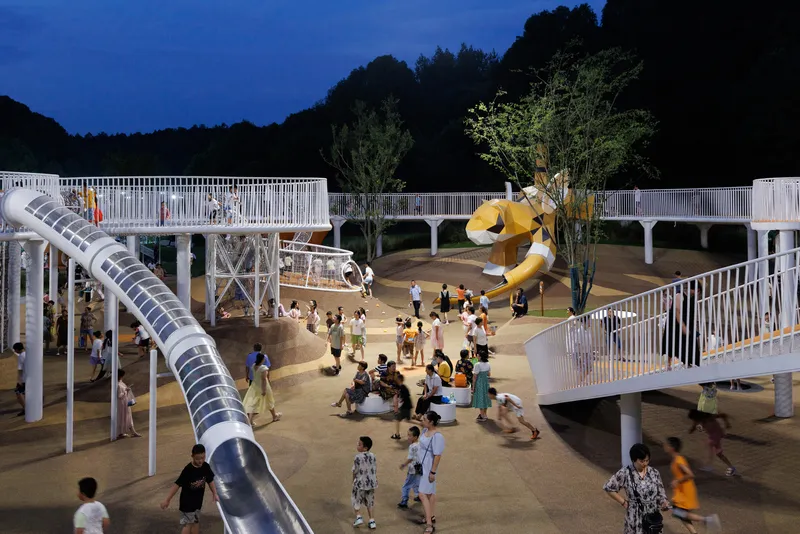
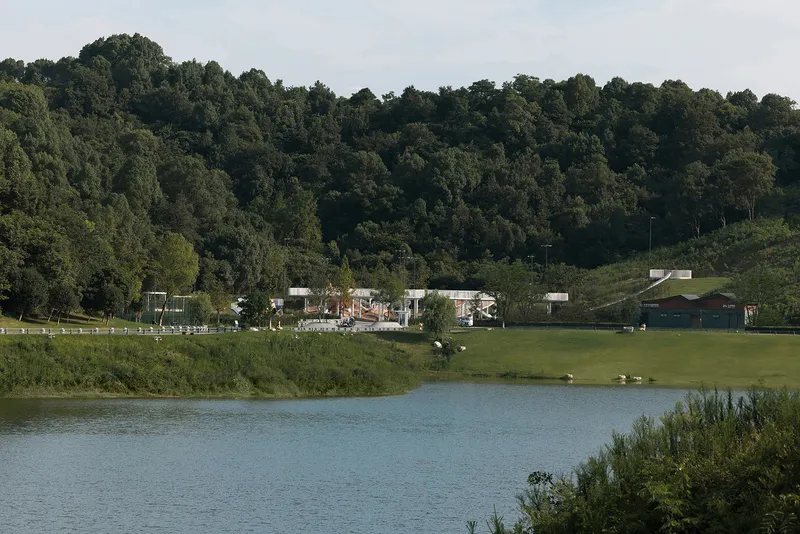
Viewed from across Liuquan Lake, the playground registers as a luminous intervention against a densely wooded hillside. The white structural elements and the warm glow of evening lighting distinguish the play zone from its surroundings without overwhelming the park's character. Liuquan Lake Park is the largest comprehensive park in Yichang City, and the playground is one of ten themed recreational spaces distributed around the water body. HID's topographic approach, reorganizing the natural mountain edge to collect water and channel it toward the lake, means the playground functions as a piece of the park's hydrological system as well as its recreational program.
The dusk view of the white elevated walkways surrounding the yellow sculpture reveals how the project operates as a beacon within the park. The tube slide, the angular tiger, and the illuminated paths together create a scene that is as much about spectacle as about play. For a project built on backfilled, geologically unstable ground, the visual confidence is remarkable.
Plans and Drawings
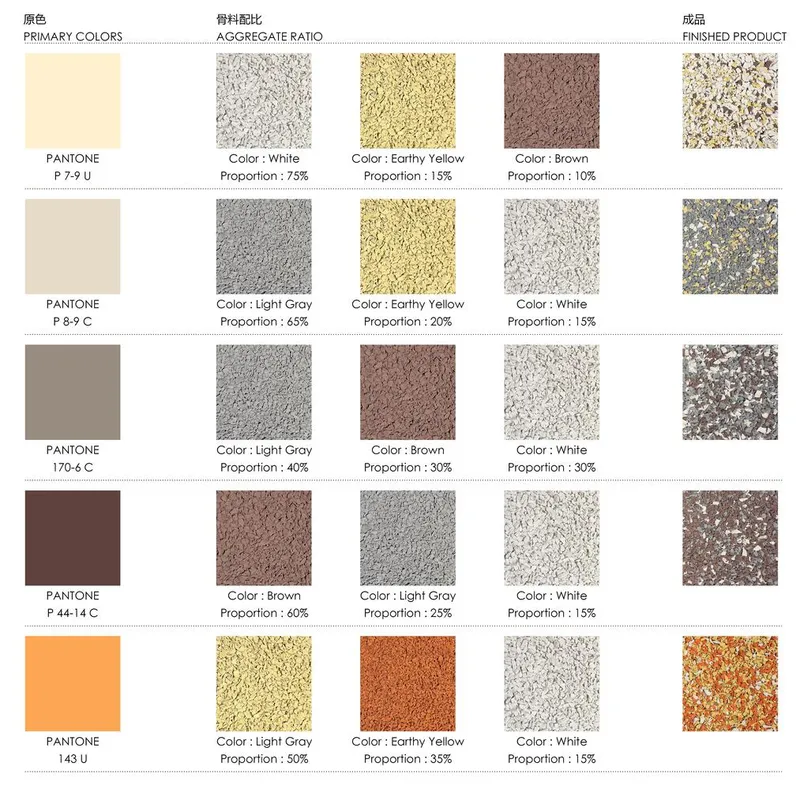
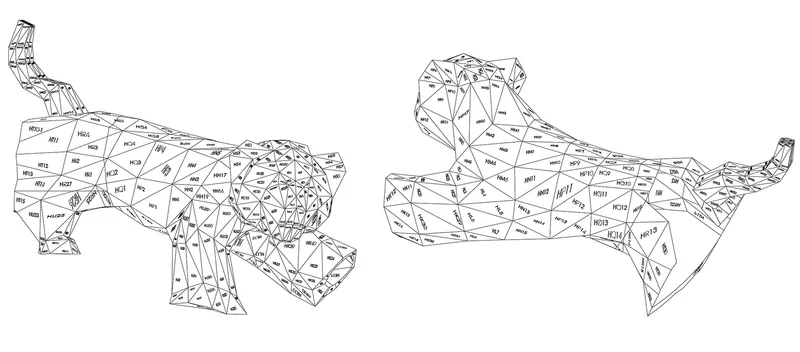
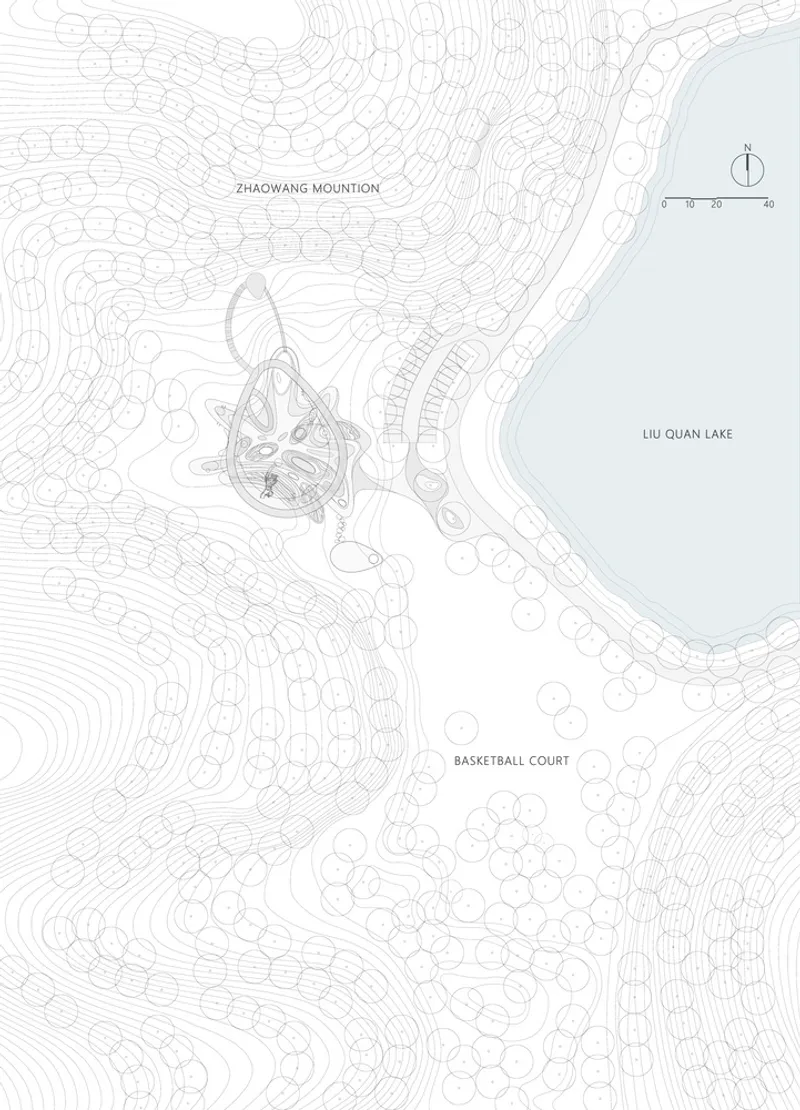
The site plan reveals the playground's careful relationship to the lake edge and the surrounding topographic contours, with vegetation buffers mediating between the constructed terrain and the existing forest. The axonometric drawing of the Yu Xiao sculpture shows the triangulated panel logic in detail: each face is a flat triangle, eliminating the need for complex curved fabrication while producing a form that reads as organic from a distance. The material palette chart documents the aggregate ratios for five colored surface finishes, evidence of the attention HID paid to ground-level texture. These drawings collectively demonstrate a project where the design resolution extended from earthwork strategy down to surface aggregate composition.
Why This Project Matters
Liuquan Lake Children's Playground matters because it treats a children's play environment with the same rigor typically reserved for cultural buildings or infrastructure projects. The earthwork balancing, the geological remediation, the hydrological integration, and the structural engineering of the adventure ring collectively represent an argument that recreational landscapes deserve serious design investment. HID did not drop off-the-shelf equipment onto a flat rubber surface. They rebuilt the ground, invented a mythology, and engineered a structure that makes topography itself the primary play experience.
The project also offers a model for how to recover degraded foothill sites in rapidly developing Chinese cities. Rather than stabilizing the slope and moving on, HID turned remediation into program, using the spoil and fill required for safety as the raw material for an entirely new terrain. The playground proves that landscape architecture, when given the latitude to rethink the ground itself, can produce public spaces that are simultaneously ecological infrastructure and genuinely exciting places to be a child.
Liuquan Lake Children's Playground by HID Landscape Architecture. Liuquan Lake Park, Xiaoting District, Yichang, China. 15,000 m². Completed 2024. Photography by IMA.
About the Studio
Share Your Own Work on uni.xyz
If projects like this are the kind of work you want to make, uni.xyz is a place to publish your own, find collaborators, and enter design competitions.




Popular Articles
Popular articles from the community


The Musturak Paradise: Senior Living Architecture for a Connected Future in Temara, Morocco
The Musturak Paradise reimagines senior living architecture in Temara via private homes, social spaces, culture, community, and shared care.
EW PARK: Sustainable Architecture Reimagines the Future of Urban Parking
EW PARK reimagines city parking as a modular wooden tower combining automation, solar energy, electric mobility, and adaptable urban design.

Hill & Cross Opera: Sculptural Opera House Architecture Shaped by Tallinn’s Landscape and Identity
Hill & Cross Opera reimagines opera house architecture in Tallinn through its sculptural hill, civic plaza, glass wave and a luminous cross.

Co-life: Sustainable Architecture for Age-Friendly Community Living
Co-life reimagines sustainable architecture for seniors through courtyards, rammed earth, shared gardens, and spaces designed for belonging.


Similar Reads
You might also enjoy these articles


Hodi-Mandai Geram
Project Function: Preservation and revitalization of the Intangible heritage and socio-spatial identity of the Hodi by Housing, Cultural Memory Center, Sacred Grove, landscape, local tourism economy


Olio Towers: A Mid-Rise for Performers That Fuses Housing, Rehearsal, and Stage
Located blocks from Houston's Theater District, this modular tower stacks living units around a central performance atrium.

Oasis: Modular Green Housing Carved into Dhaka's Urban Fabric
A shortlisted Plugin Housing entry reclaims unauthorized settlements in Dhaka with stepped concrete volumes, green roofs, and ventilation-driven design.

Black Hole: A Floating Megastructure for the Post-Physical Era
Emiliano Mazzarotto envisions a spherical, self-scaling arena where e-sports, digital hotels, and holographic stadiums replace traditional public space.


Explore Playground Competitions
Discover active competitions in this discipline



Challenge to reimagine the Iron Throne


Photograph architecture without architects


Illustrate the lost glory of Angkor Wat - Render Challenge


Design challenge to reuse E-waste
Comments (0)
Please login or sign up to add comments
No comments yet. Be the first to comment!