

Living Frame: Architecture Grown from Trees, Mycelium, and AI-Directed Biology
A speculative urban habitat where directed plant growth, bioluminescent grafting, and fungal petrification replace conventional construction entirely.


What if buildings grew themselves? Not as metaphor, but as literal woody structures bent into inhabitable form by artificial intelligence, cemented by mycelium, and lit from within by bioluminescent ferns. Living Frame proposes a future where the construction industry is replaced by directed biology: trees twist on command, modified berries emerge from walls to feed occupants, and fungal cultures petrify completed structures into load-bearing permanence. It is speculative architecture at its most radical, treating flora not as ornament but as the primary building material, structural system, and life-support infrastructure all at once.
Designed by Travis Rebsch, Living Frame is a shortlisted entry in the Breaking Work - Singularity competition. The brief asked designers to imagine a future where emerging technologies fundamentally reshape how we work and build. Rebsch's answer bypasses conventional construction altogether, positing that newly emergent AI can fuse with natural growth patterns to produce architecture without human labor, without conventional waste, and without the emotional disconnect that comes from living in purely synthetic environments.
Perforated Towers Rising Through Mist
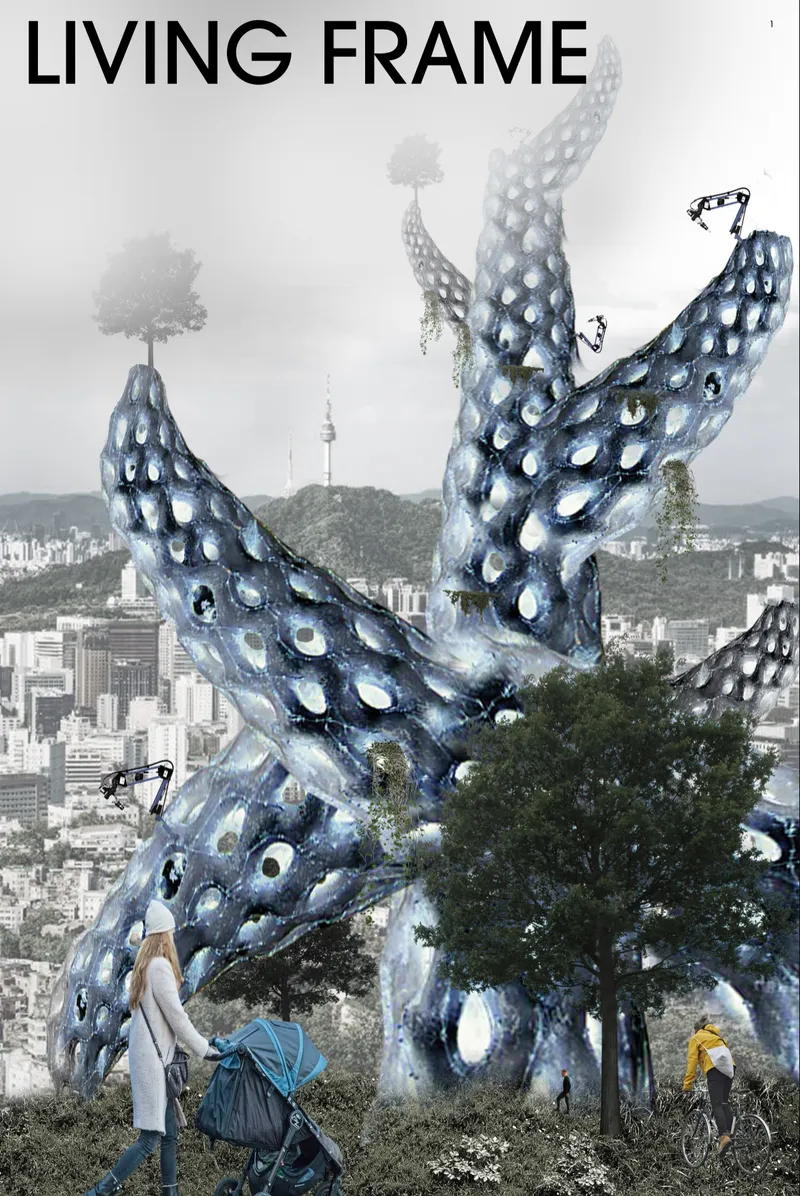
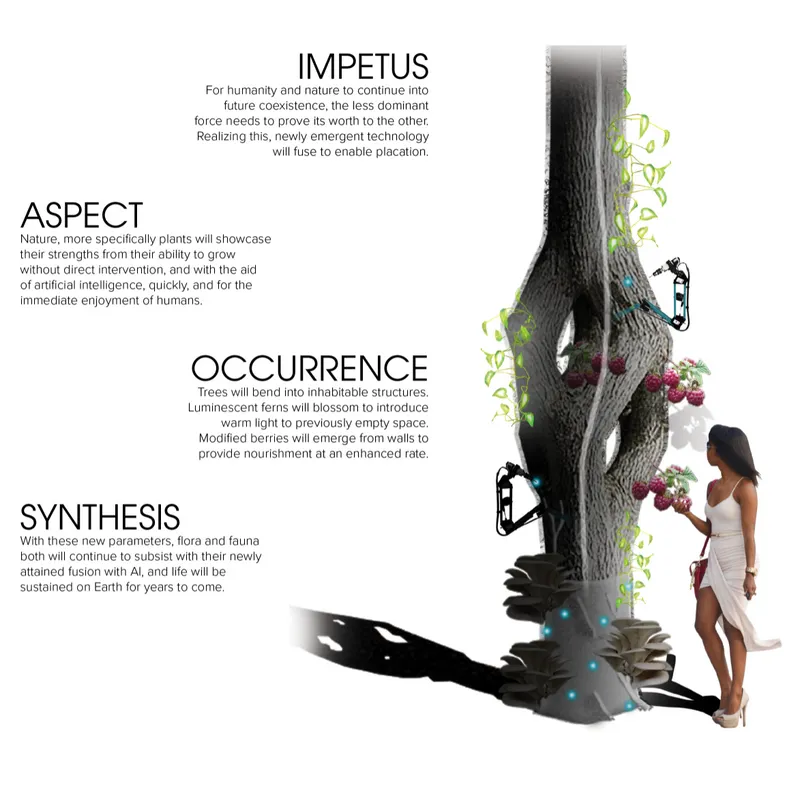
The project's signature forms are tall, perforated vertical towers that rise above a hillside cityscape, their surfaces punctuated by circular openings that house trailing plants and integrated biological systems. These are not conventional high-rises. Their profiles suggest growth rather than assembly: tapering, branching, porous. Pedestrians and trees at their base provide human scale, making the sheer vertical ambition of the structures legible. A conceptual diagram clarifies the interior logic, showing a single tower in section with integrated vegetation zones and a standing human figure for reference. The message is clear: these are habitats, not monuments.
Bridged Sections and Underground Chambers
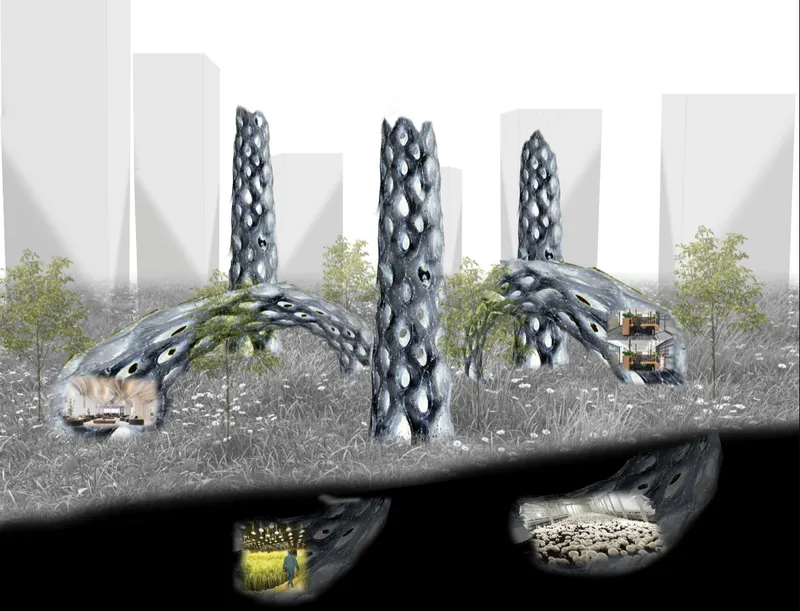
A detailed section drawing reveals how the towers operate as a connected system. Arching bridges span between perforated vertical structures, their forms suggestive of tree canopy linkages rather than engineered spans. Below grade, underground chambers house root networks and what Rebsch describes as rail systems for supply movement and construction automation. The section makes the project's material logic explicit: trees provide the structural armature, mycelium acts as the cementing agent to petrify completed forms into rigid, inert scaffolds, and rice starch serves as both fuel source and moldable material for furniture and interior detailing. Grafting, the horticultural practice of combining traits from linked plants, enables multi-use applications where a single organism can serve as food source, lighting element, and structural support simultaneously.
Walls That Feed and Illuminate
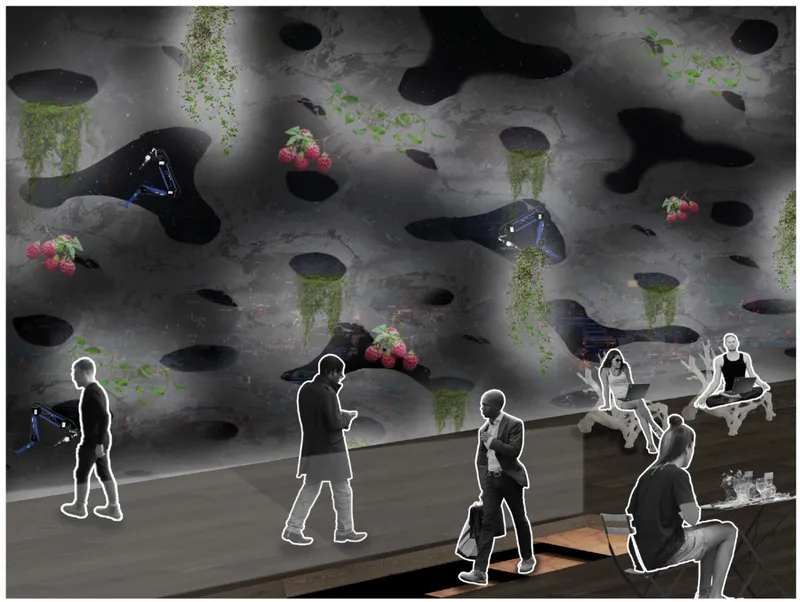
The interior rendering is where the project's ambition becomes most tangible. A textured wall surface, perforated with circular openings, hosts trailing plants and flowers that cascade into the inhabitable space. Rebsch envisions these surfaces lined with modified berries that emerge at enhanced growth rates to provide nourishment, alongside luminescent ferns that blossom to introduce warm light. It reads as something between a vertical garden and a living pantry.
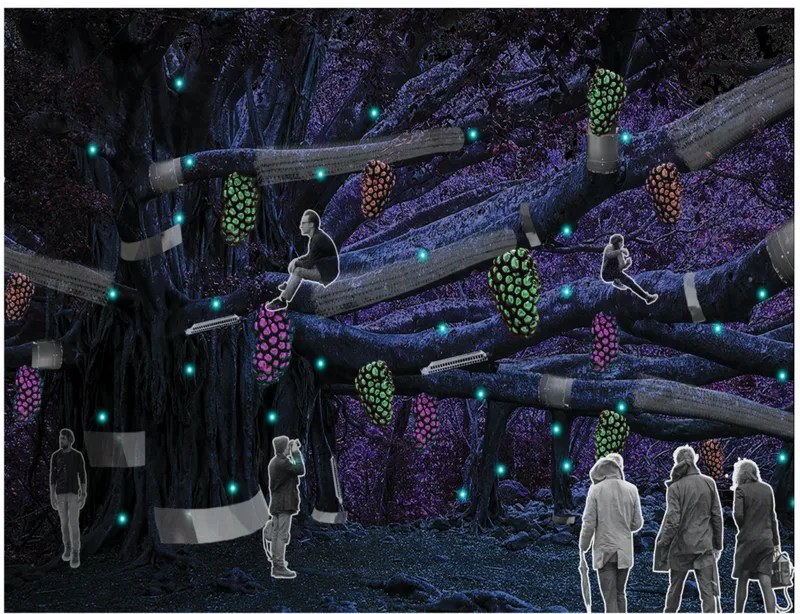
At night, the project's bioluminescent character takes full effect. Illuminated tree branches support horizontal platforms with clustered pods, human figures moving among them in a scene that feels genuinely otherworldly. The lighting is entirely organic in origin, produced by grafted plant species designed to glow. There are no electrical fixtures visible, no mechanical systems. The implication is that the architecture's entire energy and illumination cycle is biological, powered by the same organisms that form its walls and ceilings.
An Urban Grid Absorbed by Biology
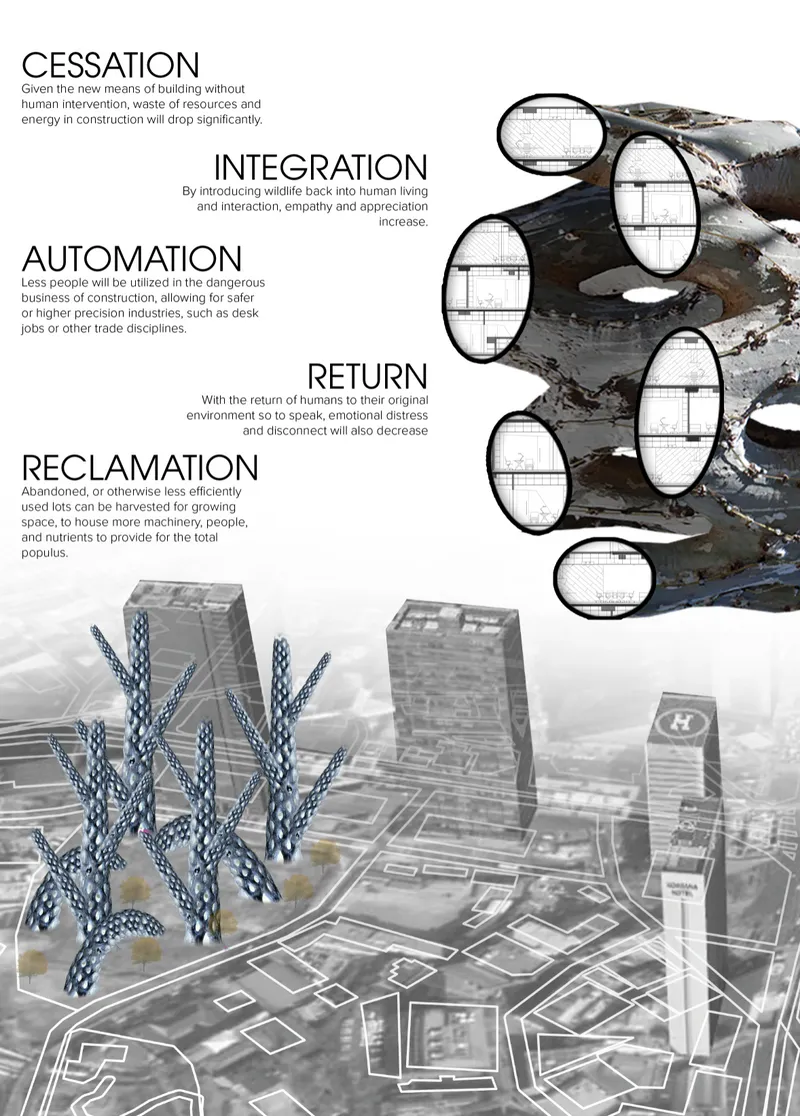
The axonometric drawing pulls back to show the project at the urban scale, with perforated towers and layered platforms rising above an existing city grid. The relationship is parasitic in the best sense: abandoned or underused lots are reclaimed as growing space to house machinery, people, and nutrient systems. Rebsch frames this as reclamation, arguing that the fusion of AI-directed biology with urban fabric enables far higher density and productivity than conventional development. The drawing communicates something important about the project's intent. It does not propose razing cities to start over. It grows through them.
Why This Project Matters
Living Frame operates in deeply speculative territory, and it knows it. The proposal does not pretend these technologies exist today. Instead, it asks what architecture becomes when nature is no longer a passive amenity but the active agent of construction. The argument is structured carefully: AI directs tree growth, mycelium petrifies form, grafting produces multi-functional organisms, and rice provides fuel and moldable material. Each component has a defined role, and the project's visual language, those perforated towers and bioluminescent interiors, emerges directly from that material logic rather than from arbitrary formal choices.
What makes Rebsch's work worth attention is its refusal to treat sustainability as an optimization problem. Most green architecture asks how to build the same things with less damage. Living Frame asks what happens when you remove the construction industry entirely and let biology do the building. The answer is strange, luminous, and genuinely provocative. It reframes the human role in architecture from builder to cultivator, and in doing so, it imagines a coexistence that is not sentimental but structural.
View the Full Project
About the Designers
Designer: Travis Rebsch
Enter a Design Competition on uni.xyz
uni.xyz runs architecture and design competitions year-round that reward proposals with spatial conviction and real site intelligence.
Project credits: Living Frame by Travis Rebsch Breaking Work - Singularity (uni.xyz).


Popular Articles
Popular articles from the community


Cloaked Colonization: A Mobile Underwater Habitat That Moves Like a Fish
Micah Abaya's shortlisted EHC Pacific entry reimagines ocean settlement as a dispersed network of self-sustaining architectural organisms.

Manzana Morphosis: Stretching Barcelona's Grid into a Living Landscape for 2050
A radical reworking of the Eixample manzana turns density into a tool for generous public space, vertical ecology, and environmental performance.
Tsunami Convergenics: Turning Catastrophic Ocean Forces into Underwater Housing Infrastructure
A speculative underwater settlement off the coast of Onagawa, Japan, treats tsunamis and typhoons as energy sources rather than threats.

Singing Woman: An Opera House That Performs Before the Curtain Rises
Ovidiu Cristian Pavel's conceptual opera house translates Estonia's choral identity into a sculpted waterfront landmark facing the Baltic Sea.

Similar Reads
You might also enjoy these articles

Pixel Gardens: One Repeated Module Stacked Into a Terraced Social Housing Tower for Famagusta
Salem Bader's shortlisted housing tower builds a vertical neighbourhood from one repeated module, offsetting units to carve terraces, light and air.

Bao Huynh Watercolor Atelier: A Serene Art Retreat in Hội An
Bao Huynh Watercolor Atelier in Hội An blends multifunctional art spaces, sustainable design, local materials, and family-friendly living in a serene environment.

Atelier Macri Concept Store Interior Design by CASE-REAL
Atelier Macri store features a "ko" counter, walnut wood details, cork displays, blending retail, gallery, and seamless customer experiences.

Manuel Vargas Izquierdo Stadium and High-Performance Sports Center: Architectural Excellence in Jalpa de Méndez
The Manuel Vargas Izquierdo Stadium blends sustainable design, inclusive sports facilities, and cultural-inspired architecture, revitalizing Jalpa de Méndez’s public spaces.


Comments (0)
Please login or sign up to add comments
No comments yet. Be the first to comment!