
LMNL Office Builds a Vapor-Permeable Thatched House from CLT in the Dutch Countryside
In North Brabant, a CLT-framed family home wrapped in local brick and thatch stores 80,000 kg of CO2 and breathes like a barn.


The Dutch barn is one of the most persistent building types in the Netherlands: brick walls, a steep thatched roof, and an honest relationship between structure and enclosure. On a historic road in North Brabant lined with farmhouses from the 1800s and 1900s, LMNL office has completed a 350 m² family house that takes that typology apart and reassembles it around a contemporary set of demands. The result is the Veldhuis House, a low-carbon home that looks rooted in its context but is structurally unlike anything the road has seen before.
What makes this project genuinely interesting is not the reference to tradition but the material system behind it. The entire structure is cross-laminated timber, prefabricated in Germany and erected on site in just 12 days. It is then insulated with wood fibre and clad in locally made IJsselsteen-format bricks and Dutch thatch, producing a fully vapor-permeable wall and roof assembly that the architects describe as the first of its kind in the world. The house doesn't just store nearly 80,000 kilograms of CO2 in its 128 cubic metres of timber; it also regulates its own indoor climate through material performance rather than mechanical complexity. A massive earth-brick wall running the length of the interior acts as a radiant heating and cooling surface and a humidity buffer. The building breathes.
A Barn Typology, Pulled Apart
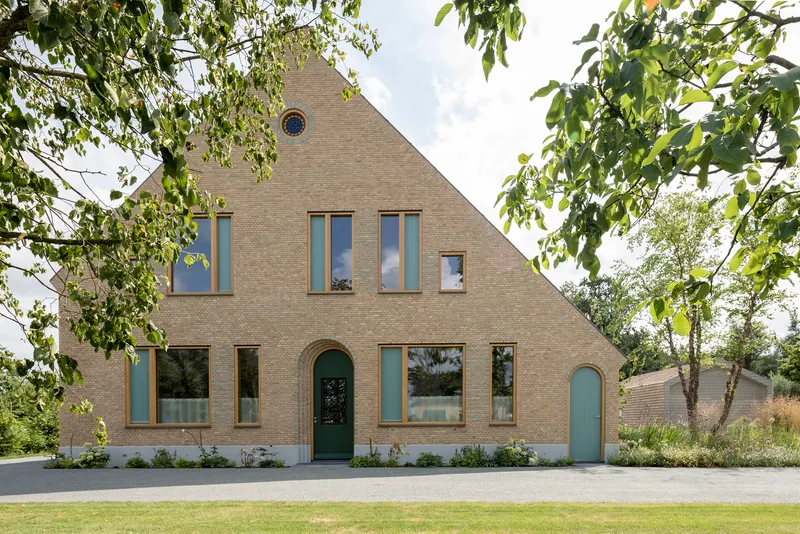
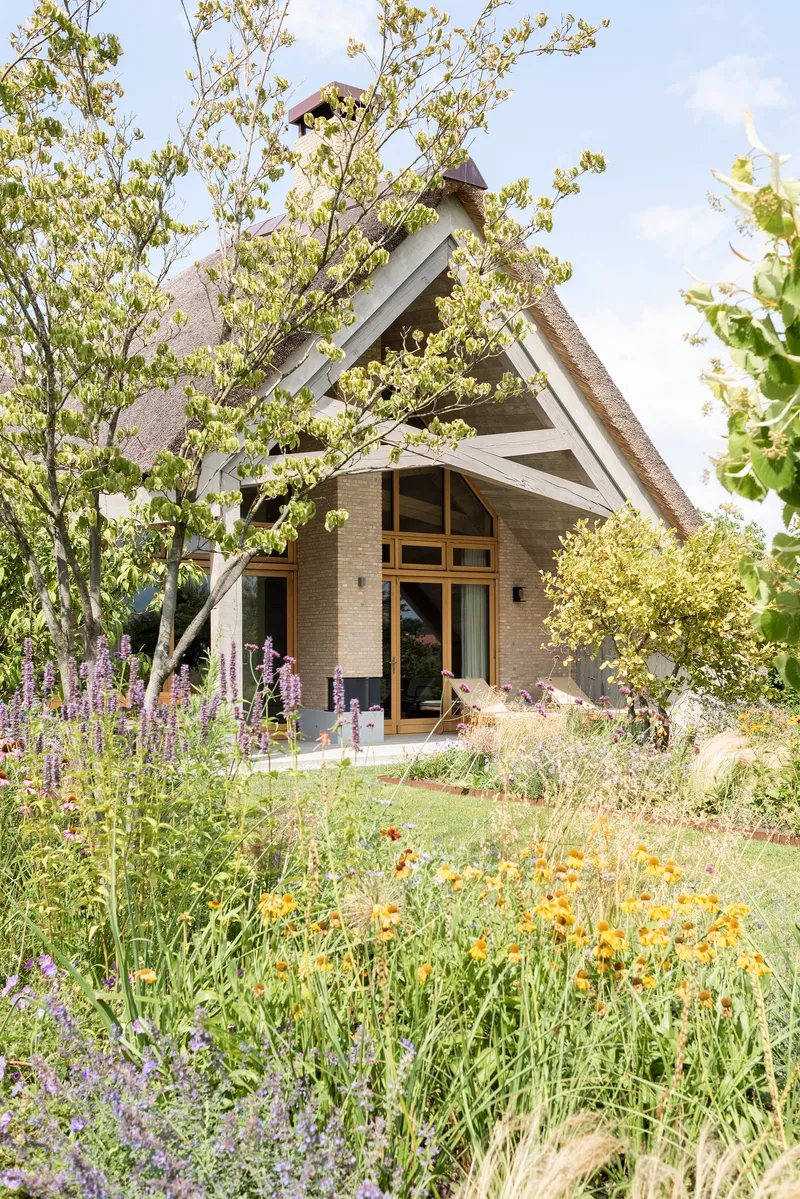
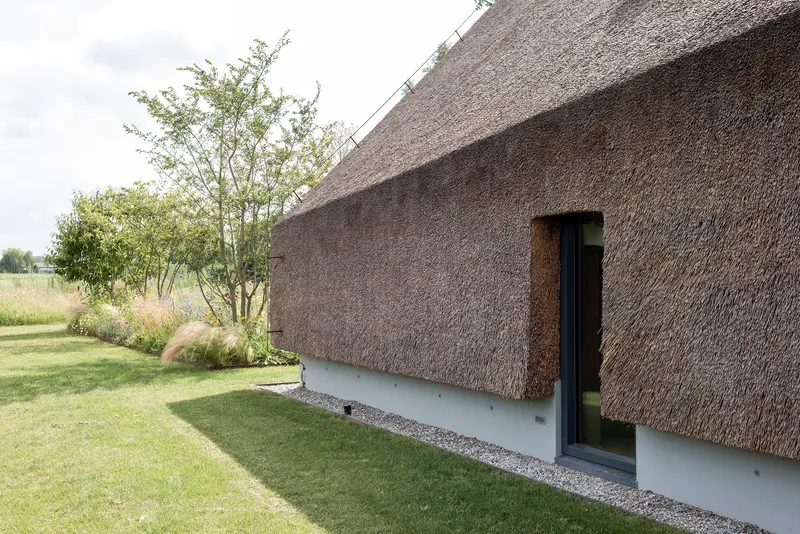
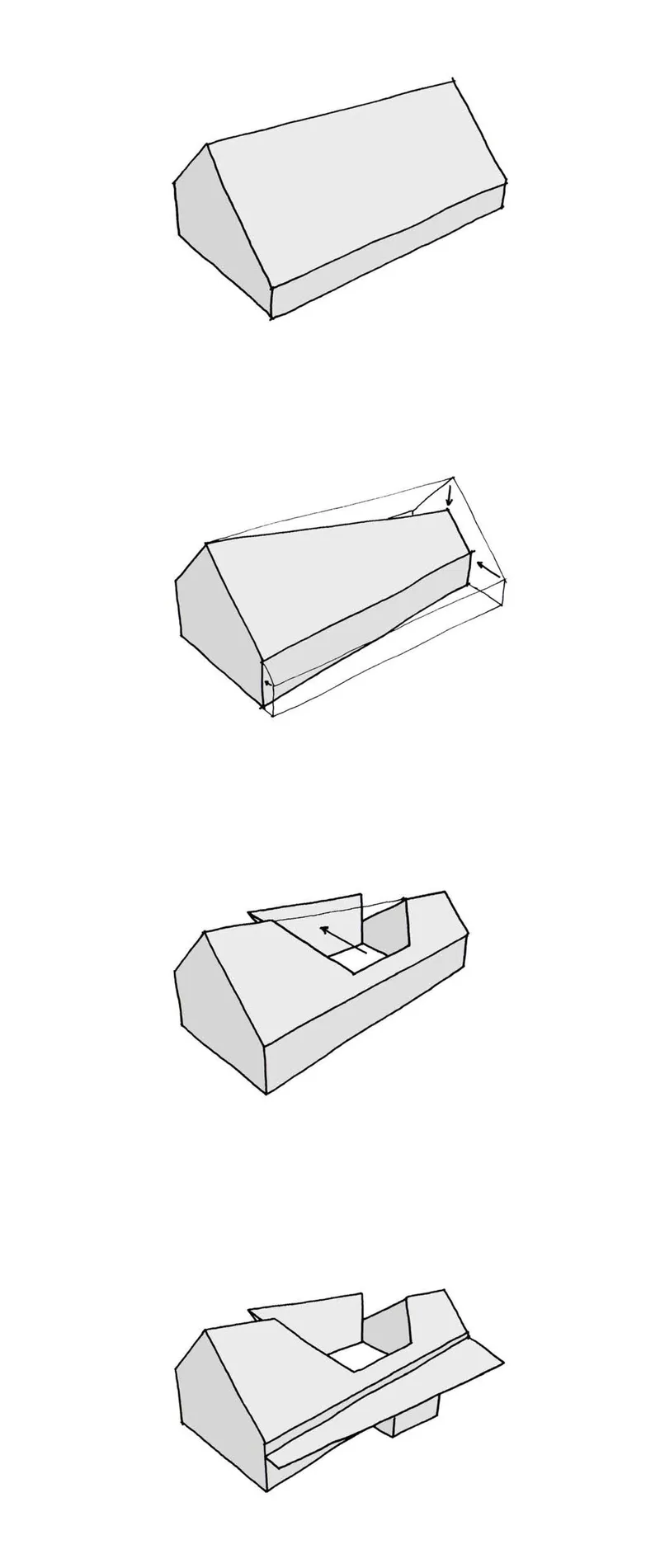
From the road, the Veldhuis House reads as a gabled brick volume with a thatched cap, a silhouette that sits comfortably alongside its older neighbors. But the proportions have been subtly altered. The house tapers in both height and width toward the rear, breaking the monolithic barn form into smaller, more legible fragments. The thatched roof is cut and shifted outward in places to bring light into the center of the plan, a move that produces unexpected sectional variety beneath a surface that appears traditional.
The brickwork carries its own story. The IJsselsteen-format bricks are the smallest standard unit, hand-formed from regional clay by a nearby brickmaker and laid in lime mortar. Around doors and windows, specially glazed bricks create colored accents that read as abstracted shutters. These elements are operable, connecting the house to a long Dutch tradition of articulating openings as deliberate events in a wall face.
Landscape as Extension
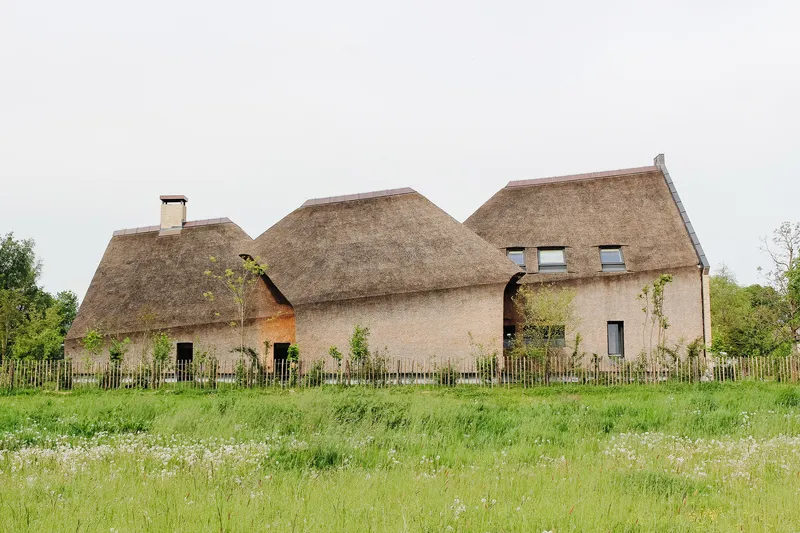
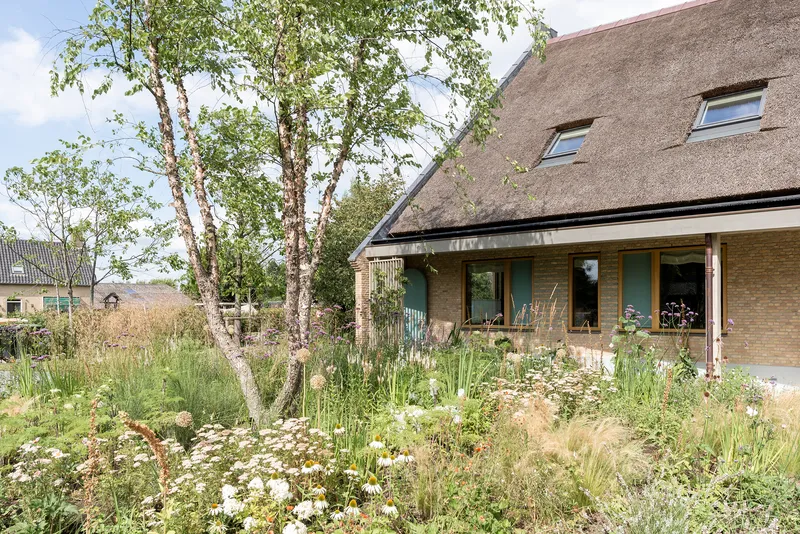
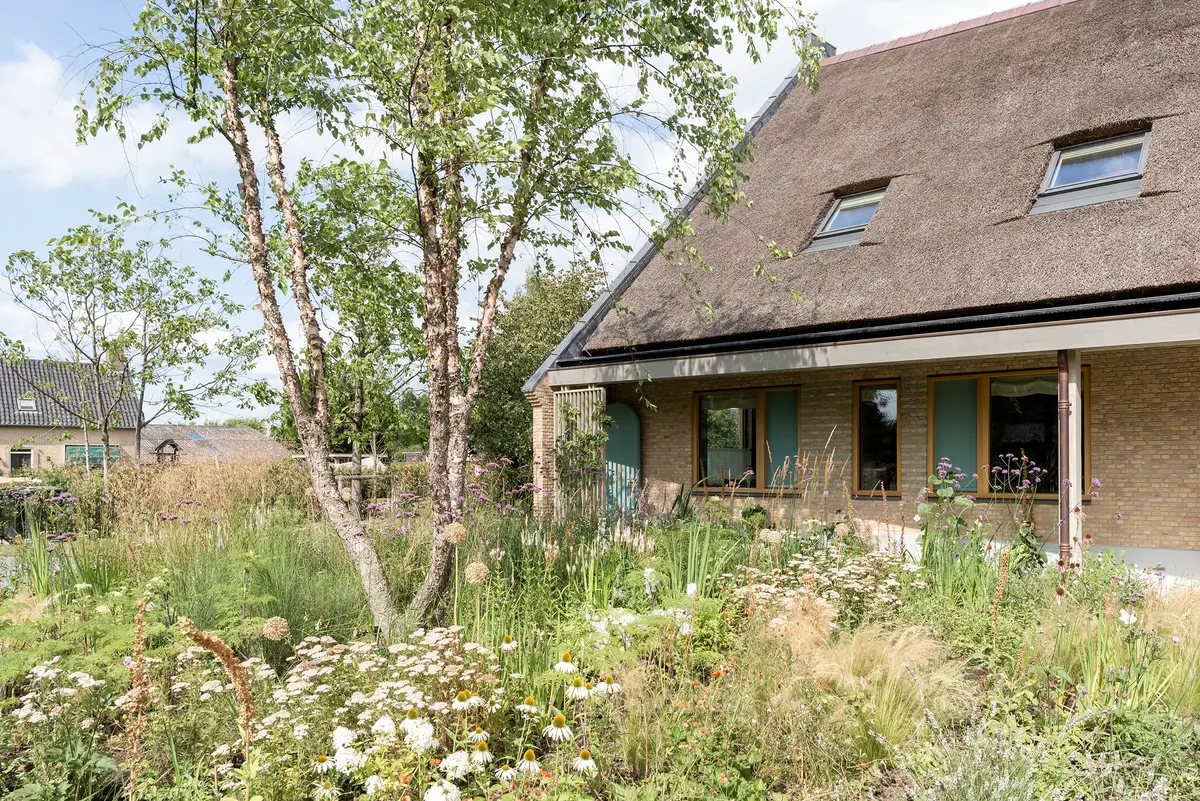
The site was formerly a sheep meadow, and LMNL office has organized the garden around twelve newly planted mature trees, perennial beds, a small water feature, an orchard, and a wildflower meadow that stretches toward open farmland beyond. The planting strategy layers the view: perennial beds and multi-stem trees in the foreground draw the eye through to the wildflower meadow and the fields behind it. It is a deliberate gradient from domestic to agricultural, reinforcing the house's claim to belong here.
Seen from the meadow side, the thatched roof and yellow brick walls emerge behind birch trees and tall grasses as if they have been there for decades. The landscape does critical work in mediating the building's scale. Without the tree canopy and the layered planting, the house would register as larger than its neighbors. With them, it settles into the terrain.
The Veranda and the In-Between
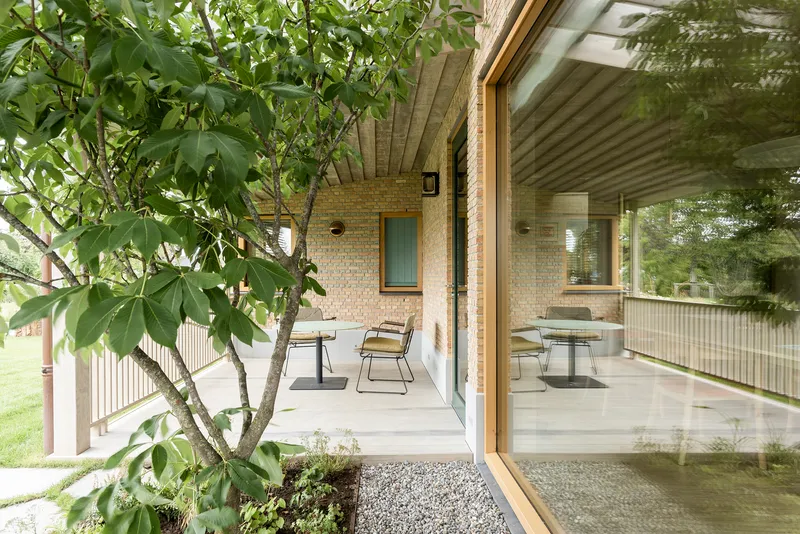
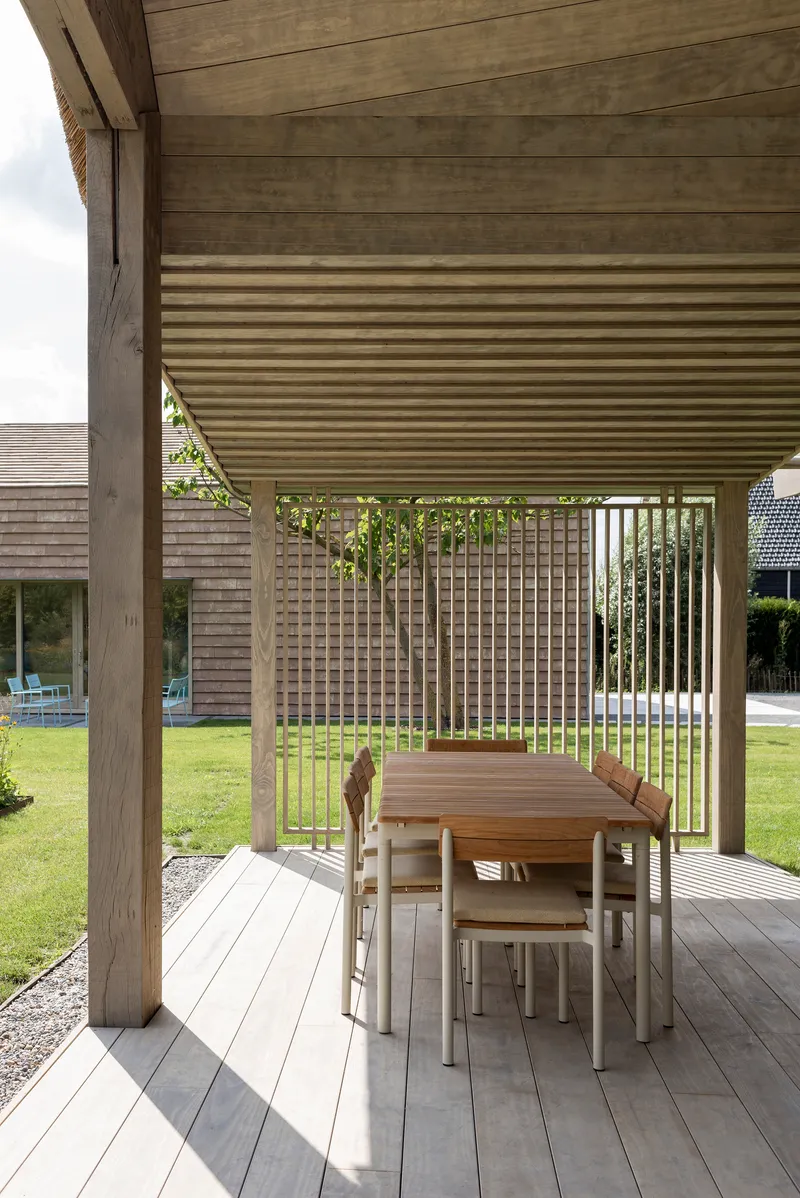
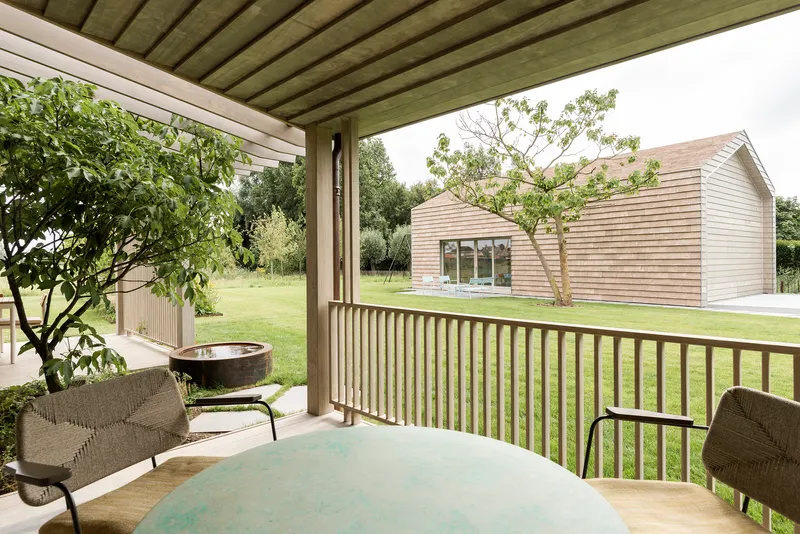
A wrap-around veranda links the house to its garden, interrupted only where the kitchen volume pushes out into the landscape, splitting the covered walkway in two. This is a shrewd organizational move: the kitchen becomes the hinge between indoor and outdoor life, its glazed rear facade dissolving the boundary between cooking and garden. Solar panels are integrated into the veranda roof, turning a shading device into an energy generator without the visual clutter of a rooftop array.
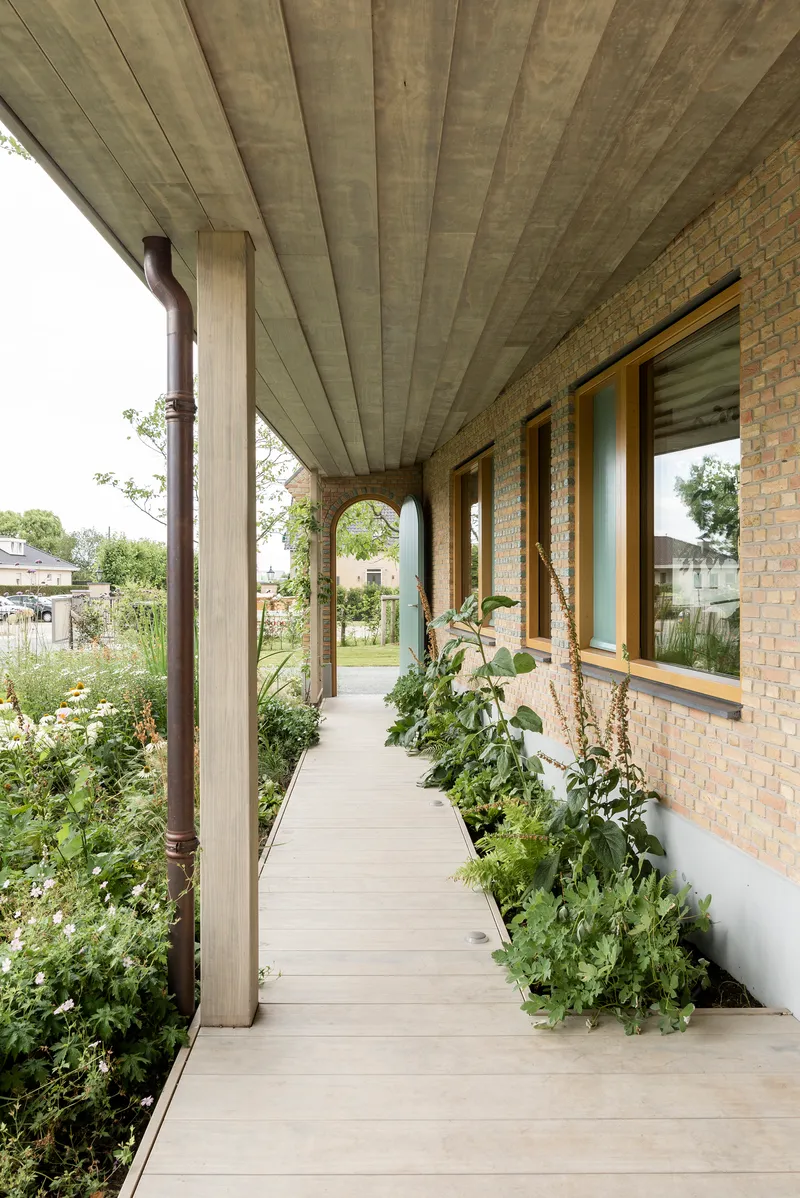
The veranda itself is a sequence of timber decking, vertical slat railings, and exposed ceiling beams. It frames views of the garden in a way that feels cinematic, each gap in the slats offering a slightly different angle on the lawn, the trees, and the timber-clad volume beyond. The covered walkway alongside the brick wall, with its concrete plank ceiling and planted beds, functions as a more enclosed corridor, closer in character to a cloister than a porch.
Interior Warmth Without Decoration
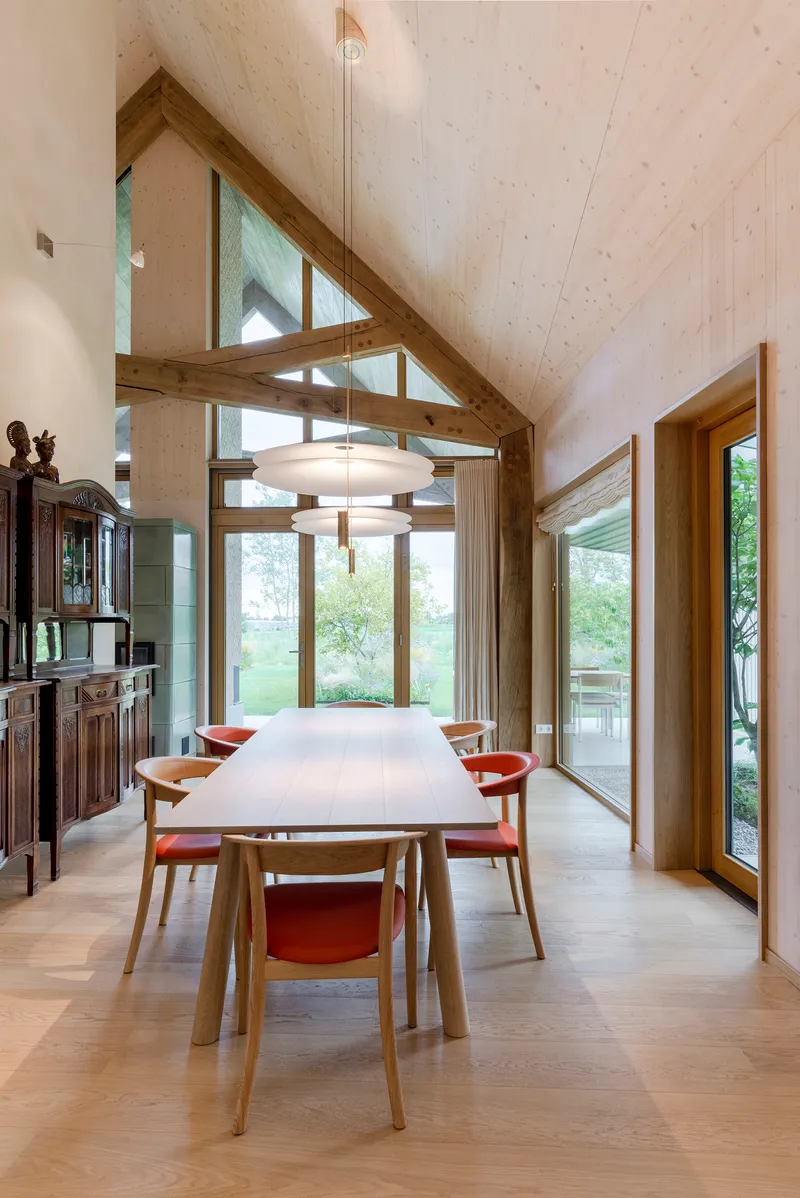
Inside, the CLT structure remains visible as warm plywood surfaces on ceilings and walls, complemented by white clay plaster and oak floors. The dining room is the spatial highpoint: exposed timber trusses rise to a vaulted ceiling, their geometry revealing the shifted roof planes visible from outside. A single pendant light drops into the center of the space, and the effect is both grand and intimate, a room scaled for gathering that never feels cavernous.
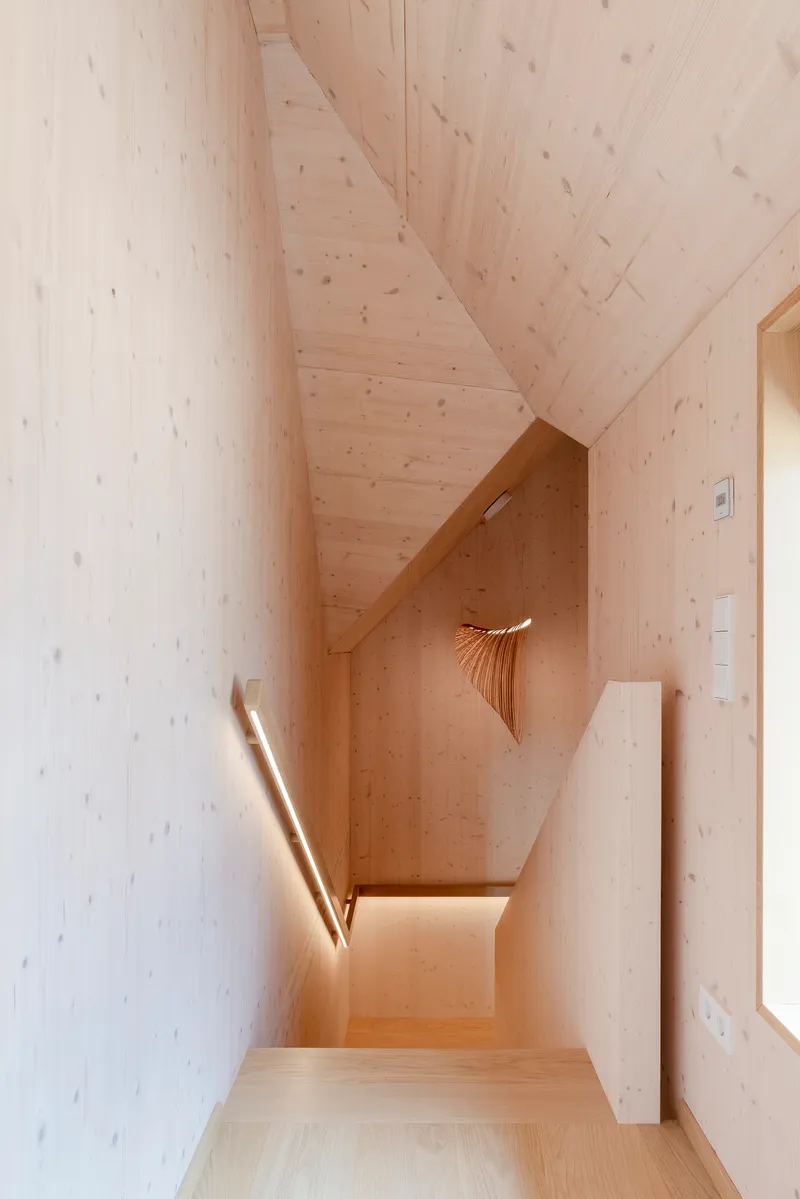
The stairwell, paneled in light wood with a skylight above, channels daylight deep into the three-story front portion of the house. A sculptural pendant lamp hangs in the shaft, turning a functional circulation space into something worth pausing in. The triple-glazed windows throughout are set in bespoke solid oak frames sealed with a clear finish that lets the grain show, reinforcing a material palette that trusts wood to do the visual work.
Running the full length of the house, the earth-brick wall is more than a visual feature. Connected to a ground-source heat pump, it provides radiant heating in winter and cooling in summer while passively regulating humidity. Combined with the vapor-permeable envelope, this means the indoor climate stays stable and healthy year-round with minimal reliance on mechanical ventilation. The house manages comfort the way a well-built barn always has: through mass, breathability, and material intelligence.
Plans and Drawings
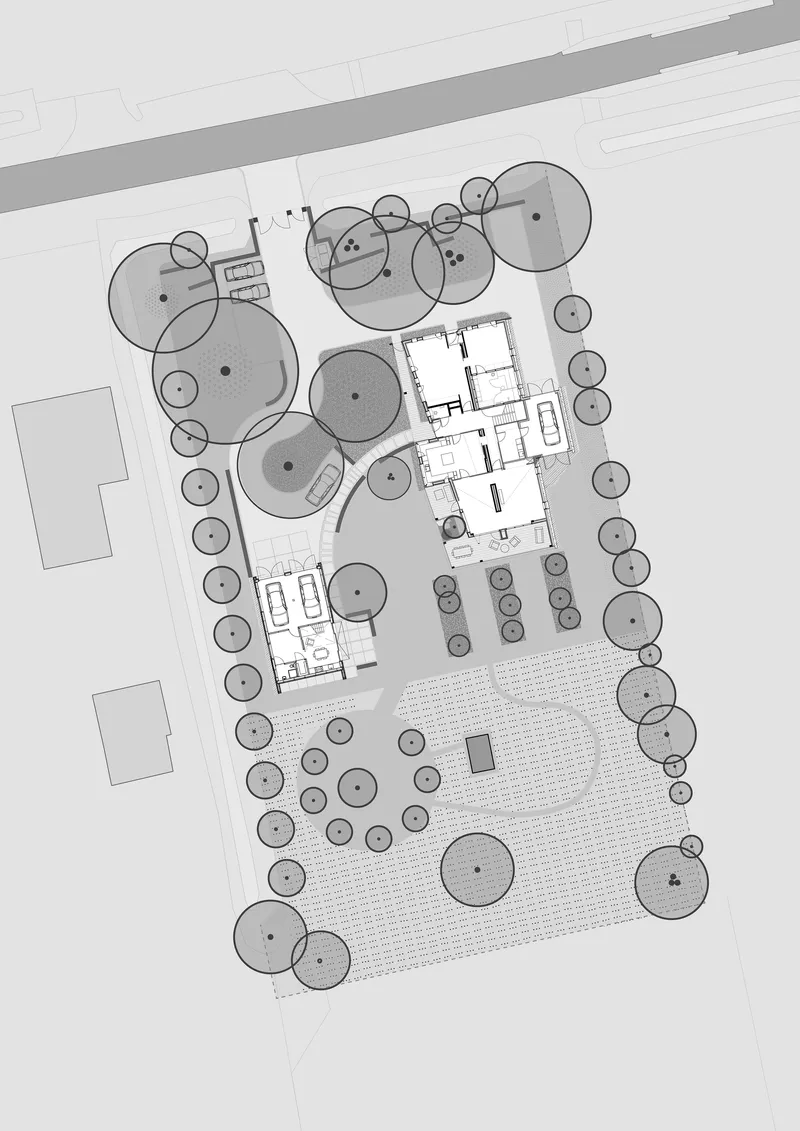
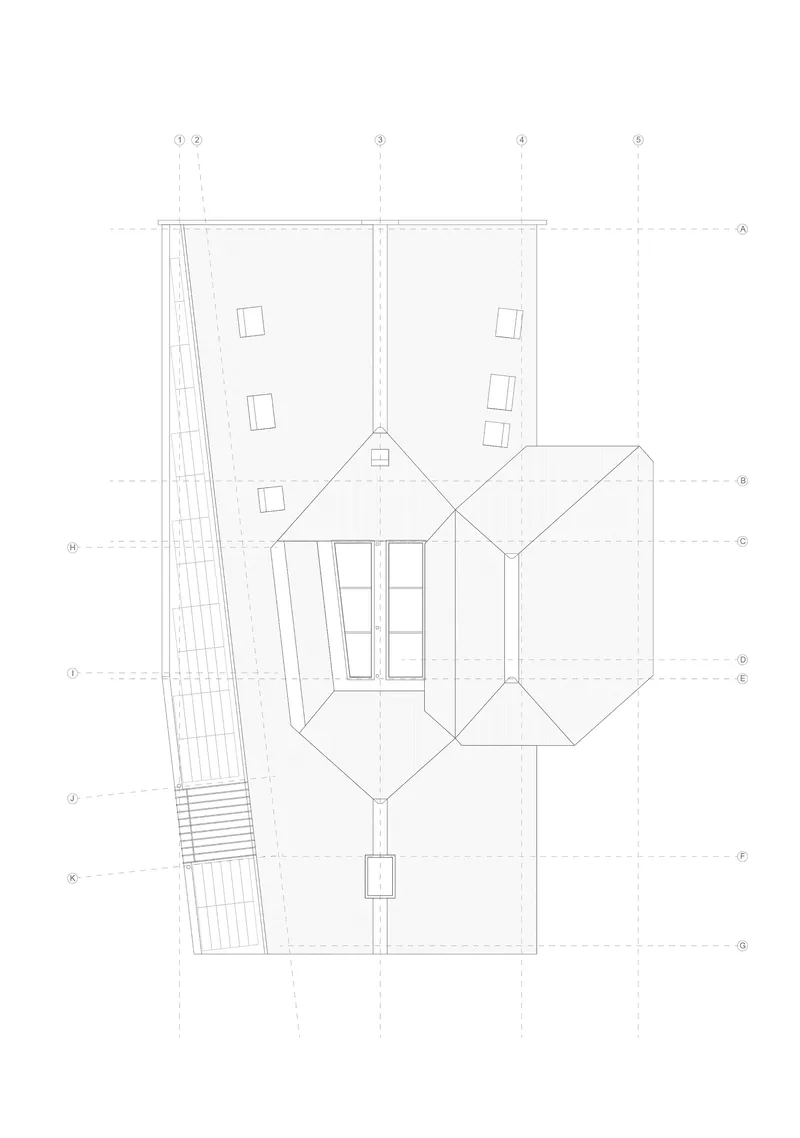
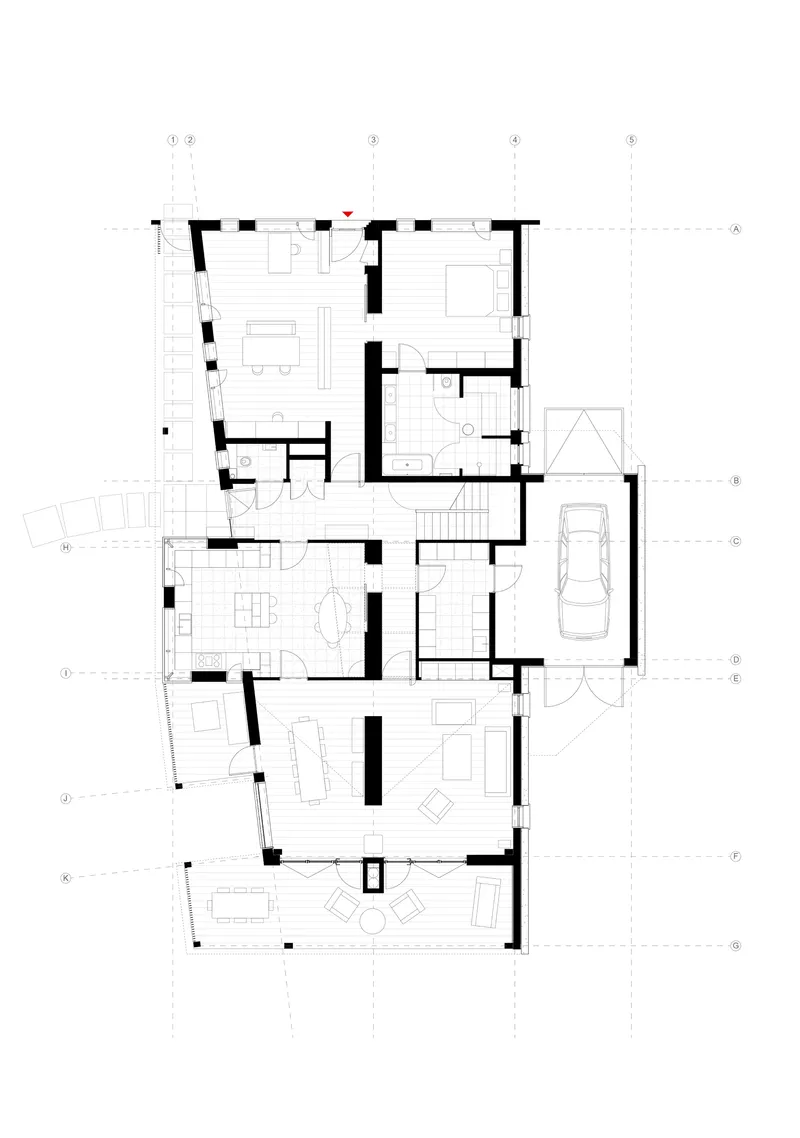
The drawings reveal a plan that is deceptively simple in outline but spatially rich in section. The site plan shows three building volumes set within a dense tree canopy, confirming that the landscape strategy is integral to the architecture rather than an afterthought. The floor plan makes clear how the house organizes itself around a thick central core containing kitchen, wet room, and garage, with the three-story front portion handling bedrooms and study and the single-story rear portion opening up for living and dining.
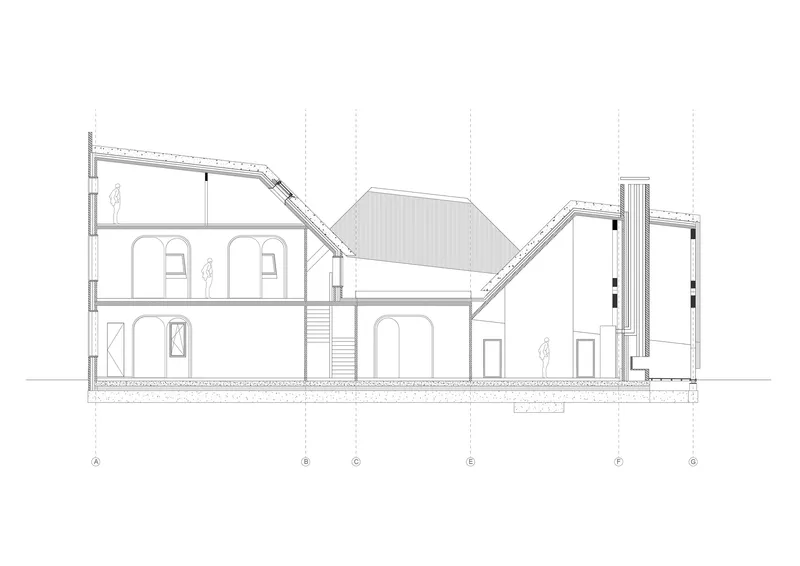
The section drawing is the most revealing: sloped roof profiles of different pitches overlap and shift, creating arched openings between volumes and carving out double-height spaces where the thatched cap lifts away from the brick walls. The axonometric sketch sequence, illustrating four stages of volumetric transformation, shows how the architects arrived at the final form by folding and cutting a single roof plane. It is a useful reminder that behind the traditional materials lies a rigorous geometric logic.
Why This Project Matters
The Veldhuis House is a serious proposition about the future of residential construction in the Netherlands and beyond. Its fully vapor-permeable CLT-and-thatch assembly is not a gimmick; it is a buildable, repeatable system that addresses carbon storage, indoor air quality, and material longevity simultaneously. The fact that the structure went up in 12 days and stores nearly 80 tonnes of CO2 gives the project a quantitative argument that most bio-based housing lacks. And the decision to source bricks, thatch, and clay from the immediate region turns supply-chain ethics into architectural identity.
Equally important is the project's refusal to treat sustainability and contextual design as separate agendas. LMNL office has demonstrated that you can build a house that fits a historic Dutch road, performs passively, and adapts over a lifetime, with a ground floor that can function independently for aging in place or split into a separate unit. The Veldhuis House does not look like the future of housing. That may be exactly why it is.
Veldhuis House by LMNL office, North Brabant, The Netherlands. 350 m², completed 2022. Photography by Loes van Duijvendijk and LMNL office.
About the Studio
LMNL office
Official website of LMNL office, one of the studios behind this project.
liminaloffice.comShare Your Own Work on uni.xyz
If projects like this are the kind of work you want to make, uni.xyz is a place to publish your own, find collaborators, and enter design competitions.


Popular Articles
Popular articles from the community


Co-Life: Senior Housing Design That Reconnects Older Adults With the City
Co-Life reimagines senior housing design through healing gardens, shared streets, workshops, and a sustainable community across generations.

Little Red Riding Hood: Architectural Design as a Journey Through Fear, Light, and Storytelling
Little Red Riding Hood reimagines the fairy tale through architectural design shaped by fear, light, scale, memory, uncertainty, and choice.

Play: Fragments of Their World
Familiar architecture becomes modular playground design, creating safe spaces where displaced children can learn, connect, imagine and play.

The Musturak Paradise: Senior Living Architecture for a Connected Future in Temara, Morocco
The Musturak Paradise reimagines senior living architecture in Temara via private homes, social spaces, culture, community, and shared care.

Similar Reads
You might also enjoy these articles

Bao Huynh Watercolor Atelier: A Serene Art Retreat in Hội An
Bao Huynh Watercolor Atelier in Hội An blends multifunctional art spaces, sustainable design, local materials, and family-friendly living in a serene environment.

Atelier Macri Concept Store Interior Design by CASE-REAL
Atelier Macri store features a "ko" counter, walnut wood details, cork displays, blending retail, gallery, and seamless customer experiences.

Manuel Vargas Izquierdo Stadium and High-Performance Sports Center: Architectural Excellence in Jalpa de Méndez
The Manuel Vargas Izquierdo Stadium blends sustainable design, inclusive sports facilities, and cultural-inspired architecture, revitalizing Jalpa de Méndez’s public spaces.

KAKR Buluh Awar Hall: Revitalizing Community and Ecology Through Bamboo Architecture
Community built bamboo hall revitalizes Buluh Awar village, empowering youth, restoring ecology, celebrating vernacular craftsmanship through sustainable architecture and culture.


Comments (0)
Please login or sign up to add comments
No comments yet. Be the first to comment!