

Lorem Ipsum Hospice
Write your own story
“Life is a circle.”
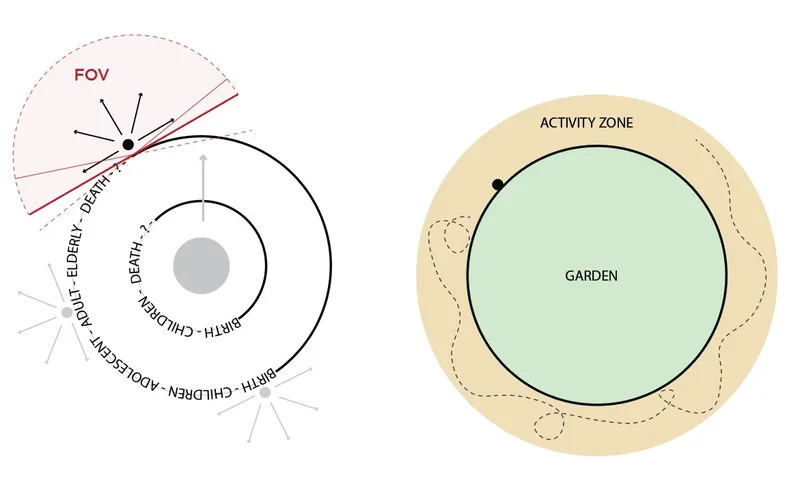
We often hear the common saying, of different seasons and cycles in life, i.e. the ending of adolescence journey is the start of adulthood. Terminally ill children, however, do not have such luxury. In their short cycle of life, the end of the circle is death.
Throughout your life, you can only view the present.
LIFE IN A CIRCLE: EMBRACING THE UNKNOWN
If your life is the circumference of a circle, an omnipresent being (at the circle center) would be able to view all happenings in life, as all lines are connected to the circle. However, we can only live in the present. Our field of view is limited to our current position, whether in space or in time. As such, we are living outside the “circle of life”. Our current moment is a point in a circle, with limited views due to the tangent. How can we embrace the unknown?
What happens in the afterlife on earth? Death seems to be a long way to go for most people. Humans constantly fear death, yet death’s presence is only felt when it‘s just around your corner. Terminally ill children do not have such luxury. Every day and even breath, they are living by death’s door.
Humans fear death as we do not know what comes after. Yet not knowing, is also an exciting and momentary/meaningful journey of discovery, of taking in all there is in the moment.
FROM INDEPENDENT CIRCLES TO NETWORK OF STRINGS: Garden as central space
If life happens in circles, then the relationship between each life could be represented as a tangent. The intersection of these tangents are moments where those lives interact, with some important moments as major events affecting its surrounding. Connecting the nodes of importance are the invisible “strings”.
The lives, which is the source of the derivation, are depicted as four main gardens in the Cercle Hospice, acting as the central spaces that give soul to the project. The network of strings surrounding the circles composes the circulation, giving volume to the body of the project.
By practicality, the hospice can operate without the gardens, as all necessities are in the activity zone. Yet excluding the gardens is akin to taking away the source of life itself, the hospice became an empty husk.
GARDEN OF FOUR SEASONS: Garden as activity generator
Humans have long lived alongside nature. Nature comes as gentle and sometimes violent. It affects our daily life
Seasons have long been a measure of time. Seasons come and go.
Inspired by the changing seasons, we capture the ambiance of each season into our gardens. Seasons happen in a constant cycle, each season affects our daily activities to a certain extent. Seasons are important markers of the way we live. Seasons propagate their surrounding activity. The gardens, like seasons, though not directly part of our lives, are a huge factor affecting it.



Popular Articles
Popular articles from the community


Lunar Spiral: Space Architecture Shaped by the Mathematics of the Universe
Lunar Spiral reimagines space architecture through Fibonacci geometry, lunar regolith, levitating habitats, and self-sustaining Moon living.

Riyadh For All: Intergenerational Urban Design for Active Aging in Rabat
Riyadh For All reimagines urban design in Rabat with intergenerational co-living, adaptive courtyards, and Moroccan cultural exchange today.

Hill & Cross Opera: Sculptural Opera House Architecture Shaped by Tallinn’s Landscape and Identity
Hill & Cross Opera reimagines opera house architecture in Tallinn through its sculptural hill, civic plaza, glass wave and a luminous cross.

The Ocean Hive: Sustainable Architecture for a Self-Sufficient Civilization at Sea
The Ocean Hive imagines sustainable architecture at sea, where modular habitats, algae, wave power and ocean waste sustain a growing colony.


Similar Reads
You might also enjoy these articles

The Rhythm of Seasons
A Farmers' Market Connecting Nature and the City

More Than a Building-Designing a Living System
More Than a Building-Designing a Living System
Base Beyond
DESERT COMPOUND ARID: TOURISM OF ABSENCE AND ABUNDANCE

Comments (0)
Please login or sign up to add comments
No comments yet. Be the first to comment!