LOTUS PAVILION
Pavilion for the University of Lagos Main Library Terrace.

The project benefits the site not only in terms of spatial reorganization for various activities but also in terms of qualifying the spaces by offering a new program. This new pavilion allows students to make greater use of the open space by hosting events, meetings, festivals, social gatherings, and so on. A mound with landscaping is also located at the center of the pavilion as a way to bring nature into a densely concretized surface and ensure cool air flows throughout the entire structure.
The pavilion's fluid structure is intended to provide an exciting area for students while also appearing to be a mask for space used for educational and social activities. The project uses the form-finding process based on gravity, which was first realized and developed by Antonio Gaudi, and then by Frei Otto, to determine the best structural shape.
Bamboo was chosen for the pavilion's main construction because of its economic and environmental benefits. Working with bamboo makes it simple to modularize components and build small-scale components that can be easily combined for the pavilion's overall structure. The benefit is the ease of fabrication; these structures are simple to make (even by industrial means) and transport to the site, which allows construction at a low cost. Elements that deteriorate over time can be easily replaced to keep the pavilion in good working order. Furthermore, because the site is in a region where bamboo is abundant, we may benefit not only from the local material, which helps decrease shipping costs and environmental implications but also from the local bamboo know-how.
Beyond bamboo, this pavilion employs a typical material in the form of PVC waterproof cloth. The membrane system is also recommended for the cover in controlling the influence of sunshine and wind on the pavilion in different seasons, inspired by the Lotus Flower and the local weaving fabric craft in the region. Arduino, an open-source prototyping platform based on simple hardware and software, is used in this scenario. This is a recommendation for controlling the membrane's opening. This technology is said to be effective, low-cost, and simple to use or install.

Popular Articles
Popular articles from the community


Manzana Morphosis: Stretching Barcelona's Grid into a Living Landscape for 2050
A radical reworking of the Eixample manzana turns density into a tool for generous public space, vertical ecology, and environmental performance.
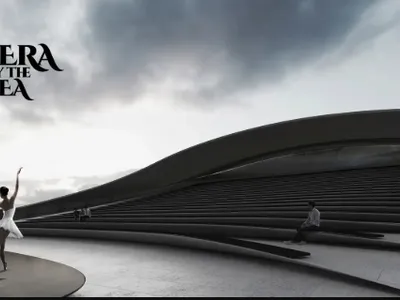
Opera by the Sea Estonia: Three Shells Dissolving Architecture into Tallinn's Coastline
A winning opera house proposal replaces monumental form with interconnected shells that blur the boundary between building, park and Baltic Sea.

The Amber Palace Opera: A Geological Fiction Surfaces on Tallinn's Baltic Waterfront
Pierre Brillard reimagines a Baltic legend as a public landscape, opera house, and waterfront promenade rooted in Tallinn's coastal identity.
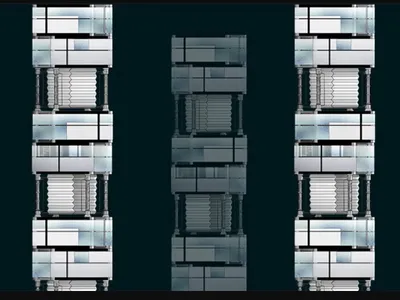
Tsunami Convergenics: Turning Catastrophic Ocean Forces into Underwater Housing Infrastructure
A speculative underwater settlement off the coast of Onagawa, Japan, treats tsunamis and typhoons as energy sources rather than threats.

Similar Reads
You might also enjoy these articles

Day and Night Park: A Time-Based Urban Newsstand in Beijing
A temporary urban newsstand in Beijing blending travel, light, and reading through poetic colors, compact form, and community-focused design.

Modernist Patio Renovation in El Masnou, Barcelona by Oliver Segura Arquitectura + Cebrià Arquitectura
Modernist patio renovation blending tradition and innovation with a movable pool, leveled floors, and Catalan materials in El Masnou.

Alto Residencial Coop: Cooperative Housing Development in Santiago de Compostela by Carbajo Barrios Arquitectos
A linear cooperative housing complex blending white volumes and perforated metal façades, enhancing community living, natural light, privacy, and urban integration.

Vil Genis School by BPA ARCHITECTURE – Massy, France
Vil Genis School in Massy, France, features sustainable design, south-facing classrooms, community integration, accessible spaces, and modern educational architecture.
Explore Pavilion Competitions
Discover active competitions in this discipline


Challenge to design public laboratory

Bring back Drive In's
Comments (0)
Please login or sign up to add comments
No comments yet. Be the first to comment!