

The Luc Lifestyle Spirals Upward in Bali
Atelier Generations Vasudeva Design wraps food, fashion, and fragrance into a concentric terracotta vortex on the island of the gods.


Bali's commercial architecture has, for years, oscillated between two poles: the thatched-roof resort pastiche and the white-cube minimalism favored by foreign-funded concept stores. The Luc Lifestyle, completed in 2024 by Atelier Generations Vasudeva Design, sidesteps both. Designed by I Putu Angga Prastika and Julius Saptian Gunawan, the 908 square meter mixed-use building folds food and beverage, fashion retail, fragrance, and aesthetic dental care into a single spiraling organism whose primary gesture is a concentric, sunken amphitheater open to the Balinese sky.
What makes the project genuinely interesting is its refusal to flatten its program into a conventional two-story retail box. Instead, the building coils around a central void, using stepped terraces, planted rings, and a spiraling staircase to collapse the boundary between landscape and commerce. Every route through the building is curved, every threshold soft. The result is a place where you shop, eat, and linger without ever feeling herded through a corridor.
The Concentric Void


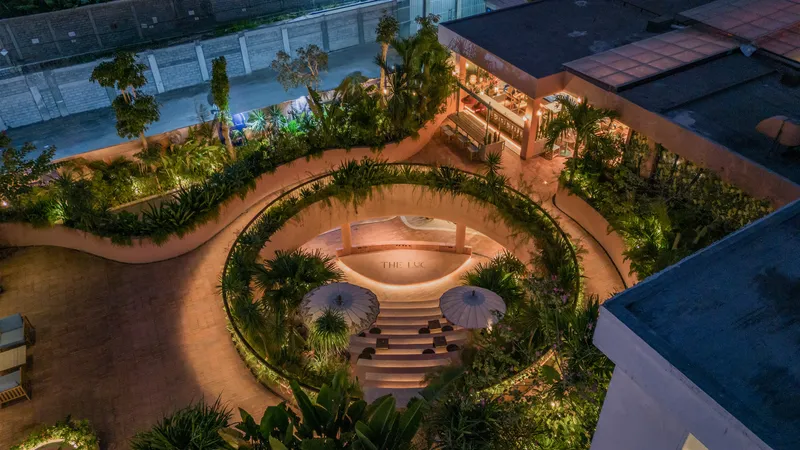
The building's organizational logic radiates from a single circular void cut through the center of the plan. From above, the effect is unmistakable: concentric rings of terracotta, planting, and stepped seating spiral inward toward a focal point marked by two white parasols and a cluster of palms. At night, integrated lighting transforms the sunken courtyard into a glowing crater, pulling the eye down rather than outward.
This void does more than create visual drama. It introduces daylight deep into the ground level, draws breezes through the section, and gives every program element, from the restaurant to the retail bays, a shared center of gravity. It is the spatial equivalent of a town square, compressed and verticalized.
Amphitheater as Social Infrastructure
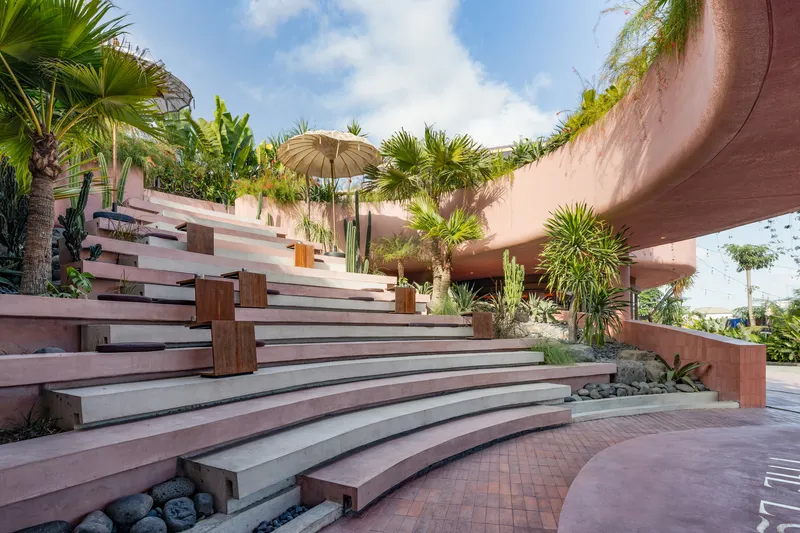


The wide, pink-and-grey stepped seating that wraps around the void is not decoration. It is the building's primary social surface: part amphitheater, part lounge, part landscape. Integrated timber blocks serve as informal tables or perches, and the planting pockets between risers hold fan palms, cacti, and succulents that blur the line between furniture and garden.
At its most generous, the amphitheater sits beneath a sweeping terracotta canopy that shades without enclosing, with potted cacti and recessed lighting lending the steps a theatrical quality after sundown. The move is smart: rather than carving out a dedicated event space that would sit empty most of the time, the architects distributed gathering capacity across the section itself.
Terracotta Skin and Colonnade
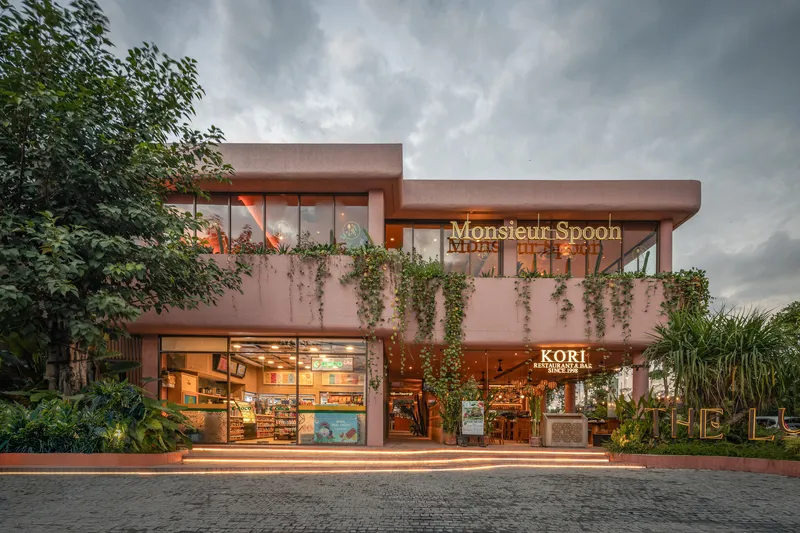
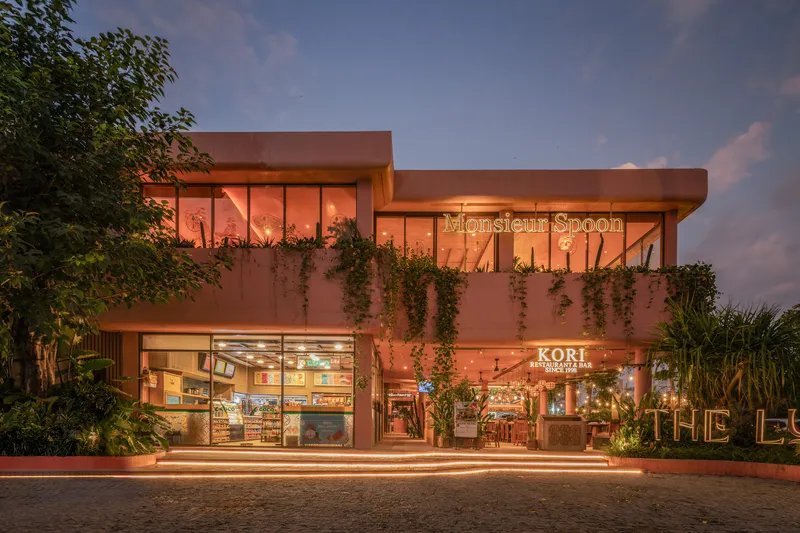
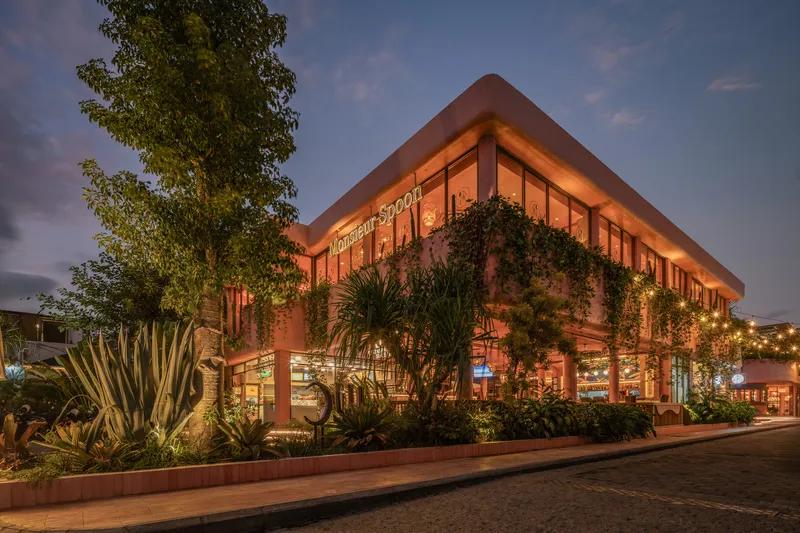
From the street, The Luc presents as a restrained two-story volume defined by a flat overhanging roof and a warm terracotta palette that unifies columns, soffits, and balcony edges. Continuous glazing at the ground and first levels exposes the retail interiors while planted balconies soften the upper register. The facade avoids the monumental impulse common to Bali's newer commercial developments; it is low, horizontal, and deliberately porous.
The colonnade that wraps the ground floor deserves attention. Cylindrical columns in a soft terracotta finish support the roof overhang and create a covered threshold between street and interior. At dusk, the illuminated storefronts glow behind the column rhythm, producing a lantern effect that signals hospitality without resorting to signage or spectacle.
Entry and Threshold


The covered porticos and walkways function as a decompression zone between the busy street and the spiraling interior. Cylindrical columns at the entry colonnade frame retail displays beyond, while the pink-tinted ceiling overhead carries the warm palette from the exterior inward. Planted gravel beds line the edge, a minimal but effective gesture that keeps the commercial frontage from feeling like a generic shopping strip.
There is no single grand entrance. Instead, the building offers multiple points of access along its perimeter, each filtered through the colonnade. The architects understood that in Bali's climate, the threshold between inside and outside is not a door but a gradient of shade, breeze, and enclosure.
The Spiral Stair and Vertical Circulation

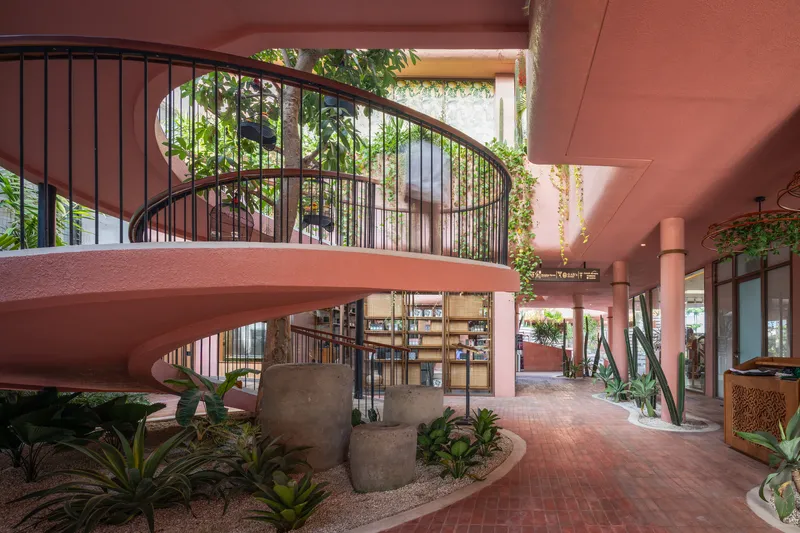
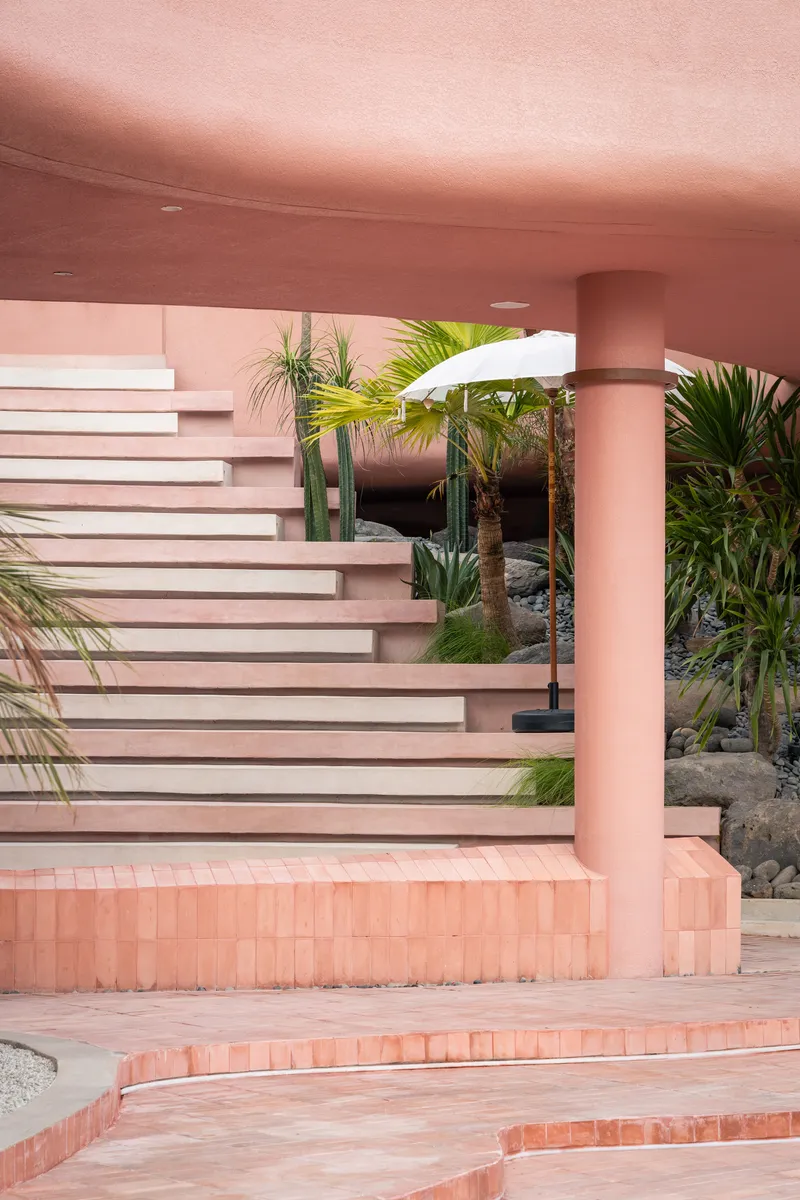
A spiral staircase with pink concrete treads and black metal railings threads through the building's central void beneath a glass roof laced with hanging vines. It is both the primary vertical connection and a piece of spatial theater: as you ascend, the view shifts from the planted courtyard below to the open rooftop terrace above. The cantilevered treads, alternating between pink and white, float beneath a continuous curved soffit, lending the stair a lightness that belies its concrete construction.
From the courtyard level, the curved staircase is framed by planting on all sides. This is circulation as experience rather than obligation, a deliberate inversion of the fire-stair mentality that plagues most commercial buildings.
Dining Under the Canopy
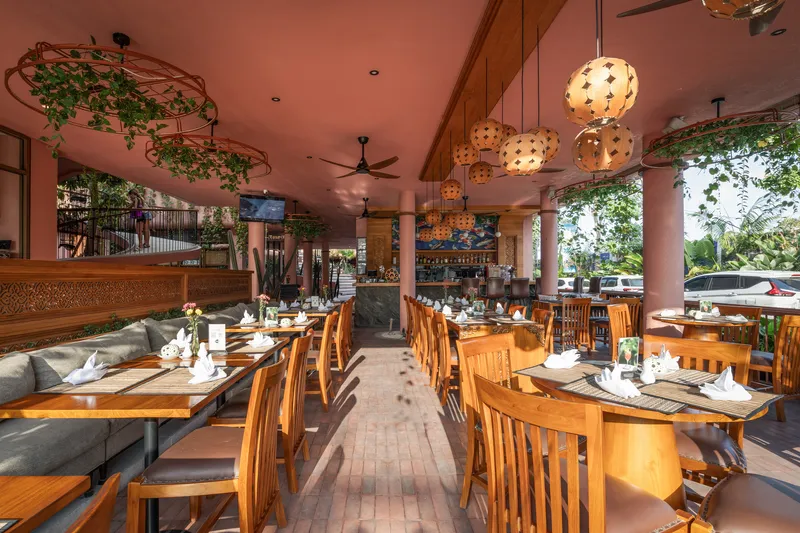
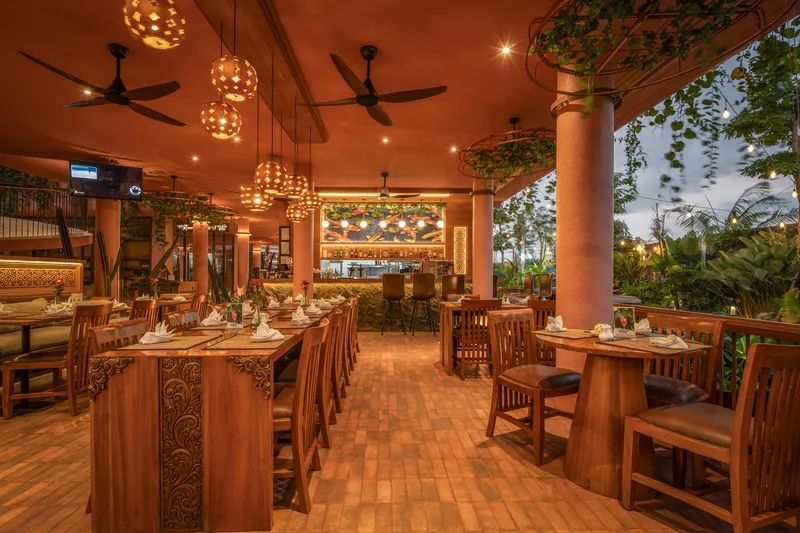
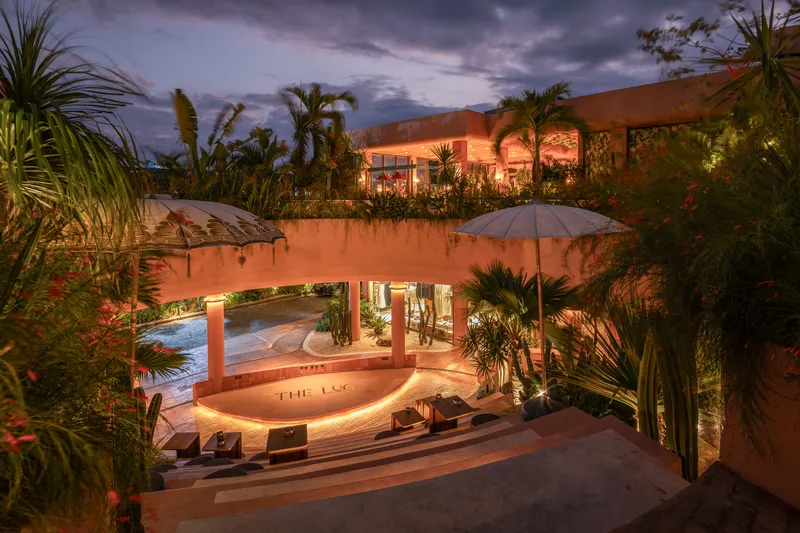
The restaurant occupies the most atmospheric zone in the building: an open-air dining area ringed by cylindrical columns and tropical plants, covered by the terracotta ceiling but never sealed off from air movement. Carved timber tables and spherical pendant lights establish a material warmth that complements the architecture rather than competing with it. At twilight, the space reads as a clearing in a constructed garden.
Nearby, the sunken courtyard with its curved seating and planted terraces doubles as an extension of the dining program under the evening sky. The transition between restaurant and courtyard is seamless, reinforcing the building's core strategy of dissolving rigid programmatic boundaries.
Rooftop Landscape
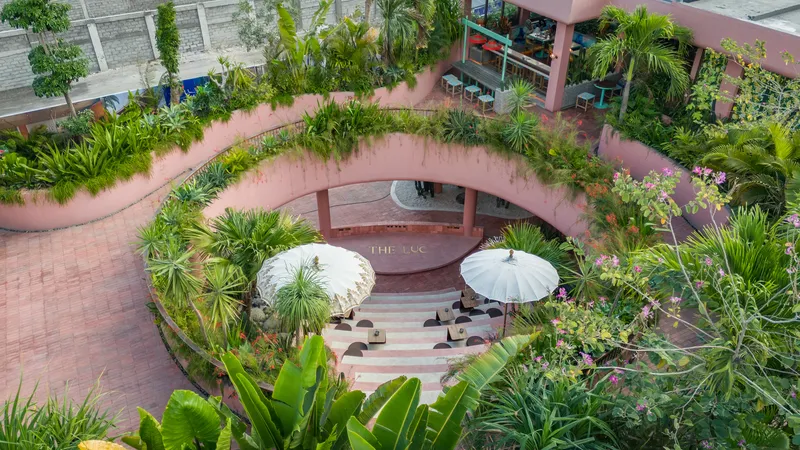
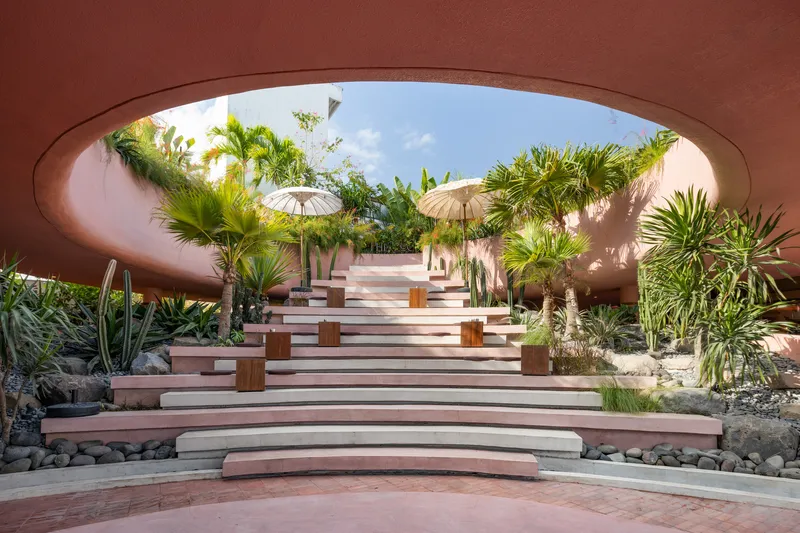
The rooftop is not an afterthought or a mechanical penthouse screened by louvers. It is the culmination of the spiral: planted beds, curved walls of greenery, and an elliptical opening that frames palms and parasols below. Wide steps lead visitors upward through the opening, collapsing the distance between terrace and sky. The effect is that of a constructed hilltop garden, one where the building's concentric geometry terminates in open air and planted earth.
Plans and Drawings


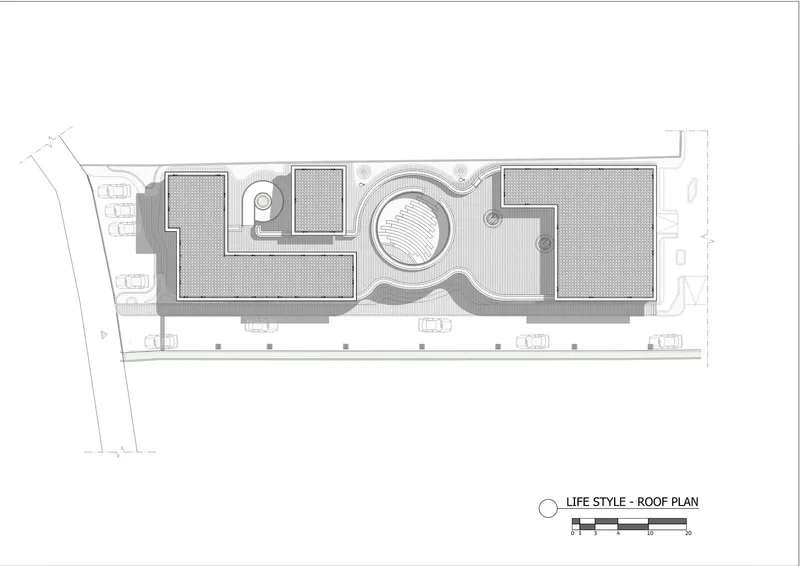


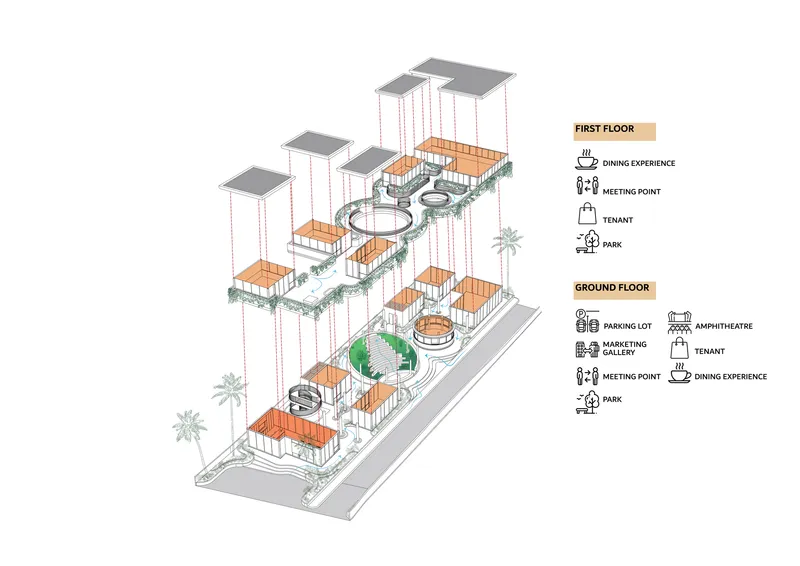
The ground floor plan confirms the circular logic visible in the photographs: a large central void anchors the composition, with retail and service spaces arranged around its perimeter and parking pushed to one side. The first floor plan reveals the upper-level rooms wrapping the circular void, while the roof plan shows planted terraces converging on the central skylight opening.
The section drawing is particularly revealing. It illustrates natural airflow pathways drawn through the two-level section by the central void, with vegetation acting as both shading device and thermal buffer. The exploded axonometric labels the diverse program elements, color-coded in orange, and the isometric phasing diagram shows the design's evolution from site orientation through massing, circulation, and landscape to its final expression. The sequence makes clear that the spiral was not an applied form but a generative strategy.
Why This Project Matters
Mixed-use commercial buildings in tourist economies tend toward one of two failures: they either over-program every square meter in the name of revenue, or they invest so heavily in atmosphere that the architecture becomes a backdrop for Instagram. The Luc Lifestyle manages neither trap. Its concentric plan distributes attention across the section, giving every program, from dental clinic to fashion boutique, proximity to daylight, air, and landscape without privileging any single tenant. The architecture is the experience, not a container for one.
For Bali specifically, the project offers a credible alternative to the imported retail typologies that have proliferated across the island's south. Atelier GVD has produced a building that is tropical in strategy, not just in ornament: the void ventilates, the planting shades, the colonnade mediates. That these environmental moves also happen to generate the building's strongest spatial moments is not a coincidence. It is the mark of a design where climate, culture, and commerce are addressed with the same gesture.
The Luc Lifestyle by Atelier Generations Vasudeva Design (lead architects: I Putu Angga Prastika, Julius Saptian Gunawan). Bali, Indonesia. 908 m². Completed 2024. Photography by Indra Wiras.
About the Studio
Atelier Generations Vasudeva Design
Official website of the studio behind this project.
ateliergvd.comShare Your Own Work on uni.xyz
If projects like this are the kind of work you want to make, uni.xyz is a place to publish your own, find collaborators, and enter design competitions.


Popular Articles
Popular articles from the community


Cloaked Colonization: A Mobile Underwater Habitat That Moves Like a Fish
Micah Abaya's shortlisted EHC Pacific entry reimagines ocean settlement as a dispersed network of self-sustaining architectural organisms.
Tsunami Convergenics: Turning Catastrophic Ocean Forces into Underwater Housing Infrastructure
A speculative underwater settlement off the coast of Onagawa, Japan, treats tsunamis and typhoons as energy sources rather than threats.

Opera on the Sea: Driftwood Logic Shapes a Timber Opera House on Estonia's Coast
Trevor Orgill's opera house translates the entangled drift of floating timber into a civic building where wood, water, and music converge.
Opera by the Sea Estonia: Three Shells Dissolving Architecture into Tallinn's Coastline
A winning opera house proposal replaces monumental form with interconnected shells that blur the boundary between building, park and Baltic Sea.

Similar Reads
You might also enjoy these articles

Pixel Gardens: One Repeated Module Stacked Into a Terraced Social Housing Tower for Famagusta
Salem Bader's shortlisted housing tower builds a vertical neighbourhood from one repeated module, offsetting units to carve terraces, light and air.

Bao Huynh Watercolor Atelier: A Serene Art Retreat in Hội An
Bao Huynh Watercolor Atelier in Hội An blends multifunctional art spaces, sustainable design, local materials, and family-friendly living in a serene environment.

Atelier Macri Concept Store Interior Design by CASE-REAL
Atelier Macri store features a "ko" counter, walnut wood details, cork displays, blending retail, gallery, and seamless customer experiences.

Manuel Vargas Izquierdo Stadium and High-Performance Sports Center: Architectural Excellence in Jalpa de Méndez
The Manuel Vargas Izquierdo Stadium blends sustainable design, inclusive sports facilities, and cultural-inspired architecture, revitalizing Jalpa de Méndez’s public spaces.

Comments (0)
Please login or sign up to add comments
No comments yet. Be the first to comment!