
Luciano Kruk Conceals a 753 m² Concrete House in the São Paulo Landscape
On the outskirts of São Paulo, a board-formed concrete pavilion dissolves into its lakeside setting through careful massing and a hidden lower level.


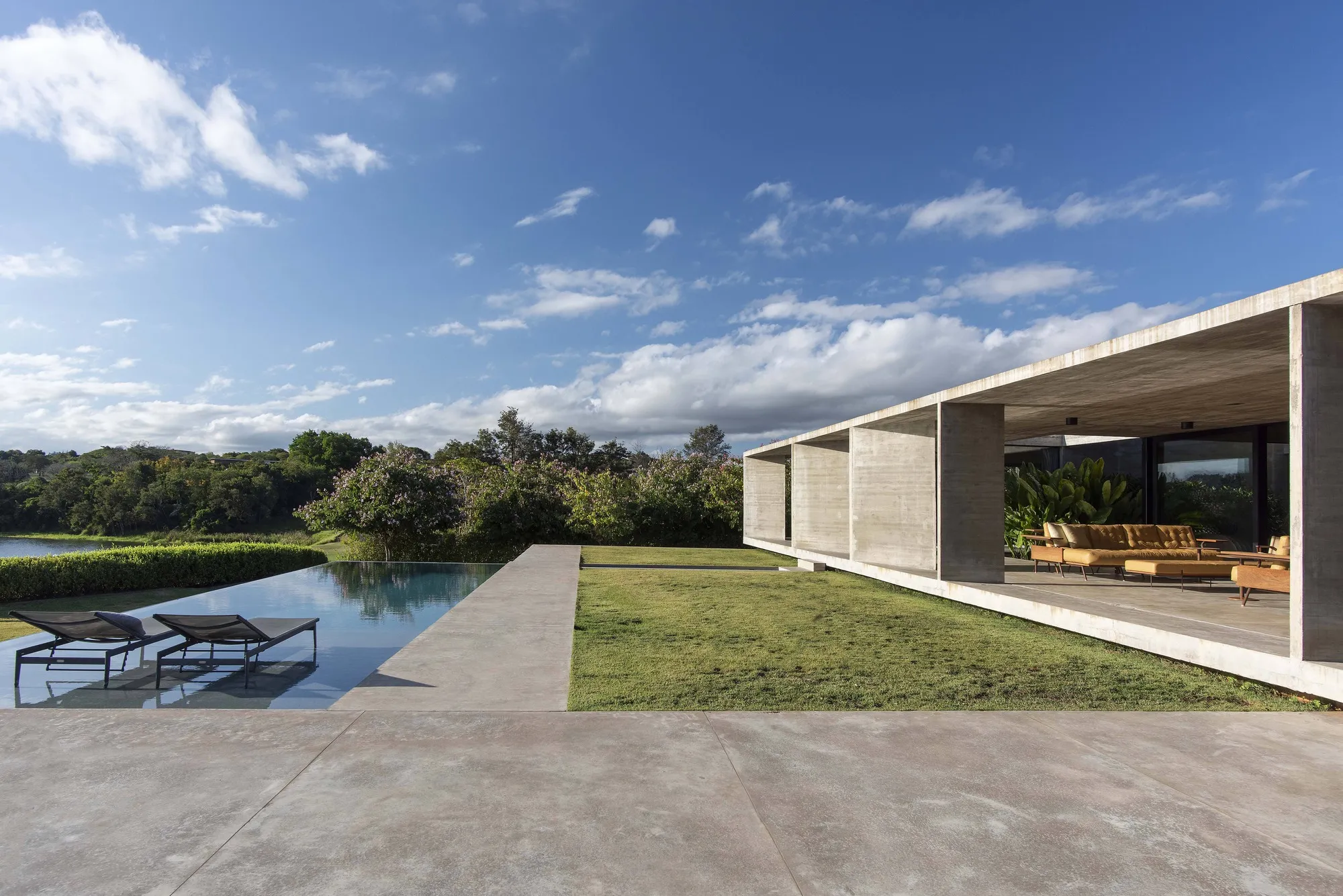
Making a large house feel small is one of architecture's oldest problems, and one that most large houses fail to solve. Paula's House, designed by Luciano Kruk on the outskirts of São Paulo, spreads 753 square meters across a 3,070 square meter site next to an artificial lagoon and golf course. It does so without ever reading as a mansion. The strategy is fundamentally horizontal: a single main level stretches along the ground, its board-formed concrete frame punctuated by deep overhangs and rhythmic columns that pull the eye sideways rather than upward.
What makes the project genuinely interesting is the way Kruk weaponizes concrete not just as structure but as climate device. Inclined concrete walls, tilted to deflect the punishing western sun, do double duty as sculptural partitions and passive cooling elements. A hidden lower level tucks the gym and service spaces underground, keeping the main floor free of bulk. The result is a house that belongs to its owners, a couple passionate about Brazilian art and culture, while also belonging to the flat, open terrain it sits on.
A Pavilion That Reads as Landscape
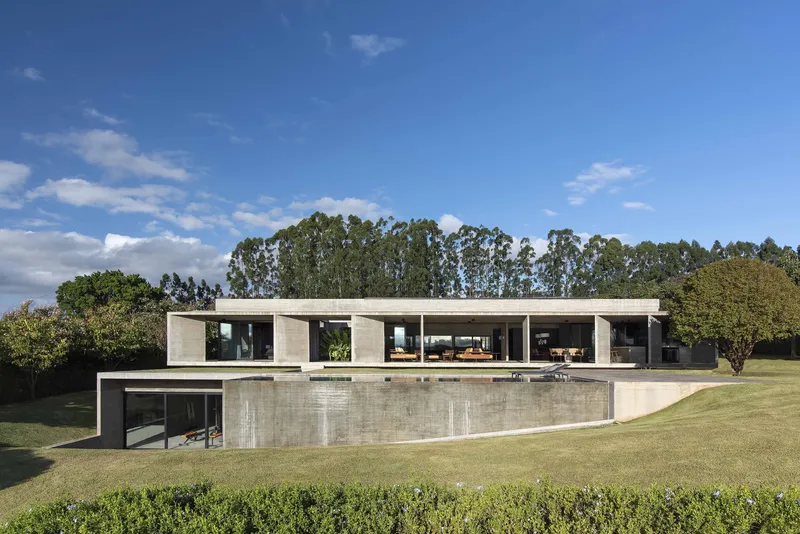
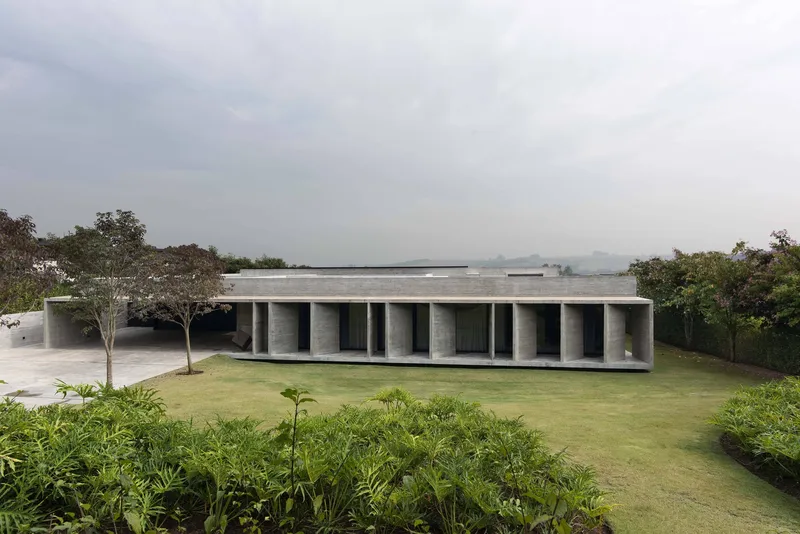
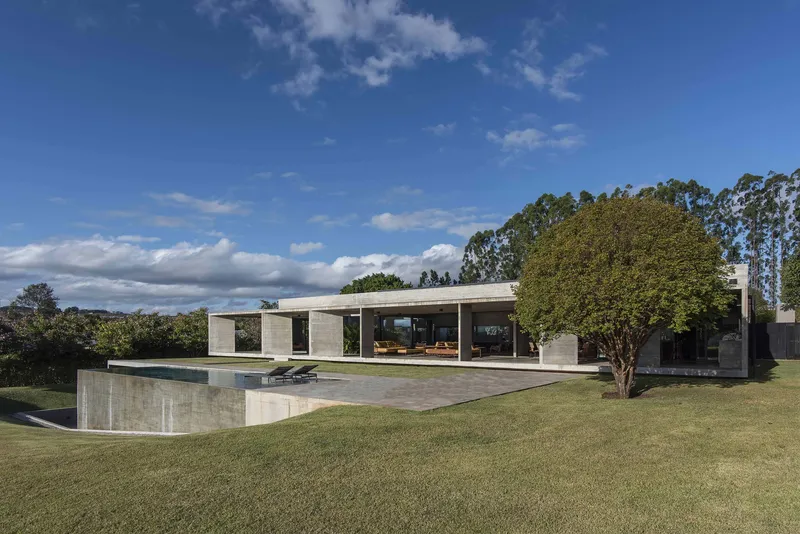
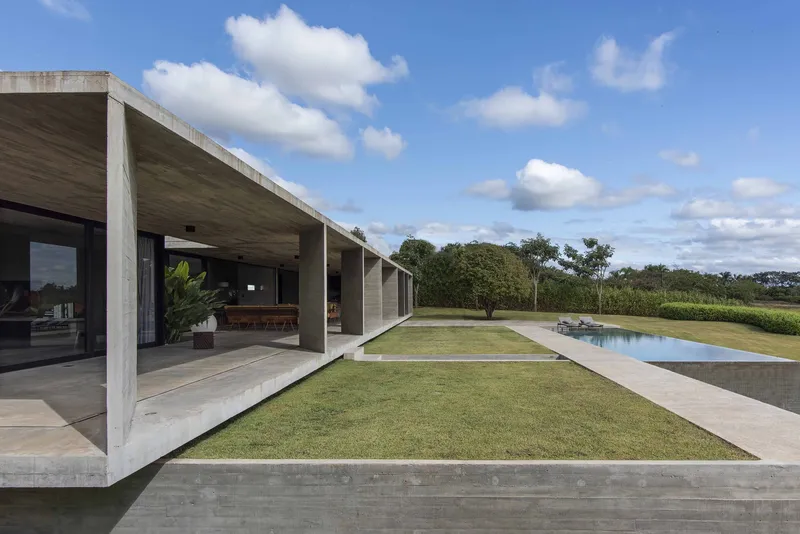
From a distance, the house registers less as a building and more as a long concrete horizon line set against eucalyptus trees and open lawn. Kruk keeps the roofline deliberately flat and low, stretching the pavilion form until it almost disappears into the grade. The decision to hold everything to a single main level is the key move: it eliminates the vertical massing that would announce the house's considerable size.
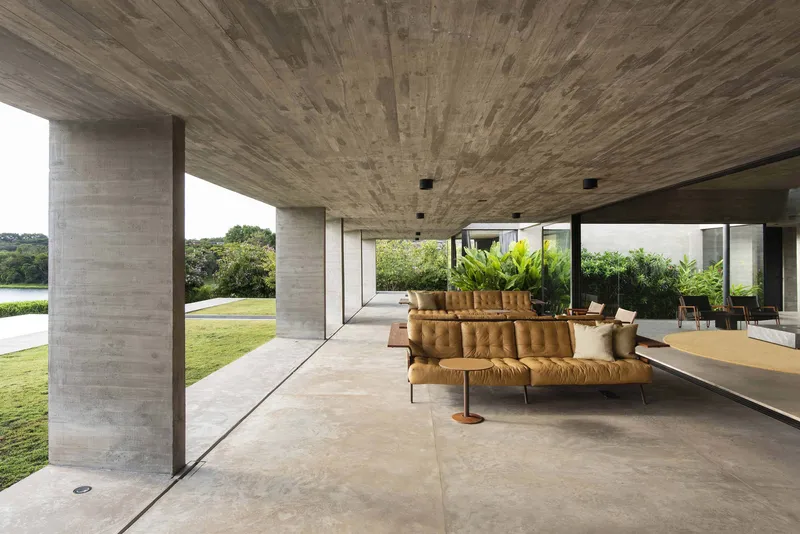
The rhythmic colonnade along the terrace side reinforces this reading. Spaced evenly and cast in board-formed concrete, the columns create a measured cadence that makes the house feel more like a covered walkway or an open pergola than a 753 square meter residence. It is a trick of proportion, and it works.
Board-Formed Concrete as Material Identity
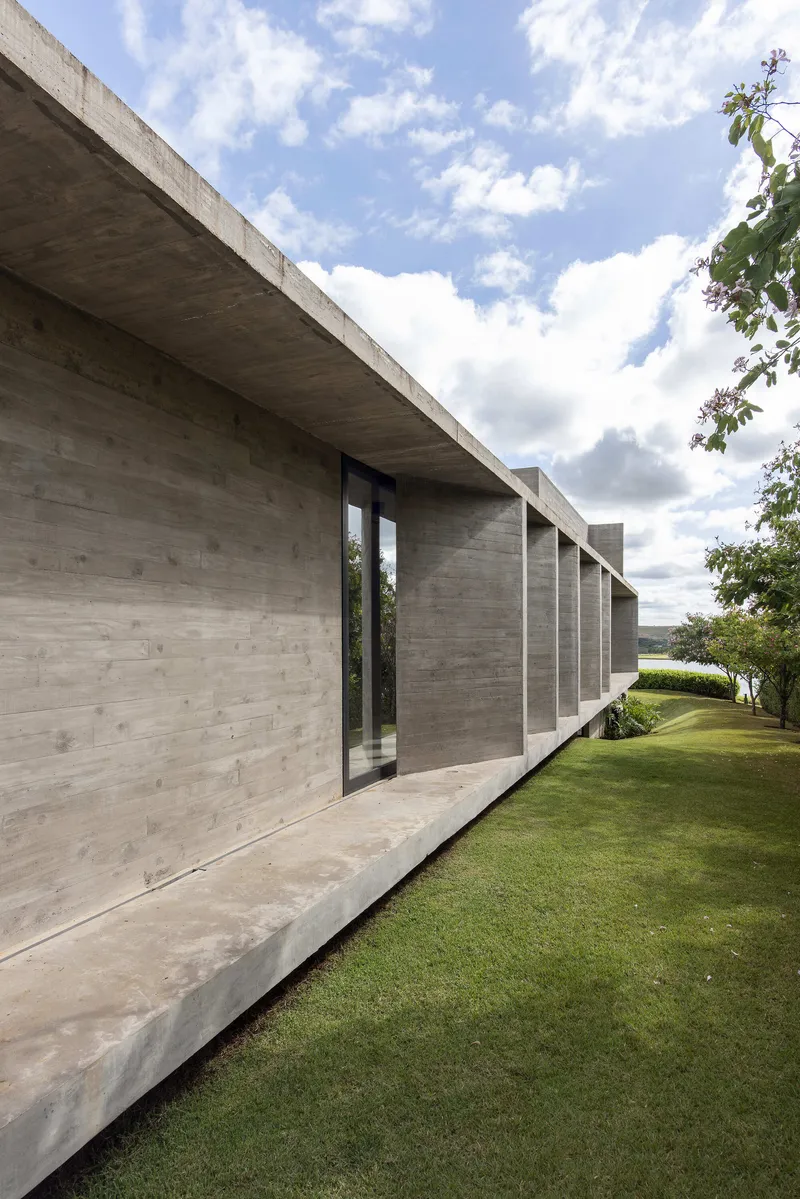
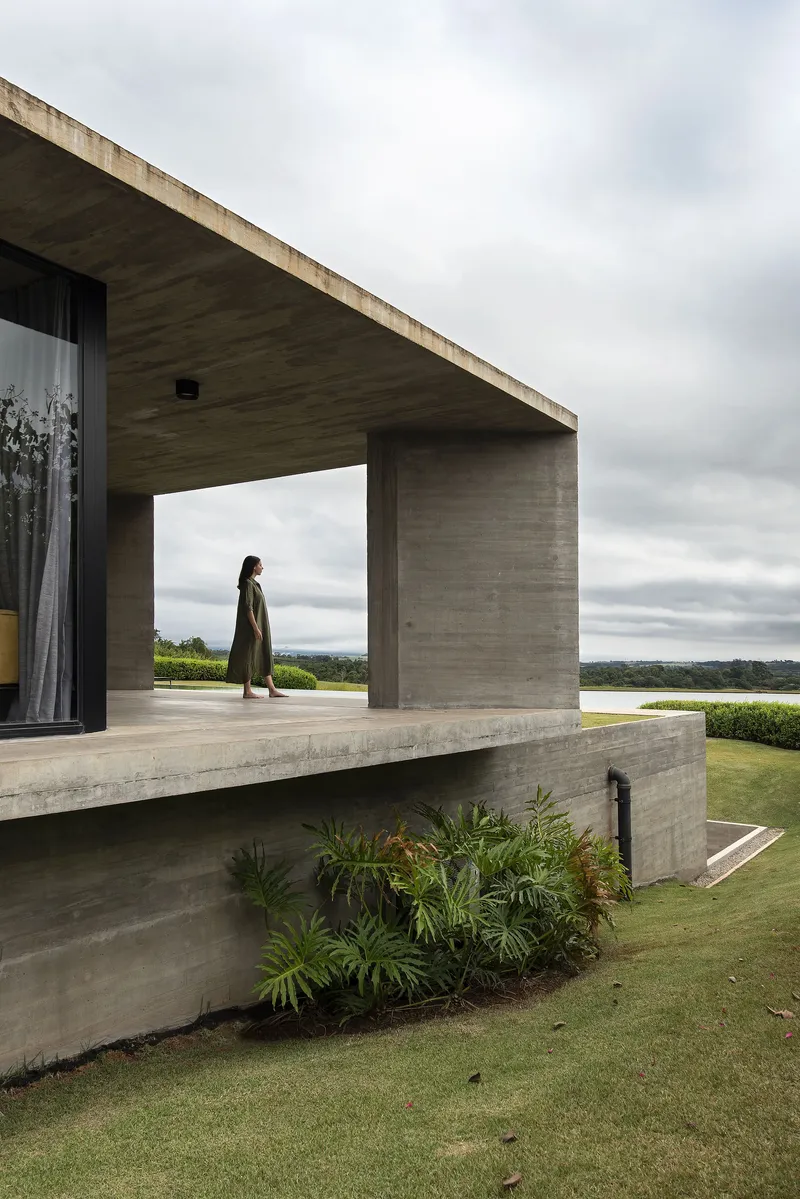
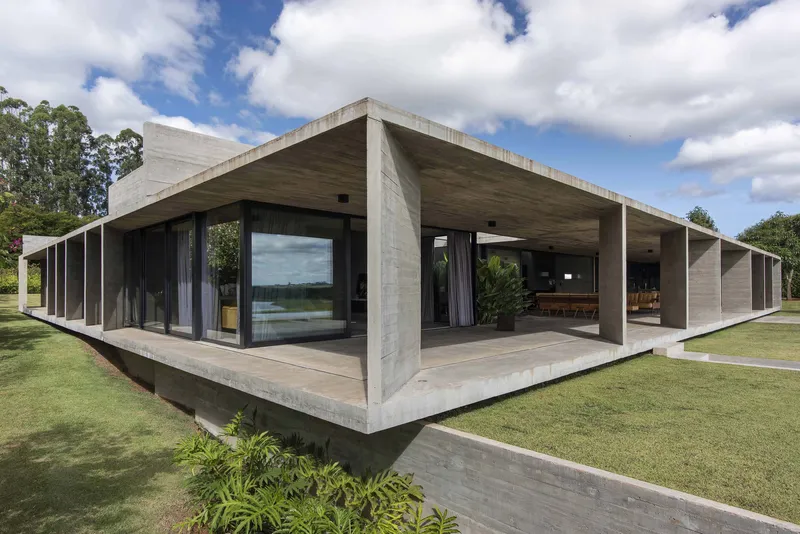
Luciano Kruk's commitment to exposed board-formed concrete is well documented, but Paula's House pushes the material into territory that goes beyond texture. The wood grain imprinted on every surface, walls, ceilings, columns, and roof slabs, gives the monolithic structure a warmth and legibility that smooth concrete would lack. Each panel records the process of its making, turning construction into ornament without any applied decoration.
The cantilevered roof slab, visible in the corner views, demonstrates the structural ambition at play. Deep overhangs protect the glass walls below from rain and direct sun, while the concrete mass overhead creates a sense of shelter that counterbalances the openness of the floor-to-ceiling glazing. It is heavy architecture deployed in the service of lightness.
Living Between Water and Sky
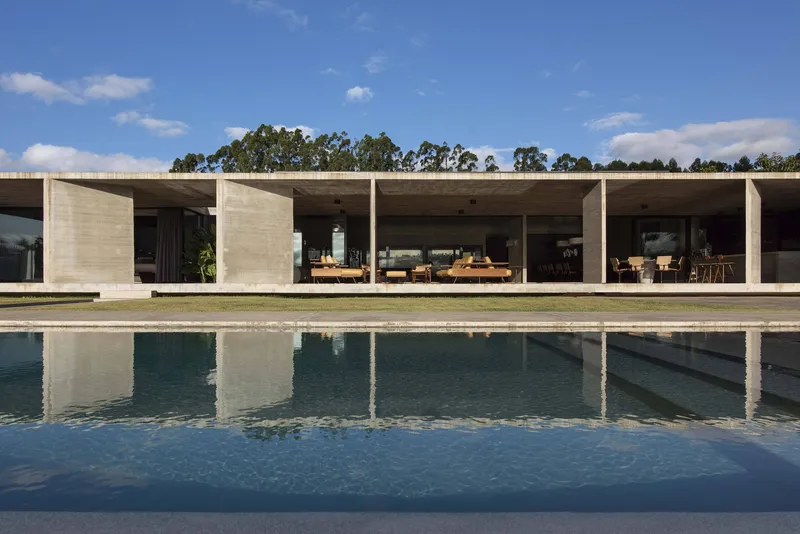
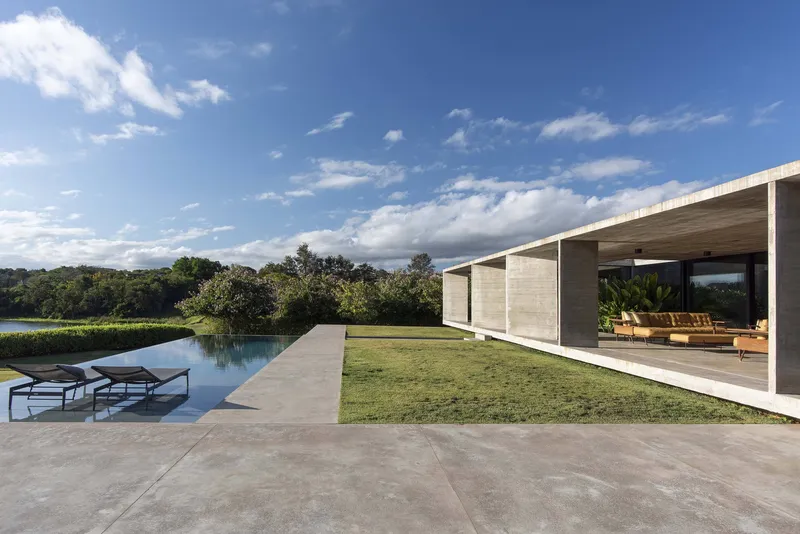
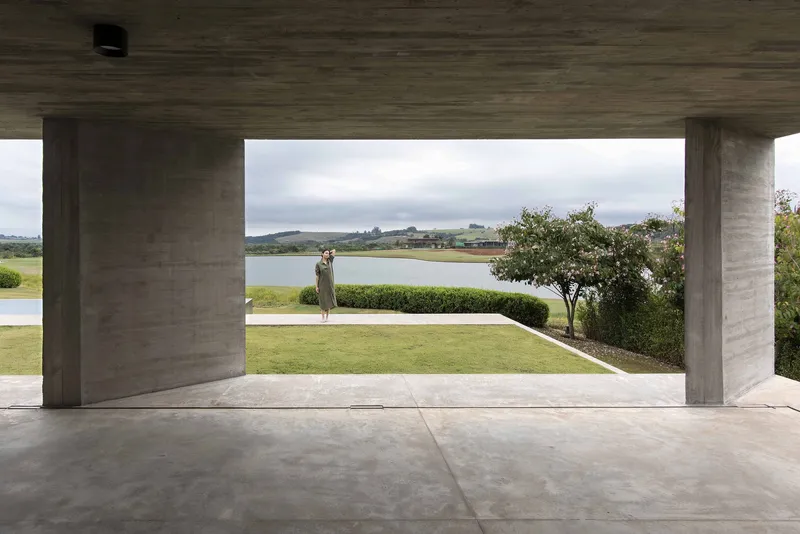
The infinity pool, elevated to the main floor level, is not merely a luxury amenity. It functions as an optical device. Its surface catches the sky and, through the infinity edge, merges visually with the distant lagoon, collapsing the boundary between domestic space and open water. A cascading overflow reinforces the connection, sending water down toward the landscape below.
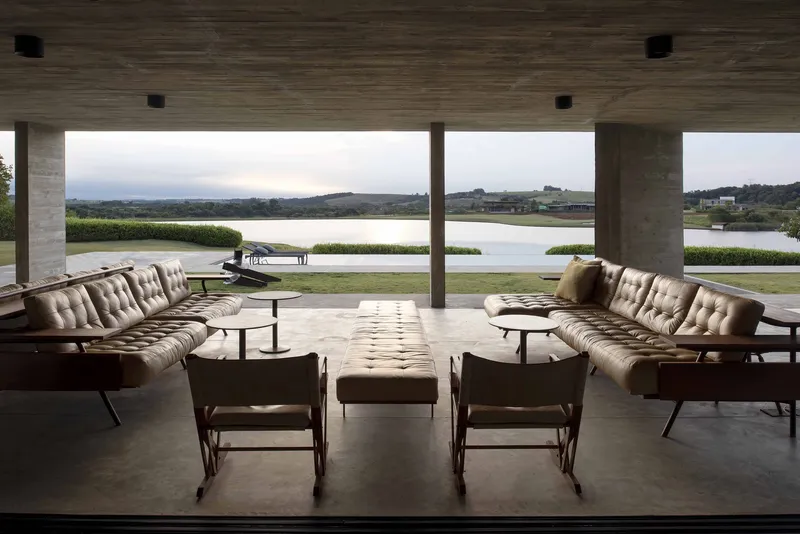
From the covered terrace, the colonnade frames these water views in a sequence of vertical slices. The effect is cinematic: as you move along the terrace, the lagoon and wetlands beyond shift between the columns like frames in a panoramic film. The concrete ceiling overhead compresses the vertical field of vision, forcing your eye outward to the horizon.
The Courtyard as Lung
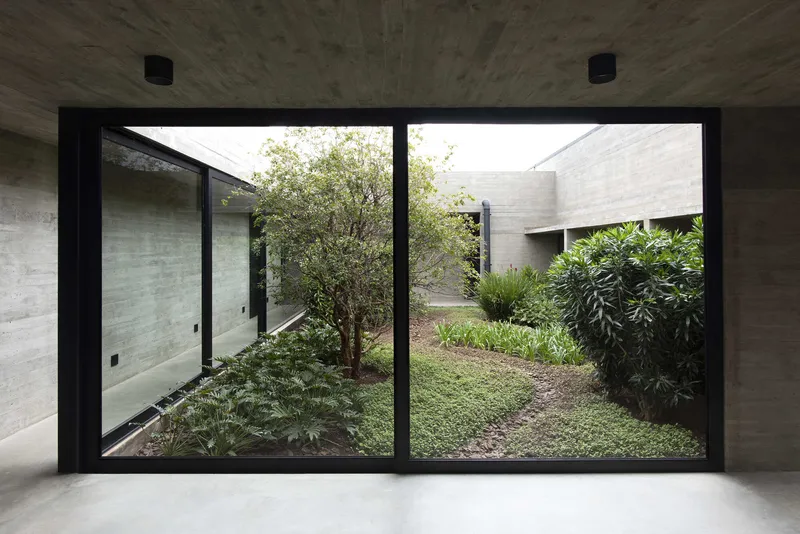
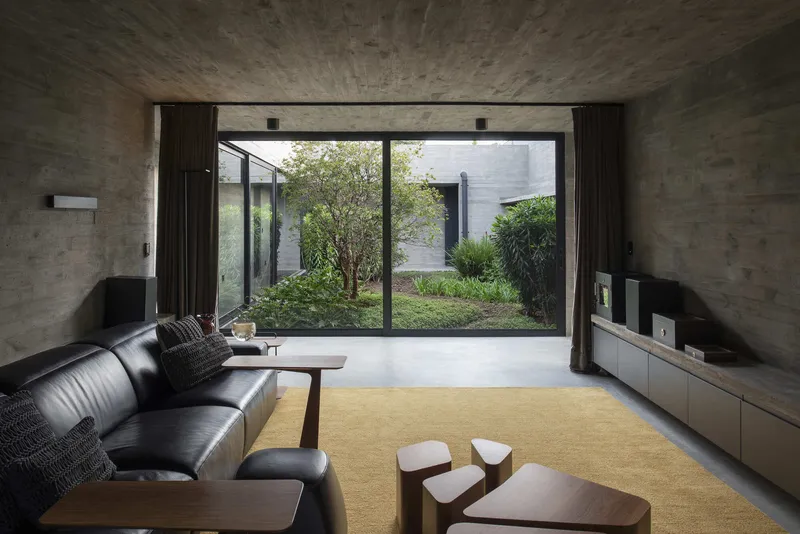
Two interior courtyards organize the plan around pockets of Atlantic Forest vegetation. These are not decorative gestures. They pull daylight deep into the center of a long, linear floor plate that would otherwise rely entirely on perimeter glazing. The planted courtyard visible through floor-to-ceiling glass walls introduces a controlled micro-landscape, small trees and dense groundcover, that contrasts with the open lawn outside.
The courtyard strategy also solves a circulation problem. In a house this long, corridors can become monotonous tunnels. By breaking the plan with open-air rooms, Kruk creates moments of spatial release. You pass from enclosed concrete interiors into bright, planted voids and back again, a rhythm that keeps the experience varied despite the house's relentlessly horizontal parti.
Interior Atmospheres
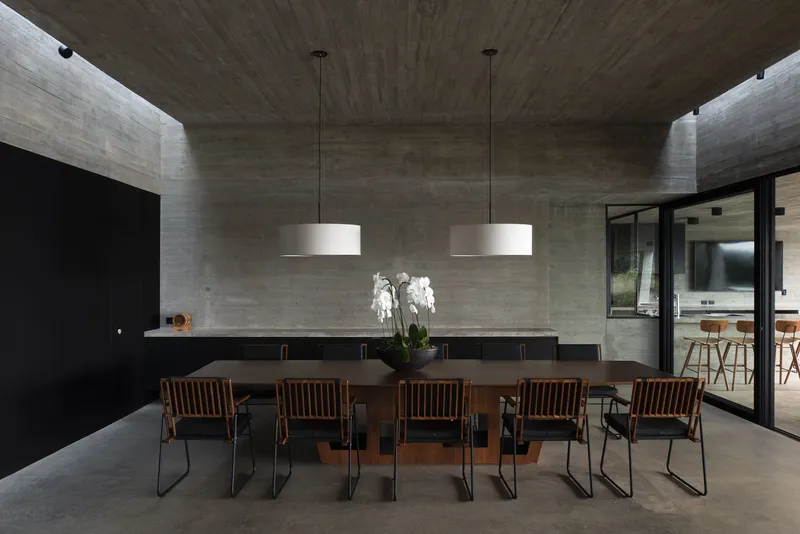
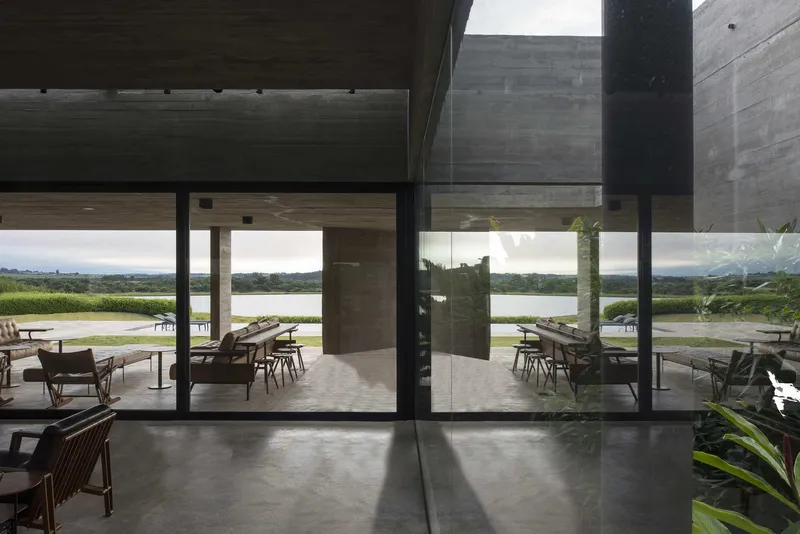
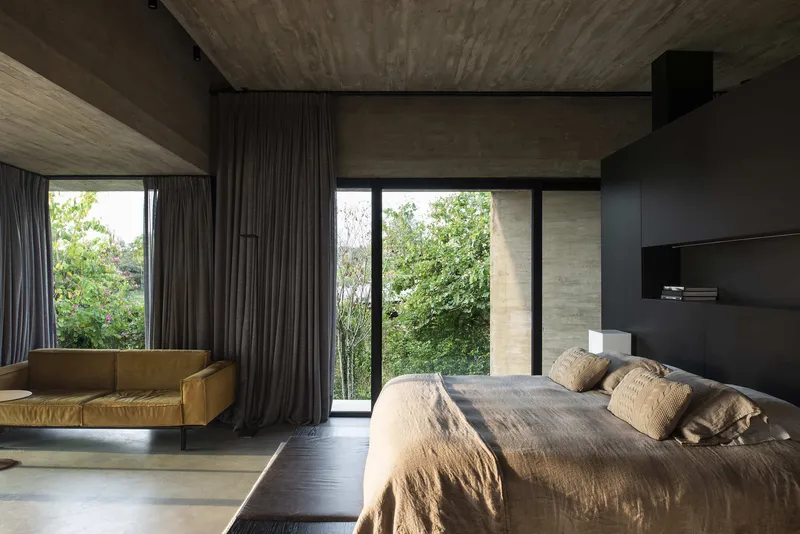
Inside, the board-formed concrete continues without interruption from exterior to interior, dissolving the threshold between covered outdoor spaces and enclosed rooms. The dining room, with its long table centered under pendant lights, demonstrates how the material operates at a domestic scale: the textured concrete ceiling and walls absorb sound and light, creating an atmosphere that is warm despite the industrial palette.
Bedrooms open through full-height glass doors onto planted exterior spaces, maintaining the house's insistence on visual and physical connection to the landscape. The primary suite and three children's rooms are positioned toward the front of the lot, facing a large garden rather than the more public lagoon side. It is a sensible zoning decision that gives private rooms their own landscape territory.
The Hidden Level and the Inclined Wall
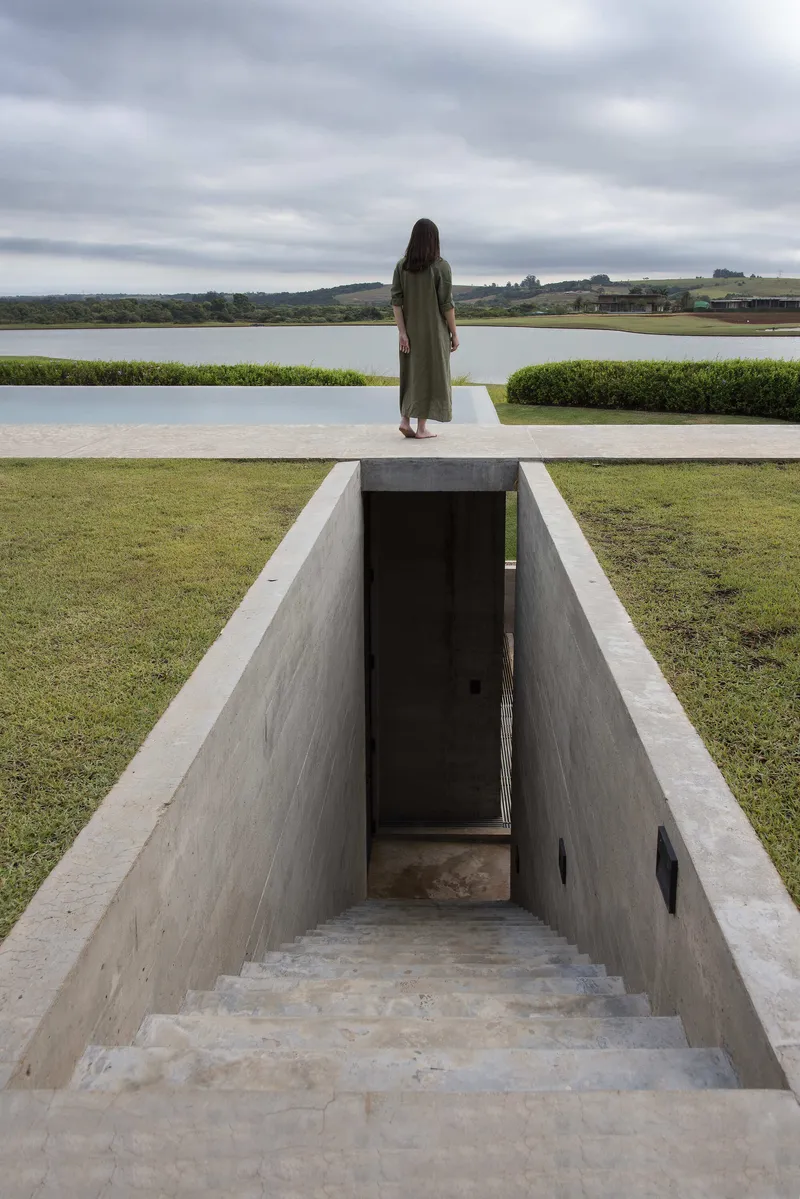
A staircase cut into the lawn descends to the lower level, where the gym and technical spaces are buried beneath the main floor. This move is essential to the house's massing strategy: by pushing service program underground, Kruk avoids the second story that would have doubled the building's visual presence. The stair itself, framed by concrete retaining walls and open to the sky, becomes a small event in the landscape rather than a hidden service corridor.
The inclined concrete partitions along the western gallery are the house's most inventive climate response. Tilted to intercept low afternoon sun, these walls reduce solar gain without resorting to mechanical shading or applied louvers. They cast dramatic angular shadows across the terrace at dusk, when the lounge space facing the water comes alive as the most desirable room in the house.
Plans and Drawings
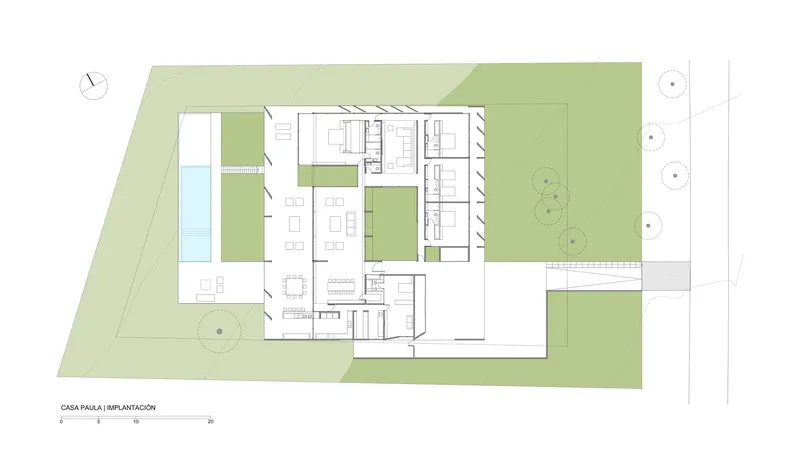
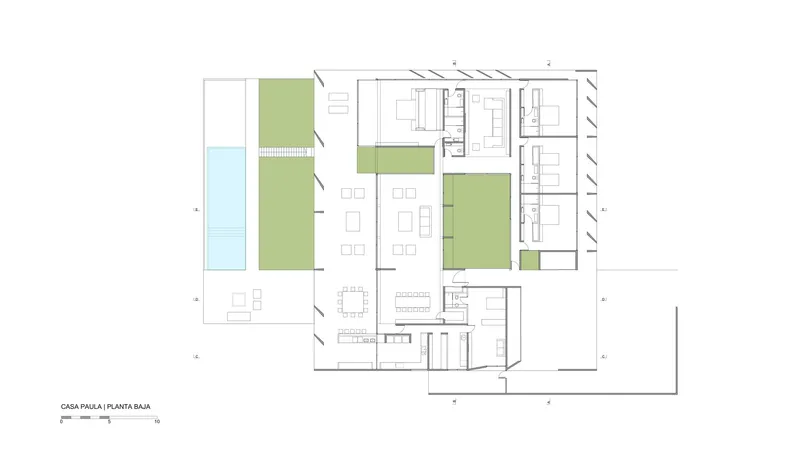
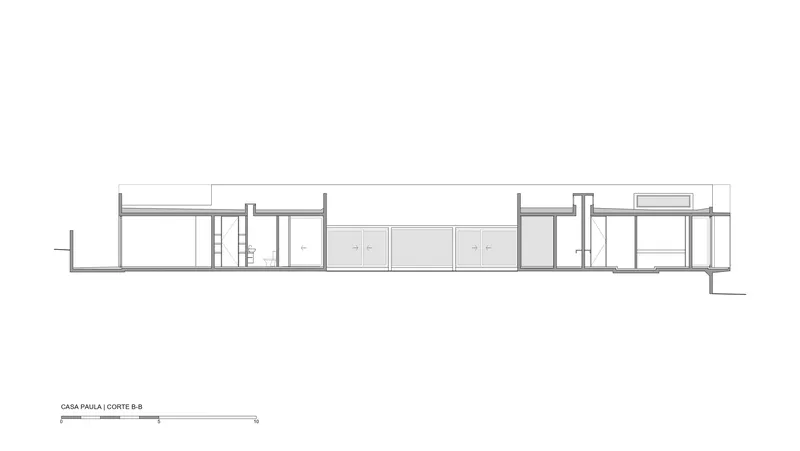
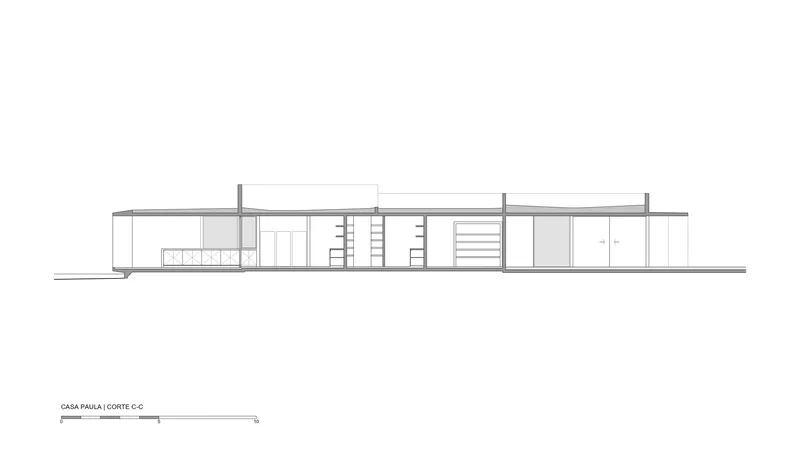
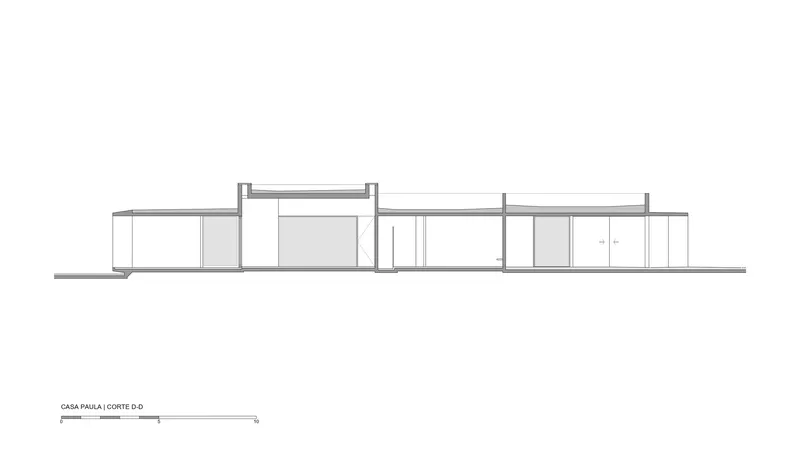
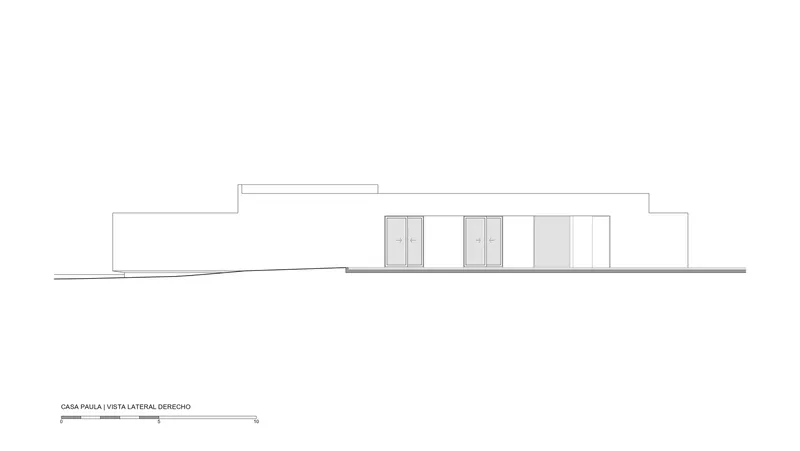
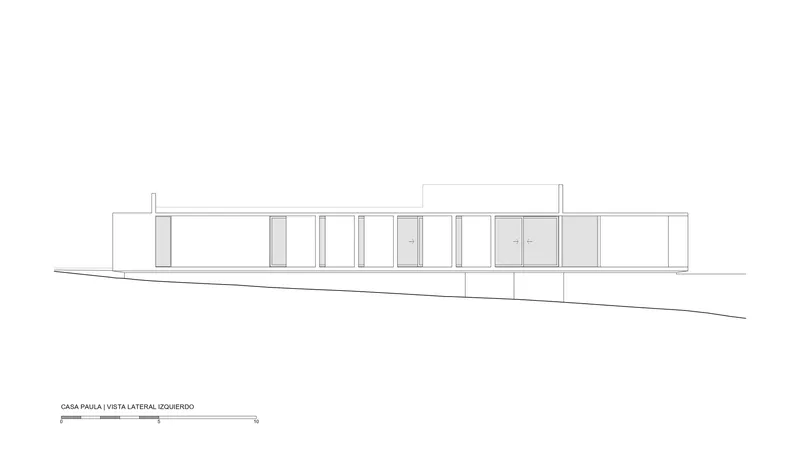
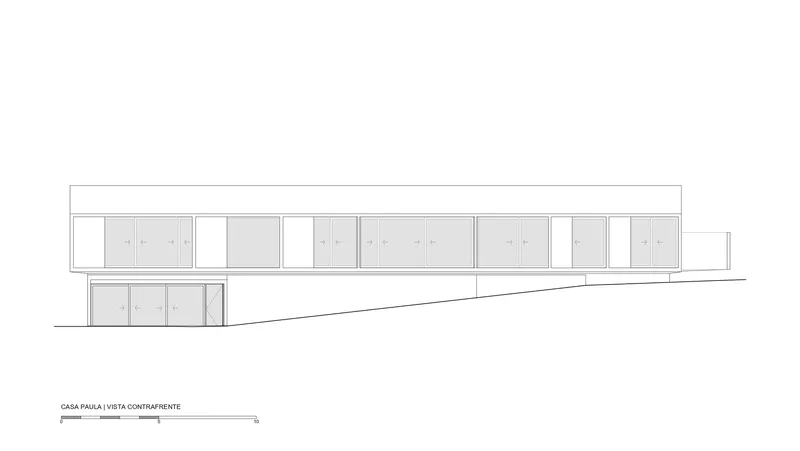
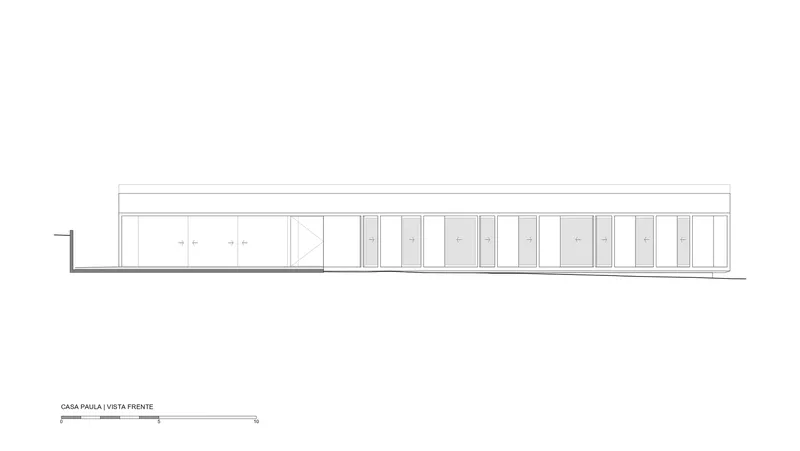
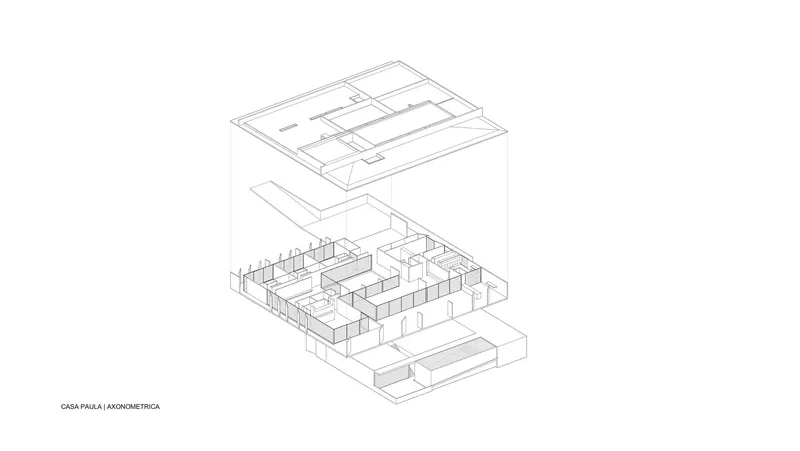
The site plan reveals just how much of the 3,070 square meter lot is given over to landscape rather than building. The house occupies a disciplined band across the site, with courtyards punched through its mass and the pool extending laterally toward the lagoon. The ground floor plan confirms the linear organization: rooms arranged around two interior courts, with the gallery and living spaces oriented toward the water.
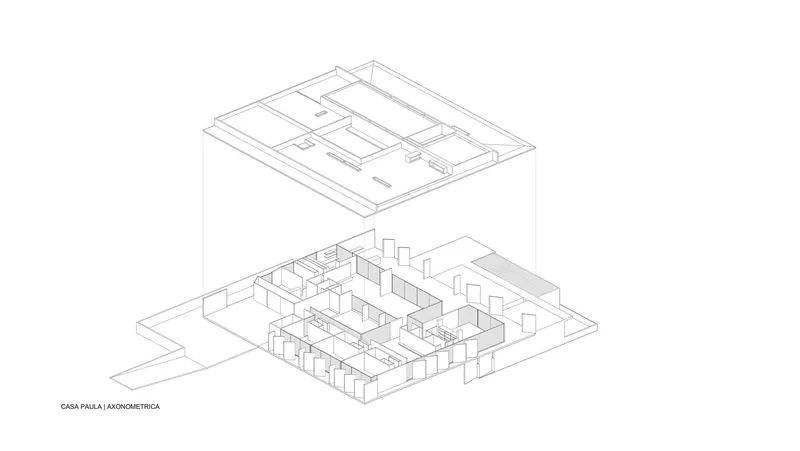
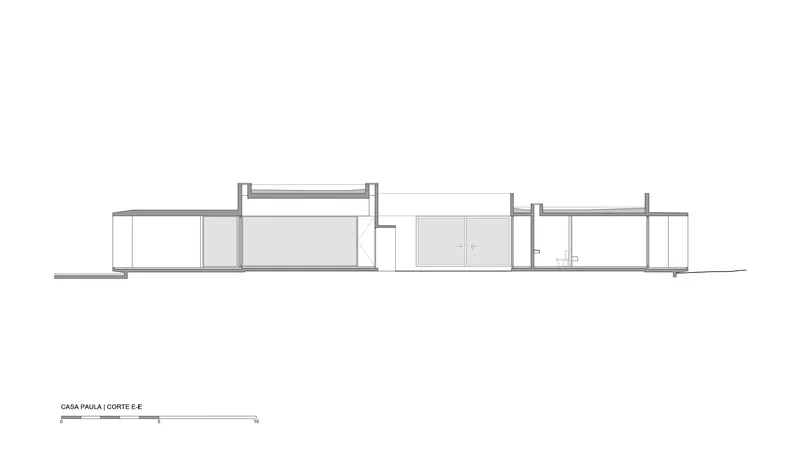
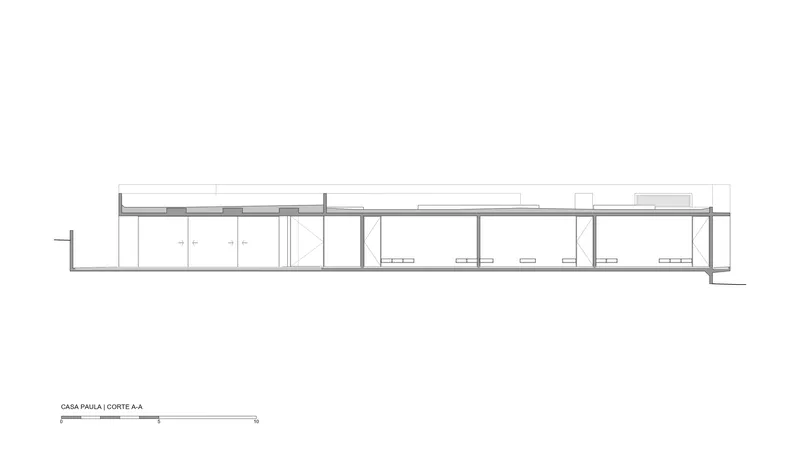
The sections are where the hidden lower level becomes legible. Stairwells drop below grade to connect the main floor with the gym and service areas, and the varied ceiling heights across the plan create internal spatial diversity despite the flat roofline. The axonometric explosions are particularly revealing, showing how the roof plane, interior partitions, and floor slabs stack as independent layers. The elevations confirm the building's commitment to horizontality: even the slight variations in roof height never break the dominant reading of a low, grounded volume.
Why This Project Matters
Paula's House demonstrates that concrete residential architecture does not have to announce itself. In a market where large houses routinely compete for visual dominance, Kruk takes the opposite approach, using a single material system, a flat profile, and buried service spaces to make 753 square meters feel like a modest intervention in a lakeside landscape. The inclined concrete walls prove that climate response and formal invention can be the same gesture.
More broadly, the project offers a counterpoint to the glass-box transparency that dominates high-end residential design in Brazil and beyond. Here, openness is controlled and directional. Courtyards bring light inward on the architect's terms. Colonnades frame views selectively. The house is generous with its landscape but deliberate about what it reveals and what it holds back, a discipline that makes it far more compelling than its program might suggest.
Paula's House by Luciano Kruk, São Paulo, Brazil. 753 m², completed 2019. Photography by Daniela Mac Adden.
About the Studio
Share Your Own Work on uni.xyz
If projects like this are the kind of work you want to make, uni.xyz is a place to publish your own, find collaborators, and enter design competitions.


Popular Articles
Popular articles from the community


Riyadh For All: Intergenerational Urban Design for Active Aging in Rabat
Riyadh For All reimagines urban design in Rabat with intergenerational co-living, adaptive courtyards, and Moroccan cultural exchange today.

The Musturak Paradise: Senior Living Architecture for a Connected Future in Temara, Morocco
The Musturak Paradise reimagines senior living architecture in Temara via private homes, social spaces, culture, community, and shared care.

Conexión: Biophilic Design Reimagines High-Rise Living in Hong Kong
Conexión reimagines high-rise living in Hong Kong through biophilic design, green facades, shared spaces, daylight, water and nature within.

Co-life: Sustainable Architecture for Age-Friendly Community Living
Co-life reimagines sustainable architecture for seniors through courtyards, rammed earth, shared gardens, and spaces designed for belonging.


Similar Reads
You might also enjoy these articles

Bao Huynh Watercolor Atelier: A Serene Art Retreat in Hội An
Bao Huynh Watercolor Atelier in Hội An blends multifunctional art spaces, sustainable design, local materials, and family-friendly living in a serene environment.

Atelier Macri Concept Store Interior Design by CASE-REAL
Atelier Macri store features a "ko" counter, walnut wood details, cork displays, blending retail, gallery, and seamless customer experiences.

Manuel Vargas Izquierdo Stadium and High-Performance Sports Center: Architectural Excellence in Jalpa de Méndez
The Manuel Vargas Izquierdo Stadium blends sustainable design, inclusive sports facilities, and cultural-inspired architecture, revitalizing Jalpa de Méndez’s public spaces.

KAKR Buluh Awar Hall: Revitalizing Community and Ecology Through Bamboo Architecture
Community built bamboo hall revitalizes Buluh Awar village, empowering youth, restoring ecology, celebrating vernacular craftsmanship through sustainable architecture and culture.


Explore Residential Building Competitions
Discover active competitions in this discipline



Challenge to design a portable theatre


Challenge to design a portable music platform

Challenge to design an open learning module for the elderly


Challenge to design mud housing for contemporary communities
Comments (0)
Please login or sign up to add comments
No comments yet. Be the first to comment!