

Luminary Tide: A Timber Canopy That Pulses with the Rhythm of the Harbor
Joel Colunga's beacon competition entry weaves a gridded timber roof into the waterfront, turning tidal light into architecture.


What if a lighthouse didn't stand alone on a cliff but instead stretched itself flat across an entire waterfront, catching light the way a tide pool catches the sea? Luminary Tide proposes exactly that: a sweeping timber canopy whose gridded ribs glow at dusk, transforming a harbor plaza into a navigational signal scaled to the size of a public gathering space. The structure refuses to be monumental in the vertical sense. Instead, it earns its presence through horizontal reach, hovering low enough to feel intimate while spanning far enough to redefine the shoreline.
Designed by Joel Colunga for the Beacon's competition on uni.xyz, the project reimagines the beacon not as a solitary tower but as a distributed field of light embedded in a public canopy. Sited along a working harbor, the design negotiates between the scale of docked boats and the human scale of visitors walking the waterfront at twilight.
A Roof That Reads as Landscape
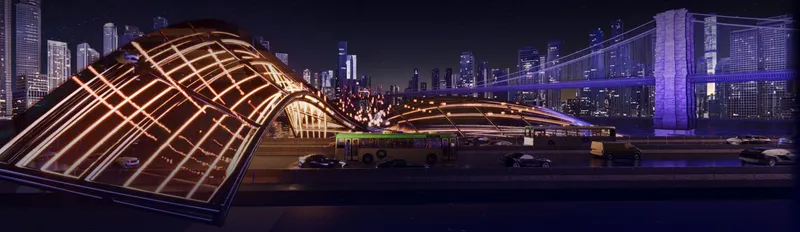
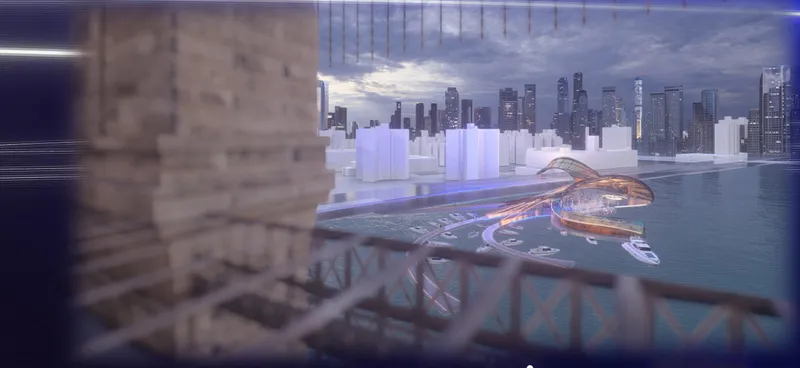
Seen from the water at night, the canopy reads as a luminous shelf, its gridded timber members forming a rhythmic pattern that recalls both the rigging of sailboats and the repetitive crests of waves. The night view reveals how the structure's lighting strategy turns each rib into a discrete line of illumination, collectively producing a warm, low glow that avoids the aggressive floodlighting typical of waterfront developments. From above, the model view confirms the canopy's gentle curve, which follows the harbor's natural arc rather than imposing a geometric abstraction on the coastline.
Underneath the Glow: Public Space as Theater


The interior experience is where the project truly earns its name. Beneath the canopy, curved structural ribs cast long shadows and reflections that shift with the sun's angle, creating an effect that is less like standing under a roof and more like wading through bands of warm light. Visitors in the renderings appear small but unhurried, suggesting a space designed for lingering rather than transit. The waterfront deck view, with its two figures silhouetted against dusk, captures the quieter register of the design: a place where the architecture recedes just enough to let the sky and water do the talking.
Colunga's sectional instinct here is strong. The ribs are spaced widely enough to avoid claustrophobia but closely enough to create a legible overhead rhythm. The result is a canopy that provides shelter without enclosure, a threshold condition between the solid ground of the city and the open water of the harbor.
Harbor as Context, Not Backdrop


The aerial model view reveals the project's ambition to integrate with a larger harbor development rather than sitting as a sculptural object on a pier. Boats scatter across the golden water surface, and the canopy appears as one element within a broader choreography of docks, pathways, and open water. The rendering of the curved waterfront marina reinforces this reading: the translucent canopy does not compete with the city skyline behind it but instead mediates between the vertical density of the urban fabric and the horizontal expanse of the sea. It is a piece of connective tissue, not a monument.
Interior Darkness, Exterior Light

One of the project's more compelling moves is the interior gallery space, where an illuminated city model glows within a deliberately darkened volume. The contrast is strategic: by pulling visitors into a shadowed interior, the design makes the return to the canopy's luminous exterior feel like an emergence. The gallery functions as a narrative device, grounding visitors in the harbor's urban context before releasing them back into the sensory experience of light on water. It is a simple inversion, darkness inside to amplify brightness outside, but it demonstrates a thoughtful sequencing of spatial experience.
Why This Project Matters
Beacon competitions often produce towers, spires, and vertical gestures that echo the lighthouse archetype. Luminary Tide pushes back against that instinct with a horizontal alternative that is no less visible and arguably more useful as public infrastructure. By distributing the beacon's signal across a timber canopy rather than concentrating it in a single point, Colunga redefines what it means to guide and to gather. The light here is not a warning; it is an invitation.
The project also demonstrates a mature understanding of waterfront architecture's core challenge: how to build at the edge without turning your back on either side. The canopy faces the city and the sea simultaneously, and its translucent, rhythmic structure ensures that neither view is blocked. For a young designer, this kind of spatial generosity, the willingness to let a building be porous rather than assertive, is a rare and promising instinct.
View the Full Project
About the Designers
Designer: Joel Colunga
Enter a Design Competition on uni.xyz
uni.xyz runs architecture and design competitions year-round that reward proposals with spatial conviction and real site intelligence.
Project credits: Luminary Tide by Joel Colunga Beacon’s (uni.xyz).


Popular Articles
Popular articles from the community


Singing Woman: An Opera House That Performs Before the Curtain Rises
Ovidiu Cristian Pavel's conceptual opera house translates Estonia's choral identity into a sculpted waterfront landmark facing the Baltic Sea.


graciastudio Turns a Viewless Tijuana Lot Inward Around a Courtyard of Concrete, Timber and Trees
In Tijuana, Jorge Gracia's GA2 House stacks a timber-clad private floor over exposed concrete and replaces a missing view with a planted interior patio.

Cube Design Draws an Ecological Corridor Between Two Shenzhen Hills with the Nankai Building
Beside Shenzhen's container docks, the Nankai Building pairs stacked balconies with a climbing green screen to connect two hillsides across its height.

David Ortega Stacks a Two-Story Mexico City Penthouse Around a Steel Stair and a Pergola-Shaded Roof Terrace
In Colonia Roma, a 300 m² penthouse uses oak joinery, a planted steel stair and a slatted roof pergola to make a new-build apartment feel like a house.

Similar Reads
You might also enjoy these articles

Vereda Arquitetos Renovates a 40-Square-Meter Apartment Inside Niemeyer's Copan Building
A compact unit in São Paulo's most iconic residential tower gets a material overhaul that pairs exposed concrete with bold blue Formica.

Shakur's House: Exposed Brick as an Interior Organiser in a 168 m² Mashhad Residence
Brick moves indoors in this Mashhad residence, where masonry walls, glass partitions and teal planes sequence a compact home without closing it off.

Day and Night Park: A Time-Based Urban Newsstand in Beijing
A temporary urban newsstand in Beijing blending travel, light, and reading through poetic colors, compact form, and community-focused design.

Modernist Patio Renovation in El Masnou, Barcelona by Oliver Segura Arquitectura + Cebrià Arquitectura
Modernist patio renovation blending tradition and innovation with a movable pool, leveled floors, and Catalan materials in El Masnou.


Comments (0)
Please login or sign up to add comments
No comments yet. Be the first to comment!