

LUO Studio Builds an Entire Exhibition from 320 Sheets of Corrugated Cardboard in Shanghai
A zero-waste installation at the Power Station of Art proves that mortise-and-tenon joinery and humble cardboard can replace conventional exhibition infras


Most exhibition design treats its own architecture as disposable. Walls go up, get drilled, painted, printed on, and torn down in a cycle that generates enormous waste for something that may only last a few weeks. LUO studio took that problem literally at Shanghai's Power Station of Art, housed in a former 1985 power plant on the Huangpu River, and built the entire spatial infrastructure for the exhibition "Back to the Future: Breaking the Time Barrier" out of corrugated cardboard. Three hundred and twenty standard sheets, each 2.4 meters by 1.2 meters, were CNC-cut into 2,566 components and assembled by hand, without a single power tool, in two days.
What makes the project genuinely interesting is not the novelty of cardboard as a material. Designers have been experimenting with it for decades. The achievement here is systemic: LUO studio devised a complete modular vocabulary of 42 vertical exhibition modules, 22 stand modules, column wraps, benches, and media mounts, all connected through concave and convex mortise-and-tenon edges milled by CNC. The system requires no glue, no screws, no specialized labor. It can be disassembled, reconfigured for another show, and eventually recycled at a recovery rate of 96 percent. That is a serious proposition for an industry addicted to plywood and drywall.
Working Around the Columns


The existing gallery is a long rectangle, roughly 40 meters by 16.5 meters with a 6-meter ceiling height, bisected by a row of concrete columns that bear the scars of countless previous exhibitions: anchor holes, paint patches, evidence of hanging and drilling. Rather than ignoring the columns, LUO studio made them the organizing principle. Four cardboard display walls radiate from the center of each column in an X-shaped plan, dividing the space around every column into four outward-facing isosceles triangular zones. Between columns, two halves of adjacent X-walls form inward-facing rectangular rooms. The result is a surprisingly varied sequence of spatial experiences generated from a single repeating geometric move.
The Mortise-and-Tenon Logic
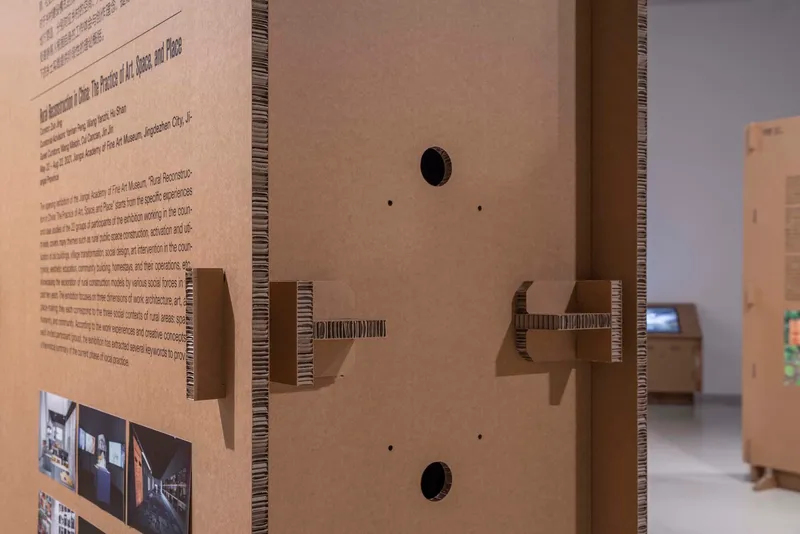

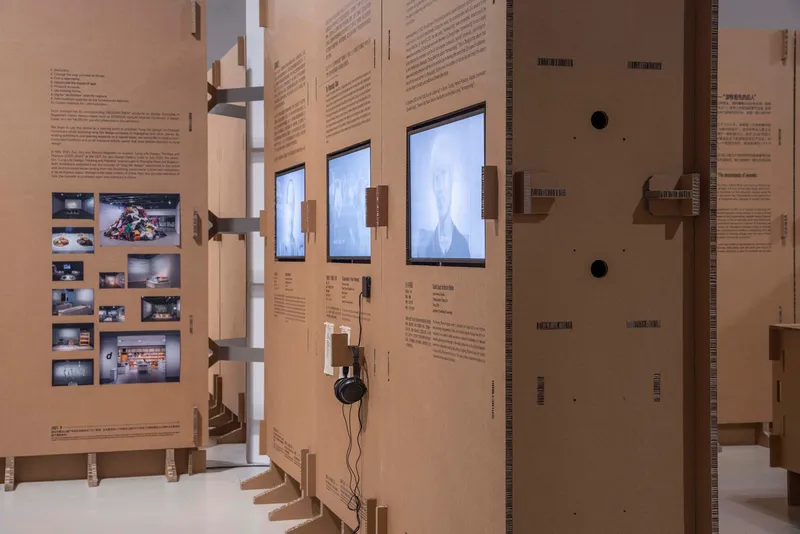
Every connection in the installation relies on interlocking edges cut directly into the cardboard panels. Three vertical boards, each 1.2 meters wide, slot together horizontally to form a single wall 3.6 meters across. The technique borrows from traditional timber joinery, scaled down to work with 15mm and 20mm corrugated stock. The CNC cutting of all 320 raw sheets took less than two days, and six or seven non-specialist workers assembled the full installation on site in another two. That speed is the real test of whether a modular system works: if untrained hands can build it quickly, the design is doing the work, not the labor.
Reinforcement components add flexibility where the loads change. LCD screens, iPads, and earphones all mount on dedicated cardboard brackets that slot into the same mortise-and-tenon grid. Even the printed graphics avoid conventional adhesion: Yukou Paper is pressed with small nails onto the cardboard surface, eliminating screen printing or pasting that would contaminate the material's recyclability.
Wrapping the Infrastructure


The column wraps are among the most telling details. Existing concrete columns in the Power Station of Art are visibly battered by prior installations. LUO studio sheathes them in fitted cardboard sleeves with slotted bases, turning structural liabilities into display surfaces. Hinged panels open from the column wraps to reveal embedded screens and documentation. It is a clever double move: the columns gain a finished appearance without any damage, and the exhibition gains additional vertical display area that would otherwise go unused.
Inhabiting the Space


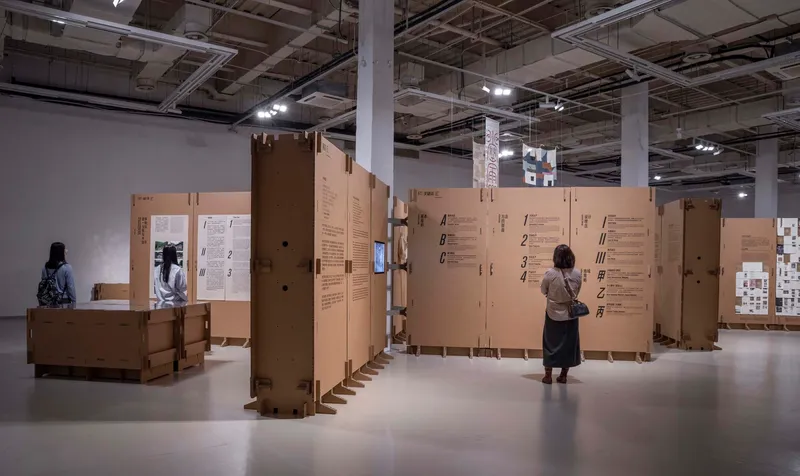
The installation is not merely a set of walls. Cardboard benches allow visitors to sit and watch video content flanked by text panels. The proportions feel deliberate: seated, you are enclosed by cardboard at shoulder height, creating a focused viewing condition without isolation. Standing visitors move through gaps between modules at a pace set by the rhythmic column spacing. The exhibition, curated by Zuo Jing, covers themes of longevity in design, and there is an appropriate irony in presenting those ideas inside architecture that can be completely recycled.
Screens, Shelves, and Media Integration


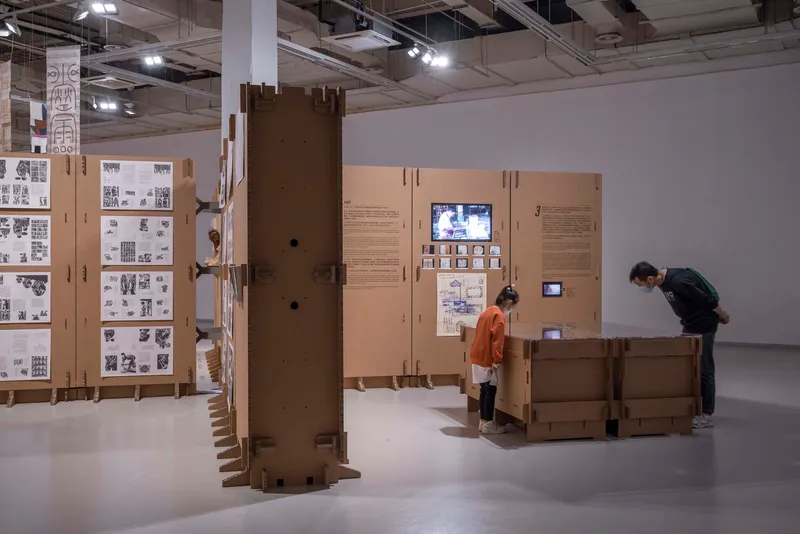
A common failure of sustainable exhibition design is that it looks provisional, as though the material constraints have defeated the curatorial ambitions. LUO studio avoids this by treating the cardboard modules as genuine furniture: video monitors sit flush within framed openings, photograph grids are mounted at precise heights, and shelving brackets cantilever cleanly from panel edges. The warm brown tone of raw corrugated stock unifies everything, giving the space a coherent identity that most white-box exhibitions achieve only with extensive painting and finishing.
Models and Prototypes


Cardboard architectural models displayed within the exhibition serve as both design documentation and proof of concept. These scaled prototypes, topped with acrylic sheets, show the spatial logic of the X-shaped column arrangement and the layered interior openings. Placed beside the weathered white columns of the former power plant, they highlight the contrast between the building's industrial permanence and the installation's deliberate impermanence. The models also demonstrate how the mortise-and-tenon system works across scales, from full-size walls down to tabletop studies.
Variations on the Module


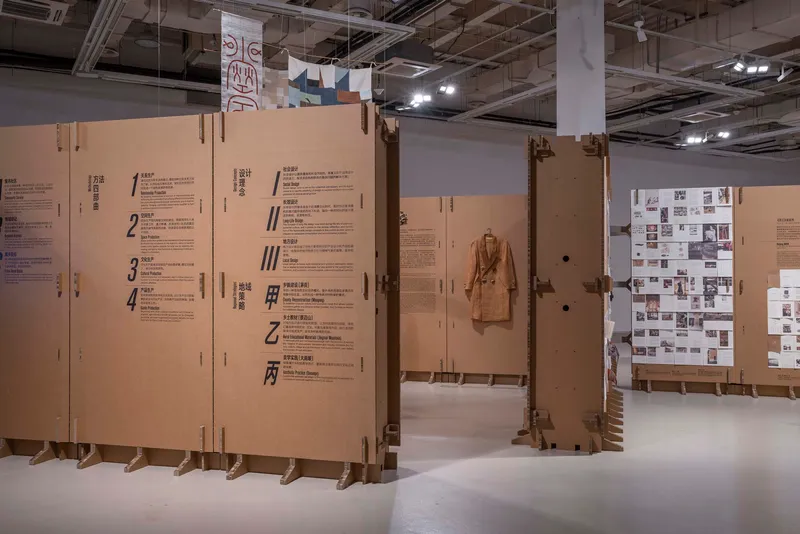
The standard 1.2m by 2.4m by 0.6m module is the base unit, but LUO studio varies it enough to avoid monotony. Some configurations include small pitched-roof structures that create visual landmarks. Others incorporate cylindrical woven elements and hanging garments, adapting the cardboard framework to a range of curatorial needs. The consistency of the connection system means every variation is structurally compatible with every other, so future exhibitions could remix the same 2,566 components into entirely different layouts.
Plans and Drawings
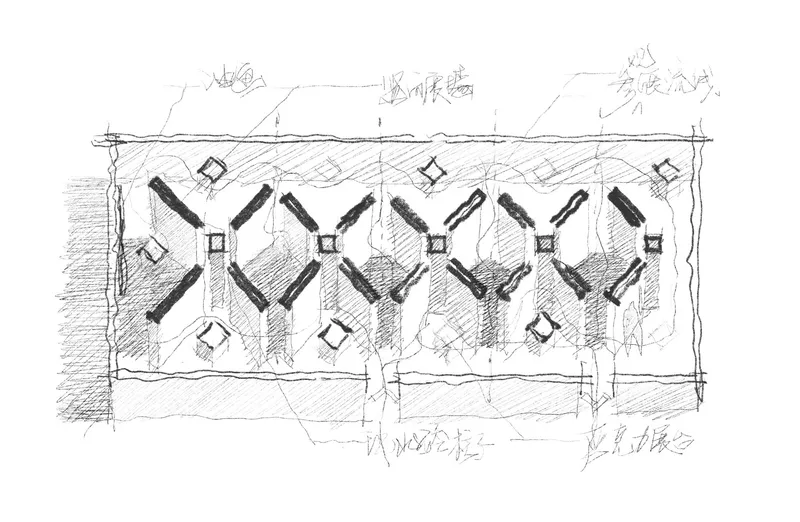
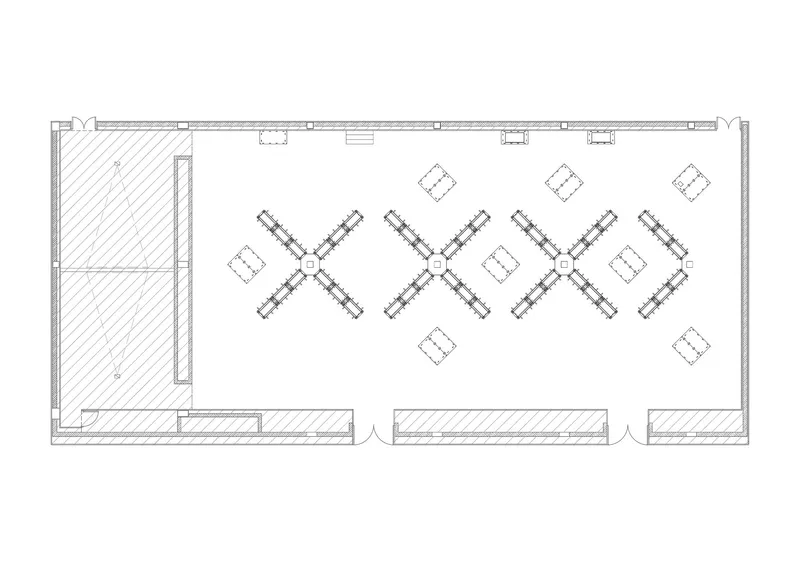


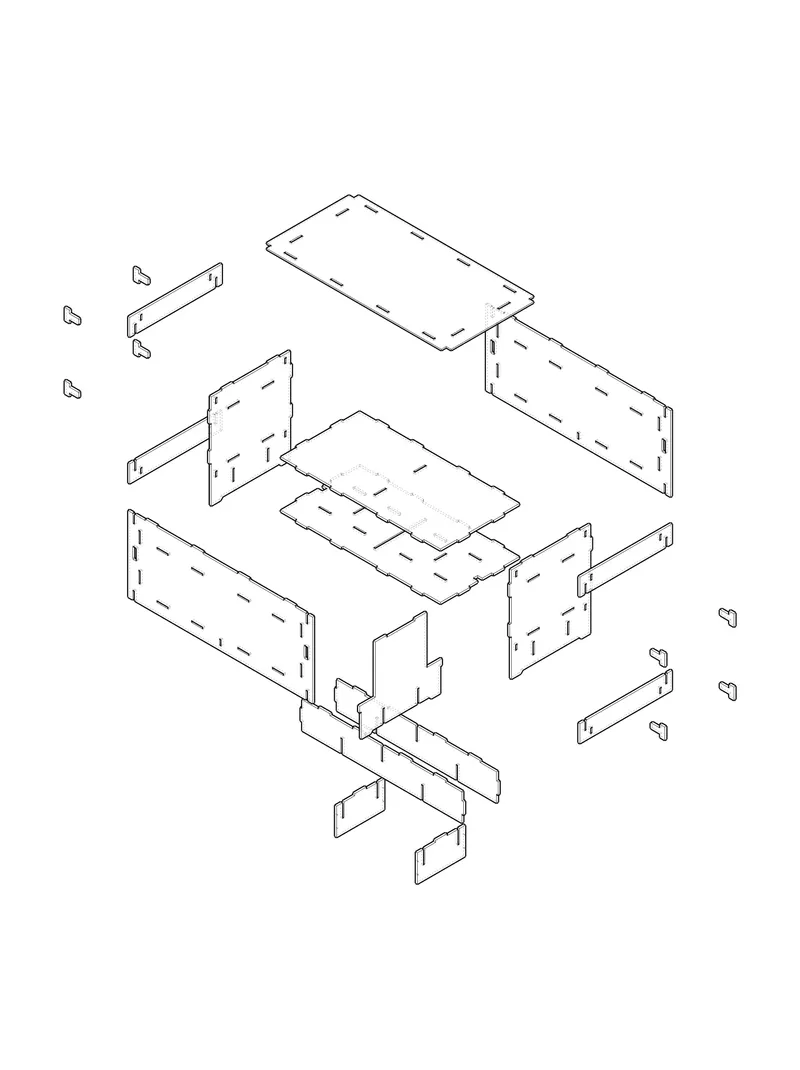
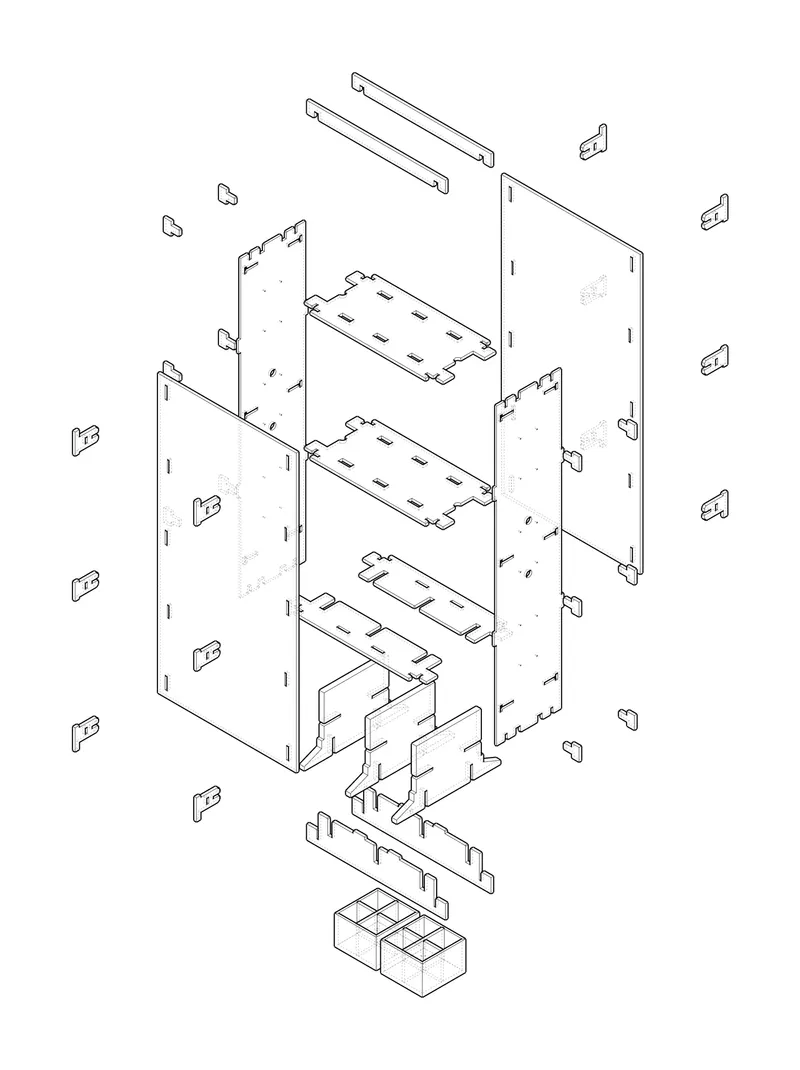
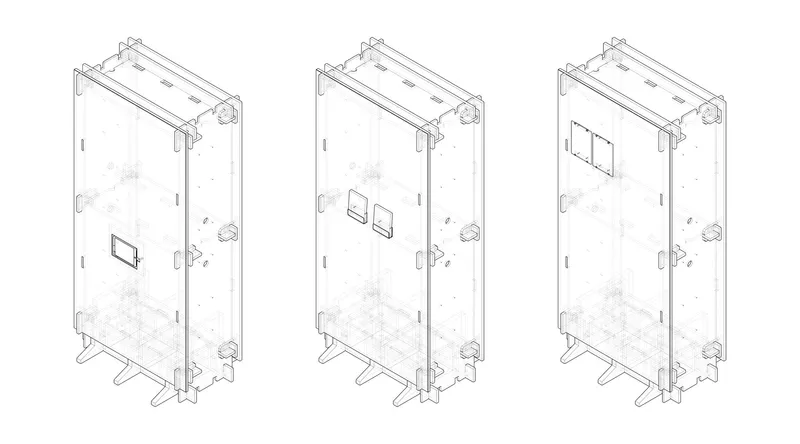
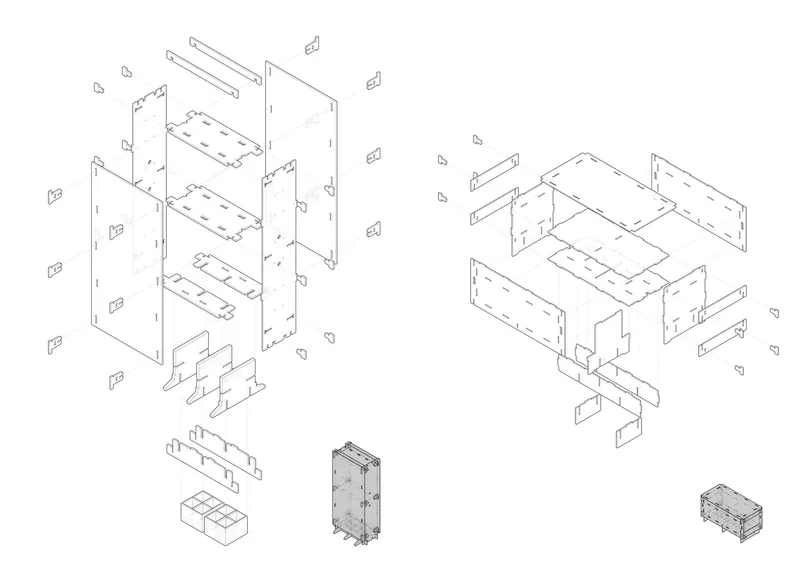

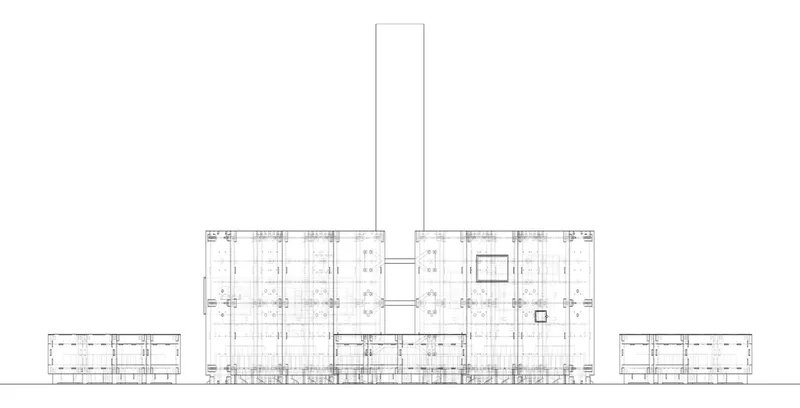

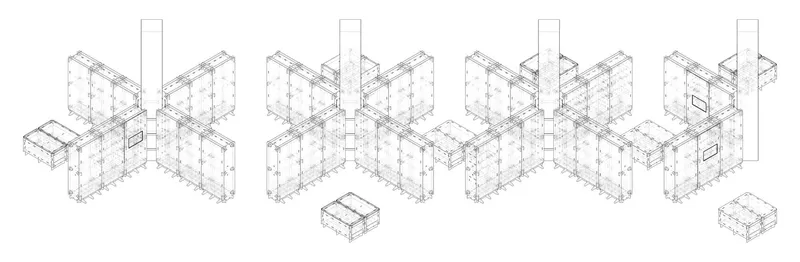

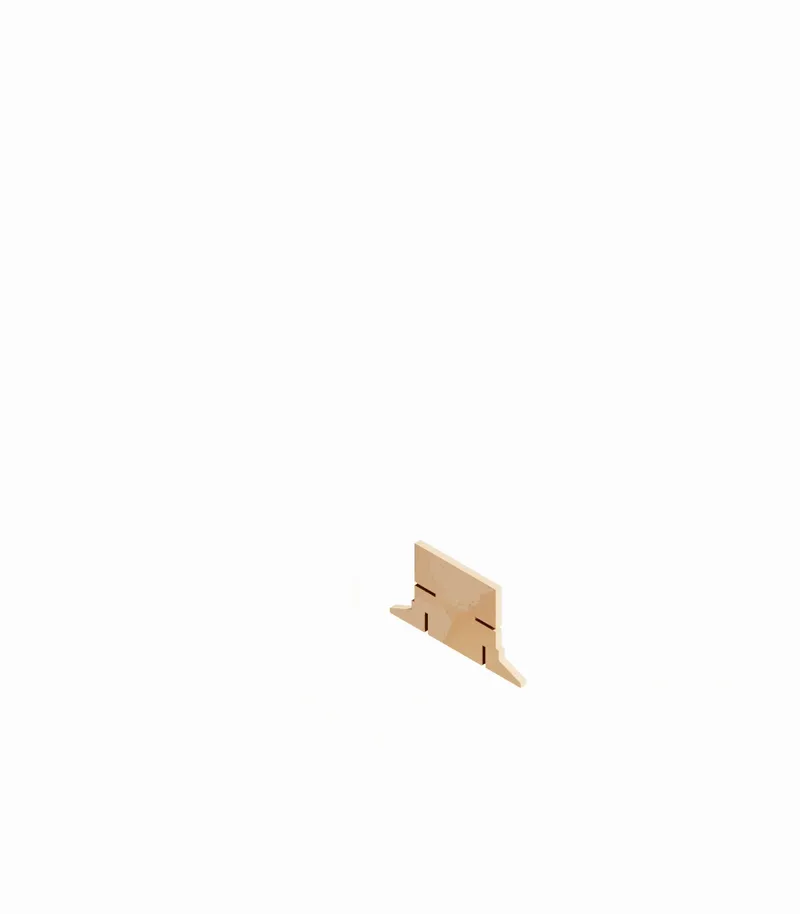
The floor plan makes the X-shaped desk cluster logic immediately legible: four pinwheel units align along the column row, each radiating display walls into the surrounding space. The exploded axonometric drawings are the most revealing documents, breaking each module into its flat panel components, horizontal shelves, interlocking base elements, and connection hardware. These drawings communicate the assembly sequence clearly enough that the "no tools required" claim becomes credible. Elevation drawings show how the modules read at the scale of the room, with tall vertical towers and lower flanking wings creating a varied roofline within the gallery's industrial envelope.
Why This Project Matters
The exhibition industry has a waste problem it rarely discusses. Temporary walls, custom vitrines, and branded environments are built to last weeks and discarded without ceremony. LUO studio's corrugated cardboard system is not a conceptual gesture about sustainability. It is an operational alternative: cheaper to fabricate, faster to assemble, easier to modify, and recoverable at end of life. The mortise-and-tenon joinery means the same material can serve multiple exhibitions before it enters the recycling stream, extending its useful life well beyond a single show.
What elevates the project beyond a technical proof is its spatial ambition. The X-shaped column strategy produces genuinely varied rooms from a repetitive grid. The integration of media, seating, and display within a single material palette gives the installation a coherence that many permanent galleries struggle to achieve. If the future of exhibition design involves taking responsibility for what happens after the doors close, this project at the Power Station of Art offers a persuasive model for how to start.
Exhibition Space Formed by Corrugated Cardboards by LUO studio. Located at the Power Station of Art, Shanghai, China. 661 m². Completed in 2022. Exhibition curated by Zuo Jing. Photography by Weiqi Jin, Sui Sicong, Yanzhi Wang, and Power Station of Art.
About the Studio
Share Your Own Work on uni.xyz
If projects like this are the kind of work you want to make, uni.xyz is a place to publish your own, find collaborators, and enter design competitions.


Popular Articles
Popular articles from the community


Faces of the Soviet Avant-Garde: Turning Moscow's Street Names into an Open-Air Museum
A network of sculptural installations across a Moscow residential district transforms forgotten architect names into spatial encounters with cultural memor
Opera by the Sea Estonia: Three Shells Dissolving Architecture into Tallinn's Coastline
A winning opera house proposal replaces monumental form with interconnected shells that blur the boundary between building, park and Baltic Sea.

Singing Woman: An Opera House That Performs Before the Curtain Rises
Ovidiu Cristian Pavel's conceptual opera house translates Estonia's choral identity into a sculpted waterfront landmark facing the Baltic Sea.
Temporary Home for Dogs: A Reversed Zoo Rethinks Animal Shelter Architecture
In Bucharest, a sinuous corridor and freed landscape flip the logic of containment, designing a shelter that works to make itself unnecessary.

Similar Reads
You might also enjoy these articles

Pixel Gardens: One Repeated Module Stacked Into a Terraced Social Housing Tower for Famagusta
Salem Bader's shortlisted housing tower builds a vertical neighbourhood from one repeated module, offsetting units to carve terraces, light and air.

Bao Huynh Watercolor Atelier: A Serene Art Retreat in Hội An
Bao Huynh Watercolor Atelier in Hội An blends multifunctional art spaces, sustainable design, local materials, and family-friendly living in a serene environment.

Atelier Macri Concept Store Interior Design by CASE-REAL
Atelier Macri store features a "ko" counter, walnut wood details, cork displays, blending retail, gallery, and seamless customer experiences.

Manuel Vargas Izquierdo Stadium and High-Performance Sports Center: Architectural Excellence in Jalpa de Méndez
The Manuel Vargas Izquierdo Stadium blends sustainable design, inclusive sports facilities, and cultural-inspired architecture, revitalizing Jalpa de Méndez’s public spaces.


Comments (0)
Please login or sign up to add comments
No comments yet. Be the first to comment!