
Ho Khue Architects Weaves 5,000 Square Meters of Greenery into a 25-Story Da Nang Hotel Tower
On Vietnam's My Khe Beach, the M Hotel channels the image of a stream flowing over rock through cascading vertical gardens and raw concrete.


Da Nang's beachfront strip along Vo Nguyen Giap Street is packed with hotel towers competing for ocean views, most of them clad in the same glass curtain wall and offering the same balcony proportions. Ho Khue Architects broke that pattern with the M Hotel, a 25-story, 199-room tower that treats vegetation not as ornament but as a building system. Five thousand square meters of planted area, roughly a fifth of the project's total floor area, are distributed across four sky gardens carved into the tower's mass and a continuous vertical garden that climbs the north and west facades. The result is a building that performs thermally in a hot, humid coastal climate while looking unlike anything else on the strip.
The concept draws on the image of a stream coursing over a rocky mountain: the exposed fair-faced concrete is the mountain, and the curving bands of greenery are the water. It sounds poetic in a brief, but what makes the M Hotel genuinely interesting is how literally that metaphor translates into plan. Ocean-facing rooms push forward with expansive glass walls; city-facing rooms on the west pull back to create deep garden terraces that shade the rooms behind them. That asymmetry drives the building's section, its energy strategy, and its identity.
A Facade That Works for Its Living
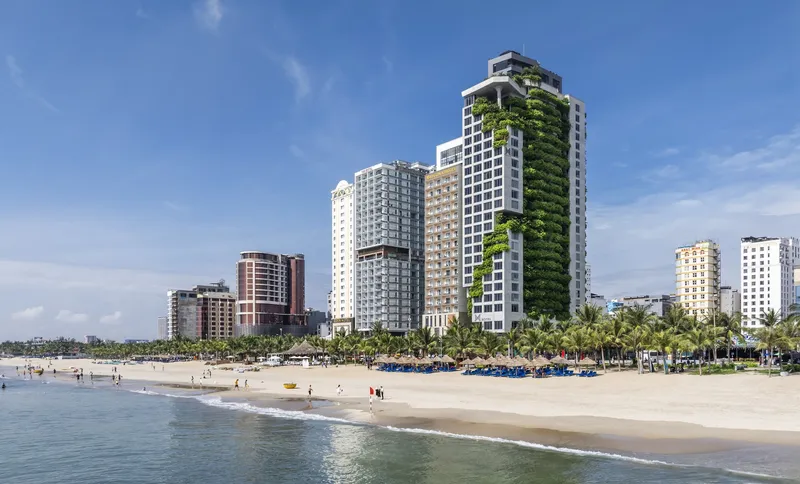
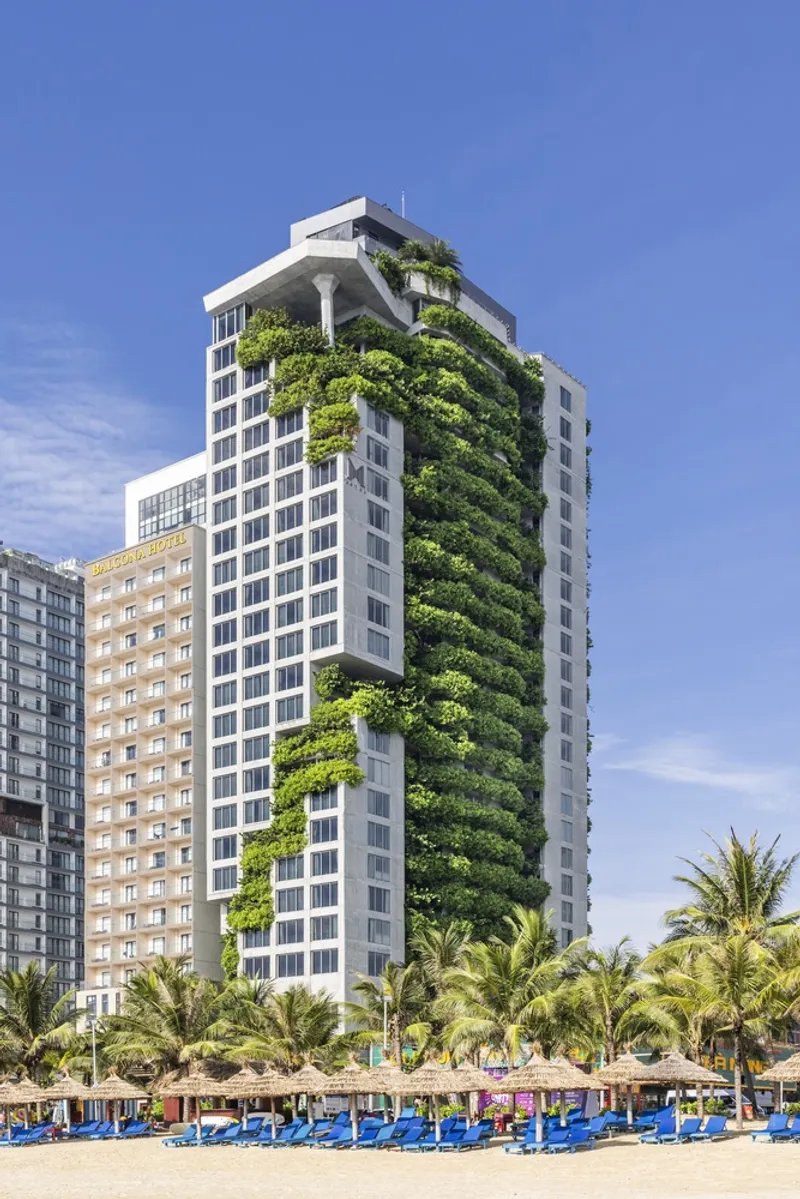
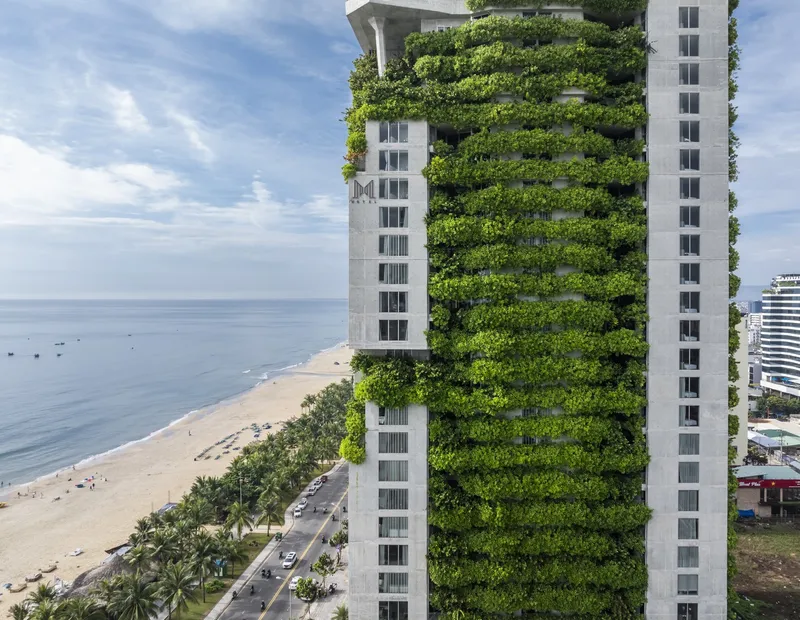
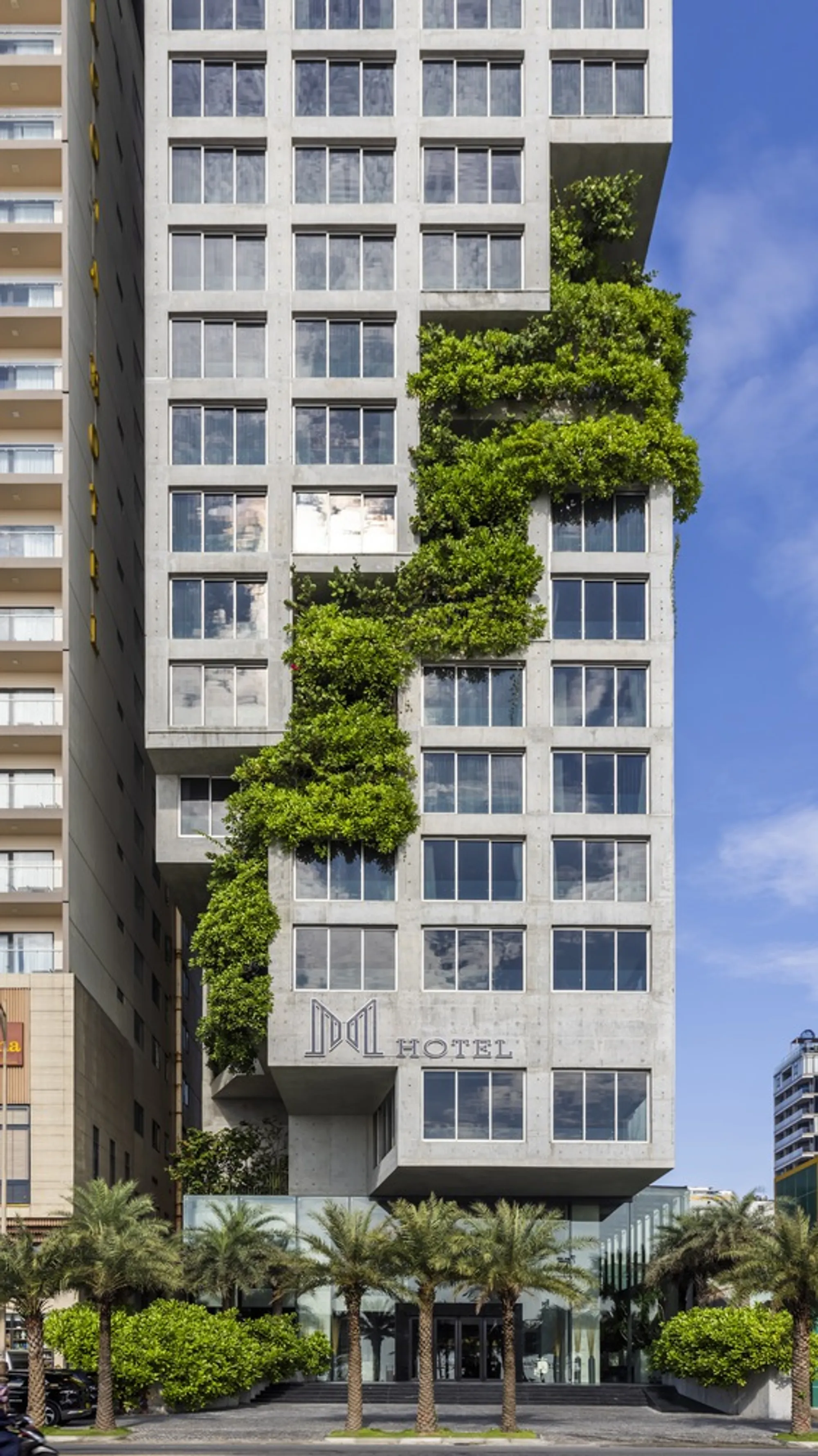
Seen from the beach, the M Hotel reads as a slender white tower interrupted by a single vertical strip of green that rises the full height of the building. From the street side, the story changes: planted terraces zigzag up the facade in deep concrete trays, creating a sculptural relief that looks almost geological. The north elevation is nearly blanketed in vegetation, while the shorter west face carries a woven framework of concrete and climbing plants. These are not afterthought planter boxes bolted to a finished facade. The concrete structure was designed to carry the load and depth of mature planting, with soil volumes large enough to sustain trees, not just creeping vines.
The climate logic is straightforward. Da Nang's western sun is punishing, and any room facing that direction in a conventional glass tower would rely heavily on air conditioning. By setting the west-facing rooms back behind garden terraces, the architects created a buffer zone of shade and evapotranspiration that measurably reduces heat gain. It is passive cooling achieved through landscape architecture rather than mechanical systems.
Cascading Terraces and the Zigzag Section
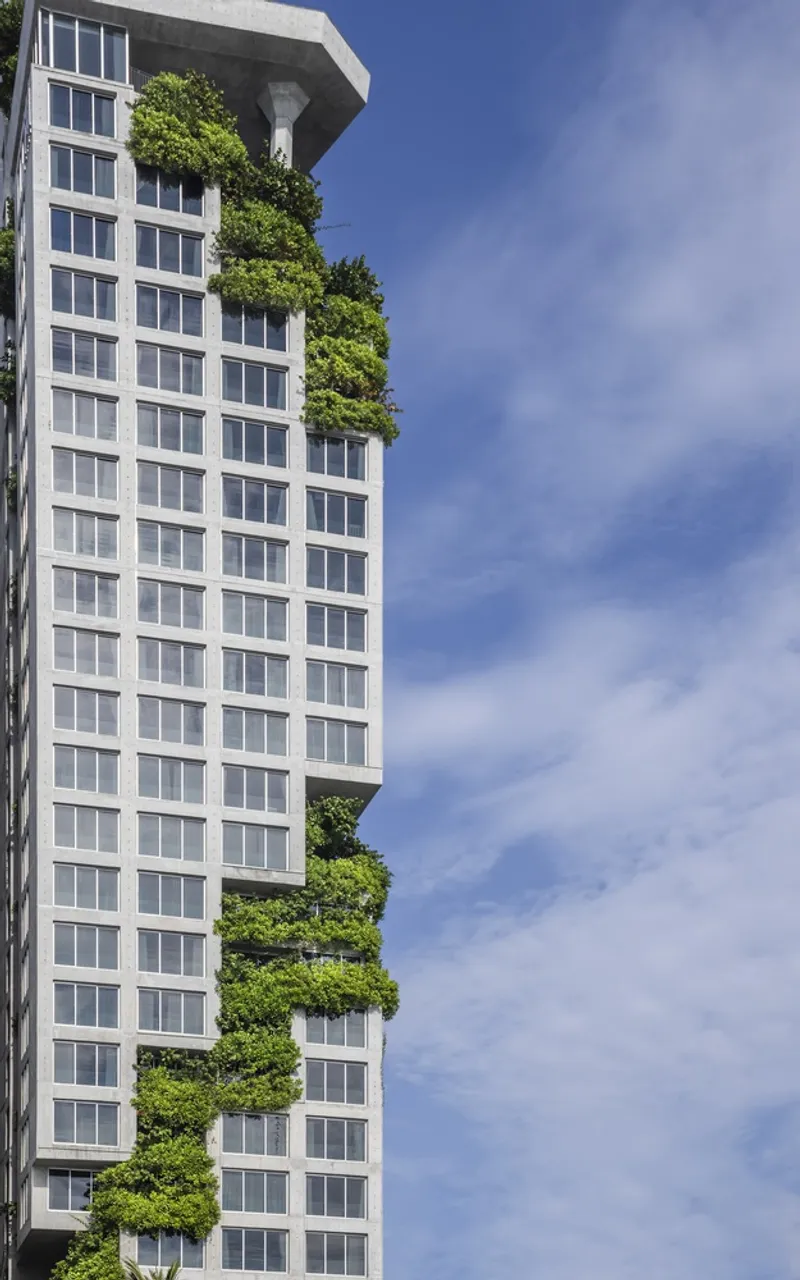
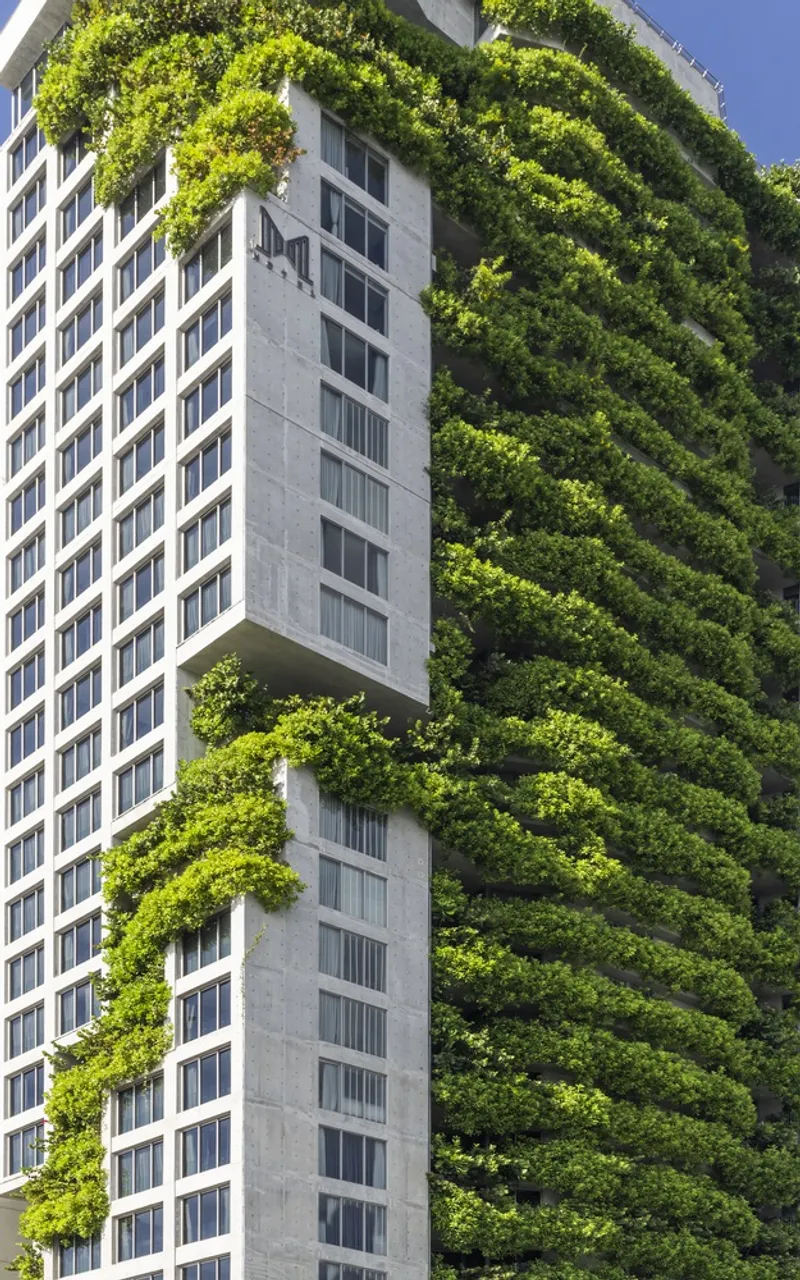
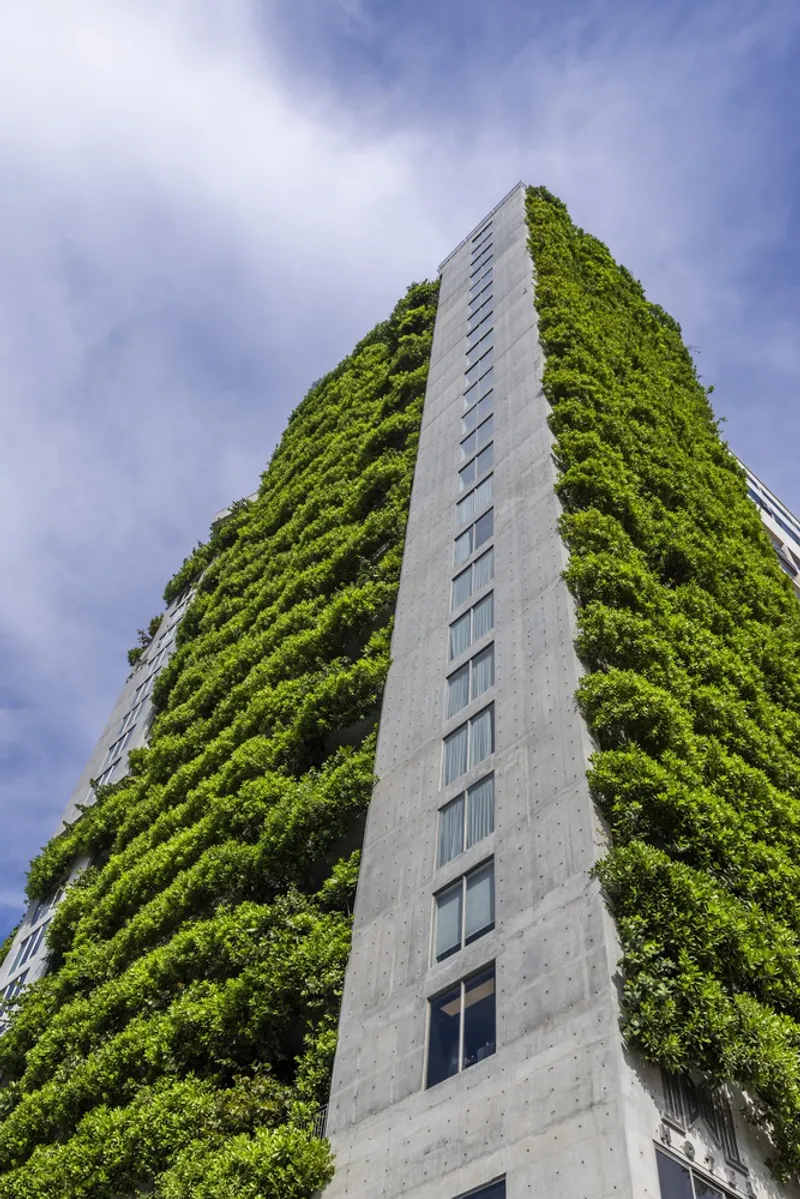
The most photogenic move is the cascading terrace sequence on the city-facing facade. Each planted level steps out or recedes from the one below it, generating the zigzag rhythm visible from the street. Structurally, these are cantilevered concrete trays supported by the building's primary column grid. The planting mix includes tropical species that tolerate wind and salt air, a practical constraint that limits the palette but gives the facade a unified, lush texture over time.
From inside a west-facing room, the terrace functions as a private garden that happens to be twenty stories above grade. The depth of the setback, visible in the interplay between concrete frames and foliage, is generous enough that the greenery genuinely filters light and view rather than sitting as a thin screen. It is one of the few high-rise green facade projects where the planted zone has real spatial volume.
Sky Gardens Carved into the Mass
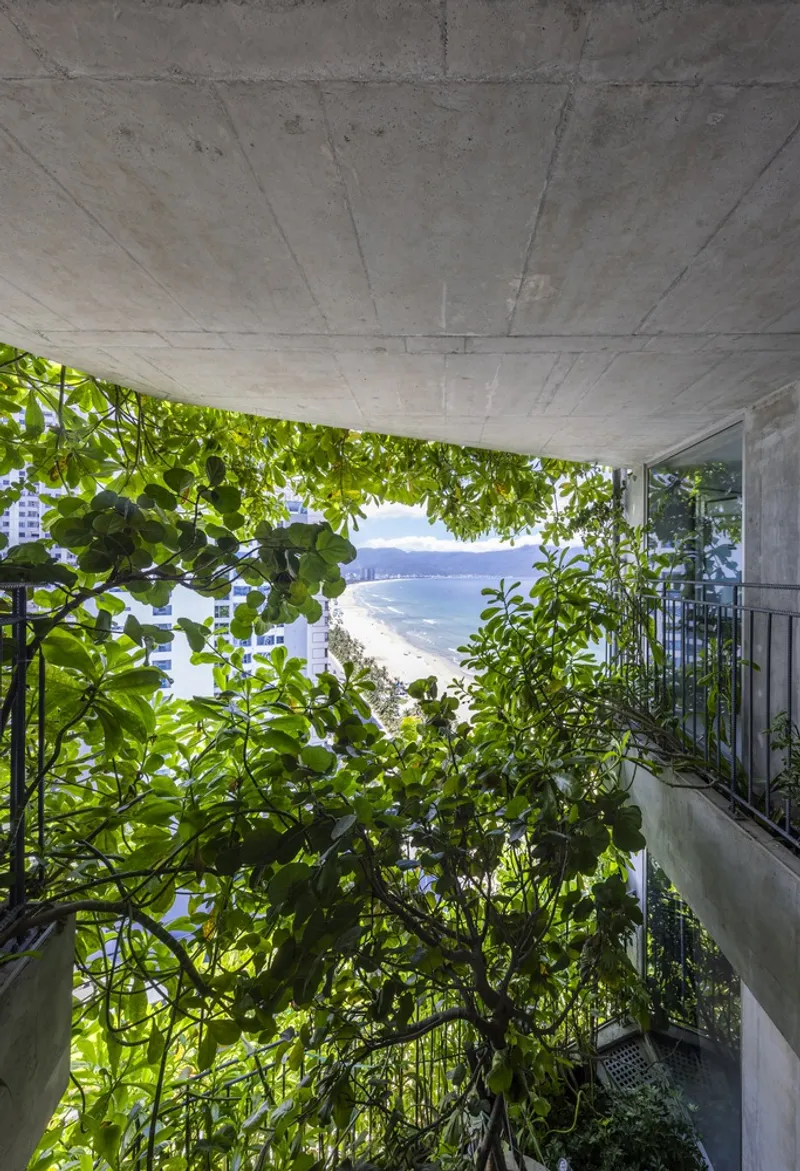
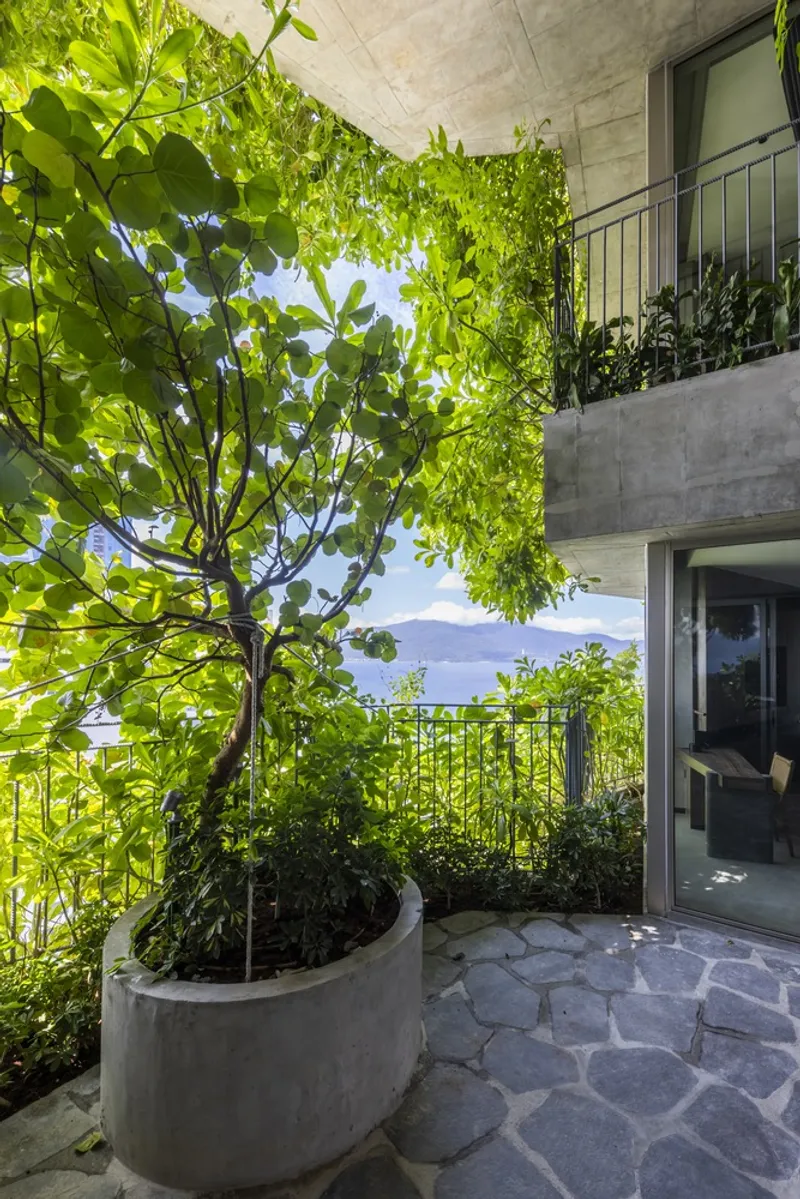
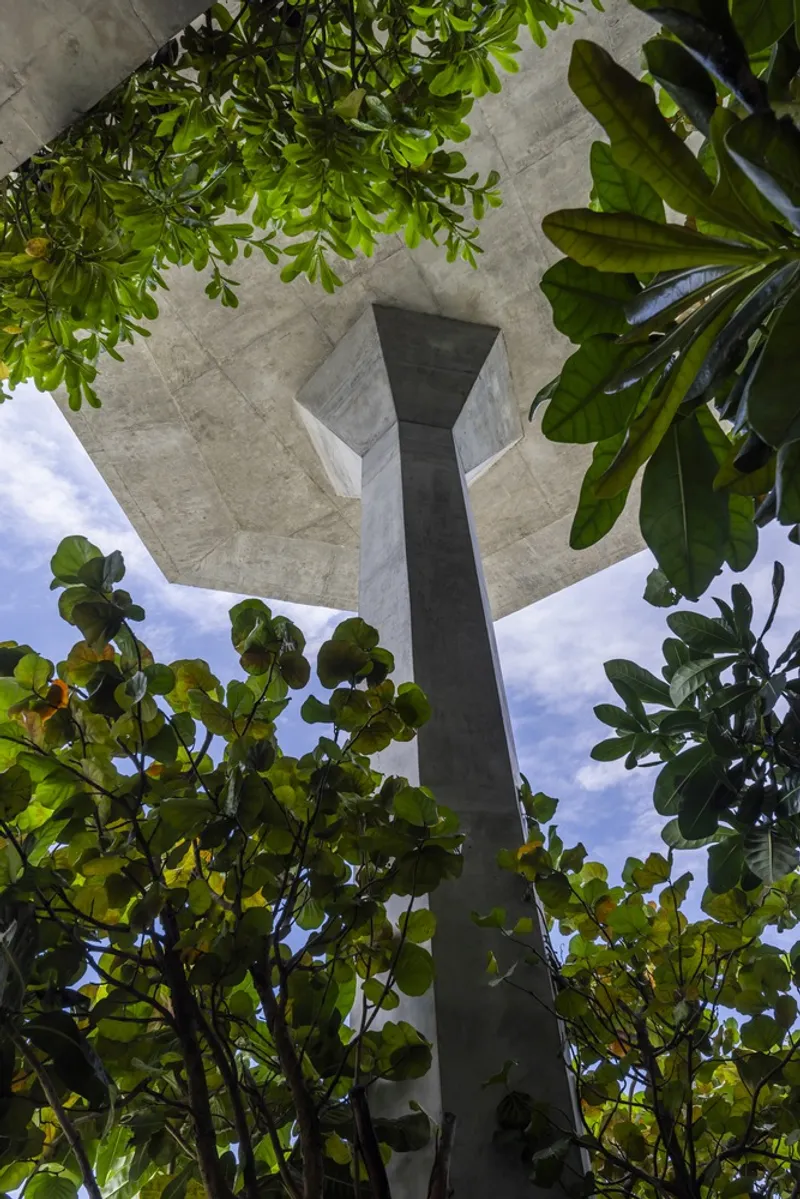
Four sky gardens are cut into the vertical progression of the tower at intervals, creating double- and triple-height voids filled with planting and open to the sky. These are not rooftop amenity decks; they are carved absences in the building's volume, visible from the exterior as dark recesses framed by concrete. Inside, they serve a dual purpose: they give adjacent rooms access to views and greenery while also optimizing the layout of elevator lobbies and common corridors that would otherwise be windowless service zones.
The concrete canopy over one of the sky gardens is visible in the upward photograph, where dense climbing vegetation wraps around columns and beams to frame a distant coastal view. Circular concrete planters with flagstone paving create the feel of a ground-level courtyard translated to altitude. The structural concrete is left exposed and board-formed, consistent with the mountain metaphor and providing a textural counterpoint to the softness of the planting.
Raw Concrete and Controlled Interiors
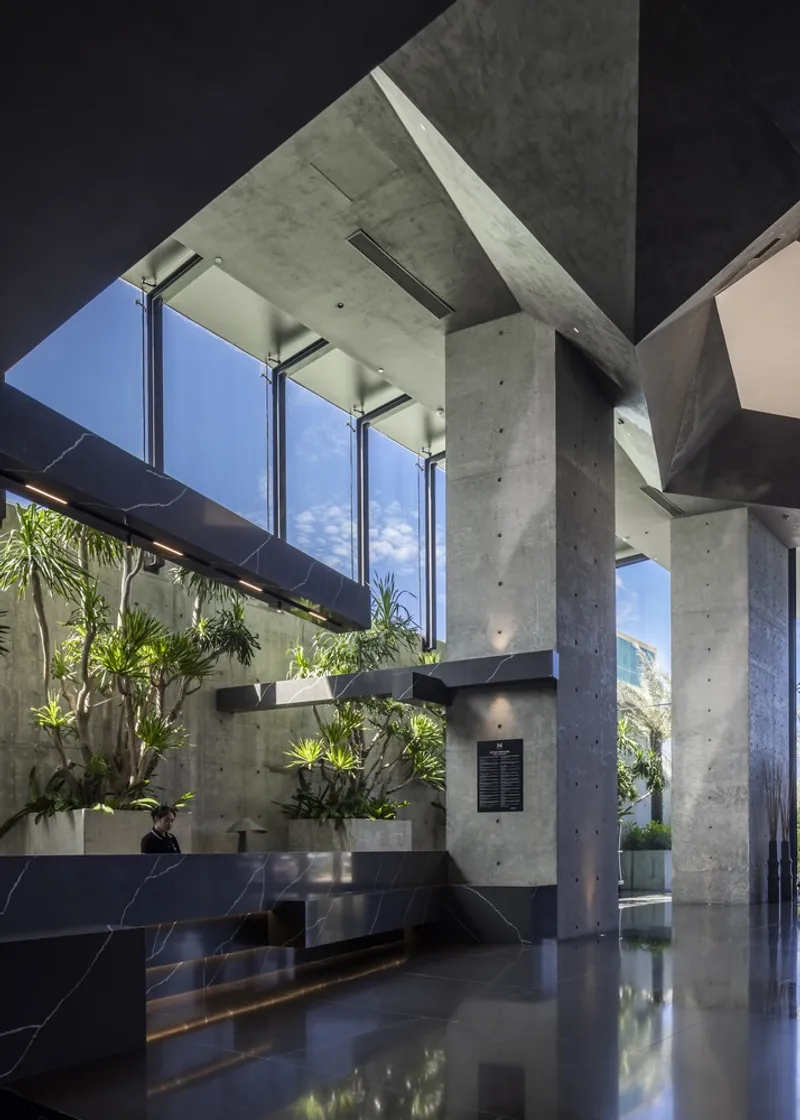
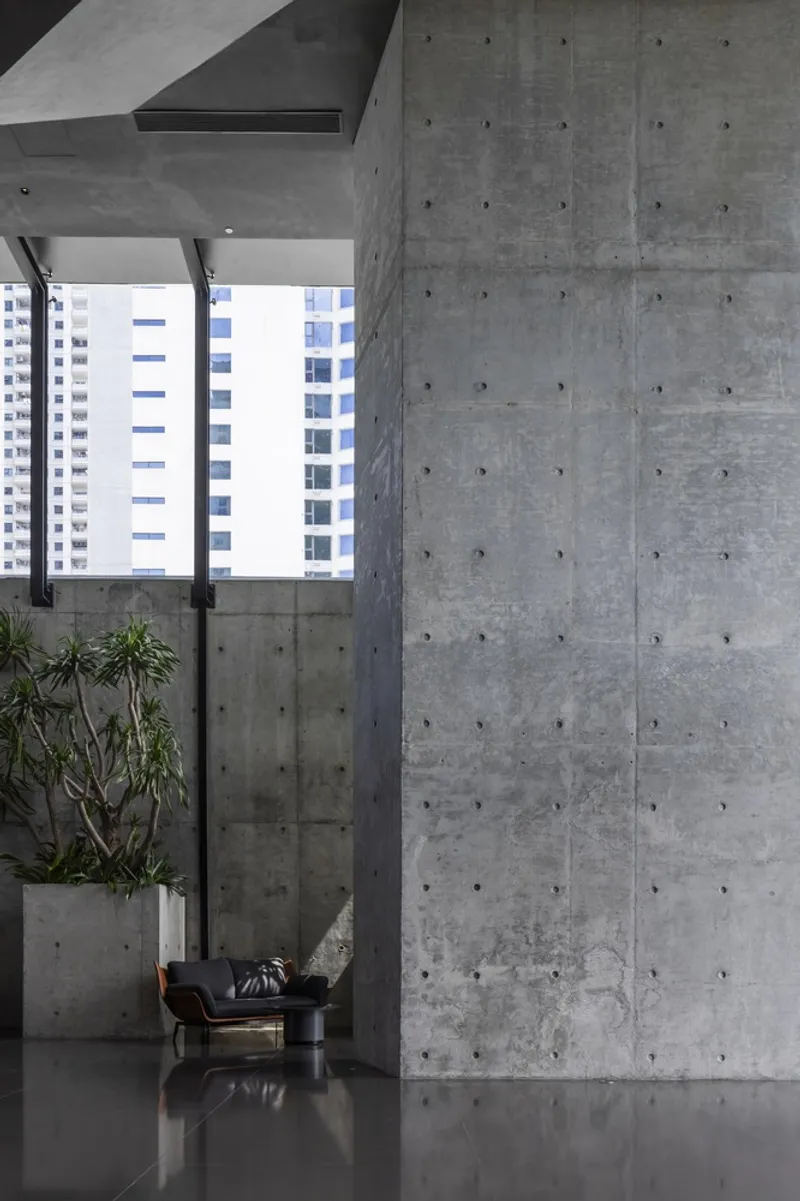
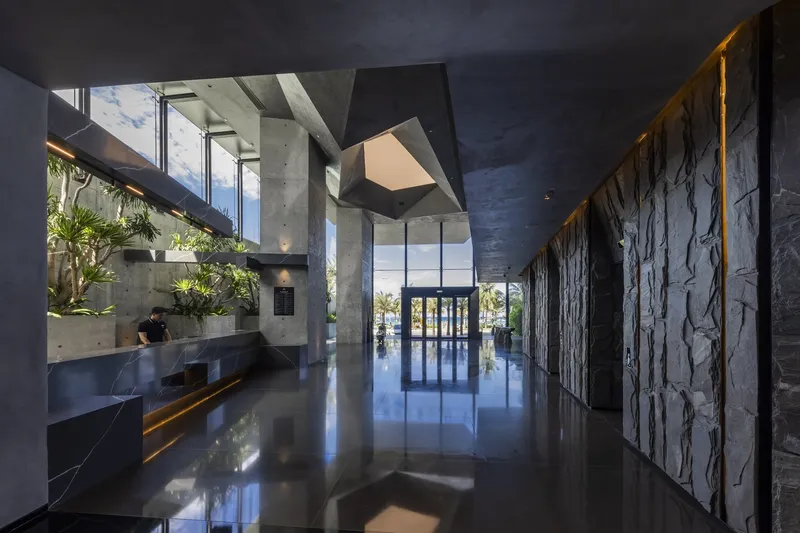
The lobby sets the material tone immediately. Board-formed concrete walls rise through a double-height volume with clerestory windows that bring in controlled daylight. The formwork pattern is intentional and consistent, giving the concrete a corduroy-like texture that catches light and shadow as the sun moves. A planted interior courtyard anchors the ground floor, extending the building's green agenda into the arrival sequence. The palette is restrained: raw concrete, polished concrete floors, dark stone panels, and limited furniture. It reads as a hotel lobby that trusts its architecture more than its interior decoration.
Interior design, handled by AA Corporation, picks up the material discipline in the guest rooms and corridors. The covered corridor alongside the planted courtyard, with grey stone flooring under an overhanging tree canopy, blurs the line between interior and exterior circulation in a way that is rare in high-rise hotels.
Guest Rooms Between Ocean and Garden
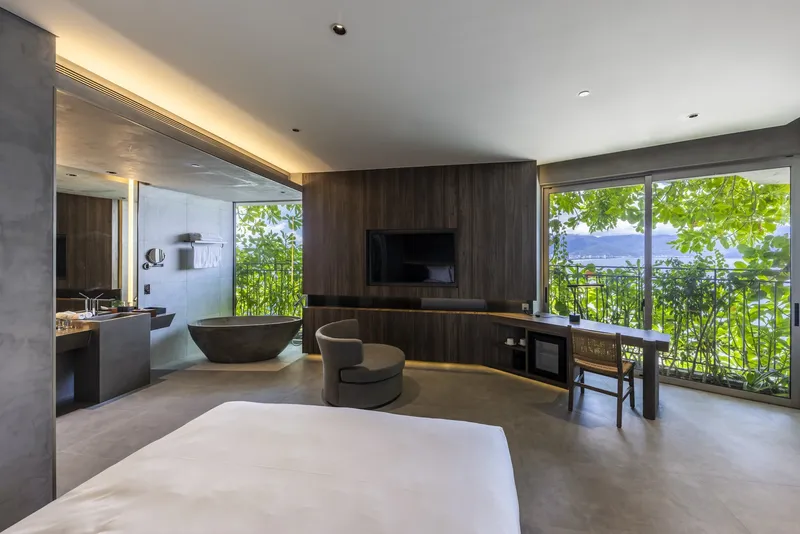
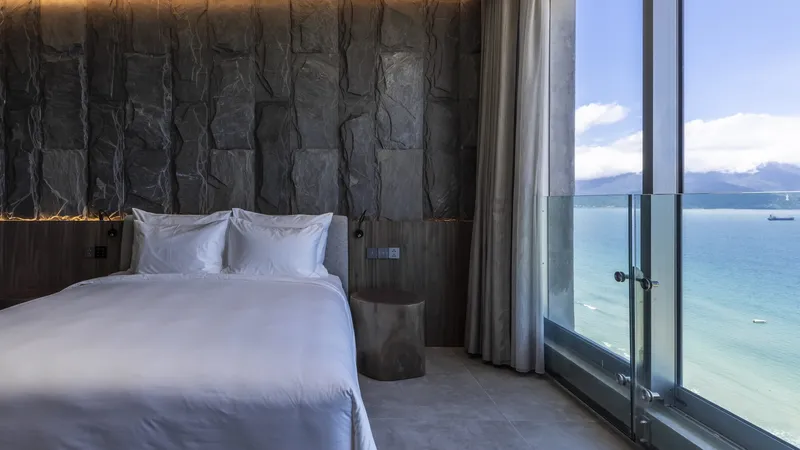
Room sizes range from 35 to 100 square meters across the 199 keys, and the orientation of each room dictates its character. Ocean-facing rooms get full-height glazing with unobstructed views of My Khe Beach and the distant Son Tra Peninsula. The interiors use walnut wall paneling, sculpted stone headboard walls, and freestanding bathtubs positioned to exploit the view. It is confident hotel design that avoids visual clutter.
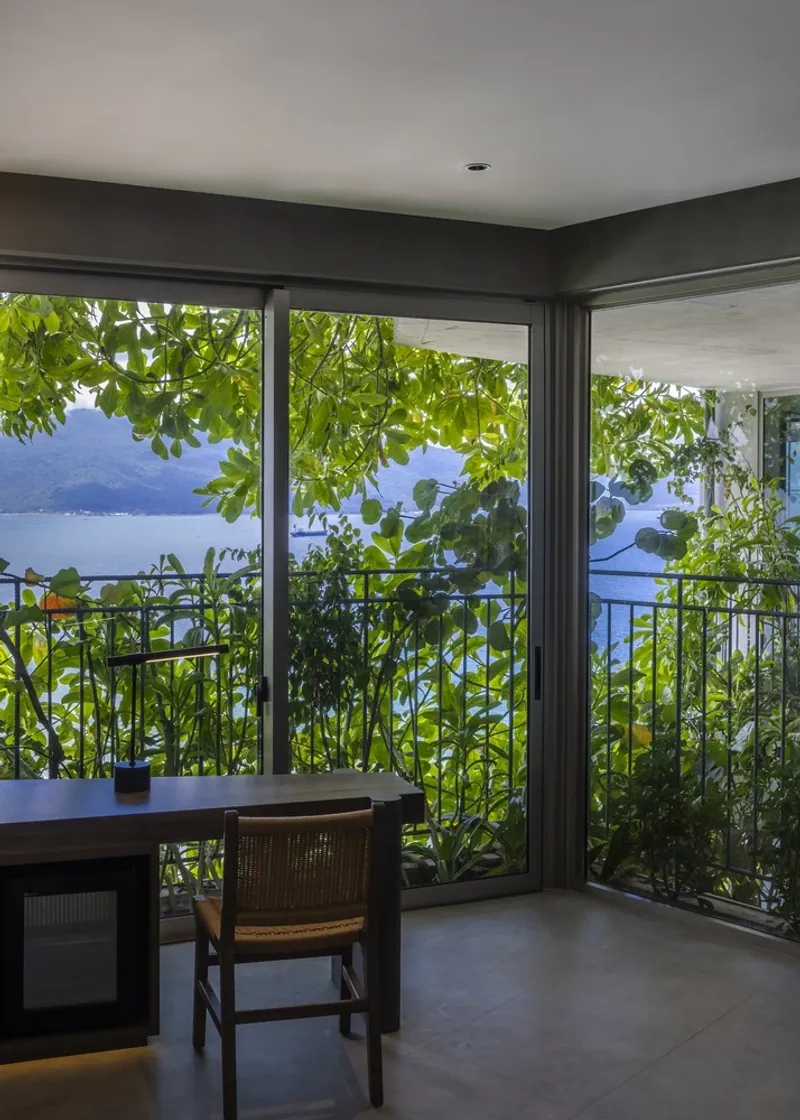
The west-facing rooms tell a different story. The corner window workspace framed by climbing vines, with views across the water to forested hills, demonstrates how the setback garden terraces transform what would otherwise be the building's worst rooms into some of its most distinctive. Rather than fighting the western exposure, the architects embraced it as an opportunity for a fundamentally different room type. Guests on the city side live inside the greenery; guests on the ocean side live above the water.
Rooftop as Culmination
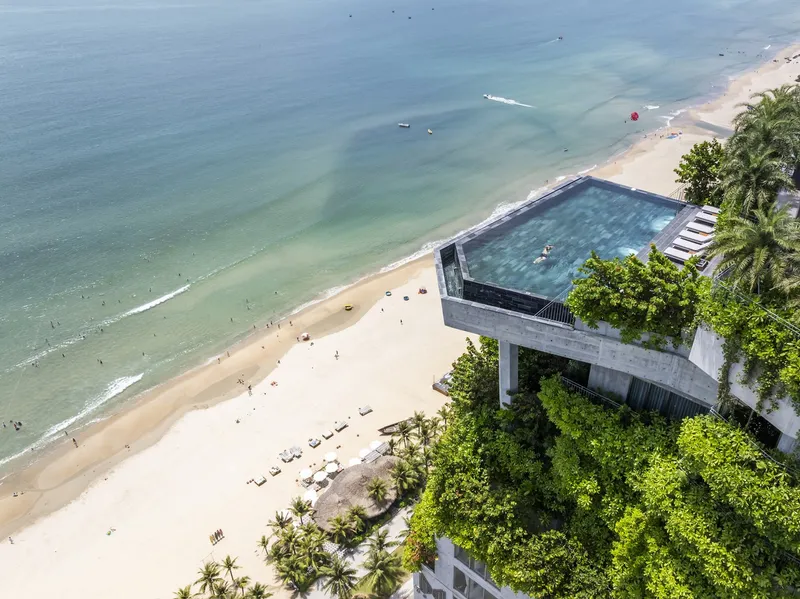
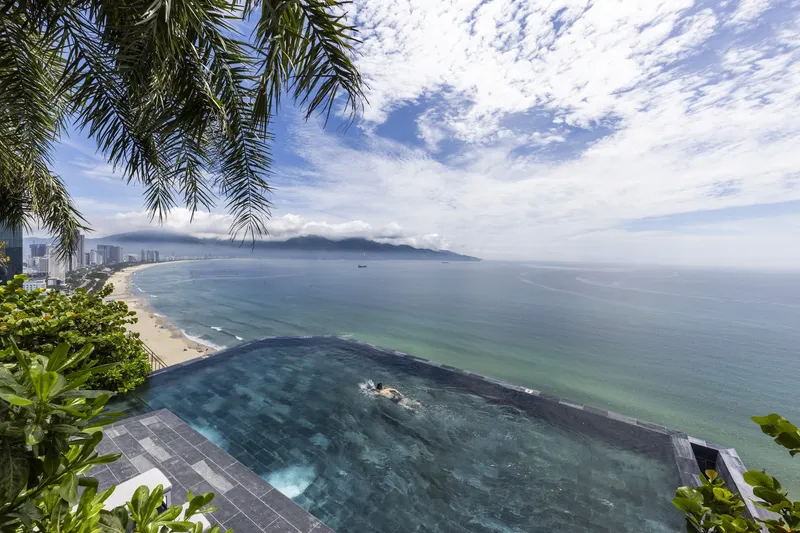
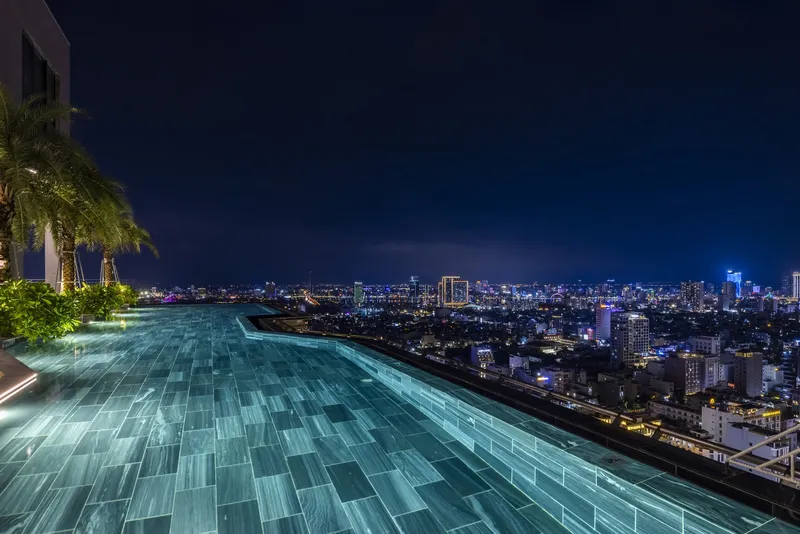
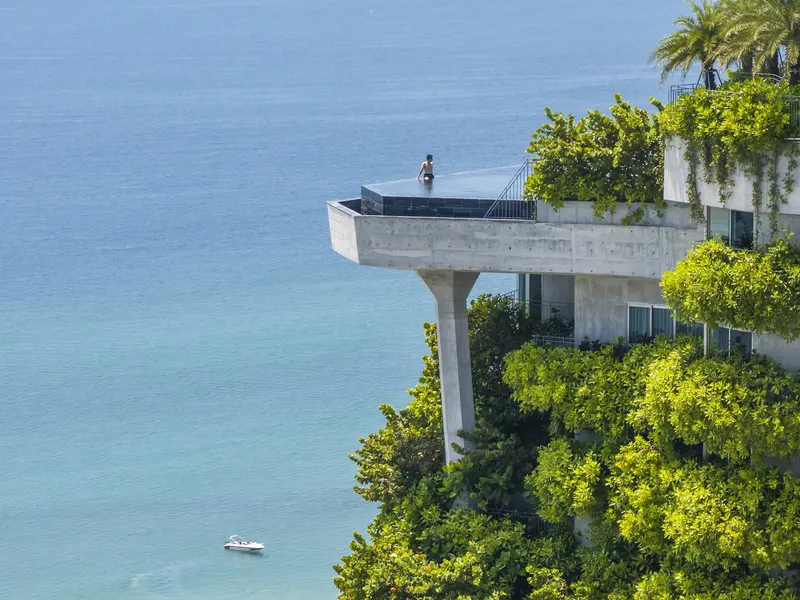
The rooftop carries two pool areas: a cantilevered infinity pool that projects out over the beach, and a dark-tiled pool framed by palm fronds with views across the bay. At night, the rooftop terrace glows against an illuminated green wall, with the cityscape of Da Nang stretching below. The aerial photograph of the cantilevered pool is the building's money shot, the image that will circulate on social media and drive bookings. But it is worth noting that the pool's cantilever is structurally continuous with the same concrete frame that supports the planted terraces below. The spectacle and the system are the same thing.
Context and the Coastal Strip
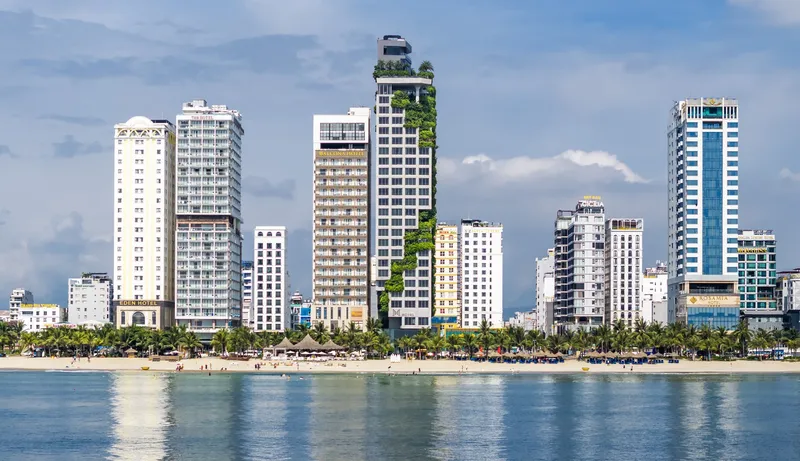
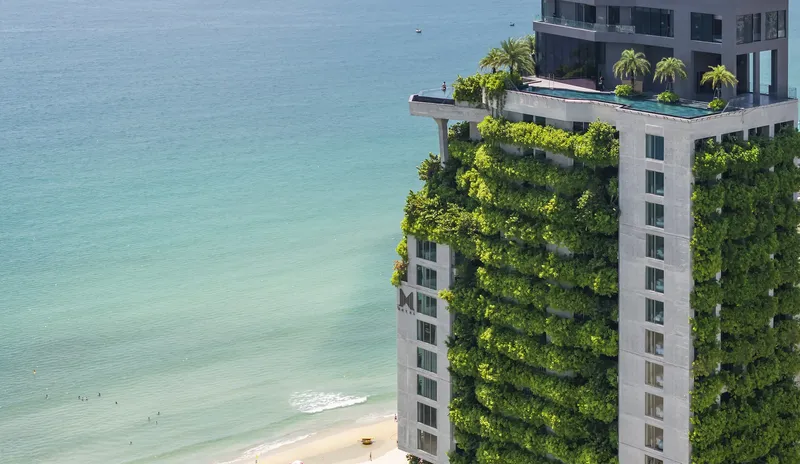
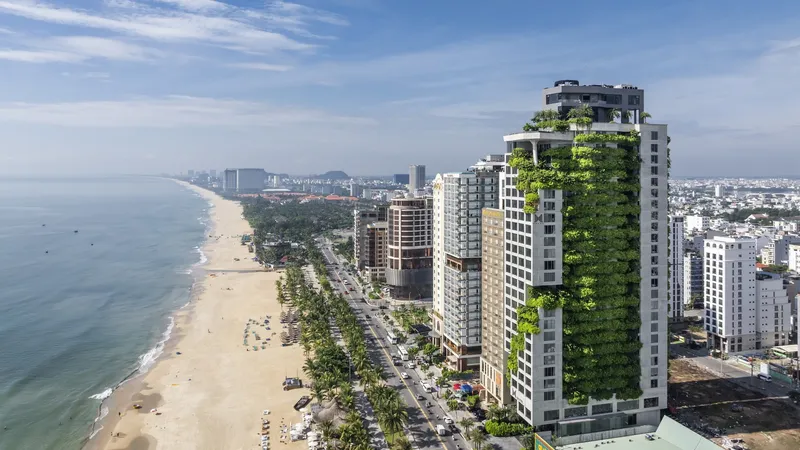
The aerial views are revealing. The M Hotel sits in a tight row of towers along the beachfront, each one pressed against its neighbors with minimal setbacks. In this context, the planted facades do more than shade the building's own rooms. They also provide a visual buffer for adjacent hotels, replacing what would be a blank party wall with a green surface. The building's environmental argument gains force when you see how dense the coastal development has become. Every tower on this strip faces the same solar exposure, the same salt air, the same competition for views. The M Hotel proposes a replicable strategy rather than a one-off gesture.
The third-floor restaurant, oriented toward My Khe Beach, and the sky gardens at upper levels ensure that the building's public life is distributed vertically rather than concentrated at the top and bottom. That vertical distribution of amenity space is another consequence of the carved-void strategy: every sky garden is also a social space.
Plans and Drawings
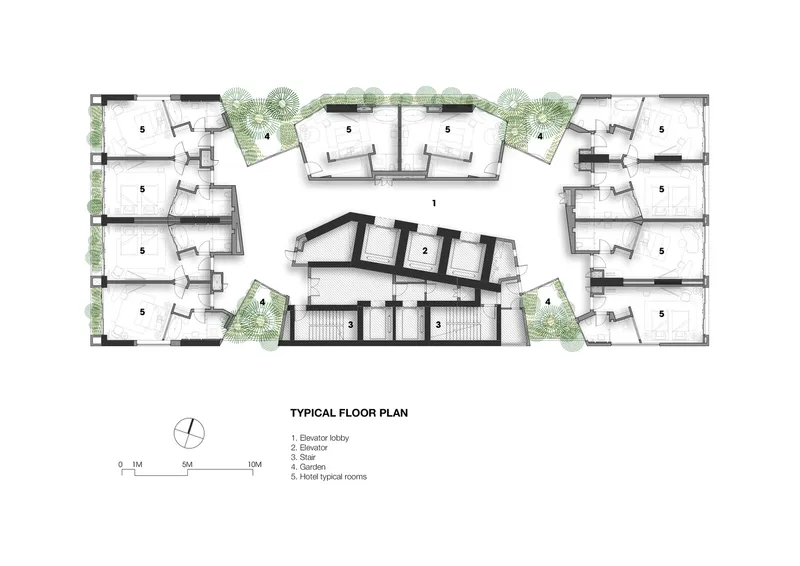
The floor plan reveals the organizational logic clearly. Guest rooms are arranged around a central circulation core, with corner garden terraces pulling the plan apart at its edges. The offset between ocean-facing and city-facing room depths is legible in plan: the east side pushes flush to maximize glazing, while the west side recedes to accommodate the planted terraces. It is a simple rectangular plan with one decisive asymmetry, and that asymmetry generates the building's entire identity.
Why This Project Matters
Green facades on tall buildings have become a familiar promise in competition renders and rarely survive contact with real budgets, real maintenance, and real gravity. The M Hotel is notable because it is built, occupied, and photographed with mature planting in place. The 5,000 square meters of planted area is not a target on a sustainability scorecard; it is visible structure that shapes the guest experience, reduces energy loads, and differentiates the building in a crowded market. Ho Khue Architects demonstrated that a biophilic high-rise can be delivered within the commercial constraints of a 199-room hotel on a competitive beachfront strip.
The deeper lesson is about orientation as design driver. By treating the west facade as a problem to solve through landscape rather than mechanical systems, the architects turned a liability into the building's strongest architectural feature. That inversion, making the difficult side the most interesting side, is the kind of move that separates a good building from a merely green one. Da Nang's hotel strip will continue to grow, and the M Hotel now stands as a proof of concept for how that growth might happen with more intelligence and more vegetation.
M Hotel, designed by Ho Khue Architects, Da Nang, Vietnam. 23,500 square meters. Completed 2023. Interior design by AA Corporation. Structural consultants: Qcons. Main contractor: Newtecons. Photography by Hiroyuki Oki.
About the Studio
Share Your Own Work on uni.xyz
If projects like this are the kind of work you want to make, uni.xyz is a place to publish your own, find collaborators, and enter design competitions.




Popular Articles
Popular articles from the community


The Musturak Paradise: Senior Living Architecture for a Connected Future in Temara, Morocco
The Musturak Paradise reimagines senior living architecture in Temara via private homes, social spaces, culture, community, and shared care.

Lunar Spiral: Space Architecture Shaped by the Mathematics of the Universe
Lunar Spiral reimagines space architecture through Fibonacci geometry, lunar regolith, levitating habitats, and self-sustaining Moon living.

Hill & Cross Opera: Sculptural Opera House Architecture Shaped by Tallinn’s Landscape and Identity
Hill & Cross Opera reimagines opera house architecture in Tallinn through its sculptural hill, civic plaza, glass wave and a luminous cross.

The Ocean Hive: Sustainable Architecture for a Self-Sufficient Civilization at Sea
The Ocean Hive imagines sustainable architecture at sea, where modular habitats, algae, wave power and ocean waste sustain a growing colony.


Similar Reads
You might also enjoy these articles


Hodi-Mandai Geram
Project Function: Preservation and revitalization of the Intangible heritage and socio-spatial identity of the Hodi by Housing, Cultural Memory Center, Sacred Grove, landscape, local tourism economy


Olio Towers: A Mid-Rise for Performers That Fuses Housing, Rehearsal, and Stage
Located blocks from Houston's Theater District, this modular tower stacks living units around a central performance atrium.

Oasis: Modular Green Housing Carved into Dhaka's Urban Fabric
A shortlisted Plugin Housing entry reclaims unauthorized settlements in Dhaka with stepped concrete volumes, green roofs, and ventilation-driven design.

Black Hole: A Floating Megastructure for the Post-Physical Era
Emiliano Mazzarotto envisions a spherical, self-scaling arena where e-sports, digital hotels, and holographic stadiums replace traditional public space.
Explore Architecture Competitions
Discover active competitions in this discipline



Challenge to reimagine the Iron Throne


Photograph architecture without architects


Illustrate the lost glory of Angkor Wat - Render Challenge


Design challenge to reuse E-waste
Comments (0)
Please login or sign up to add comments
No comments yet. Be the first to comment!