
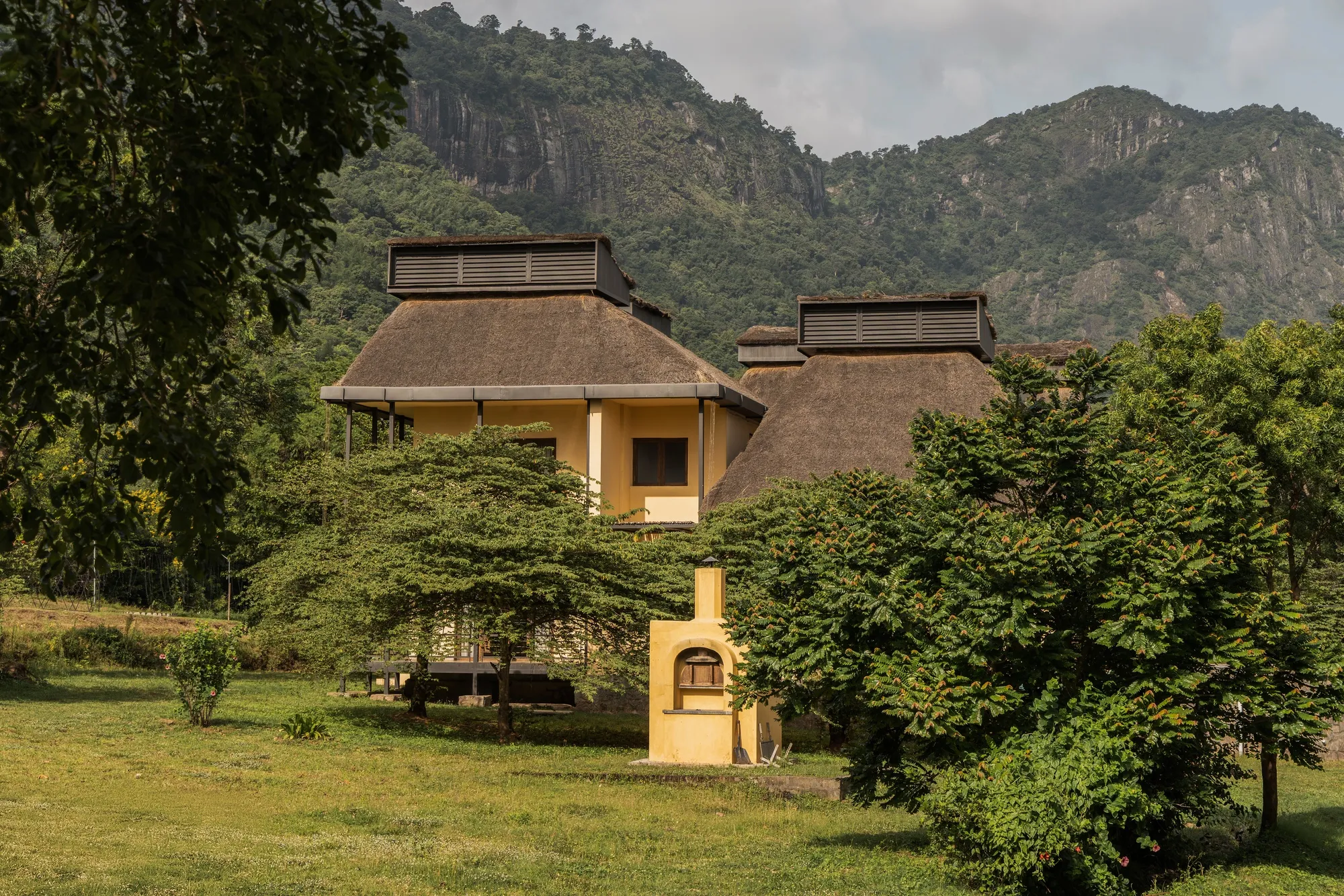
ma+rs Design a Wildlife Retreat in Tamil Nadu That Yields Half Its Site to Elephants and Leopards
A thatched-roof compound near the Anamalai mountains dedicates over half its four-acre site as a corridor for roaming wildlife.


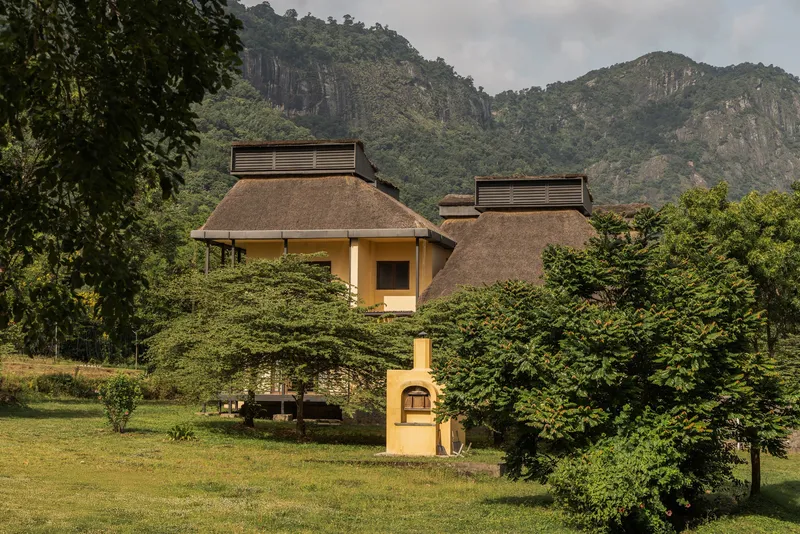
Most retreats in the Western Ghats foothills sell themselves on proximity to nature. Serenity, a 13,725 square meter compound near the village of Sethumadai outside Pollachi, takes a more radical position: it treats the building as a guest on the land, not the other way around. Designed by ma+rs, the project dedicates more than half of its 1.6-hectare site to an uninterrupted wildlife corridor shared by elephants, leopards, and bison. What remains for architecture is a tight, deliberate cluster of six pitched-roof volumes that rise from a reused stone plinth, their silhouette consciously tracing the ridgeline of the Anamalai range behind them.
The interesting move here is not the thatched roofs or the ochre plaster, both of which are handsome but not unusual in South Indian residential work. It is the ethical framework that precedes every design decision. The architects began by mapping the movement patterns of the forest's inhabitants, then carved out the buildable zone as a remainder. Architecture becomes what is left over after the animals have been given right of way. That inversion, treating human program as secondary to ecological obligation, gives the project a seriousness that elevates it well beyond a luxury weekend house.
A Compound That Mirrors the Mountains
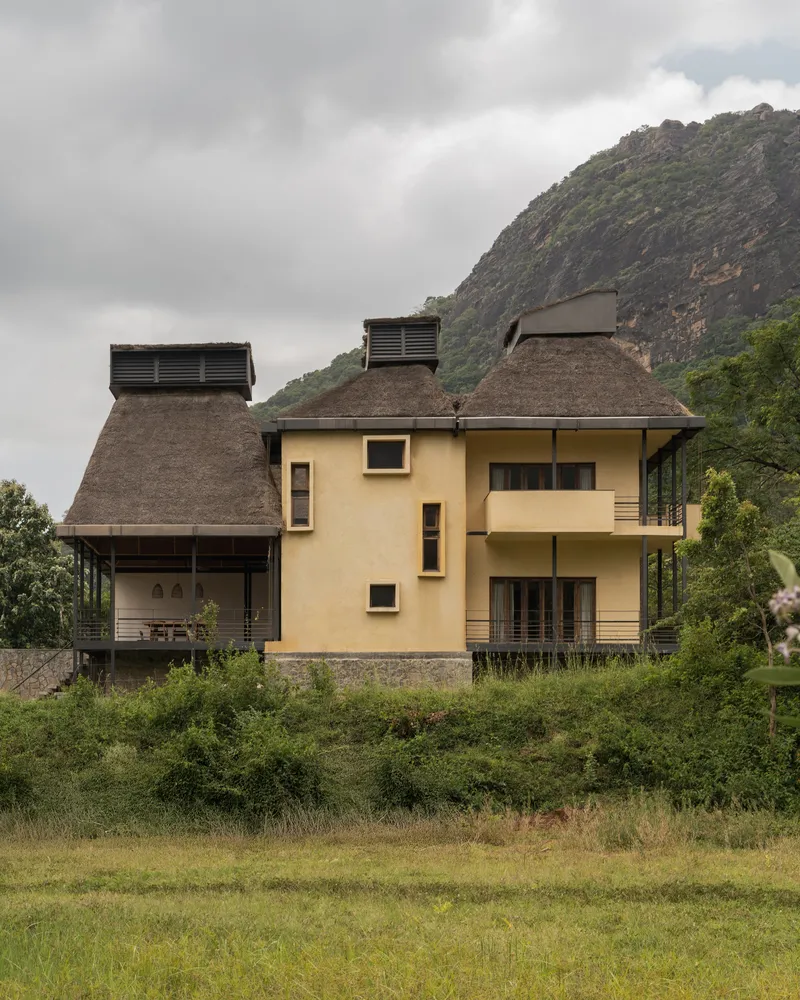
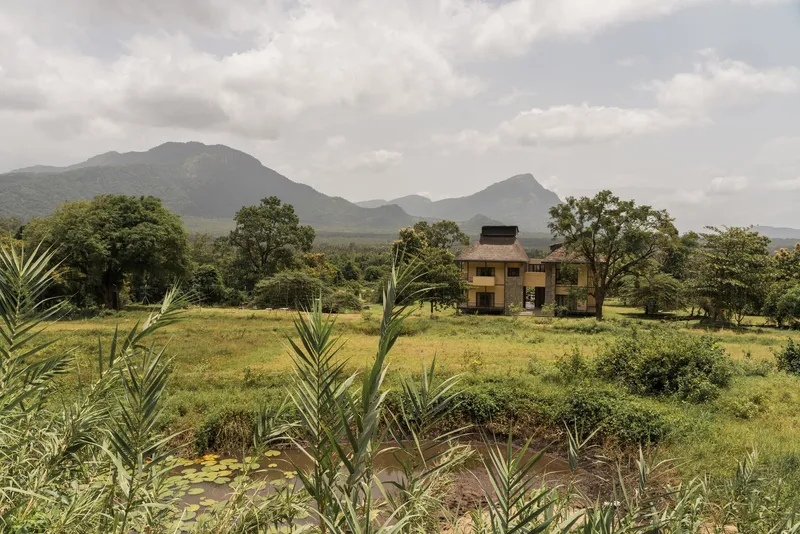
Seen from a distance, Serenity reads as a cluster of pyramidal forms rising from the grassland, their slopes roughly parallel to the layered mountain ridges behind. The six individual roof volumes are covered in ten-inch-thick thatch, a material that simultaneously insulates, breathes, and ages into the surrounding palette of browns and greens. Each volume is capped by a small ventilation tower, a functional cupola that draws hot air upward and out without mechanical assistance.
The massing strategy is deliberately anti-monolithic. Rather than a single large block, the compound fragments into smaller pavilions that allow views, breezes, and wildlife sightlines to pass between them. The effect at dusk, when the buildings settle into silhouette, is of a geological formation rather than a constructed object.
Material Honesty on a Reused Foundation
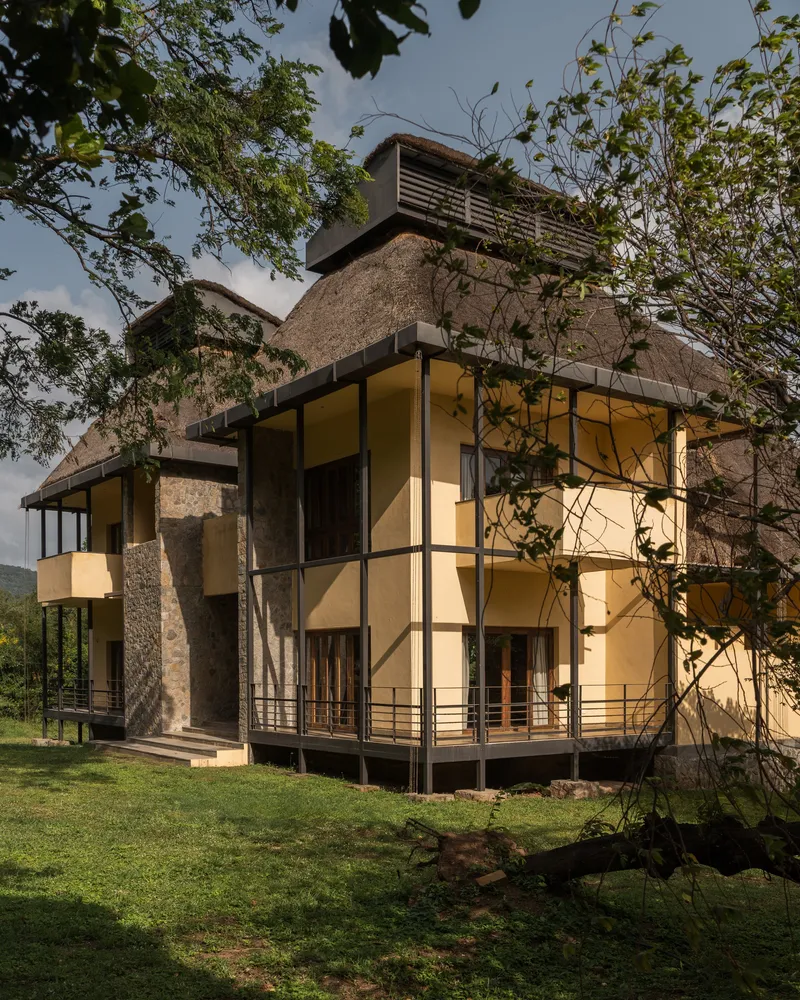
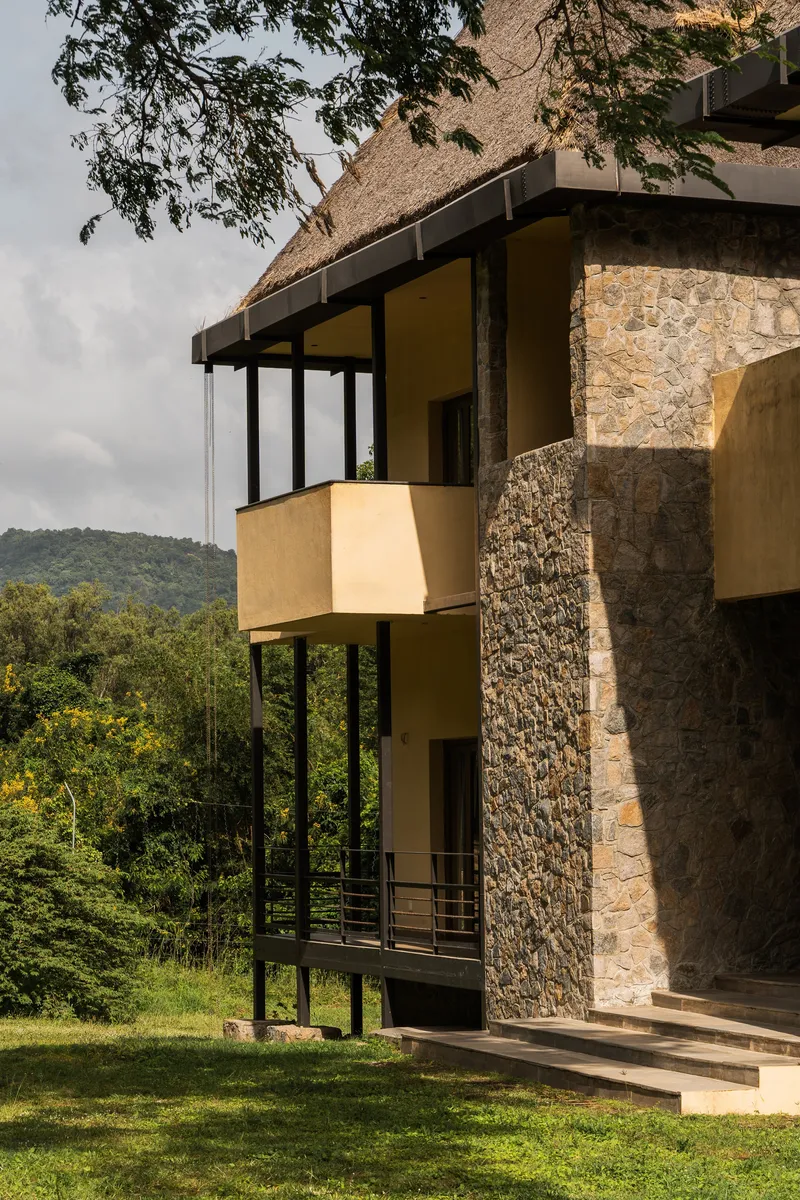
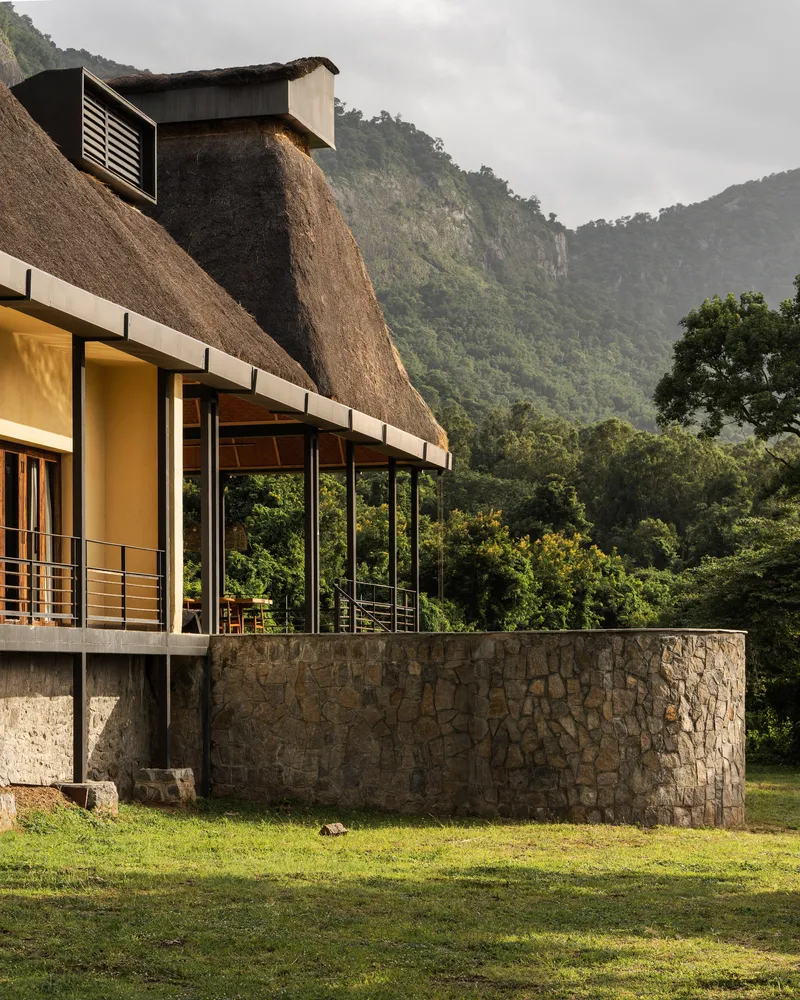
The project sits on the stone plinth of a former building that previously occupied the site. Rather than demolishing and starting fresh, ma+rs chose to reuse the existing foundation, an act of material economy that also anchors the new structure in the site's physical history. Gabion stone walls and rough-cut stone cladding continue this language at ground level, grounding the lighter volumes above.
Above the plinth, a black steel frame takes over as the primary structure, its slender columns and beams reading as a precise industrial skeleton against the softness of the lime plaster and thatch. The lime plaster is polished to a luminous sheen, giving the ochre-yellow walls a warmth that shifts throughout the day. Cantilevered balcony boxes in the same yellow finish project outward from the steel frame, creating private outdoor perches for the bedrooms without adding to the building's footprint on the ground.
The Courtyard and the Boulder
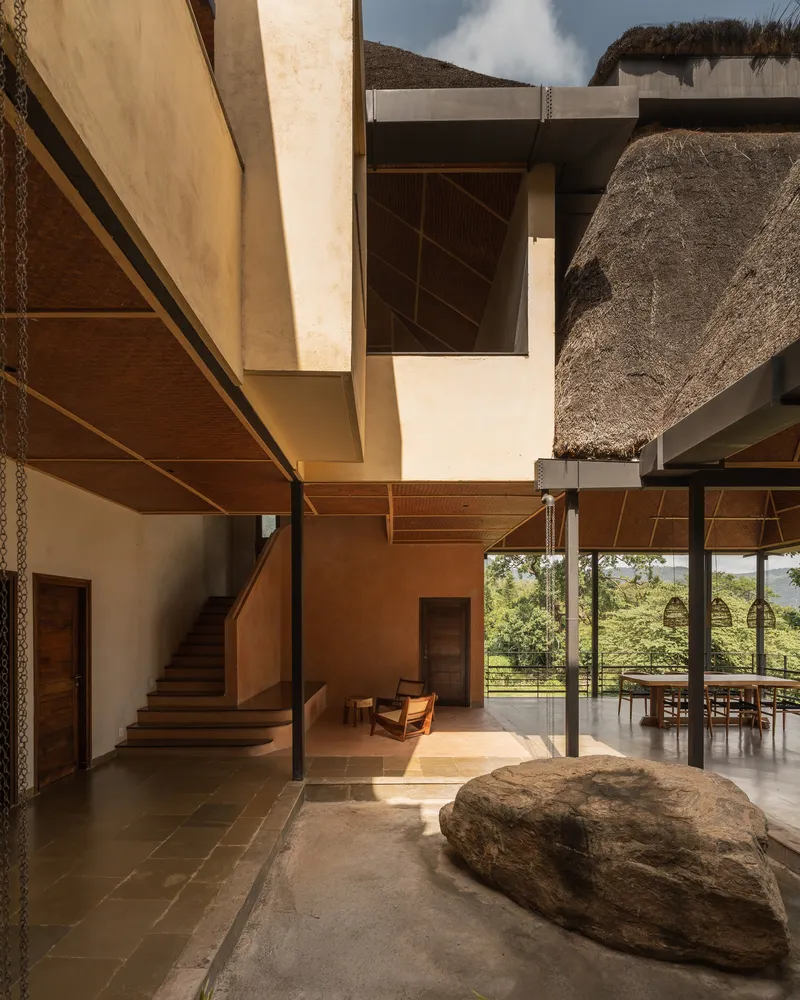
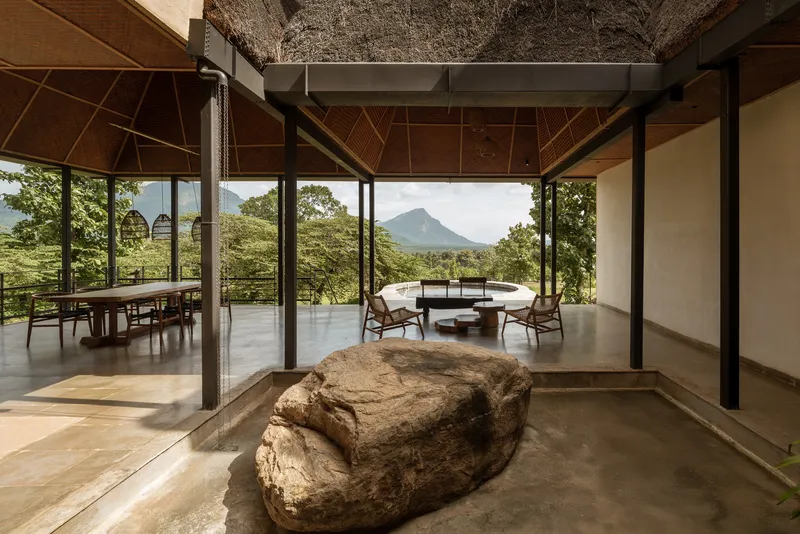
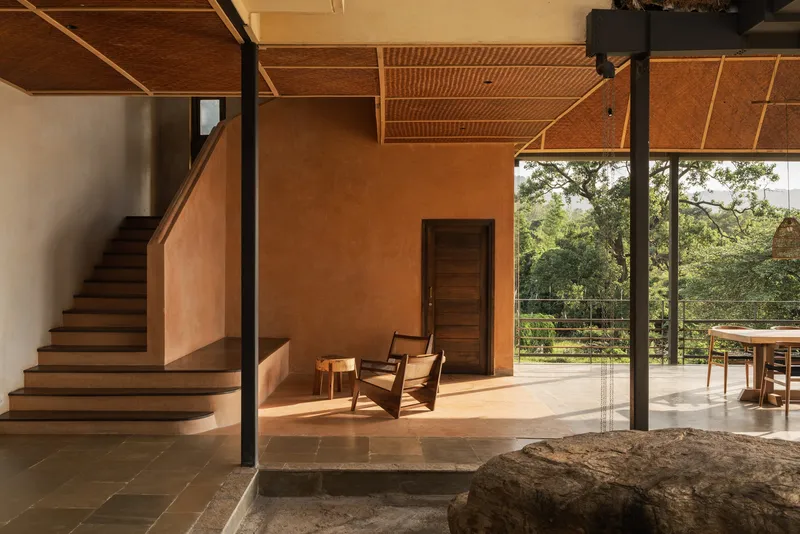
A large weathered boulder sits at the heart of the interior, left in place rather than removed during construction. It appears in the courtyard, in the open living area, and at the base of the timber staircase, functioning as a kind of geological anchor around which domestic life orbits. The decision to build around the rock rather than blast it away is consistent with the project's broader ethos: accommodation over domination.
The courtyard itself is a semi-covered zone where the deep thatch eaves filter afternoon sunlight into dappled patterns on the stone floor. A timber staircase rises alongside the boulder, connecting the ground floor public spaces to the first floor bedrooms and viewing platform. The spatial sequence from bright courtyard to shaded interior to elevated lookout gives the retreat a processional quality, each threshold offering a different relationship to the landscape.
Rooms Tuned to the Forest
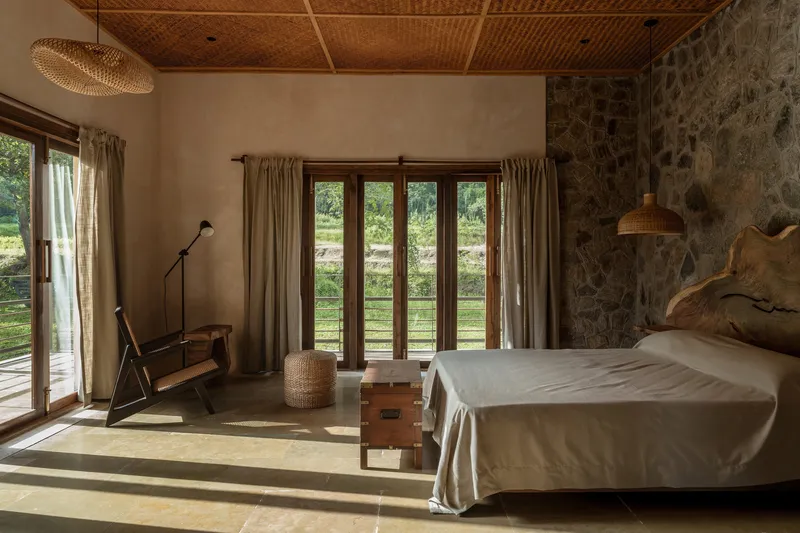
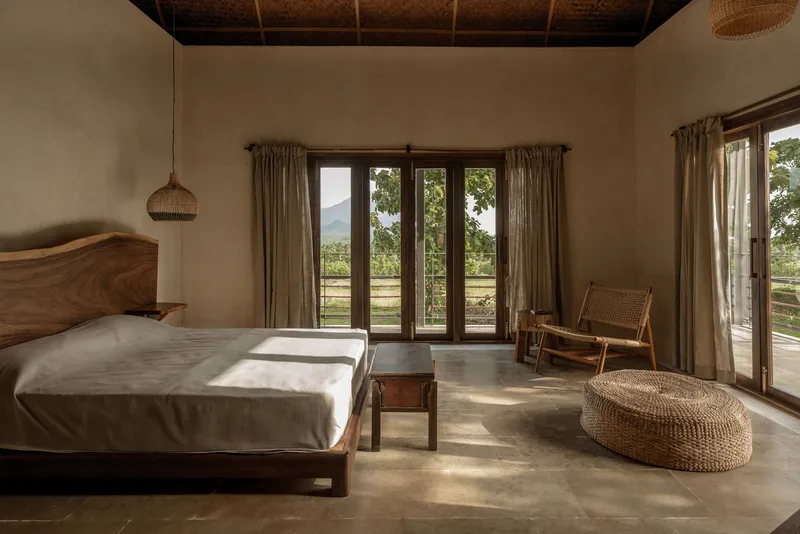
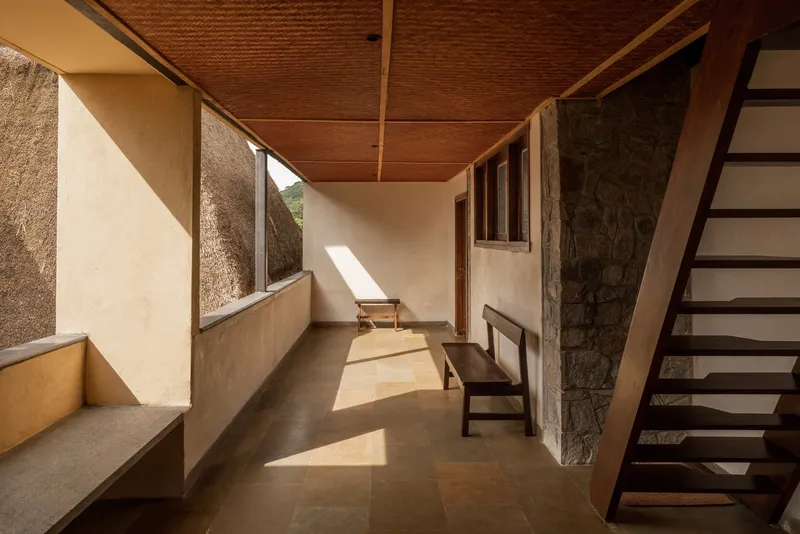
The bedrooms are arranged in a two-storey L-shaped block along the southern edge of the compound, their openings oriented north toward the open terrace and the peanut fields beyond. Woven bamboo ceiling panels line the underside of the pitched roofs, creating a tactile canopy that softens the steel structure overhead. Stone accent walls and timber-framed French doors keep the material vocabulary tight: earth tones, natural textures, nothing synthetic.
Morning light enters the east-facing rooms through tall glazed doors, throwing long rectangles of warmth across polished floors. The first-floor rooms open onto the cantilevered balconies, which are shaded by the deep roof eaves. From these perches, the Anamalai range fills the horizon. The viewing platform on the upper level is specifically oriented toward the forested corridor, turning the act of watching wildlife into an architectural event rather than a casual glance.
Communal Spaces Under the Thatch
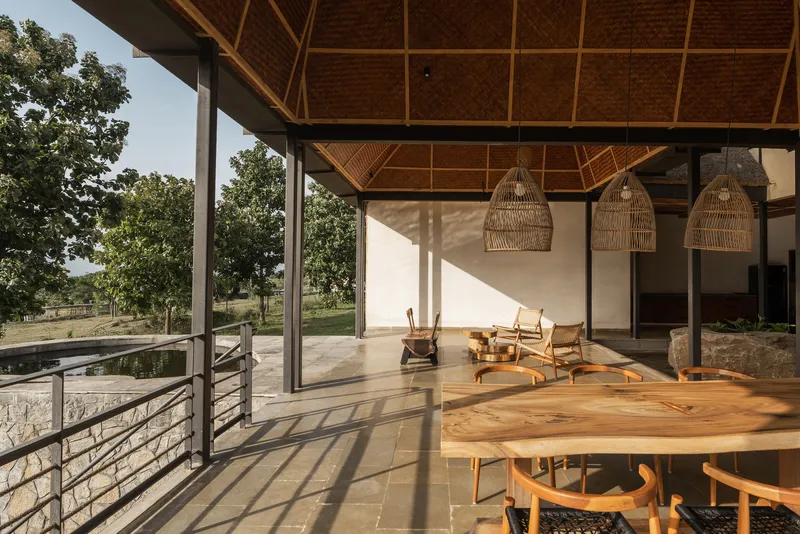
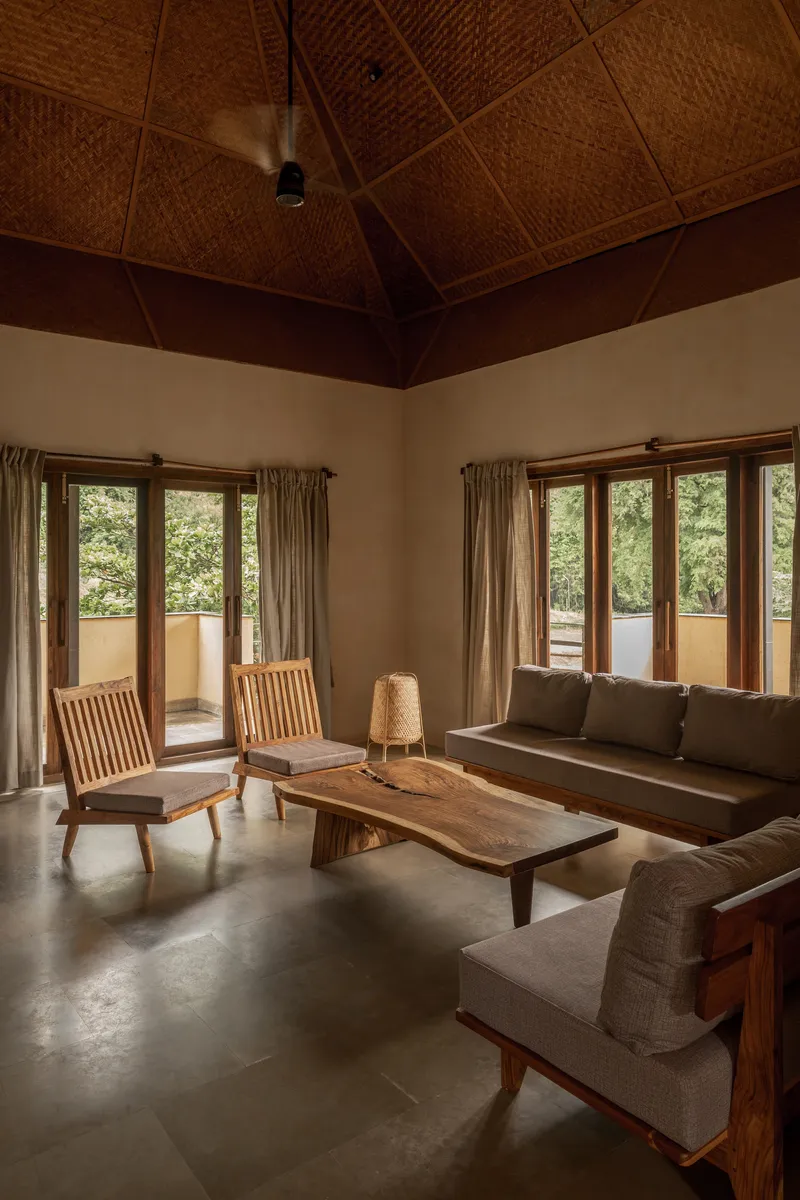
The public living spaces occupy the ground floor of the main pavilion, where the steel columns are left fully exposed and the thatch ceiling soars overhead. A covered terrace features a diagonal lattice timber ceiling structure that casts intricate geometric shadows across the stone floor, a detail that is both structural and decorative without being gratuitous. Woven pendant lights hang at intervals, their handmade quality consistent with the project's commitment to craft.
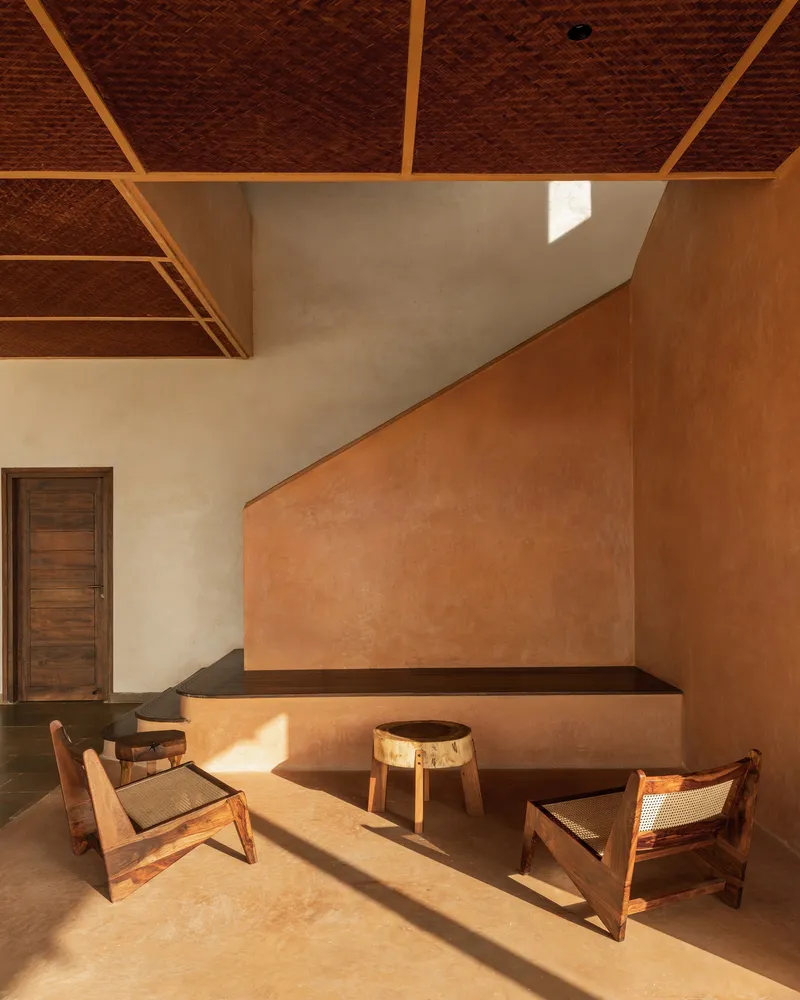
A sunken seating area carved into the ochre plaster walls creates an intimate gathering space within the larger open plan. The high ceilings generated by the pitched roof structure keep these rooms cool without air conditioning, while the breathable lime plaster walls regulate humidity passively. Every comfort strategy is embedded in the material and formal logic of the building rather than applied as a mechanical afterthought.
Landscape as Partner, Not Backdrop
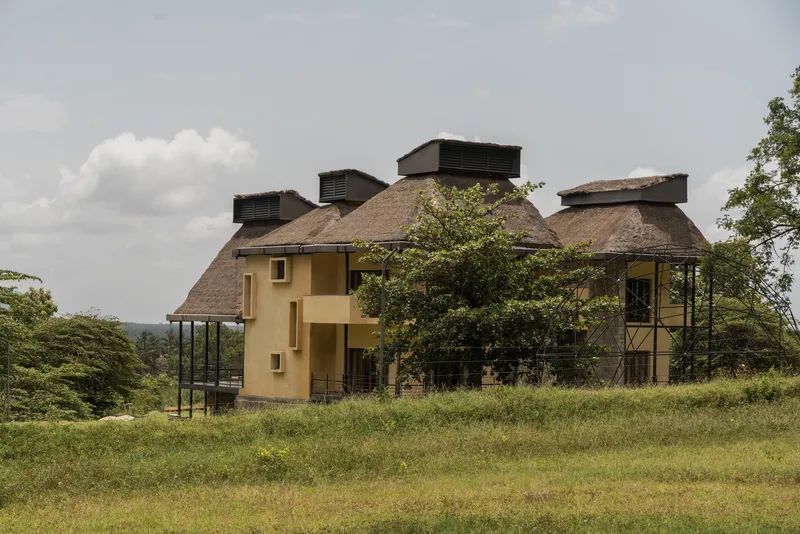
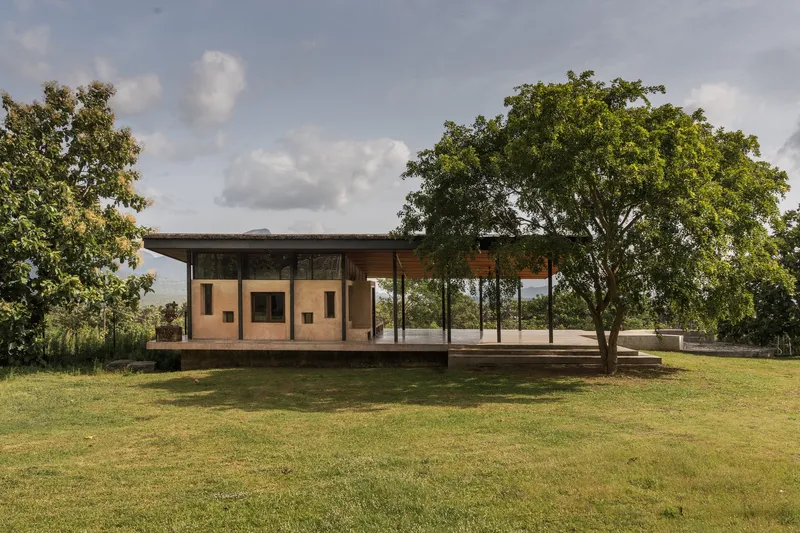
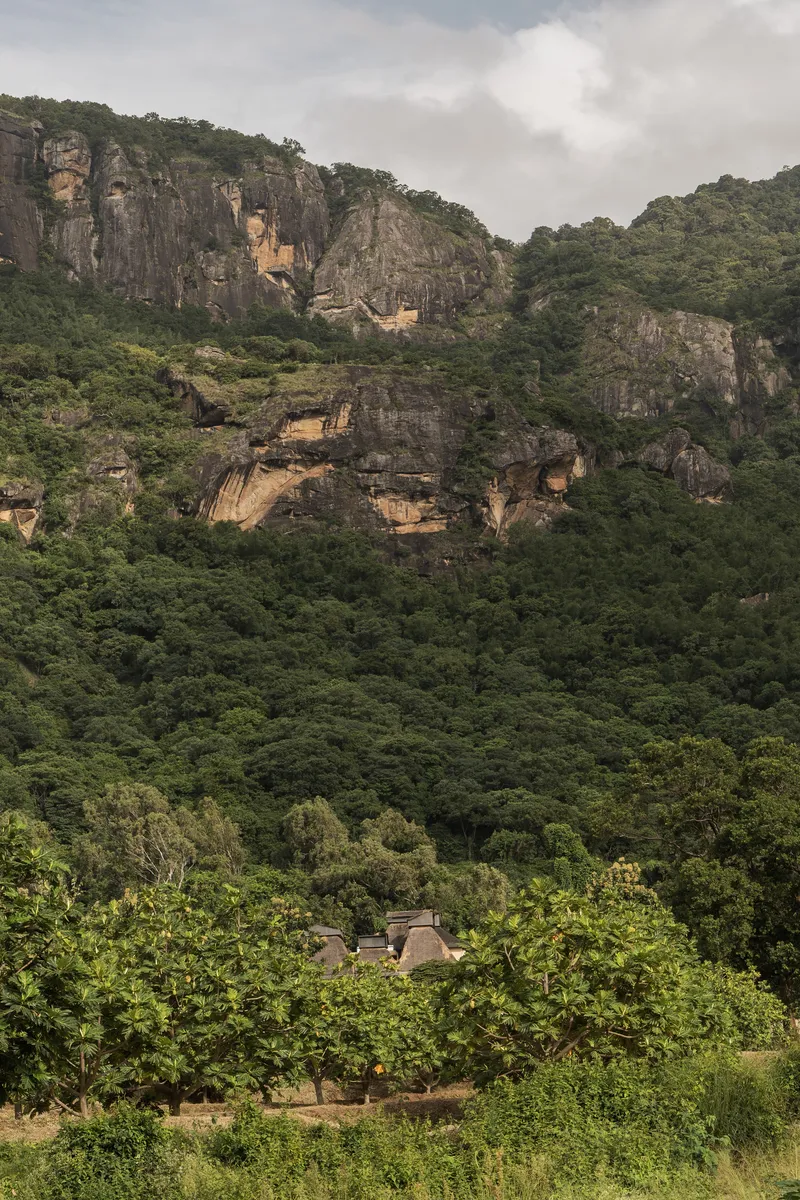
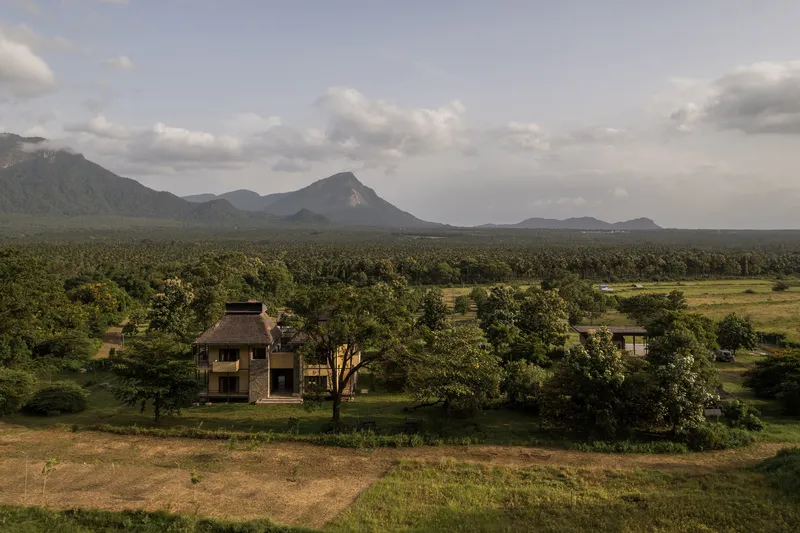
The aerial and distant views of Serenity reveal how small the built footprint actually is relative to the site. Dense vegetation crowds the compound on all sides, and the dramatic rock escarpments of the Anamalai range rise directly behind. The architects describe the project as a permeable boundary where architecture and wildlife corridor coexist, and from these vantage points the claim holds up. The buildings are absorbed into the terrain rather than asserting themselves against it.
The single-storey pavilion visible through the trees, with its deep overhanging roof, steel columns, and glazed walls, reads almost as a forest hide: a place for observation, not exhibition. A curved stone retaining wall at the base of one structure follows the natural contour of the land, avoiding the terracing and leveling that typically accompanies construction on sloped sites in the region.
The Broader Setting
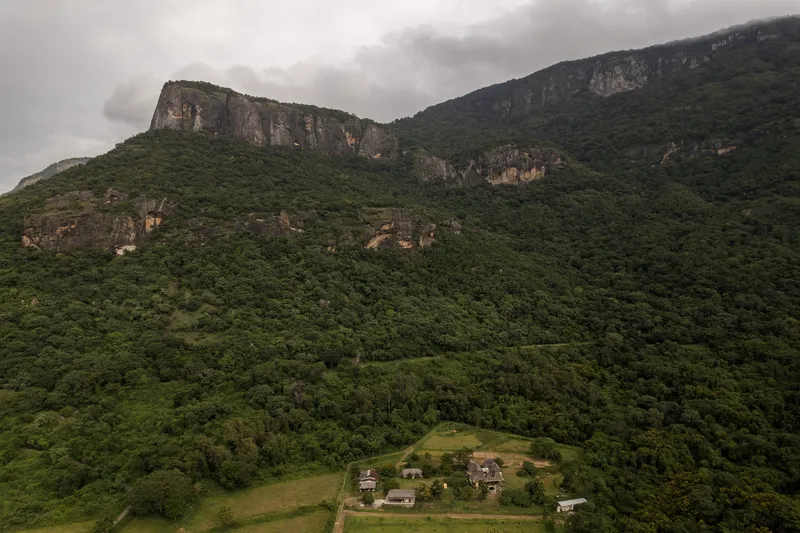
From directly above, the compound appears as a modest clearing in a dense green canopy, with the Anamalai escarpments forming an impenetrable wall to the south and east. The decision to position the L-shaped bedroom block along the southern boundary is legible: it acts as a low buffer between the built compound and the mountain forest, while opening the northern side of the site to the agricultural landscape and the prevailing breezes. The swimming pool and courtyard occupy the protected zone between these two conditions.
Plans and Drawings
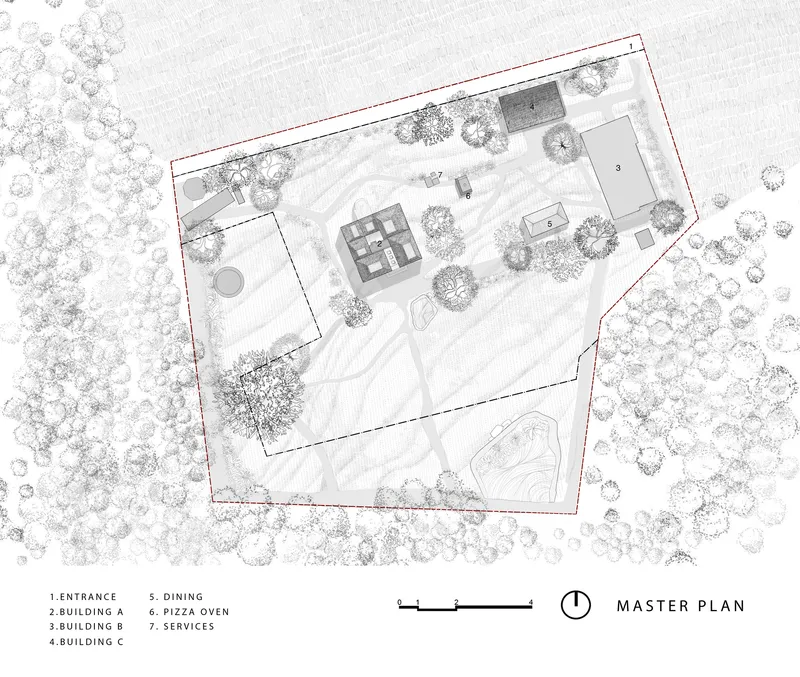
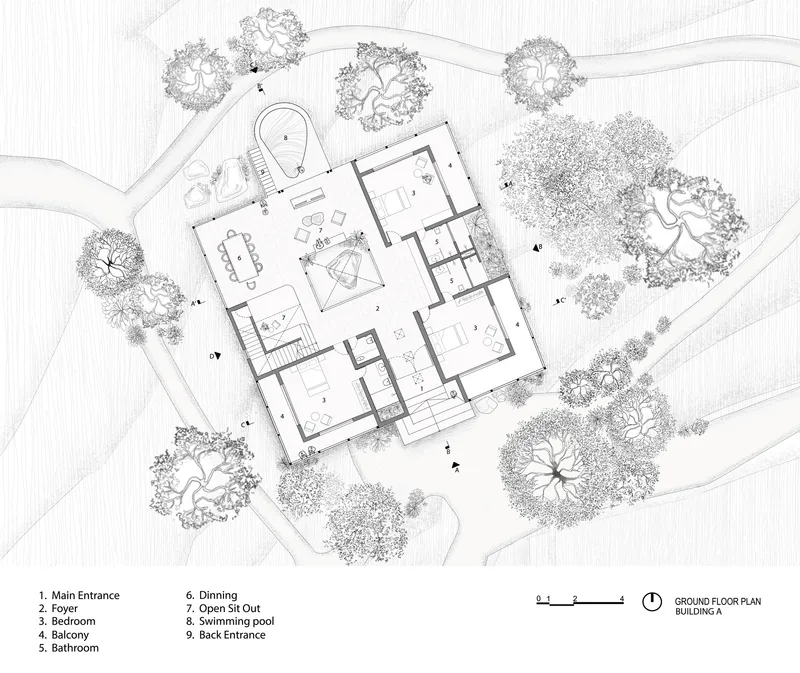
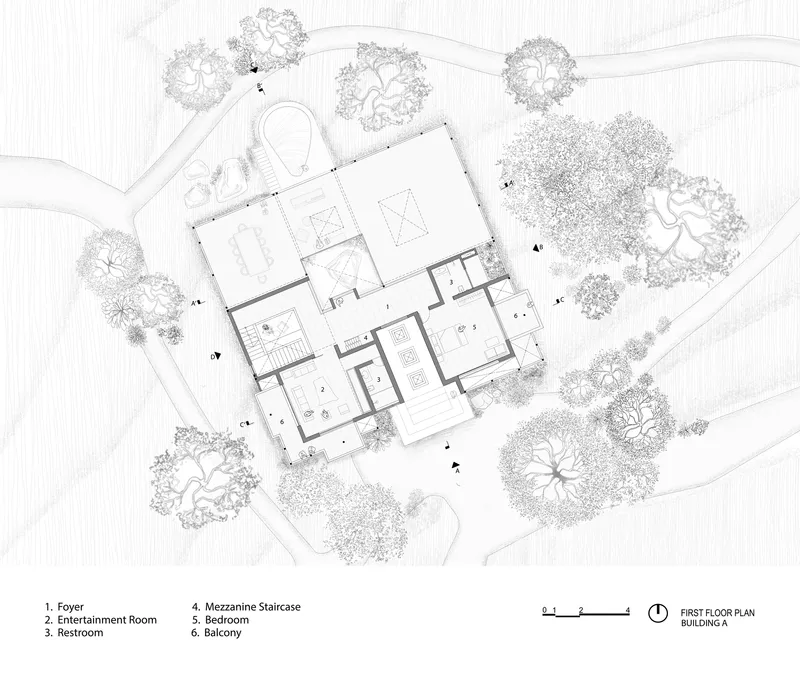
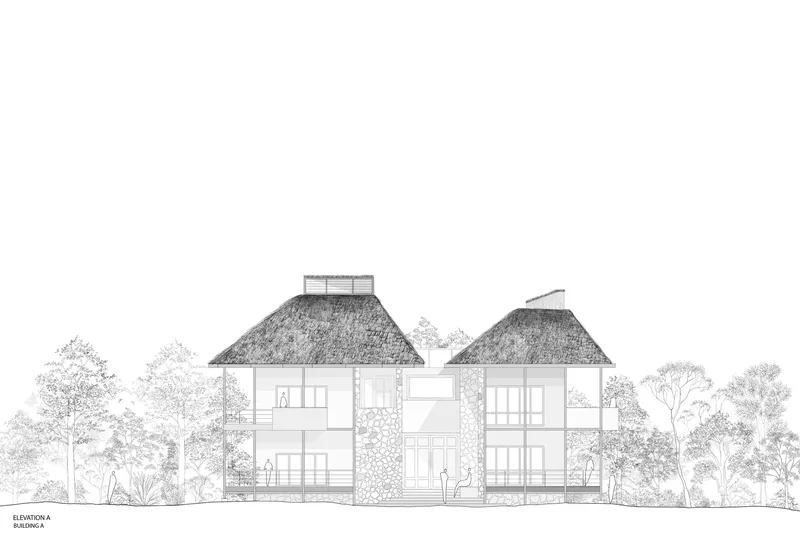
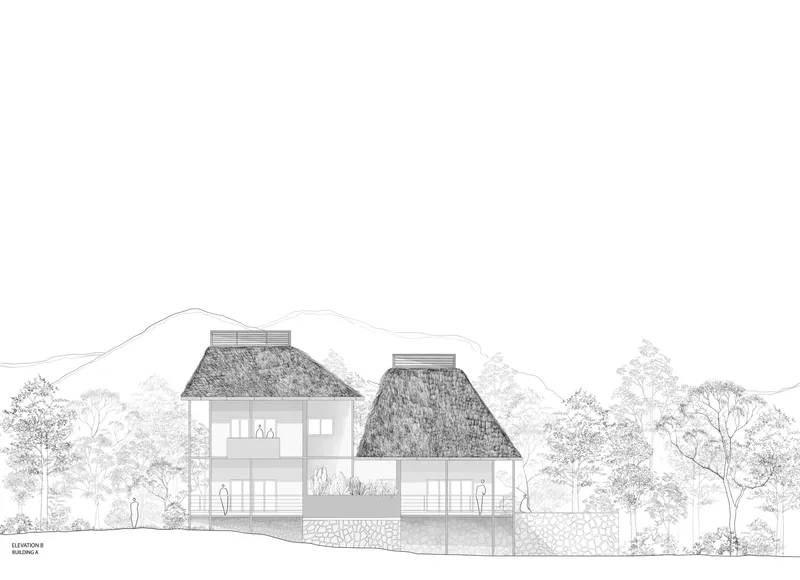
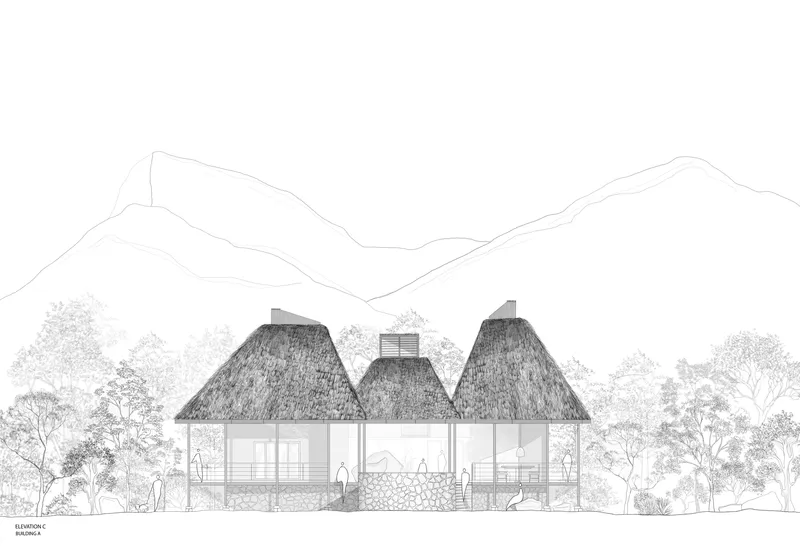
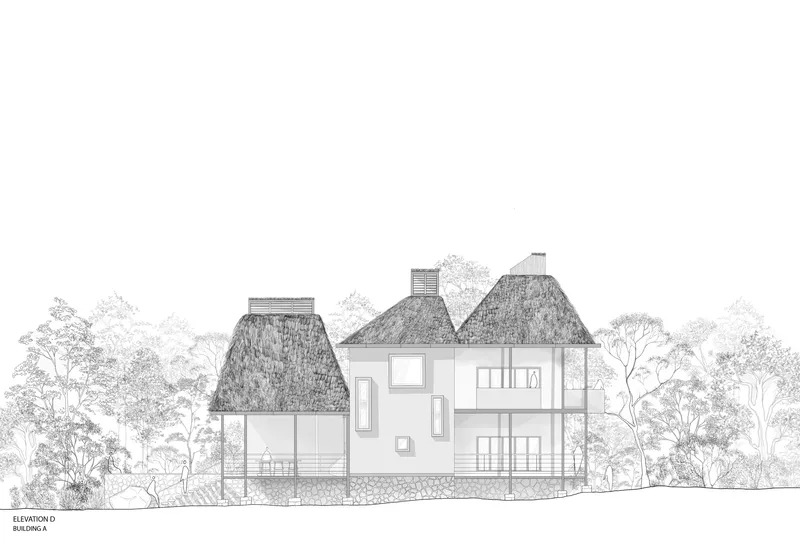
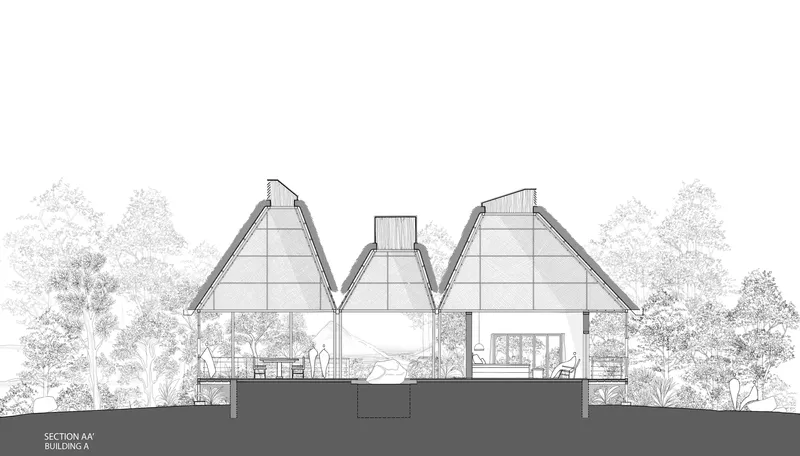
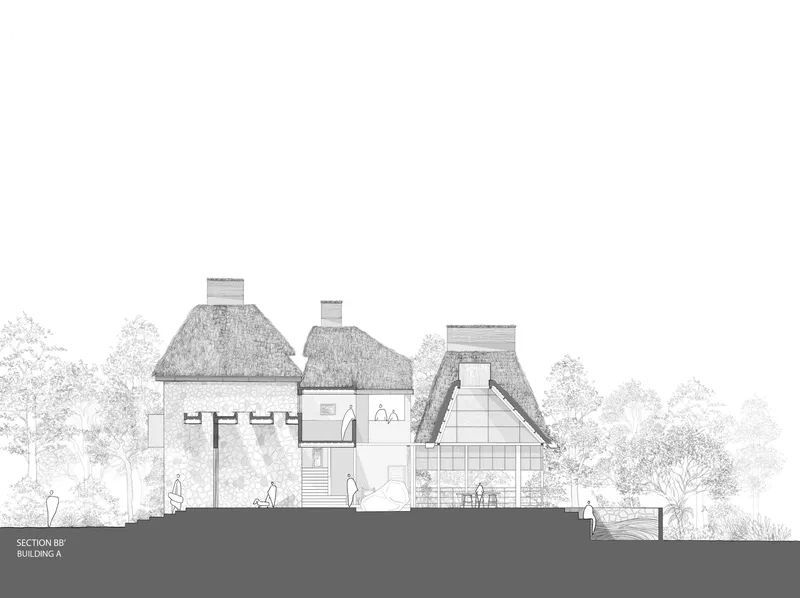
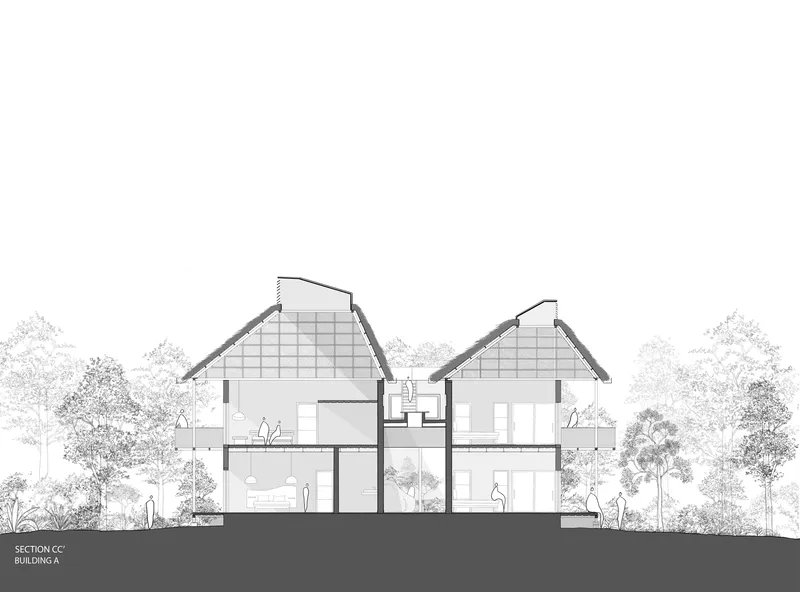
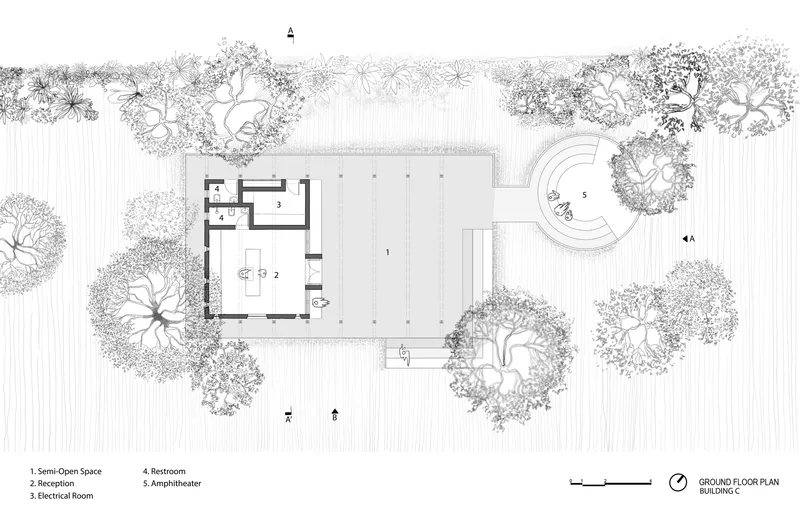
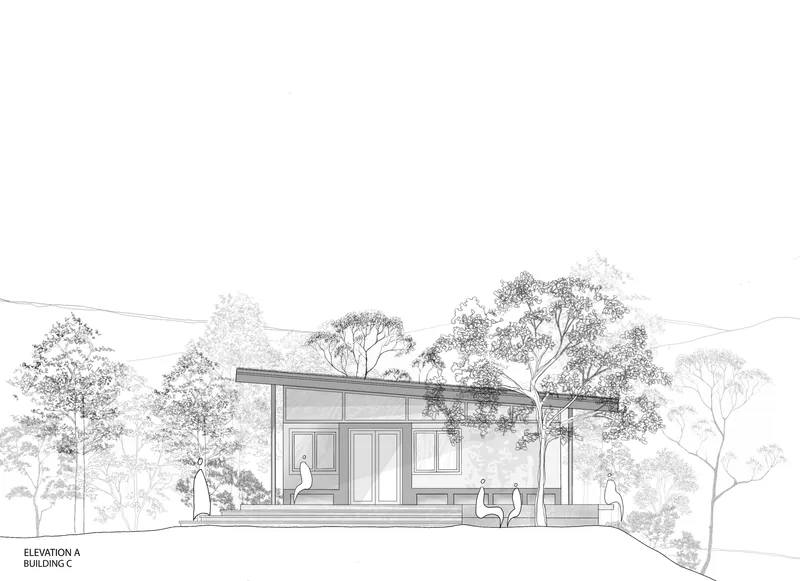
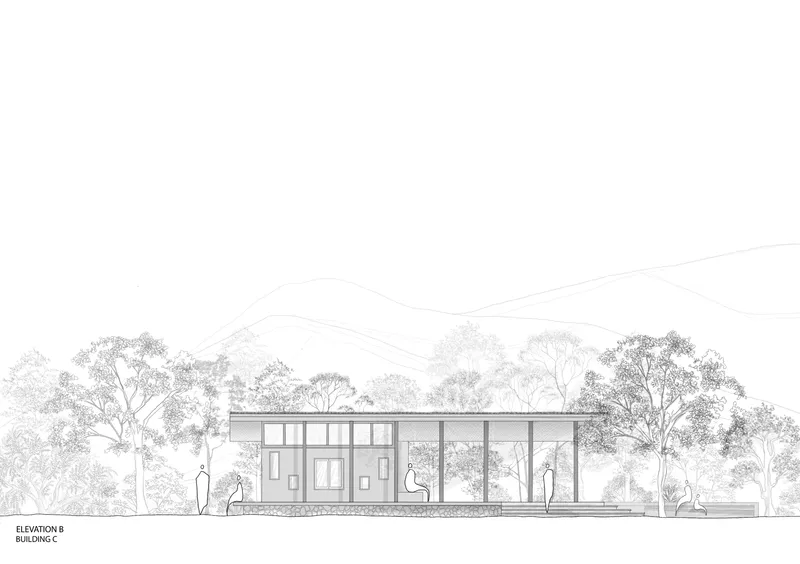
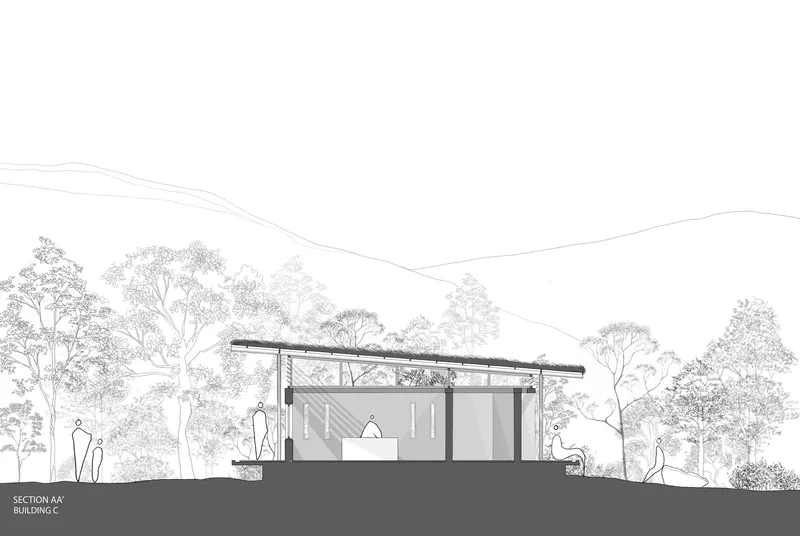
The site plan confirms the project's central claim: the majority of the four-acre property is left unbuilt, with the compound occupying a compact footprint in one corner. The ground and first floor plans show rooms organized around the courtyard, with the L-shaped bedroom block clearly legible to the south and the open terrace to the north. Circular tree canopies in the landscape drawings are not decorative filler; they represent existing mature trees that were retained and incorporated into the spatial sequence.
The sections are particularly revealing. They show how the pyramidal thatch roofs create double-height interior volumes that far exceed what the modest footprint would suggest, generating generous vertical space for ventilation and spatial drama. The ventilation cupolas at each apex are visible as functional openings, not ornamental caps. The elevations demonstrate how the roofline was shaped to echo the distant mountain profile, a compositional ambition that could easily tip into kitsch but succeeds here because the material palette, thatch over lime plaster over stone, makes the relationship feel geological rather than pictorial.
Why This Project Matters
Serenity matters because it operationalizes an idea that most architects only discuss in competition entries: genuine coexistence with nonhuman life. By surrendering more than half the buildable site to elephants, leopards, and bison before drawing a single line, ma+rs establish a design methodology in which restraint is not a limitation but a generative force. The resulting architecture is compact, specific, and materially rich precisely because it had to be. There is no wasted gesture, no sprawling terrace built for a photograph.
The project also demonstrates that passive climate strategies, breathable lime plaster, thick thatch insulation, ventilation cupolas, deep eaves, can produce spaces that are both thermally comfortable and spatially compelling without resorting to the glass-box-with-HVAC formula that dominates high-end retreats across South Asia. In a region where new construction is rapidly encroaching on sensitive wildlife corridors, Serenity offers a replicable model for building less, building well, and building with accountability to the landscape that was there first.
Serenity by ma+rs. Pollachi, Tamil Nadu, India. 13,725 m². Completed 2025. Photography by studio f8.
About the Studio
Share Your Own Work on uni.xyz
If projects like this are the kind of work you want to make, uni.xyz is a place to publish your own, find collaborators, and enter design competitions.



Popular Articles
Popular articles from the community


The Earth Pod: 3D Printed Homes for Resilient Refugee Communities
The Earth Pod reimagines refugee housing through 3D printed homes made from clay, combining resilience, self-sufficiency, and rapid shelter.

The Musturak Paradise: Senior Living Architecture for a Connected Future in Temara, Morocco
The Musturak Paradise reimagines senior living architecture in Temara via private homes, social spaces, culture, community, and shared care.

Co-life: Sustainable Architecture for Age-Friendly Community Living
Co-life reimagines sustainable architecture for seniors through courtyards, rammed earth, shared gardens, and spaces designed for belonging.

Conexión: Biophilic Design Reimagines High-Rise Living in Hong Kong
Conexión reimagines high-rise living in Hong Kong through biophilic design, green facades, shared spaces, daylight, water and nature within.


Similar Reads
You might also enjoy these articles

Bao Huynh Watercolor Atelier: A Serene Art Retreat in Hội An
Bao Huynh Watercolor Atelier in Hội An blends multifunctional art spaces, sustainable design, local materials, and family-friendly living in a serene environment.

Atelier Macri Concept Store Interior Design by CASE-REAL
Atelier Macri store features a "ko" counter, walnut wood details, cork displays, blending retail, gallery, and seamless customer experiences.

Manuel Vargas Izquierdo Stadium and High-Performance Sports Center: Architectural Excellence in Jalpa de Méndez
The Manuel Vargas Izquierdo Stadium blends sustainable design, inclusive sports facilities, and cultural-inspired architecture, revitalizing Jalpa de Méndez’s public spaces.

KAKR Buluh Awar Hall: Revitalizing Community and Ecology Through Bamboo Architecture
Community built bamboo hall revitalizes Buluh Awar village, empowering youth, restoring ecology, celebrating vernacular craftsmanship through sustainable architecture and culture.

Explore Re-Generative Competitions
Discover active competitions in this discipline


Challenge to design mud housing for contemporary communities


Challenge to reimagine the Iron Throne


Photograph architecture without architects


Illustrate the lost glory of Angkor Wat - Render Challenge
Comments (0)
Please login or sign up to add comments
No comments yet. Be the first to comment!