
Mackovič Architecture Wraps a Prague Villa Around Courtyards and Soft Southern Light
A 154-square-meter house on the eastern edge of Prague dissolves its boundaries between interior space, courtyard, and garden.


Most suburban houses in the Prague hinterland treat their plots as afterthoughts: a box dropped on a rectangle of grass, fence on all four sides, done. The Šestajovice House by mackovič architecture takes the opposite approach. The 154-square-meter residence treats the site itself as the primary design material, carving courtyards and voids that pull daylight, views, and mature tree canopies deep into the plan. The result is a house that feels substantially larger and more generous than its modest footprint suggests.
What makes this project genuinely interesting is not the whitewashed minimalism or the timber details, both of which are competent but familiar. It is the spatial choreography: the way the architects split the program into two volumes connected by glass, frame courtyards that serve as outdoor rooms, and use translucent polycarbonate screens to create privacy without claustrophobia. Every room has at least two orientations, which means every room has light that changes through the day. That is a luxury no square meter count can convey.
A Fence, a Screen, and the Question of Privacy


From the street, the house barely registers. A vertical timber fence, weathered to a silvery grey, screens the volumes behind a layer of autumn trees. The effect is deliberately understated: you see texture and canopy, not architecture. It is an act of restraint that earns the house a kind of civic politeness rare in new residential construction.
Behind that fence, a translucent polycarbonate wall defines the private courtyard. It is a clever material choice. Opaque enough to block sightlines from neighbors, transparent enough to admit a diffuse glow that softens the courtyard space. Paired with the lawn and the weeping willows, the courtyard becomes an intermediate zone: neither fully inside nor fully outside, protected but not enclosed.
Glass Walls and Garden Thresholds


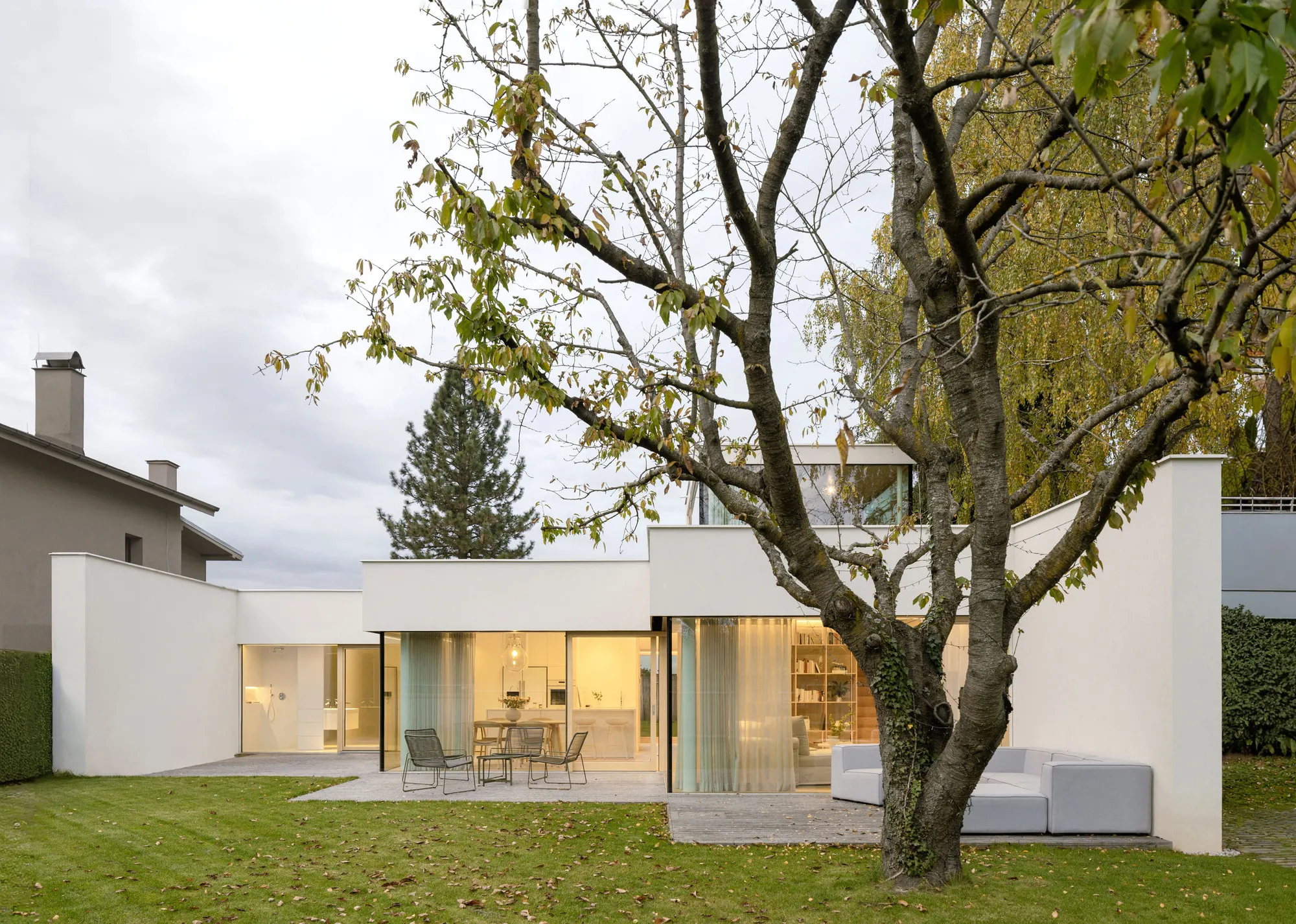
The garden facade is the house at its most extroverted. Floor-to-ceiling glazing runs nearly the full width of the ground floor, and the sliding panels retract completely, turning the timber deck into an extension of the dining area. At dusk, with interior lights on and gnarled tree branches overhead, the photographs by Alexandra Timpau capture a quality of atmosphere that is hard to fake: warmth without sentimentality.
The timber-clad ceiling inside reads as continuous with the deck outside, blurring the threshold line. It is a well-worn trick, but it works here because the proportions are right. The ceiling height is generous enough that the glass wall does not feel like a shopfront, and the deck is deep enough that you can sit outside under the overhang when it rains. Practical details like these separate livable architecture from photogenic set design.
Interior Organization: Shelving as Architecture
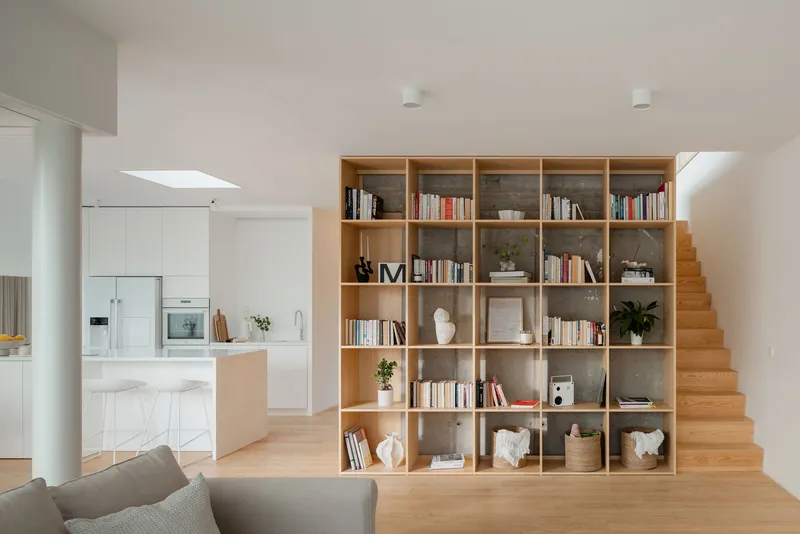


Inside, the spatial logic relies on a few bold organizing gestures rather than a maze of corridors. The most striking is the tall gridded timber shelving unit that separates the living area from the staircase and kitchen. It functions as a room divider, a storage wall, and a light filter simultaneously. Books, objects, and daylight all pass through its grid, keeping the ground floor visually connected even as it defines distinct zones.
The dining area pairs a simple timber table with sheer curtains and corner glazing, allowing light to wash in from two directions. Upstairs, a corner window desk looks out over bare birch trees, framed by the exposed concrete ceiling panels. The material palette across the house is tight: light oak flooring, white plaster, concrete soffits, timber joinery. Nothing competes. Everything recedes to let the views and the daylight do the heavy lifting.
Bedrooms, Bathrooms, and Controlled Exposure
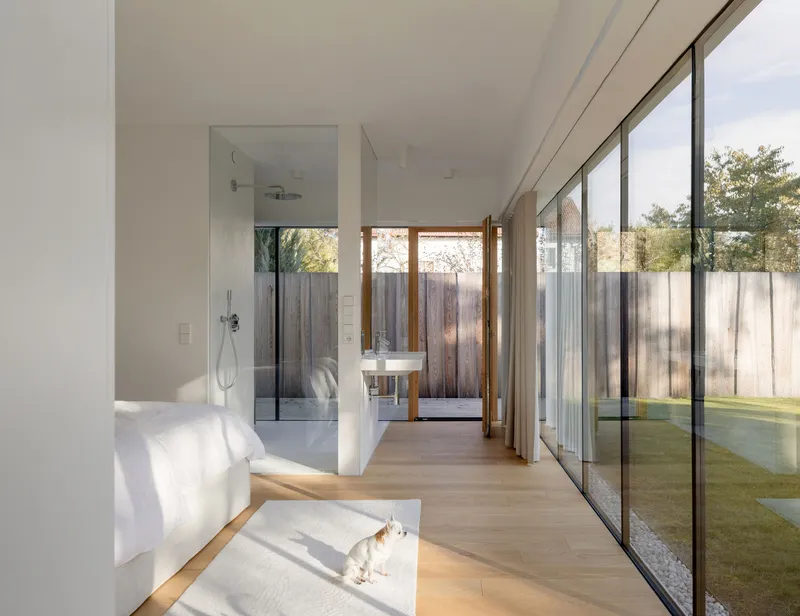


The private rooms push the inside-outside agenda further than most houses would dare. The bedroom opens through glazed walls directly onto the courtyard, with a glass-enclosed shower catching morning sunlight. The bathroom features a freestanding tub beside a timber-framed pivot door that swings open onto the deck and lawn. These are not spa gestures for the sake of novelty. The courtyard screens and translucent walls established earlier in the design do the real work here, providing enough seclusion that this openness is comfortable rather than exhibitionist.

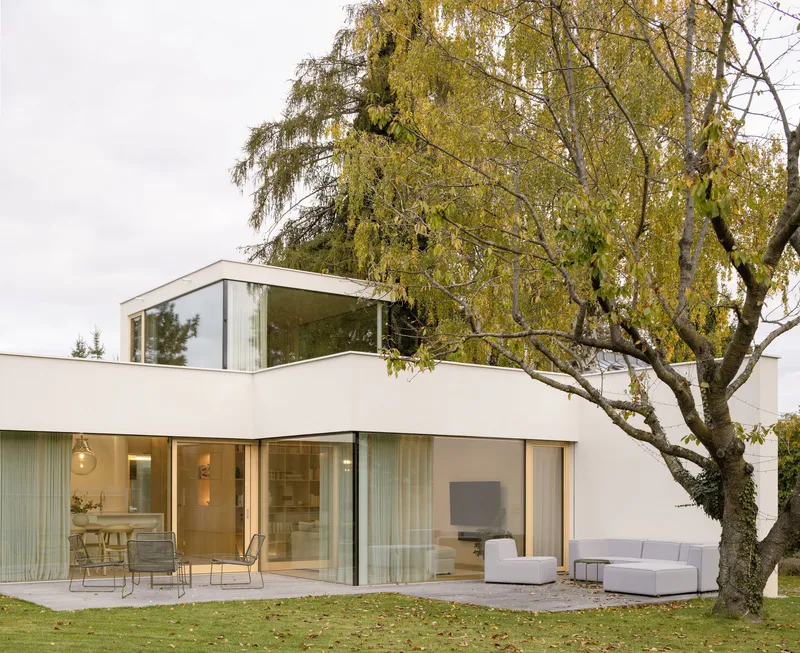
At dusk, the courtyard-facing bathroom glows through its sliding glass doors like a lantern. The two-story white volume, topped by a glazed rooftop pavilion, reads from the terrace as a compact, almost monastic composition. The architects resisted the temptation to break up the massing with gratuitous formal moves. The house stays quiet, and the quietness makes the moments of transparency feel deliberate rather than arbitrary.
Plans and Drawings

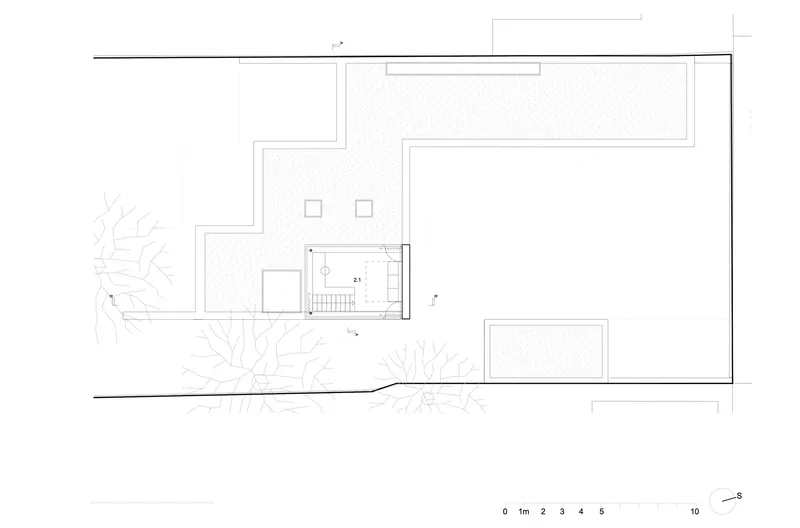
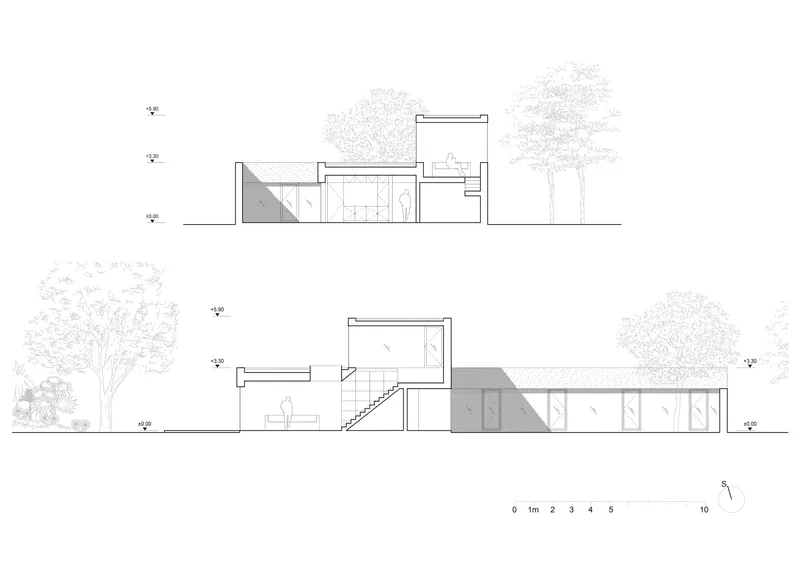


The ground floor plan reveals the key move: the house is organized as two volumes separated by courtyards, with a carport tucked to one side. Living spaces occupy the garden-facing wing while private rooms wrap the courtyard. The first floor plan is leaner, with a terrace and open double-height voids that keep the upper level from feeling compressed.
The sections are particularly instructive. The split-level arrangement, visible in the staircase section, shows how the architects used half-level shifts to create spatial variety within a compact envelope. The elevation drawing confirms the horizontal emphasis of the glazing bands, while the paired sections demonstrate how both volumes sit beneath sloped roofs that defer to the surrounding tree canopies rather than competing with them. The trees are drawn with as much care as the building, which tells you everything about the design priorities.
Why This Project Matters
The Šestajovice House is not a radical experiment. It does not invent a new structural system or deploy an unusual material. What it does, with notable discipline, is demonstrate that the suburban single-family house can be more than a container with windows. By fragmenting the program into two volumes, wrapping them around courtyards, and using translucent screens to negotiate between public and private, the architects have produced a house where spatial quality, not floor area, is the measure of generosity.
For a growing city like Prague, where the suburban fringe is expanding rapidly and often thoughtlessly, this kind of project matters because it proves that density and delight are not incompatible. A 154-square-meter house on a modest plot can feel expansive if the design takes light, orientation, and the existing landscape seriously. That is not a flashy argument. It is a necessary one.
Šestajovice House by mackovič architecture, Czechia. 154 m², completed 2024. Photography by Alexandra Timpau.
About the Studio
Share Your Own Work on uni.xyz
If projects like this are the kind of work you want to make, uni.xyz is a place to publish your own, find collaborators, and enter design competitions.




Popular Articles
Popular articles from the community


EW PARK: Sustainable Architecture Reimagines the Future of Urban Parking
EW PARK reimagines city parking as a modular wooden tower combining automation, solar energy, electric mobility, and adaptable urban design.

The Ocean Hive: Sustainable Architecture for a Self-Sufficient Civilization at Sea
The Ocean Hive imagines sustainable architecture at sea, where modular habitats, algae, wave power and ocean waste sustain a growing colony.

Conexión: Biophilic Design Reimagines High-Rise Living in Hong Kong
Conexión reimagines high-rise living in Hong Kong through biophilic design, green facades, shared spaces, daylight, water and nature within.

Co-Life: Senior Housing Design That Reconnects Older Adults With the City
Co-Life reimagines senior housing design through healing gardens, shared streets, workshops, and a sustainable community across generations.


Similar Reads
You might also enjoy these articles

Bao Huynh Watercolor Atelier: A Serene Art Retreat in Hội An
Bao Huynh Watercolor Atelier in Hội An blends multifunctional art spaces, sustainable design, local materials, and family-friendly living in a serene environment.

Atelier Macri Concept Store Interior Design by CASE-REAL
Atelier Macri store features a "ko" counter, walnut wood details, cork displays, blending retail, gallery, and seamless customer experiences.

Manuel Vargas Izquierdo Stadium and High-Performance Sports Center: Architectural Excellence in Jalpa de Méndez
The Manuel Vargas Izquierdo Stadium blends sustainable design, inclusive sports facilities, and cultural-inspired architecture, revitalizing Jalpa de Méndez’s public spaces.

KAKR Buluh Awar Hall: Revitalizing Community and Ecology Through Bamboo Architecture
Community built bamboo hall revitalizes Buluh Awar village, empowering youth, restoring ecology, celebrating vernacular craftsmanship through sustainable architecture and culture.




Comments (0)
Please login or sign up to add comments
No comments yet. Be the first to comment!