
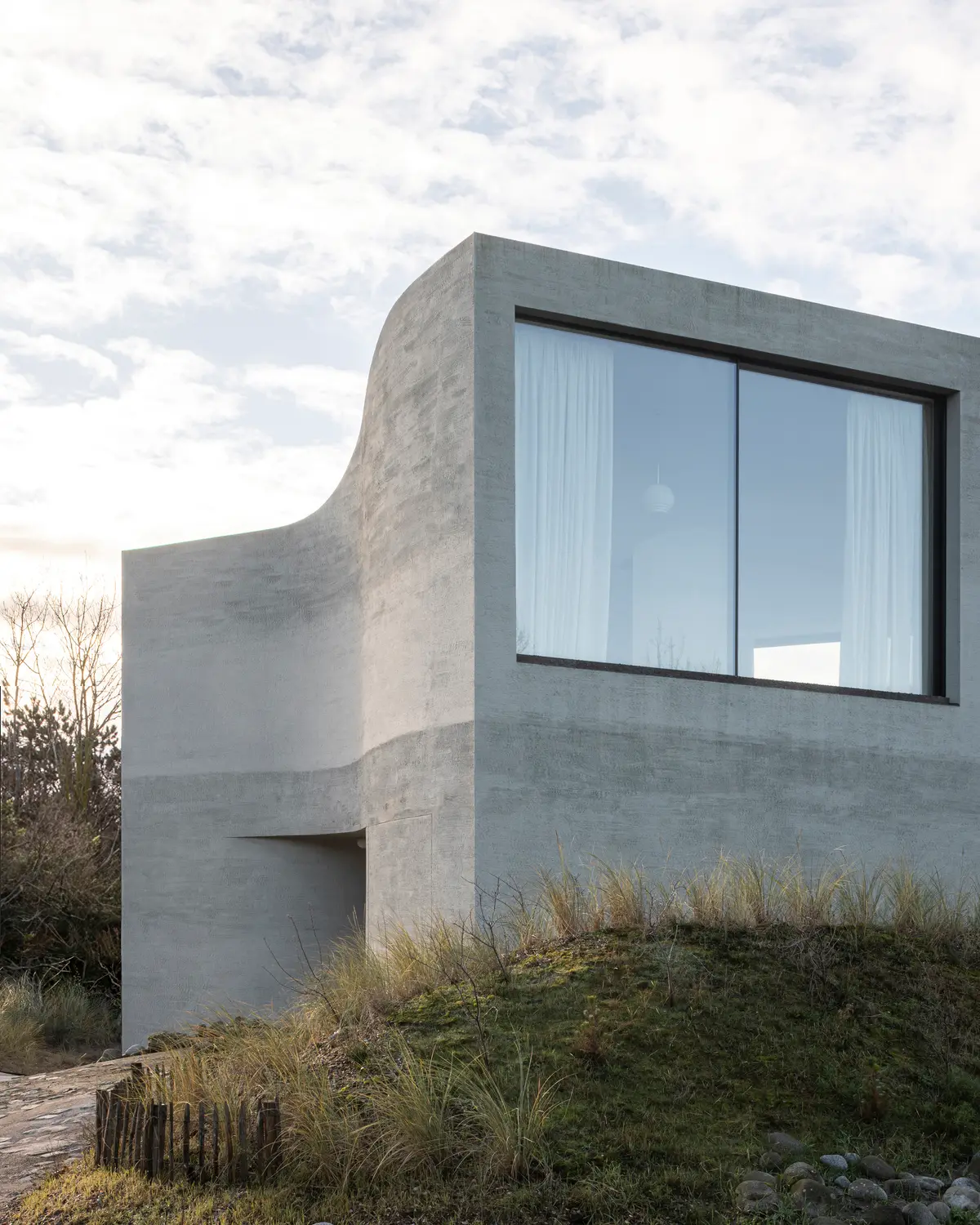
Magalie Munters Carves a Monolithic Concrete Villa into the Belgian Dunes
Villa Nouvelle Vague buries itself in the protected dune reserve of Oostduinkerke, shaped by wind, terrain, and tidal memory.


On a corner plot at the edge of a protected dune reserve in Oostduinkerke, Magalie Munters™ Architecture has completed Villa Nouvelle Vague, a 330 square meter house that refuses every right angle the Belgian coast might expect. The building reads less like something placed on its site and more like something excavated from it: a monolithic concrete form partly embedded in the ground, its curved surfaces textured to recall sand at low tide. Finished in early 2025, it is one of the more committed attempts in recent residential work to make a house behave like geology.
What makes the project genuinely interesting is not just the sculptural ambition but the discipline behind it. Munters developed the house through what she calls a D/S™ methodology, where spatial intent and structural intelligence evolve simultaneously rather than sequentially. The result is a building where the curve is never decorative. Every bend in the concrete does double duty: deflecting coastal wind, channeling daylight, compressing a threshold, or framing a view of the dunes. The house has no visible roof edges. Its section slopes upward over the living spaces and descends toward the bedrooms, half of which are buried below grade. It is a house that knows exactly what it wants to be.
A Dune, Not a Box
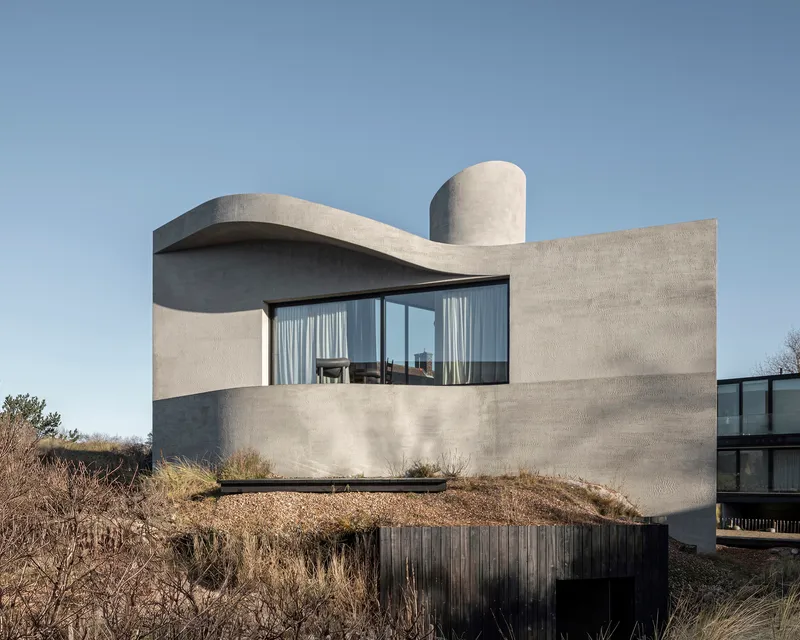
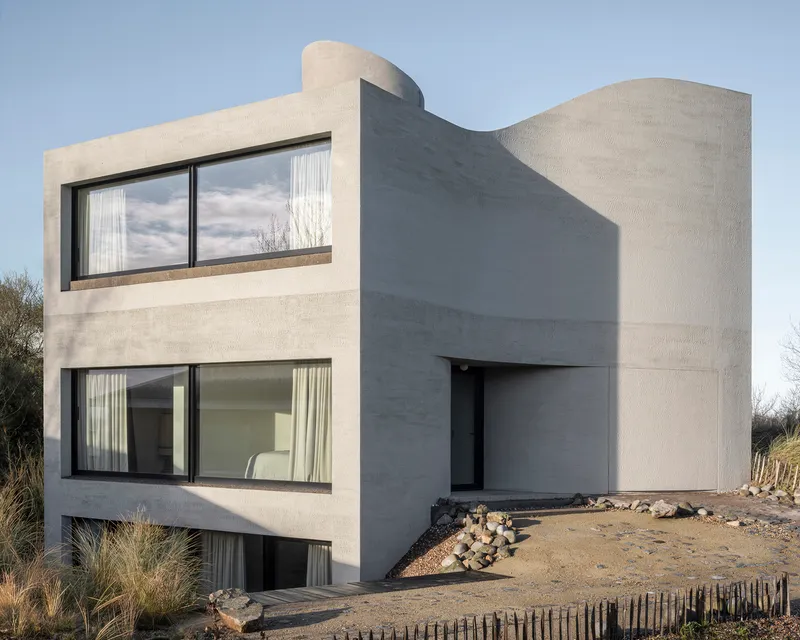
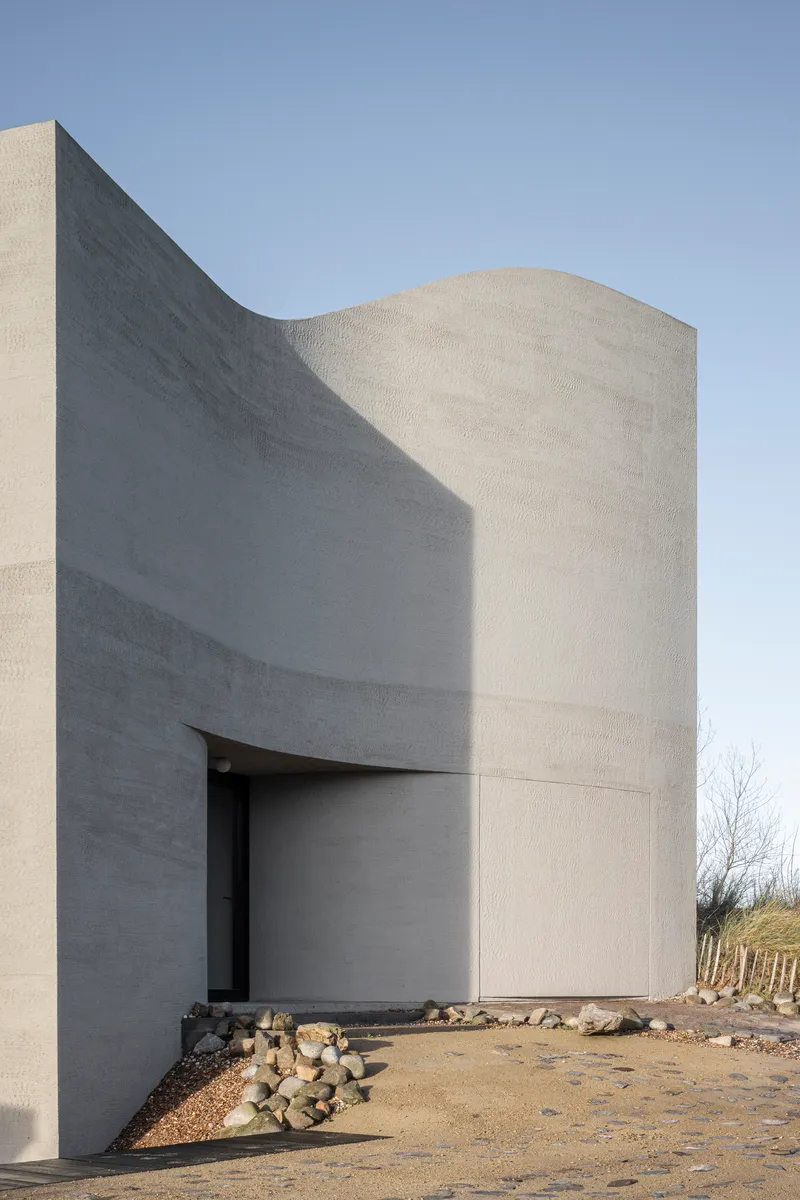
The villa's massing is difficult to categorize from any single vantage point. A cylindrical tower rises from the roofline. The main volume swells and tapers as it wraps around the corner plot, narrowing toward the rear to carve out a generous garden. From the street, the building presents a protective shell of board-formed concrete, punctured only by deep-set openings. From the dune side, it opens up with large glazed surfaces that pull the landscape inside.
The geometry is purposeful. By narrowing the rear of the plan, Munters ensures that both the southern and western facades receive sustained daylight throughout the day, wrapping the interior in shifting light. The curved street facade acts as a windbreak, a necessary consideration on a site exposed to North Sea weather. The horizontal banding of the concrete formwork reinforces the impression of sedimentary layers, as though the house was deposited over time rather than poured in one campaign.
Concrete as Surface, Structure, and Furniture
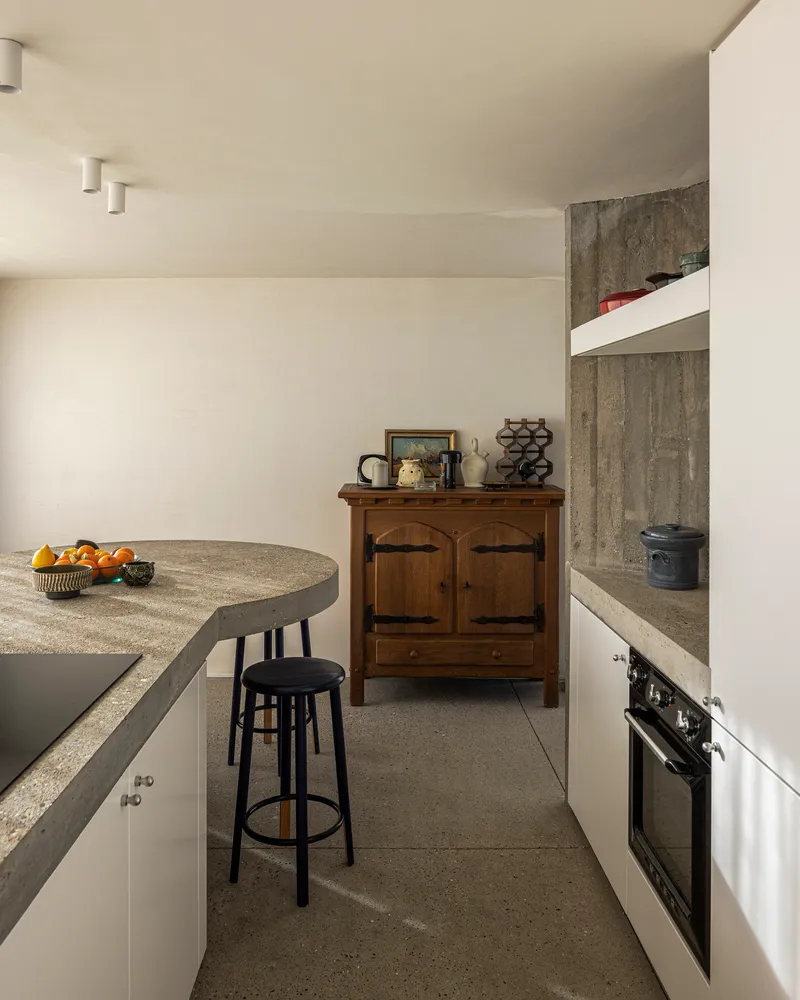
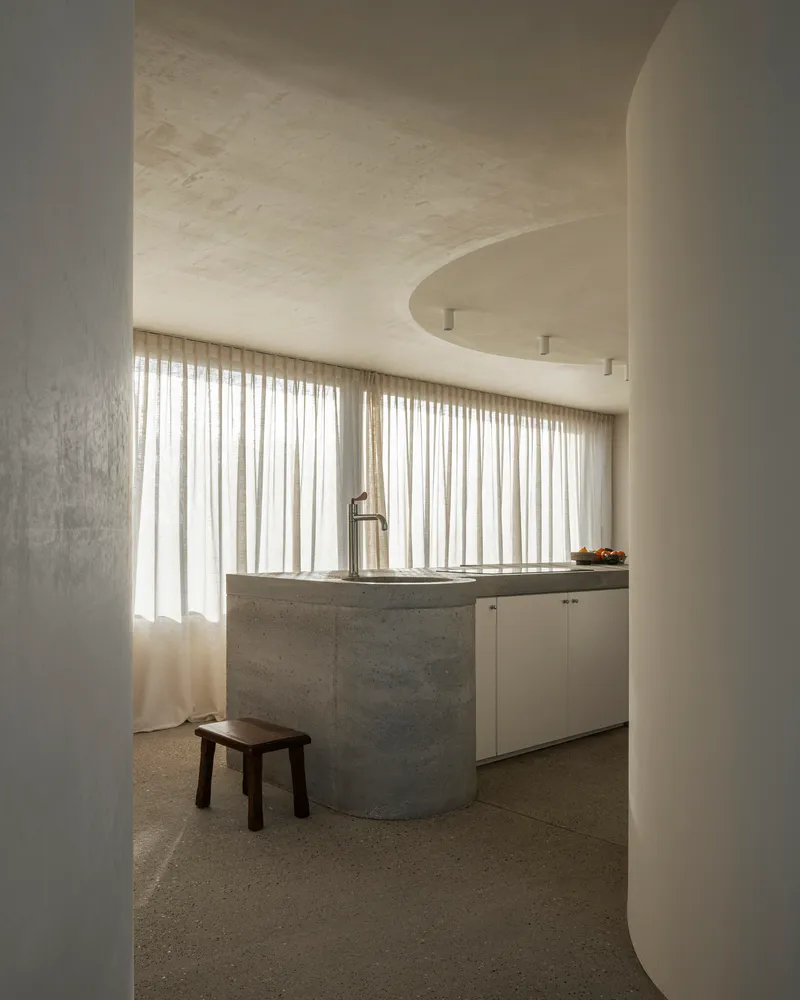
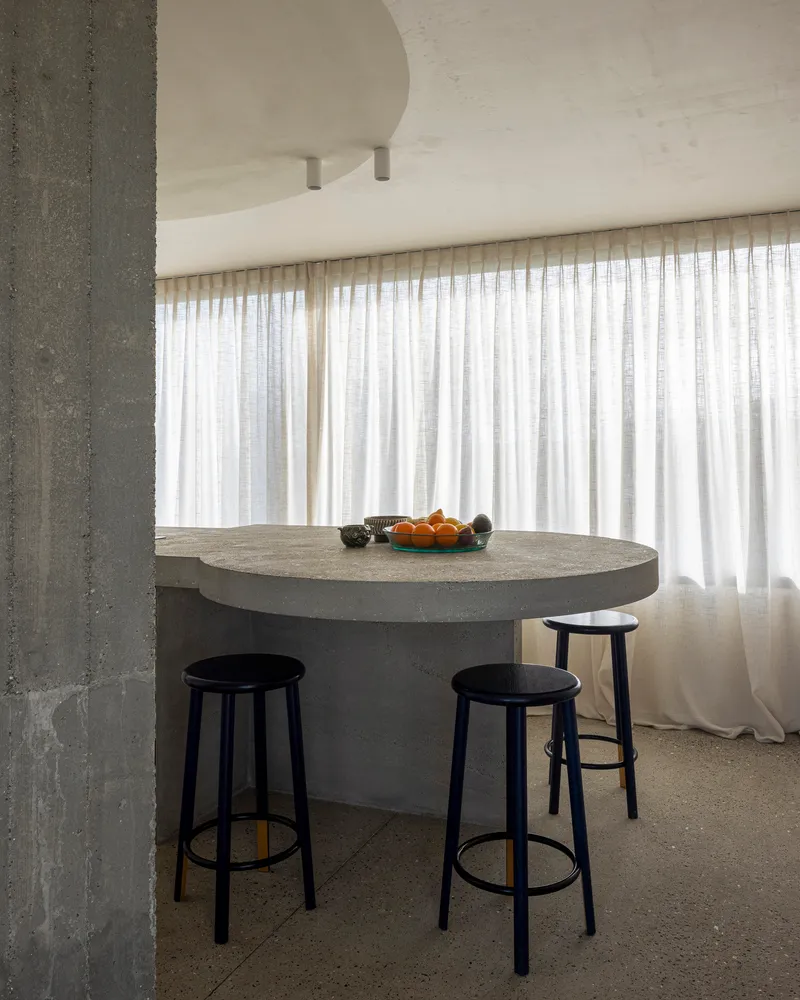
Inside, the concrete does not stop. It continues as the primary spatial substance, forming kitchen islands, bench seating, tub surrounds, and stair walls. The board-formed texture of the exterior carries through to interior surfaces, creating a continuity between shell and furniture that eliminates the typical hierarchy of structure, finish, and object. A curved concrete island in the kitchen sits on a terrazzo floor, its base showing the same wavy formwork patterns found on the facade.
Where the concrete relents, lime-washed plaster takes over, softening the interior light and providing visual relief. Sandblasted oak furnishings and sheer curtains introduce warmth without competing with the material logic. The kitchen, dining area, and built-in breakfast counter form a continuous sequence of carved volumes, each framed by arched doorways that echo the overall geometry. Nothing here was added after the fact. The architecture is the interior.
The Spiral Core
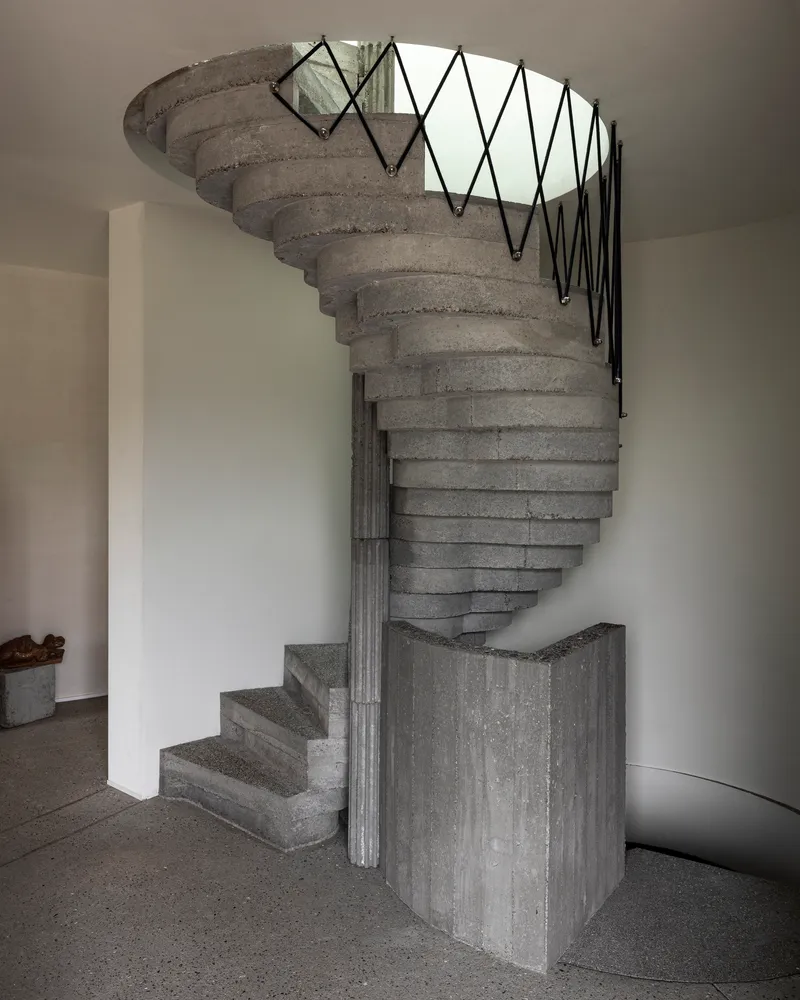
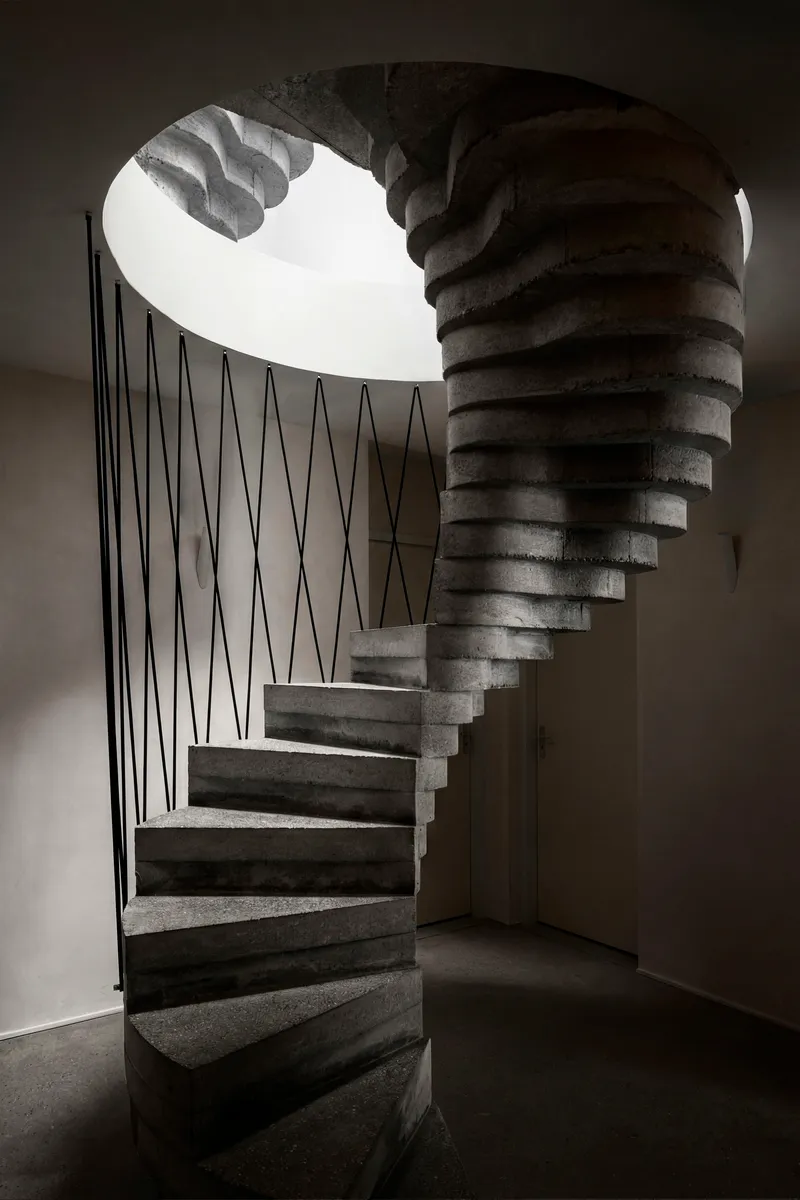
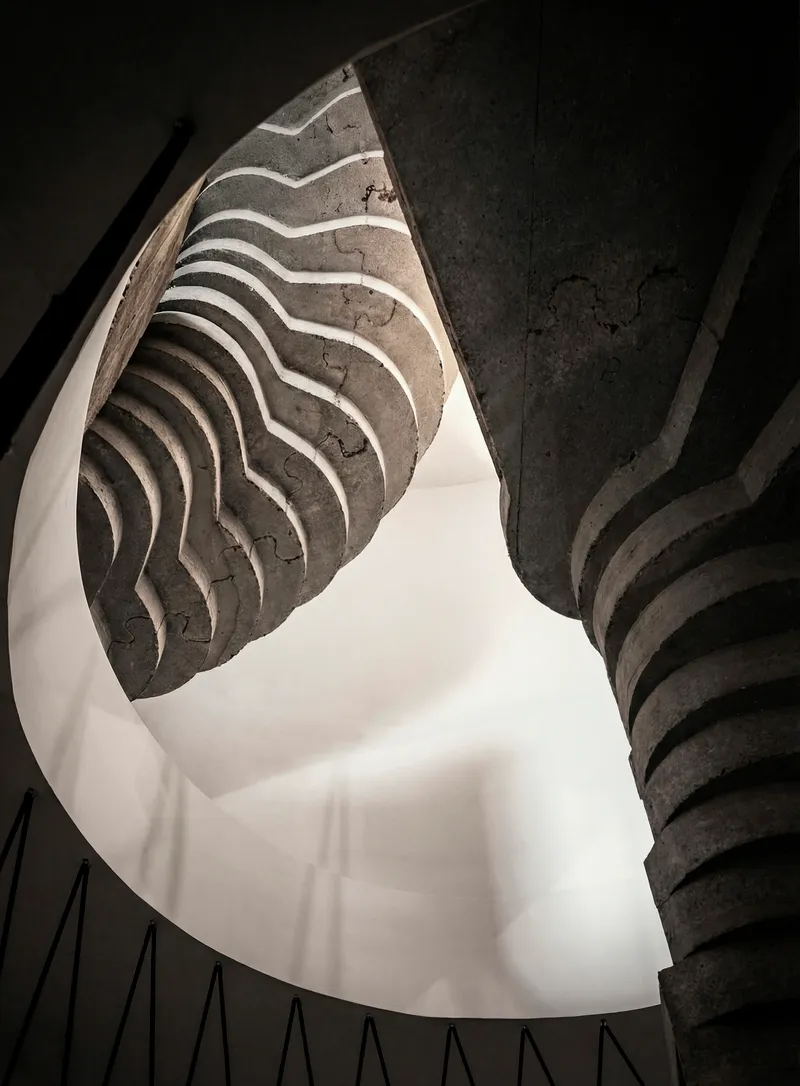
The helical staircase is the vertical spine of the house, connecting four levels through a circular opening capped by a skylight. A board-formed central column anchors the spiral, while a zigzag steel balustrade wraps the ascent with an almost textile quality. Looking up through the stair, the layered concrete soffit reveals the formwork process in exquisite detail: each undulation a record of the pour, each seam a construction joint made visible.
The stair is not merely circulation. It is the primary light well for the half-buried bedrooms below, pulling natural light down through the center of the house. Curved built-in benches at the landings turn the stair into a habitable space rather than a passageway. The diamond-patterned metal balustrade catches the skylight in ways that change throughout the day, casting geometric shadows onto the concrete walls below.
Framing the Dunes
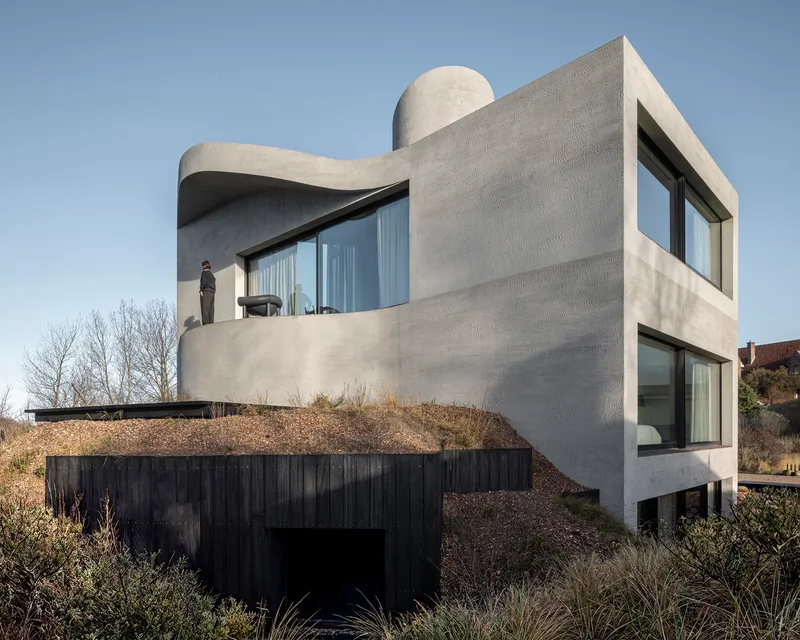
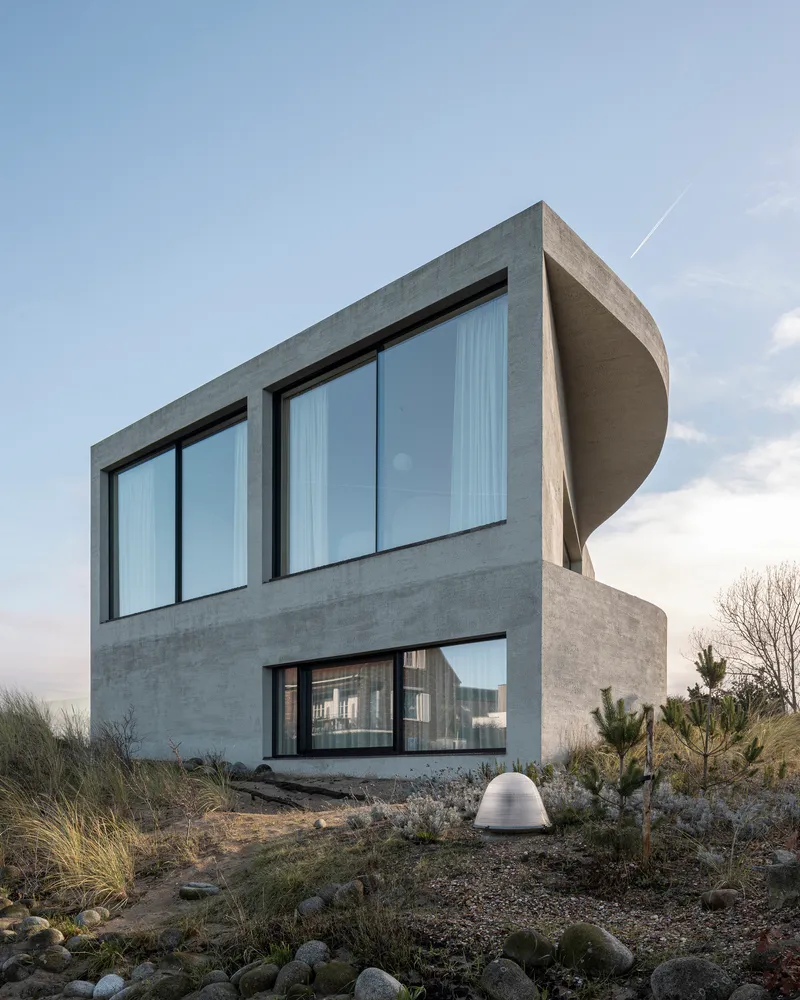
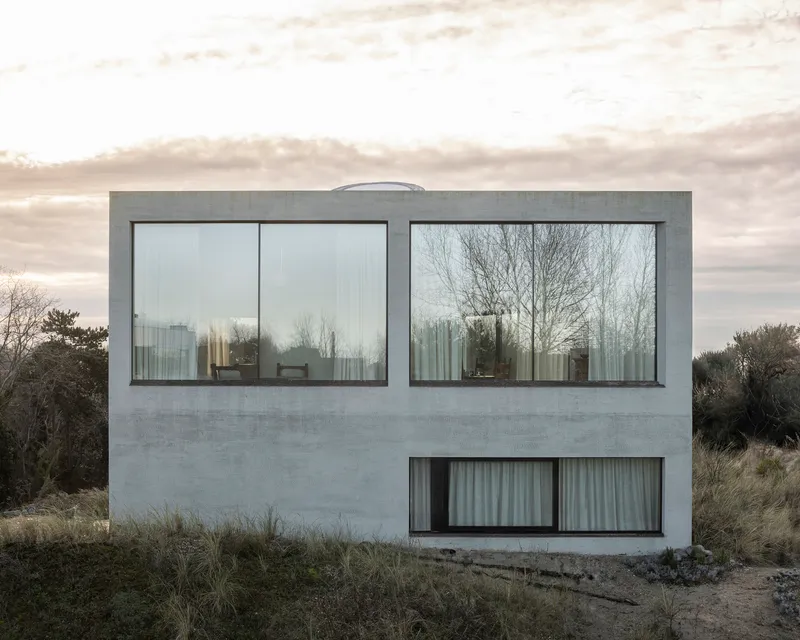
The rear facade opens the house to its most valuable asset: the dune reserve. A deep horizontal incision on the south side frames the landscape through the thickness of the concrete wall, creating a shadowed threshold between interior comfort and coastal exposure. At dusk, the glazed openings glow against the planted dunes, and the cylindrical roof element reads as a lighthouse or watchtower presiding over the reserve.
The paired horizontal windows on the upper level offer a cinematic view of the coast, their proportions deliberately wide and low to emphasize the horizon. Native grasses have been planted right up to the base of the building, further dissolving the boundary between architecture and terrain. The recessed terrace on the ground floor provides sheltered outdoor space without breaking the monolithic silhouette.
Interior Light and Texture
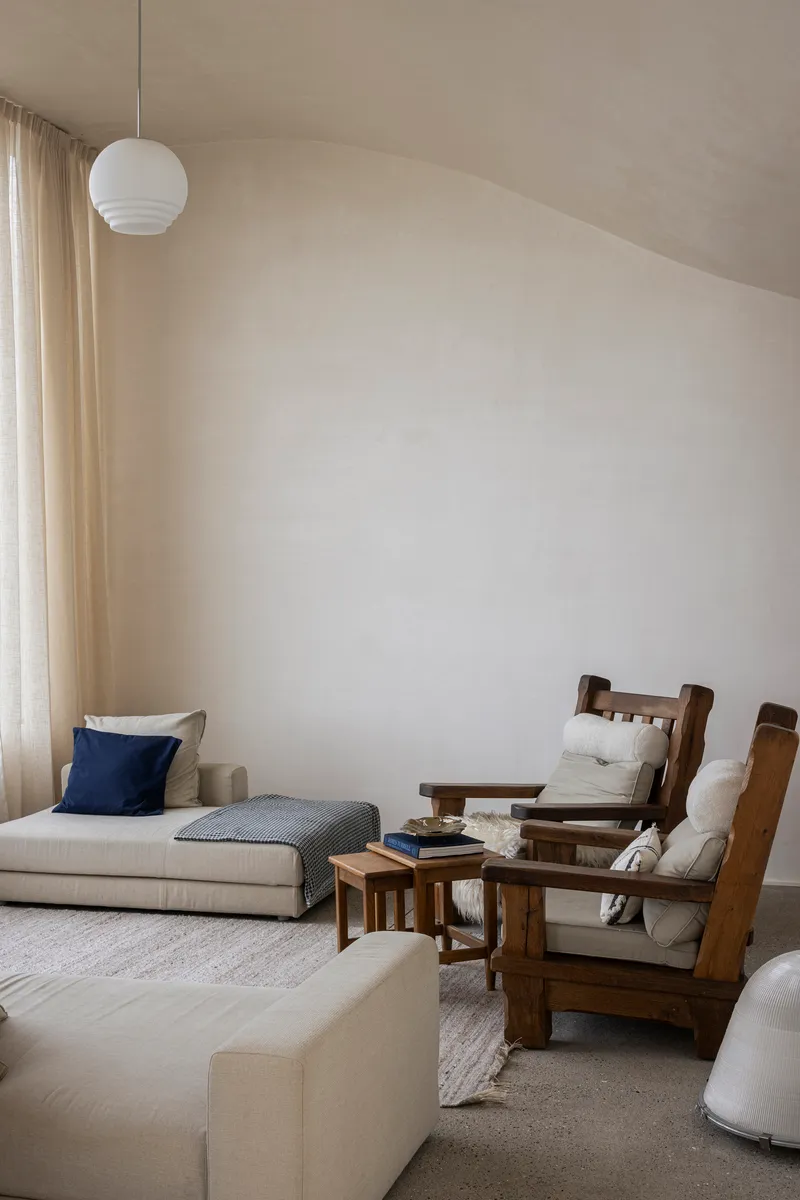
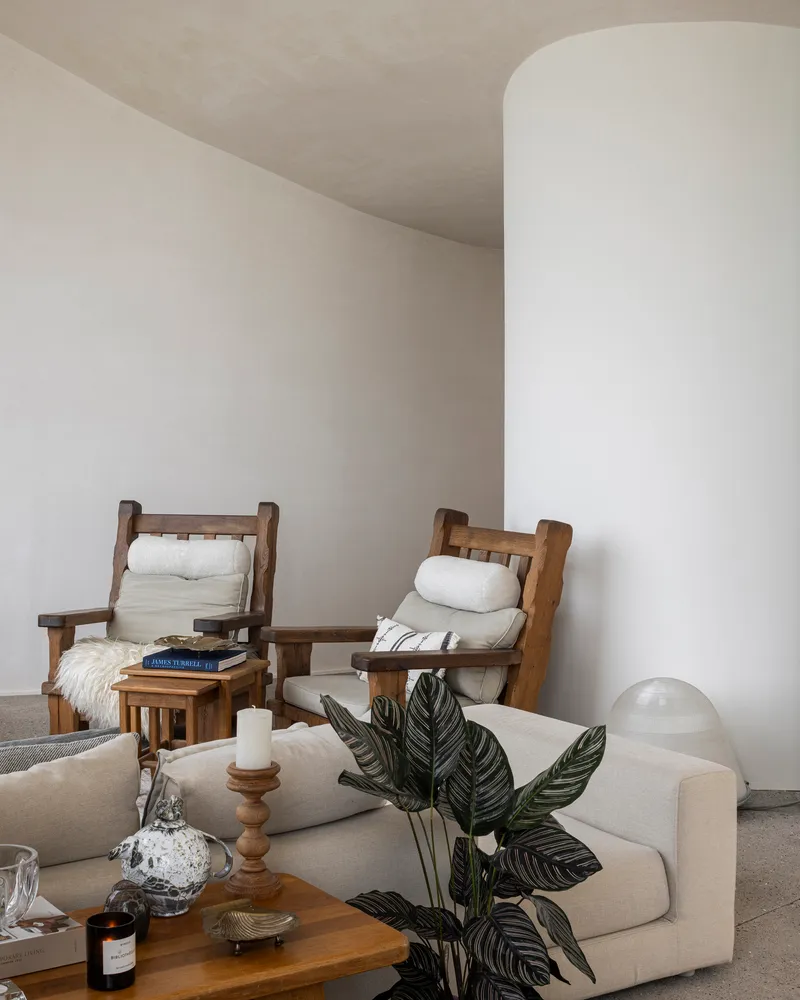
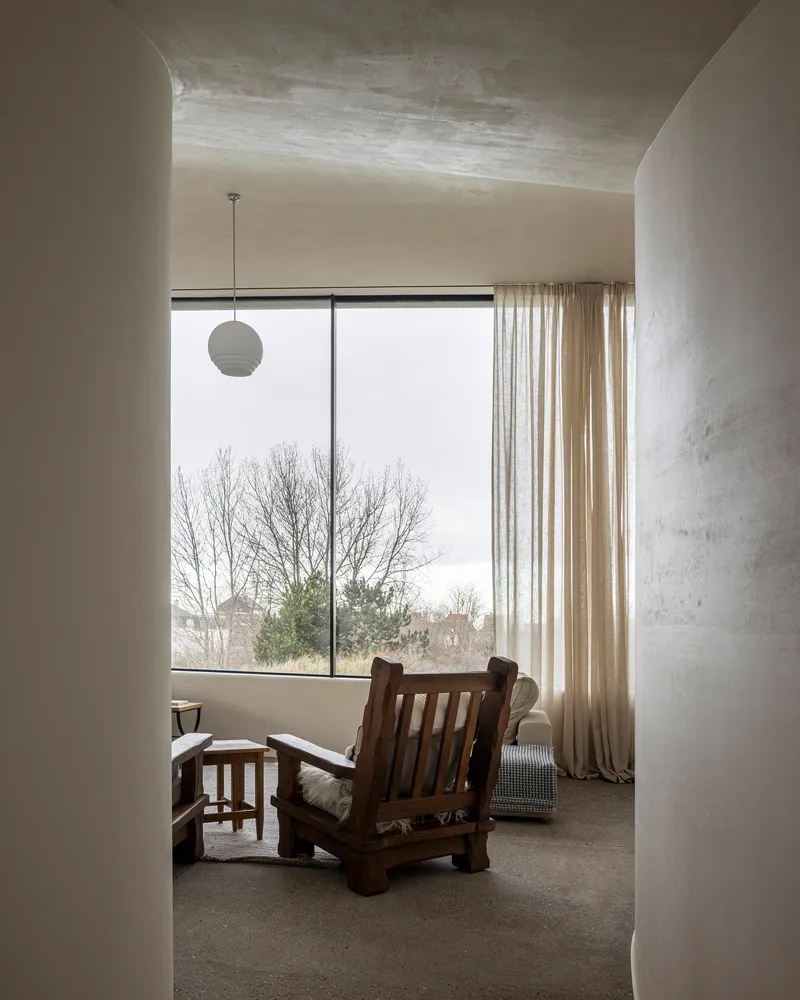
The living room sits beneath the highest point of the sloping roof, where the volume expands and a globe pendant light hangs at the apex. Timber lounge chairs are arranged beneath the curved ceiling in soft, diffused daylight. A white cylindrical column beside the seating area supports the structure while doubling as a spatial marker, signaling the transition from public living space to more intimate zones.
Throughout the house, windows are positioned to exploit the curvature of the walls. A large opening framed by curved plaster reveals bare winter trees outside, its proportions tuned to the specific view. The arched ceiling above compresses the space just enough to create a sense of shelter without claustrophobia. Light washes the lime-washed surfaces differently at every hour, and the house's orientation ensures that no room is left in permanent shadow.
Bathrooms Carved from Mass
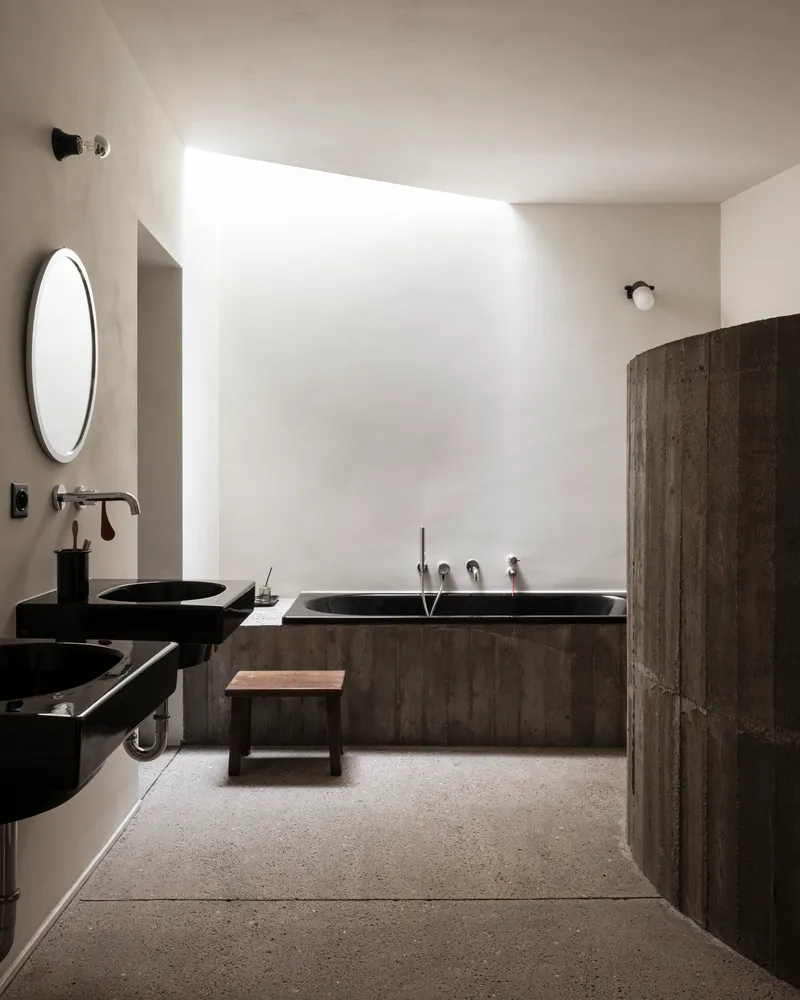
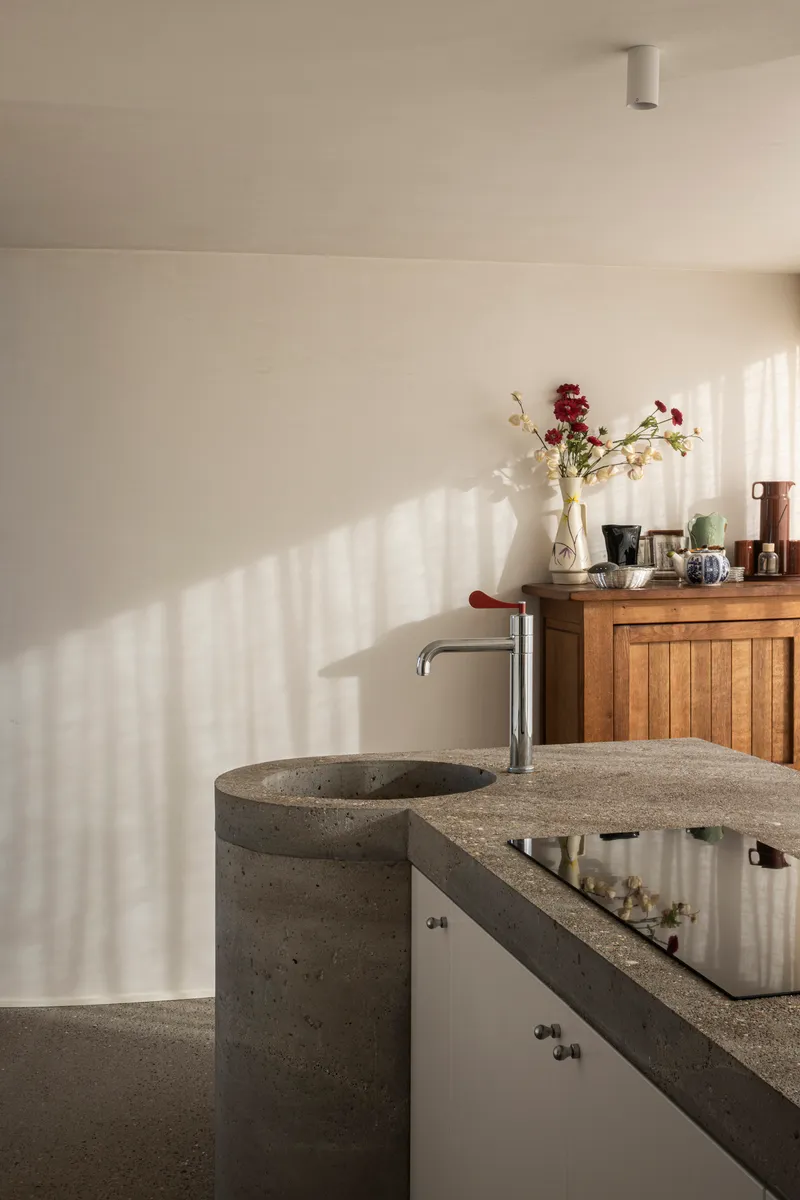
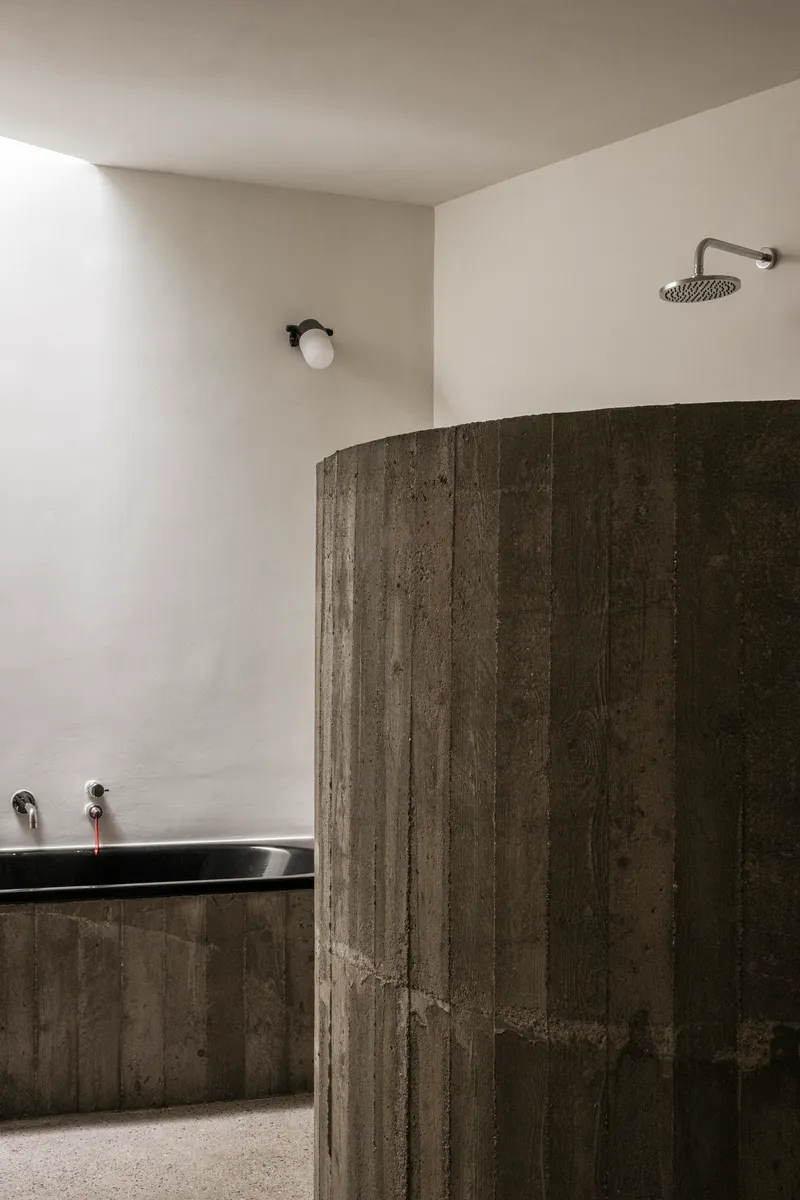
The bathrooms continue the logic of monolithic subtraction. A skylight washes a board-formed tub surround in raking light, while black vessel sinks sit on a plaster shelf that appears to have been scooped from the wall. In another bathroom, a terrazzo counter catches striped shadows from a slatted window, turning the vanity into a sundial. The curved shower wall, also board-formed, wraps around a minimal rainfall fixture with no threshold or transition: just one continuous concrete surface.
These are not bathrooms designed to impress with luxury finishes. They are rooms where the material commitment of the entire house is carried through to its most private moments. The consistency is the point. When the shower wall has the same texture as the street facade, the building achieves a rare integrity.
Material Details at Close Range
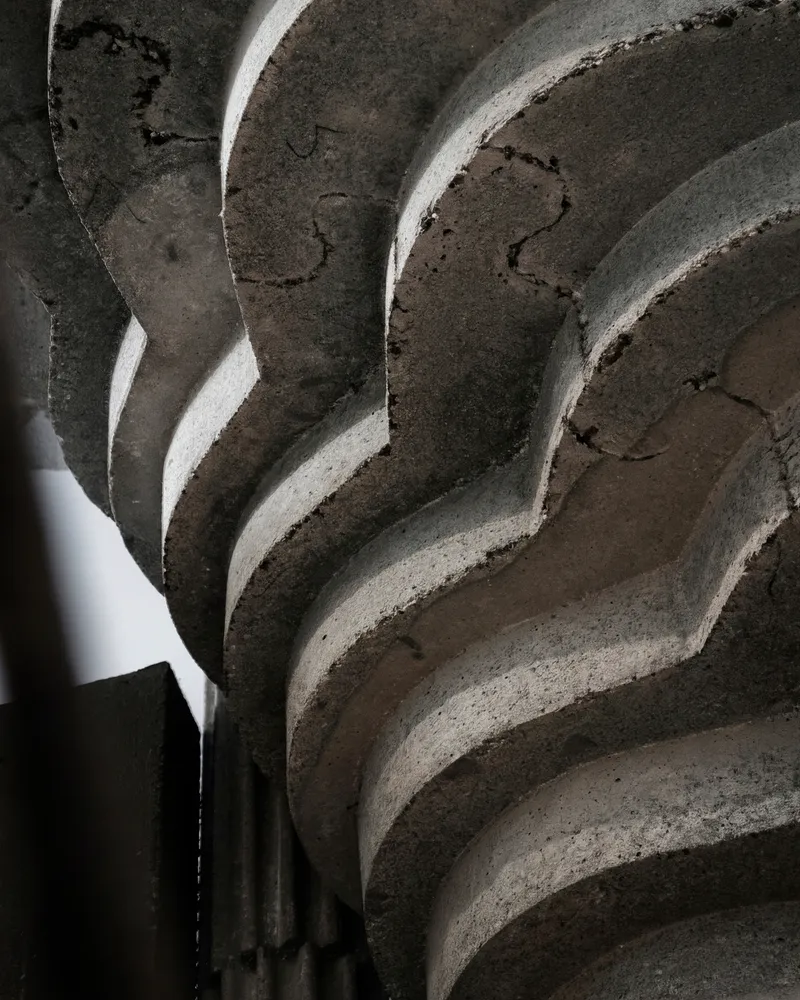
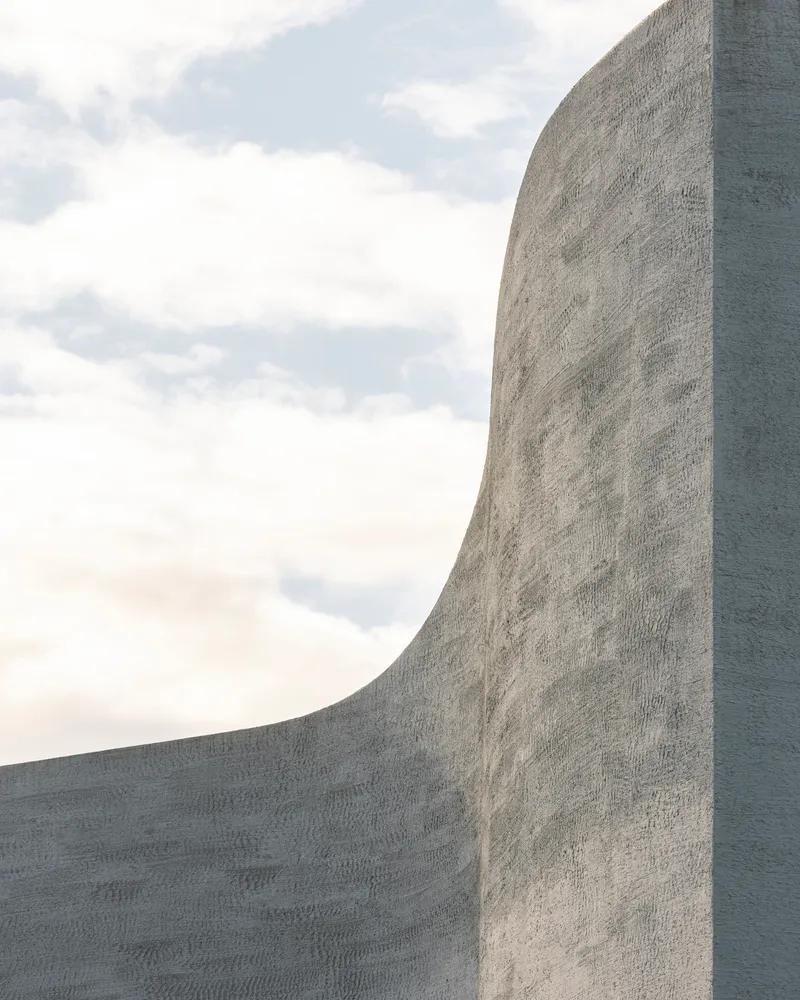
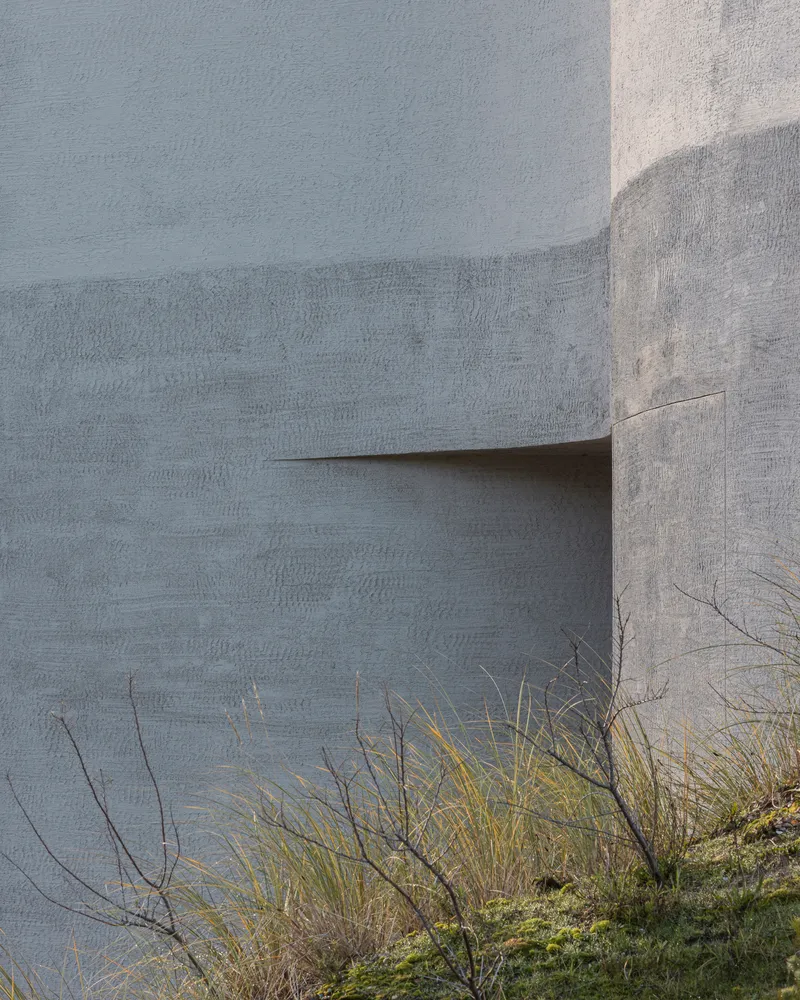
Up close, the concrete reveals its biography. The undulating soffit beneath the staircase shows the rhythm of the formwork boards, each layer offset slightly to produce a rippling texture. On the exterior, the horizontal lines of the board forms register as geological strata, while native grasses at the base soften the transition to the dune. The roof edge, photographed against a dusk sky, curves without any visible flashing or trim, an absence that required significant detailing effort to achieve.
These details matter because they demonstrate that the organic geometry of the house is not a surface effect. The curves are structural. The texture is formwork, not applied finish. The absence of conventional roof edges, window sills, and wall-to-floor transitions is the result of a design process where architecture and engineering were developed as a single discipline. It is an expensive way to build a house, and the result justifies the investment.
Plans and Drawings
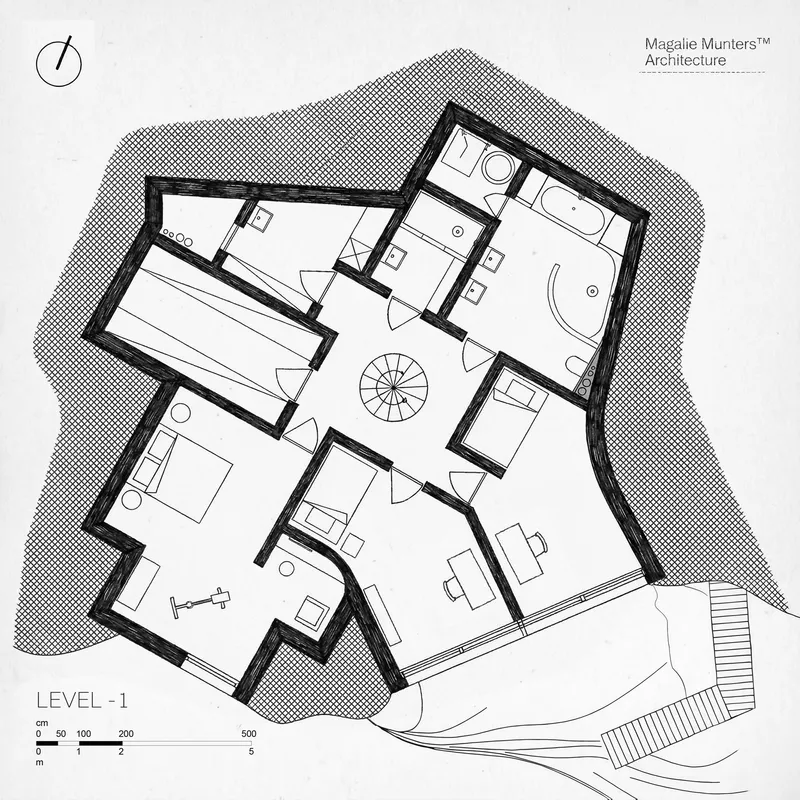
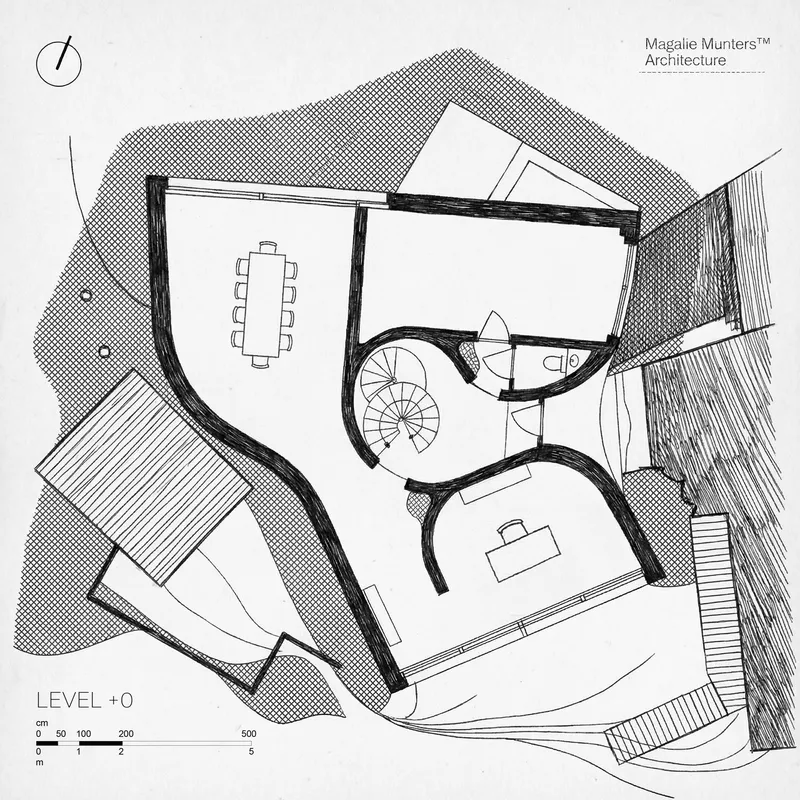
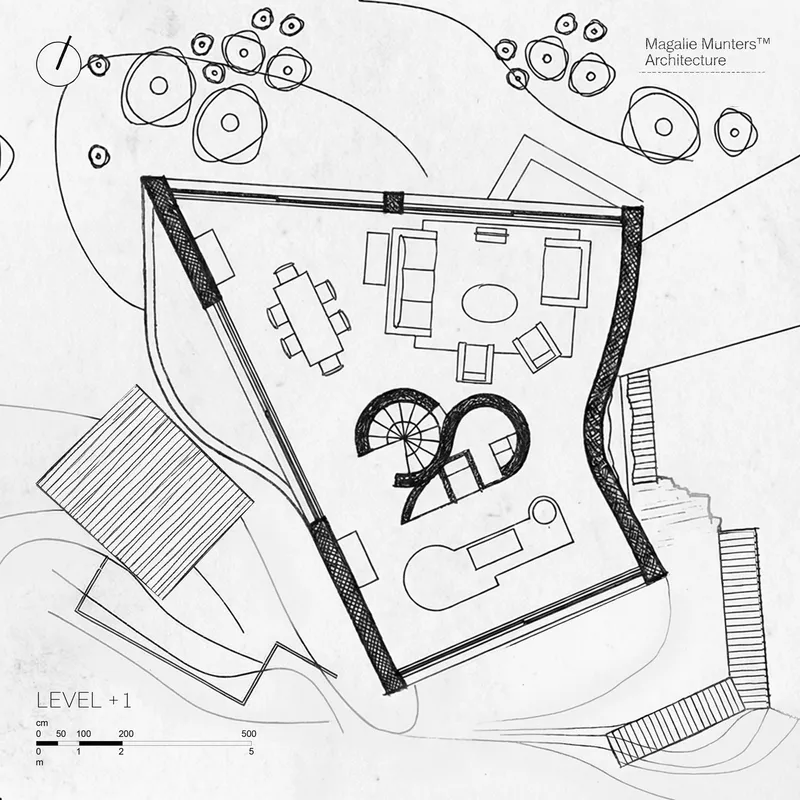
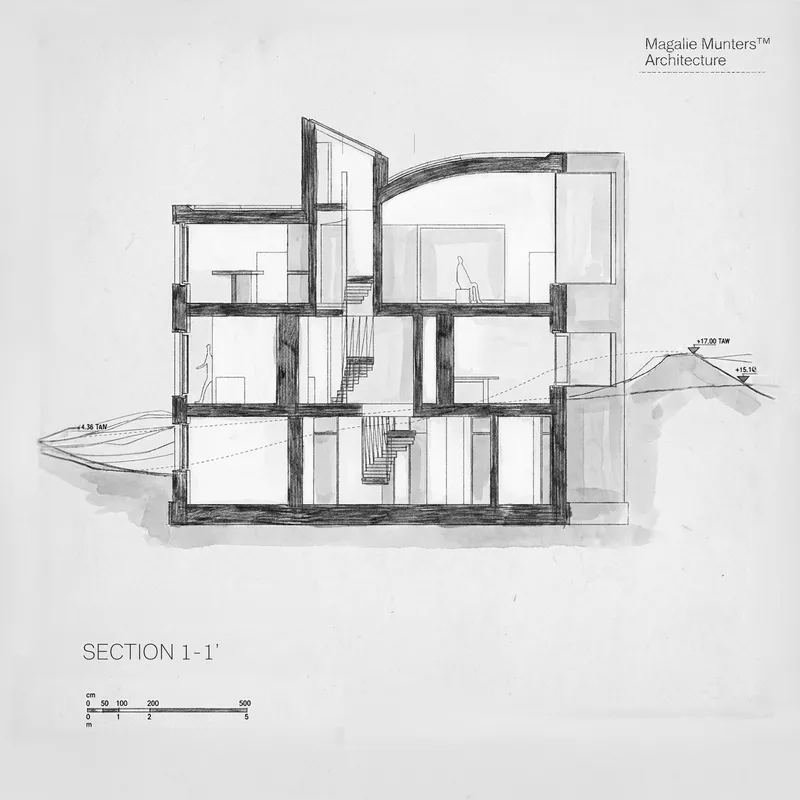
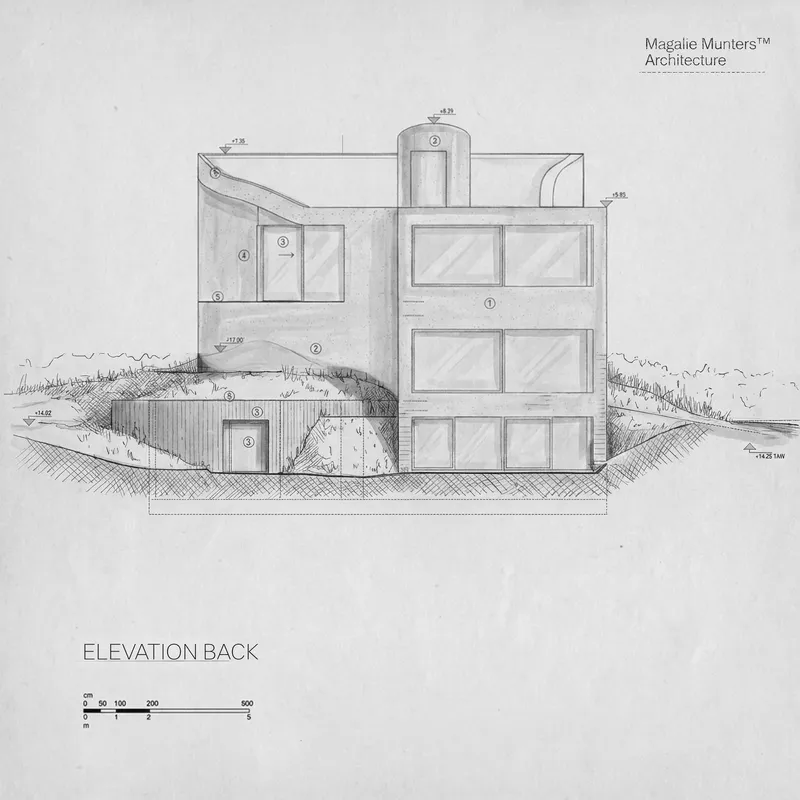
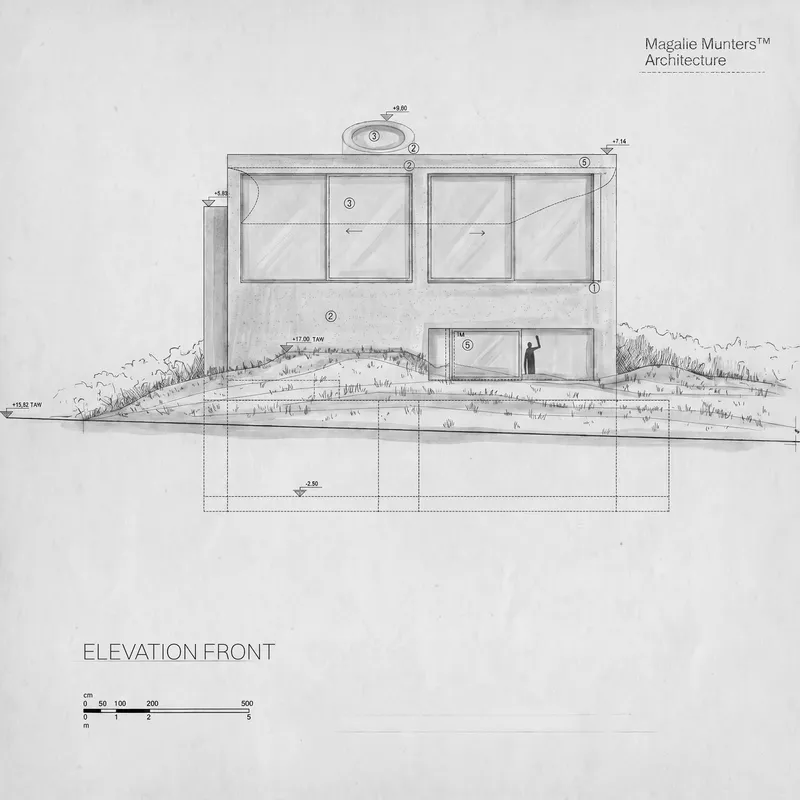
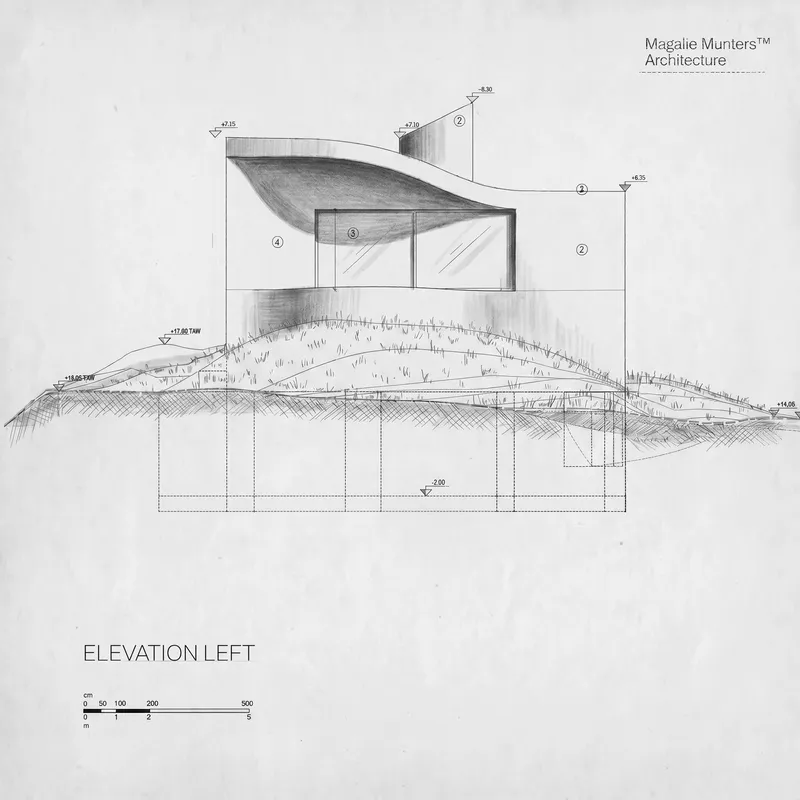
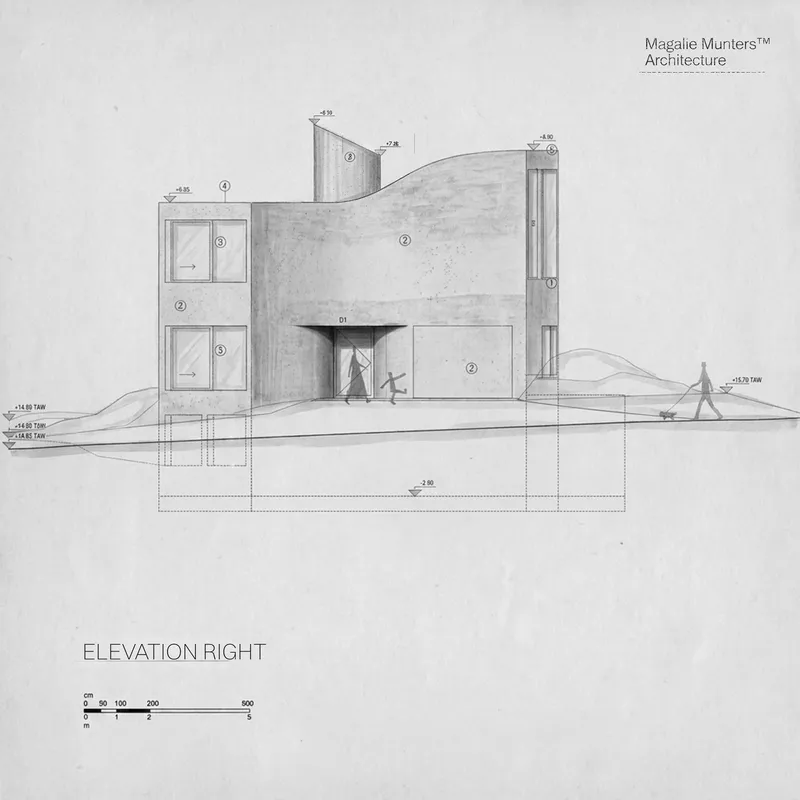
The floor plans confirm what the photographs suggest: the house is organized around a central spiral stair that connects all four levels. Level minus one contains the bedrooms, arranged in a compact cluster around the stair core. Level zero holds the dining and living areas, their curved walls pushing outward toward the garden and the dunes. Level plus one opens to a generous living space with the surrounding landscape indicated in the drawing, showing how the building narrows to preserve its garden.
The section drawing is the most revealing. It shows the sloping terrain to the right, the half-buried lower level, and the ascending roofline that rises over the living areas before descending toward the bedrooms. Four levels are connected by staircases at two locations, providing redundancy in a compact plan. The elevations, meanwhile, demonstrate the range of facade expression: the street side is mostly solid concrete with punched openings, while the dune side is predominantly glazed. The annotated elevation shows the curved roof structure emerging from the landscape, confirming that the building was designed to be read in profile as much as in plan.
Why This Project Matters
Villa Nouvelle Vague arrives at a moment when residential architecture is awash in rendered curves that never get built, or get built and immediately leak. Magalie Munters has delivered a house where the organic form is not a stylistic preference but a site-specific response to wind, light, and the topography of a protected dune reserve. The building is partly buried, oriented to track the sun, shaped to deflect the prevailing coastal weather, and detailed so that the concrete continues uninterrupted from facade to furniture. That kind of total integration is rare in houses at any budget.
The project also represents an increasingly visible trend in Belgian architecture: small practices producing highly crafted, materially intense buildings that prioritize spatial experience over programmatic novelty. Munters is not reinventing the house. She is making one that feels inevitable on its site, as though it had always been there, waiting for the dune grass to grow back. In a discipline that often rewards the spectacular over the considered, Villa Nouvelle Vague is a welcome argument for the latter.
Villa Nouvelle Vague by Magalie Munters™ Architecture, Koksijde, Belgium. 330 m², completed 2025. Photography by Tim Van de Velde.
About the Studio
Share Your Own Work on uni.xyz
If projects like this are the kind of work you want to make, uni.xyz is a place to publish your own, find collaborators, and enter design competitions.


Popular Articles
Popular articles from the community


U.GA Architects Wraps an Oval Rooftop Pool in Curved Board-Formed Concrete on Busan's Jeollidan-gil
In Busan's Jeonpo-dong, a 454 m² mixed-use block stacks a neighborhood facility, guest rooms and an oval rooftop pool inside spiraling concrete walls.

David Macias Steps a Doorless Stone and Plaster House Down a Tropical Colombian Hillside
In the humid hills of Colombia, Threshold House replaces the front door with an open void and terraces its 850 m² down the slope instead of fighting it.

David Ortega Stacks a Two-Story Mexico City Penthouse Around a Steel Stair and a Pergola-Shaded Roof Terrace
In Colonia Roma, a 300 m² penthouse uses oak joinery, a planted steel stair and a slatted roof pergola to make a new-build apartment feel like a house.

Jaramillo Van Sluys Arquitectura and Urbanismo Turn a Demolished Registry Lot in Quito into an Orchard Plaza
In Quito's Centro Histórico, a 2,800 m² plaza exposes the San Agustín convent wall and redraws its lost Augustinian orchard in volcanic stone.

Similar Reads
You might also enjoy these articles


LAVA Architecten Gives Vocational Education a Sawtooth-Roofed Face on a Mechelen School Campus
In Mechelen, Belgium, a 2,053 m² STEM school on a 6×6 m grid turns workshops and classrooms into rooms that can be rearranged as teaching changes.

KEMA Studio Turns a Derelict Marvila Attic into a 60 m² Lighthouse Apartment Above Lisbon
In Lisbon's Marvila district, a rebuilt roof, four skylights and two plywood volumes turn an unlivable attic into a bright home facing the Tagus.

Pixel Gardens: One Repeated Module Stacked Into a Terraced Social Housing Tower for Famagusta
Salem Bader's shortlisted housing tower builds a vertical neighbourhood from one repeated module, offsetting units to carve terraces, light and air.

Bao Huynh Watercolor Atelier: A Serene Art Retreat in Hội An
Bao Huynh Watercolor Atelier in Hội An blends multifunctional art spaces, sustainable design, local materials, and family-friendly living in a serene environment.

Explore Residential Building Competitions
Discover active competitions in this discipline

Comments (0)
Please login or sign up to add comments
No comments yet. Be the first to comment!