

Magnum Architectes Wraps 16 Kilometers of Archives in Stamped Concrete on a Former Convent Site
Two six-story extensions bookend a 1987 storage facility in the heart of Angers, France, adding monolithic presence to a constrained urban plot.


Sixteen kilometers of linear archive storage is not a poetic brief. It is a logistical problem wrapped in environmental controls and fire codes, the kind of program that rarely yields a building worth photographing. Yet the Maine-et-Loire Archives Storage Extension by Magnum architectes and urbanistes manages exactly that: a pair of pale, faceted volumes that bookend an existing 1987 storage building on the rue de Frémur in Angers, giving a utilitarian facility a civic presence it never had.
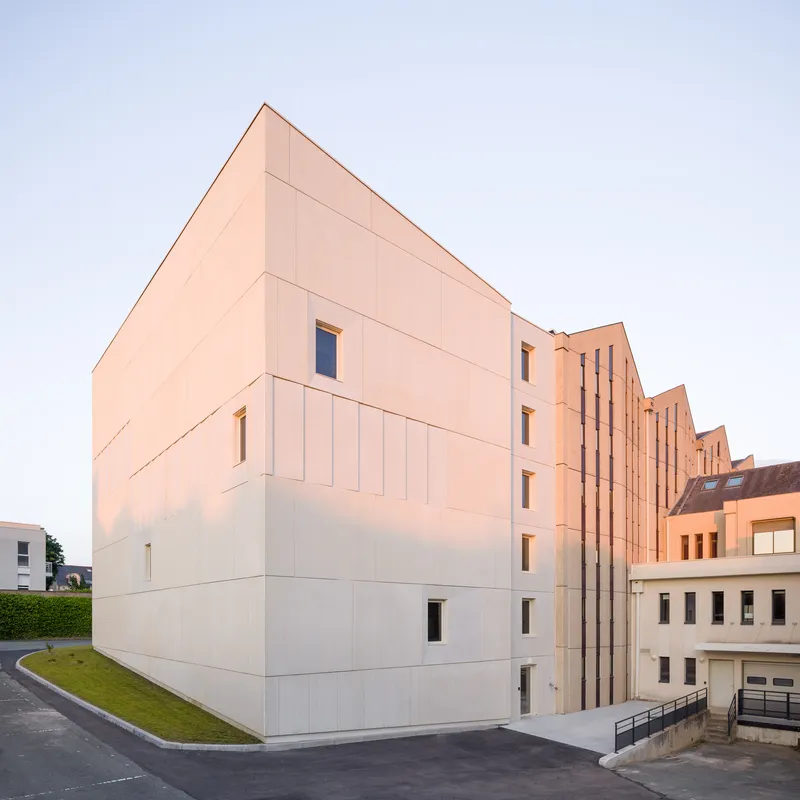
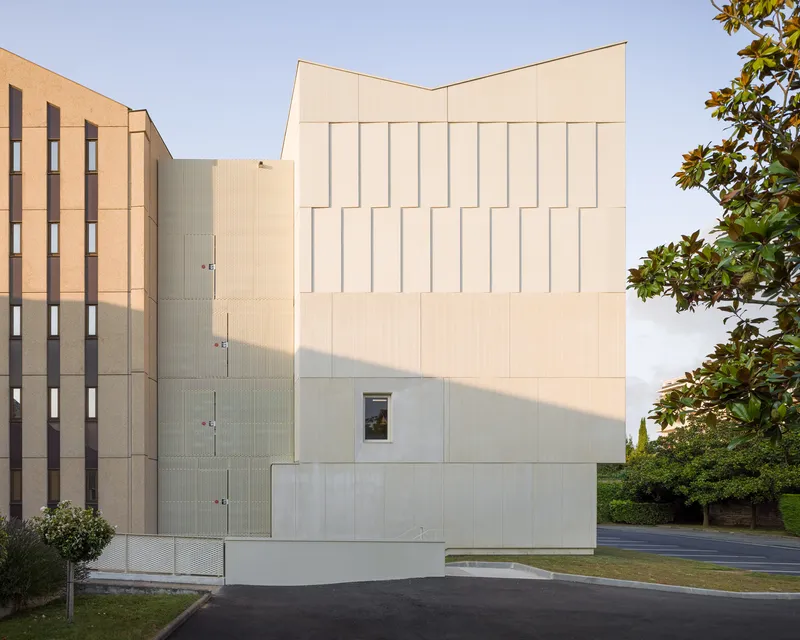
The site is the former Visitation convent, an enclosed urban plot hemmed in by residential towers and narrow streets. There was essentially nowhere to expand but up and out at either end. The architects responded with two six-story additions, each clad in stamped concrete panels whose vertical striations catch raking light and shift in tone throughout the day. The result is a building that reads as monolithic from a distance but reveals fine-grained texture up close, a quality that rewards the pedestrian in a neighborhood that otherwise turns its back on the street.
A Double Move on a Tight Plot
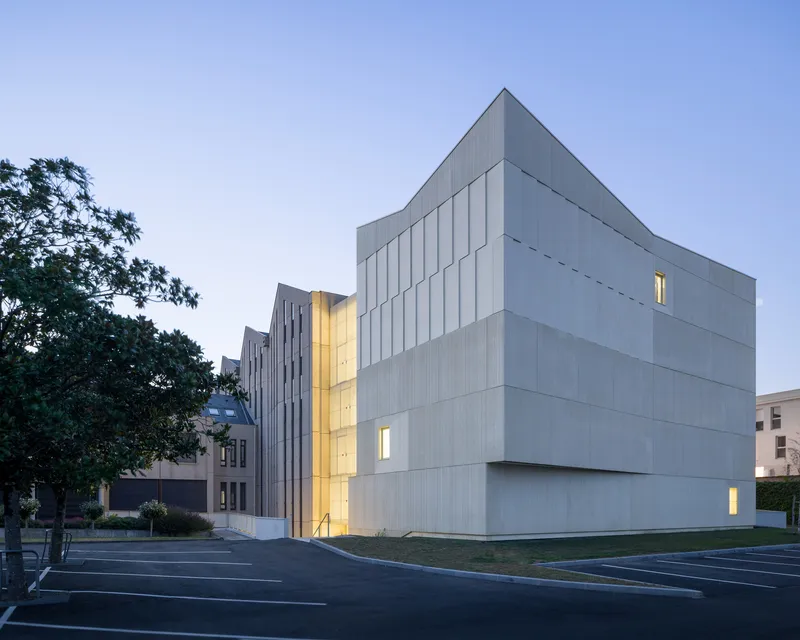
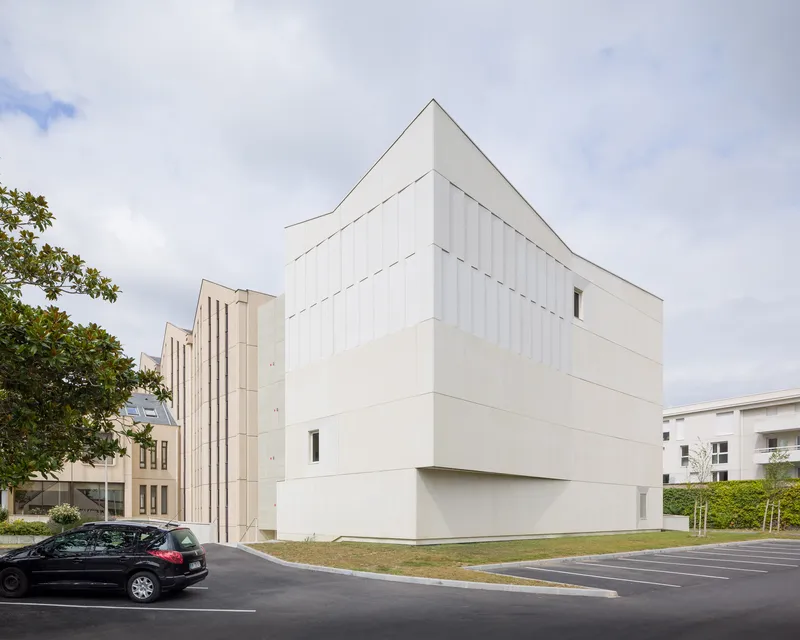
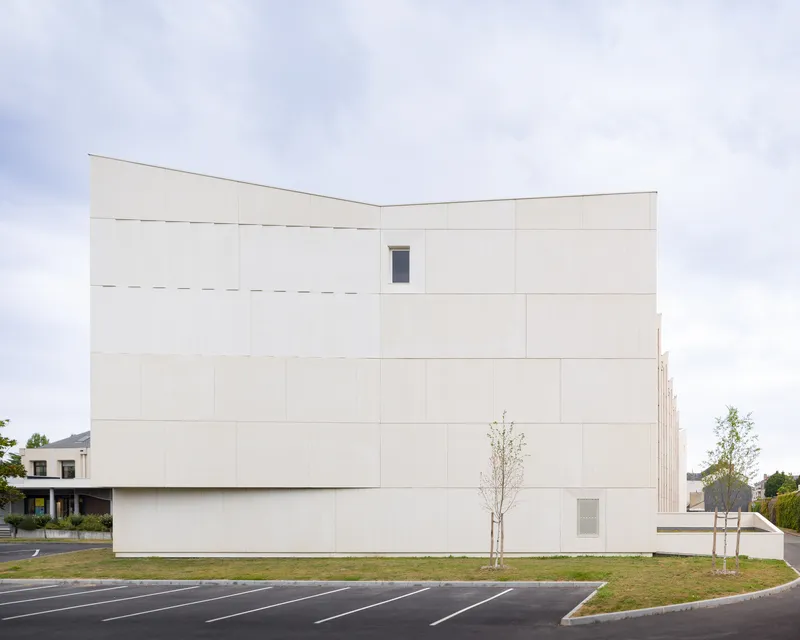
Rather than a single extension, the project splits its program into two complementary volumes placed at opposite ends of the existing facility. The strategy is pragmatic: it distributes structural loads, keeps the central building operational during construction, and avoids the need to demolish anything. But it also has formal consequences. The two new volumes frame the older building between them, turning what was a nondescript shed into the middle term of a composed sequence. From the street, the pale gabled end walls register as a pair, giving the complex a bilateral symmetry it never possessed.
The constrained site means that each extension pushes right up against the plot boundary. There is no landscaped setback, no buffer zone. The buildings meet the sidewalk with flat, nearly windowless walls. In most contexts this would feel hostile, but the warm cream tone and the fine vertical ribbing of the stamped concrete soften the effect considerably.
Stamped Concrete as Civic Armor
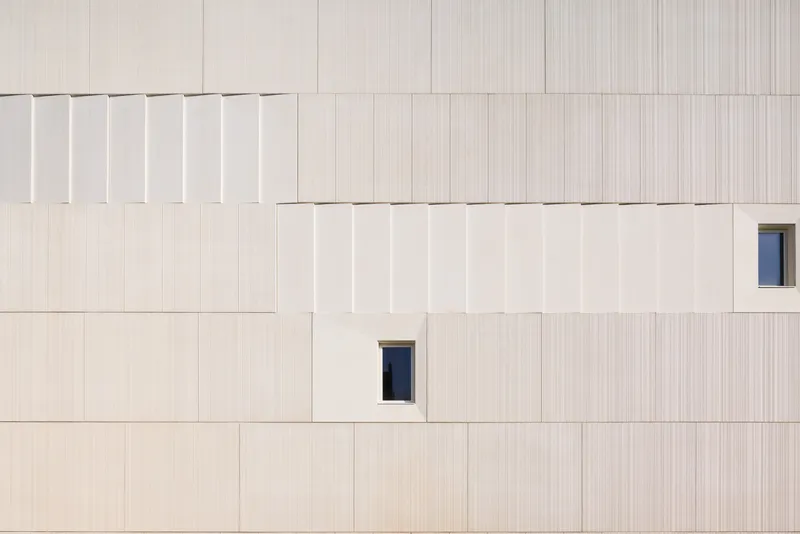
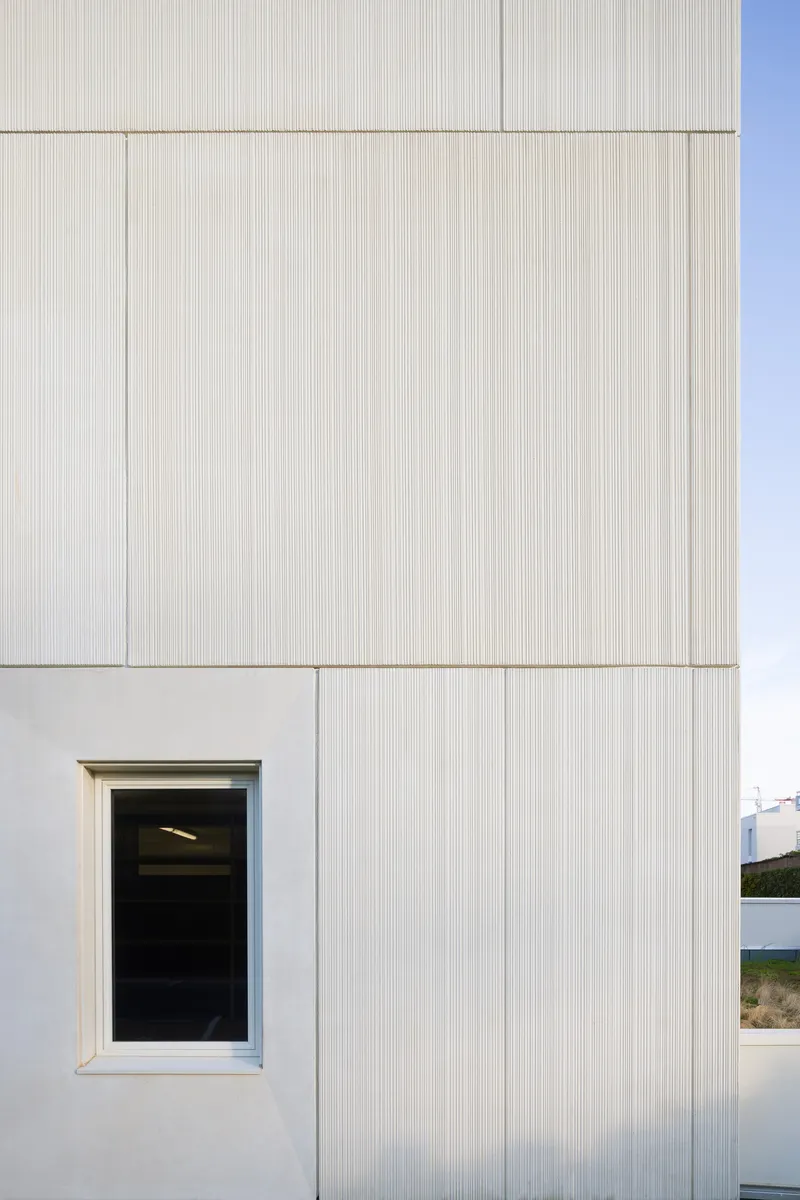
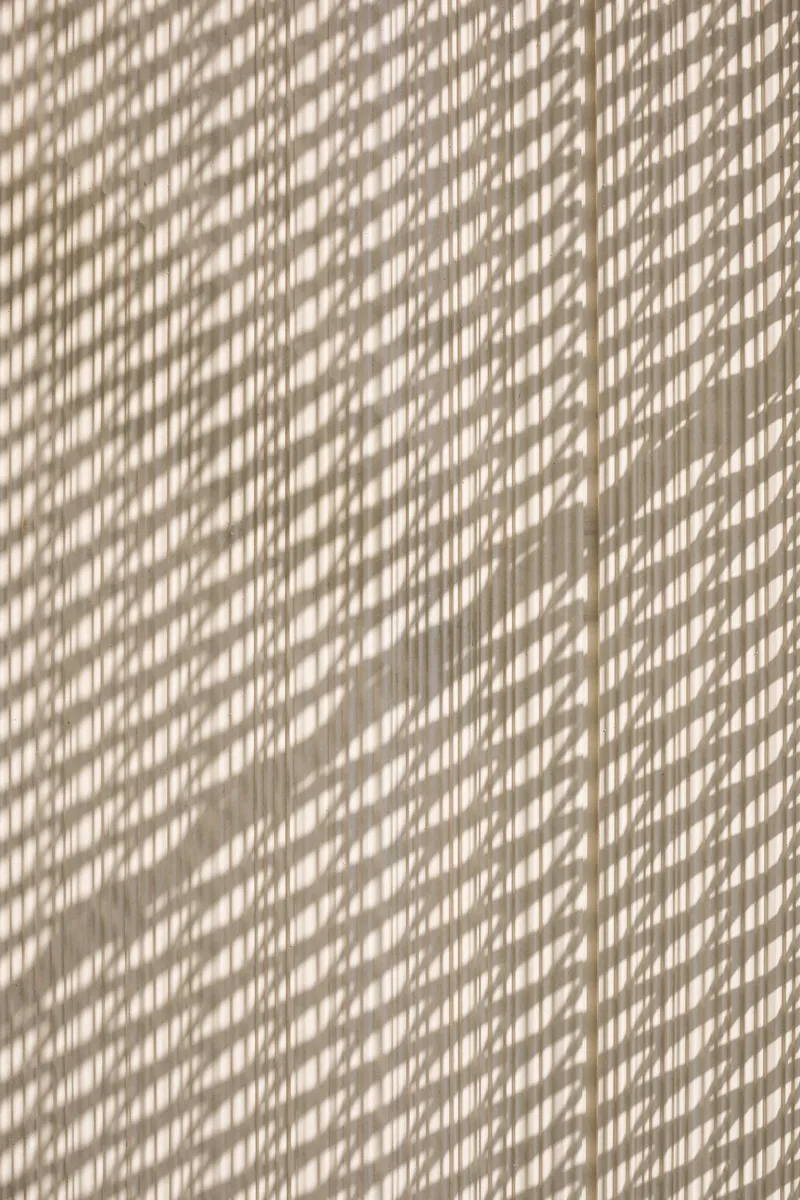
The cladding is the project's signature move. Stamped concrete panels with offset vertical joints cover every face of the two extensions, creating a striated surface that oscillates between masonry and textile depending on the angle of light. The panels are not decorative appliqué; they form the outer leaf of a double-wall construction that is essential to the archival program, providing the thermal mass and vapor control that paper documents demand.
Close up, the texture is surprisingly tactile. Dappled sunlight falling across the ribbed surface produces the kind of shadow play you normally associate with stone carving. It is a reminder that concrete, when treated with care, can be as refined as any natural material. The minimal window openings, just two small rectangular slots on some elevations, reinforce the impression of a sealed container, a strongbox for collective memory.
The Glass Stair Tower as Hinge
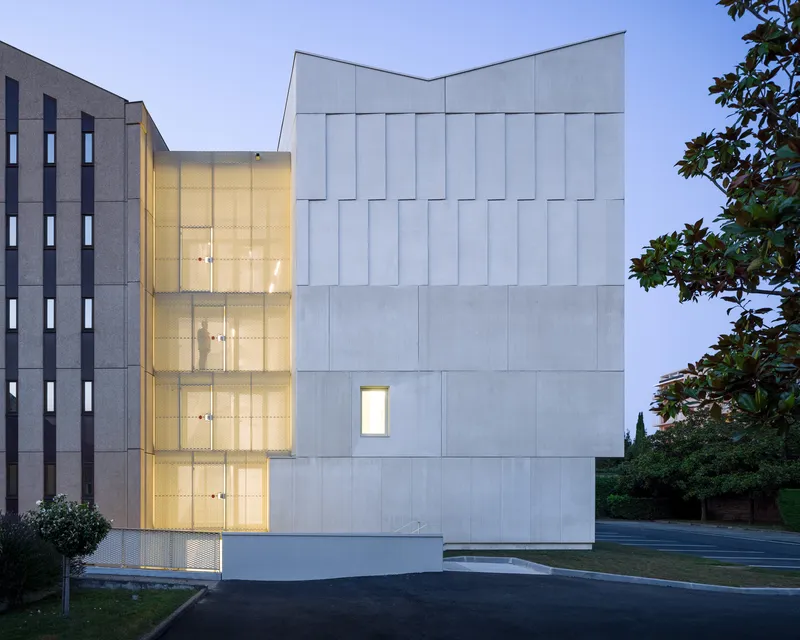
Where the new extensions meet the existing building, a glazed stair tower acts as the primary circulation spine. At dusk it glows from within, drawing a luminous line between the old concrete frame and the new stamped panels. The transparency is strategic: it signals the public-facing parts of the building (stairs, lobbies, a small reception area) while the opaque volumes behind it remain resolutely closed. The hierarchy is legible even from across the street.
The stepped sawtooth profile of one of the extensions adds a further wrinkle. Seen from the west in warm evening light, the angled roofline breaks the silhouette of the residential tower behind it, introducing a scale and rhythm that is distinctly institutional without being overbearing. It is a quiet assertion that public buildings, even storage buildings, deserve more than a flat parapet.
Controlled Light Inside the Vault
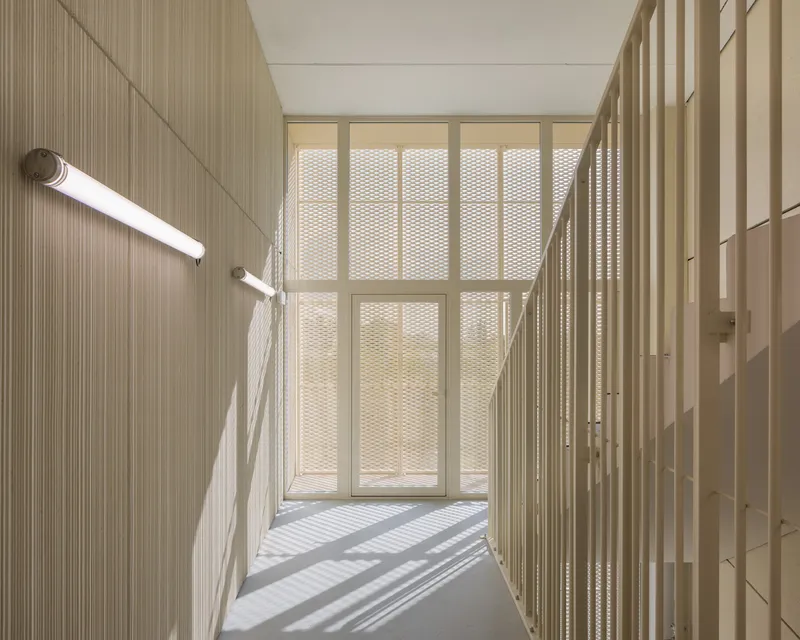
Natural light inside an archival facility is a paradox. Paper, parchment, and photographic film degrade under ultraviolet exposure, yet the humans who manage them need daylight to work comfortably. The architects resolve this by restricting each storage level to a single patio door, enough to orient staff and provide emergency egress without bathing shelves in sunlight. The stairwell takes a different approach: timber slats and translucent glass screens filter light into a warm amber glow that softens the institutional character of the circulation core.
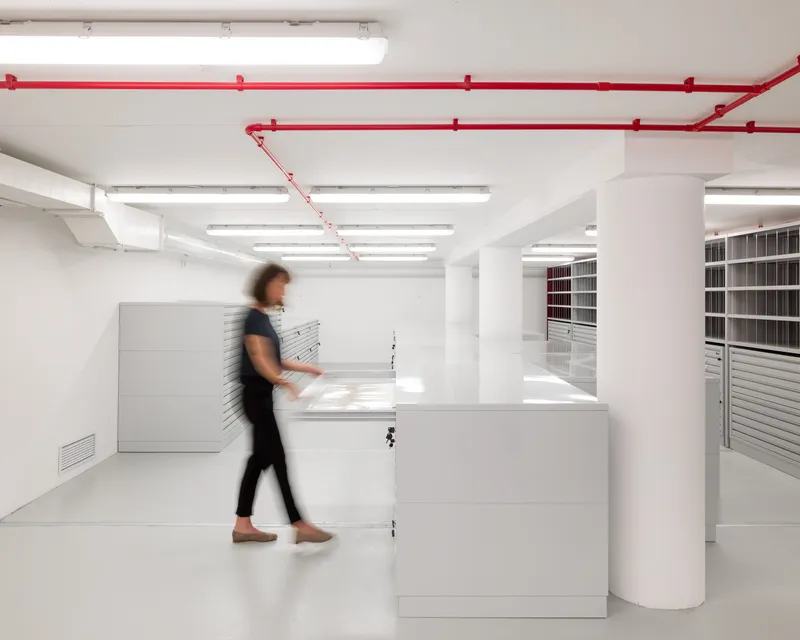
The reception area, with its white desk and exposed red conduit on the ceiling, is deliberately spartan. There is no attempt to dress up the utilitarian nature of the program. The architecture does the work on the outside; inside, function rules.
Red Shelving, White Walls
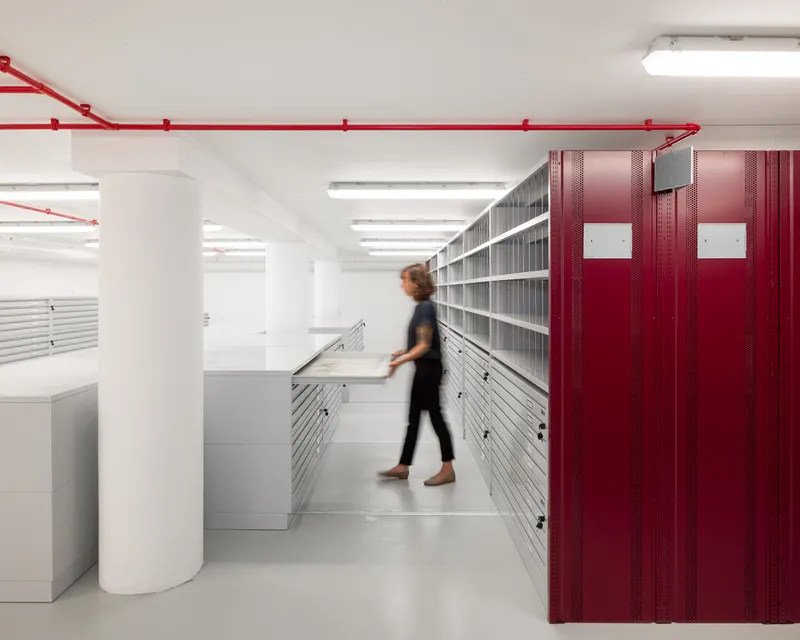
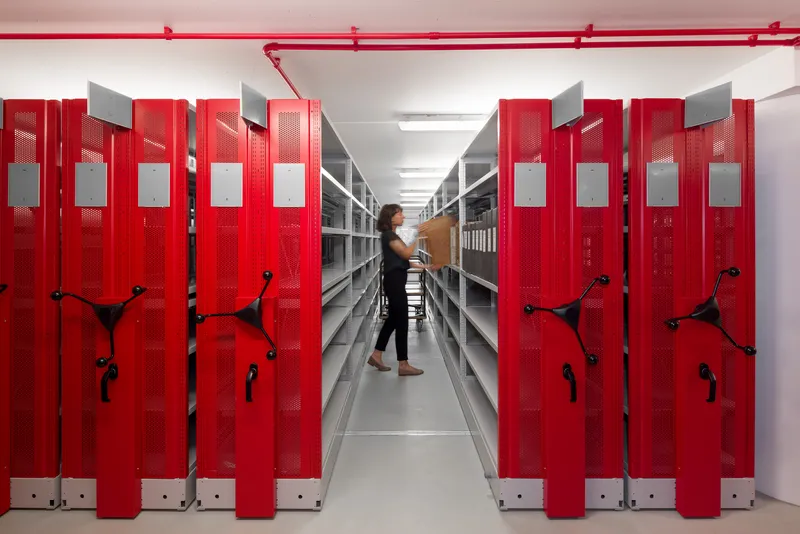
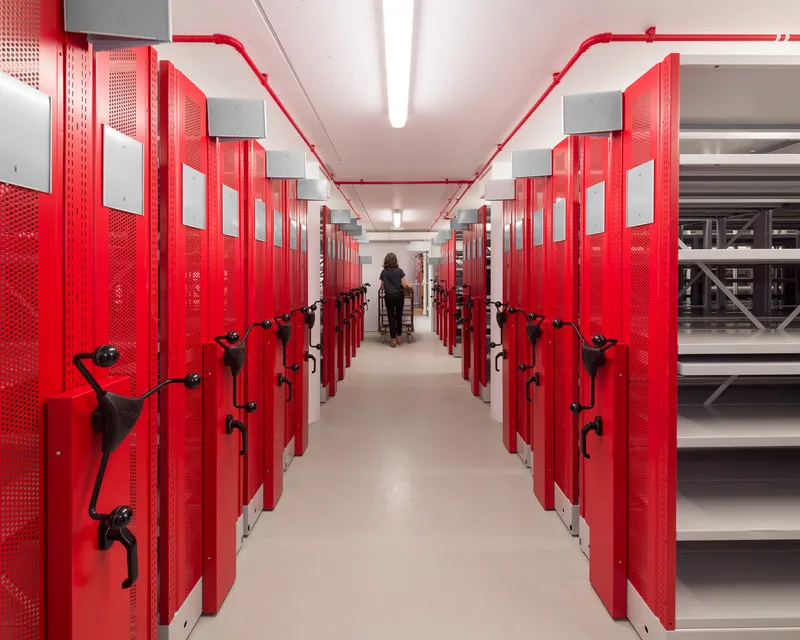
The archive rooms themselves are governed by the mobile shelving system: tall red units on rails that compact together to maximize storage density and pull apart to create aisles on demand. It is a standard solution for institutional archives, but the color is striking. Against the white walls and polished floors, the red shelves produce an almost graphic environment, more De Stijl than filing cabinet.
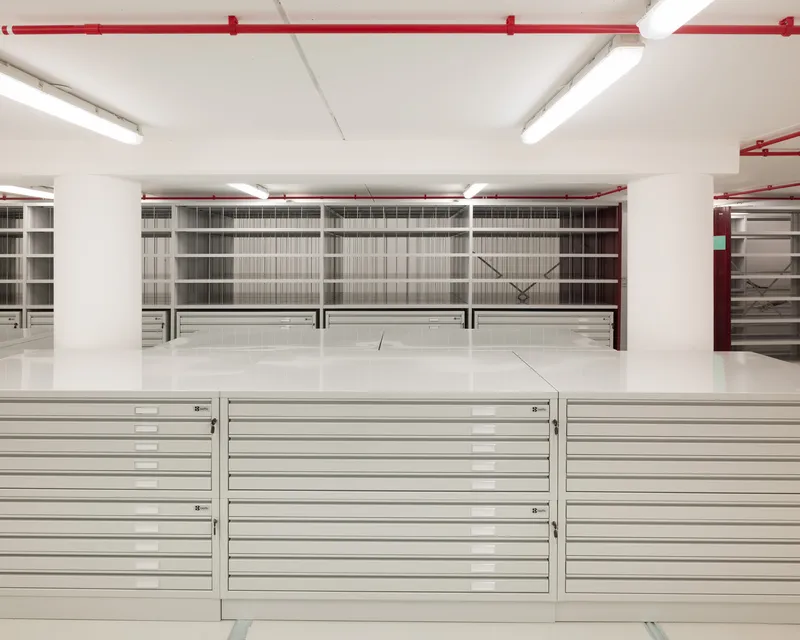
Flat-file cabinets for oversized documents and wall-mounted shelving for smaller collections round out the storage typology. Everything is modular, everything is replaceable, and the concrete shell will outlast several generations of furniture. The architects clearly understood that the building is a container first and a composition second, and they designed accordingly.
Plans and Drawings
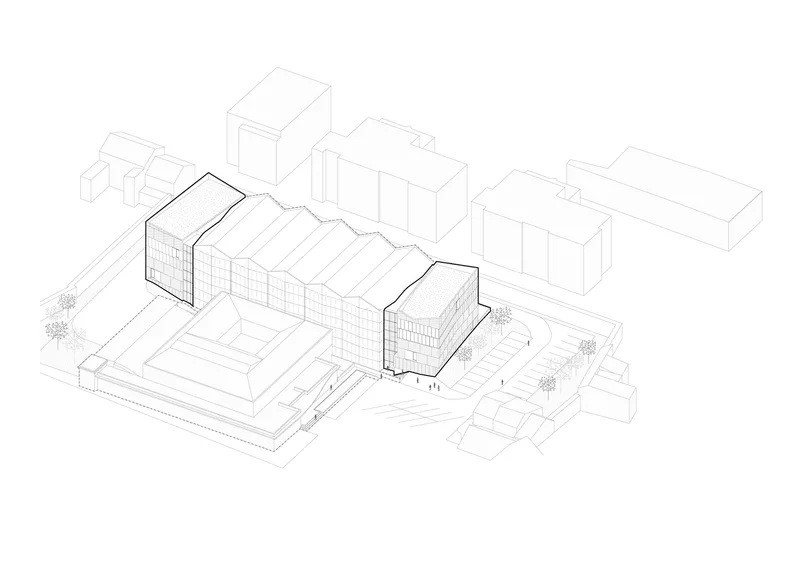
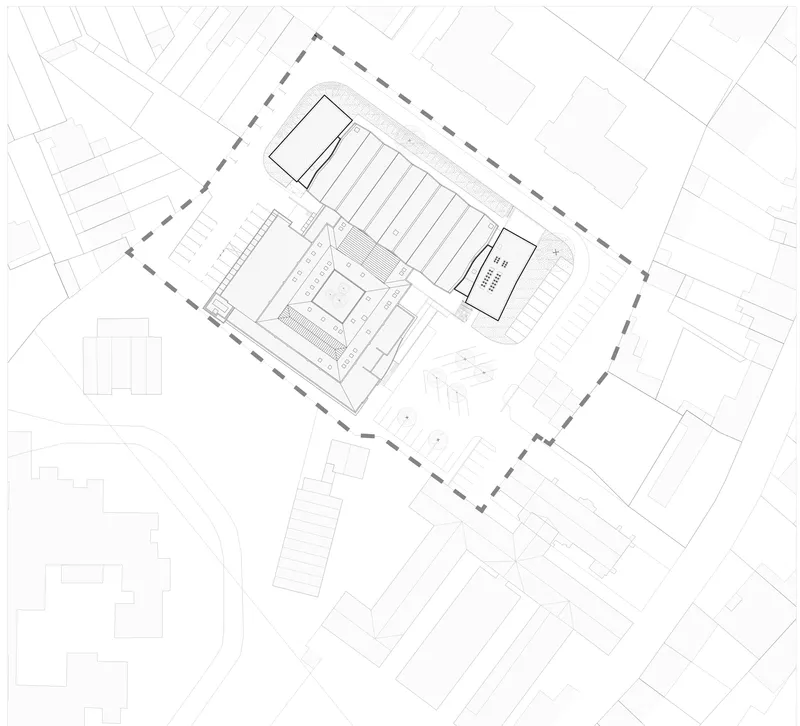
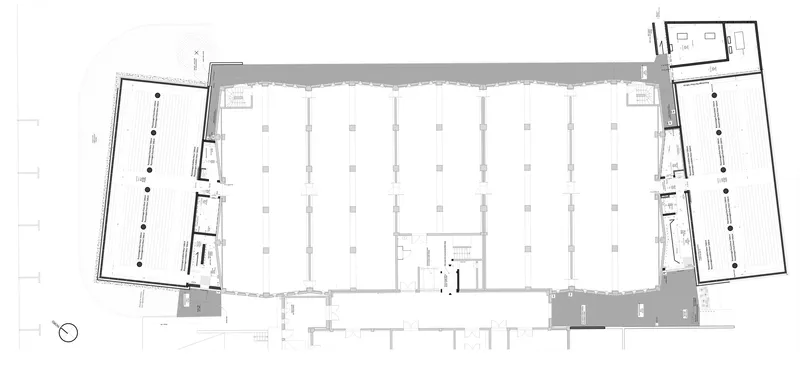
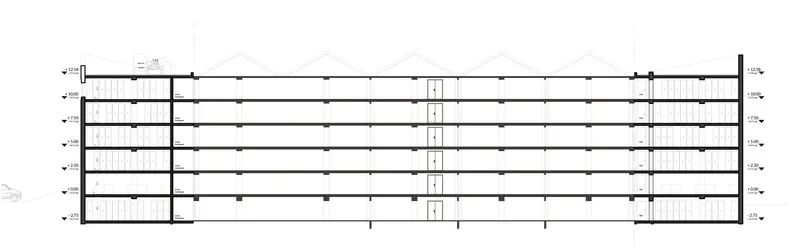
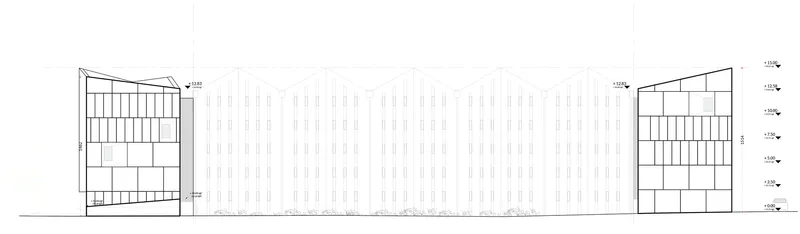
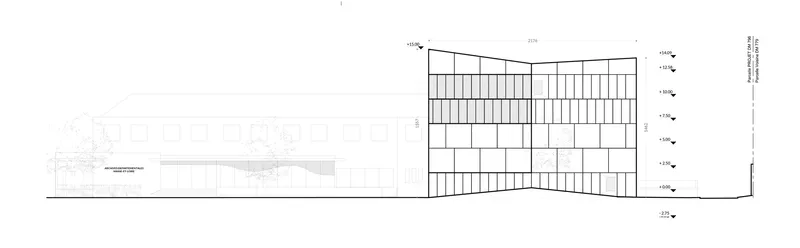
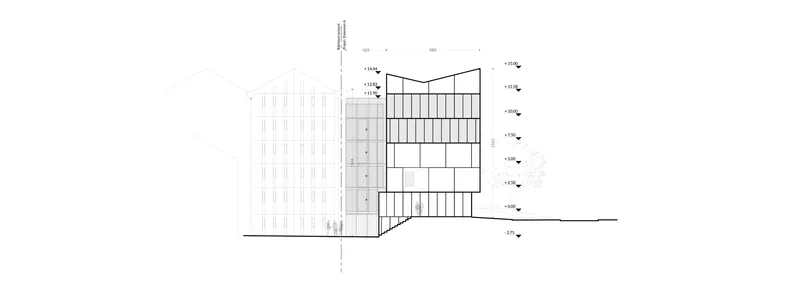
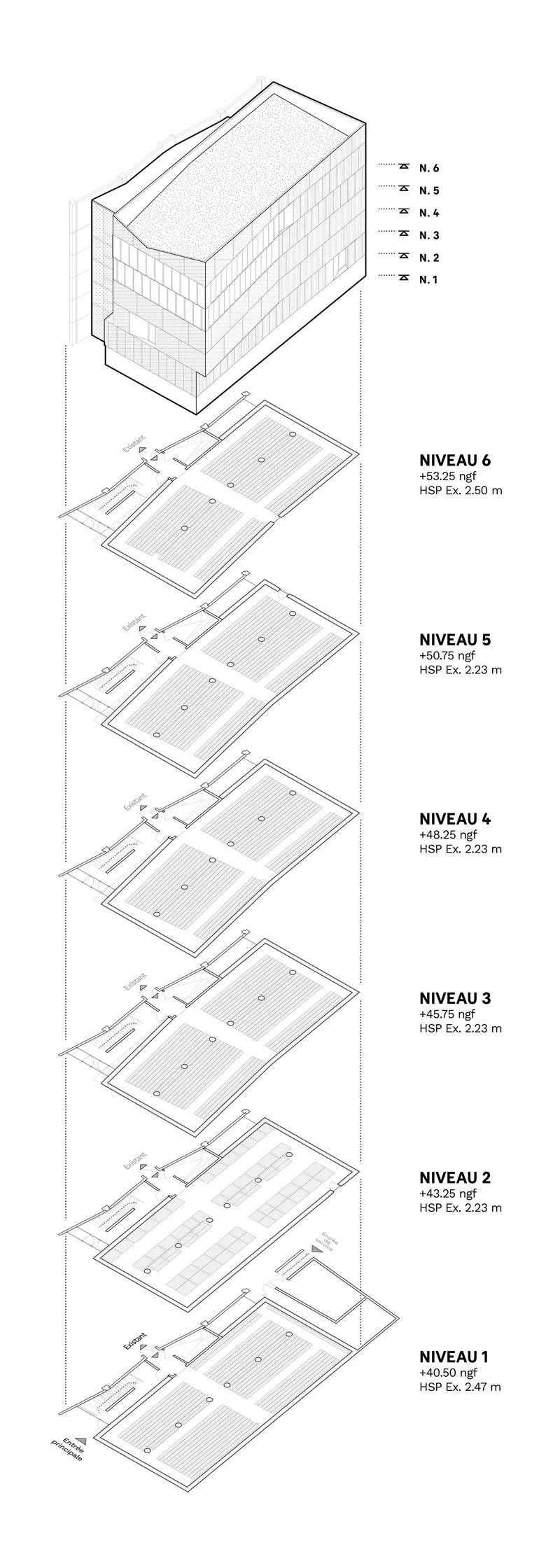
The drawings make the bilateral strategy legible. The site plan shows the sawtooth-roofed hall sitting within a tight urban grain, its extensions reaching toward the plot edges. The floor plans reveal a long rectangular layout with a central circulation core and stairwells at each end, an arrangement that keeps the storage floors column-free and maximizes flexibility. The exploded axonometric is particularly instructive: six floor plates stacked above a gridded facade volume, each plate a self-contained archive environment. The elevations confirm the interplay between the taller end volumes and the horizontal glazed central section, a tripartite composition that reads clearly despite the complexity of the program.
Why This Project Matters
Archives are among the least glamorous building types in public architecture. They store documents that most citizens will never see, they demand stable humidity and temperature at the expense of spatial drama, and their budgets reflect the low priority governments assign to cultural infrastructure. The usual result is a warehouse on the outskirts of town. What Magnum architectes and urbanistes have done in Angers is refuse that default. By placing the extension in the historic core, cladding it in a material that rewards close looking, and composing its massing to engage the surrounding streetscape, they argue that preservation of the public record deserves the same architectural ambition as a museum or a concert hall.
The building also demonstrates that constraint can be generative. A landlocked site, a demanding conservation program, and a limited material palette (concrete, aluminum, glass) produced something more coherent than most projects enjoy with far greater freedom. The stamped concrete panels do triple duty as weatherproofing, thermal mass, and civic ornament. The double-wall construction is both structural and environmental. Nothing is arbitrary, and that discipline is legible in the finished building. Sixteen kilometers of shelving, wrapped in a skin that changes with every shift of the sun: that is a reasonable definition of architecture doing its job.
Maine-et-Loire Archives Storage Extension by Magnum architectes and urbanistes. Angers, France. Completed 2022. Photography by François Dantart.
About the Studio
Share Your Own Work on uni.xyz
If projects like this are the kind of work you want to make, uni.xyz is a place to publish your own, find collaborators, and enter design competitions.


Popular Articles
Popular articles from the community


Singing Woman: Contemporary Architecture Inspired by Estonia’s Voice and the Sea
Singing Woman turns Estonia’s song culture into flowing opera house architecture, blending public life, landscape, sea, and national memory.

Opera by the Sea Estonia: Three Shells Dissolving Architecture into Tallinn's Coastline
A winning opera house proposal replaces monumental form with interconnected shells that blur the boundary between building, park and Baltic Sea.
Temporary Home for Dogs: A Reversed Zoo Rethinks Animal Shelter Architecture
In Bucharest, a sinuous corridor and freed landscape flip the logic of containment, designing a shelter that works to make itself unnecessary.

Tsunami Convergenics: Turning Catastrophic Ocean Forces into Underwater Housing Infrastructure
A speculative underwater settlement off the coast of Onagawa, Japan, treats tsunamis and typhoons as energy sources rather than threats.

Similar Reads
You might also enjoy these articles

Bao Huynh Watercolor Atelier: A Serene Art Retreat in Hội An
Bao Huynh Watercolor Atelier in Hội An blends multifunctional art spaces, sustainable design, local materials, and family-friendly living in a serene environment.

Atelier Macri Concept Store Interior Design by CASE-REAL
Atelier Macri store features a "ko" counter, walnut wood details, cork displays, blending retail, gallery, and seamless customer experiences.

Manuel Vargas Izquierdo Stadium and High-Performance Sports Center: Architectural Excellence in Jalpa de Méndez
The Manuel Vargas Izquierdo Stadium blends sustainable design, inclusive sports facilities, and cultural-inspired architecture, revitalizing Jalpa de Méndez’s public spaces.

KAKR Buluh Awar Hall: Revitalizing Community and Ecology Through Bamboo Architecture
Community built bamboo hall revitalizes Buluh Awar village, empowering youth, restoring ecology, celebrating vernacular craftsmanship through sustainable architecture and culture.

Explore Staarch Architects Competitions
Discover active competitions in this discipline

Design Challenge - Contemporary interpretation of a religious complex

Challenge to design locus for the upliftment of human rights

Design challenge to reuse E-waste
Comments (0)
Please login or sign up to add comments
No comments yet. Be the first to comment!