
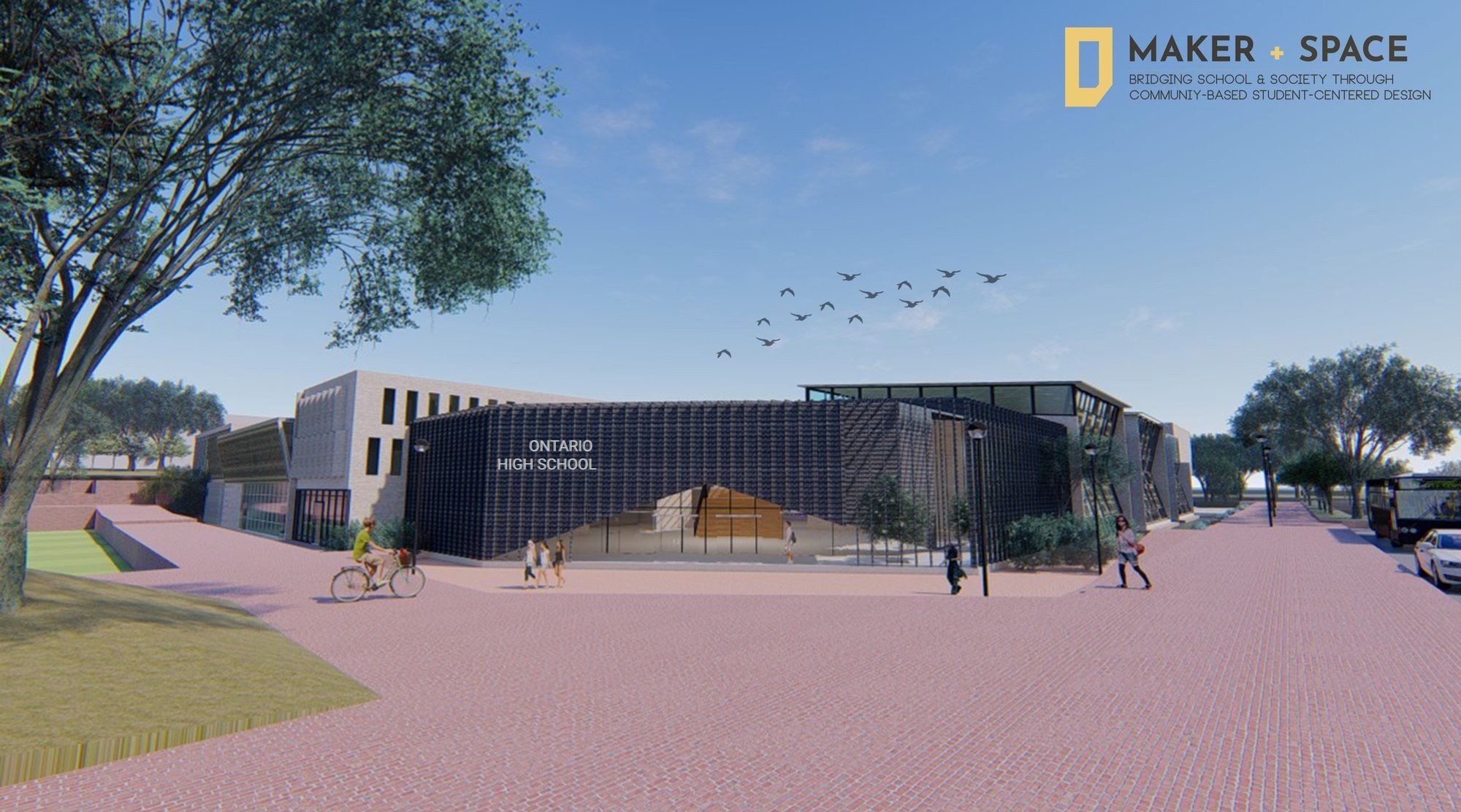
MAKER+SPACE: Redefining Future School Architecture Through Community-Centered Learning
A visionary future school architecture project transforming education through collaborative learning, community engagement, and adaptive spaces.

Shortlisted entry of School Of Thought 2020
Project by Patrisha Acuesta and Marie Eirene Fabon
The future of education is no longer confined to rigid classrooms, isolated academic systems, or standardized learning environments. Around the world, architects and educators are beginning to question how educational spaces can evolve to support creativity, collaboration, adaptability, and real-world engagement. The project MAKER+SPACE emerges as a powerful response to this transformation, proposing a new model for future school architecture that bridges the gap between education and society through community-based, student-centered design.
Designed by Patrisha Acuesta and Marie Eirene Fabon as a shortlisted entry for the School Of Thought 2020 competition, MAKER+SPACE reimagines the contemporary school as an active social ecosystem. Rather than treating education as the passive transfer of information, the proposal positions learning as an immersive and collaborative experience deeply connected to community, experimentation, and interdisciplinary exploration.
At its core, the project argues that schools must prepare students not only for examinations or institutional expectations, but for real-life participation in an increasingly technological and interconnected world. The design recognizes that future generations require spaces that cultivate critical thinking, problem-solving, digital literacy, and collaborative intelligence. Architecture becomes the medium through which these educational values are spatially expressed.
Future School Architecture Beyond Traditional Classrooms
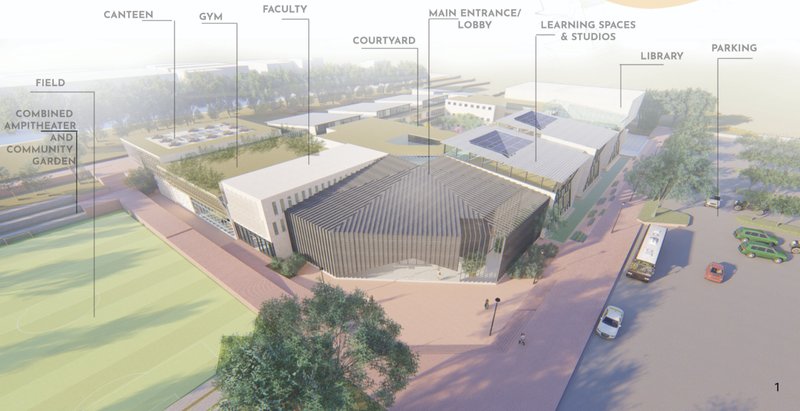
One of the strongest aspects of MAKER+SPACE is its rejection of the conventional classroom model. Instead of isolated rooms separated by corridors, the project introduces fluid learning studios, collaborative zones, laboratories, and breakout spaces that encourage interaction between students, educators, and the surrounding environment.
The architecture is intentionally porous and interconnected. Learning spaces transition organically into research zones, collaboration hubs, and creative studios, allowing students to move freely between different modes of engagement. This flexibility reflects the realities of modern learning, where innovation often emerges through interdisciplinary collaboration rather than rigid academic boundaries.
The proposal redefines classrooms as adaptable learning environments capable of supporting diverse educational methods. Students are no longer grouped solely according to age, but according to skills, interests, and collaborative activities. The resulting environment promotes peer learning, open dialogue, and dynamic participation.
This spatial strategy aligns strongly with contemporary discussions around student-centered architecture and experiential education design. Instead of designing buildings around administrative efficiency, MAKER+SPACE prioritizes the educational journey of students and their interaction with both space and society.
Architecture as a Bridge Between School and Community
A defining feature of the project is its emphasis on community integration. The school is envisioned not as a closed institution, but as a community node embedded within the social and cultural fabric of its surroundings.
The proposal recognizes that schools can play a much larger civic role by providing public facilities, collaborative programs, and socially responsive spaces. Community gardens, amphitheaters, libraries, greenhouse facilities, roof deck gardens, and phyto-remediation ponds transform the campus into an active public destination.
This community-based architectural strategy reinforces the idea that education extends beyond formal instruction. Students engage directly with real-world issues such as sustainability, urban ecology, local industries, and social participation. The architecture therefore supports both academic growth and civic responsibility.
The project specifically responds to the context of Scarborough, acknowledging its transformation from an industrial and manufacturing-based district into a diverse urban community. Through localized curriculum spaces including robotics labs, fashion studios, woodworking facilities, and artisan craft workshops, MAKER+SPACE creates educational programs rooted in local identity and economic realities.
This approach demonstrates how educational architecture can become context-sensitive while simultaneously preparing students for global futures.
Built Environment as Teacher
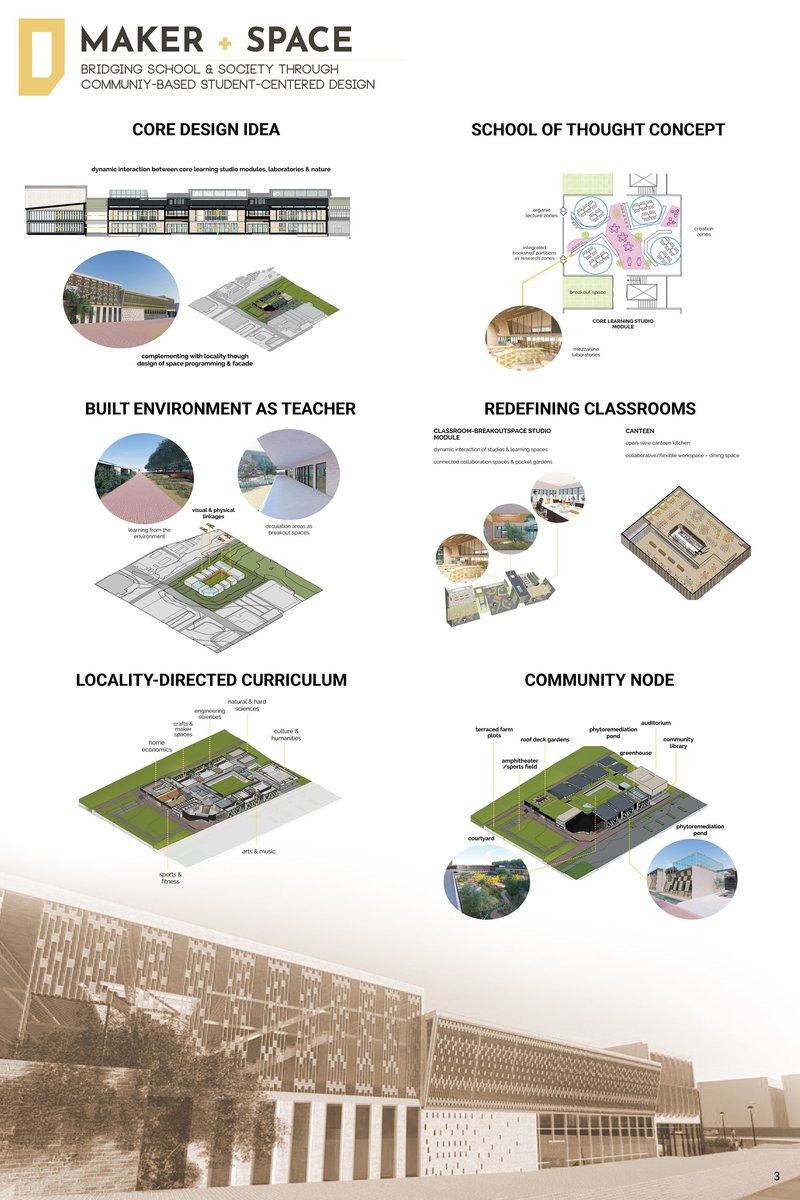
MAKER+SPACE adopts the philosophy that architecture itself can function as a teaching tool. The built environment is not treated merely as a container for learning, but as an active participant in the educational experience.
Visual and physical connectivity play a major role throughout the project. Semi-perforated facades, transparent learning zones, internal courtyards, and interconnected circulation systems encourage visibility, interaction, and curiosity. Students are constantly exposed to the activities, experiments, and creative processes occurring around them.
The integration of landscaped spaces further strengthens this educational framework. Outdoor courtyards, pocket gardens, and collaborative terraces become informal learning zones where nature operates as both classroom and facilitator. These environments encourage exploration, reflection, and social interaction while improving environmental quality and psychological well-being.
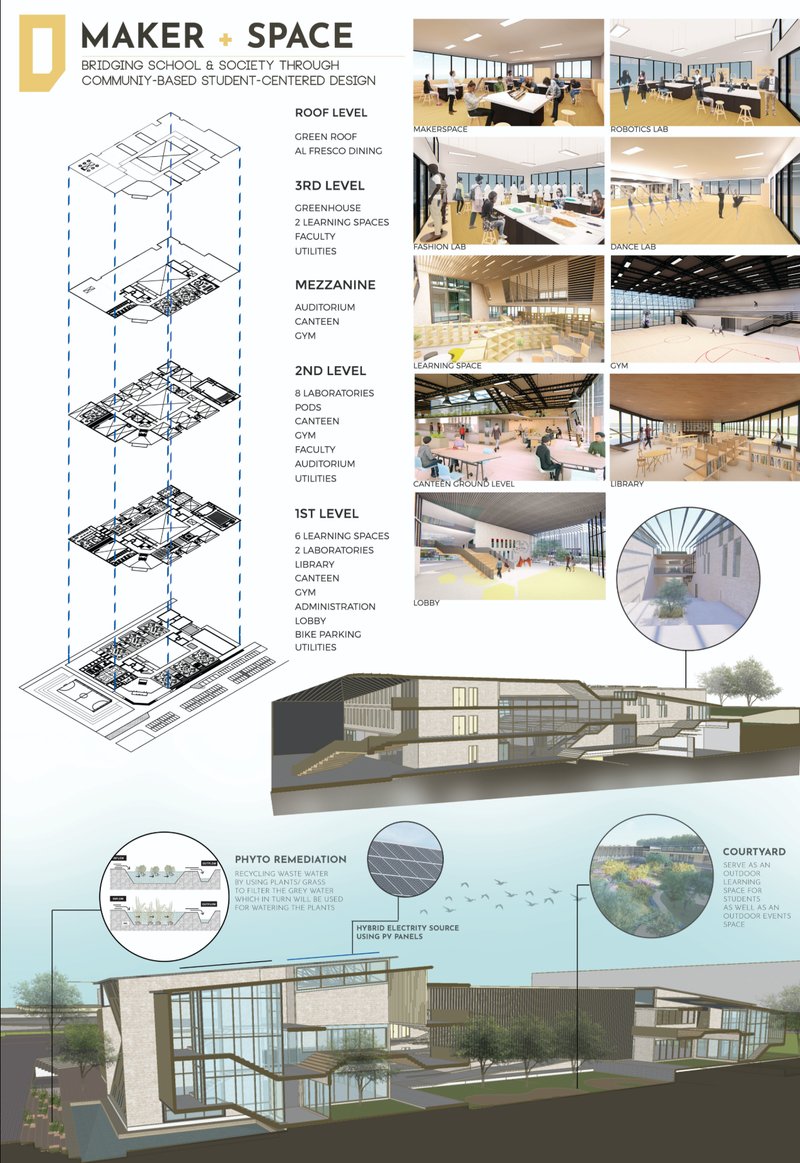
The project also incorporates sustainable architectural strategies such as phyto-remediation systems, green roofs, recycled water filtration, and photovoltaic energy systems. These ecological interventions are not hidden infrastructure elements but visible educational components that allow students to directly engage with sustainability practices.
In this way, the school itself becomes a living laboratory for environmental awareness and responsible design thinking.
Flexible Learning Studios and Collaborative Spaces
The internal organization of MAKER+SPACE revolves around modular learning studios designed to support fluid educational experiences. Rather than fixed classrooms with singular functions, the project proposes adaptable studio environments capable of evolving according to changing educational needs.
These studios are divided into multiple activity zones including research, collaboration, creation, and discussion spaces. Breakout areas, student pods, and open interaction zones encourage communication and teamwork while reducing the rigid hierarchy often found in traditional educational settings.
The circulation system is equally important. Corridors are transformed into social and collaborative spaces rather than transitional voids. Informal meeting areas and visual connections between floors allow movement itself to become part of the learning experience.
Facilities such as robotics labs, makerspaces, dance studios, libraries, gyms, and fashion laboratories reinforce the project’s interdisciplinary philosophy. Students are encouraged to move between technical, creative, and social forms of learning without spatial separation between disciplines.
This integrated approach reflects the realities of contemporary innovation culture where boundaries between science, technology, art, and design continue to dissolve.
Sustainability and Human-Centered Educational Design
Sustainability within MAKER+SPACE is approached not only as an environmental objective but also as a social and educational value. The project prioritizes natural light, ventilation, greenery, water recycling, and renewable energy integration while creating healthier and more engaging learning environments.
The architecture carefully balances openness and privacy through layered facades, shaded courtyards, and landscaped buffers. Large glass surfaces create transparency and daylight penetration while maintaining visual connections across the campus.
The central courtyard acts as both environmental regulator and social condenser. It becomes a shared gathering space where students, faculty, and community members intersect. This reinforces the broader vision of education as a collective and participatory process.
The material palette and building massing further contribute to the project’s grounded and community-oriented identity. Industrial-inspired forms reference Scarborough’s manufacturing heritage while contemporary detailing introduces a forward-looking architectural language suited for future educational models.
Reimagining Educational Architecture for the 21st Century
MAKER+SPACE demonstrates how architecture can fundamentally reshape the way education is experienced. Rather than designing static institutions focused solely on instruction, the project creates an evolving ecosystem that supports collaboration, creativity, adaptability, and social responsibility.
The proposal challenges outdated educational typologies and instead embraces a future where schools become open platforms for innovation and community engagement. Through student-centered planning, sustainable systems, interdisciplinary learning environments, and strong community integration, MAKER+SPACE presents a compelling vision for the next generation of educational architecture.
As cities continue to evolve and educational demands become increasingly complex, projects like MAKER+SPACE highlight the importance of designing schools that are flexible, human-centered, and deeply connected to their social context.
More than a school building, MAKER+SPACE is a vision of how architecture can help shape future citizens, future communities, and future ways of learning.



Popular Articles
Popular articles from the community

R/URBAN DESIGN OFFICE Carves a Communal Living Room from a Tokyo Corporate Dormitory
In Shinagawa's Oi district, a 35-year-old reinforced concrete tower becomes a 49-unit rental residence with shared spaces that redefine cohabitation.
S.O.S Architects Scatters a Cluster of Timber Pavilions Across a Chiang Rai Hillside
The Wood Cabin arranges shingled gabled volumes along the slopes of Doi Chang, framing mountain vistas from every room and courtyard.
Pablo Senmartin Suspends a Steel-and-Timber Refuge Above a River Forest in Córdoba
An 80-square-meter dwelling on pilotis camouflages itself among the trees of Mayu Sumaj, designed to be dismantled without waste.
GGR Architectes Anchors a New Neighborhood in Frouzins with a Brick and Timber School Complex
A cruciform plan of terracotta brick and exposed wood frames four courtyards for 140 students outside Toulouse, France.


Similar Reads
You might also enjoy these articles


Urban Forest: A Vertical Ecosystem for 5,000 Workers in Singapore's Changi Business Park
Radially stacked pods and layered green decks turn a 7-acre plot into 47 acres of ecological workspace projected for 2040.
interACT: A Wearable Transit Object That Turns Commuting Into Social Infrastructure
A backpack-mounted foldable device transforms walking, waiting, and riding into moments of shared comfort across Jakarta's transit network.
Lean On Barrier System: Where Traffic Safety Meets Chai Culture in Ahmedabad
A modular steel barrier doubles as informal seating and lean-on furniture at one of Ahmedabad's busiest intersections, keeping vendors in place.

The Black Bagh: A Living Monument Built from Water, Light, and Memory
On the banks of the Yamuna, two designers replace the myth of a marble mausoleum with a regenerative landscape of reflection and ritual.

Explore Interior Design Competitions
Discover active competitions in this discipline




The Global Benchmark for Architecture Dissertation Awards


Challenge to design luxury tourism on rails


VR headsets Storefront design competition

Designing a staircase for a client
Comments (0)
Please login or sign up to add comments
No comments yet. Be the first to comment!