
MAMOU-MANI Builds a Fractal Timber Pavilion That Refuses to Burn at Burning Man
Catharsis brings hyperbolic geometry to the Nevada desert as a reusable, modular amphitheater designed for radical inclusion.


At Burning Man, most monumental structures exist to be destroyed. MAMOU-MANI rejected that premise outright. Catharsis, a fractal amphitheater composed of 60 modular timber units joined by metal hinges, was designed from the start for disassembly and reassembly, making it one of the rare large-scale Burning Man installations built around the logic of circular economy rather than spectacle through combustion. The structure first existed virtually, as a piece in the BRCvr metaverse during COVID lockdowns, before materializing on the Black Rock Desert playa in 2022, funded by Therme Group and fabricated by Fab Pub.
What makes Catharsis genuinely interesting is not just its politics of reuse but its geometry. The pavilion is a physical representation of hyperbolic space: seven gateways, arranged in a circular pattern with seven-fold rotational symmetry, rise from the desert floor with increasing intricacy. Each gateway is a hexagonal portal framed by latticed timber that grows denser and more ornate toward the edges, creating a fractal condition where every module is a smaller version of the whole. Between and above the amphitheaters, nets stretch across the structure for people to rest on, turning the interstitial zones into inhabitable voids. The result is a building that functions simultaneously as gallery, amphitheater, climbing frame, and observation deck.
Seven Gateways Rising from the Playa
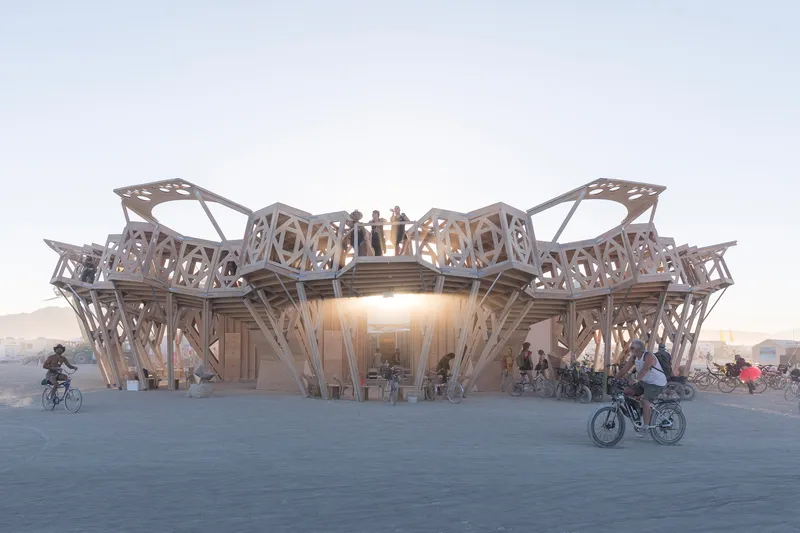
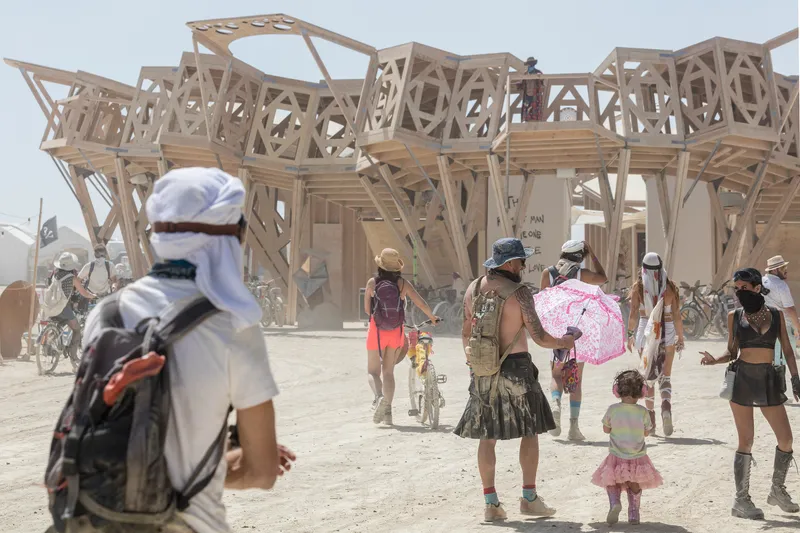
From the ground, Catharsis reads as a cluster of angular timber volumes, each punctuated by latticed openings that filter light and wind. The seven gateways elevate progressively, pulling the eye upward and creating a legible hierarchy of scale even in the disorienting flatness of the desert. In dusty conditions, the perforated screens catch and scatter light, making the structure appear almost geological.
The seven-fold rotational symmetry is not merely aesthetic. It directly serves fabrication and assembly: because every module shares the same geometry, the construction team could repeat the same joining sequence across all sixty units, reducing on-site complexity to a manageable set of operations. Symmetry here is a construction strategy, not a stylistic choice.
Fractal Geometry Made Tangible
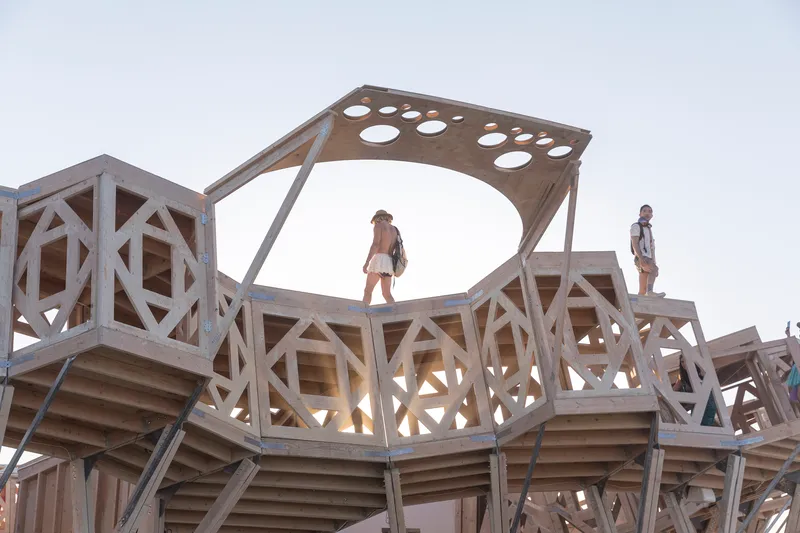
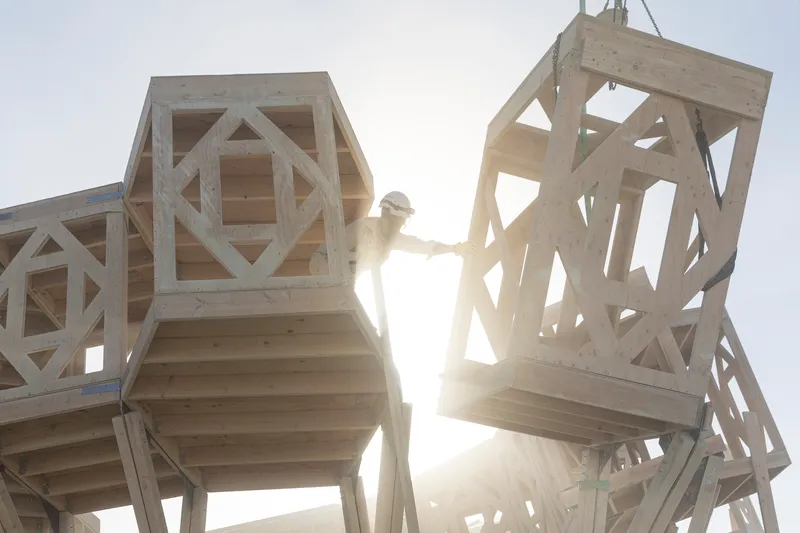
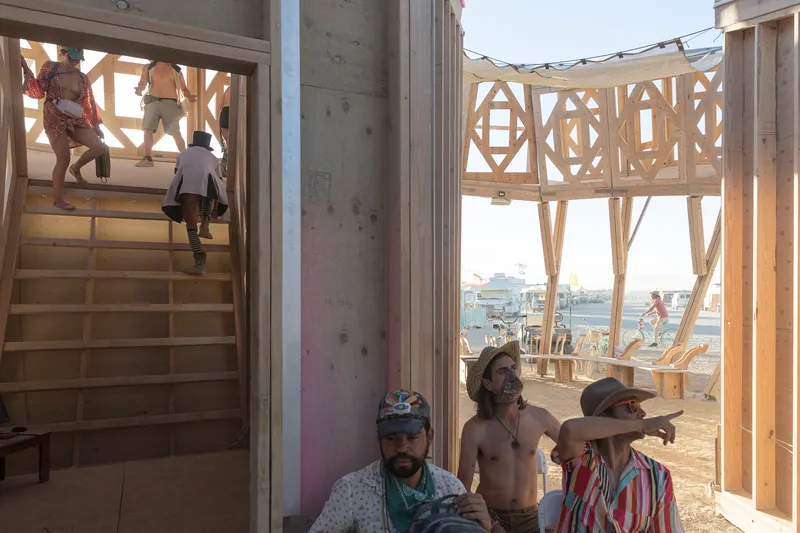
The fractal logic is most legible at intermediate scale. Looking up through the canopy, you see the same hexagonal motif repeated at different magnifications: large openings framed by progressively finer lattice members, each subset echoing the form of the whole. The diamond lattice patterns on individual modules are backlit by sun or LED, depending on the hour, which emphasizes the self-similarity and gives the structure a kaleidoscopic quality that changes with every viewing angle.
The density gradient is key. The geometric pattern is heavier and more open around the central apertures, then tightens toward the edges into increasingly intricate screens. This produces a graded porosity: at the core, air and people move freely; at the periphery, the structure becomes more intimate, more enclosed, more detailed. It is a single material system doing the work of walls, windows, and ornament all at once.
Performance and Gathering Spaces
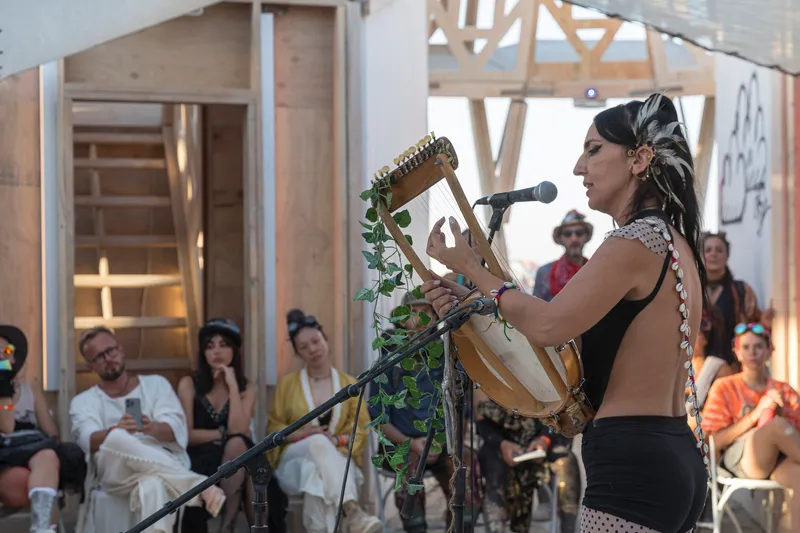
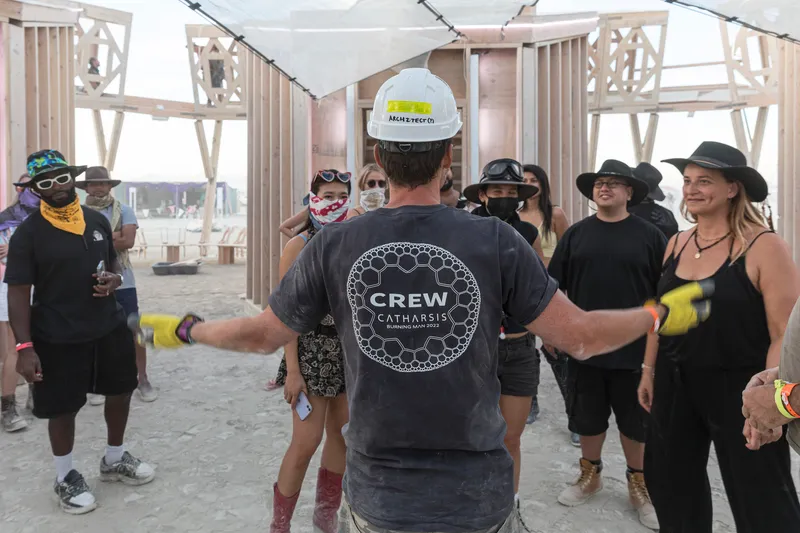
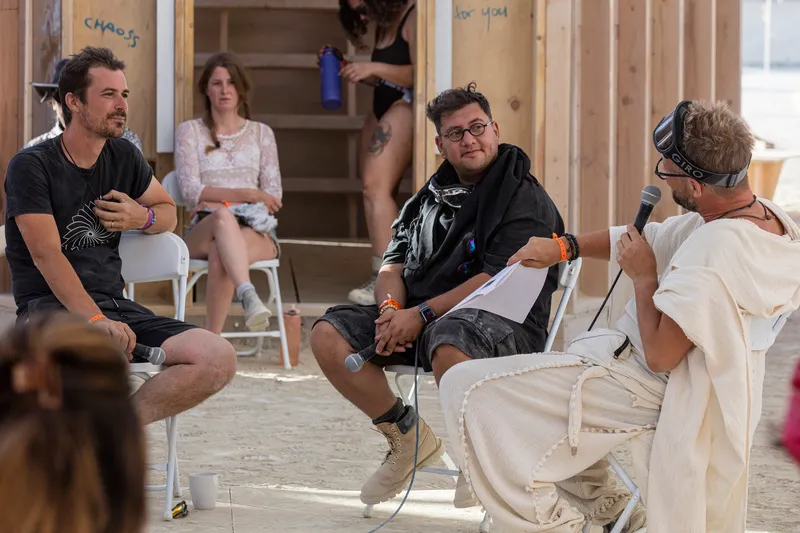
Catharsis is described as a fractal gallery for infinite dreams, but it operates more practically as a network of performance venues nested within one another. Each of the seven amphitheaters accommodates a different gathering: a guided discussion, a musical performance, a spontaneous lecture. The exposed timber framing creates acoustic enclosures that are open enough to the sky and desert to avoid claustrophobia, while the tiered seating and elevated platforms provide natural sight lines.
The in-between gallery spaces, those interstitial zones connecting the amphitheaters, are just as important. They allow visitors to drift between events, to discover art hung on timber studs, or simply to find shade. The structure's commitment to radical inclusion is legible in its spatial generosity: there is no single stage, no privileged audience position. Every threshold is also a gateway.
Living on the Structure
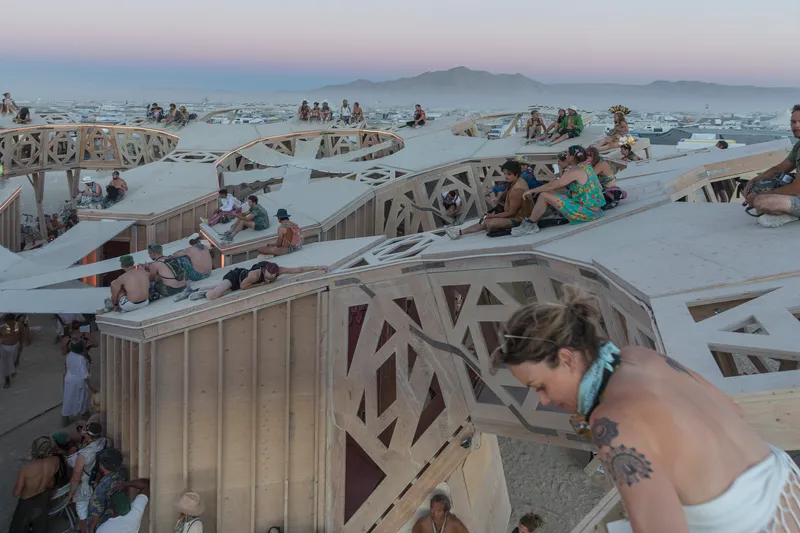
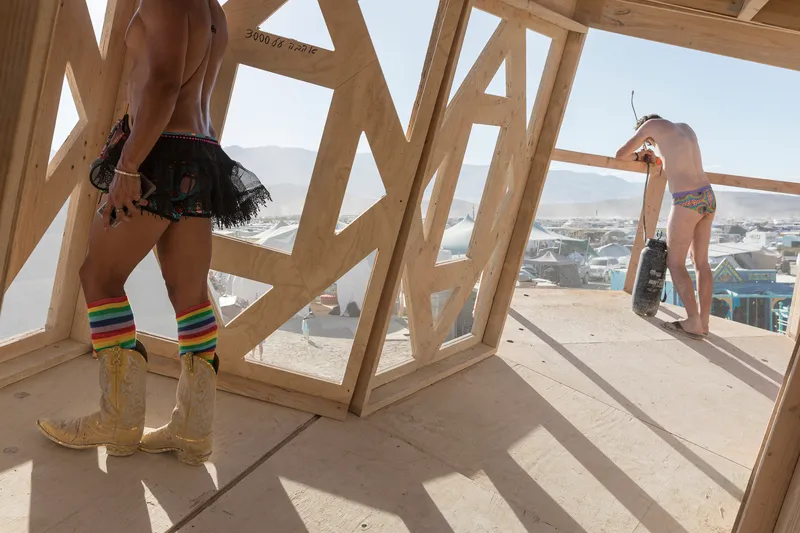
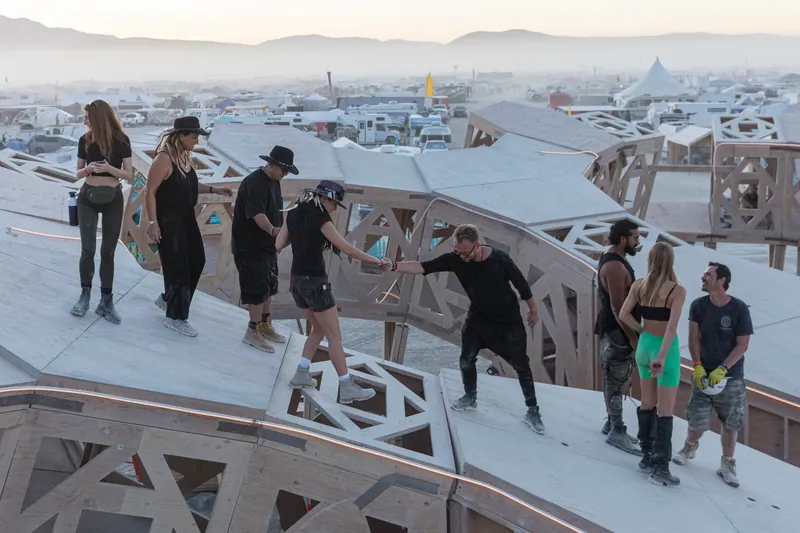
The rooftop decks and elevated platforms turn Catharsis into one of the best vantage points on the playa. Visitors climb timber staircases to reach upper levels where angled trusses frame panoramic views of the encampment and distant mountain ranges. At twilight, these platforms become social condensers, places where strangers gather to watch the desert light change and the temporary city glow beneath them.
Nets suspended between modules add another layer of inhabitation. People lie, rest, and interact above the main gathering spaces, turning the structure's section into something genuinely three-dimensional. The experience of Catharsis is not limited to its ground-level amphitheaters; you are meant to climb it, occupy it at every altitude, and see the fractal geometry from within its own matrix.
After Dark
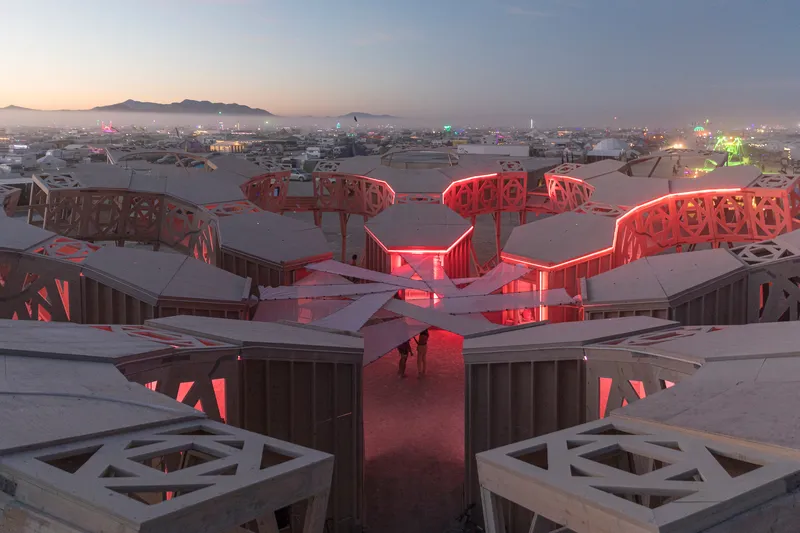
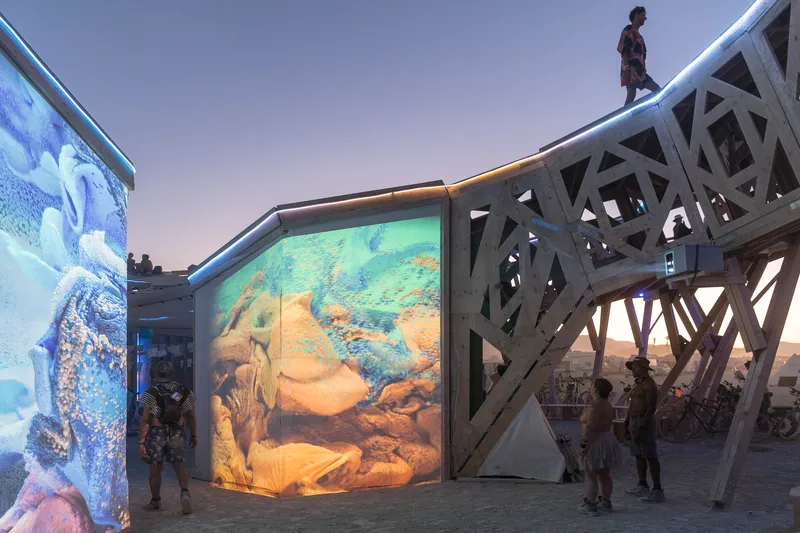
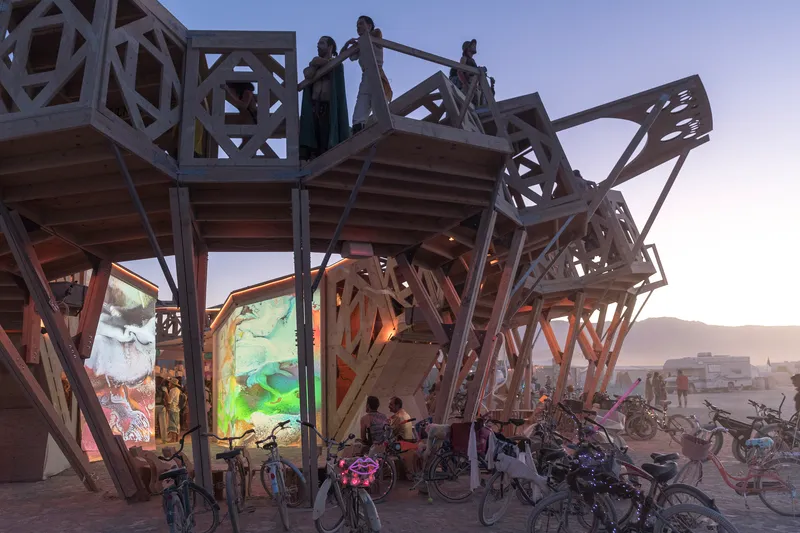
At night, the pavilion transforms. Translucent panels glow with projected imagery, and red interior lighting turns the three-lobed timber volumes into lanterns visible across the playa. The latticed screens, which filter sunlight during the day, become shadow-casting surfaces under artificial illumination, projecting intricate geometric patterns onto the surrounding dust.
The nocturnal identity of Catharsis is arguably its most generous contribution to Burning Man's visual culture. Rather than relying on neon or fire, MAMOU-MANI uses the timber structure itself as the primary medium for light, letting the material's perforations and layered depth do the visual work. The result is warm, intricate, and unmistakably architectural.
Fabrication and Assembly
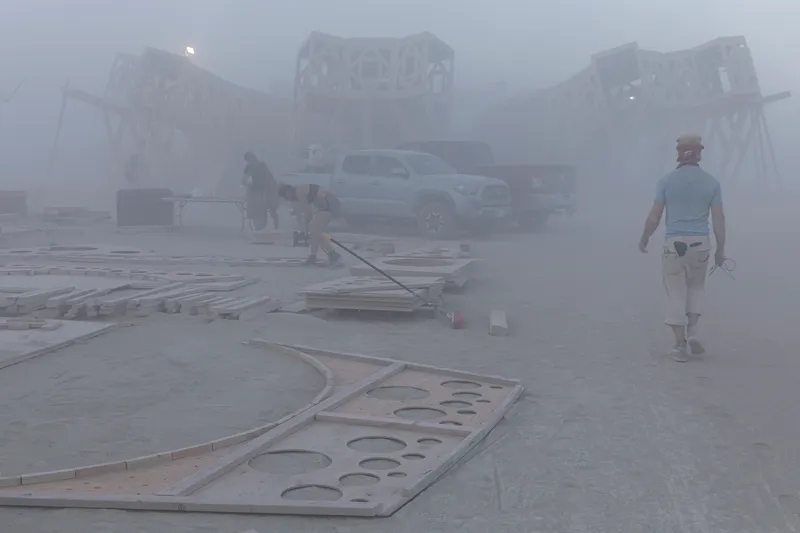
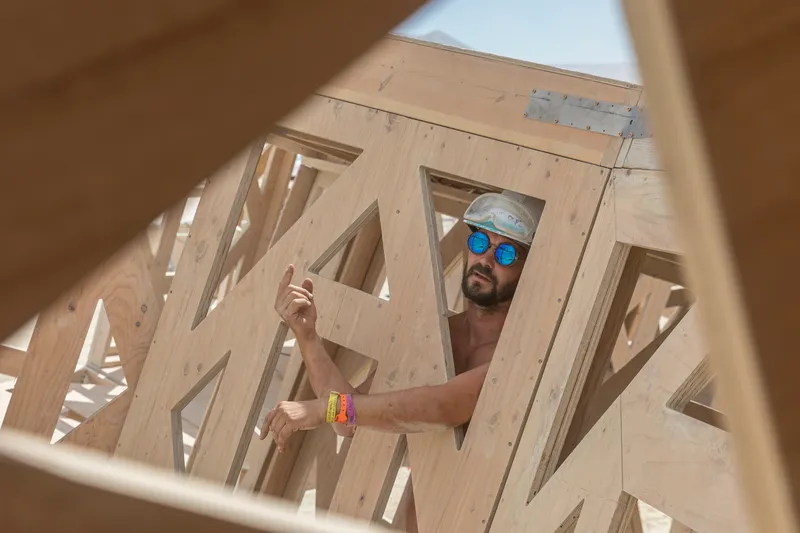
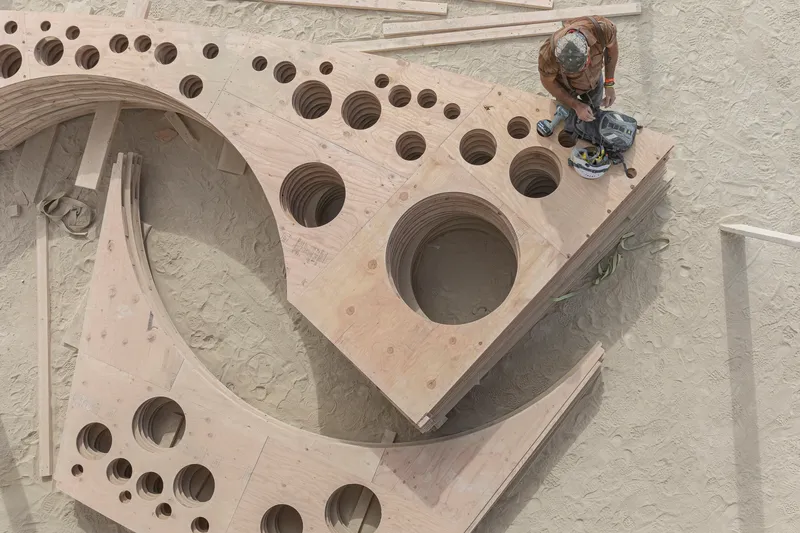
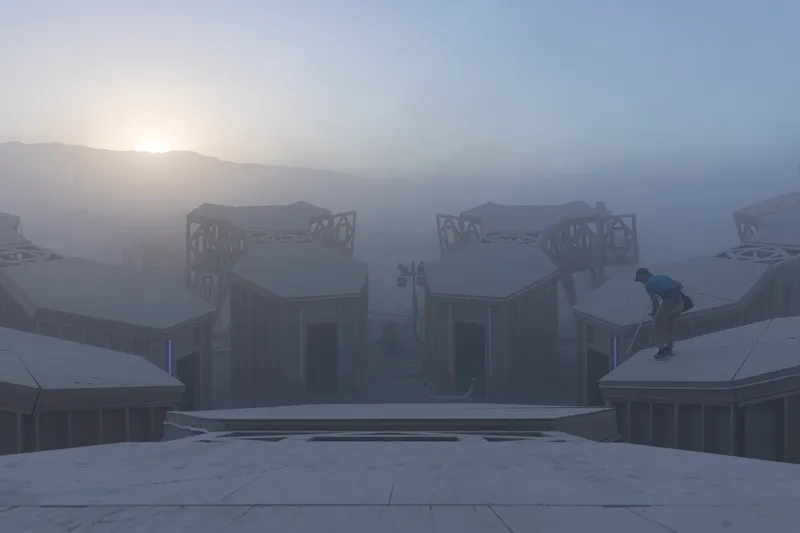
The construction documentation reveals curved perforated plywood panels laid out during foggy desert mornings, workers applying finishes to circular-perforated sheets, and builders threading their way through triangular openings to connect the structural framework. The metal hinges that join the 60 units are the critical detail: they allow each module to lock into position during assembly and release cleanly during disassembly, enabling the structure to travel to other sites after its Burning Man debut.
The choice of timber was driven by environmental credentials rather than aesthetic preference. On a playa where structures are routinely soaked in fuel and set ablaze, building something designed to survive is itself a radical act. The fabrication, handled by Fab Pub, had to balance the precision demanded by fractal geometry with the rough realities of desert construction, wind, dust, and heat that warp materials overnight.
Self-Expression at Every Scale
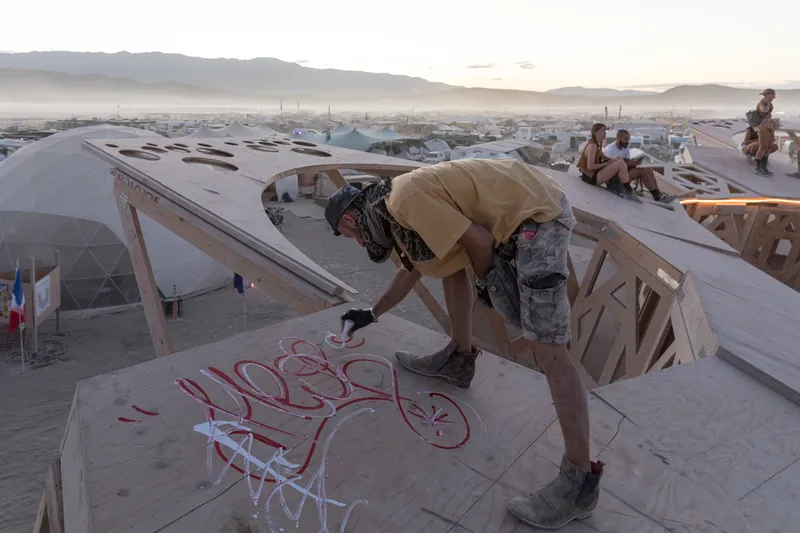
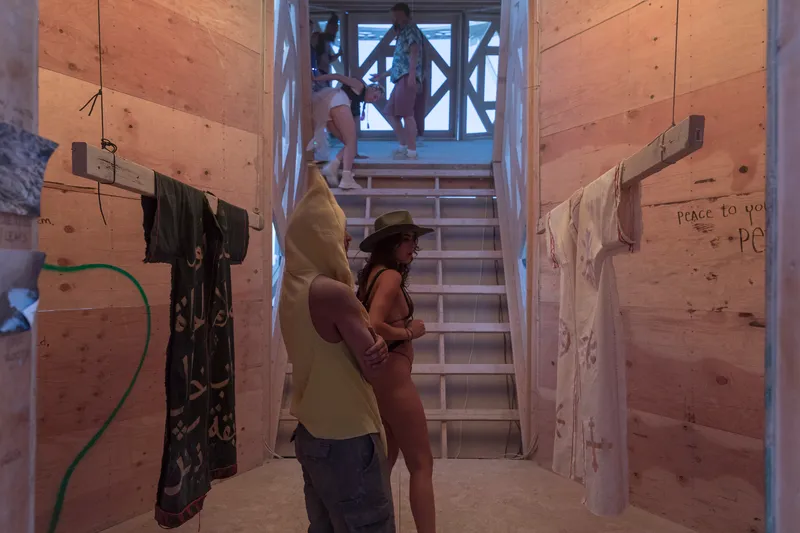
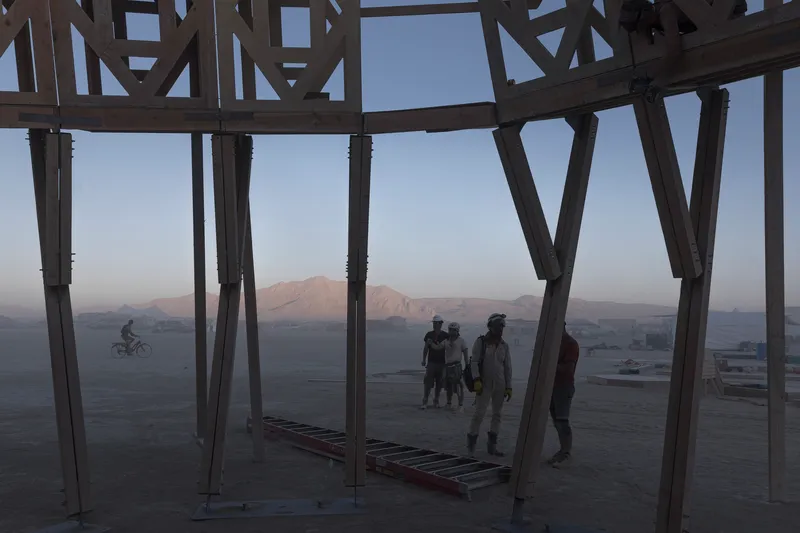
Catharsis invited participants to leave their marks. Workers spray-painting graffiti onto plywood panels at dawn, clothing hung in stairwells, visitors ascending toward bright openings: these images capture the structure not as a finished object but as a scaffold for collective authorship. MAMOU-MANI designed the framework; the Burning Man community completed the architecture.
Context on the Playa
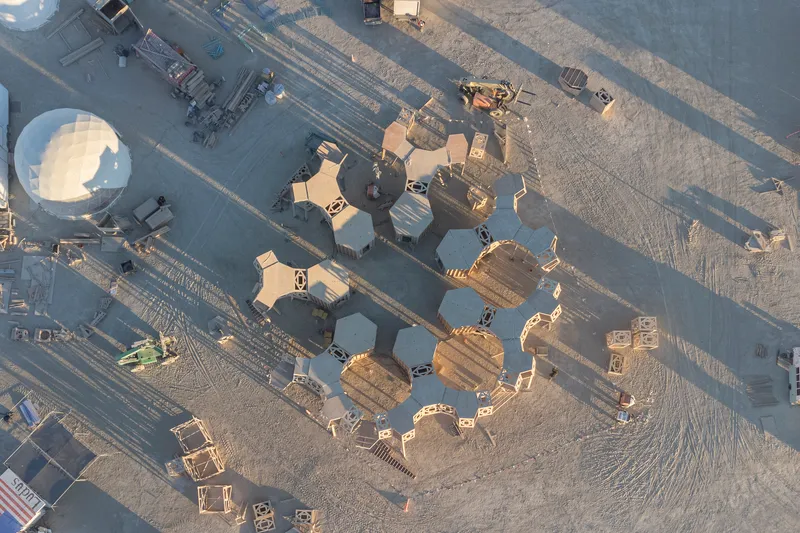
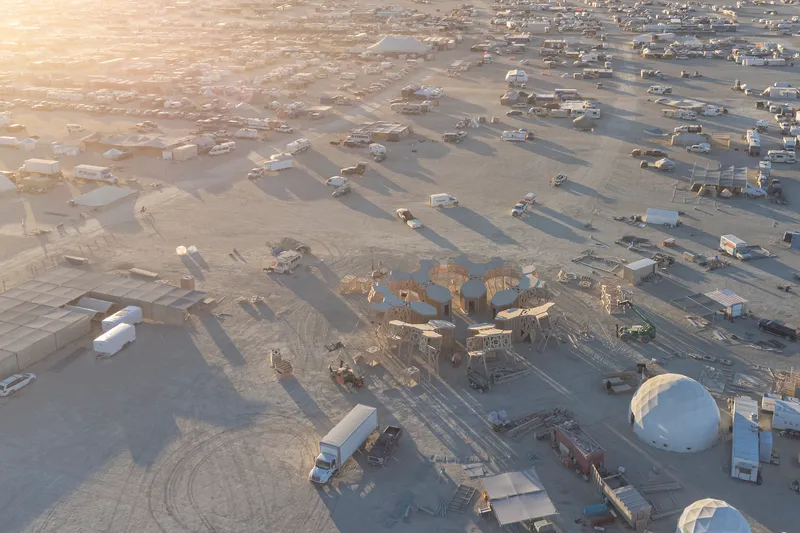
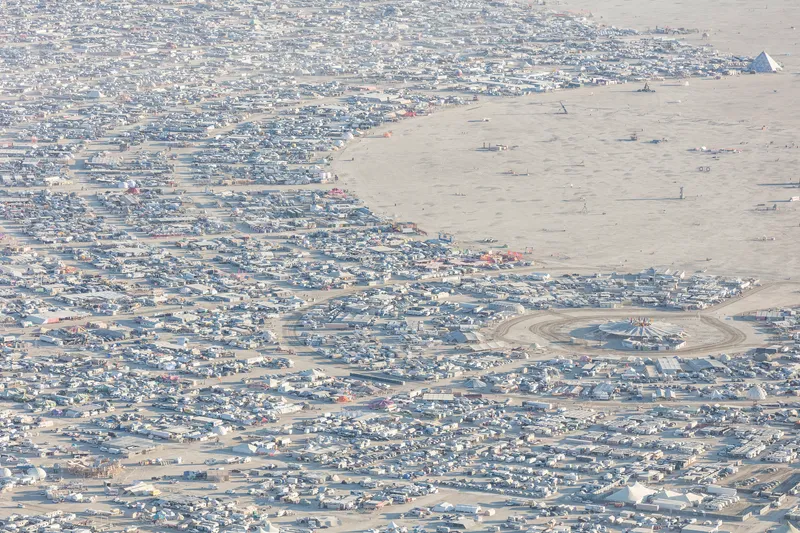
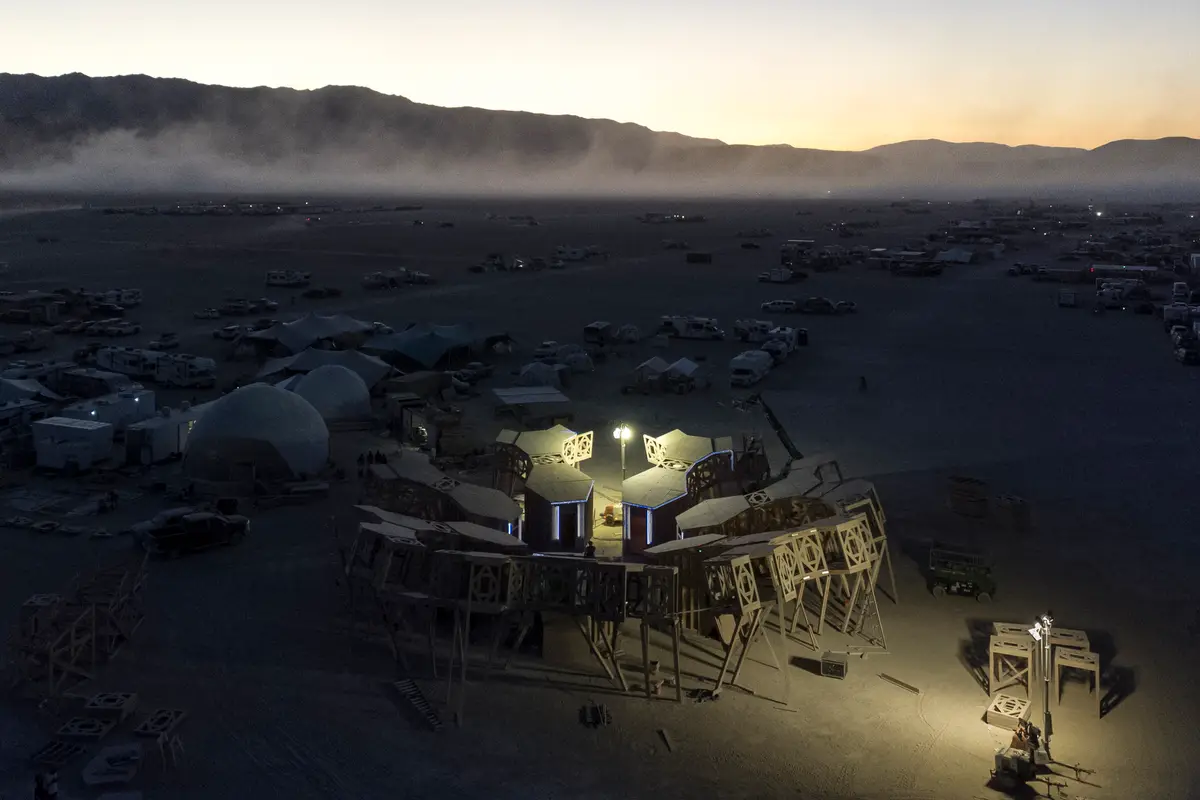
Aerial views reveal how Catharsis sits within the larger organism of Black Rock City. The radial timber installation reads as a precise, dark cluster amid the improvised sprawl of tents, vehicles, and temporary structures. Its geometric clarity anchors it as a civic landmark within a city that reinvents itself annually and vanishes without a trace. Originally intended for the central 6:00 Plaza behind Center Camp, the structure was positioned to serve as a fulcrum for movement and gathering across the playa.
Why This Project Matters
Catharsis matters because it refuses the false binary between spectacle and sustainability that has long defined large-scale festival architecture. MAMOU-MANI proved that a structure can be geometrically ambitious, socially generous, and environmentally responsible simultaneously. By designing for disassembly rather than destruction, the studio introduced a model of circularity that treats temporary architecture not as disposable scenography but as a reusable infrastructure capable of accumulating cultural meaning across multiple installations and contexts.
It also matters as evidence that computational design, specifically fractal geometry and parametric fabrication, can produce spaces that feel deeply human rather than coldly algorithmic. The amphitheaters, the climbing nets, the rooftop decks: these are spaces where bodies gather, rest, perform, and watch. The math serves the program, not the other way around. In a discipline increasingly anxious about the relationship between digital tools and lived experience, Catharsis offers a compelling answer: use the computation to generate complexity, then let people inhabit it on their own terms.
Catharsis by MAMOU-MANI, Black Rock City, United States, 2022. Photography by Laurian Ghinitoiu.
About the Studio
Share Your Own Work on uni.xyz
If projects like this are the kind of work you want to make, uni.xyz is a place to publish your own, find collaborators, and enter design competitions.


Popular Articles
Popular articles from the community


Little Red Riding Hood: Architectural Design as a Journey Through Fear, Light, and Storytelling
Little Red Riding Hood reimagines the fairy tale through architectural design shaped by fear, light, scale, memory, uncertainty, and choice.

ALGAL REALM: A Bio-Integrated Lunar Habitat Design for Life Beyond Earth
ALGAL REALM reimagines lunar habitat design with algae-powered life support, 3D-printed regolith, and vertical living for a lunar future.

The Musturak Paradise: Senior Living Architecture for a Connected Future in Temara, Morocco
The Musturak Paradise reimagines senior living architecture in Temara via private homes, social spaces, culture, community, and shared care.

Conexión: Biophilic Design Reimagines High-Rise Living in Hong Kong
Conexión reimagines high-rise living in Hong Kong through biophilic design, green facades, shared spaces, daylight, water and nature within.

Similar Reads
You might also enjoy these articles

Bao Huynh Watercolor Atelier: A Serene Art Retreat in Hội An
Bao Huynh Watercolor Atelier in Hội An blends multifunctional art spaces, sustainable design, local materials, and family-friendly living in a serene environment.

Atelier Macri Concept Store Interior Design by CASE-REAL
Atelier Macri store features a "ko" counter, walnut wood details, cork displays, blending retail, gallery, and seamless customer experiences.

Manuel Vargas Izquierdo Stadium and High-Performance Sports Center: Architectural Excellence in Jalpa de Méndez
The Manuel Vargas Izquierdo Stadium blends sustainable design, inclusive sports facilities, and cultural-inspired architecture, revitalizing Jalpa de Méndez’s public spaces.

KAKR Buluh Awar Hall: Revitalizing Community and Ecology Through Bamboo Architecture
Community built bamboo hall revitalizes Buluh Awar village, empowering youth, restoring ecology, celebrating vernacular craftsmanship through sustainable architecture and culture.

Explore Architecture Competitions
Discover active competitions in this discipline

Challenge to design a portable theatre

Challenge to design a portable music platform

Challenge to design an open learning module for the elderly

Challenge to reimagine the Iron Throne
Comments (0)
Please login or sign up to add comments
No comments yet. Be the first to comment!