
Mangh House: Vertical Living and Vernacular Cooling in Jodhpur's Blue City
A four-storey courtyard residence on a 4m x 12m plot channels windcatchers, jaali screens, and sectional strategy into climate-responsive urban infill.


In Jodhpur's old city, where temperatures routinely push past 40°C and shared walls press buildings into a near-continuous mass, the courtyard house has survived for centuries because it works. Mangh House takes that survival logic and runs it vertically. Built on a 4m x 12m ancestral plot for a family of six, the residence stacks four storeys of multi-generational program around a central void that functions simultaneously as a gathering space, a thermal buffer, and a ventilation shaft. The result is a home that feels spacious despite its slender footprint, cool without heavy reliance on mechanical systems, and unmistakably rooted in the neighborhood it occupies.
Designed by Harshit Laddha and Niharika Pareek, Mangh House received an Honorable Mention in the Nano Nest 2020 competition. The project responds to a specific brief: housing that is compact, sustainable, and socially grounded. Rather than retreating to suburban sprawl, the designers chose to reinhabit the dense historic fabric, treating an inherited plot not as a constraint but as an opportunity for smarter urban density.
A Narrow Footprint, a Layered Section
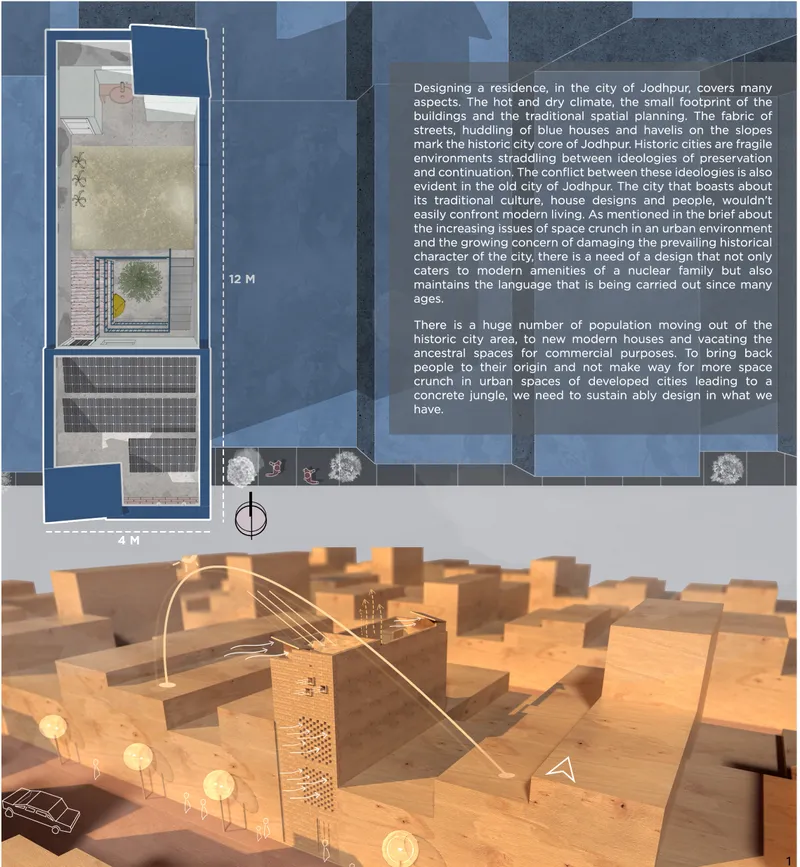
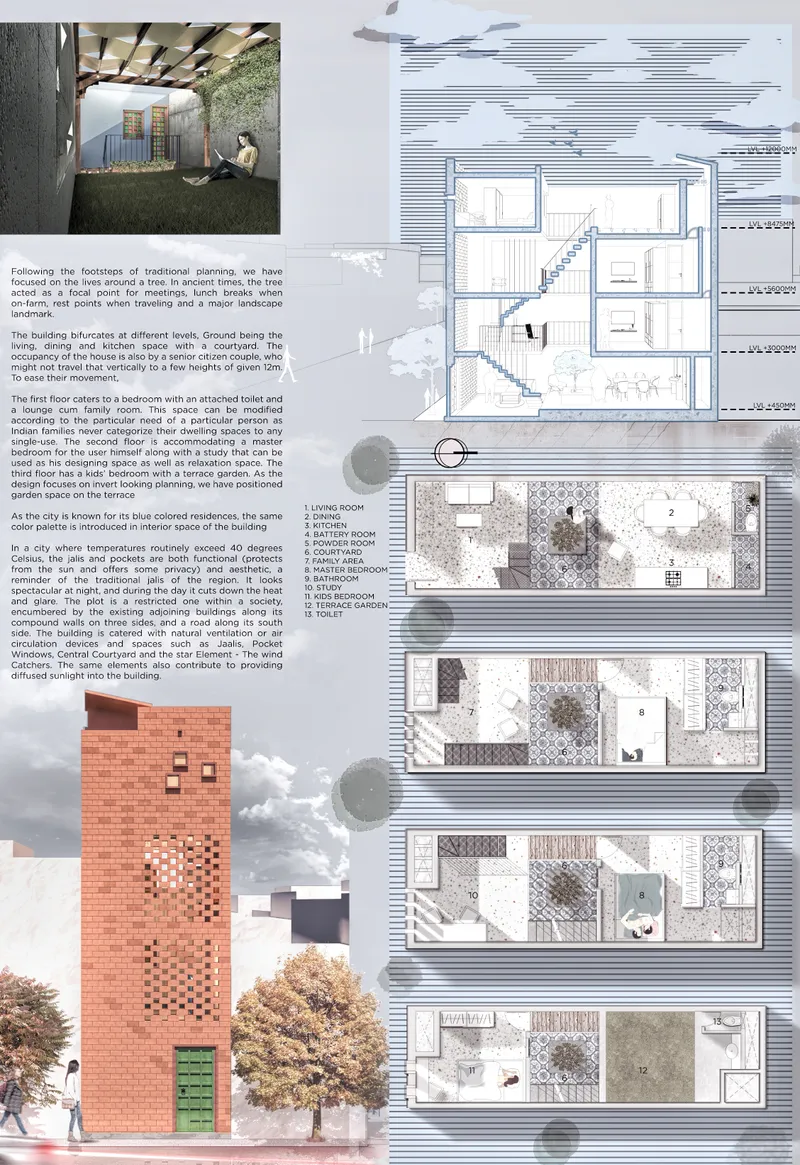
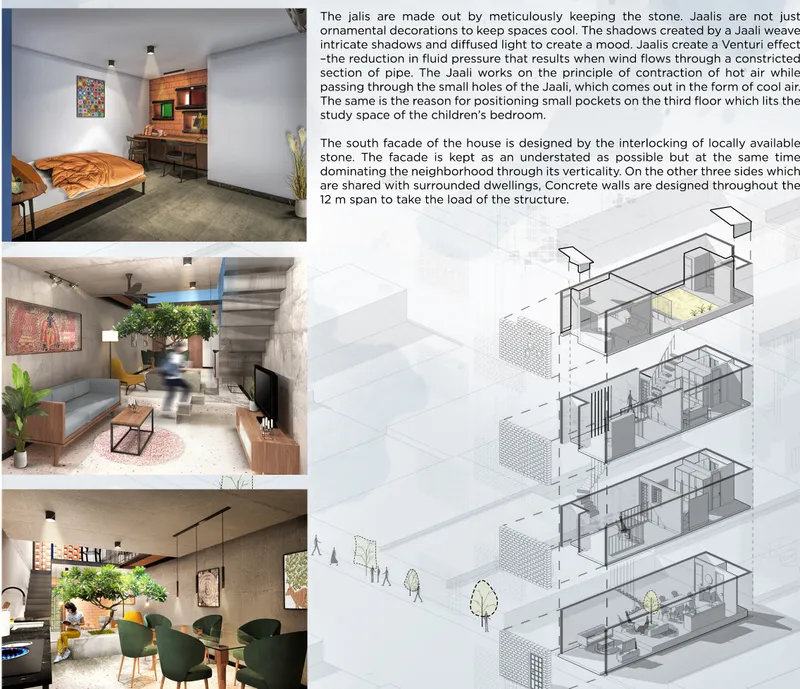
The site plan and aerial render show how Mangh House slots into its neighborhood without disrupting the existing grain. Shared walls on three sides minimize exposed surface area, improving thermal insulation while respecting the compact urban fabric. The section drawing reveals the real intelligence of the design: each of the four storeys is calibrated for a different generation and use. The ground floor places living, dining, and kitchen around the courtyard, keeping the elderly couple close to grade. A first-floor bedroom and lounge serve flexible family needs. The second floor pairs a master bedroom with a study for the homeowner's design and export work. Up top, a children's bedroom opens onto a terrace garden, pushing outdoor space skyward where the footprint cannot provide it at ground level.
What holds the section together is the courtyard void. It connects floors visually, pulls daylight deep into the plan, and drives the stack ventilation that makes this house livable without constant air conditioning. The floor plans confirm that despite extreme compactness, circulation is clear and rooms enjoy cross-ventilation where possible. Sectional interconnectivity, not plan area, is what gives Mangh House its sense of generosity.
The Perforated Tower Rising Above the Blue City
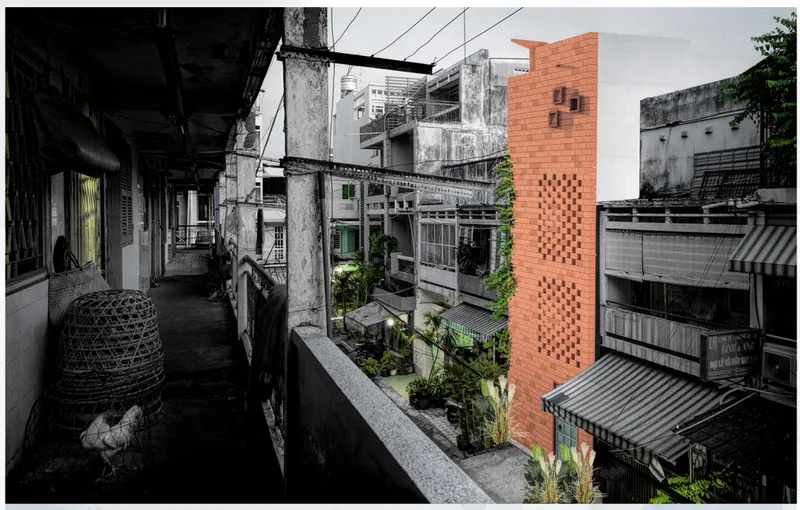
Seen from an adjacent rooftop, the perforated tower asserts itself quietly against the low-rise skyline. The jaali-clad facade is not decorative flourish; it is a precision instrument. The intricate perforations cast diffused light into the interior while maintaining privacy from close neighbors. More critically, they exploit the Venturi effect: hot air inside is expelled through the small openings, drawing cooler air in behind it. The facade's interlocked local stone ties the building materially to its context while the jaali grid gives it a distinct identity within the urban tapestry.
The axonometric drawing peels back the skin to show how the stacked levels interlock. Each floor plate is slightly different in depth and configuration, accommodating the programmatic variation from communal ground-floor spaces to private upper bedrooms. The perforated brick envelope wraps one face continuously, unifying the massing while the remaining three sides, shared with neighbors, remain solid for insulation and structural economy. Strategic punctures on these walls optimize light ingress without sacrificing thermal performance.
Windcatchers, Solar Panels, and the Logic of Passive Cooling
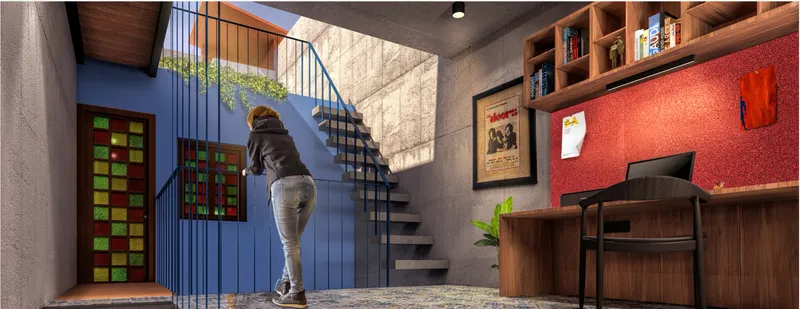
The interior entry space reveals a material palette that balances economy with sensory richness: concrete walls, a floating metal staircase, and a panel of colorful glass blocks that filters light into the lower levels. The staircase doubles as the vertical spine connecting all four storeys while occupying minimal floor area. The house's name, "Mangh," refers to the traditional windcatchers installed on the rooftop. Two such shafts channel cool southwestern breezes down into the bedrooms and lounge, substantially reducing the need for mechanical cooling. Where air conditioning is unavoidable during peak summer, rooftop solar panels generate approximately 200 kWh monthly, covering around 25% of the household's energy demand.
These systems are not applied technologies but integrated elements of the building's architecture. The windcatchers shape the roofline. The jaalis define the facade. The courtyard void organizes the plan. Every passive strategy simultaneously performs a spatial and a social role, which is precisely what makes this approach more resilient than bolting sustainability features onto a conventional plan.
A Street Presence That Belongs
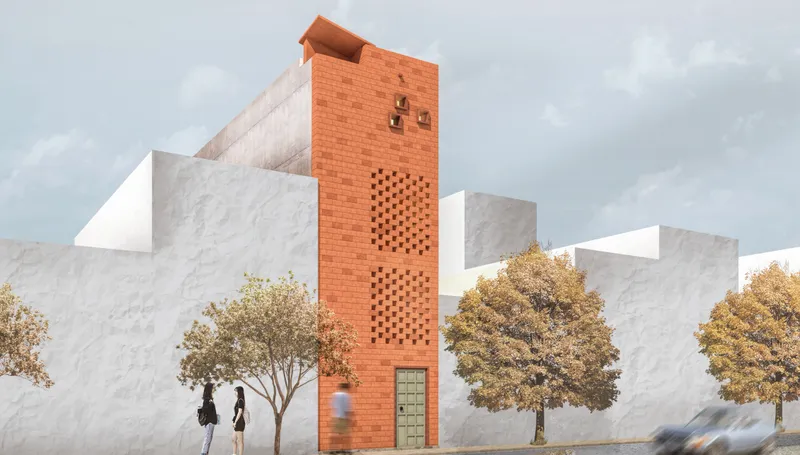
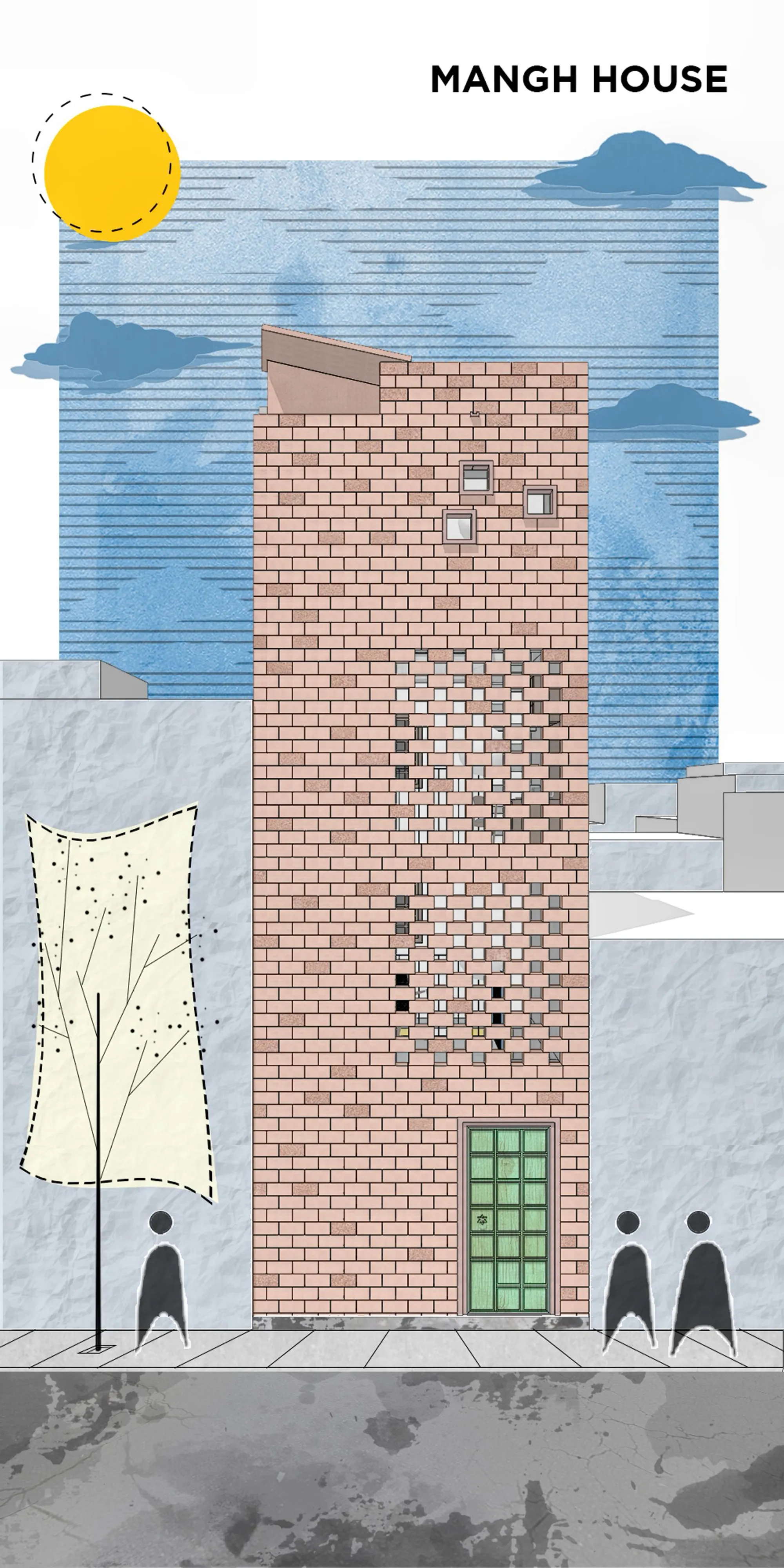
The street-level render shows Mangh House as a pedestrian would encounter it: a red brick tower with circular perforations rising from the narrow lane, flanked by trees and foot traffic. The facade reads as both contemporary and familiar. Its minimalism, built from interlocked local stone, contrasts with the expressive regularity of the jaali pattern. The building neither mimics its historic neighbors nor ignores them. It participates in the street wall, matches the surrounding scale at its base, and gains presence only as it rises. The homeowner's daily rhythm, from courtyard tea to studio work, is embedded in the spatial sequence from this threshold inward.
Why This Project Matters
Across India's historic cities, families are abandoning inherited plots for the convenience of suburban apartments, leaving old urban cores to decay or be redeveloped without care. Mangh House argues against that trajectory. It demonstrates that a narrow ancestral site can accommodate a modern multi-generational household, deliver comfort in an extreme climate, and reinforce rather than erode the character of its neighborhood. That argument is made not through nostalgia but through concrete performance: windcatchers that reduce cooling loads, jaalis that manage heat gain and privacy simultaneously, and a section that distributes program intelligently across four compact levels.
Laddha and Pareek have produced a prototype for sustainable infill housing that synthesizes vernacular wisdom with contemporary spatial thinking. The project's strength lies in its refusal to separate heritage from performance, or context from innovation. In a hot-dry city where passive cooling is not a luxury but a necessity, Mangh House shows that the smartest technology is often the oldest, simply reimagined with precision.
View the Full Project
About the Designers
Designers: Harshit Laddha, Niharika Pareek
Enter a Design Competition on uni.xyz
uni.xyz runs architecture and design competitions year-round that reward proposals with spatial conviction and real site intelligence.
Project credits: Mangh House by Harshit Laddha, Niharika Pareek Nano Nest 2020 (uni.xyz).



Popular Articles
Popular articles from the community


AL-JANNAH: Sustainable Architecture and Permaculture for Afghan Widows
AL-JANNAH uses sustainable architecture and permaculture to create resilient oasis of housing, learning, work and renewal for Afghan widows.

The Earth Pod: 3D Printed Homes for Resilient Refugee Communities
The Earth Pod reimagines refugee housing through 3D printed homes made from clay, combining resilience, self-sufficiency, and rapid shelter.

Riyadh For All: Intergenerational Urban Design for Active Aging in Rabat
Riyadh For All reimagines urban design in Rabat with intergenerational co-living, adaptive courtyards, and Moroccan cultural exchange today.

The Ocean Hive: Sustainable Architecture for a Self-Sufficient Civilization at Sea
The Ocean Hive imagines sustainable architecture at sea, where modular habitats, algae, wave power and ocean waste sustain a growing colony.


Similar Reads
You might also enjoy these articles

Day and Night Park: A Time-Based Urban Newsstand in Beijing
A temporary urban newsstand in Beijing blending travel, light, and reading through poetic colors, compact form, and community-focused design.

Modernist Patio Renovation in El Masnou, Barcelona by Oliver Segura Arquitectura + Cebrià Arquitectura
Modernist patio renovation blending tradition and innovation with a movable pool, leveled floors, and Catalan materials in El Masnou.

Alto Residencial Coop: Cooperative Housing Development in Santiago de Compostela by Carbajo Barrios Arquitectos
A linear cooperative housing complex blending white volumes and perforated metal façades, enhancing community living, natural light, privacy, and urban integration.

Vil Genis School by BPA ARCHITECTURE – Massy, France
Vil Genis School in Massy, France, features sustainable design, south-facing classrooms, community integration, accessible spaces, and modern educational architecture.





Comments (0)
Please login or sign up to add comments
No comments yet. Be the first to comment!