

Mankind Studios Stacks a Whole Neighborhood Vertically
Studio Kota compresses hotel, retail, and bar into a narrow timber-clad tower that breathes light through slatted screens in dense Bandung.


Bandung's residential neighborhoods are tight, layered, and relentlessly horizontal. Terracotta roofs push up against each other with barely a gap for air, let alone new construction. Into this context, Studio Kota has inserted Mankind Studios: a 637 square meter mixed-use tower that stacks a bar, retail, lobby, and hotel rooms onto a footprint that would otherwise accommodate little more than a single shophouse. The result is a vertical sliver that refuses to be polite about its ambitions but manages, against the odds, to feel generous.
What makes Mankind Studios worth studying is not just the programmatic density, though that is impressive. It is the way the building negotiates light, privacy, and material warmth on a site that offers almost none of those things freely. The dominant move is a timber slat screen that wraps the tower, filtering sunlight into every interior space while giving the facade a textile-like grain that softens its mass against the low-rise roofscape. Lead architect Erick Kristanto has produced a building that reads simultaneously as a tall object and a series of intimate rooms, which is exactly the contradiction a good mixed-use project has to hold together.
A Tower in a Sea of Terracotta


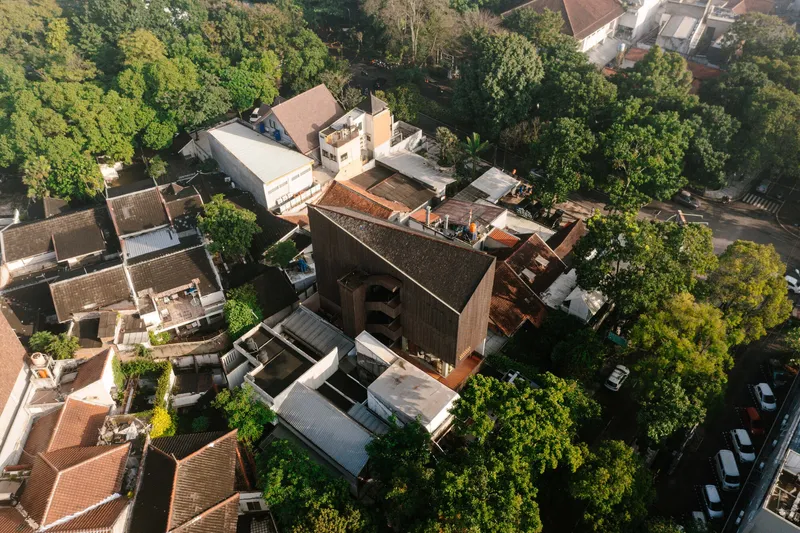
Seen from the air, the scale gap between Mankind Studios and its neighbors is stark. The surrounding fabric is a continuous carpet of red tile roofs interrupted only by canopy trees. The tower rises out of this like a periscope, its dark timber cladding and angular profile clearly foreign to the neighborhood's grain. Yet the building's slender proportions keep it from dominating. It occupies roughly the width of two adjacent houses, and its vertical push upward means it casts a relatively short shadow.
The drone perspectives reveal something the street never could: just how little open ground exists on this site. Every square meter of floor plate is carved from the minimum setback the plot allows, which makes the inclusion of a ground-level courtyard all the more deliberate. That courtyard is the project's pressure valve, the single void that lets the dense vertical stack breathe.
Timber Screens as Facade Strategy
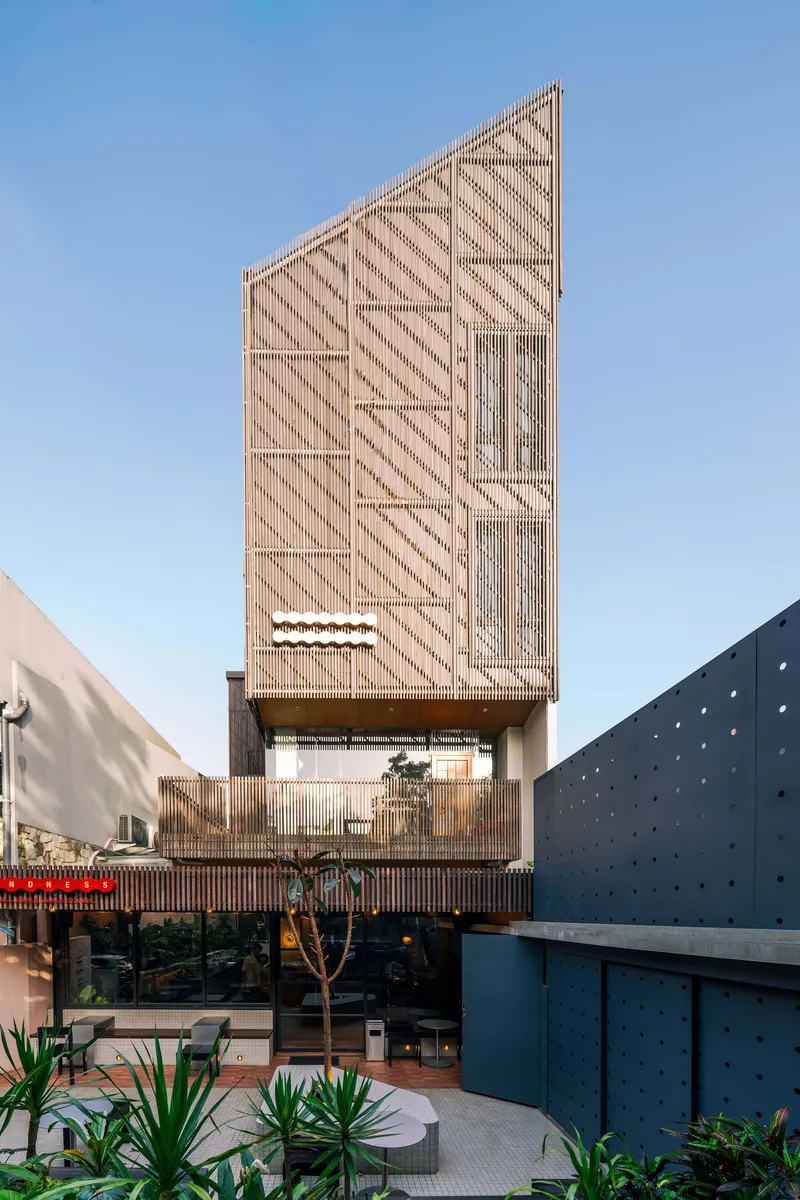
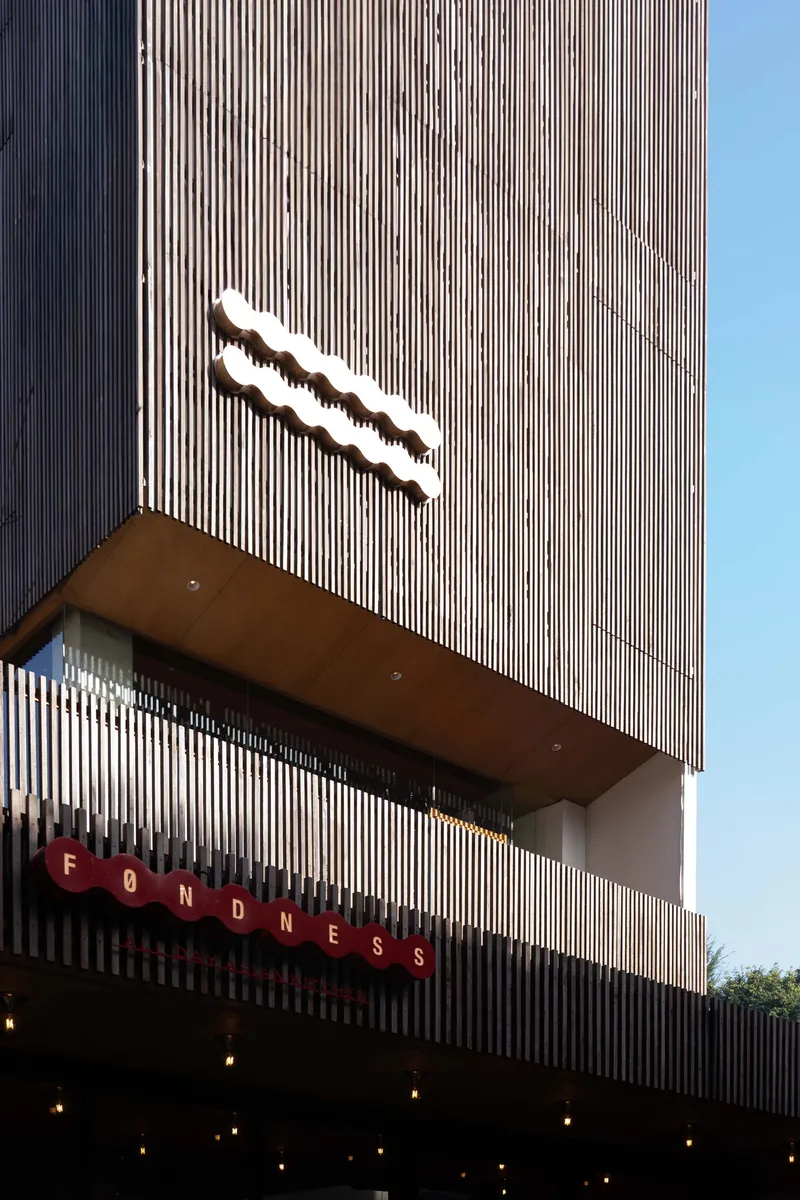
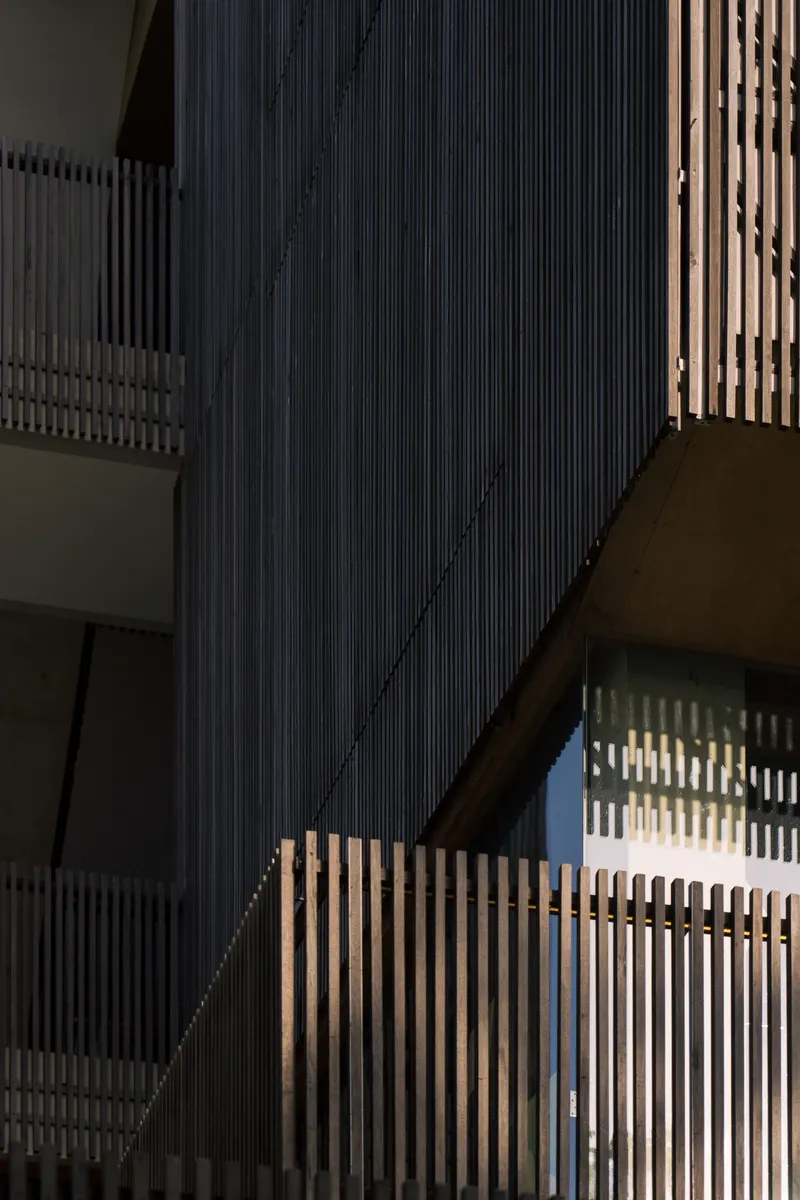
The slatted timber screen is doing more work here than any single material element should reasonably be asked to do: privacy from adjacent buildings, solar control on west-facing surfaces, visual continuity across stacked programs with very different interior requirements, and the generation of a moiré pattern that animates what is essentially a rectangular box. The diagonal slat configuration on the upper volume shifts the reading of the facade depending on viewing angle, giving the building a kinetic quality at the urban scale.
At the street level, the vertical ribbing and projecting canopies create a layered threshold between sidewalk and interior. The signage is integrated cleanly, illuminated at night against the dark cladding. The facade reads as both protective and inviting, a trick that requires discipline in detailing. Studio Kota has clearly resisted the temptation to add apertures or material breaks where the screen logic alone does the job.
Street Presence After Dark


A building like this has two reputations: the daytime version, where it sits among its neighbors as a slightly odd vertical neighbor, and the nighttime version, where it becomes a lantern. The twilight and evening shots reveal how the timber slats glow when interior light pushes outward. Recessed balconies punctuate the facade like apertures in a screen wall, and string lights at the lower levels give the ground floor a warmth that pulls pedestrians in from the street.
The gabled volume visible above the tree canopy during the day becomes a luminous peak at dusk, establishing the building's presence from several blocks away. This nocturnal identity is important for a commercial building in a residential zone. It signals activity without aggression.
The Courtyard as Social Core


The planted courtyard at the base of the tower is the project's most critical spatial move. In a 637 square meter building on a tight site, dedicating ground floor area to an open-air void takes conviction. The courtyard connects the bar, retail, and lobby programs laterally while the staircase connects them vertically. A single mature tree anchors the space, giving it a scale that feels domestic rather than commercial.
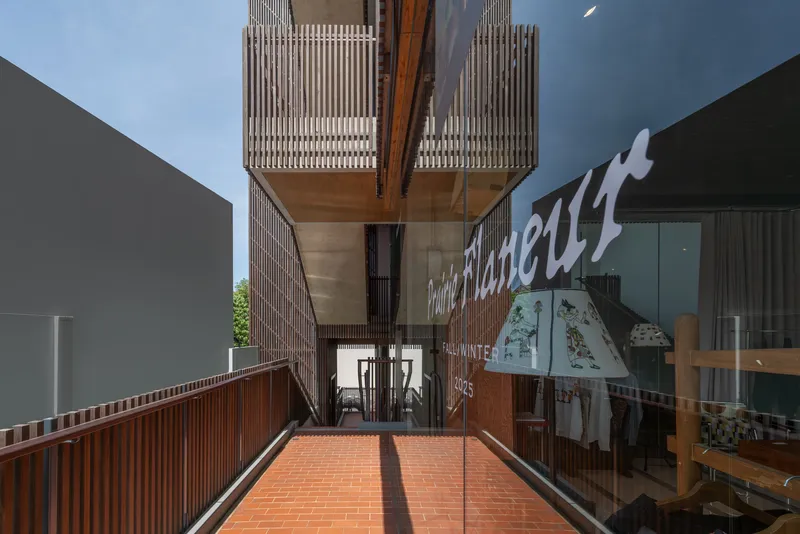
The red brick terrace on the upper level extends this outdoor logic upward, providing a second open-air gathering point where timber screen walls filter views to the surrounding roofscape. A glass-walled pavilion with a deep timber soffit overhang mediates between enclosed and exposed, creating a semi-outdoor condition that works in Bandung's tropical climate. The layering of thresholds, from full enclosure through screened zones to open terrace, gives occupants a range of environmental choices within a very compact footprint.
Vertical Circulation as Interior Event

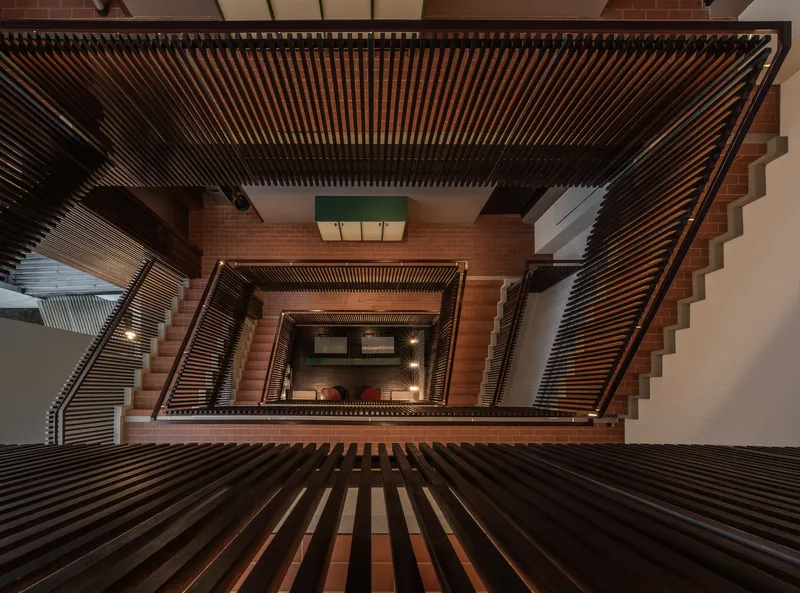

When your building is essentially a narrow stack, the staircase stops being mere circulation and becomes the primary spatial experience. Studio Kota leans into this fully. The central stair void runs the full height of the building, lined with timber slat screens and terracotta tile treads that give it a material warmth the concrete structure alone could never provide. Looking down through the void from the upper floors, you see a vertiginous spiral of slatted screens and diagonal movement.
The zigzagging stairs with backlit handrails create an almost theatrical sequence as you move between programs. A skylight at the top floods the stairwell with diffused daylight, making the climb feel less like a chore and more like an ascent through a carved volume. The stair is the spine of the building in both structural and experiential terms.
Interior Atmospheres: Bar, Dining, and Beyond


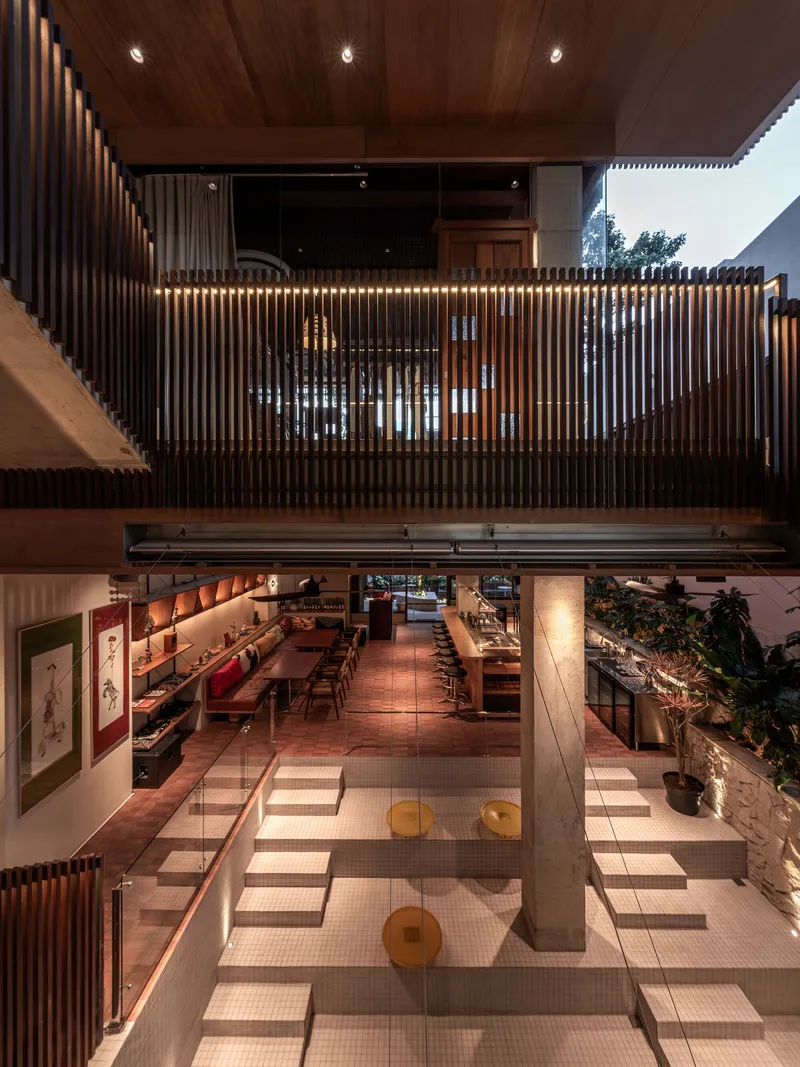
The ground floor dining and bar space sets the tone: timber slatted ceiling, long communal table, pendant lights, and a material palette that stays within a tight range of warm neutrals. The space feels curated without being precious. Stepped seating against white tile walls on the lower level introduces a different character, cooler and more graphic, that distinguishes the retail and café zones from the bar.
The double-height mezzanine condition, visible in several interior views, creates visual connections between floors that a conventional stacked plan would eliminate. You can see the dining level from the retail level, and the lobby from the bar. These sightlines knit the separate programs into a single spatial experience, which is exactly the argument the building needs to make for combining such different uses in so little area.
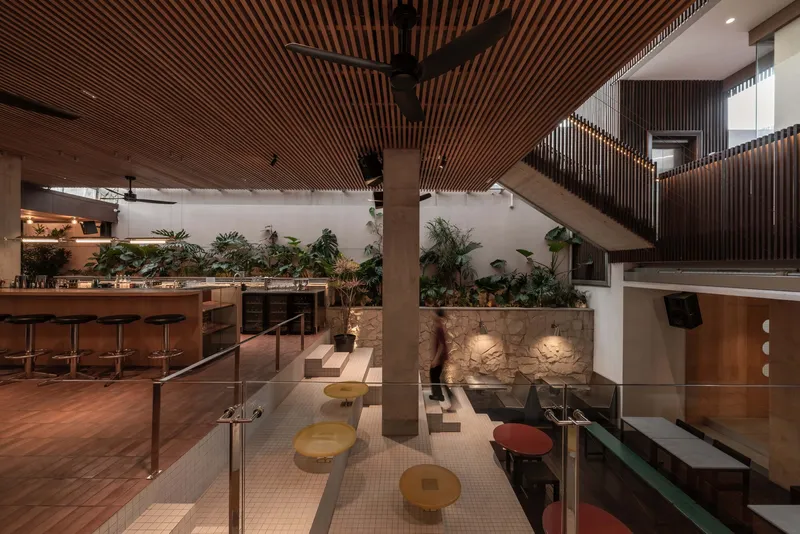

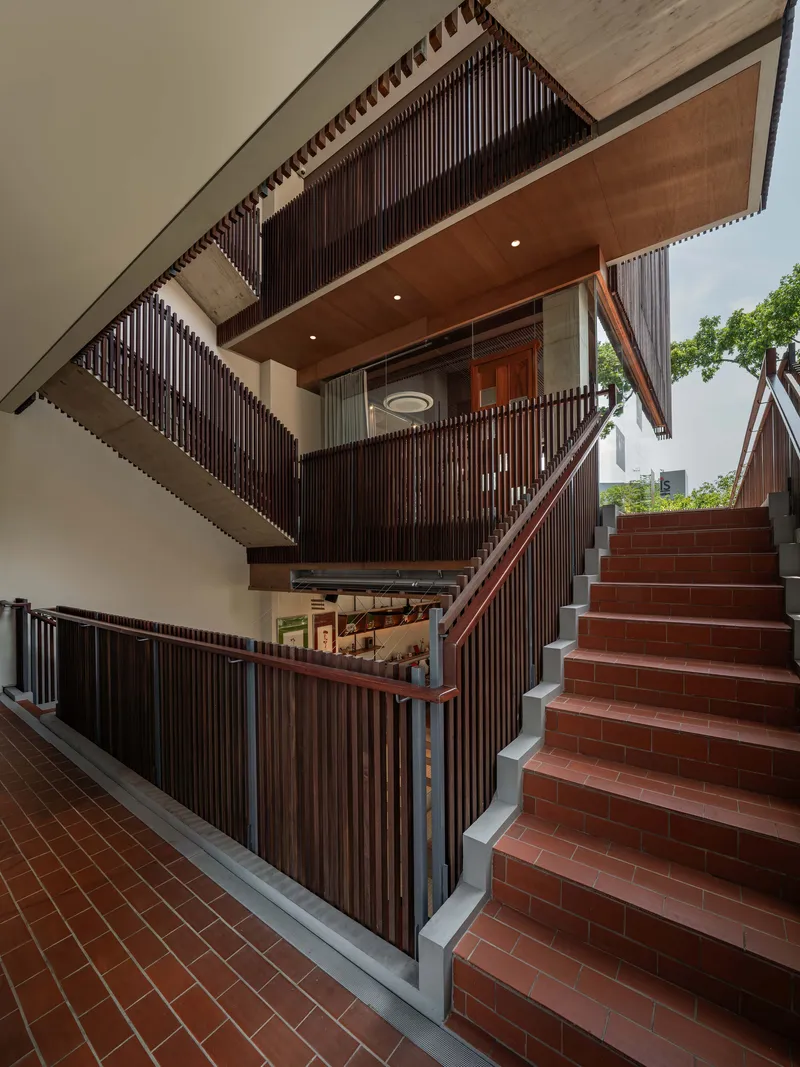
A planted wall visible through the glass-railed mezzanine introduces greenery into the deep interior, compensating for the lack of garden space at ground level. At night, the slatted screens become translucent dividers that reveal display areas and circulation in silhouette, giving the building's section a legibility from outside that most mixed-use projects lack. Every interior surface is working: the terracotta tiles underfoot, the timber slats overhead, the planted elements punctuating the concrete frame.
The Cantilevered Upper Volume

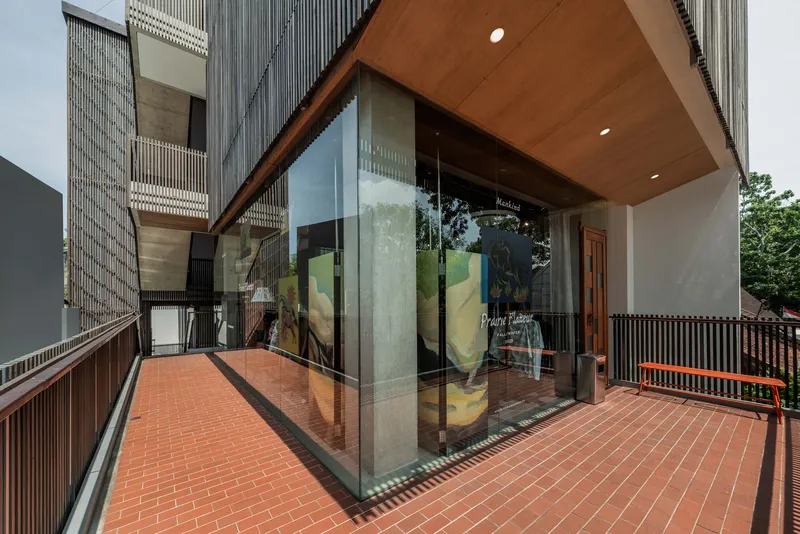

The hotel rooms on the upper floors push outward as cantilevered volumes, gaining floor area above the ground level footprint. The balconies with vertical slats and curving walls visible in the evening light give these rooms a private, almost cocoon-like quality, distinct from the public energy of the lower floors. The transition from open bar and retail at ground level to private hotel rooms at the top is managed through a progressive tightening of enclosure: open courtyard, screened terrace, enclosed room.
Peering vertically into the stairwell from the hotel levels at dusk, you see terracotta floor tiles glowing faintly through slatted screens. The separation between public and private is complete spatially but visually suggestive, a characteristic ambiguity that gives the building its hospitality character.
Plans and Drawings

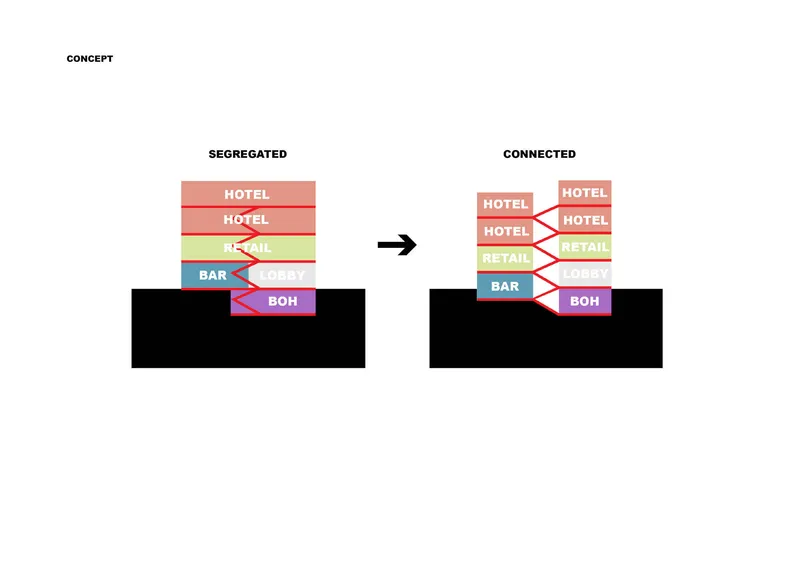
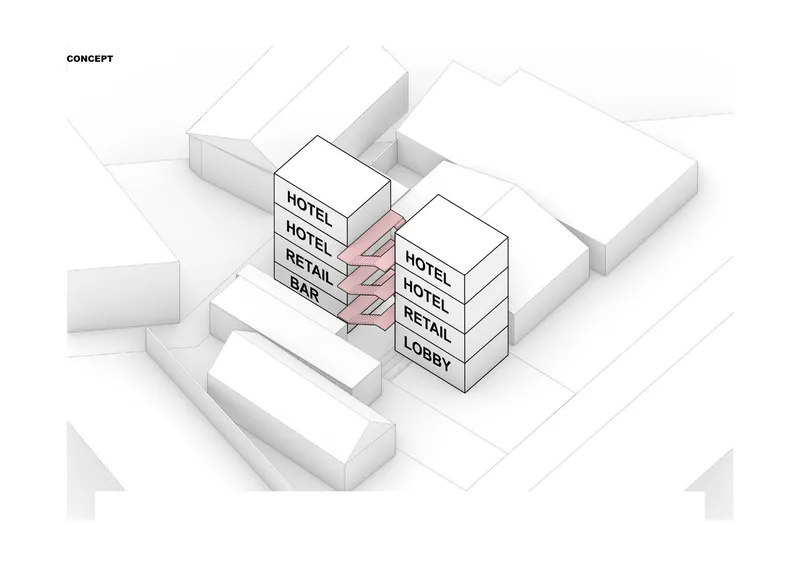
The axonometric diagrams lay out the stacking logic with unusual clarity. Color-coded volumes show hotel, retail, lobby, and bar as discrete blocks within the vertical assembly, while a comparative diagram illustrates the difference between a segregated layout (programs stacked in isolation) and the connected approach Studio Kota adopted, where bridges and shared circulation stitch the components together. The connection between two towers via bridging elements is highlighted, revealing that the project is not a single monolith but a pair of linked vertical volumes.

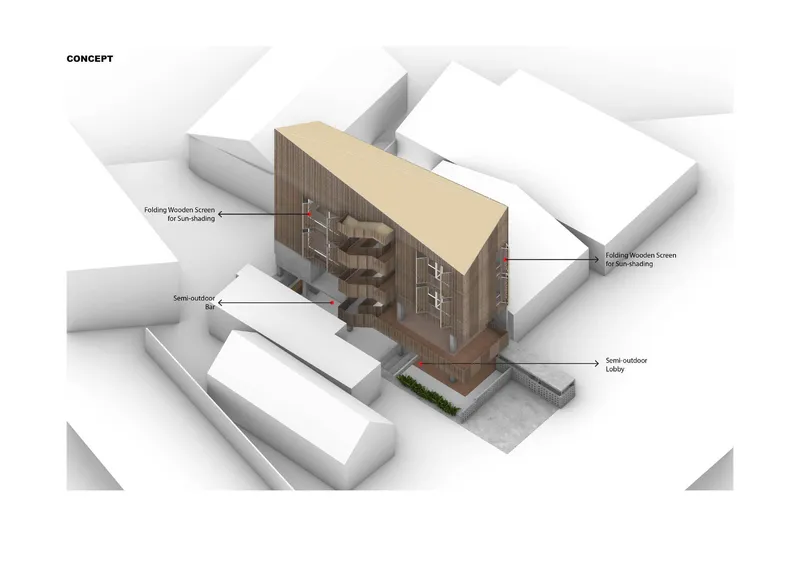
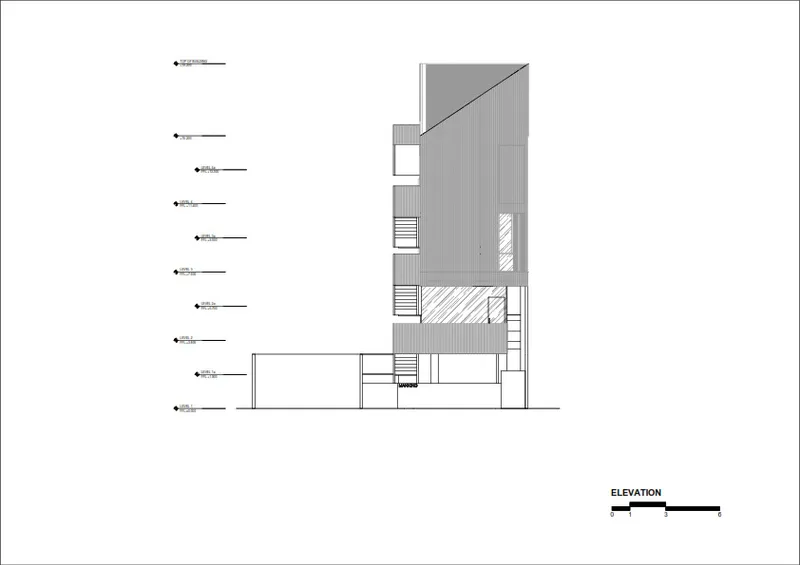
The solar analysis diagram demonstrates how the building's sliced volume maximizes daylight penetration into the deep plan, using the timber screen to calibrate light levels rather than block them entirely. An axonometric cutaway shows the spiral staircase and lobby spaces in relation to the facade screen, making the case that the screen is not decorative but integral to the section logic. The elevation drawing confirms the material hierarchy: darker cladding below, lighter timber screens above, varying floor heights that correspond to each program's spatial needs.

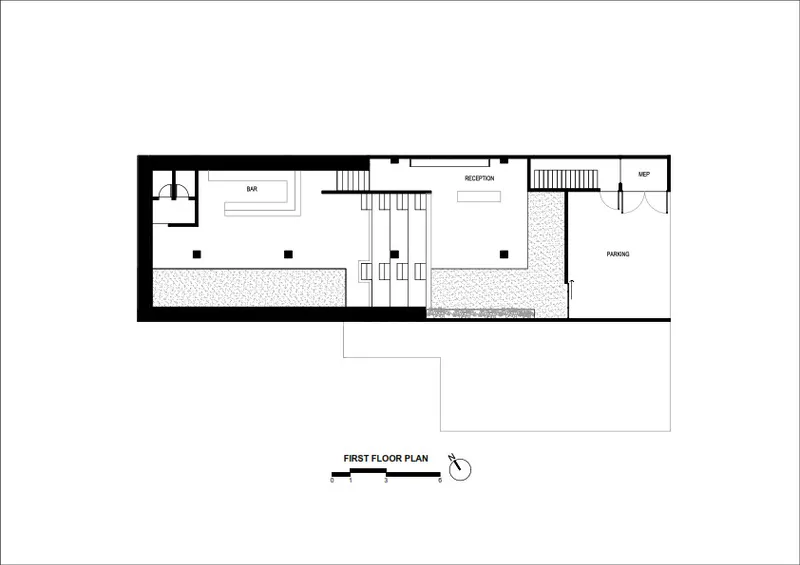

The floor plans progress from a service-heavy basement (kitchen, office, mechanical) through a ground floor that balances reception, bar, and parking around a central staircase, to a second floor where retail, storage, and an office wrap around a generous terrace. The plans are tight. There is no wasted corridor, no gratuitous gesture. Every room is carved from necessity.
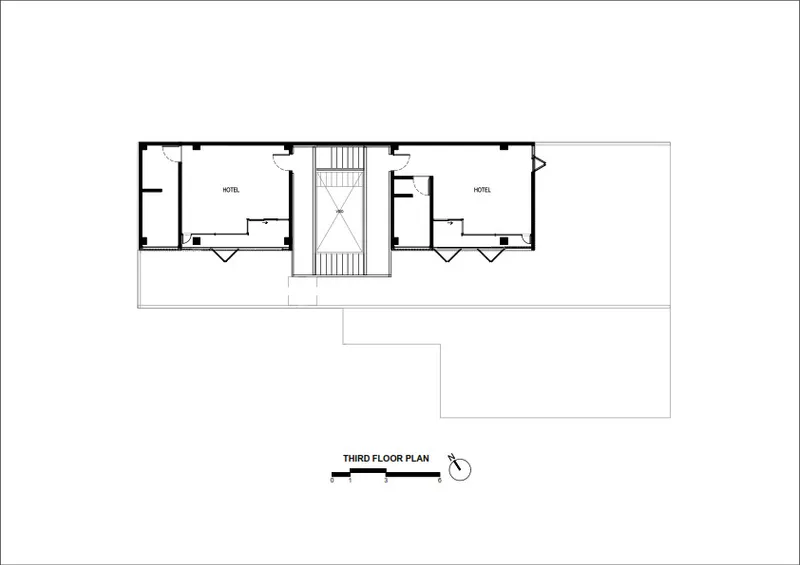
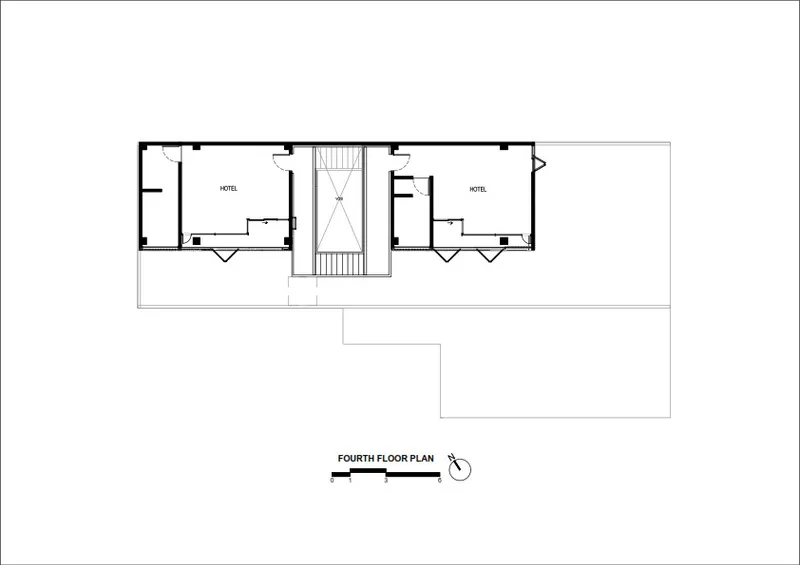

The third and fourth floor plans are mirror-image hotel room configurations flanking the central stairwell, a straightforward arrangement that maximizes privacy while sharing vertical circulation. The section drawing is the most revealing document in the set: staggered floor plates connected by diagonal stairs, a pitched roof that creates a loft-like quality on the top floor, and a clear reading of how each level's ceiling height responds to its program. The bar gets volume; the hotel rooms get intimacy.
Why This Project Matters
Mankind Studios is a proof of concept for a type of building that Southeast Asian cities need more of: a dense, mixed-use vertical stack that takes its neighborhood context seriously without mimicking it. The timber screen is not a nostalgic gesture toward traditional craft. It is a performance element that solves thermal, visual, and spatial problems simultaneously. The courtyard is not a luxury. It is the mechanism that makes a four-story commercial building habitable in the tropics. Studio Kota has made design decisions that are legible, defensible, and, based on the evidence of these images, genuinely enjoyable to occupy.
More broadly, the project challenges the assumption that mixed-use buildings require large footprints and horizontal sorting of program. By stacking hotel rooms above a bar above retail above a kitchen, and connecting everything through a single expressive stairwell, the building demonstrates that architectural ambition and site constraint are not opposed forces. They are collaborators. For architects working on tight urban sites across Indonesia and beyond, Mankind Studios offers a useful model: go vertical, stay warm, let light in, and never treat the stair as an afterthought.
Mankind Studios by Studio Kota (Lead Architect: Erick Kristanto), Bandung, Indonesia. 637 m², completed 2025. Photography by Ferrian Rinaldi and Arte Haus.
About the Studio
Share Your Own Work on uni.xyz
If projects like this are the kind of work you want to make, uni.xyz is a place to publish your own, find collaborators, and enter design competitions.


Popular Articles
Popular articles from the community


Architekt Andreas Gruber Scatters 23 Dark Timber Chalets Across a South Tyrolean Forest Edge
In Molini di Tures, Amonti Chalets breaks a resort into a hamlet of gabled timber houses, with parking, storage and services pushed into the slope.

longwave studio Reorganizes a 112 m² Tainan Apartment Around the Daily Routines of a Family and Two Cats
In Tainan, Taiwan, birch plywood, rust-red furniture and a freestanding plaster wall link arrival, storage, work and family life in one apartment.

U.GA Architects Wraps an Oval Rooftop Pool in Curved Board-Formed Concrete on Busan's Jeollidan-gil
In Busan's Jeonpo-dong, a 454 m² mixed-use block stacks a neighborhood facility, guest rooms and an oval rooftop pool inside spiraling concrete walls.

David Macias Steps a Doorless Stone and Plaster House Down a Tropical Colombian Hillside
In the humid hills of Colombia, Threshold House replaces the front door with an open void and terraces its 850 m² down the slope instead of fighting it.

Similar Reads
You might also enjoy these articles


LAVA Architecten Gives Vocational Education a Sawtooth-Roofed Face on a Mechelen School Campus
In Mechelen, Belgium, a 2,053 m² STEM school on a 6×6 m grid turns workshops and classrooms into rooms that can be rearranged as teaching changes.

KEMA Studio Turns a Derelict Marvila Attic into a 60 m² Lighthouse Apartment Above Lisbon
In Lisbon's Marvila district, a rebuilt roof, four skylights and two plywood volumes turn an unlivable attic into a bright home facing the Tagus.

Pixel Gardens: One Repeated Module Stacked Into a Terraced Social Housing Tower for Famagusta
Salem Bader's shortlisted housing tower builds a vertical neighbourhood from one repeated module, offsetting units to carve terraces, light and air.

Bao Huynh Watercolor Atelier: A Serene Art Retreat in Hội An
Bao Huynh Watercolor Atelier in Hội An blends multifunctional art spaces, sustainable design, local materials, and family-friendly living in a serene environment.

Comments (0)
Please login or sign up to add comments
No comments yet. Be the first to comment!