

Manuel Bouzas and salazarsequeromedina Build a Lounge from Wildfire-Reclaimed Wood at ARCO Madrid
A temporary installation at Spain's premier art fair transforms 350,000 hectares of devastation into luminous architecture.


The number in the title is not decorative. In August 2025, wildfires tore through northwestern Spain and consumed roughly 350,000 hectares of forest, with 150,000 hectares lost in the province of Ourense alone. For the 45th edition of ARCO Madrid, held in March 2026, Manuel Bouzas and salazarsequeromedina turned that catastrophe into the raw material and animating concept of a 1,200 square meter guest lounge. Burned wood, which must be removed within six months to prevent disease from spreading through soil, was reclaimed and reprocessed into thin veneers, cladding panels, and textured surfaces. The result is an installation that does not merely reference ecological loss but physically embodies it.
ARCO 2026 took as its central theme "two spaces within the fair," and the architects answered with a sharp spatial proposition. A diagonal wall slices the rectangular footprint into two triangles: one dark, housing a lounge bar and relaxation area; the other golden, containing a restaurant and private VIP room. Six luminous ceiling planes, suspended four meters above the ground on metal trusses, hover over both zones and unify them under a single canopy of recovered timber. It is fire abstracted twice over: first as material salvage, then as a warm, flickering glow projected through translucent wood.
Ceiling as Landscape


The most commanding element is not a wall or a floor but the overhead plane. Six independent panels of gridded timber and translucent wood veneer tilt and curve at different angles, producing a topography that reads like terrain seen from above. Metal trusses, left fully exposed, hold each panel and an adjustable spotlighting rig, so that light passes through the veneers rather than bouncing off them. The effect is something between a campfire canopy and a geological stratum: warm, directional, almost geological.
Because the trusses are independent of one another, the panels overlap and separate at their edges, generating gaps where the industrial ceiling of IFEMA's exhibition hall bleeds through. That honesty is important. The installation never pretends to be a sealed room; it acknowledges the temporary, infrastructural reality of a fair pavilion while building an atmosphere powerful enough to override it.
Light Against Darkness


The project is structured around a deliberate contrast between illuminated and unlit zones. Spotlights mounted on the truss system project upward into the veneer panels, turning them into glowing planes that radiate golden light downward. Where one triangle of the plan catches this warmth, the other retreats into a dark, rectangular enclosure for quiet relaxation. The diagonal wall separating the two is the hinge on which this duality swings.
The architects describe the atmosphere as "atavistic," referencing fire's oldest social function: gathering people around a shared source of warmth. It is a loaded metaphor when the material itself is a product of wildfire, but the installation earns it. The light feels genuinely inviting rather than commemorative. Visitors drift toward the glow, not away from a memorial.
Materiality of Recovery
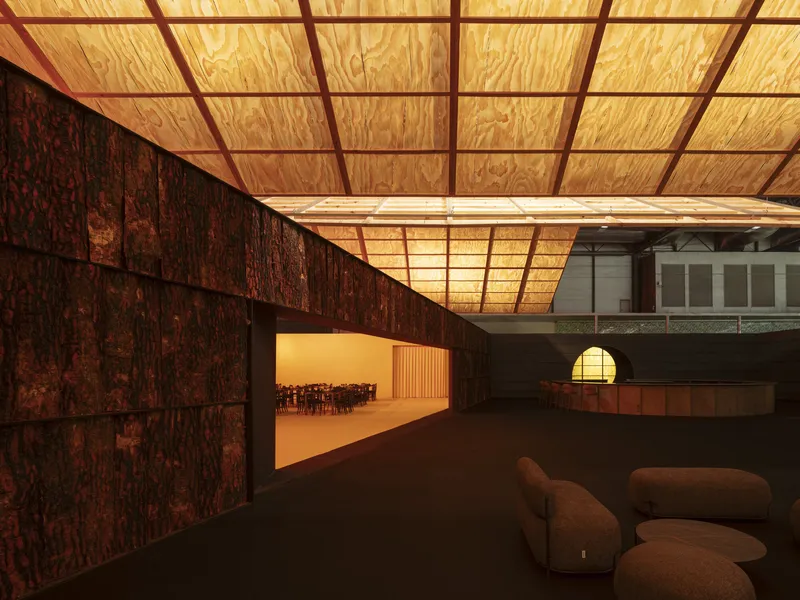
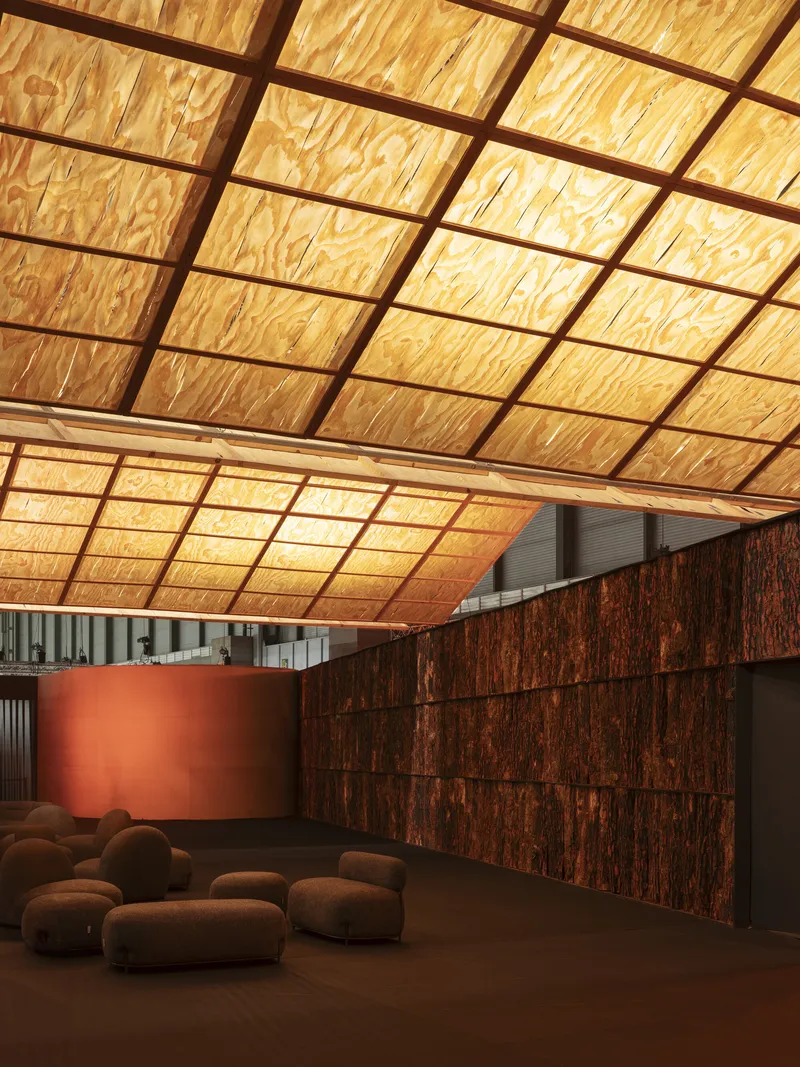

Wood appears in at least four distinct registers across the installation. Thin veneers fill the ceiling grid and glow when backlit. Bark-clad surfaces line vertical partitions, retaining the raw, unprocessed character of the original logs. Plywood panels form smooth ochre and cork-toned walls. And heavier timber members compose the structural grid of the canopy frames. Each treatment corresponds to a different stage of processing, so the installation functions as a material taxonomy of what can be recovered from a burned forest.
The collaboration with FINSA, which managed cleanup efforts in the affected regions, grounds the material story in logistics rather than sentimentality. Removing burned wood quickly is an ecological imperative, not an aesthetic choice. That the architects found a way to make that urgency legible, transforming cleanup into construction, gives the project a pragmatic weight that many memorial installations lack.
Color and Enclosure

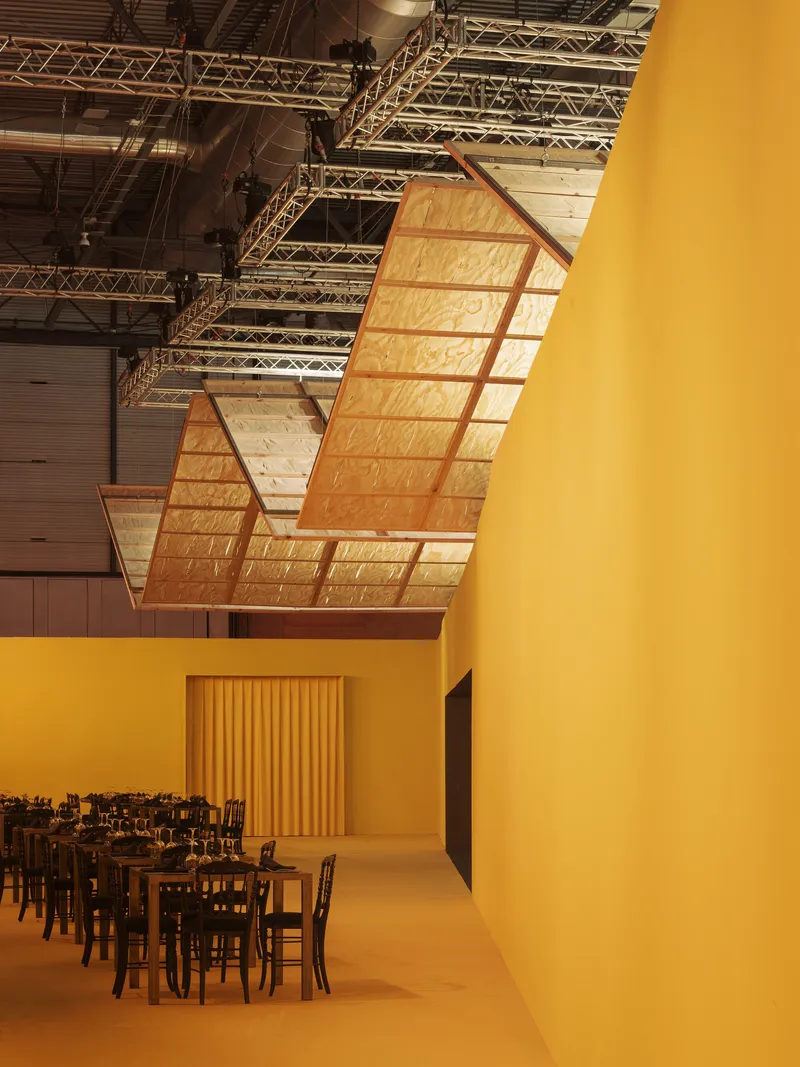
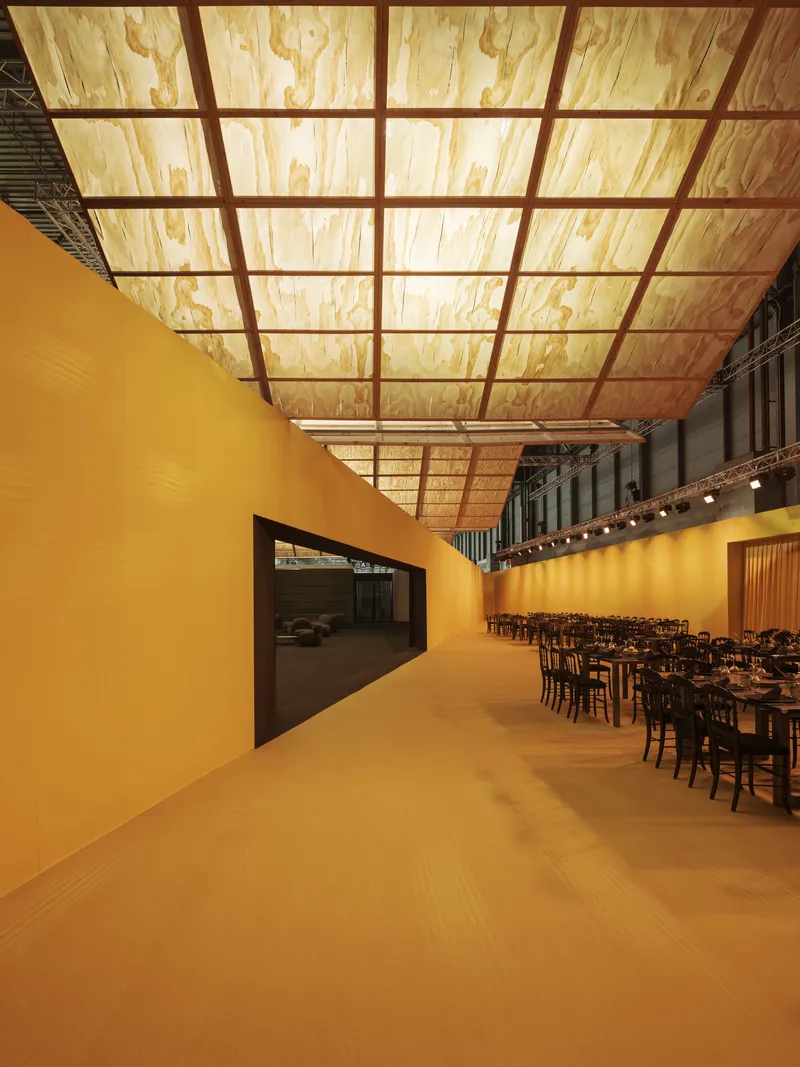
Against the natural palette of reclaimed timber, the architects introduce painted surfaces in ochre, terracotta, and coral. These aren't accent walls; they define entire spatial volumes. A yellow-painted cylinder frames a doorway, a terracotta partition wraps a bar counter, and coral tones warm the seating zones. The colors correspond loosely to the chromatic range of fire, from ember orange to ash gold, but they operate independently as spatial markers that help visitors navigate the 1,200 square meter plan without signage.
Arched openings punched through these painted walls create framed views from one zone to the next. A glimpse of the bar through a yellow arch, or a corridor of ochre walls leading to the dining area, produces a sequence of spatial reveals that is unusually cinematic for a temporary fair installation.
The Lounge as Social Space


The program is deceptively simple: a bar, a restaurant, a cloakroom, sponsor areas, a VIP room, and a central relaxation space. What elevates it is the way these functions are arranged around the diagonal cut. The bar and cloakroom orbit the perimeter, keeping service functions at the edges. The center opens into a low-slung seating area where rounded ottomans and upholstered benches cluster beneath the highest point of the suspended canopy. It is the hearth, the place where the firelight metaphor lands most directly.
Visitors photographed in the space tend to look up. That upward gaze is the surest sign that the ceiling plane is doing its job, pulling attention away from the generic exhibition hall and into the world the architects have constructed overhead.
Structural Legibility


Nothing is hidden. The metal trusses that support each ceiling panel are painted black and left visible, running at angles that cross the overhead planes. Spot fixtures, cabling, and adjustment hardware all register as part of the composition. For a project about recovery and reuse, this transparency feels essential. The structure is not a finished object but a visible act of assembly, a temporary scaffolding that holds salvaged material aloft for five days before being disassembled.
Plans and Drawings


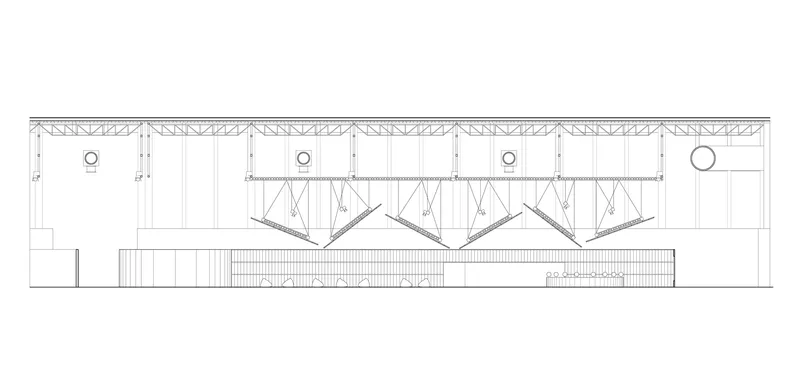
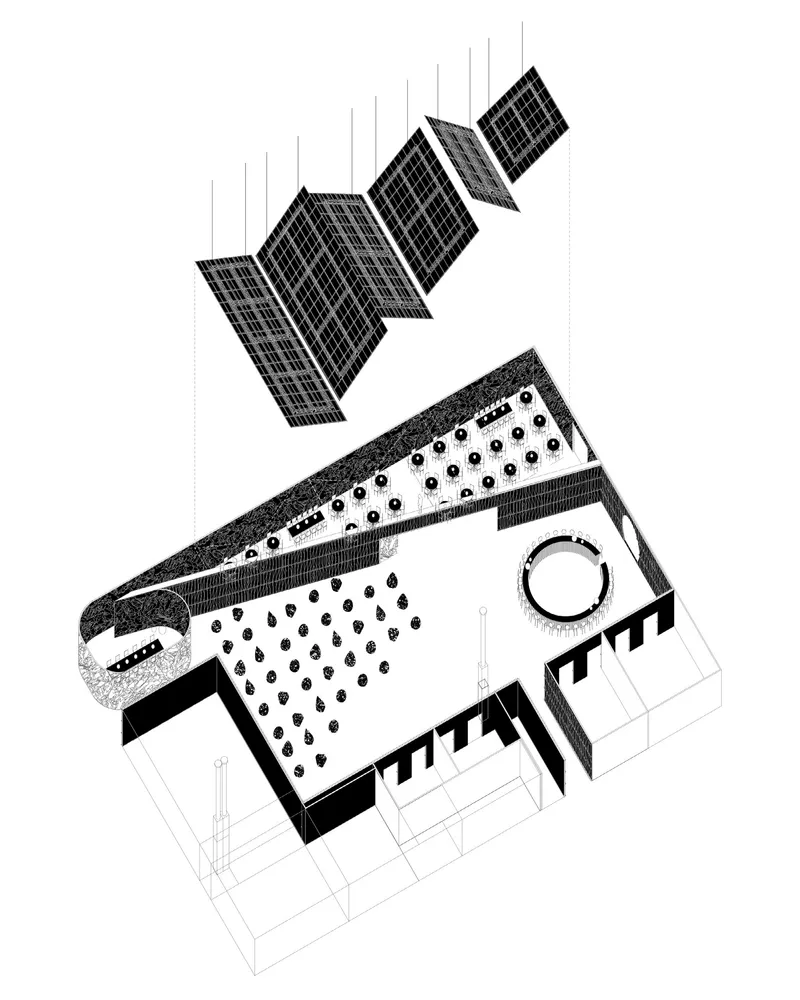
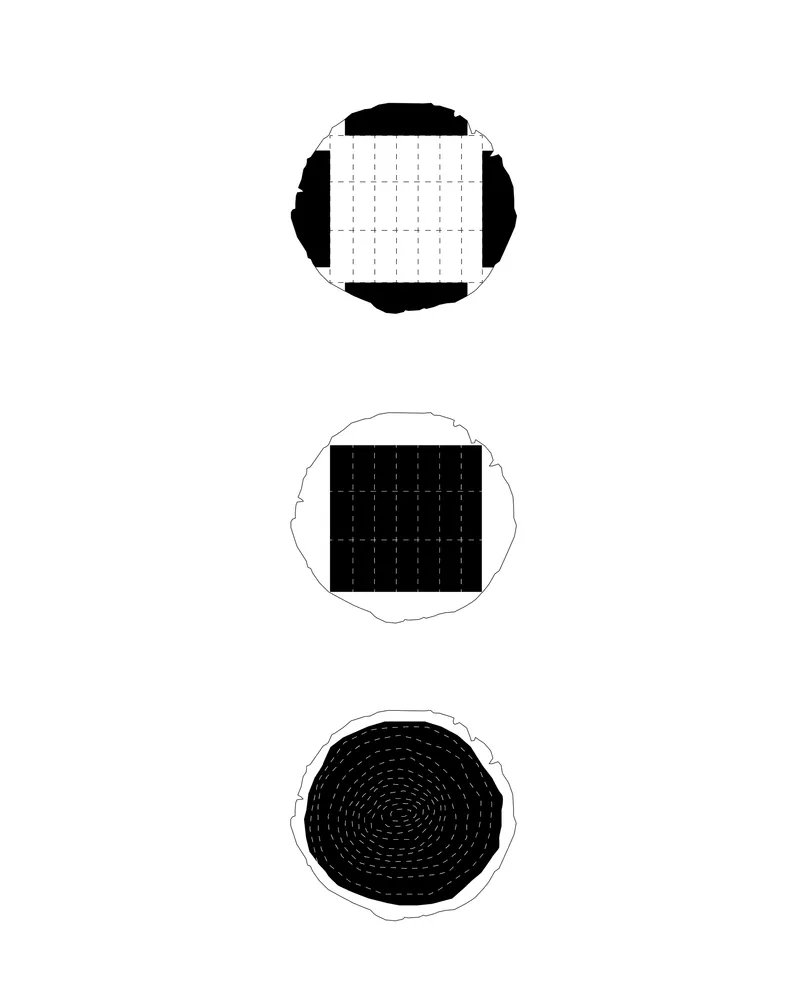
The floor plans reveal the diagonal division clearly: two triangular zones carved from a rectangle, with a circular element at the center that likely corresponds to the primary social gathering point. The section drawing confirms the four-meter suspension height and shows how the truss system creates a double ceiling, industrial infrastructure above and luminous timber below. The axonometric and diagrams illustrate variations in panel geometry and orientation, suggesting the design team explored multiple configurations before settling on the final arrangement of six tilted planes.
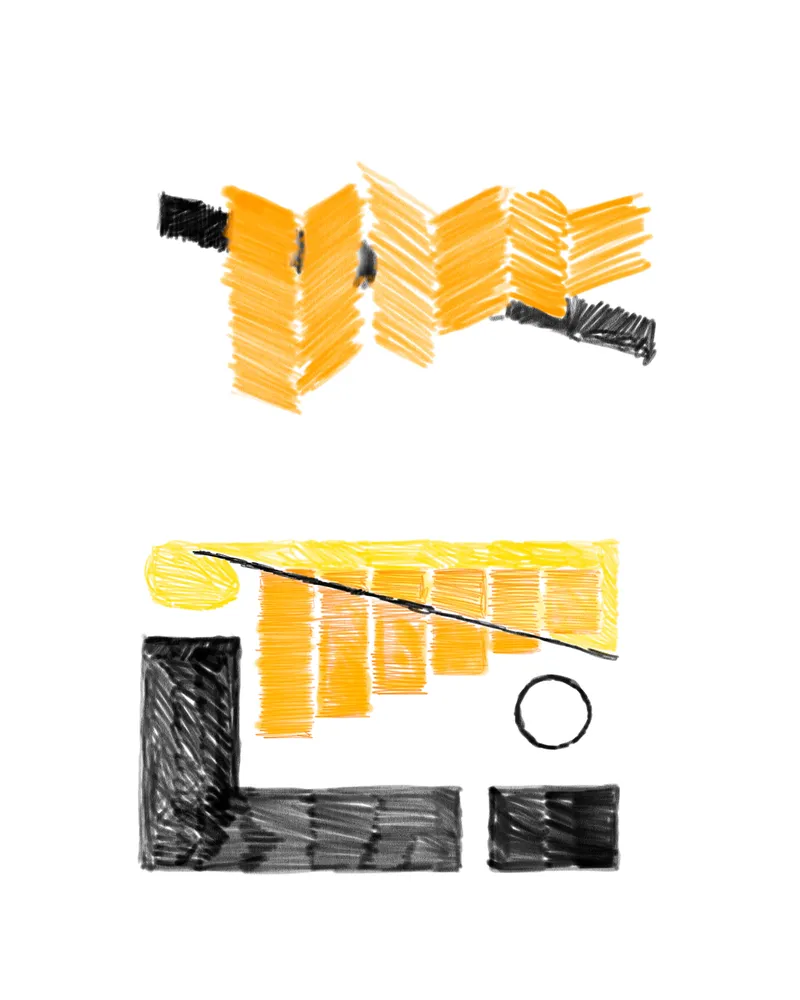
The sketch in yellow, black, and white is worth pausing on. It captures the conceptual DNA of the project in a few strokes: angular colored volumes, dark masses of reclaimed timber, and the ever-present circle at the center. It reads like a painting, which is fitting for a project housed inside one of Europe's most important contemporary art fairs.
Why This Project Matters
Temporary installations at art fairs face a particular credibility problem. They exist for days, consume resources, and often serve as brand exercises rather than architectural arguments. Guest Lounge 350.000 Ha sidesteps that trap by making the material itself the argument. Every veneer panel, every bark-clad wall, every structural timber carries a specific provenance: forests in Ourense that burned in August 2025 and needed clearing before contamination spread. The installation does not just use reclaimed material; it depends on it conceptually. Without the wildfire, there is no project.
That dependency is what makes the work genuinely interesting. Manuel Bouzas and salazarsequeromedina have designed a space where ecological crisis, material economy, and atmospheric ambition are inseparable. The warm glow of the ceiling planes is beautiful, but it is also the light of a specific disaster, filtered through a specific recovery process. When the fair ends and the structure comes down, the wood will have completed a journey from standing forest to ash-scarred log to architectural surface and back to raw material. That cycle, not the lounge itself, is the real design.
Guest Lounge 350.000 Ha, designed by Manuel Bouzas and salazarsequeromedina. Located at IFEMA, Madrid, Spain. 1,200 m². Completed 2026. Photography by Luis Díaz Díaz.
About the Studio
Share Your Own Work on uni.xyz
If projects like this are the kind of work you want to make, uni.xyz is a place to publish your own, find collaborators, and enter design competitions.


Popular Articles
Popular articles from the community


Cloaked Colonization: A Mobile Underwater Habitat That Moves Like a Fish
Micah Abaya's shortlisted EHC Pacific entry reimagines ocean settlement as a dispersed network of self-sustaining architectural organisms.

The Amber Palace Opera: A Geological Fiction Surfaces on Tallinn's Baltic Waterfront
Pierre Brillard reimagines a Baltic legend as a public landscape, opera house, and waterfront promenade rooted in Tallinn's coastal identity.

Temporary Home for Dogs: A Reversed Zoo Rethinks Animal Shelter Architecture
In Bucharest, a sinuous corridor and freed landscape flip the logic of containment, designing a shelter that works to make itself unnecessary.
Manzana Morphosis: Stretching Barcelona's Grid into a Living Landscape for 2050
A radical reworking of the Eixample manzana turns density into a tool for generous public space, vertical ecology, and environmental performance.

Similar Reads
You might also enjoy these articles

Pixel Gardens: One Repeated Module Stacked Into a Terraced Social Housing Tower for Famagusta
Salem Bader's shortlisted housing tower builds a vertical neighbourhood from one repeated module, offsetting units to carve terraces, light and air.

Bao Huynh Watercolor Atelier: A Serene Art Retreat in Hội An
Bao Huynh Watercolor Atelier in Hội An blends multifunctional art spaces, sustainable design, local materials, and family-friendly living in a serene environment.

Atelier Macri Concept Store Interior Design by CASE-REAL
Atelier Macri store features a "ko" counter, walnut wood details, cork displays, blending retail, gallery, and seamless customer experiences.

Manuel Vargas Izquierdo Stadium and High-Performance Sports Center: Architectural Excellence in Jalpa de Méndez
The Manuel Vargas Izquierdo Stadium blends sustainable design, inclusive sports facilities, and cultural-inspired architecture, revitalizing Jalpa de Méndez’s public spaces.

Explore Lounge Chair Competitions
Discover active competitions in this discipline

Challenge to design a portable theatre

Challenge to design a portable music platform

Challenge to design an open learning module for the elderly
Comments (0)
Please login or sign up to add comments
No comments yet. Be the first to comment!