
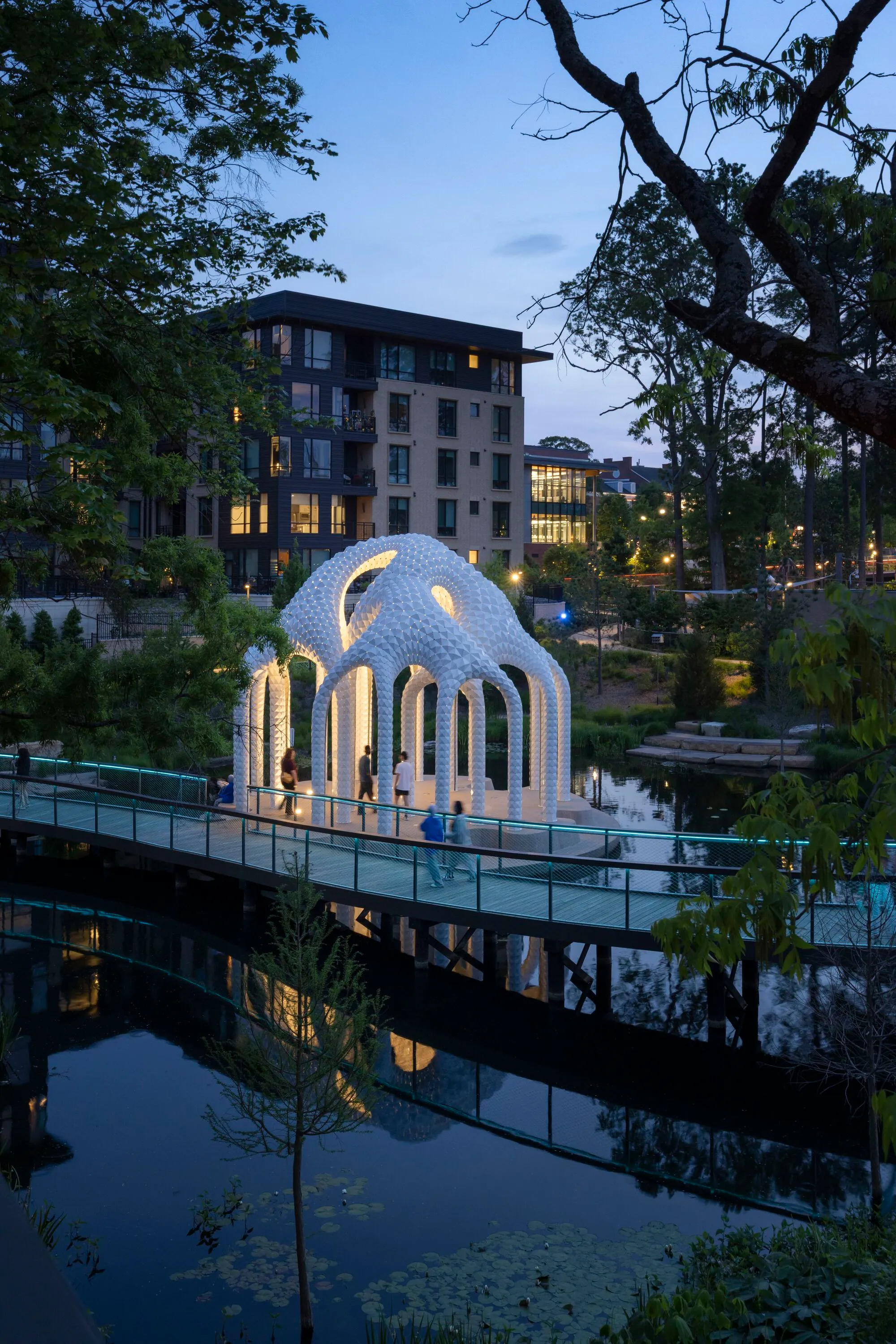
Marc Fornes Floats a Perforated Aluminum Folly on a Pond in Downtown Cary
L'Île Folie rises 31 feet from an artificial island in a North Carolina park, filtering sunlight through thousands of unique panels.


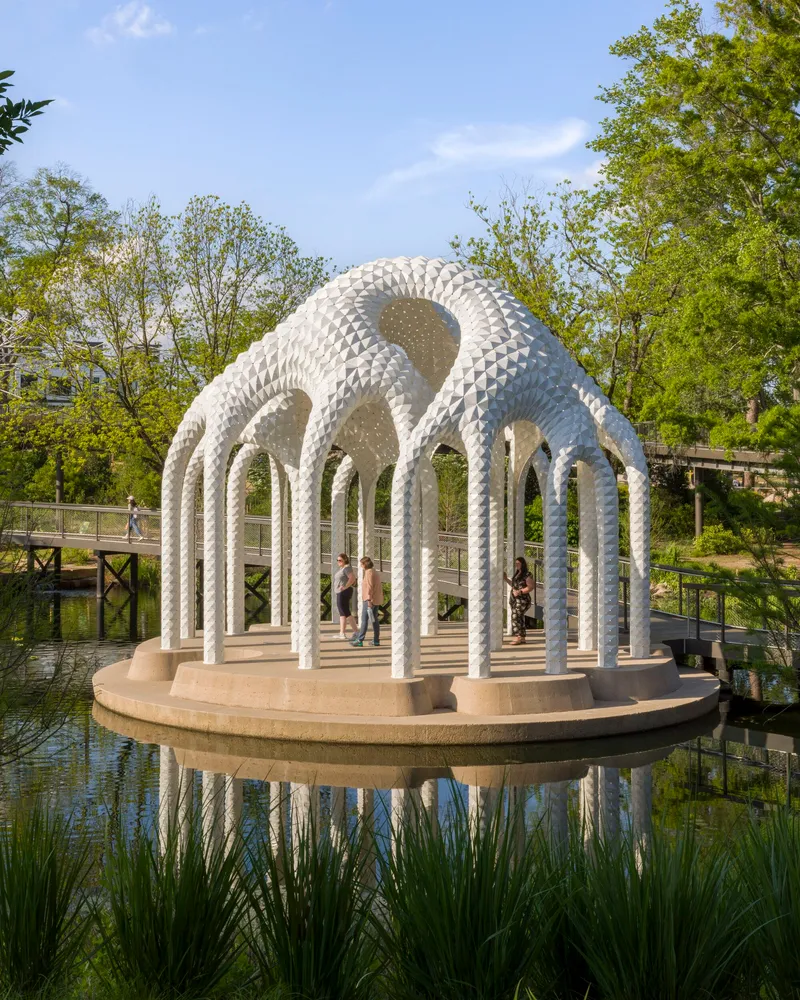
The architectural folly has always been a sly contradiction: a building with no obligation to be useful, freed to be purely provocative. MARC FORNES and THEVERYMANY take that provocation literally with L'Île Folie, a 31-foot structure perched on a small artificial island in the middle of a pond in Downtown Cary Park. Commissioned by the City of Cary as the centerpiece of a new 7-acre civic park, the pavilion is less a building than a sculptural organism, its branching aluminum limbs gathering overhead into a perforated canopy that transforms sunlight into something closer to a forest floor.
What makes L'Île Folie genuinely interesting is not its strangeness but its structural honesty. There is no hidden frame, no steel skeleton disguised behind decorative cladding. The skin is the structure. Thousands of uniquely shaped, digitally fabricated aluminum panels are riveted together to form a stressed-skin shell that stands on slender legs, curves upward, and cocoons visitors beneath it. The result is a pavilion that functions as public art, wedding venue, performance space, and urban landmark simultaneously, all without a single prescribed path through it.
An Island Setting
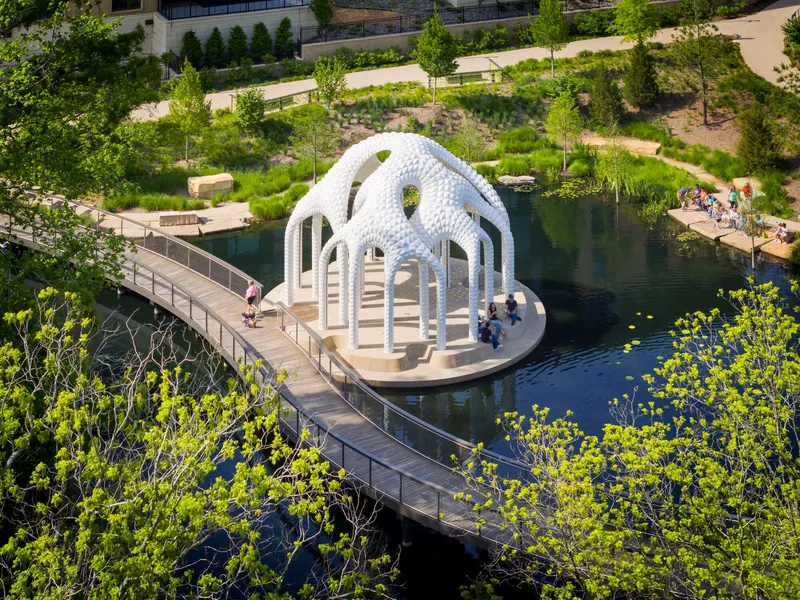
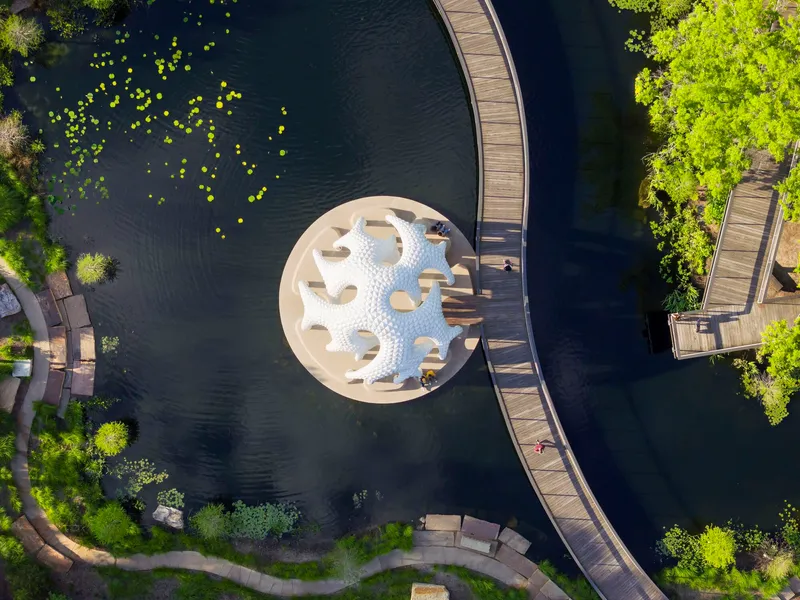

The aerial views make the strategy legible. L'Île Folie sits on a concrete island within a reflective pond, reachable only by a curving timber boardwalk that delays arrival just enough to build anticipation. The island is circular, the pavilion roughly so, and the surrounding landscape of native plantings and boardwalks wraps the water in a series of soft arcs. The approach is borrowed directly from European garden history, where follies were placed to provoke surprise and theatrical discovery. Here, the theater is the walk across the water.
Cary is no longer the sleepy suburb it once was. The town has grown into a hub for younger, tech-oriented communities, and Downtown Cary Park, completed in 2023, is part of a deliberate effort to give that population a civic center worth gathering around. L'Île Folie anchors the park not through scale but through singularity. Nothing else in the vicinity looks like this.
Skin as Structure
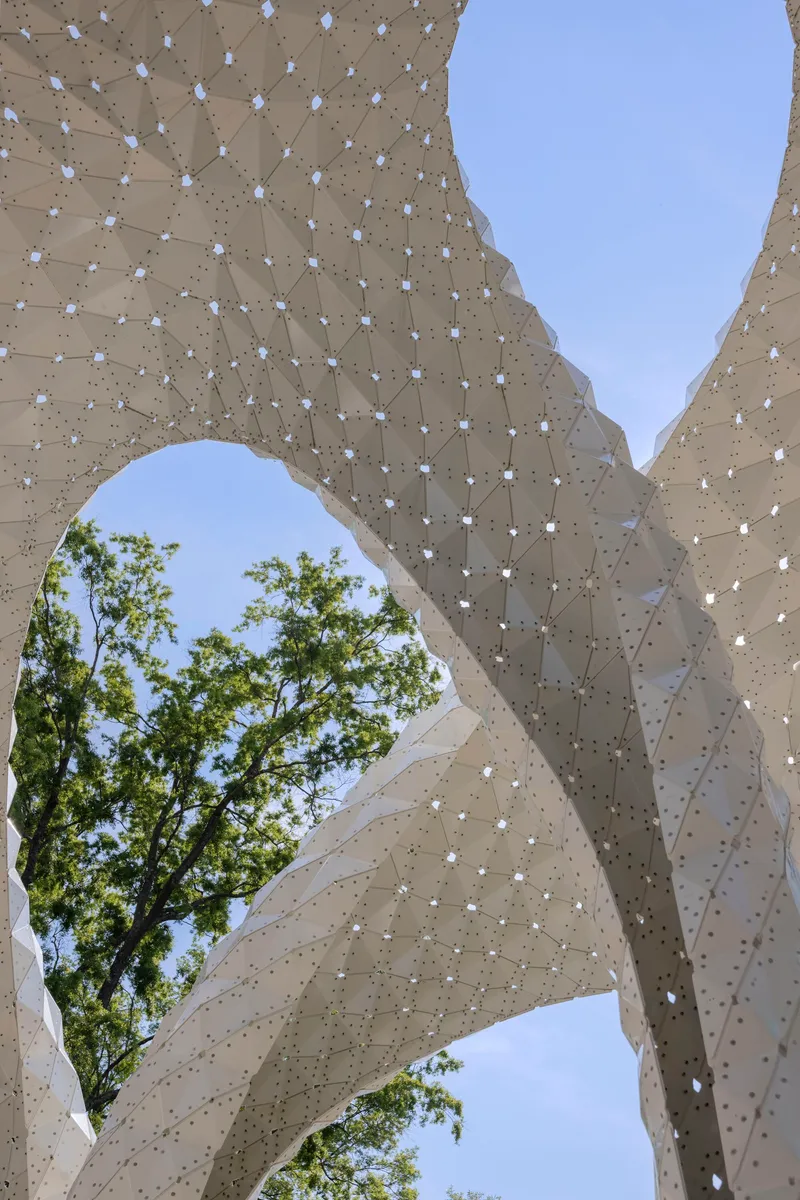
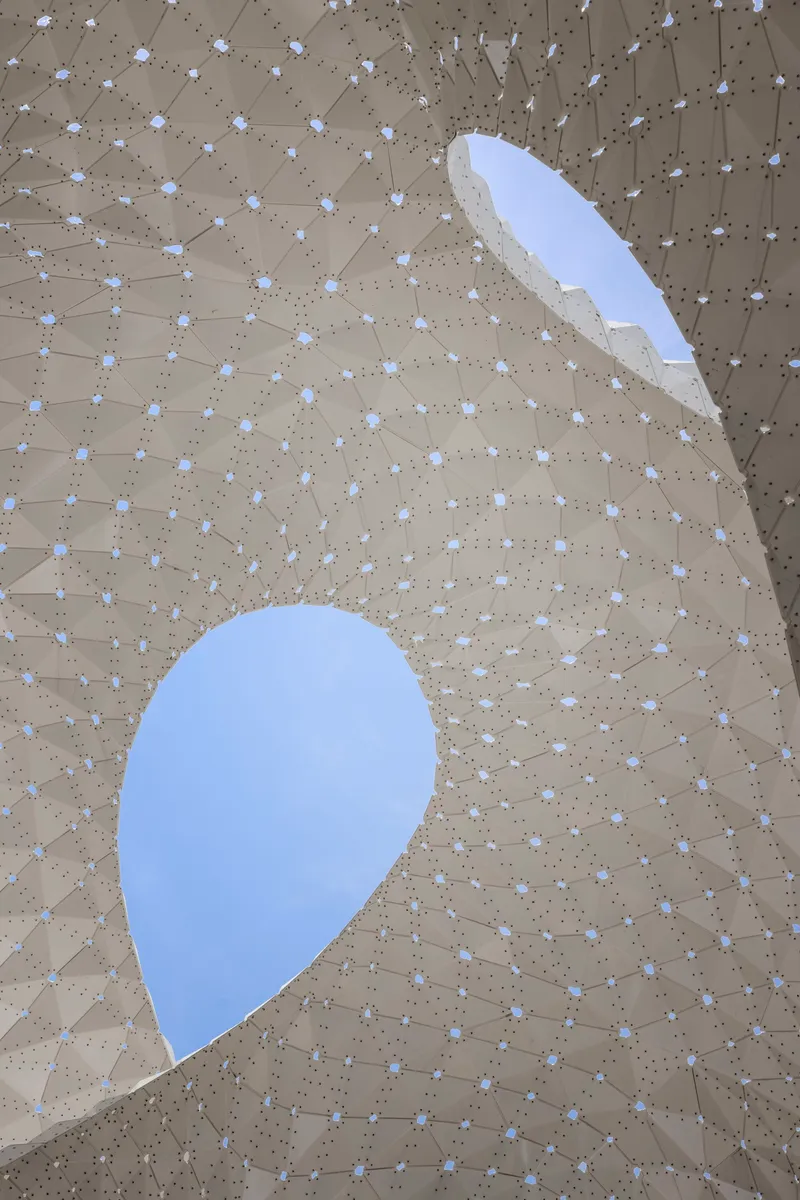
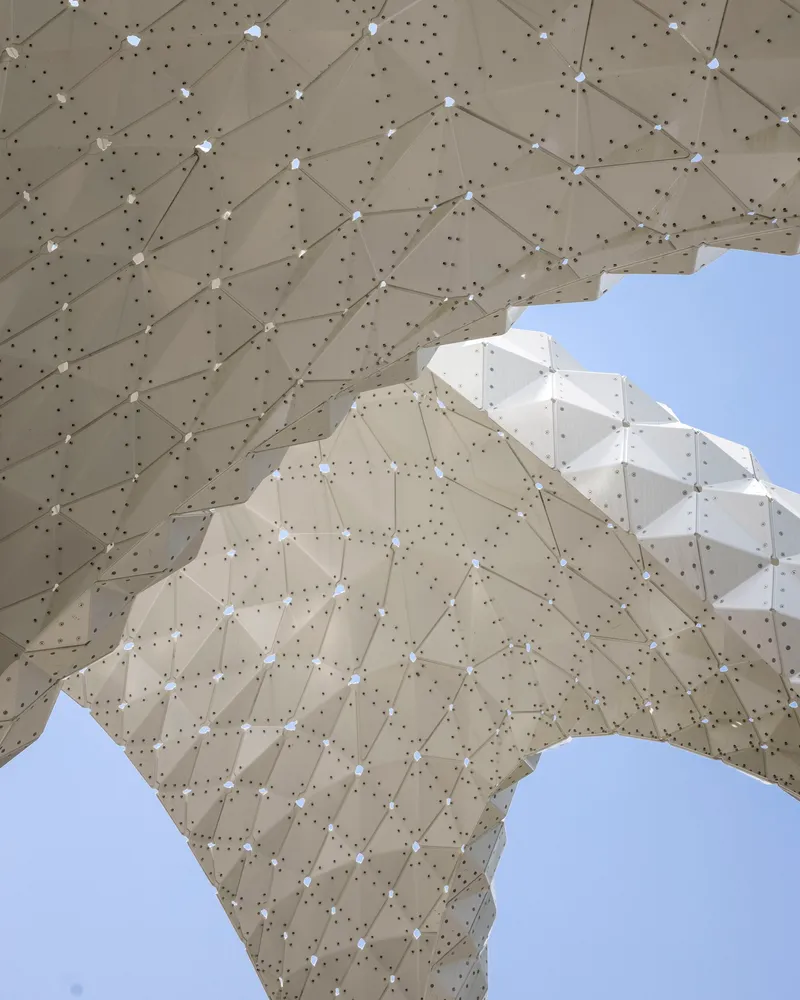
The close-up views of the surface reveal the real achievement. Each aluminum panel is unique, cut and folded with computational precision, then riveted into place one by one to form a seamless shell. The faceted geometry reads differently at every scale: from a distance, the pavilion appears smooth and organic; up close, each triangulated face catches light at its own angle, producing a shimmering, almost reptilian texture.
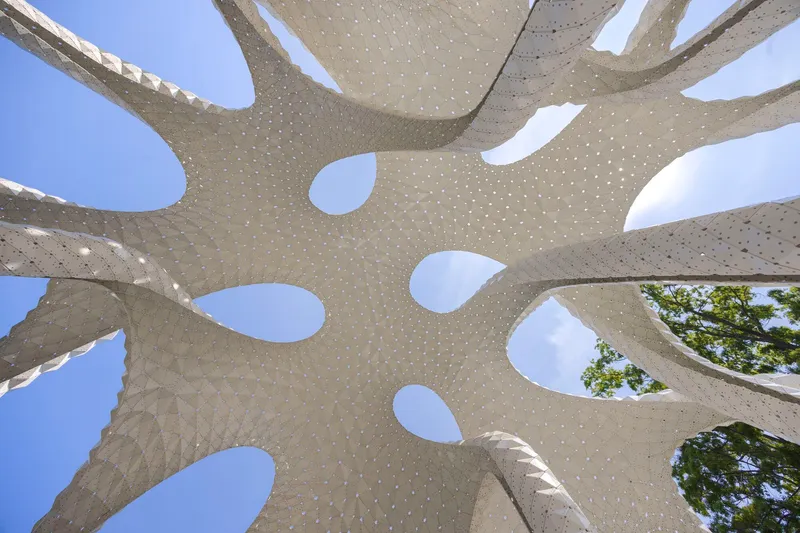
The timber-toned underside panels, visible in the ceiling details, add warmth to what could otherwise feel cold and industrial. The teardrop-shaped openings punched through the canopy are not decorative afterthoughts. They are structural necessities, lobed voids that distribute loads across the shell while framing views of sky and treetops. The entire form is a negotiation between digital geometry and physical assembly, each rivet a small commitment to an extraordinarily complex whole.
Filtering the Carolina Sun
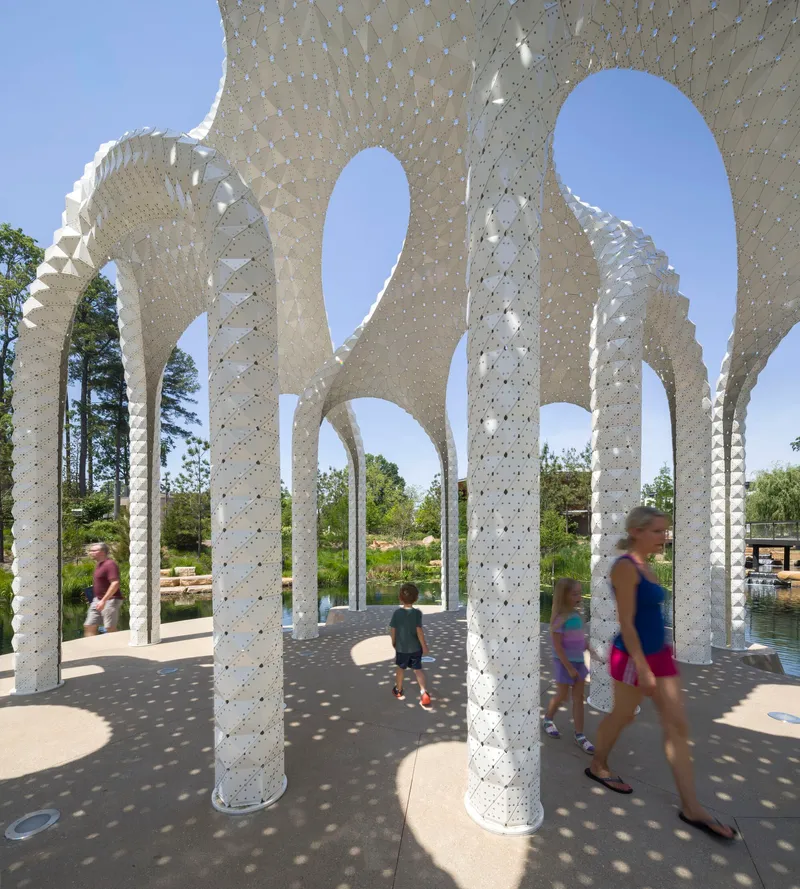
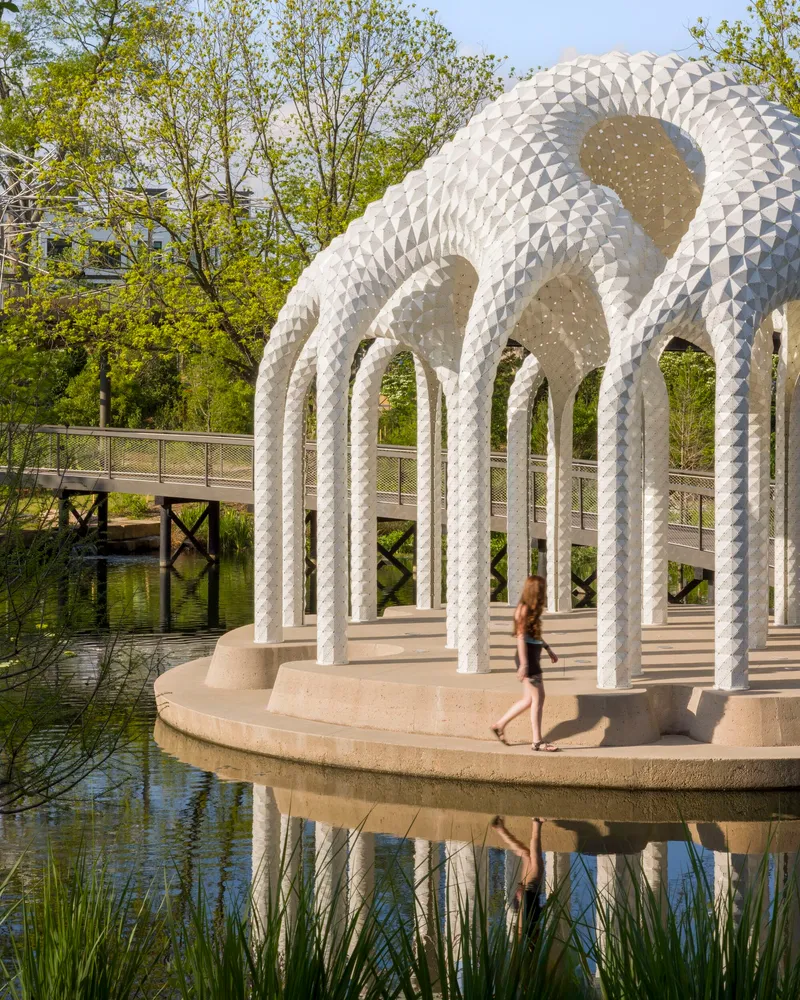
Thousands of perforations puncture the aluminum skin, and their purpose is as much environmental as aesthetic. In North Carolina's intense summer light, the perforated canopy acts like a forest canopy, scattering dappled shadows across the platform and the visitors below. The effect shifts throughout the day as the sun moves, projecting a constantly evolving pattern that turns the pavilion's interior into a kind of slow-motion animation.
The upward views through the canopy, where lobed openings frame blue sky and tree branches, make the roof feel less like a ceiling and more like a membrane between the visitor and the atmosphere. There is no enclosure here, only graduated degrees of shade. The design avoids any hard boundary between inside and outside, which is exactly what a folly should do: invite you in without trapping you.
At Ground Level
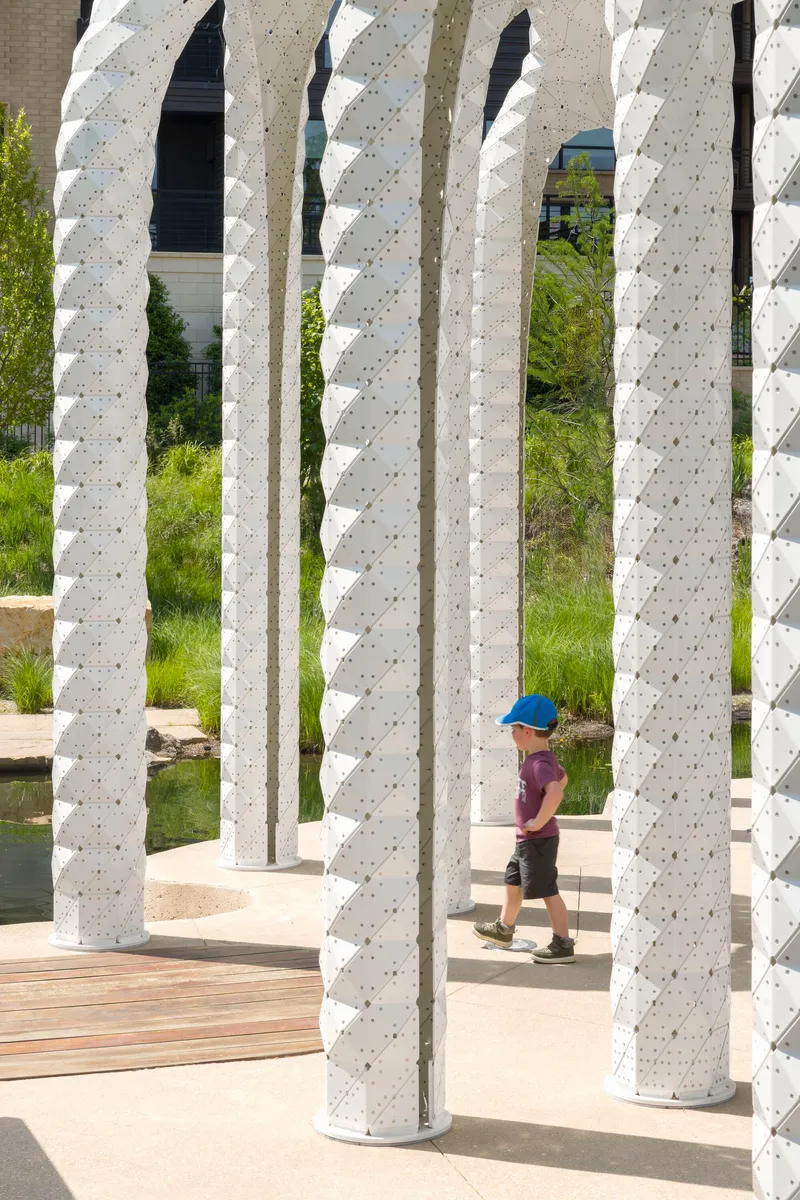
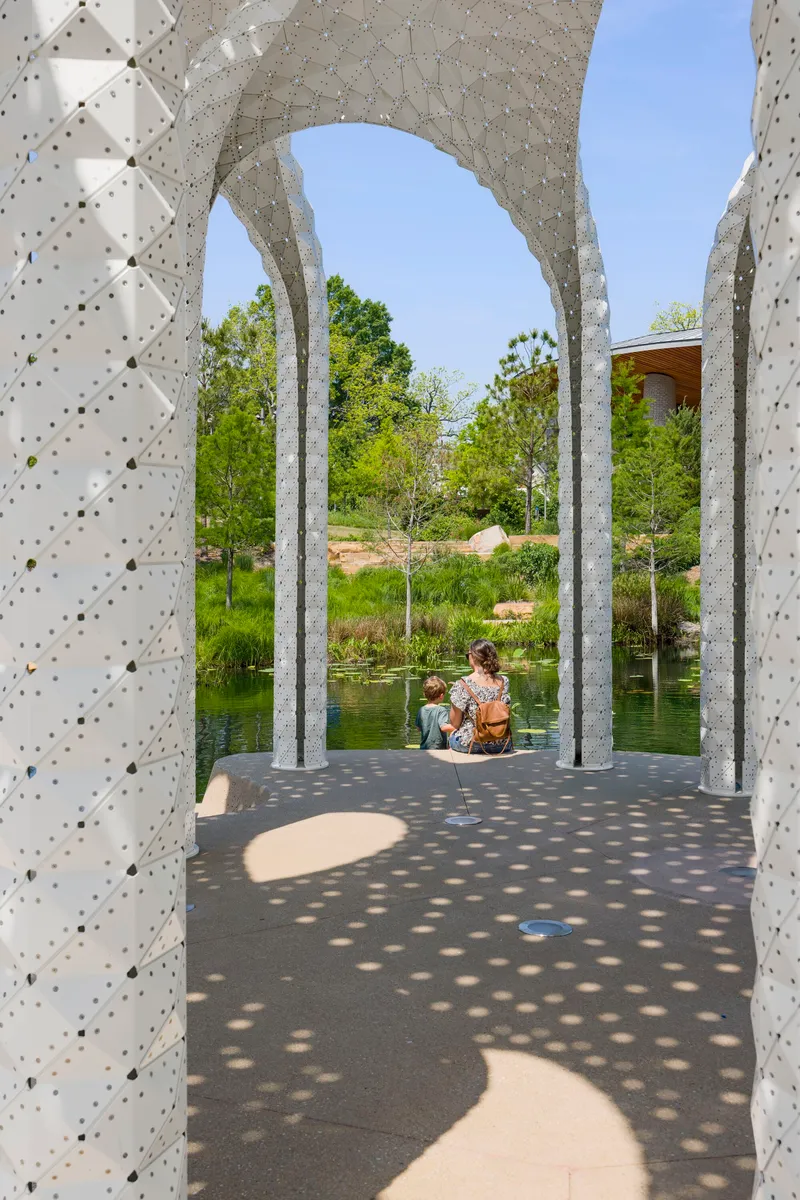
The pavilion has no front door, no single entrance, no obvious orientation. Visitors approach from the boardwalk and wander in between the branching legs of the structure, choosing their own path. A child in a blue cap walking through the columns carries the same spatial authority as the adults seated on the platform edge overlooking the pond. There is no hierarchy of use here, no velvet rope separating the "art" from the people.
That lack of prescription is deliberate. L'Île Folie hosts weddings, small ceremonies, performances, and the kind of aimless hanging out that makes a public space actually public. The timber decking is generous enough to accommodate a crowd but intimate enough that two people sitting on its edge feel like they own the place. The surrounding pond provides both visual buffer and acoustic separation from the park's busier zones.
The Lantern Effect
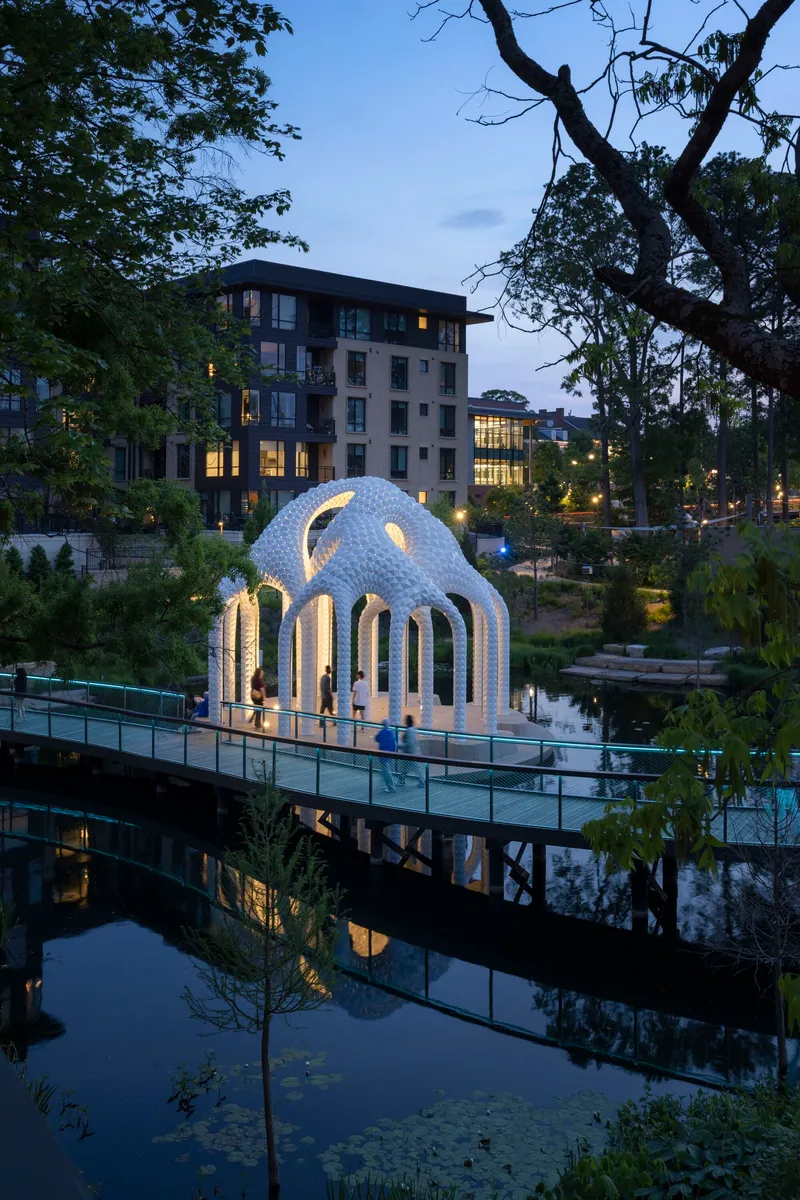
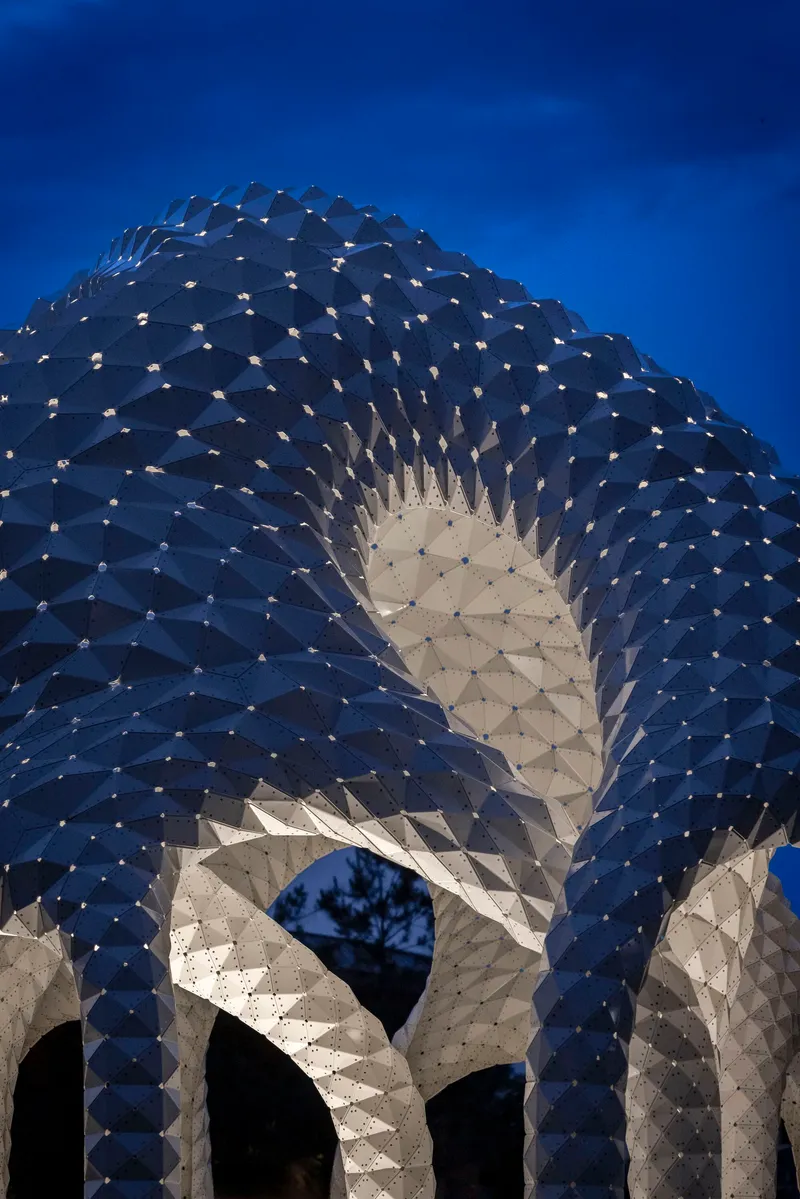
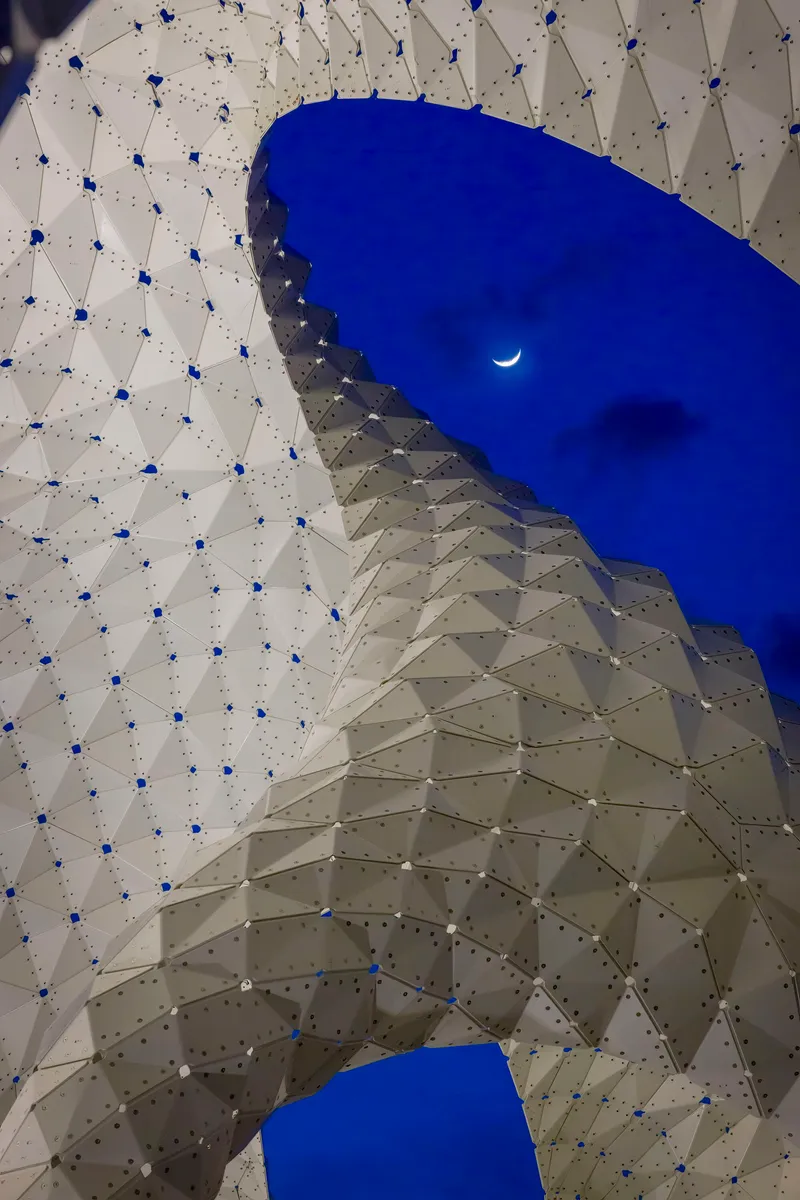
At dusk, L'Île Folie undergoes a transformation. Illuminated from within, the perforated shell glows against the darkening sky, its reflection doubling in the still water of the pond. The pavilion becomes a lantern, a signal flare for the park and for a downtown that is still defining its identity. The crescent moon visible through one of the canopy's openings in the twilight images is an accident of timing, but it captures something essential about the design: a structure porous enough to frame the sky.
The faceted panels take on a warmer, amber tone under artificial light, and the sculptural loops that rise above the tree canopy during the day become silhouettes at night. The building operates in two distinct registers, one solar and one electric, and both are convincing.
Sculptural Presence from Above
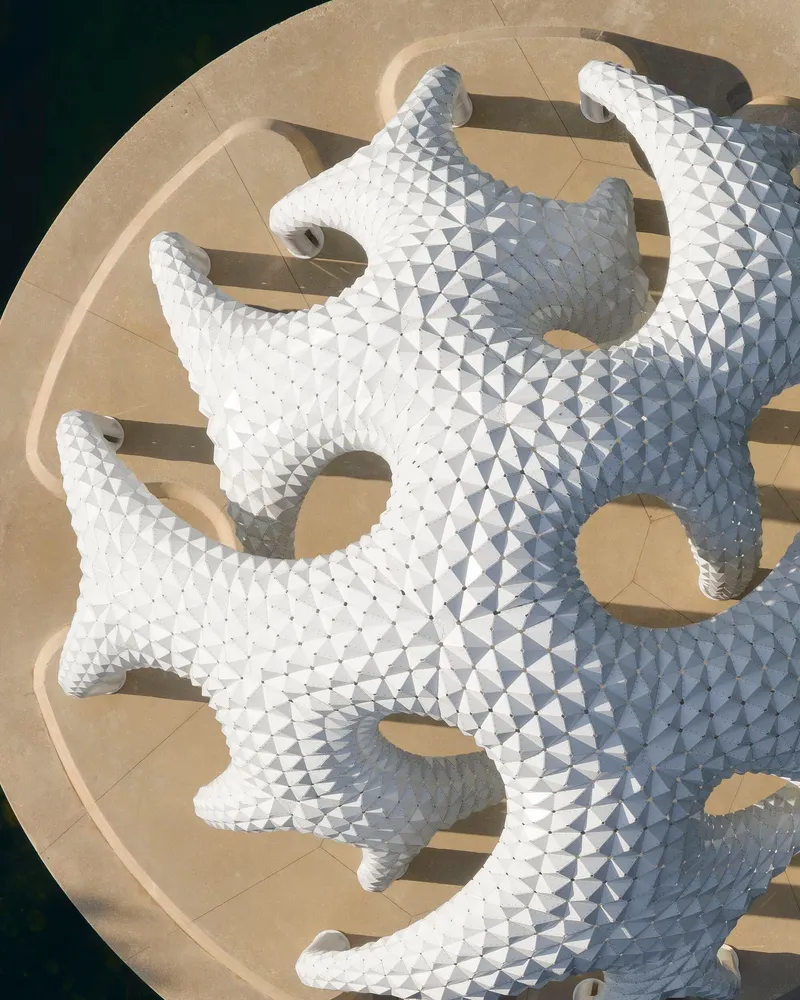
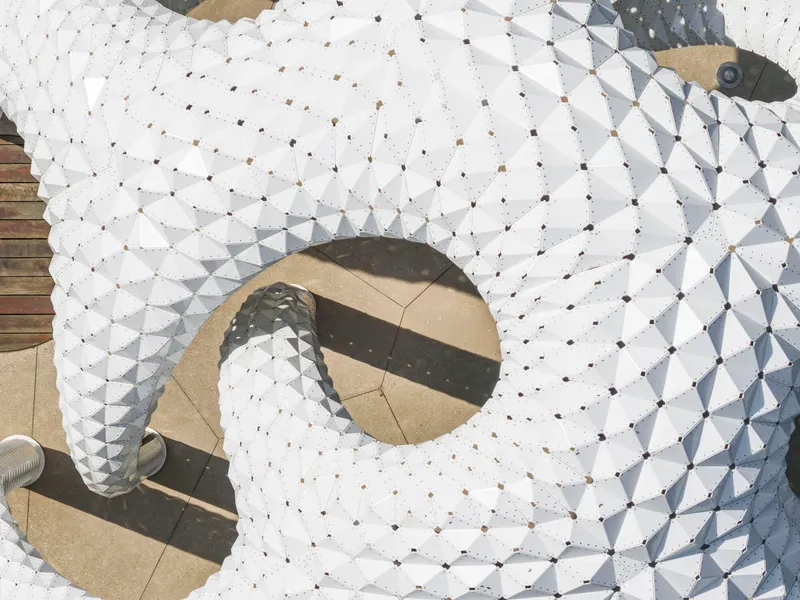
From directly overhead, the pavilion reads as pure pattern: white faceted panels radiating outward from lobed openings, with the shadows of visitors below creating a secondary layer of graphic information. The roof surface is not a simple dome but a topography of ridges and valleys that channel rainwater and reinforce the stressed-skin geometry. It is designed to be seen from above, which matters in an era when every public project will inevitably be photographed by drones.
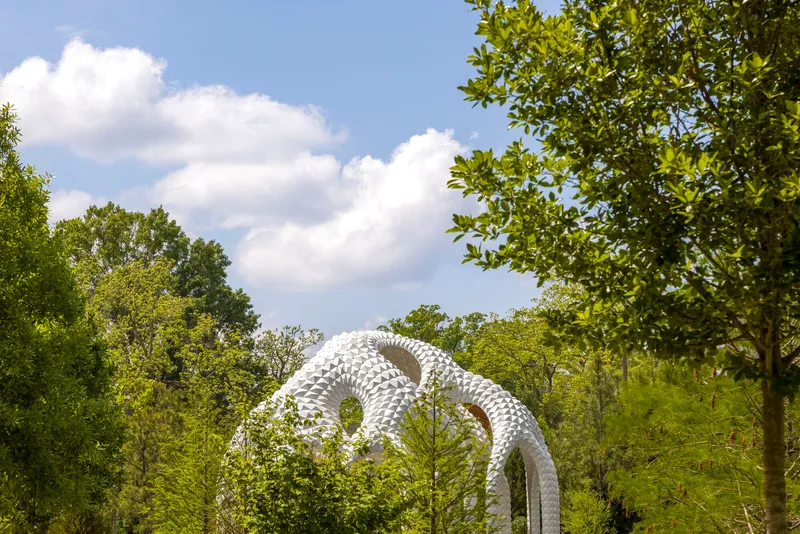
The view from further afield, where the white sculptural loops rise above the tree canopy, confirms that L'Île Folie is scaled to mark a place, not just occupy one. At 31 feet, it is tall enough to register as a civic gesture from the surrounding streets, a deliberate choice for a commission intended to anchor an emerging downtown.
The Interior Atmosphere
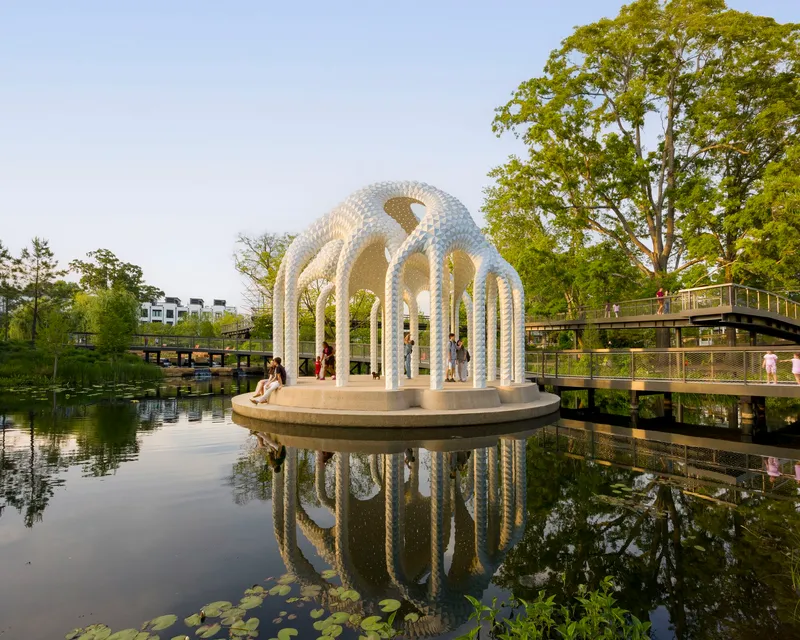
The lattice-like quality of the structure becomes clearest in the views that show the intersecting arched ribs from within. Shadows crisscross the platform in a dense weave, and the arched openings frame the pond and surrounding trees like a series of natural portals. The pavilion does not compete with its landscape; it curates it, selecting and framing views through its perforations and voids.
Walking beneath the canopy is closer to walking through a grove of trees than entering a building. The branching legs taper as they rise, the canopy thickens where it needs to carry load, and the openings occur where the geometry allows them. Every decision reads as structural necessity given formal expression, which is the hallmark of MARC FORNES' computational approach: the algorithm does the engineering, and the architect steers the aesthetics.
Plans and Drawings
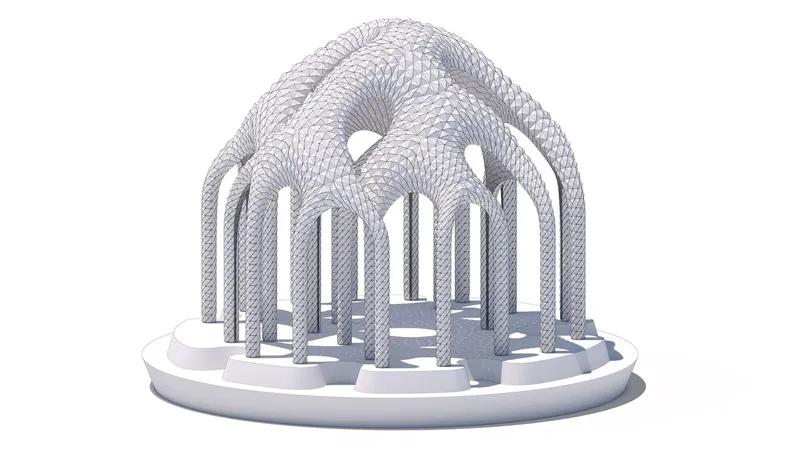
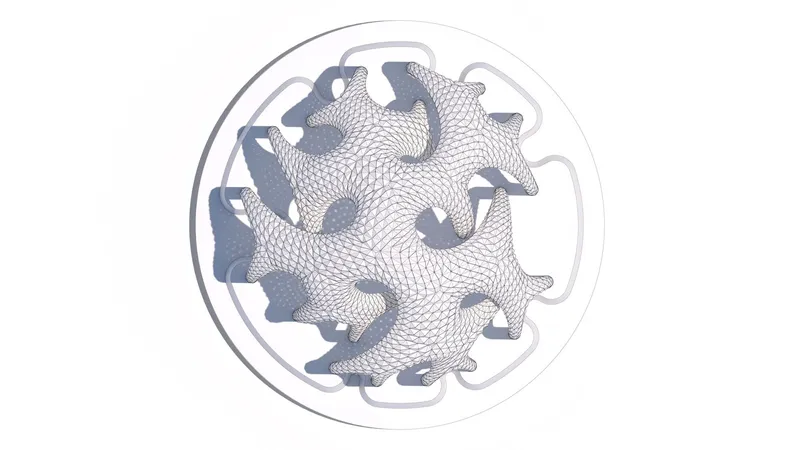
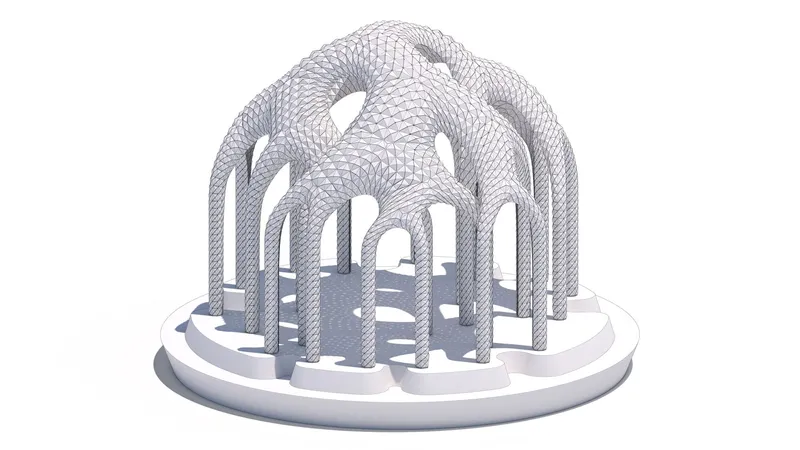
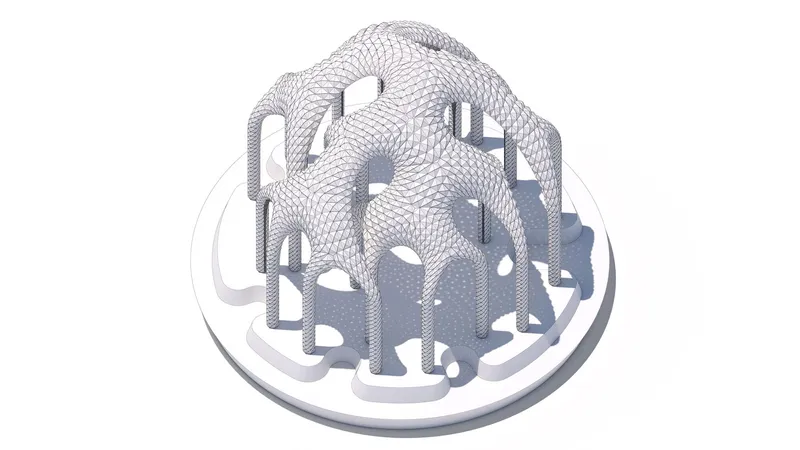
The renderings reveal the underlying logic of the design. The three-dimensional view shows how arched elements interlock to form a self-supporting lattice, each rib leaning into its neighbors for mutual bracing. The plan view makes the radial organization explicit: arched elements fan out from the center of the circular base, creating a pinwheel of structure and void that reads as organic from below but systematic from above.
These drawings also illustrate why the stressed-skin approach matters. There are no columns in the conventional sense, no beams, no trusses. Every element is simultaneously skin and structure, surface and support. The computational design process generates thousands of unique panel geometries that, when assembled, produce a shell of remarkable stiffness from remarkably thin material. It is a method that only digital fabrication makes feasible, and THEVERYMANY has refined it across a body of work that now includes one of the more ambitious public commissions in the American South.
Why This Project Matters
L'Île Folie matters because it takes the historical concept of the folly seriously without taking it literally. The European garden folly was a provocation disguised as decoration, a structure whose real purpose was to make you look and then think. Marc Fornes' version does the same thing with contemporary tools: computational geometry, digital fabrication, stressed-skin engineering. It is not a nostalgic gesture toward garden history; it is an argument that the folly, as a typology, has a future in civic space.
For a rapidly growing town like Cary, where identity is still being constructed alongside the infrastructure, a project like this stakes a cultural claim. It says that public investment in architecture can produce something that is both useful and unapologetically strange, a place to get married and a place to wonder what you are looking at. That combination of utility and mystery is rare, and it is precisely what the best follies have always delivered.
L'Île Folie by MARC FORNES and THEVERYMANY. Located in Downtown Cary Park, Cary, United States. Completed 2023. Photography by Kroo Photography.
About the Studio
THEVERYMANY
Share Your Own Work on uni.xyz
If projects like this are the kind of work you want to make, uni.xyz is a place to publish your own, find collaborators, and enter design competitions.



Popular Articles
Popular articles from the community


The Musturak Paradise: Senior Living Architecture for a Connected Future in Temara, Morocco
The Musturak Paradise reimagines senior living architecture in Temara via private homes, social spaces, culture, community, and shared care.

Co-life: Sustainable Architecture for Age-Friendly Community Living
Co-life reimagines sustainable architecture for seniors through courtyards, rammed earth, shared gardens, and spaces designed for belonging.

Hill & Cross Opera: Sculptural Opera House Architecture Shaped by Tallinn’s Landscape and Identity
Hill & Cross Opera reimagines opera house architecture in Tallinn through its sculptural hill, civic plaza, glass wave and a luminous cross.

Riyadh For All: Intergenerational Urban Design for Active Aging in Rabat
Riyadh For All reimagines urban design in Rabat with intergenerational co-living, adaptive courtyards, and Moroccan cultural exchange today.

Similar Reads
You might also enjoy these articles

Bao Huynh Watercolor Atelier: A Serene Art Retreat in Hội An
Bao Huynh Watercolor Atelier in Hội An blends multifunctional art spaces, sustainable design, local materials, and family-friendly living in a serene environment.

Atelier Macri Concept Store Interior Design by CASE-REAL
Atelier Macri store features a "ko" counter, walnut wood details, cork displays, blending retail, gallery, and seamless customer experiences.

Manuel Vargas Izquierdo Stadium and High-Performance Sports Center: Architectural Excellence in Jalpa de Méndez
The Manuel Vargas Izquierdo Stadium blends sustainable design, inclusive sports facilities, and cultural-inspired architecture, revitalizing Jalpa de Méndez’s public spaces.

KAKR Buluh Awar Hall: Revitalizing Community and Ecology Through Bamboo Architecture
Community built bamboo hall revitalizes Buluh Awar village, empowering youth, restoring ecology, celebrating vernacular craftsmanship through sustainable architecture and culture.
Explore Island Competitions
Discover active competitions in this discipline


Challenge to design a portable theatre

Challenge to design a portable music platform


Challenge to design an open learning module for the elderly

Bring back Drive In's
Comments (0)
Please login or sign up to add comments
No comments yet. Be the first to comment!