

Matsuyama Architect and Associates Carve a Five-Level Family Home into an Okinawan Hilltop
In Ginowan, a red concrete house steps down a six-meter slope, trading lost ocean views for intimate courtyards and sky.


Ginowan sits in the northern reaches of Okinawa, where hilltop sites once offered panoramic views of plains stretching to the Pacific. Decades of rapid urbanization have closed those vistas off, hemming hilltops with apartment blocks and low-rise housing. For a family of five who had spent years living in a compact apartment, the commission to Matsuyama Architect and Associates was straightforward enough: build a house on a sloped lot that would feel generous without feeling tall. What the architects delivered is a 245 m² residence that spans five distinct floor levels across a six-meter grade change, yet reads from the street as a single-storey structure half-buried in its own hillside.
The most striking decision here is the refusal to fight the topography. Rather than cutting a flat pad into the hill and stacking floors above it, the house follows the land downward, room by room, using the slope itself as the organizing logic. The vigorous red of the concrete facade is not decorative whimsy; it references the iron-rich soil of southern Japan's islands, making the building look almost geological. Courtyards puncture the mass at strategic points, pulling daylight deep into interior rooms and replacing the ocean panorama that urbanization stole with a private sky overhead.
Geology as Architecture


Seen from the air or from the hillside below, the house registers less as a building and more as an outcrop. The red-toned concrete volumes sit flush with the grassy slope, their rooflines barely clearing the surrounding neighborhood rooftops. The decision to embed the structure this deeply into the grade achieves two things simultaneously: it limits the visual bulk of a 245 m² home on a tight residential street, and it allows the interior to cascade through five half-levels without ever requiring a conventional multi-storey facade.
The material itself is worth pausing on. From a distance, the concrete reads as rammed earth, its warm pigmentation blurring the line between built and natural surfaces. That ambiguity is deliberate. In a neighborhood defined by the neutral greys and whites of standard Okinawan residential construction, the house draws its color palette from the literal ground it occupies.
Courtyards That Replace the View


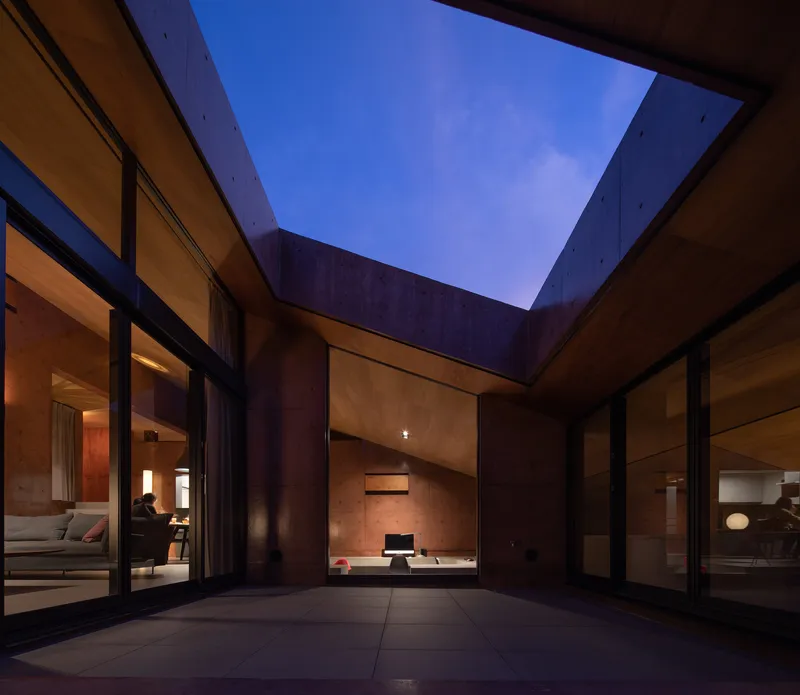
The site's former asset, a sweeping ocean panorama, no longer exists. Matsuyama's response is to turn the gaze inward. Several courtyards of varying scale are carved into the plan, each one bounded by the same pigmented concrete walls that define the exterior. Palms and tropical plantings fill the voids, and because the courtyards sit at different levels along the slope, they catch sunlight at different times of day. The result is a house that feels porous and bright despite its heavy masonry walls.
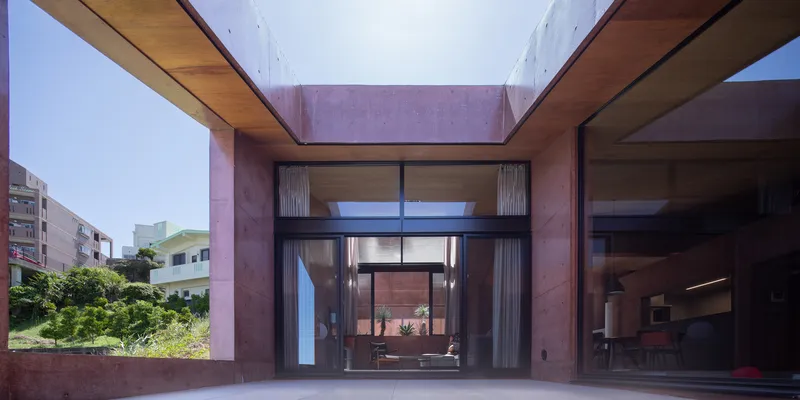
The twilight shot of the central courtyard is particularly revealing. Framed by glass doors on two sides, the void acts as both a light well and a social threshold between the living zones above and the children's rooms below. The sky, visible in a clean rectangle overhead, becomes the view the house was designed around.
Living on the Middle Ground
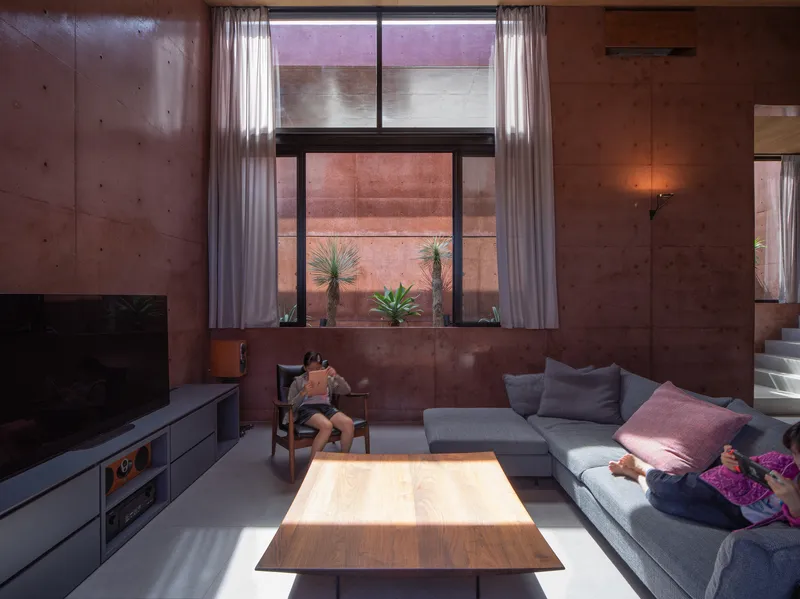


The sectional logic places the living room at the midpoint of the slope, sandwiched between the upper floor along the street and the children's rooms at the bottom. It is the hinge of the house, the level where the whole family converges. High windows frame planted exterior pockets rather than the neighboring buildings, and the folded plywood ceiling gives the room a warmth that counterbalances the raw concrete surfaces. Diagonal sunlight rakes across furnishings in the afternoon, controlled by the careful orientation that keeps direct western exposure out of habitable rooms.
The family's previous life in an apartment is embedded in the spatial proportions. Rooms are compact and interconnected rather than vast and isolated. You move through the house vertically the way you might move through rooms in a corridor apartment, always aware of where other family members are. The architects describe this as transferring an existing living style into a new form, and the evidence is in the sightlines: from the sofa, you can see the courtyard, the study nook below, and the kitchen beyond.
Timber, Concrete, and the Art of Contrast
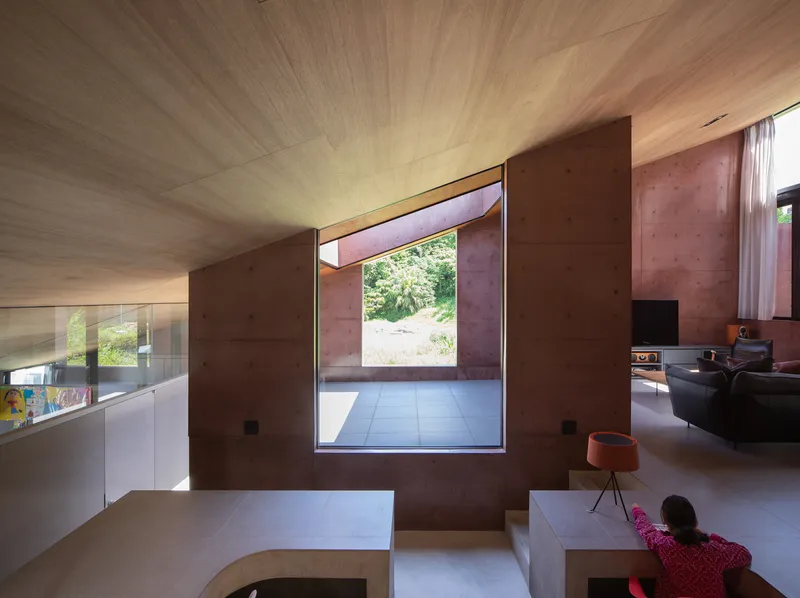


The interiors play a continuous game of material opposition. Ceilings are lined in plywood with a warm, almost honey tone. Walls are exposed pigmented concrete or white plaster. The effect is not precious; it reads as straightforward construction honestly expressed. Vaulted timber ceilings in certain rooms amplify the sense of volume, while the framed openings through rammed earth walls to greenery beyond recall the layered depth of traditional Okinawan garden walls.
Glazed partitions between the living room and the central courtyard dissolve the interior-exterior boundary entirely. Natural light bounces off the planted beds and into the timber-lined spaces, producing a softness that hard concrete alone could never achieve. The palette is limited to three or four materials, but the architects extract a surprising range of moods from that restraint.
Between Walls: Stairs and Thresholds
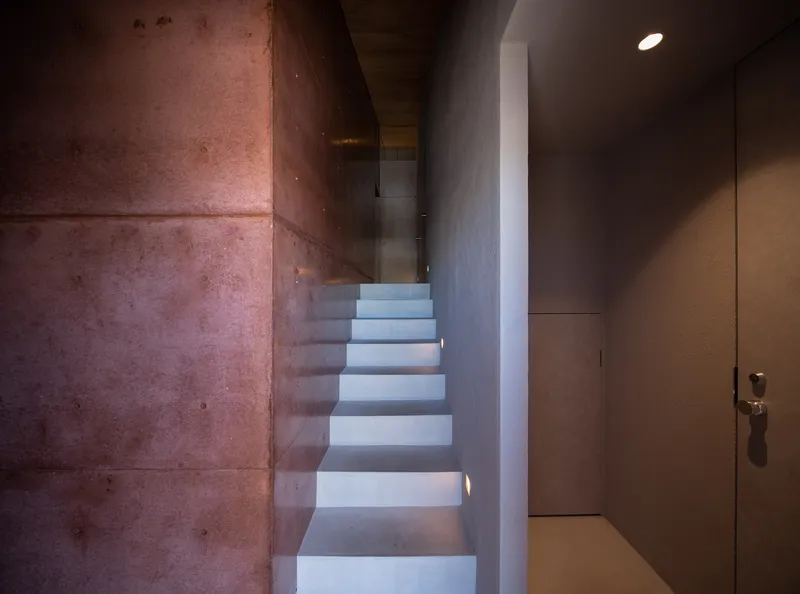


In a house that moves through five levels, the stairways are not incidental. They are the primary spatial experience. Concrete stairs rise between exposed aggregate walls and white plaster surfaces, lit by recessed fixtures that wash the textured concrete in even light. The passage between rammed earth walls catches morning sunlight filtered through palm fronds, casting shadow patterns that shift throughout the day. These are some of the most atmospheric moments in the house, where the heavy materiality of the structure becomes almost theatrical.
Corridors, too, are treated with care. The timber-ceilinged hallway with its clerestory window and white millwork demonstrates that circulation space in this house is never residual. Every passage is sized, lit, and detailed as deliberately as the rooms it connects.
Rooms for Study and Gathering
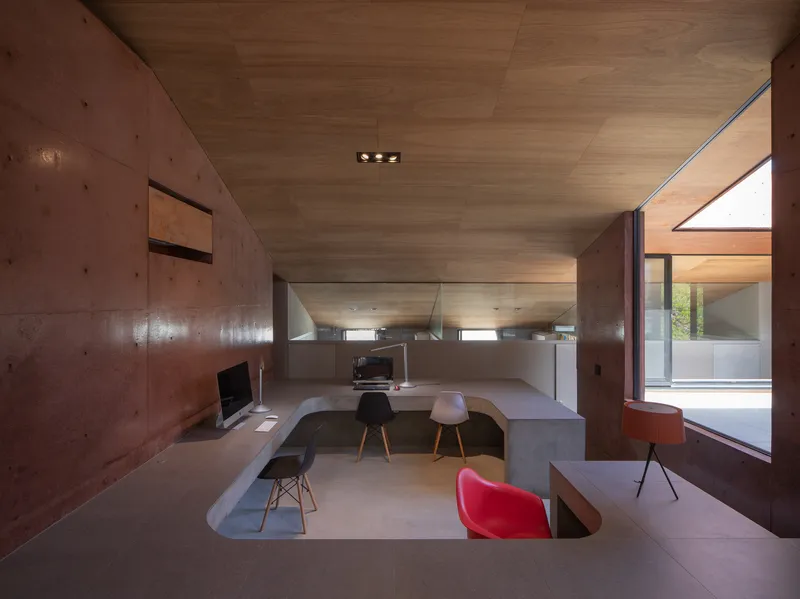
The sunken study area, with its built-in concrete desks and ribbon windows, is a quietly brilliant piece of design for a household with three children. It is set apart from the main living zone but not sealed off from it, offering the kind of focused seclusion that an apartment could never provide. The ribbon windows frame the exterior at seated eye level, reinforcing the sense that even in a house turned inward, there is always a connection to the landscape beyond.
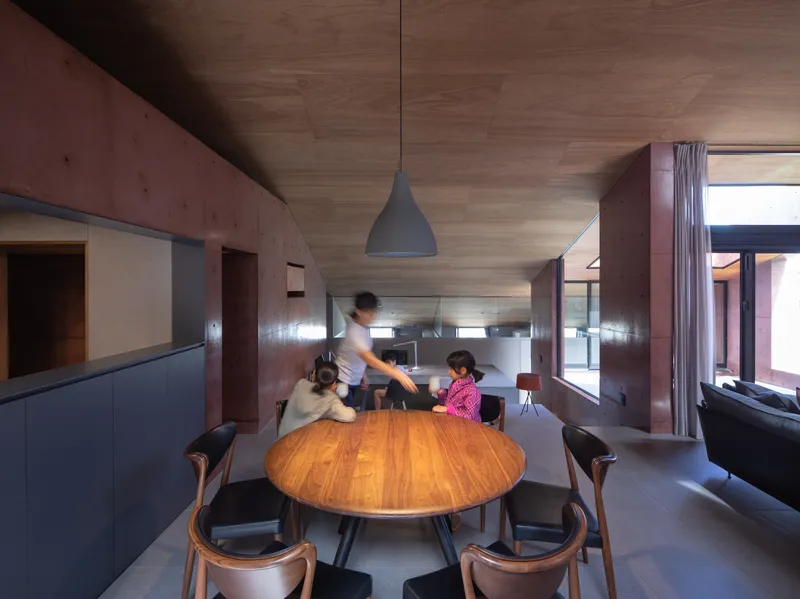
The dining area, by contrast, is warm and convivial: a round timber table beneath a single pendant light, rammed earth walls glowing in the evening. The covered terrace at the upper level frames views through timber-clad volumes toward the courtyard and neighborhood beyond, functioning as a threshold between the private interior world and the dense urban context outside.
Plans and Drawings


The floor plan confirms what the photographs suggest: the house is organized around a central courtyard, with rooms arrayed along the contour of the slope. A garage is integrated at the street level, and the landscape wraps the structure on all sides, softening its edges against the neighborhood. The long section is the most instructive drawing. It reveals the full six-meter descent from east to west, the sloped roof that follows the grade, and the way each half-level interlocks with the next. No room is more than a few steps from an exterior courtyard or planted opening.
The site plan places the building within a dense residential fabric of streets and small lots. The house occupies nearly the full footprint of its parcel, which makes the generosity of the courtyards all the more impressive. They are not leftover space; they are carved out of usable floor area, a deliberate trade of square meters for light, air, and psychological breathing room.
Why This Project Matters
House in Ginowan belongs to a category of residential projects that treat the loss of a site's original asset as a design catalyst rather than a defeat. The ocean views are gone, blocked by decades of building. A lesser project would have stacked floors to reclaim them or turned its back on the neighborhood entirely. Matsuyama Architect and Associates instead accepted the new condition and redirected the entire spatial strategy inward and downward, using the hill's own topography as both structure and narrative. The red concrete, the planted courtyards, the five interlocking half-levels: all of it follows from that single, pragmatic realization.
For families transitioning from apartment life to a freestanding house, the project offers a persuasive model. Proximity and visual connection between rooms are preserved, not abandoned in favor of sprawl. Every level is linked by sightline and stairway in a way that keeps a household of five within earshot and eyeline of one another. The house proves that on Okinawa's increasingly crowded hilltops, the most valuable view might be the one you build for yourself.
House in Ginowan, designed by Matsuyama Architect and Associates, Ginowan, Japan. 245 m², completed 2019. Photography by Toshihisa Ishii.
About the Studio
Share Your Own Work on uni.xyz
If projects like this are the kind of work you want to make, uni.xyz is a place to publish your own, find collaborators, and enter design competitions.


Popular Articles
Popular articles from the community


Jaramillo Van Sluys Arquitectura and Urbanismo Turn a Demolished Registry Lot in Quito into an Orchard Plaza
In Quito's Centro Histórico, a 2,800 m² plaza exposes the San Agustín convent wall and redraws its lost Augustinian orchard in volcanic stone.

Cube Design Draws an Ecological Corridor Between Two Shenzhen Hills with the Nankai Building
Beside Shenzhen's container docks, the Nankai Building pairs stacked balconies with a climbing green screen to connect two hillsides across its height.

LT2A and OPEN Architectes Thread a Brick and Glass High School Through a Wooded Belgian Campus
In Braine-l'Alleud, a 3,000 m² wing for Collège Cardinal Mercier pairs pale brick with a glazed colonnade, deferring to a small chapel and a dense wood.

longwave studio Reorganizes a 112 m² Tainan Apartment Around the Daily Routines of a Family and Two Cats
In Tainan, Taiwan, birch plywood, rust-red furniture and a freestanding plaster wall link arrival, storage, work and family life in one apartment.

Similar Reads
You might also enjoy these articles


LAVA Architecten Gives Vocational Education a Sawtooth-Roofed Face on a Mechelen School Campus
In Mechelen, Belgium, a 2,053 m² STEM school on a 6×6 m grid turns workshops and classrooms into rooms that can be rearranged as teaching changes.

KEMA Studio Turns a Derelict Marvila Attic into a 60 m² Lighthouse Apartment Above Lisbon
In Lisbon's Marvila district, a rebuilt roof, four skylights and two plywood volumes turn an unlivable attic into a bright home facing the Tagus.

Pixel Gardens: One Repeated Module Stacked Into a Terraced Social Housing Tower for Famagusta
Salem Bader's shortlisted housing tower builds a vertical neighbourhood from one repeated module, offsetting units to carve terraces, light and air.

Bao Huynh Watercolor Atelier: A Serene Art Retreat in Hội An
Bao Huynh Watercolor Atelier in Hội An blends multifunctional art spaces, sustainable design, local materials, and family-friendly living in a serene environment.

Explore Residential Building Competitions
Discover active competitions in this discipline

Challenge to design mud housing for contemporary communities

Design challenge to reuse E-waste
Comments (0)
Please login or sign up to add comments
No comments yet. Be the first to comment!