
We Meet
a statement for the competition "Informally"

The informal economy is an indispensable component of the urban retail system in cities worldwide. Street vendors offer a wide range of low-cost goods and services in accessible neighbourhood locations for local residents to shop and socialize. It can be helpful in representing the authentic local culture, reducing urban poverty, and fostering more inclusive cities. However, street vendors are always harassed and evicted by the authorities as they are dispersed, spontaneous, and disorderly.
Thus, our project, We Meet, intends to present a more beneficial informal market with the following principles:
1. Appropriate: the proposal will respond to the local environment and cultural background.
2. Adaptability: the proposal serves not only as an informal market just for trading.
3. Modular: designing a standard form that adapts to the needs of its users and enables future expansion.
4. Cost-effective: the use of economic materials and an easily-constructed structure to reduce stall rent and attract informal vendors.
1. Appropriate
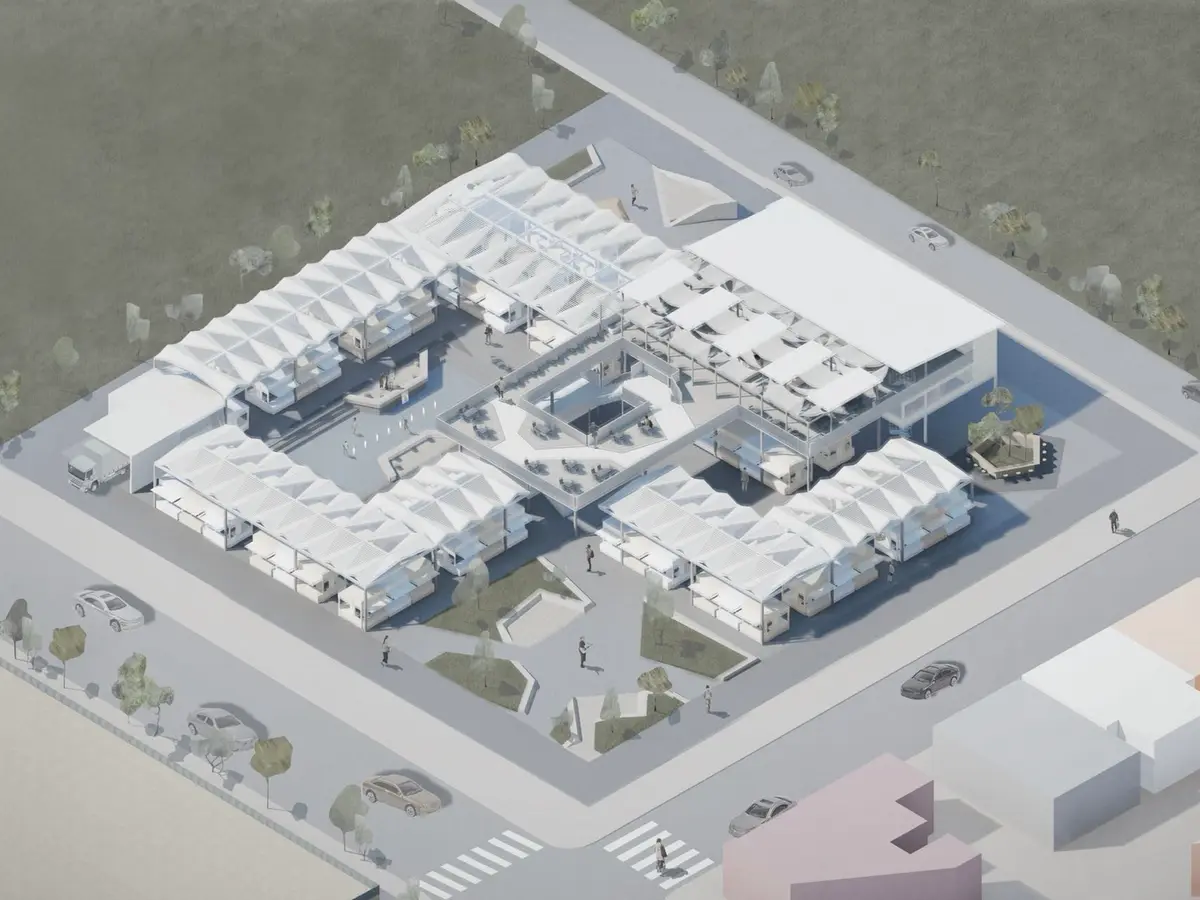
According to the site analysis, there is a large-scale residential area around the site accompanied by the culture of a thriving Polish immigrant community. Port Richmond is a thriving neighbourhood with a long history of spontaneous markets. In addition, this area is lack of reliable aggregated markets and public areas for neighbourhood gatherings. Therefore, our project WeMeet is dedicated to fostering a variety of interactions between nature, visitors and vendors. It is challenging to promote interaction with the conventional parallel distribution of stalls. So we arranged the stalls in a closure form around plazas for people to intersect, mingle, and blend. In the new design, an open plan enables people to enter the site from E Somerset Street, Tulip Street and E Rush Street. A south entrance plaza is arranged at the intersection of E Somerset Street and Tulip Street to greet visitors. Visitors can view as much of the entire site as possible as they move under the vendor canopy.
Landscape serves as a soft barrier between the residential areas and informal markets. The semi-enclosed arrangement of vendors brings two distinctive experiences of the landscape for visitors. The outer landscape serves as a soft barrier between the market and the street. In order to smoothly integrate the market and residential area, it also functions as a warm and accessible gathering space. The inner landscape is shielded by surrounding vendors to create a cozy atmosphere and the sunken pool provides a space for visitors to rest and engage with the water. Besides, a platform at the top of the structure offers a reasonably private gathering space for people to enjoy meals and drinks.
Inspired by the local row house typology, folded plate truss is chosen as the canopy structure. The arrangement of the landscape is also designed to echo the folding form. The whole canopy roof is mainly composed of prefabricated triangular concrete panels. There are glass panels and gratings installed between the steel construction to allow sunlight to pass through.
2. Adaptability
According to the renowned urbanist Jane Jacob, mixed-use urban planning can encourage social interaction. As a result, we envision our project is not only a market just for trading, but also a gathering place provided for the local residents to socialize and entertain.
The folded shape seating integrated with the lawn stimulates a closer relationship between people and nature by providing a dynamic resting place for residents. The seating forms some semi-enclosed spaces to encourage socializing and intimate gatherings with others in urban spaces. Timber floor is used in these areas to distinguish from the concrete pathway to emphasize an ambiguous space for different activities, such as performing. The facilities for children playing are combined with the northern landscape. And the landscape staircase at the sunken pool also invites visitors to seat around and engage in a conversation with people and nature. A tree at the central void space highlights the vertical movement between the ground floor and the upper platform. Besides, there is a polygon seating at the centre and a dining table on the eastern side surrounded by trees to develop a symbiotic relationship with nature.
3. Modular
A new type of 3mx3m vendor which can change its forms flexibly according to different selling situations is designed to fulfil the selling needs of one or two traders. During opening hours, the rear of a stall can be transformed into closed storage or an opened goods display by adjusting the folding panel. And the closed folding panels also encourage graffiti and creative expression. Besides, the front and back sides of a single unit can be shared by two sellers. In this design, each three vendor composites together for flexible circulation and the seller can occupy two or three units if they want. Moreover, A new form of purchase--self-service goods transaction, is also integrated into the market design to try to make the trade process more efficiently and bring a fresh shopping experience.
4. Cost-effective
The vendor canopy is made of prefabricated light steel structure and concrete roof panels which reduce the cost of labour and improve the efficiency of assembling. And the prefabricated components are also environmental friendly to reduce the production of construction waste. In addition, the 3mx3m square vendor will also be prefabricated in the factory which can be assembled on the site easily. The use of timber on the vendor neutralizes the rigid sense brought from the cold steel-structure canopy.


Popular Articles
Popular articles from the community


Singing Woman: Contemporary Architecture Inspired by Estonia’s Voice and the Sea
Singing Woman turns Estonia’s song culture into flowing opera house architecture, blending public life, landscape, sea, and national memory.

Extended Shell: Retrofitting Kolkata's Balconies as Living Urban Thresholds
A modular retrofit system recovers the social and environmental intelligence of Kolkata's historic verandas for contemporary Park Street residents.

Temporary Home for Dogs: A Reversed Zoo Rethinks Animal Shelter Architecture
In Bucharest, a sinuous corridor and freed landscape flip the logic of containment, designing a shelter that works to make itself unnecessary.

Opera by the Sea Estonia: Three Shells Dissolving Architecture into Tallinn's Coastline
A winning opera house proposal replaces monumental form with interconnected shells that blur the boundary between building, park and Baltic Sea.

Similar Reads
You might also enjoy these articles
The Rhythm of Seasons
A Farmers' Market Connecting Nature and the City

More Than a Building-Designing a Living System
More Than a Building-Designing a Living System
Base Beyond
DESERT COMPOUND ARID: TOURISM OF ABSENCE AND ABUNDANCE

Comments (0)
Please login or sign up to add comments
No comments yet. Be the first to comment!