

MEAN* Sinks a Geometric Lounge into a Dubai Flagship Store for Send Location
A 340 square meter retail interior in Dubai fuses sunken gathering spaces, Arabic calligraphy, and octagonal geometry into one charged room.


Retail interiors in Dubai tend to reach for the same register: luminous white boxes, floating product, polished neutrality. The Send Location flagship store, completed in 2026 by MEAN* (Middle East Architecture Network) under the direction of Riyad Joucka, refuses that formula entirely. Instead of a frictionless container, the 340 square meter space operates more like a compressed public interior, one organized around a sunken octagonal core that draws visitors down into a social pit rather than guiding them along a linear rack-to-register path.
What makes the project interesting is not simply the geometric ambition but the collision of registers it orchestrates: plush pink upholstery against raw concrete, illuminated Arabic neon calligraphy hovering over dark glass, and a geometric tile language that reads simultaneously as traditional Islamic pattern and 1970s sunken living room. The store functions as both a place to buy things and a place to sit, gather, and linger, an increasingly rare proposition in commercial design where dwell time is usually engineered rather than genuinely invited.
The Sunken Core

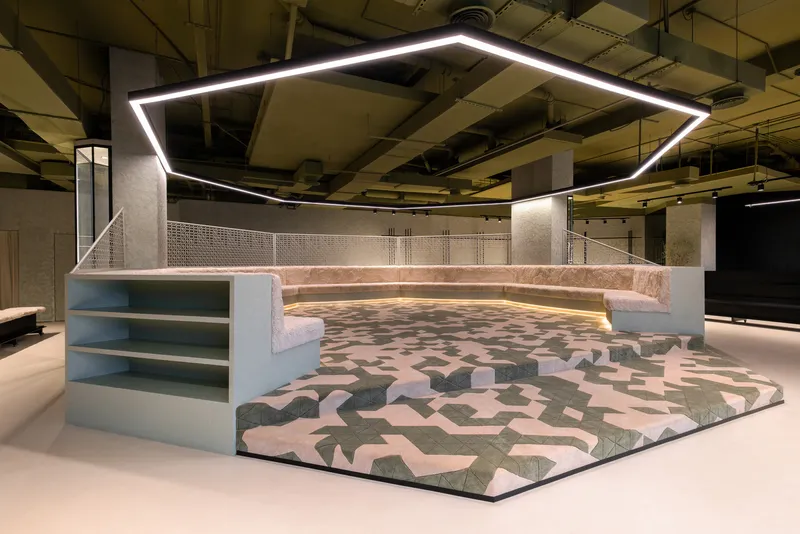
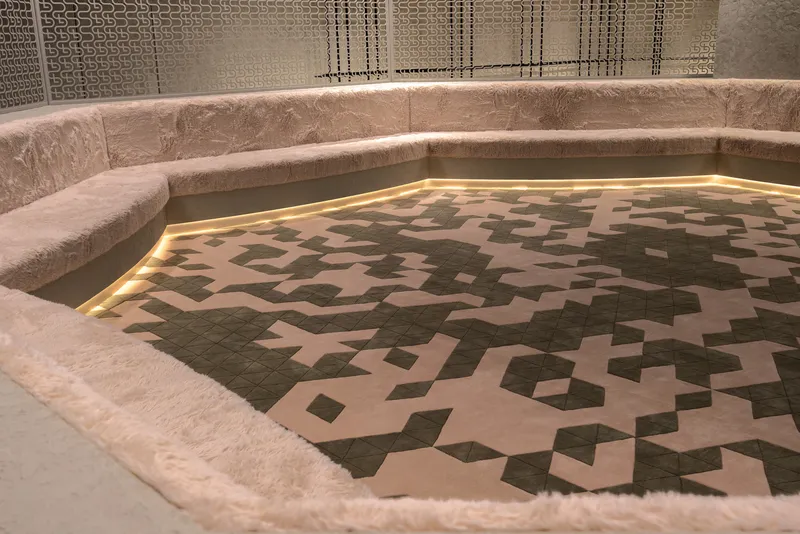
The heart of the store is a stepped seating pit that reads as part lounge, part amphitheater. Curved pink upholstered benches descend toward a geometric patterned floor, framed by perforated metal screens and capped overhead by a pentagonal light fixture. The move is deliberate: sinking the social program below the retail floor plane creates a spatial hierarchy that privileges conversation and rest over transaction. Exposed concrete columns rise above the seating, lending the pit a tectonic weight that makes the surrounding retail areas feel lighter by contrast.
The geometric tile work at the base of the pit is worth pausing on. Its olive and pink tones pick up the palette of the surrounding upholstery, but its angular pattern operates at a completely different scale, pulling the eye down and inward. Bordered by plush fur-edged benches and screened by laser-cut metal panels, the pit never feels precious. It feels inhabited, like a courtyard translated into an interior section.
Retail as Landscape
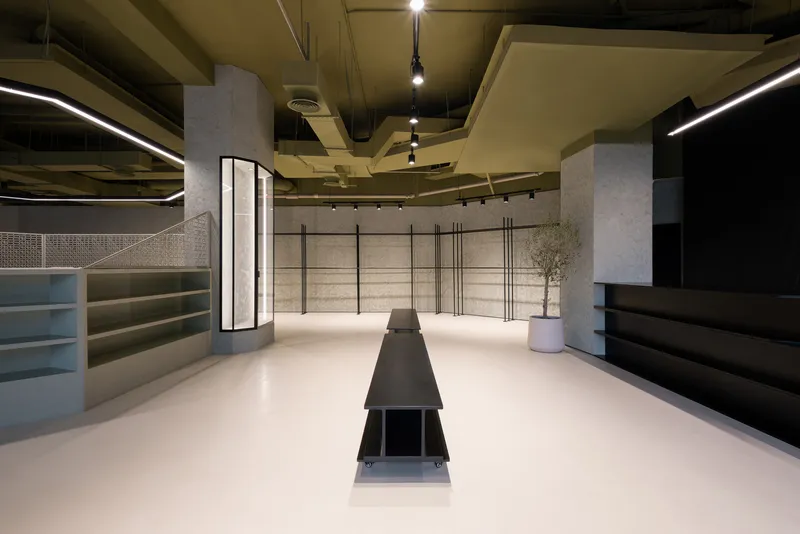
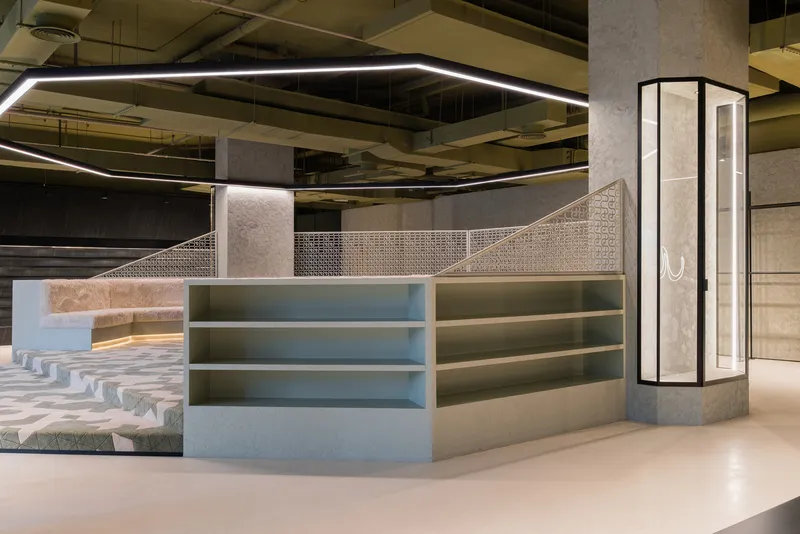
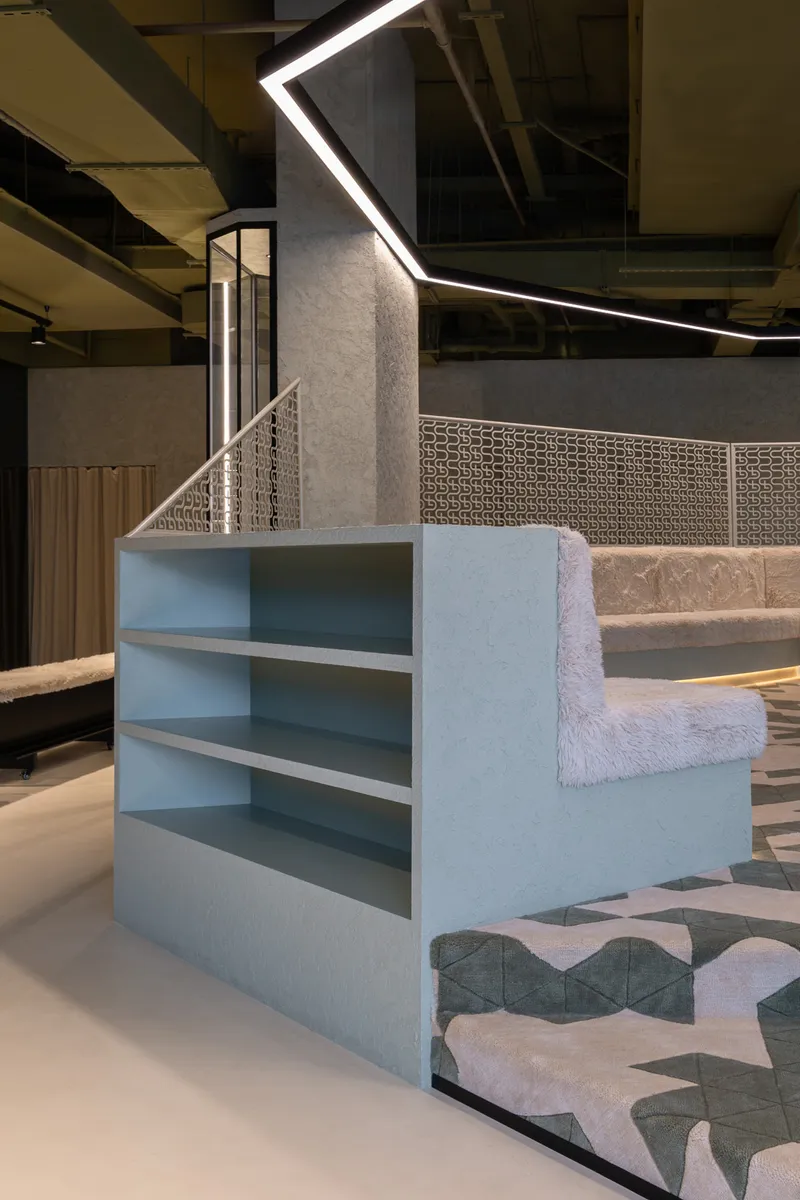
Beyond the central gathering space, the retail zone is organized with unusual restraint. White resin flooring, glass-framed columns, and metal shelving create a bright perimeter that defers to the merchandise. A potted olive tree anchors one area, introducing an organic vertical element in a space otherwise defined by angular geometry. Tiered display shelving steps down alongside the patterned floor, blurring the boundary between the sunken social core and the product zones.
A blue-painted stepped shelving unit adjacent to the patterned tile floor adds an unexpected chromatic shift, a moment of saturated color that breaks the pink and concrete palette and signals a different product zone. MEAN* treats the retail surface not as a neutral backdrop but as topography, with level changes, material shifts, and embedded furniture that give the space a navigable landscape quality rather than the flat efficiency of a typical shop floor.
Calligraphy and Surface
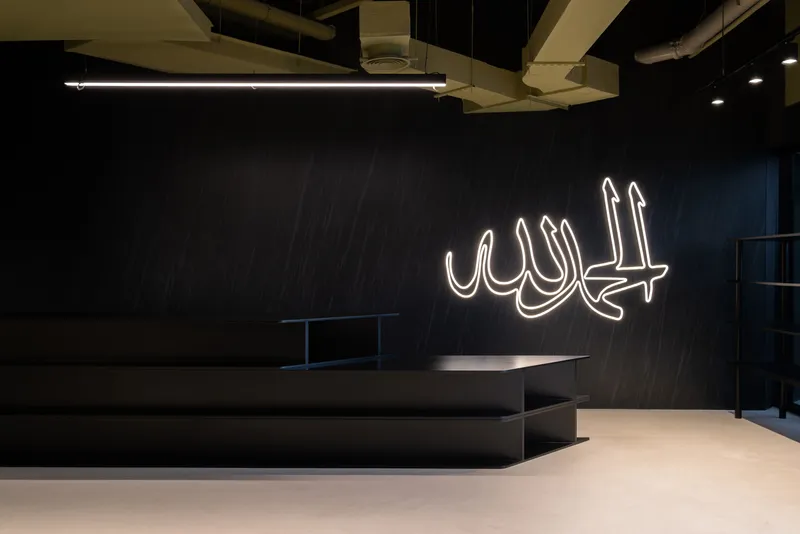

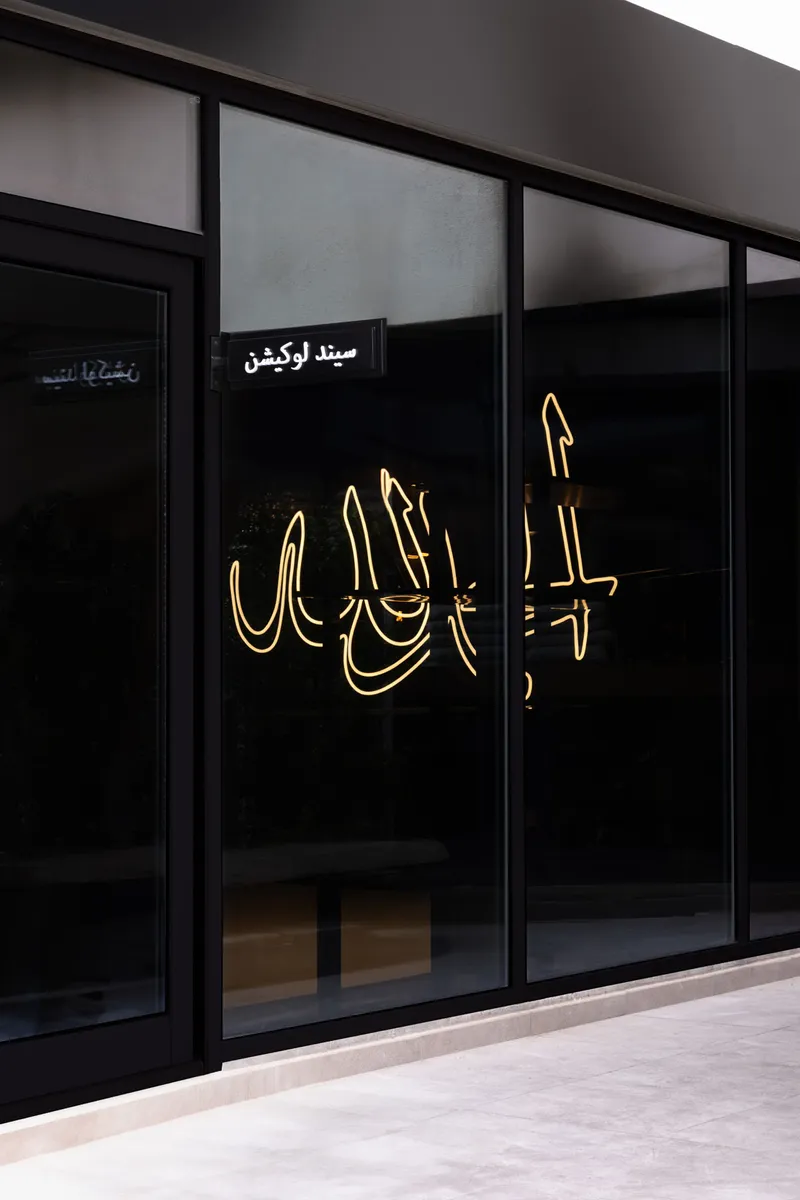
The dark feature wall is arguably the project's most graphic moment. White neon Arabic calligraphy illuminates a matte black surface, hovering above low platform seating and a polished concrete floor. The script reads as both branding and cultural marker, tying the store to its Dubai context without resorting to pastiche. At the storefront, the same calligraphic neon glows against black glass beneath transom windows, creating a legible beacon that announces the interior's character before you step inside.
A textured pink reception counter occupies the corner of this dark zone, its soft materiality pushing against the hard neon glare. The juxtaposition is intentional and effective: the warm, tactile counter invites approach while the calligraphic wall establishes atmosphere and scale. MEAN* understands that lighting in retail is never neutral; here, it is explicitly narrative.
Material Detail and Texture
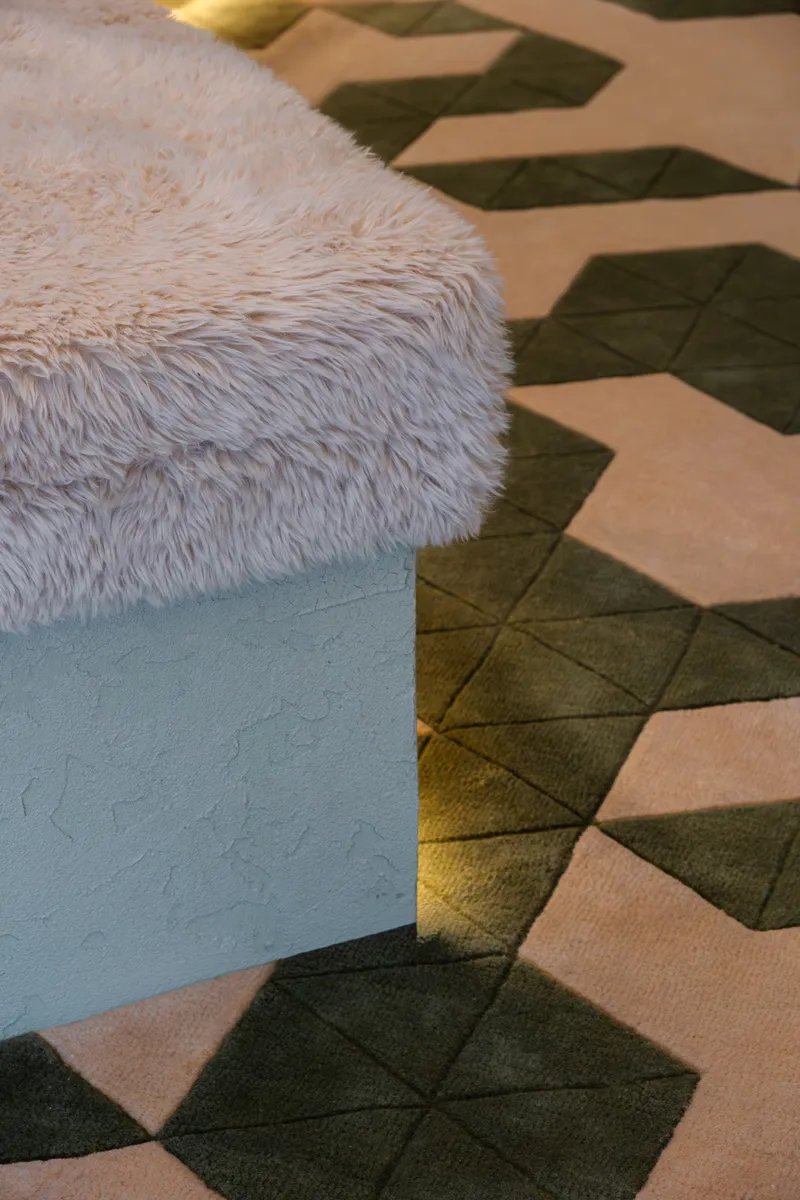
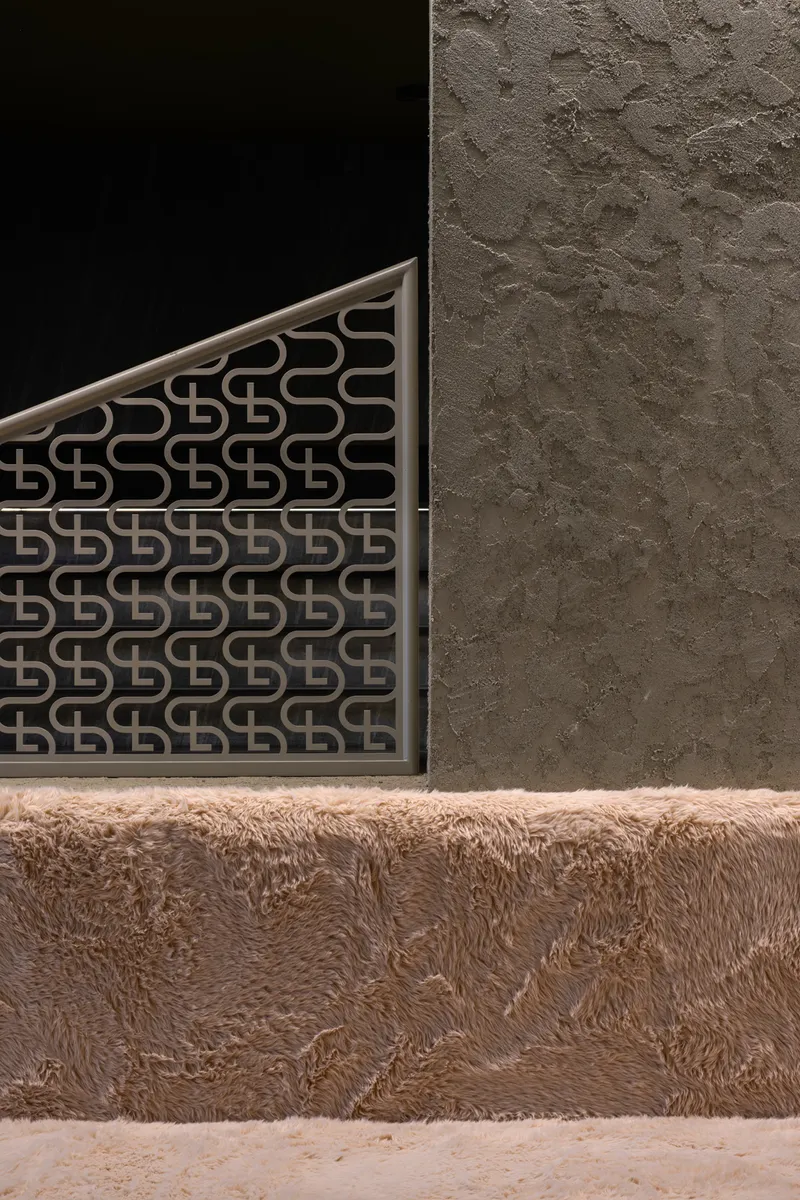
Close up, the material choices reveal a layered sensibility. Fur-upholstered bench edges meet geometric carpet tiles in olive and pink, producing a seam where softness collides with precision. Patterned metal screens press against textured plaster walls, their perforated geometry casting subtle shadow patterns that shift throughout the day. These are not surface treatments applied over a generic shell; they are integral to the spatial identity, each material performing a specific role in mediating between the monumental geometry of the plan and the intimate scale of the body resting on a bench.
Plans and Drawings
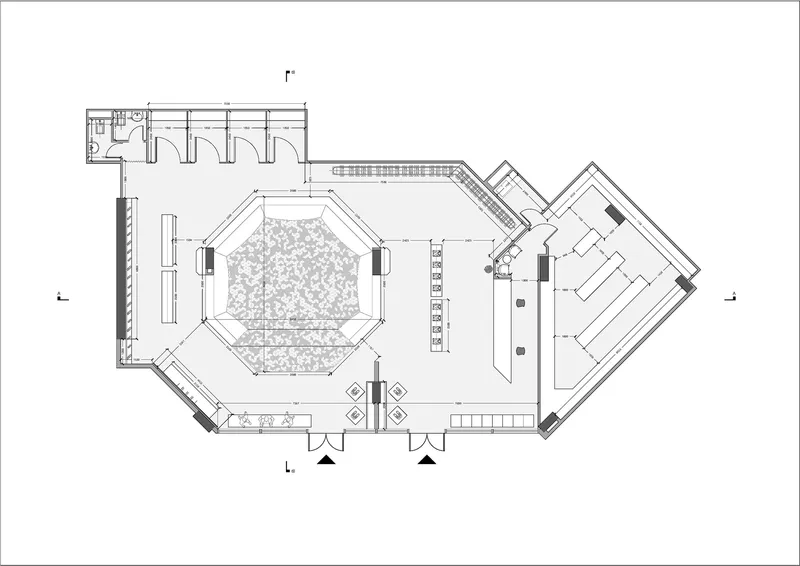
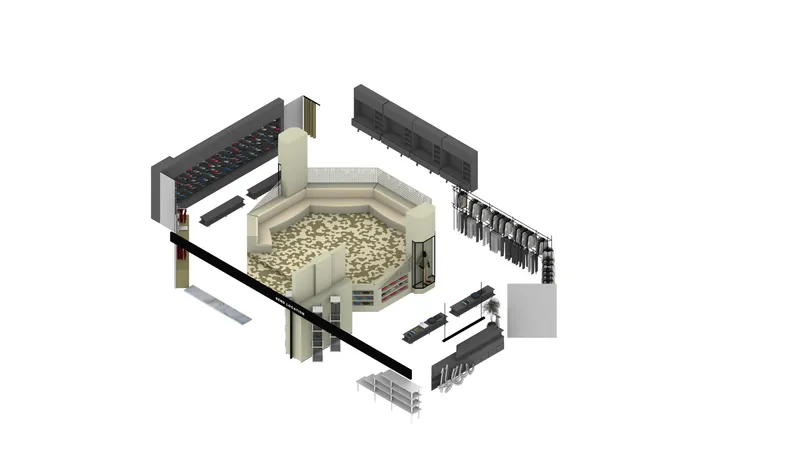
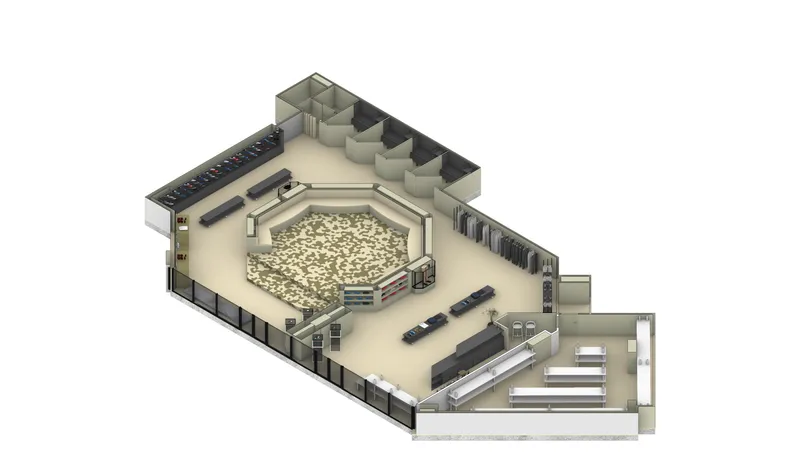
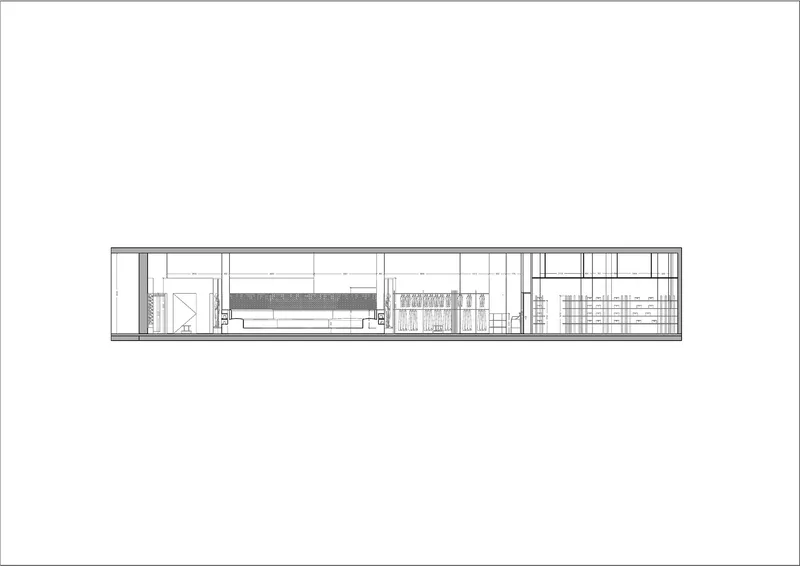
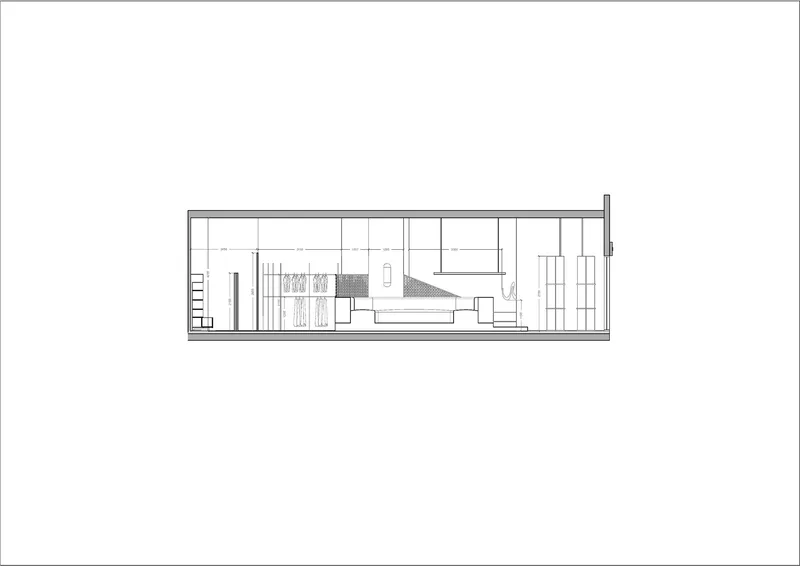

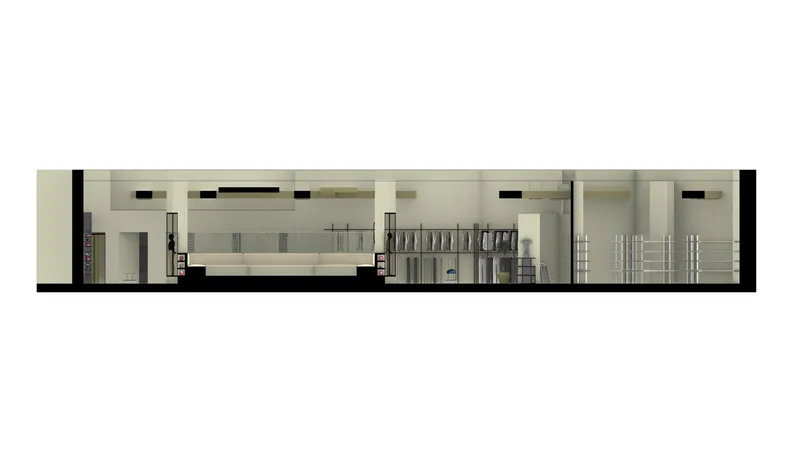
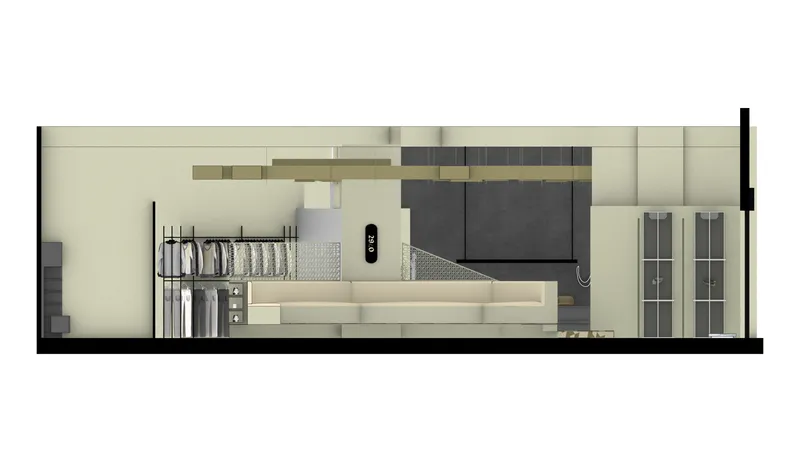
The floor plan confirms what the photos suggest: the octagonal central space is not a decorative conceit but the organizing principle of the entire layout. Adjacent angular retail zones and service rooms radiate outward, their irregular geometries a direct consequence of the central figure. The exploded axonometric makes the strategy legible, showing the hexagonal core as a distinct volume surrounded by dispersed service and storage elements, each maintaining its own formal character rather than dissolving into a single envelope.
The longitudinal sections are revealing. Sloped floor levels and vertical circulation elements produce a surprisingly dynamic section for a single-story retail interior. Suspended ceiling planes define zones overhead while built-in seating and wardrobe storage line the perimeter walls, integrating program into the shell rather than layering freestanding furniture on top of a flat slab. The cutaway axonometric shows a glass curtain wall wrapping the front of the interior, making the complex spatial organization partially visible from the street.
Why This Project Matters
Retail design in the Gulf region often defaults to one of two modes: hyper-minimalist international or thematically overwrought local. The Send Location flagship sidesteps both by building a genuinely spatial argument. The sunken pit, the sectional complexity, the collision of materials are not ornamental strategies layered over a generic box. They are architectural decisions that shape how people move, sit, and linger. In a city where commercial square meters are aggressively optimized, giving 340 of them a public, almost civic character is a meaningful provocation.
MEAN* demonstrates here that retail can be a vehicle for architectural ideas rather than a concession to branding consultants. The geometric rigor of the plan, rooted in Islamic spatial traditions but executed with contemporary materials and sensibilities, gives the project a cultural specificity that no amount of mood lighting could replicate. It is a store, yes. But it is also a room worth being in, and that distinction matters more than ever.
Send Location Flagship Store, designed by MEAN* (Middle East Architecture Network). Dubai, United Arab Emirates. 340 m². Completed 2026. Photography by Aylul Studio.
About the Studio
Share Your Own Work on uni.xyz
If projects like this are the kind of work you want to make, uni.xyz is a place to publish your own, find collaborators, and enter design competitions.


Popular Articles
Popular articles from the community

Tsunami Convergenics: Turning Catastrophic Ocean Forces into Underwater Housing Infrastructure
A speculative underwater settlement off the coast of Onagawa, Japan, treats tsunamis and typhoons as energy sources rather than threats.
Opera by the Sea Estonia: Three Shells Dissolving Architecture into Tallinn's Coastline
A winning opera house proposal replaces monumental form with interconnected shells that blur the boundary between building, park and Baltic Sea.

Manzana Morphosis: Stretching Barcelona's Grid into a Living Landscape for 2050
A radical reworking of the Eixample manzana turns density into a tool for generous public space, vertical ecology, and environmental performance.

The Amber Palace Opera: A Geological Fiction Surfaces on Tallinn's Baltic Waterfront
Pierre Brillard reimagines a Baltic legend as a public landscape, opera house, and waterfront promenade rooted in Tallinn's coastal identity.

Similar Reads
You might also enjoy these articles

Bao Huynh Watercolor Atelier: A Serene Art Retreat in Hội An
Bao Huynh Watercolor Atelier in Hội An blends multifunctional art spaces, sustainable design, local materials, and family-friendly living in a serene environment.

Atelier Macri Concept Store Interior Design by CASE-REAL
Atelier Macri store features a "ko" counter, walnut wood details, cork displays, blending retail, gallery, and seamless customer experiences.

Manuel Vargas Izquierdo Stadium and High-Performance Sports Center: Architectural Excellence in Jalpa de Méndez
The Manuel Vargas Izquierdo Stadium blends sustainable design, inclusive sports facilities, and cultural-inspired architecture, revitalizing Jalpa de Méndez’s public spaces.

KAKR Buluh Awar Hall: Revitalizing Community and Ecology Through Bamboo Architecture
Community built bamboo hall revitalizes Buluh Awar village, empowering youth, restoring ecology, celebrating vernacular craftsmanship through sustainable architecture and culture.

Explore Site Location Competitions
Discover active competitions in this discipline

Challenge to design luxury tourism on rails

VR headsets Storefront design competition

Designing a staircase for a client
Comments (0)
Please login or sign up to add comments
No comments yet. Be the first to comment!