

Meier Unger Revives the Swiss Stöckli Tradition in a 105 m² Timber and Concrete Pavilion
A linear farmstead retirement house in Selzach, Switzerland, distills rural building customs into a precise modern structure.


In certain Swiss German cantons, there is a centuries-old building type called the Stöckli, or Auszughaus: a compact dwelling built on the family farm for the retiring generation, freeing the main house for successors while keeping elders close to the land they once worked. It is a program defined not by style but by social contract, and it is nearly extinct. Meier Unger, the Zurich practice led by Jan Meier and Lena Unger, has taken this tradition seriously for the Scholl House in Selzach, a municipality in the canton of Solothurn, and produced a 105 m² pavilion that is as disciplined as the convention it inherits.
What makes the project worth studying is not nostalgia but compression. At just over a hundred square meters, the house must contain an entire life: sleeping, cooking, bathing, sitting by a fire, tending a garden, watching a horse graze. The architects respond with a single linear volume, board-formed concrete walls at the base, a corrugated metal and timber structure above, and a generous wraparound porch that blurs the threshold between shelter and pasture. Every decision reads as subtraction rather than addition, which is exactly what a Stöckli demands.
A Pavilion Set Against the Rural Grain
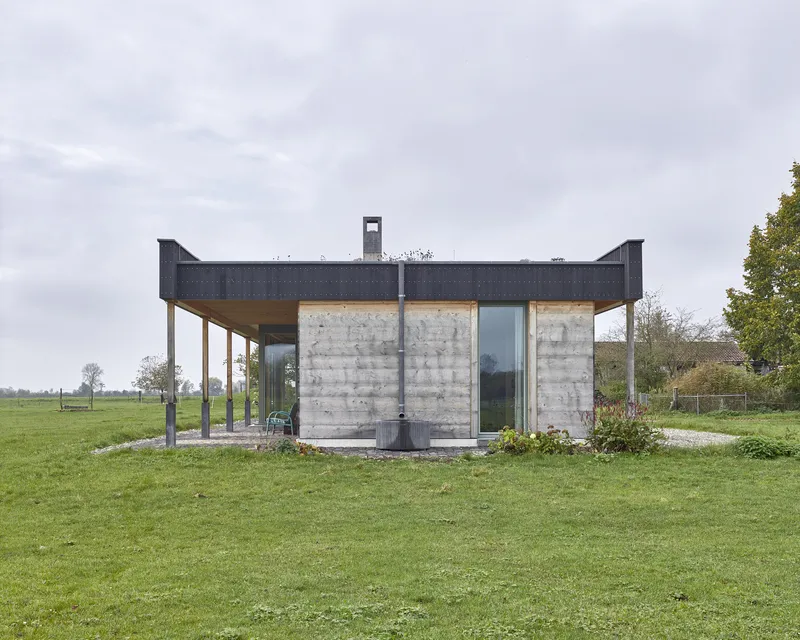
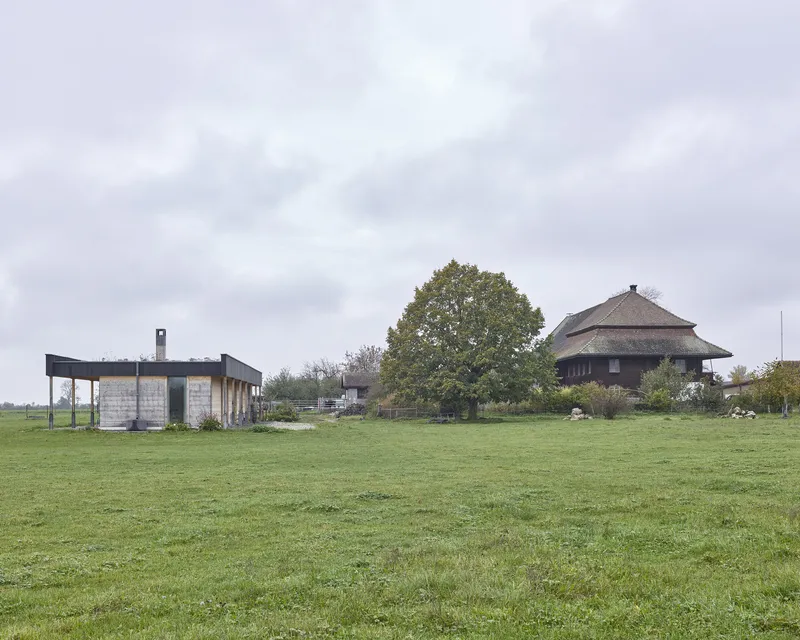

Seen from across the meadow, the Scholl House reads as a long, low horizontal against a sky of Swiss overcast. Its proportions are deliberate: slim enough to avoid competing with the traditional thatched-roof barn nearby, wide enough to register as architecture rather than a shed. The central chimney anchors the composition and signals domestic occupation in the most elemental way possible. Meier Unger has clearly calibrated the massing to sit beside the existing agrarian fabric, not above it.
The relationship between the new pavilion and the old barn is one of the project's most convincing moves. Neither building mimics the other. The barn is steep-roofed, dark, organic in its weathering. The Scholl House is flat, metallic, precise. Yet they share a commitment to economy of means, and that material frankness allows them to coexist without friction.
Concrete Base, Timber Crown

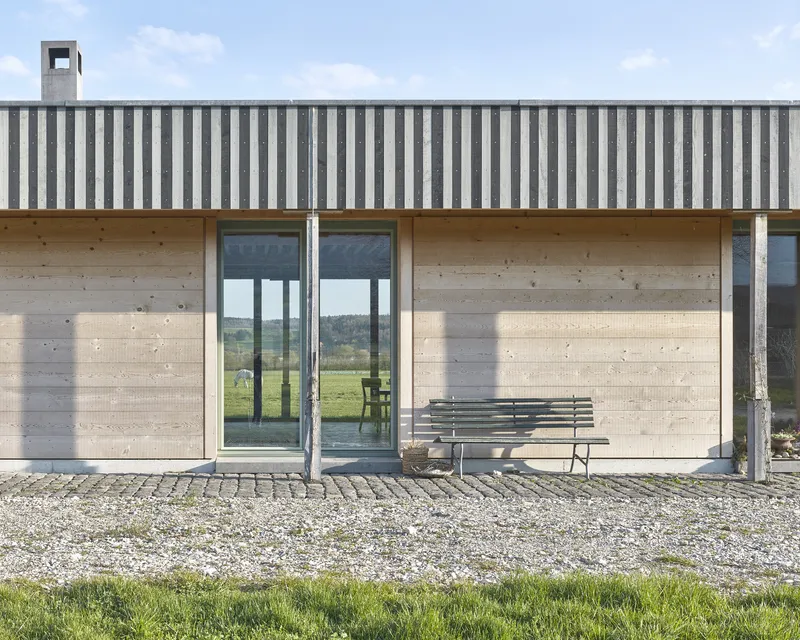
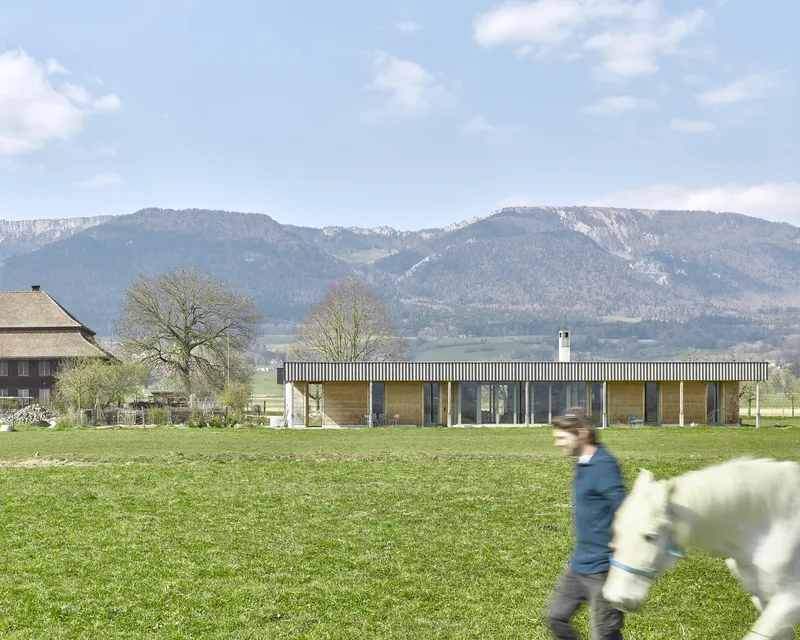
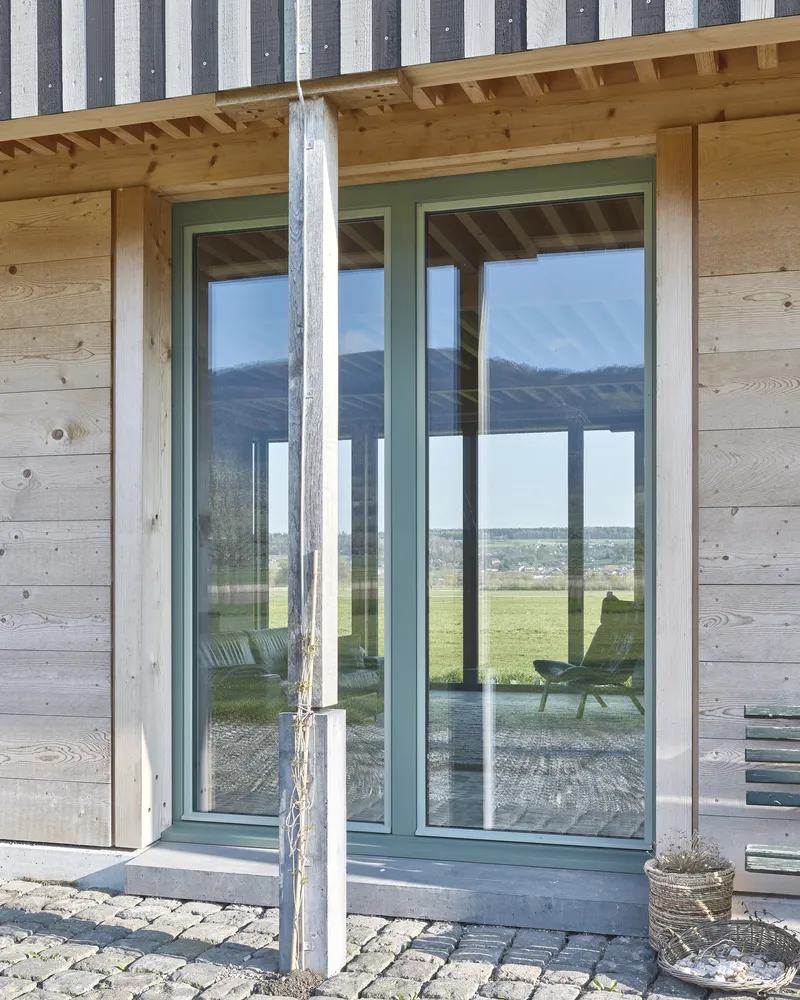
The facade resolves into two clear registers. Below, board-formed concrete block walls provide mass and thermal inertia. Above, vertical timber sunshades and corrugated metal cladding create a lighter, more rhythmic zone that mediates light and ventilation. The transition between the two is handled with steel columns and glazed doors that sit flush with the concrete, allowing the upper volume to appear to float. It is a straightforward tectonic idea executed with care.
Green-framed glass doors punctuate the facade at regular intervals, and their color, a quiet olive, is the only concession to ornament. Against the grey concrete and raw timber, the frames function almost like trim on a farmhouse window, a subtle nod to vernacular color traditions without resorting to pastiche.
The Porch as Social Infrastructure
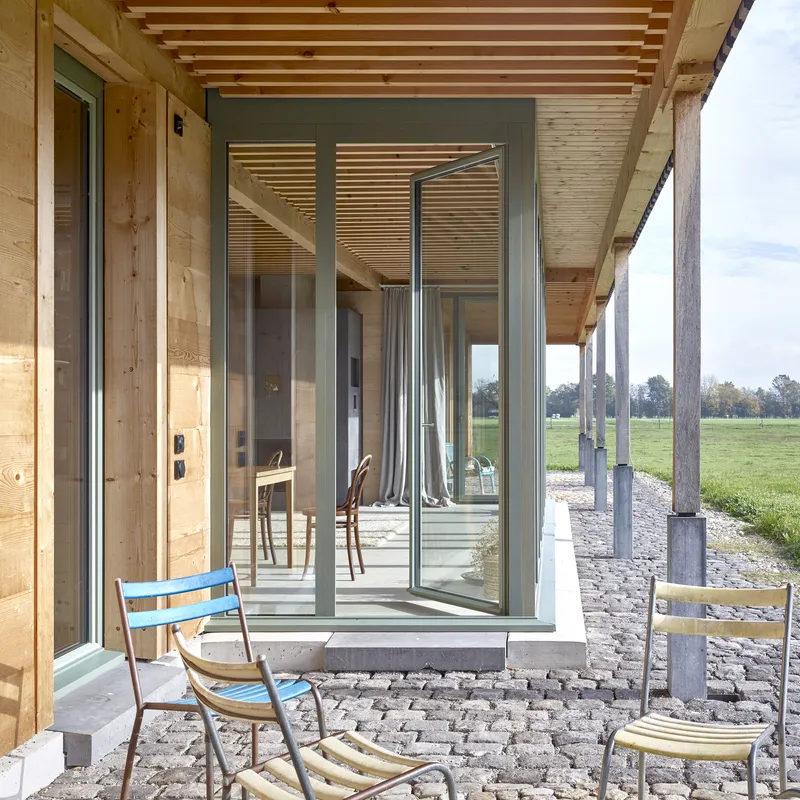
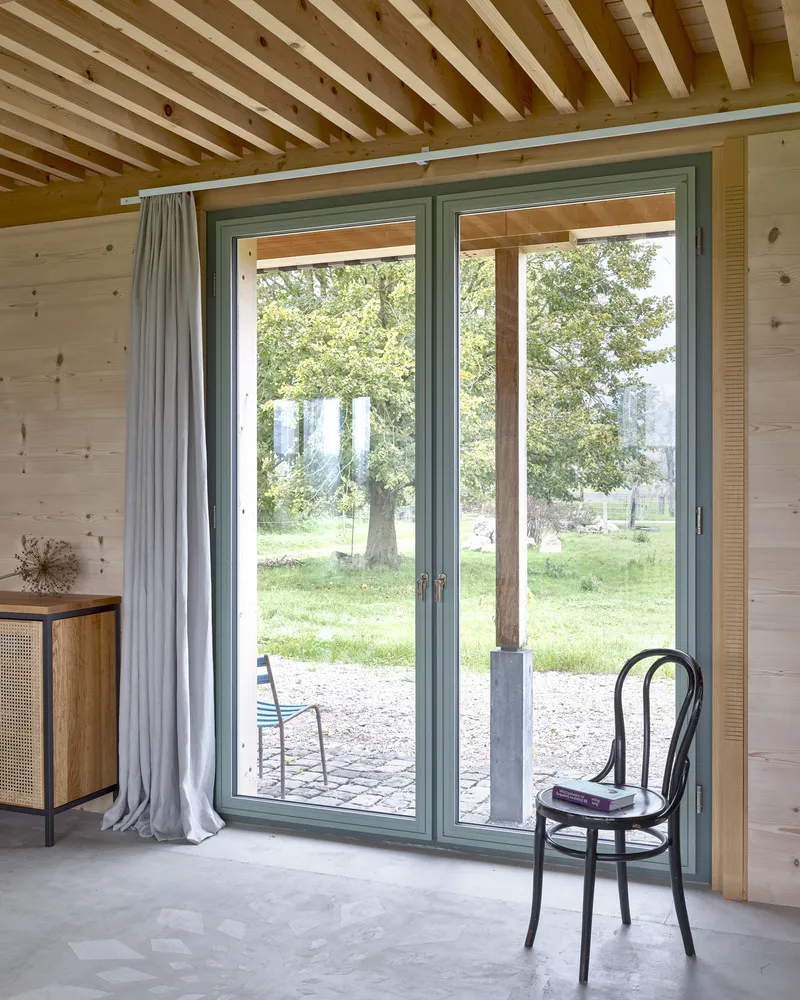

A Stöckli is fundamentally about proximity: to family, to land, to daily agricultural rhythms. The covered porch that wraps the Scholl House serves this function. It is not a decorative veranda but an outdoor room, floored in gravel, furnished with folding chairs, and shaded by exposed timber rafters that cast a changing pattern of light throughout the day. One side opens to a vegetable garden where leeks and flowering perennials grow within arm's reach. The porch is where retirement happens, and Meier Unger has given it the same spatial generosity as any interior room.
The cantilevered metal roof over the garden edge is a nice detail. It extends protection without enclosure, allowing the occupant to stand in rain and still tend the beds. This is pragmatic architecture, shaped by habit rather than composition.
Interior Linearity and Light
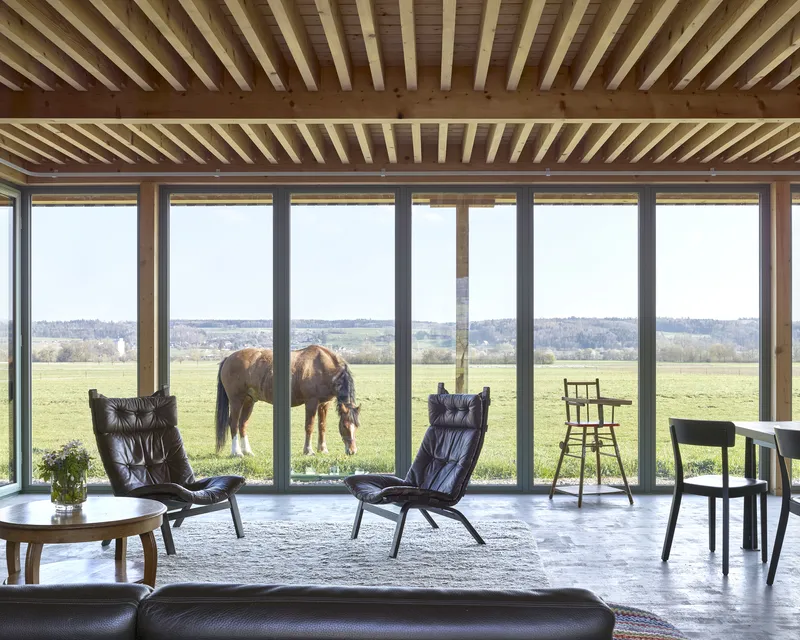
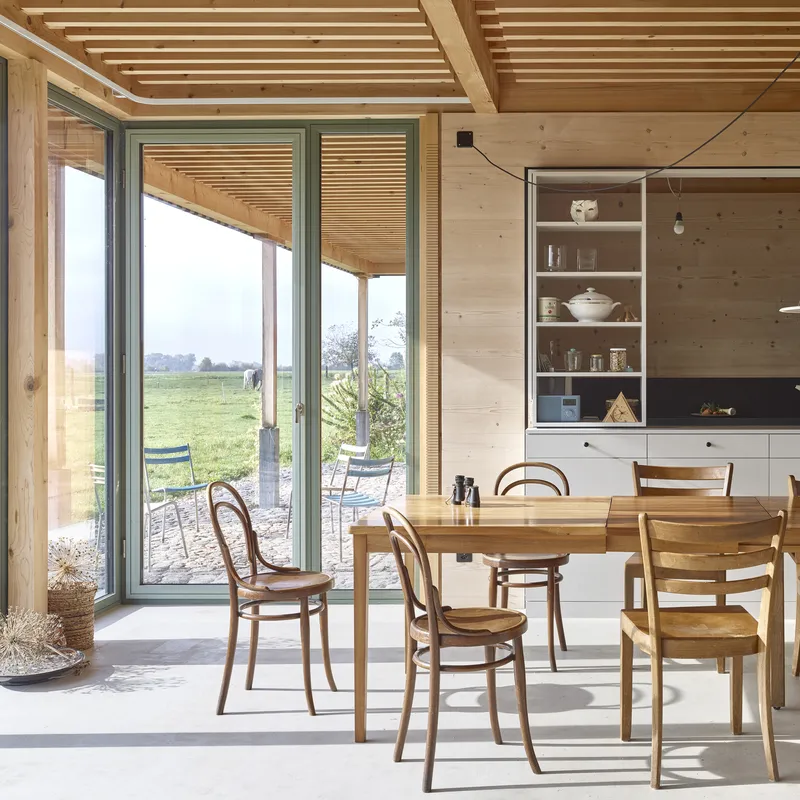
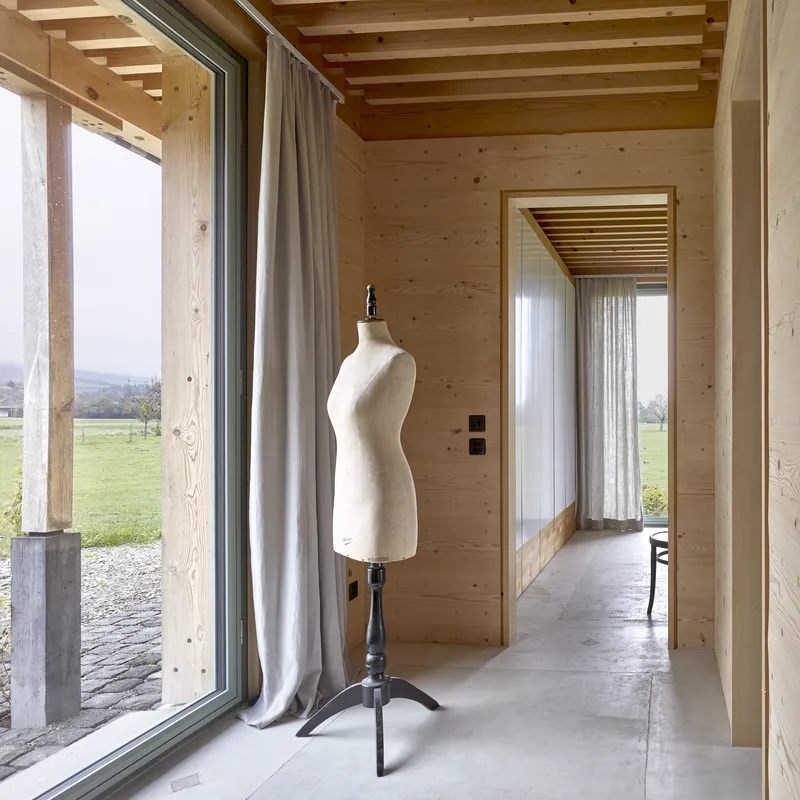
Inside, the plan unfolds as a single corridor of rooms arranged along the building's long axis. The living room, dining area, kitchen, bedrooms, and bathroom are strung together in sequence, each space defined less by walls than by shifts in ceiling treatment and light quality. Full-height glazing on the south side frames the meadow and, in one memorable view, a horse grazing just beyond the glass. The polished concrete floor runs uninterrupted from end to end, reinforcing the sense of continuity.
Exposed timber ceiling joists are left raw and closely spaced, creating a textured canopy that warms the otherwise austere palette of concrete and glass. A dressmaker's mannequin in the corridor and a bentwood chair on the terrace suggest an occupant with a life well lived. These details are Philip Heckhausen's contribution as photographer: he captures the house as inhabited rather than staged, which is exactly the right register for a building type rooted in everyday use.
Craft and Character Inside the Rooms
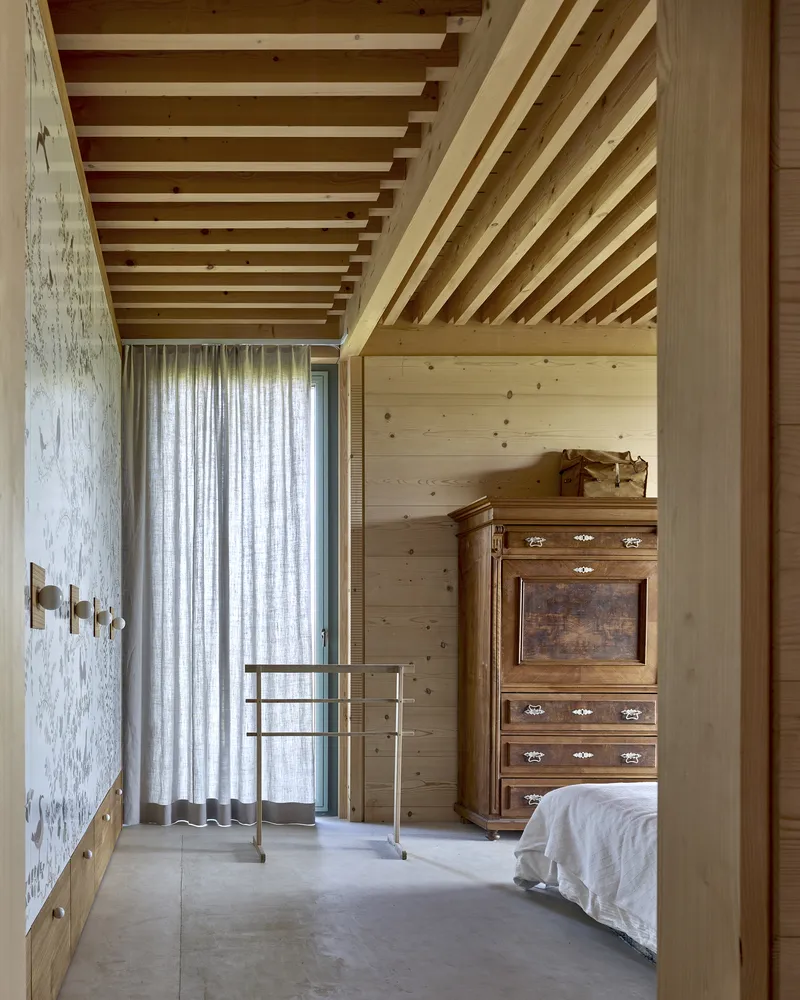
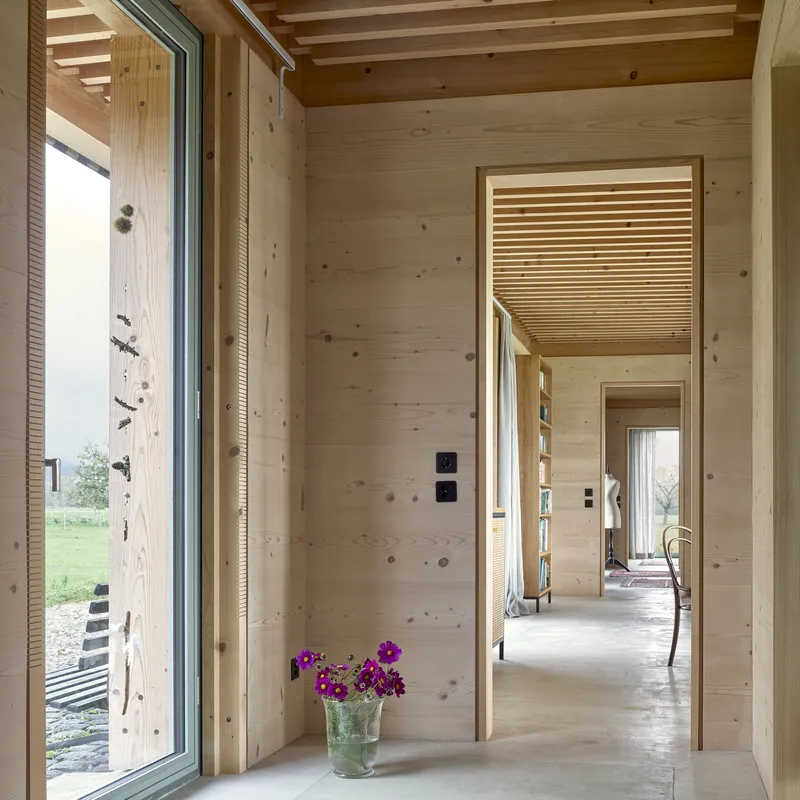

The bedrooms are spare: timber ceiling joists, pale curtains, polished concrete floors. There is a deliberate absence of built-in furniture, which keeps the rooms flexible and allows the occupant's own possessions to define the character of each space. One exception is a built-in wardrobe with hand-painted panels depicting birds and botanical motifs, a piece that feels less like a design choice and more like an heirloom integrated into the architecture. Whether it was commissioned or brought from the main farmhouse, it introduces a layer of personal narrative that no architect could have drawn.
Views through aligned doorways create a telescoping perspective that makes 105 m² feel larger than it is. Purple flowers scattered on the floor in one image, slatted ceiling inserts in another: the interiors reward close looking, revealing a level of material variation that the disciplined exterior does not immediately promise.
The Green Roof and Sectional Logic
The section drawings reveal a planted roof with vegetation layers, a choice that ties the building back to the ground it sits on. From the meadow, the roof is invisible; from a higher vantage, it would read as an extension of the field. This is not greenwashing. In a rural context where every built surface displaces soil, a vegetated roof is a genuine act of compensation. Combined with the concrete's thermal mass and the generous glazing for passive solar gain, the house is calibrated for Swiss plateau winters without mechanical excess.
Plans and Drawings

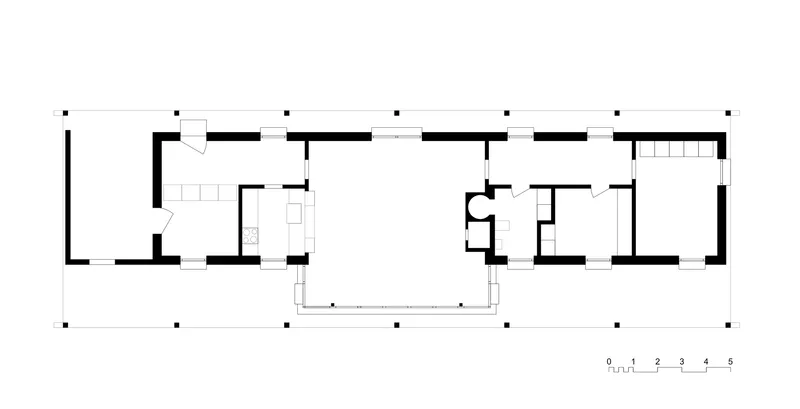
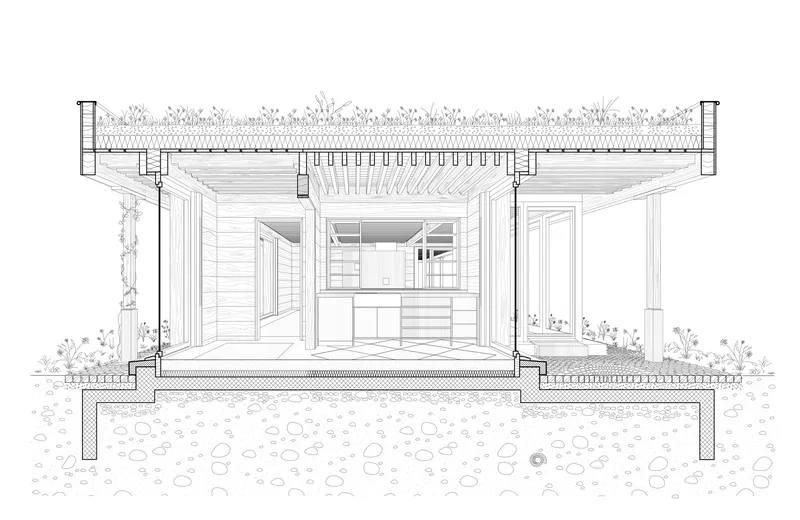


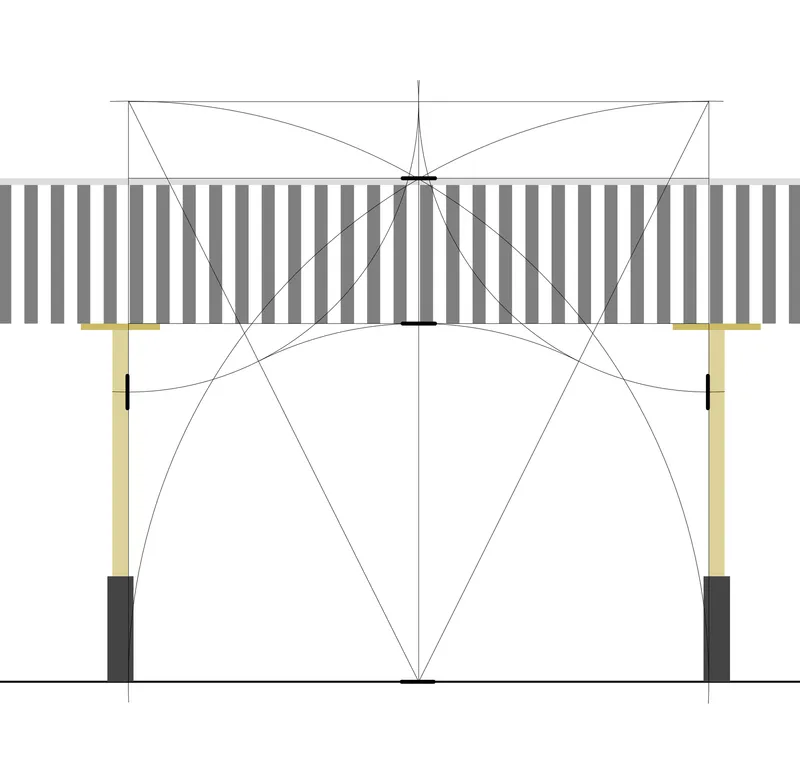
The site plan locates the Scholl House among scattered rural buildings near a railway line and river, confirming its position within a working agricultural landscape rather than a suburban subdivision. The floor plan makes the linear logic explicit: bedrooms at one end, kitchen and living at the other, a bathroom as hinge, and the wraparound porch as a continuous outdoor zone. The construction section is particularly instructive, detailing the foundation, wall assembly, and green roof layers with the kind of annotation that suggests the architects were building this for a specific climate and a specific client, not a competition jury.
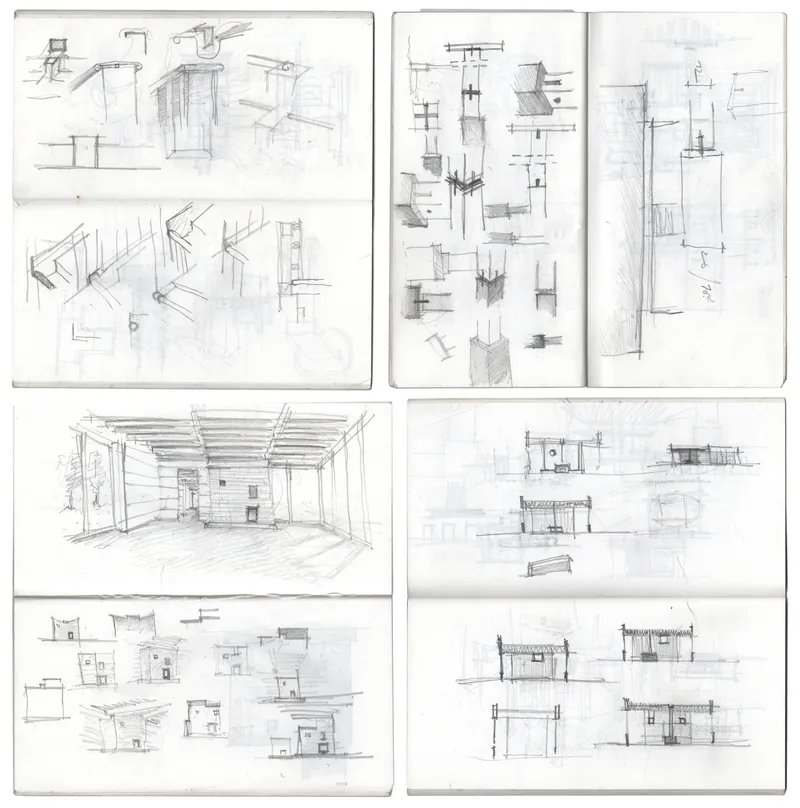
Hand-drawn sketchbook pages showing structural joints, roof framing studies, and interior perspectives offer a rare glimpse into the design process. They reveal an office that thinks through drawing, working out tectonic problems at the scale of a connection before committing to a detail. The sketches have a confidence and looseness that the finished building, for all its precision, sometimes conceals.
Why This Project Matters
The Scholl House matters because it takes a dying building type and proves it still has architectural potential. The Stöckli is not a quaint relic; it is a program with a clear social function, a compact footprint, and an inherent connection to landscape. By treating it with the same rigor they would bring to any contemporary commission, Meier Unger demonstrate that tradition and modernity are not opposing categories but overlapping ones. The house does not look old. It does not look trendy. It looks correct, which is harder to achieve than either.
At a moment when Swiss architecture is often associated with large-budget cultural institutions or high-density urban housing, the Scholl House is a reminder that the discipline's most interesting problems can be small. One hundred and five square meters, one retired farmer, one meadow, one horse. The constraints are severe, and the architecture is better for it.
Scholl House by Meier Unger (Jan Meier, Lena Unger), Selzach, Switzerland. 105 m², completed 2019. Photography by Philip Heckhausen.
About the Studio
Share Your Own Work on uni.xyz
If projects like this are the kind of work you want to make, uni.xyz is a place to publish your own, find collaborators, and enter design competitions.




Popular Articles
Popular articles from the community


The Ocean Hive: Sustainable Architecture for a Self-Sufficient Civilization at Sea
The Ocean Hive imagines sustainable architecture at sea, where modular habitats, algae, wave power and ocean waste sustain a growing colony.

Conexión: Biophilic Design Reimagines High-Rise Living in Hong Kong
Conexión reimagines high-rise living in Hong Kong through biophilic design, green facades, shared spaces, daylight, water and nature within.

Co-life: Sustainable Architecture for Age-Friendly Community Living
Co-life reimagines sustainable architecture for seniors through courtyards, rammed earth, shared gardens, and spaces designed for belonging.

Co-Life: Senior Housing Design That Reconnects Older Adults With the City
Co-Life reimagines senior housing design through healing gardens, shared streets, workshops, and a sustainable community across generations.


Similar Reads
You might also enjoy these articles

Bao Huynh Watercolor Atelier: A Serene Art Retreat in Hội An
Bao Huynh Watercolor Atelier in Hội An blends multifunctional art spaces, sustainable design, local materials, and family-friendly living in a serene environment.

Atelier Macri Concept Store Interior Design by CASE-REAL
Atelier Macri store features a "ko" counter, walnut wood details, cork displays, blending retail, gallery, and seamless customer experiences.

Manuel Vargas Izquierdo Stadium and High-Performance Sports Center: Architectural Excellence in Jalpa de Méndez
The Manuel Vargas Izquierdo Stadium blends sustainable design, inclusive sports facilities, and cultural-inspired architecture, revitalizing Jalpa de Méndez’s public spaces.

KAKR Buluh Awar Hall: Revitalizing Community and Ecology Through Bamboo Architecture
Community built bamboo hall revitalizes Buluh Awar village, empowering youth, restoring ecology, celebrating vernacular craftsmanship through sustainable architecture and culture.


Explore Residential Building Competitions
Discover active competitions in this discipline



Challenge to design a portable theatre


Challenge to design a portable music platform


Challenge to design an open learning module for the elderly


Challenge to design mud housing for contemporary communities
Comments (0)
Please login or sign up to add comments
No comments yet. Be the first to comment!