
Meireles and Pavan Arquitetura Sculpt a São Paulo Family Home Around Courtyards and Circular Light
In Vila Nova Conceição near Parque Ibirapuera, a 560-square-meter renovation trades demolition for reinterpretation, letting daylight and greenery flood in


In a São Paulo neighborhood where redevelopment pressure makes demolition the path of least resistance, the Ortiz House takes the opposite bet. Meireles and Pavan Arquitetura, led by Brunno Meireles, André Pavan, and Guilherme Delgado, kept the bones of an existing structure in Vila Nova Conceição and reshaped it into a 560-square-meter home for a family that wanted expansive, light-filled rooms connected to the outdoors. The result is not a preservation exercise for its own sake but an argument that an older building's proportions and openings can become the scaffold for genuinely contemporary living.
What makes the project compelling is its commitment to softness. Stucco walls curve at ceiling junctions rather than meeting in hard right angles. A sculptural staircase twists upward through the plan like a piece of furniture inflated to architectural scale. Circular apertures puncture ceilings and facades, trading the standard rectangular skylight for something more deliberate and playful. Across two linked volumes and a central courtyard, the architects choreograph a sequence of rooms that never feel repetitive yet hold together through a small, consistent material palette of white plaster, brick, terrazzo, and timber.
A White Facade with Timber Warmth
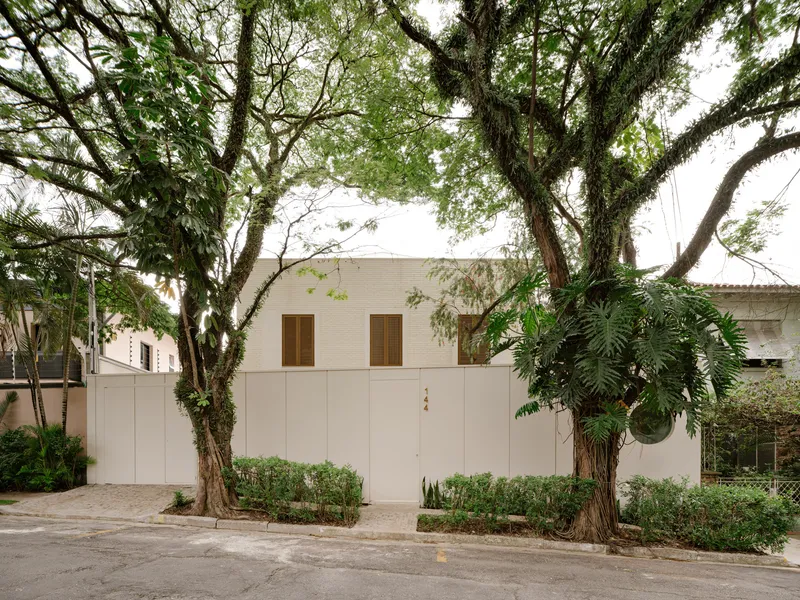
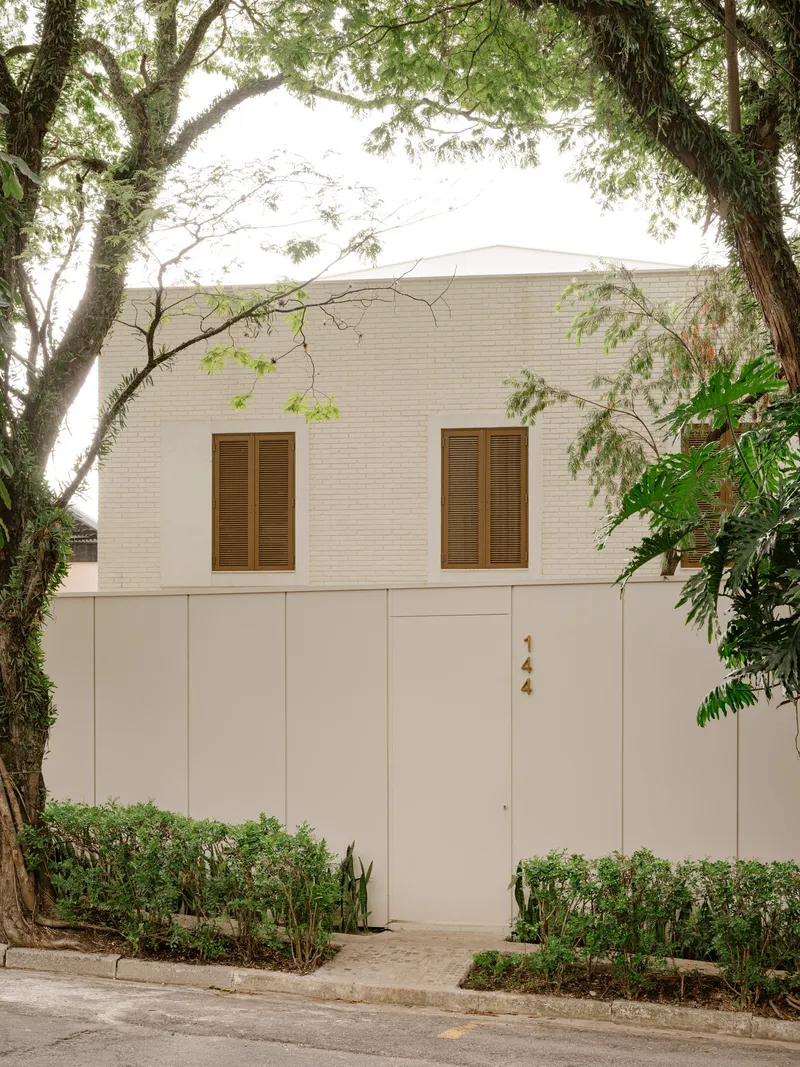
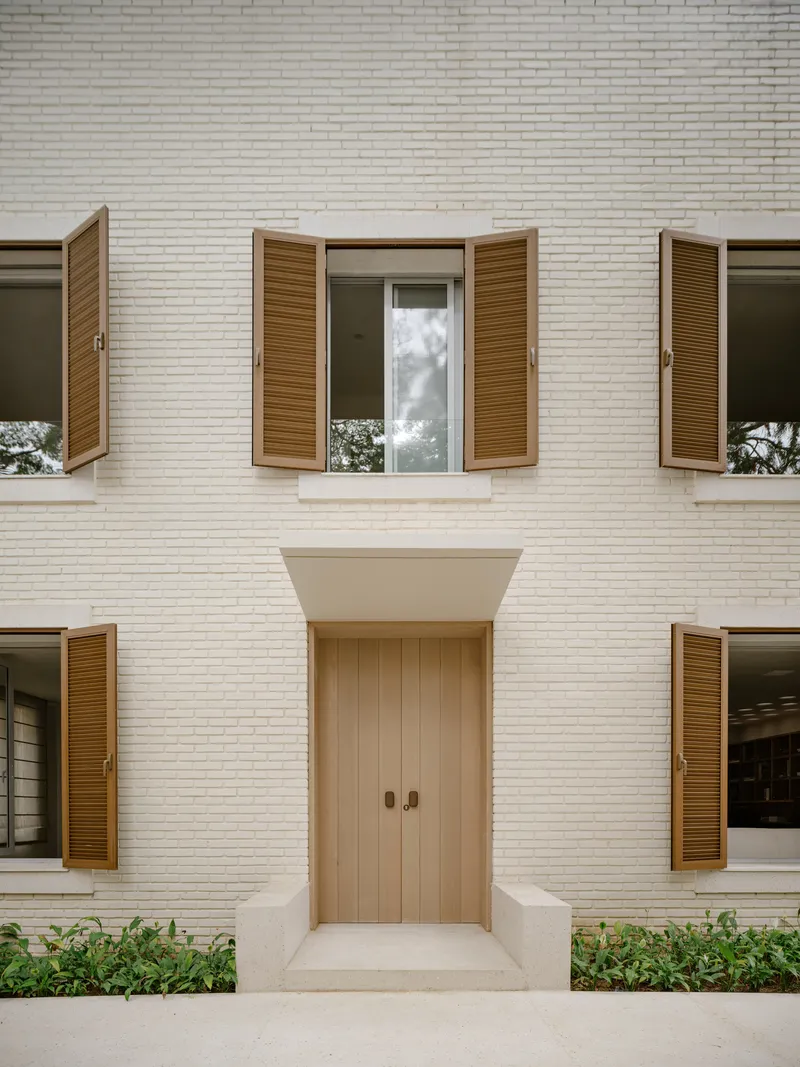
From the street, the Ortiz House reads as a calm, pale volume tucked beneath the generous tree canopy that defines Vila Nova Conceição. White rendered walls and white brick give the facade a monolithic quality, while timber shutters and a solid wooden entrance door punctuate the surface with warmth. The louvered shutters are not decorative: in the bedrooms above, they double as blackout screens behind glass guardrails and acoustic frames, a layered environmental strategy that trades mechanical systems for operable craftsmanship.
The symmetry of the front elevation is quietly deliberate. Recessed openings on both levels mirror each other without being identical, lending the composition a disciplined rhythm. Planted beds at the base soften the threshold between house and sidewalk, grounding the white volumes in greenery before you even cross the front door.
The Courtyard as Connector
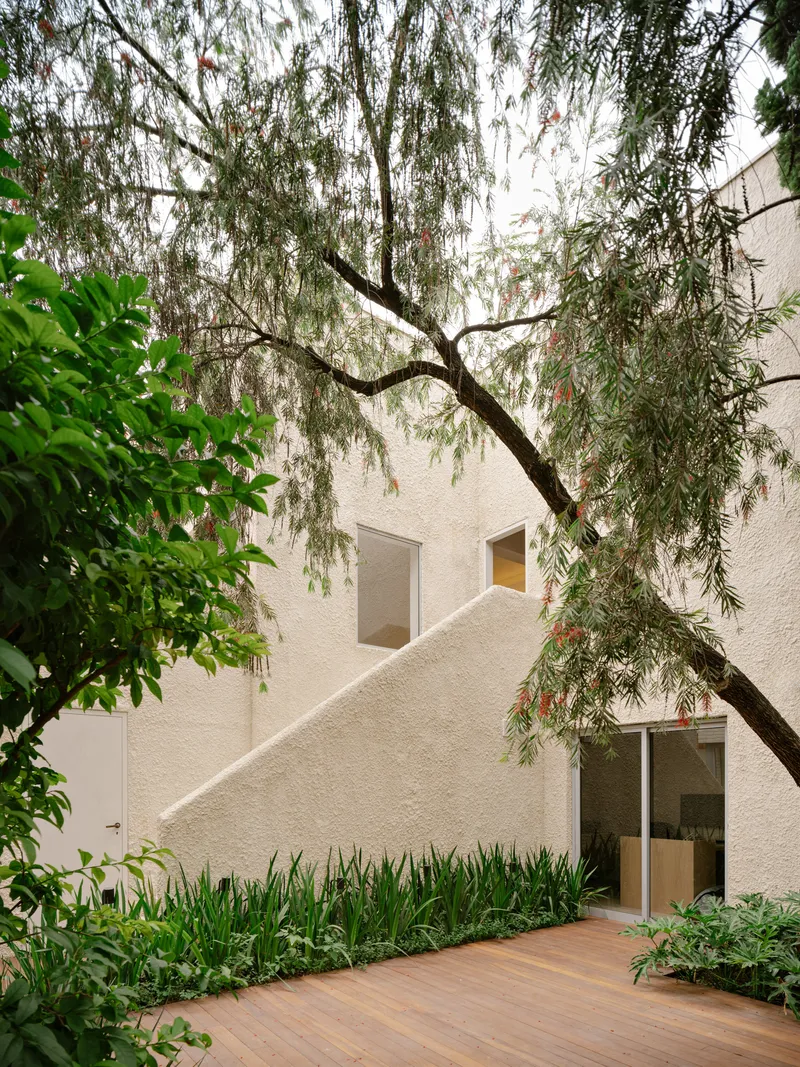
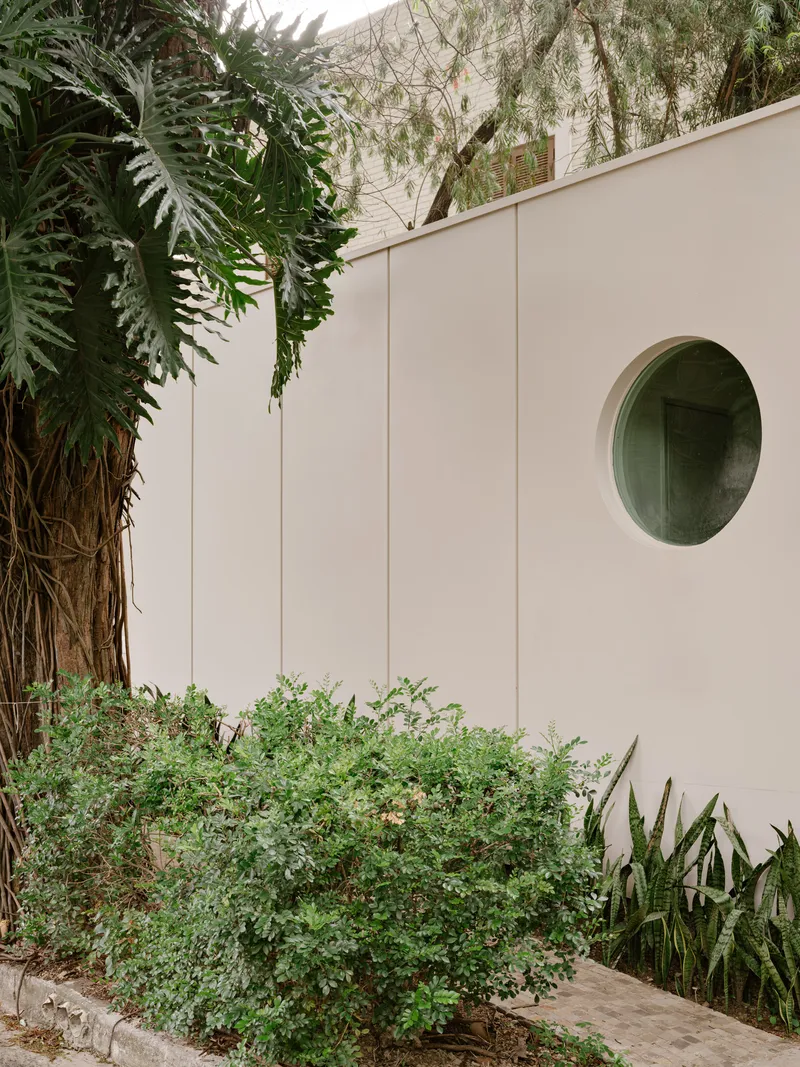
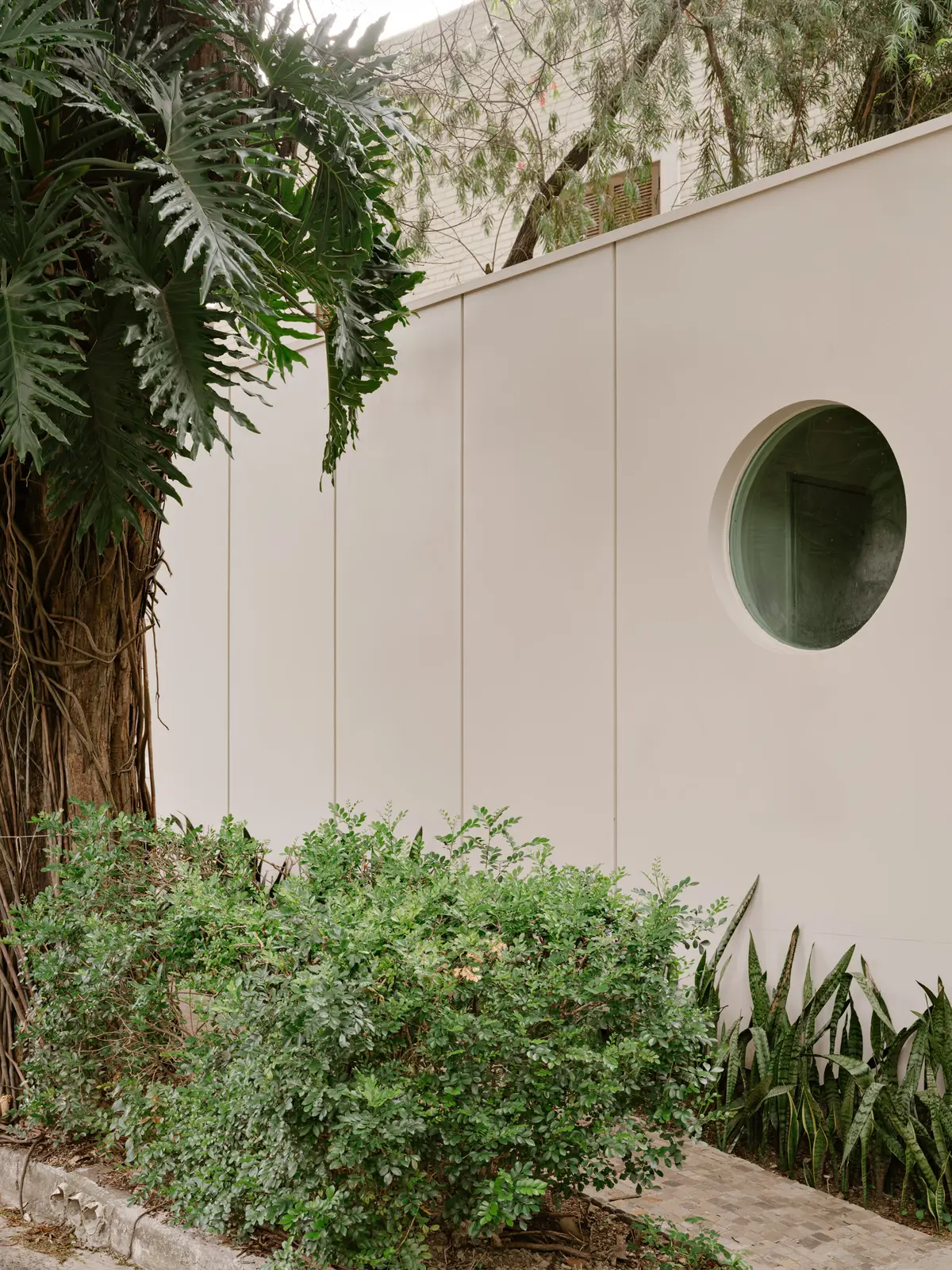
The organizational heart of the project is a central courtyard that connects the two-story main volume to a rear annexe containing an office and guest suite. It is more than a light well. Tropical planting fills the space, and a circular opening in one of the pale plaster walls frames the green beyond like a viewfinder. The courtyard establishes visual continuity between front and rear while pulling cross ventilation through the ground floor, a passive climate move that proves its worth in São Paulo's humid summers.
Landscape architect Renata Tilli's planting strategy extends from the courtyard into a rear garden, preserving existing trees and introducing new tropical species. The effect is that greenery appears at nearly every window, collapsing the perceived boundary between architecture and garden.
Living Spaces and Circles of Light
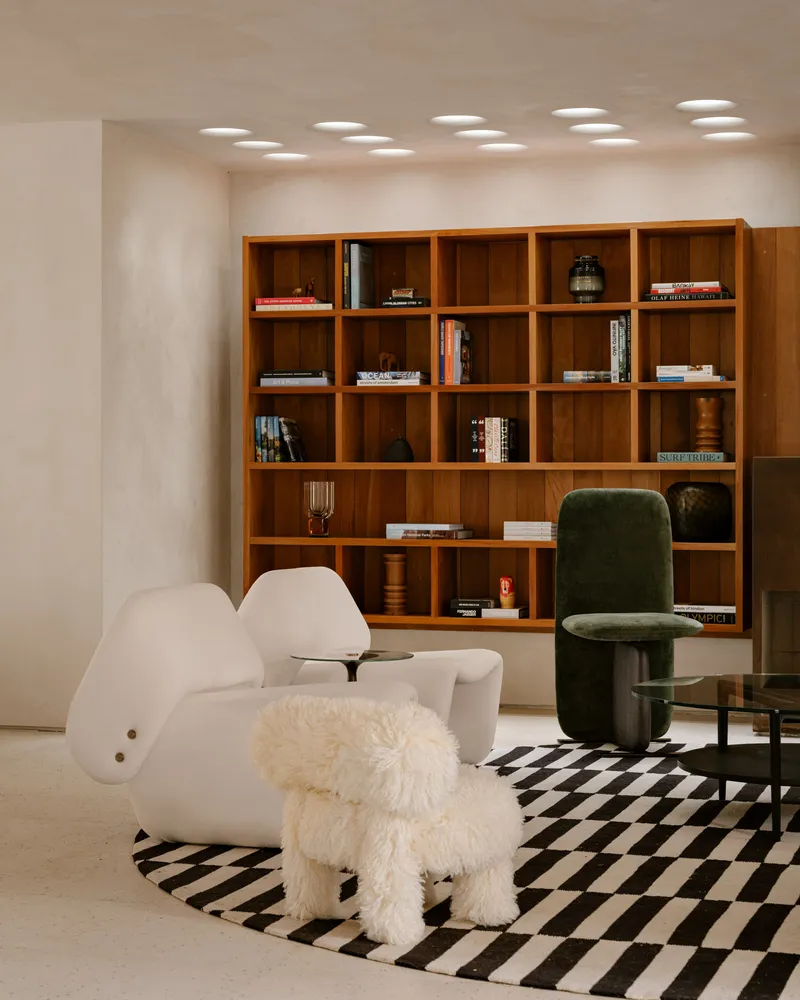
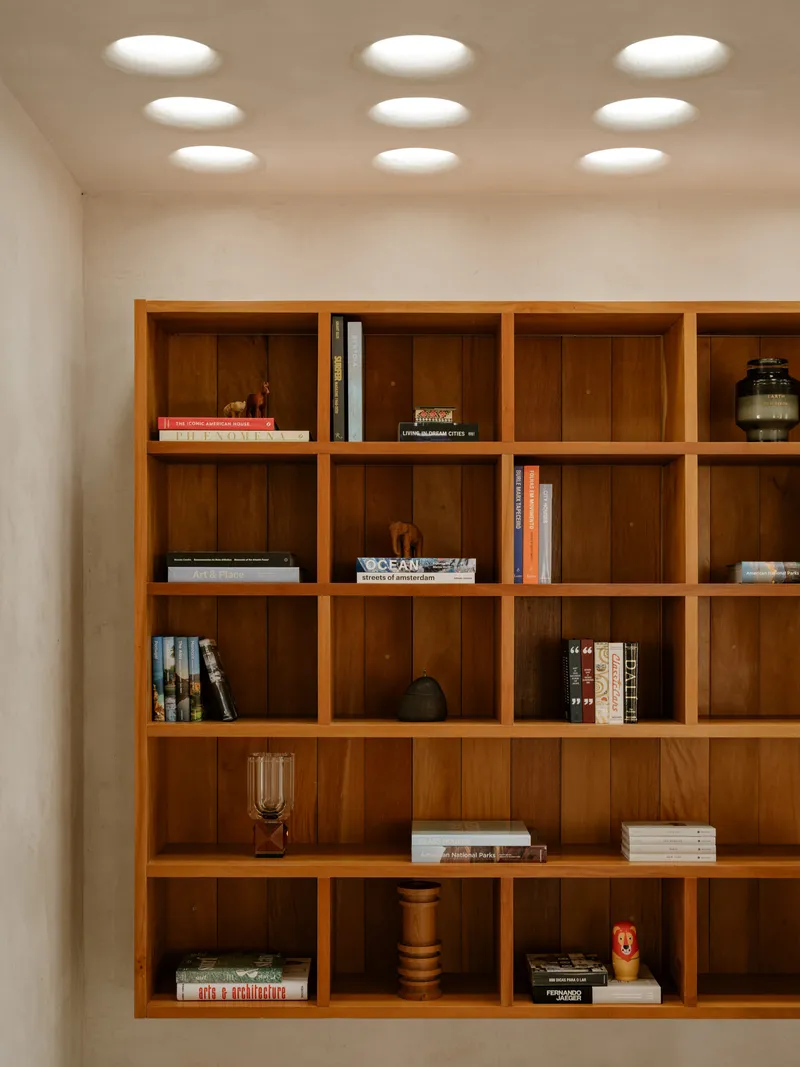
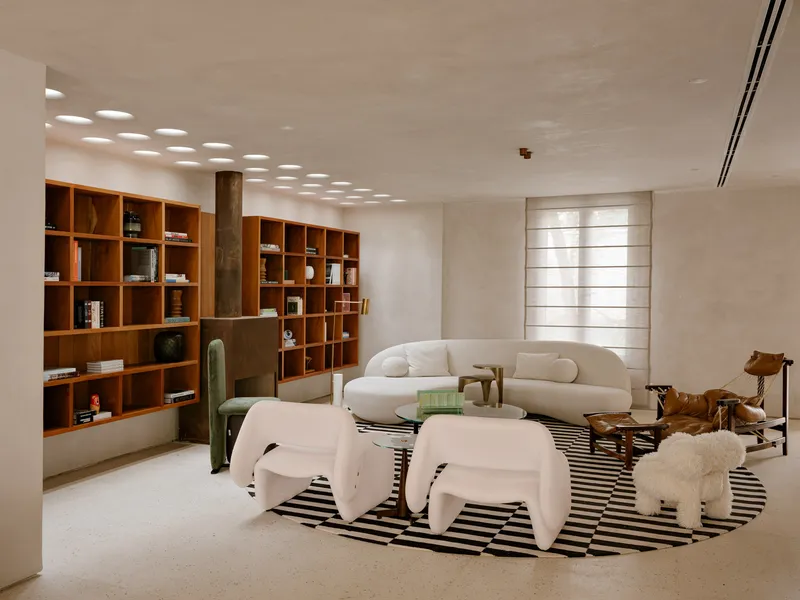
The ground floor social spaces are where the architects' interest in circular ceiling apertures hits hardest. In the living room, a constellation of round openings perforates the ceiling, each one casting a diffuse column of daylight onto the timber bookshelf wall below. The effect is theatrical without being heavy-handed: the circles give the room a rhythm that rectangular skylights would not have achieved. A suspended shelving unit, clad in wooden slats, doubles as a spatial divider and a display piece, loaded with books and objects.
The arrangement is deliberately fluid. Kitchen, dining, and gourmet spaces align along a shared axis, and the living room opens into them without corridors or pinch points. Recessed ceiling lights supplement the natural apertures after dark, maintaining the same even wash that the skylights provide during the day. Checkered and striped rugs anchor seating zones without the need for walls.
A Kitchen Split into Two Worlds
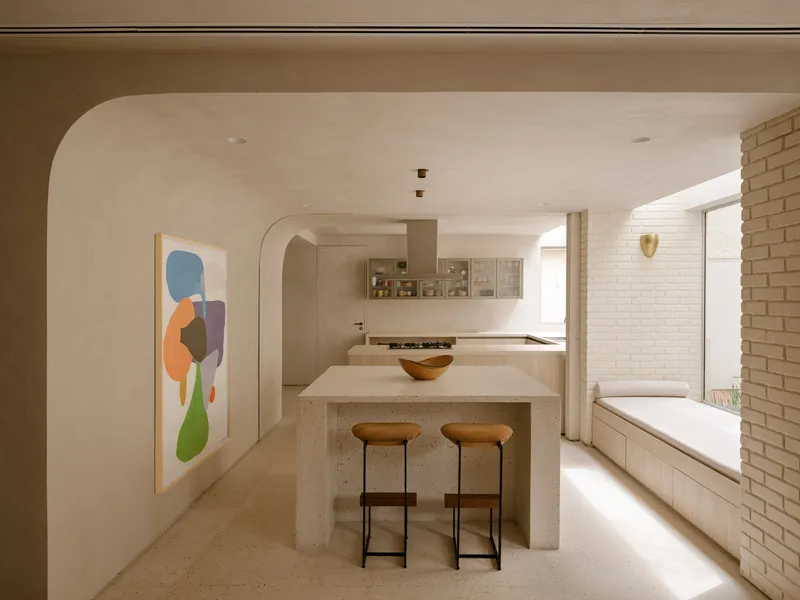
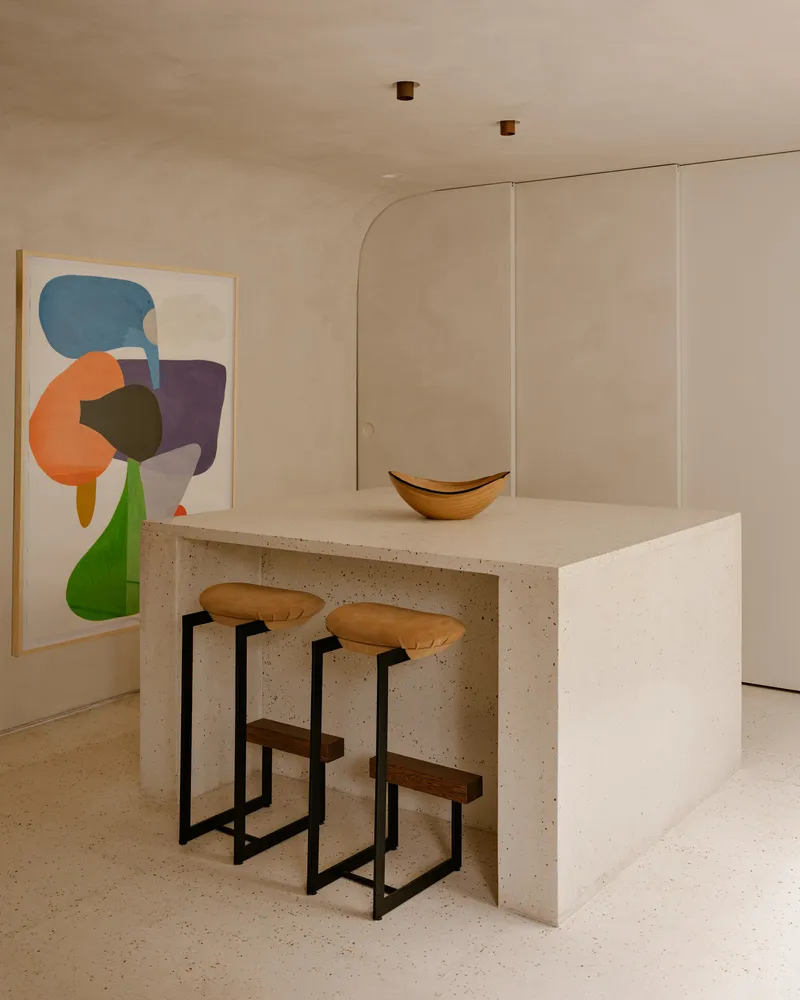
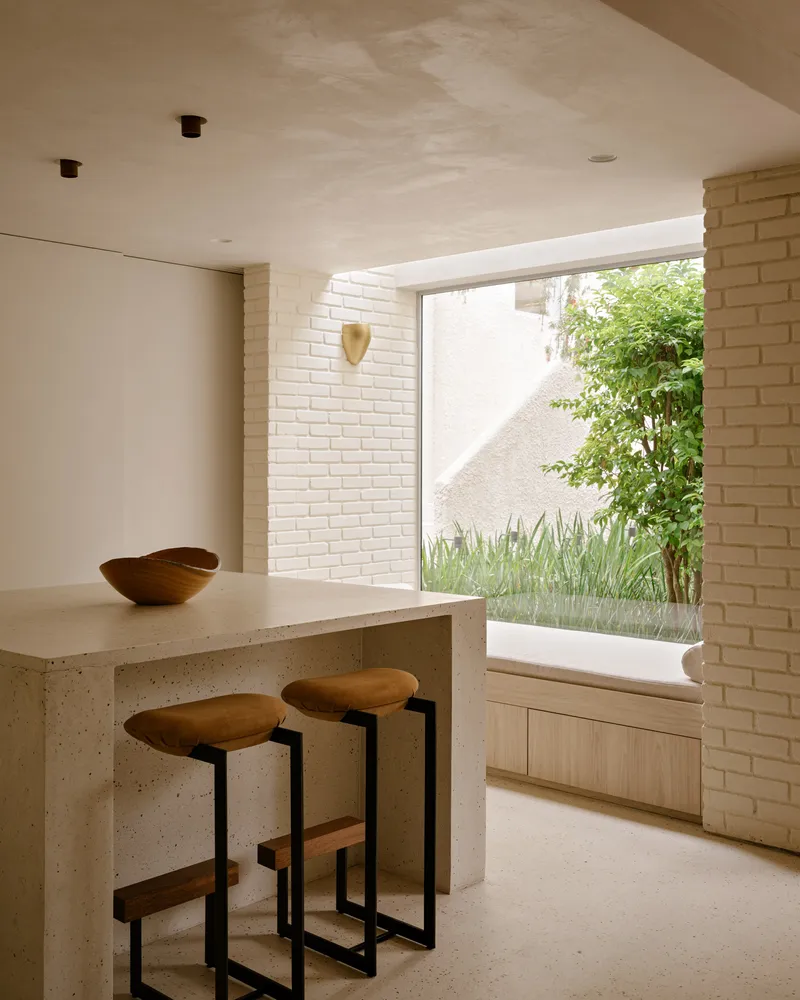
The kitchen is one of the smartest moves in the house. Rather than one open-plan cooking zone, the architects conceived two interlinked areas: a social space with a terrazzo island and casual dining counter, and a separate technical area for food preparation, hidden behind a built-in sliding door. When the family entertains, the social kitchen faces the courtyard through a large window; when the mess of actual cooking needs to disappear, the sliding door closes and the illusion of effortless hospitality holds.
Terrazzo surfaces on the island and countertops bring a tactile, handmade quality that contrasts with the precise paneled cabinetry. Arched openings and a white brick bench along one wall nod to the building's original vocabulary, while abstract artwork on the opposite wall keeps the room from tipping into nostalgia. Timber stools tuck under the counter to keep sightlines clear.
The Sculptural Stair
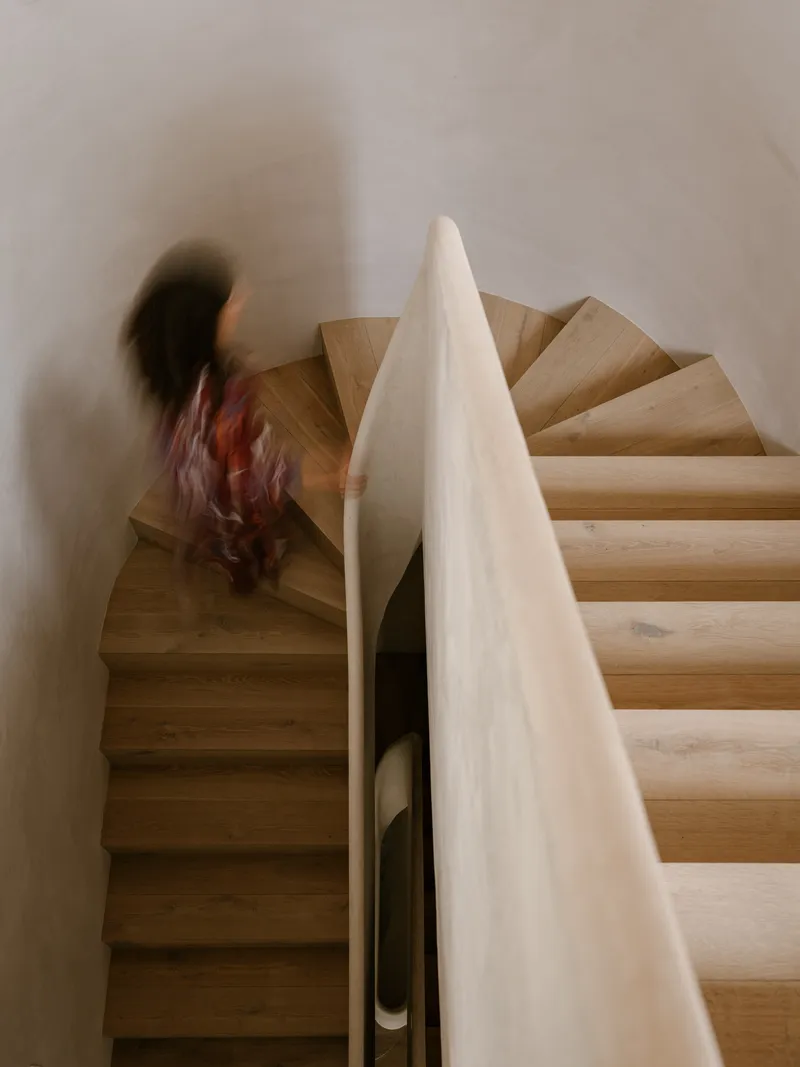
The staircase is the project's signature element, and it earns that status. A twisting stucco balustrade spirals upward through the plan, its surface continuous with the surrounding walls so that it reads as architecture rather than furniture. Wooden boards at the landings introduce warmth where your foot actually lands, and the first steps feature subtly rounded edges that extend into the adjacent walls, blurring the line between stair and room. A figure caught mid-ascent in motion blur tells you everything about the fluidity the architects were after.
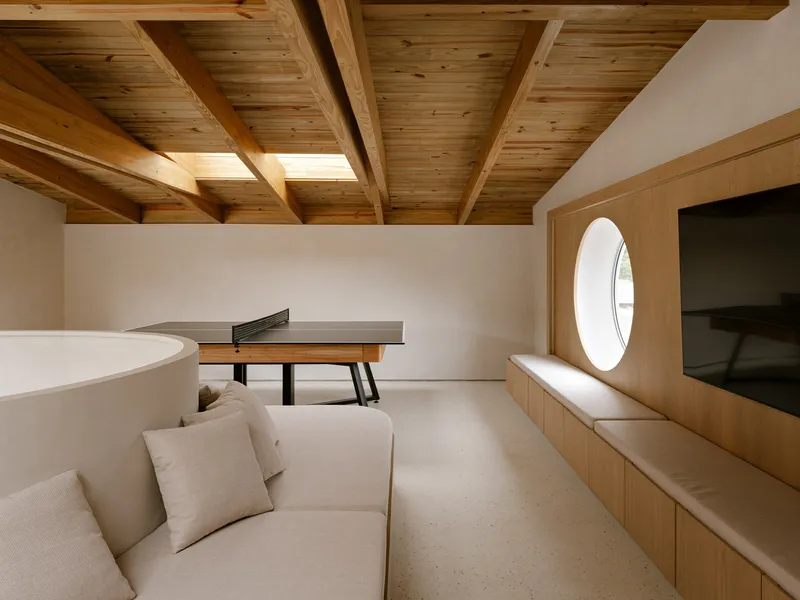
Upstairs, the private level reveals exposed timber ceiling beams, a circular window, and built-in bench seating that turns a corridor into a pause point. The circular motif from the ground floor ceilings reappears here as an actual window, framing a view of the canopy outside and reinforcing the geometric language that ties the whole house together.
Rooftop as a Room Without Walls
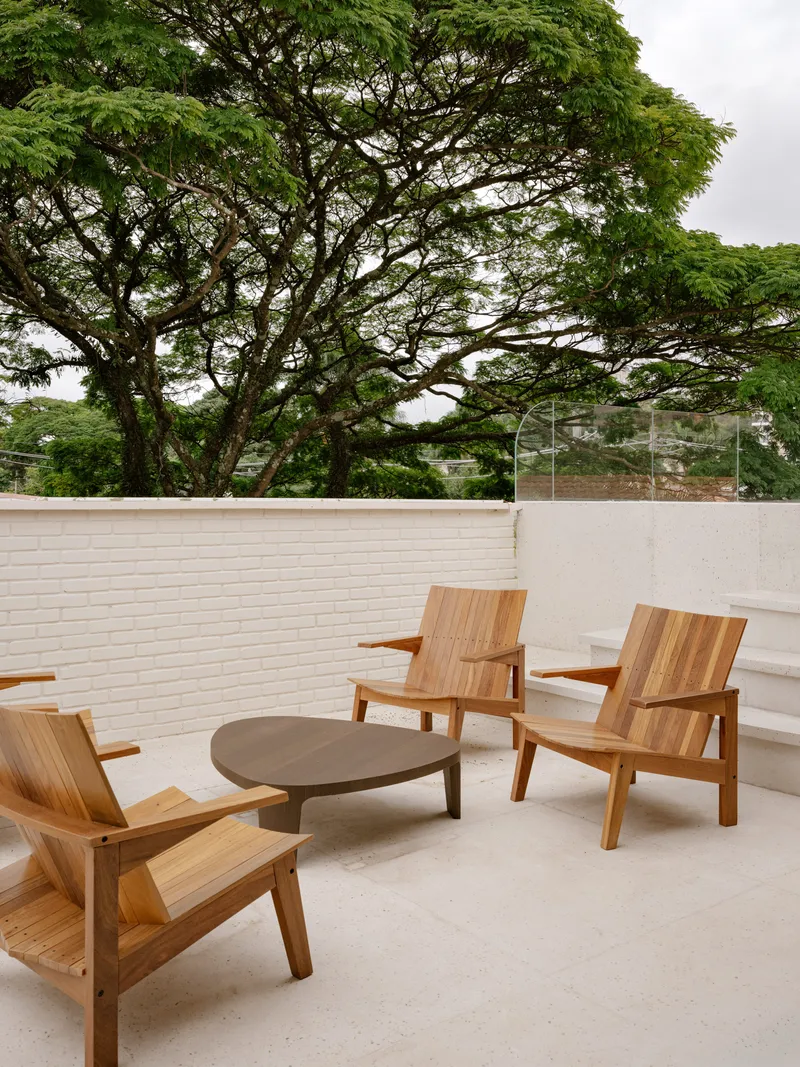
At the top of the house, the architects transformed the roof into an outdoor living room. Timber lounge chairs and a low table sit beneath the spreading canopy of a tree that was either preserved or mature enough to appear as though it has always been there. The space is designed for relaxation and contemplation, and its deliberate simplicity, just furniture, sky, and leaves, is the payoff for the dense planning below.
Plans and Drawings
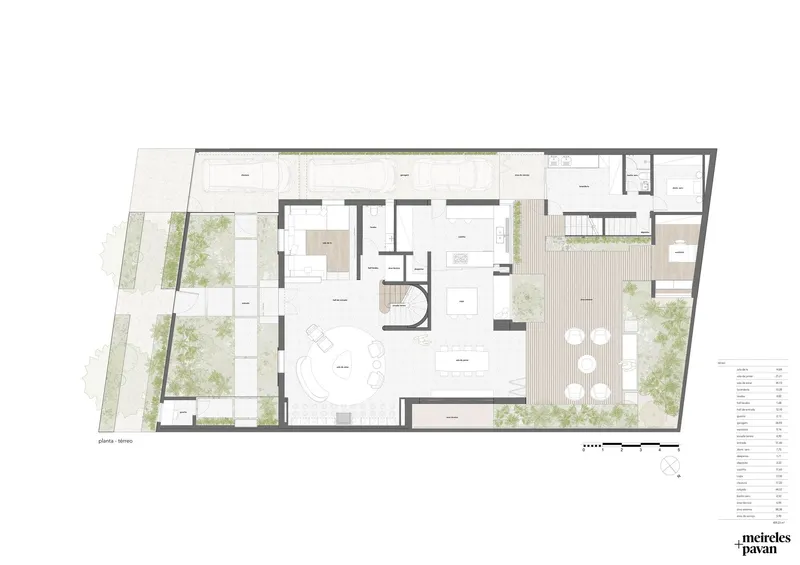
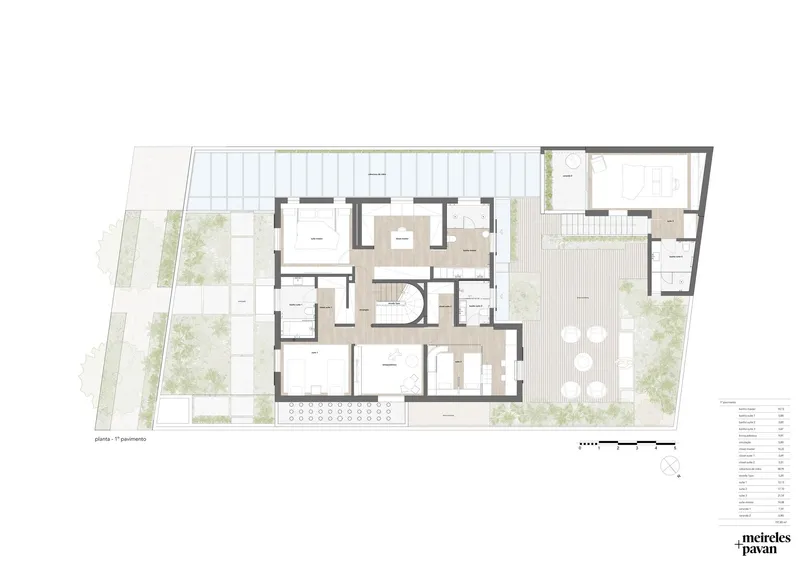
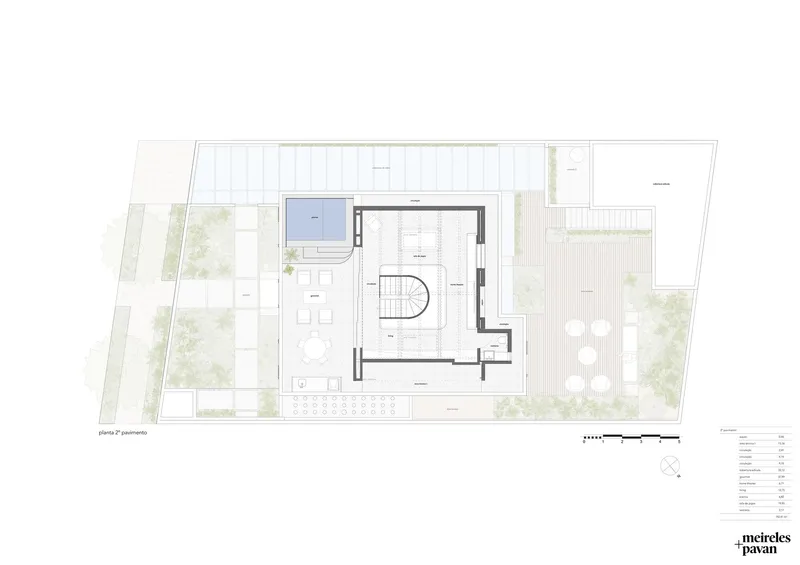
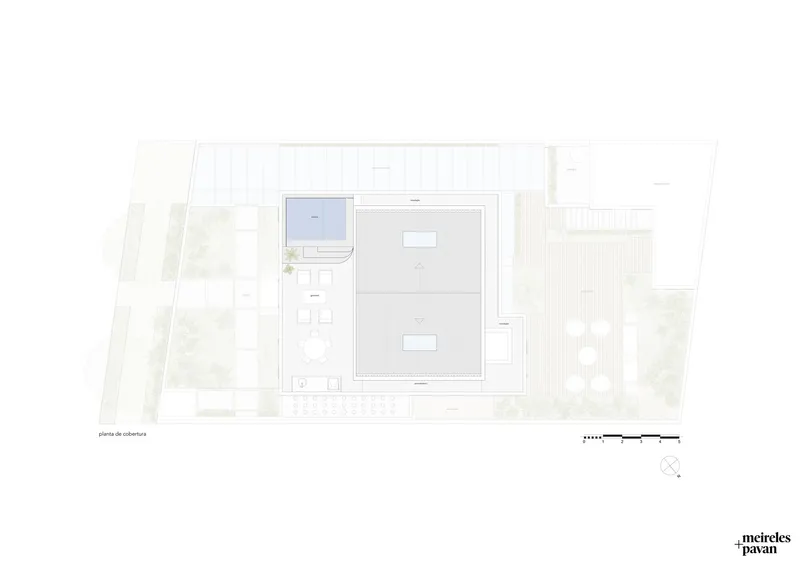
The floor plans reveal what photographs alone cannot: how tightly the curved central stair organizes circulation across all levels. On the ground floor, living spaces wrap around planted courtyards in an L-shaped arrangement, with the annexe separated by the courtyard gap. The first floor stacks three bedroom suites around the spiral stair, each with access to natural light on at least two sides. At the second floor, a double-height volume opens up to the rooftop terrace, and the roof plan shows the flat surfaces punctuated by courtyard voids and terrace openings. The geometry is compact for 560 square meters; there is almost no wasted corridor space.
Why This Project Matters
The Ortiz House is a case study in what preservation can look like when it is not burdened by sentimentality. Meireles and Pavan Arquitetura did not freeze the original building in amber. They used its proportions and openings as a starting point, then introduced a new spatial language of curves, circles, and continuous plaster surfaces that feels thoroughly of its moment. For a family whose professional life revolves around environmental protection, the decision to renovate rather than rebuild carries weight beyond aesthetics; it is a material and energy argument against the disposable approach to housing that dominates São Paulo's high-value neighborhoods.
What lingers is the consistency of detail. From the rounded stair edges to the softly curving ceiling junctions to the circular skylight perforations, every element reinforces the same idea: that a house can be rigorous without being rigid. The courtyard, the split kitchen, and the rooftop terrace each solve a specific problem of domestic life, and together they make a 560-square-meter renovation feel neither bloated nor cramped. In a district where tearing down and starting over is the norm, this house makes a persuasive case for keeping what works and reshaping everything else.
Ortiz House by Meireles and Pavan Arquitetura. Vila Nova Conceição, São Paulo, Brazil. 560 m². Completed 2025. Lead architects: Brunno Meireles, André Pavan, Guilherme Delgado. Landscape: Renata Tilli. Photography by Fran Parente.
About the Studio
Share Your Own Work on uni.xyz
If projects like this are the kind of work you want to make, uni.xyz is a place to publish your own, find collaborators, and enter design competitions.


Popular Articles
Popular articles from the community


Conexión: Biophilic Design Reimagines High-Rise Living in Hong Kong
Conexión reimagines high-rise living in Hong Kong through biophilic design, green facades, shared spaces, daylight, water and nature within.

Play: Fragments of Their World
Familiar architecture becomes modular playground design, creating safe spaces where displaced children can learn, connect, imagine and play.

Hill & Cross Opera: Sculptural Opera House Architecture Shaped by Tallinn’s Landscape and Identity
Hill & Cross Opera reimagines opera house architecture in Tallinn through its sculptural hill, civic plaza, glass wave and a luminous cross.

Little Red Riding Hood: Architectural Design as a Journey Through Fear, Light, and Storytelling
Little Red Riding Hood reimagines the fairy tale through architectural design shaped by fear, light, scale, memory, uncertainty, and choice.

Similar Reads
You might also enjoy these articles

Bao Huynh Watercolor Atelier: A Serene Art Retreat in Hội An
Bao Huynh Watercolor Atelier in Hội An blends multifunctional art spaces, sustainable design, local materials, and family-friendly living in a serene environment.

Atelier Macri Concept Store Interior Design by CASE-REAL
Atelier Macri store features a "ko" counter, walnut wood details, cork displays, blending retail, gallery, and seamless customer experiences.

Manuel Vargas Izquierdo Stadium and High-Performance Sports Center: Architectural Excellence in Jalpa de Méndez
The Manuel Vargas Izquierdo Stadium blends sustainable design, inclusive sports facilities, and cultural-inspired architecture, revitalizing Jalpa de Méndez’s public spaces.

KAKR Buluh Awar Hall: Revitalizing Community and Ecology Through Bamboo Architecture
Community built bamboo hall revitalizes Buluh Awar village, empowering youth, restoring ecology, celebrating vernacular craftsmanship through sustainable architecture and culture.


Comments (0)
Please login or sign up to add comments
No comments yet. Be the first to comment!