
Memorial Center in Aleppo: Architecture as a Vessel of Collective Memory
A museum and living monument in Aleppo's historic core frames the ruined city itself as its most powerful exhibit.


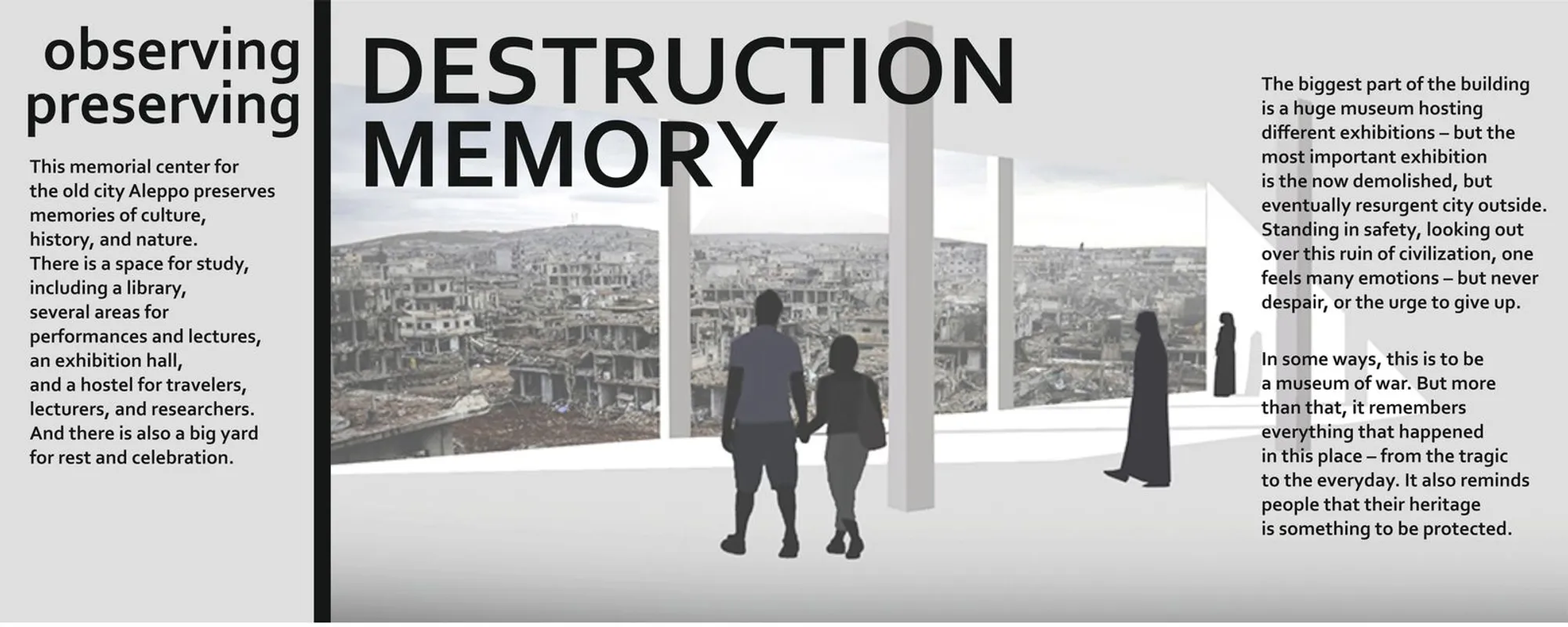
What does it mean to build a memorial in a city that is, itself, the memorial? In Aleppo, where entire neighborhoods were reduced to rubble during years of conflict, the act of constructing a museum of cultural memory forces a confrontation with an uncomfortable question: how do you exhibit loss when loss is visible in every direction? The Memorial Center in Aleppo answers by refusing to contain its subject. The building houses curated collections, artifacts, drawings, and multimedia installations, but its most radical move is architectural: framed openings, elevated walkways, and carefully placed windows turn the surrounding urban landscape into the primary exhibit. The city becomes the collection.
Designed by Maria Zhukova, the project is sited in the historic heart of Aleppo, once celebrated as a crossroads of civilizations. The design positions itself as both a museum and a living monument, a place where community gathers for reflection and renewal. Zhukova's conceptual foundation rests on the understanding that Aleppo's old quarters faced widespread destruction, and the memorial center acknowledges this disappearance not as an ending but as a call to reassemble the cultural fragments that define Aleppine identity.
A Contemporary Citadel in Sand-Colored Stone
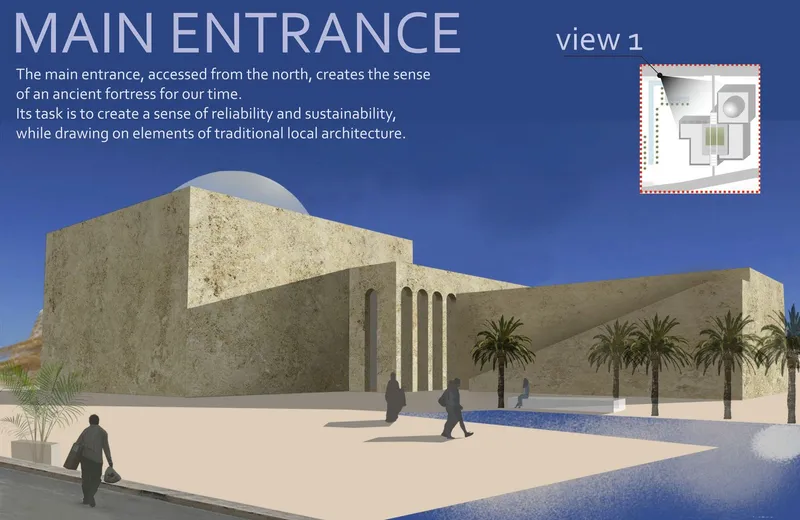
The northern entrance reads as a contemporary fortress, and that reading is intentional. Massive stone walls finished in a local sand-colored materiality express solidity, endurance, and permanence: qualities essential to a structure tasked with preserving what conflict nearly erased. Vertical arcades of arched recesses reinterpret the rhythms found in Aleppo's traditional souks and religious buildings, translating familiar proportions into a cleaner, more restrained architectural language. Palm trees and a blue water feature at the base soften the monumentality without undermining it, grounding the entrance in the sensory textures of the region rather than in abstraction.
The masterplan organizes volumes, open courts, vertical shafts, and circulation networks around a central idea of continuity. Circular geometry recurs throughout the design, symbolizing cycles of fall and rebirth. A radial formation in plan, anchored by an inner square and oriented pathways, guides visitors through layers of memory, progressing from public gathering spaces to contemplative interiors. Each floor, from the first to the fifth, mirrors the logic of historical excavation: one descends into memory, ascends into awareness, and ultimately moves toward collective understanding.
Light Falling Through a Central Oculus
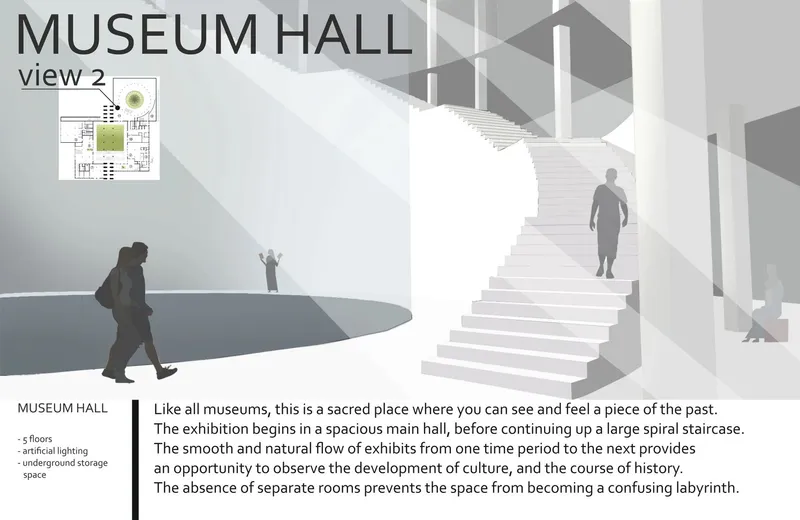
Inside, the building unfolds as a multi-level spatial narrative. Large halls accommodate both temporary and permanent exhibitions reflecting cultural heritage, archaeological treasures, artisan traditions, and the urban history of Aleppo. A curved staircase sweeps through the bright museum hall, and visitors move through dappled light that shifts throughout the day. The central oculus, visible across multiple floor plans, acts as both a practical light source and a symbolic device: natural light descending from the circular opening creates moving shadows and illuminated zones that mirror the interplay between loss and hope.
Zhukova treats light not as decoration but as material. The oculus is the building's vertical axis, pulling the eye upward and connecting every level to a single source of orientation. It transforms the interior into a kind of sundial, marking time in a space dedicated to preserving it.
Prayer Rooms That Frame the Skyline
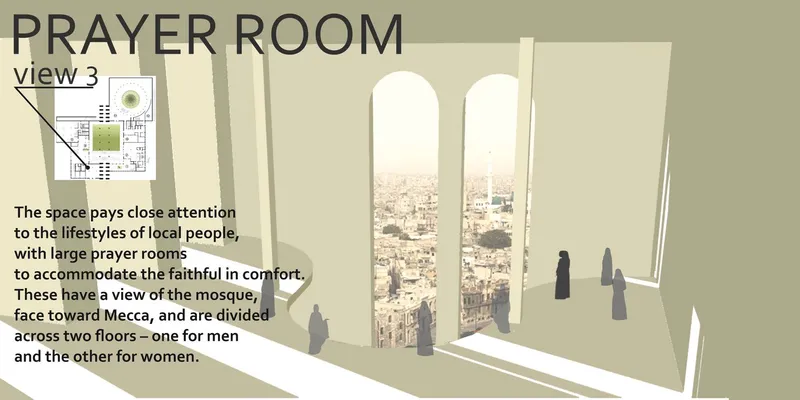
Spanning two floors, the prayer rooms demonstrate the project's commitment to community life beyond the museum program. Tall arched windows open onto sweeping views of Aleppo's skyline, connecting spiritual practice to the physical reality of the city below. The proportions are generous, the light is warm, and the framing is precise: each window operates as a carefully composed picture plane, making the act of looking outward an integral part of the room's function. Architecture here does not compete with devotion; it serves it.
The inclusion of prayer spaces within a memorial museum is a deliberate statement about what cultural preservation actually means. It is not only about artifacts behind glass. It is about sustaining the rituals, rhythms, and daily practices that gave those artifacts meaning in the first place. The prayer rooms anchor the building in the lived present, preventing it from becoming a mausoleum.
Why This Project Matters
Memorial architecture often falls into one of two traps: it either aestheticizes grief into abstract form or it recreates what was lost in sentimental replica. Zhukova's Memorial Center in Aleppo avoids both. By drawing directly from local materiality, traditional Syrian architectural language, and the circular geometries of cyclical history, the design roots itself in specificity. It belongs to Aleppo, not to a generic catalog of memorial typologies.
The project's most powerful proposition is that the city itself is the exhibit. Every curated view through a framed opening, every walkway that lifts visitors above the streetscape, reinforces the idea that preservation is not only about what you build but about how you direct attention toward what already exists. In a city where so much has been destroyed, that act of directed looking is, itself, a form of reconstruction.
View the Full Project
About the Designers
Designer: Maria Zhukova
Enter a Design Competition on uni.xyz
uni.xyz runs architecture and design competitions year-round that reward proposals with spatial conviction and real site intelligence.
Project credits: The Memorial Center in Aleppo by Maria Zhukova.



Popular Articles
Popular articles from the community


Riyadh For All: Intergenerational Urban Design for Active Aging in Rabat
Riyadh For All reimagines urban design in Rabat with intergenerational co-living, adaptive courtyards, and Moroccan cultural exchange today.

The Musturak Paradise: Senior Living Architecture for a Connected Future in Temara, Morocco
The Musturak Paradise reimagines senior living architecture in Temara via private homes, social spaces, culture, community, and shared care.

Play: Fragments of Their World
Familiar architecture becomes modular playground design, creating safe spaces where displaced children can learn, connect, imagine and play.

Co-life: Sustainable Architecture for Age-Friendly Community Living
Co-life reimagines sustainable architecture for seniors through courtyards, rammed earth, shared gardens, and spaces designed for belonging.


Similar Reads
You might also enjoy these articles

Lunar Spiral: Space Architecture Shaped by the Mathematics of the Universe
Lunar Spiral reimagines space architecture through Fibonacci geometry, lunar regolith, levitating habitats, and self-sustaining Moon living.
The Main Dream: Modular Architecture for Play, Learning, and Community
A modular playground turns recycled plastic into adaptable spaces where refugee children can play, build, learn, and reconnect.
Play: Fragments of Their World
Familiar architecture becomes modular playground design, creating safe spaces where displaced children can learn, connect, imagine and play.

Wadi Rum Observatory: Desert Architecture Designed for the Night Sky
Wadi Rum Observatory turns desert architecture into a quiet instrument for astronomy, hiding research spaces under Jordan's starlit terrain.


Comments (0)
Please login or sign up to add comments
No comments yet. Be the first to comment!