
Mendiola Arregui Embeds a Private Spa into the Mountains of Tapalpa
A 220-square-meter retreat in western Mexico turns the rituals of bathing into an architectural sequence of stone, timber, and silence.


Architecture built for retreat has a tendency to overperform. It announces serenity with excessive gestures, piling on materials and moods until the quietness it promises becomes noise. El Retiro Spa, a 220-square-meter private wellness pavilion by Mendiola Arregui in the mountain town of Tapalpa, Mexico, avoids that trap. Designed by Carlos Mendiola and Andrea Arregui, the project proceeds through compression and release, guiding a visitor from a deliberately narrow, darkened entrance into a series of rooms that open, one by one, toward the surrounding landscape.
What makes the project genuinely interesting is its treatment of sequence. Rather than offering a single spectacular panorama, the building controls exactly when and how much of the outside world you see. Corridors tighten, ceilings drop, light is rationed through slots and niches, and then a wall of glass swings open to reveal the full depth of the valley. The spa is less a building than a choreography of thresholds, each one calibrated to shift your physiological state before the next room does the same.
Entering Through Darkness
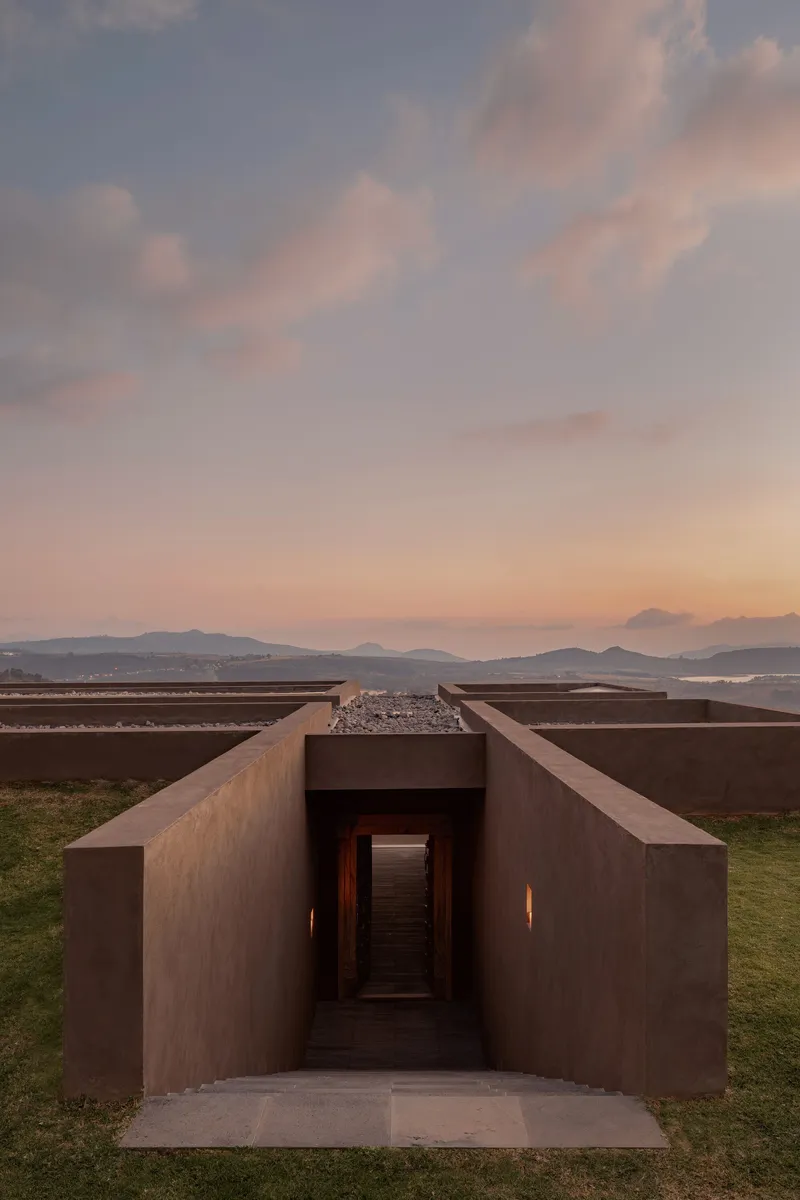

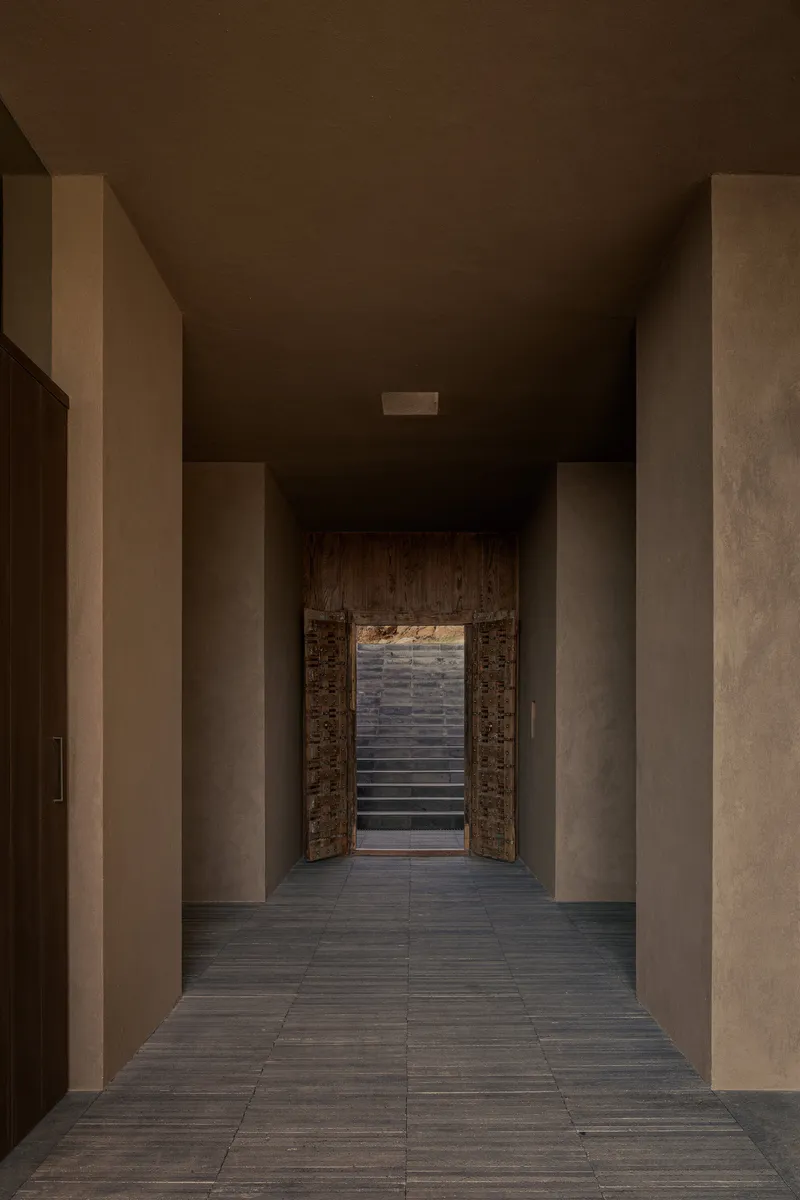
The arrival sequence is deliberately confrontational. A sunken portal framed in oxidized metal walls draws you downward, with flanking vertical slits casting thin blades of light at twilight. It reads more like the entrance to a subterranean chamber than a spa. The compression continues inside through layered thresholds: a corridor stacks frame behind frame, terminating at a stone sculpture bathed in the glow of a recessed ceiling slot.
These transitional passages are not hallways in the conventional sense. They are spaces of anticipation. Narrow timber-floored corridors end at carved doors or illuminated niches, each one asking you to pause before advancing. The effect is cumulative. By the time you reach the main living volume, your eyes have adjusted and your pace has slowed. The architecture has already done the work that most spas delegate to a playlist.
Timber Frame as Spatial Rhythm
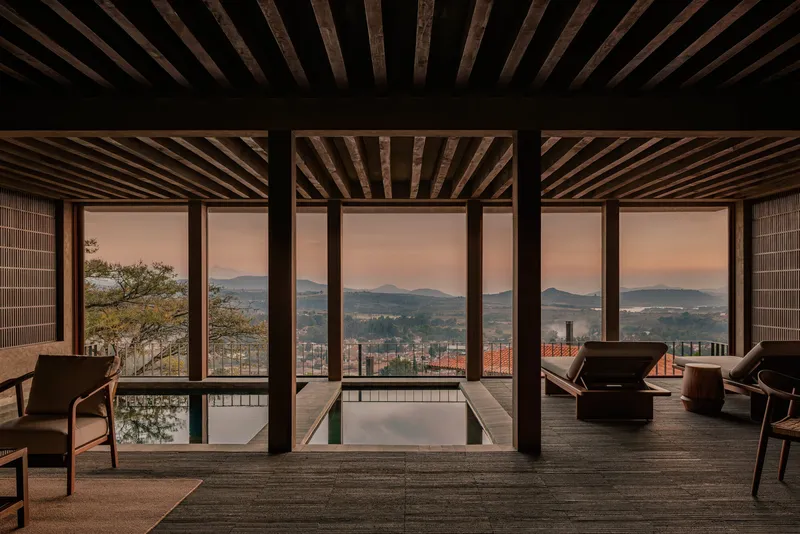

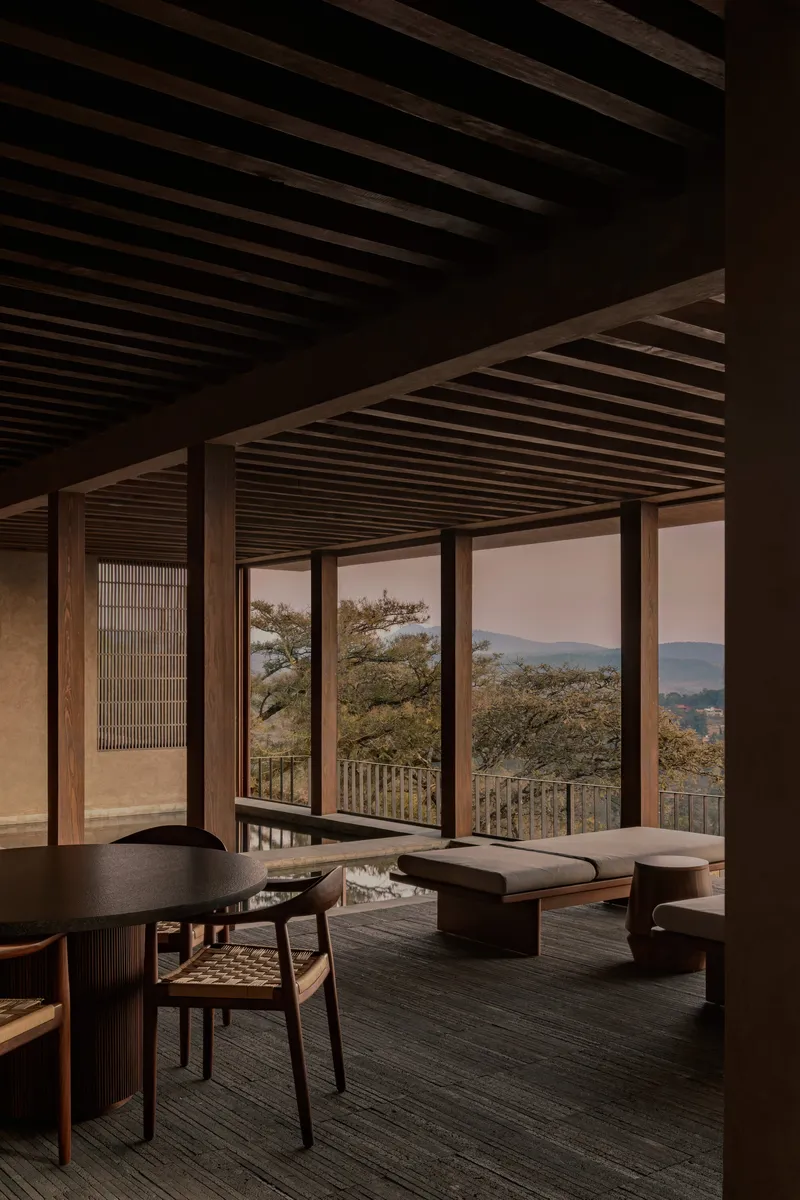
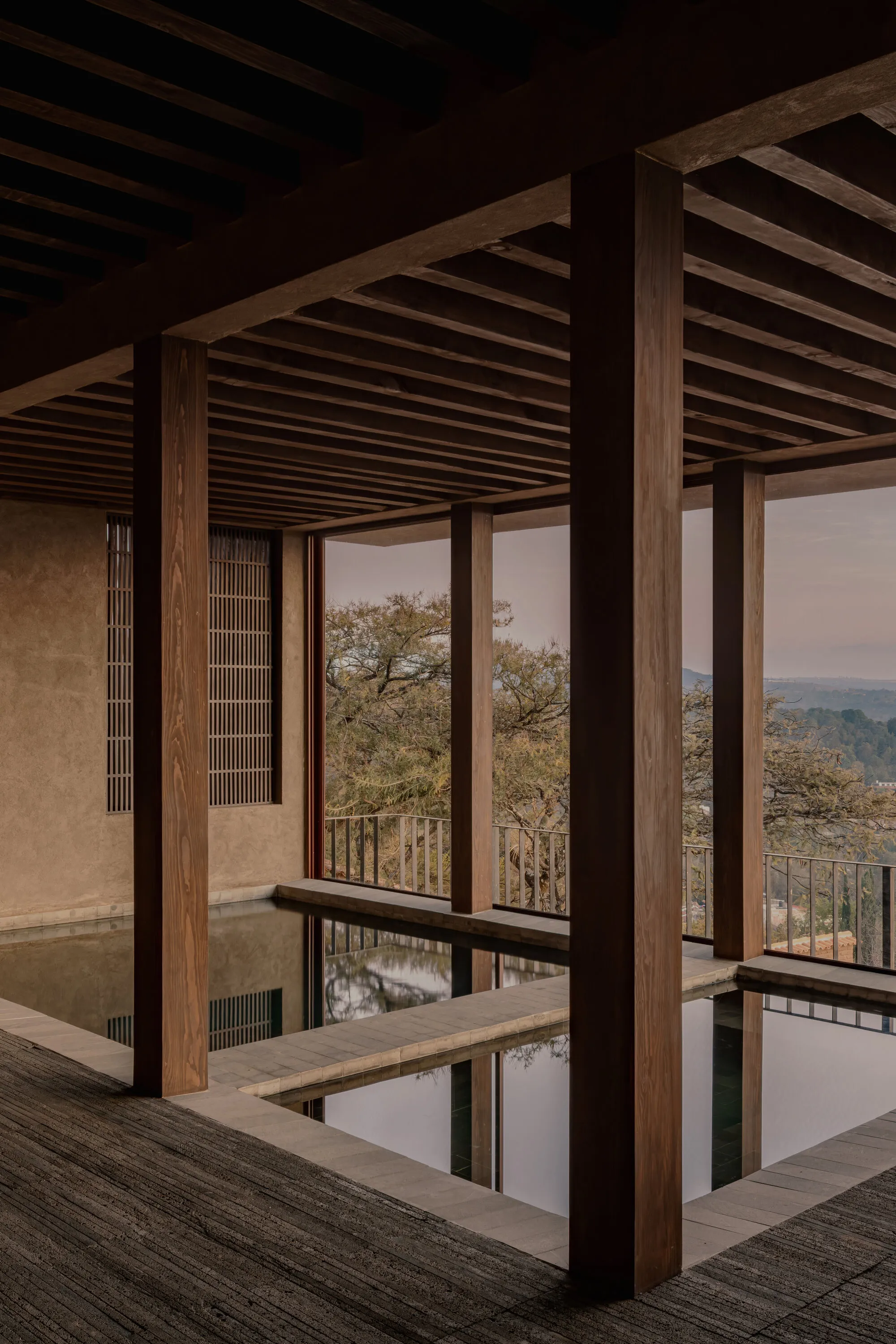
The primary living volume opens up with a timber post-and-beam structure that establishes a strong visual cadence. Exposed ceiling joists run in parallel, creating a rhythm overhead that echoes across multiple rooms. The structural grid is generous enough to define discrete zones for dining, sitting, and contemplation without requiring partition walls. Columns become furniture in their own right, anchoring each zone while remaining visually porous.
At dusk, the glazed walls dissolve the boundary between interior and mountain landscape. The timber ceiling reads as a kind of canopy suspended between you and the sky. Mendiola Arregui uses the repetition of the joists to pull your eye horizontally, reinforcing the panorama rather than competing with it. The material choice is warm but restrained; the wood is left in a relatively natural state, gaining texture from grain rather than finish.
Water and Reflection
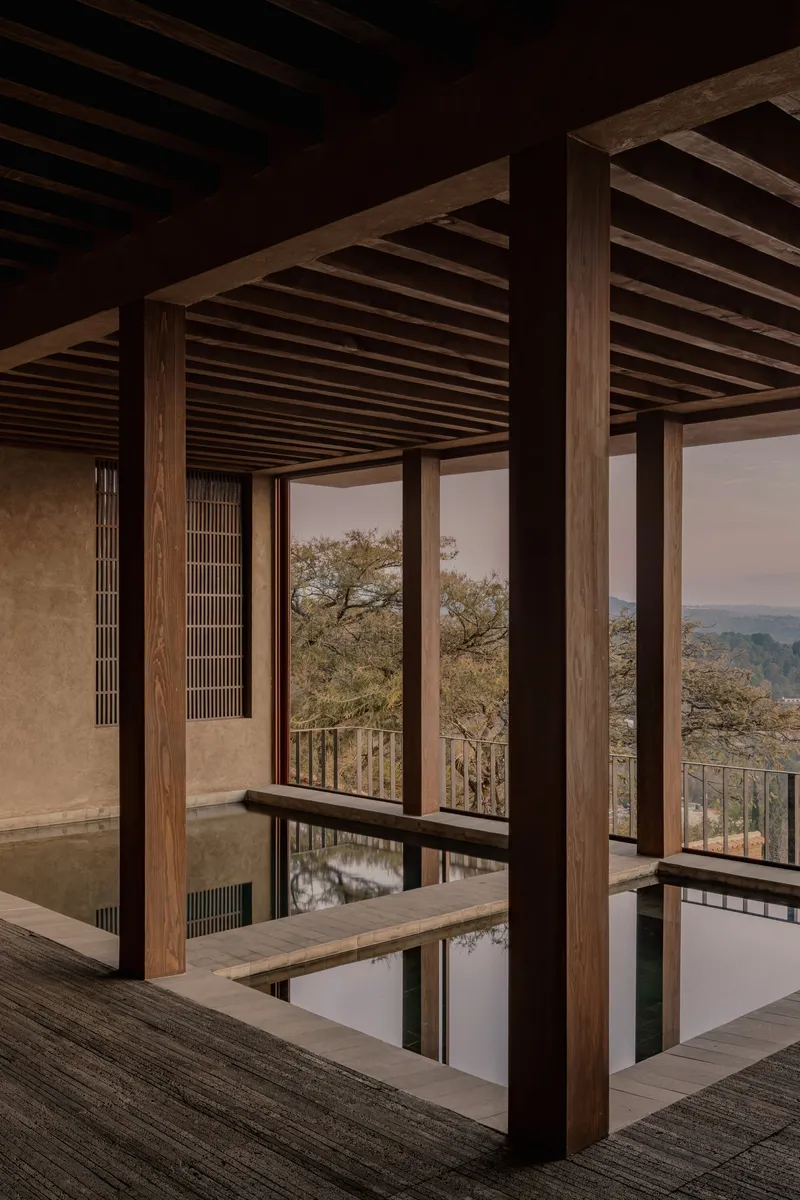

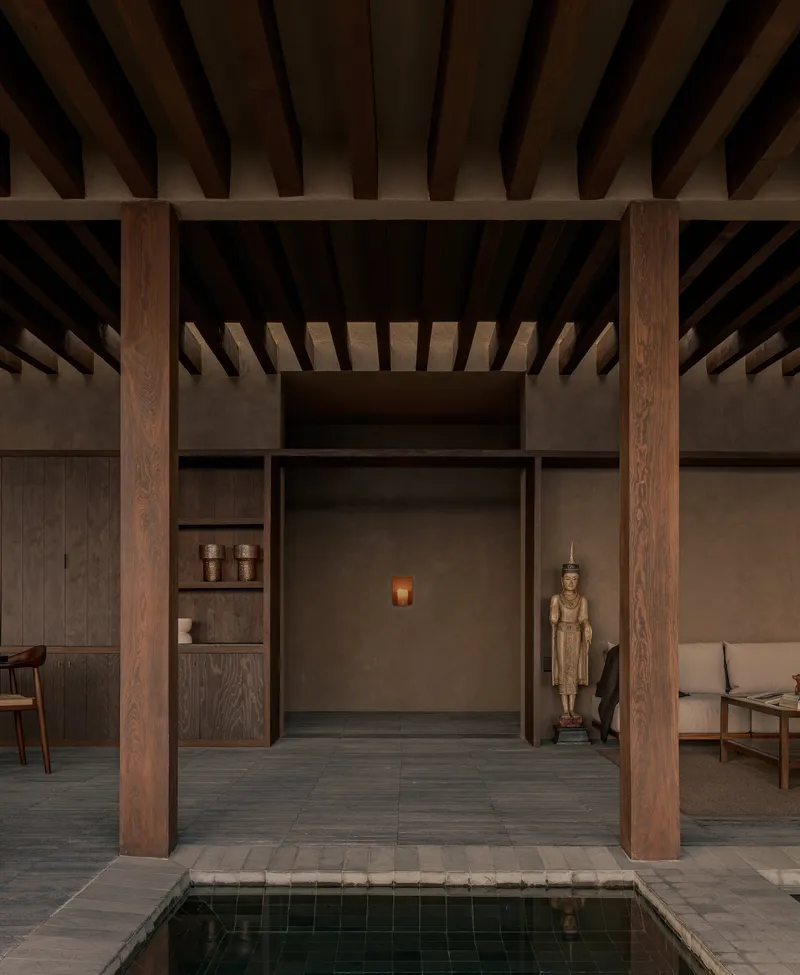
Water occupies the center of the plan, both literally and conceptually. A reflecting pool sits within the timber framework, its still surface doubling the structural columns and the landscape beyond the glass. The pool is not a swimming pool; its proportions and placement suggest ritual rather than exercise. You move around it, not through it.
Flanking the pool are alcoves with built-in shelving and sculptural objects. A carved figure stands at the water's edge in one niche, framed by timber columns as if displayed in a gallery. These moments of curated stillness are intentional: the architects treat the spa as a space for looking as much as for bathing. The artifacts and the architecture share the same quiet register, neither demanding attention but both rewarding it.
Interior Corridors and the Logic of the Niche
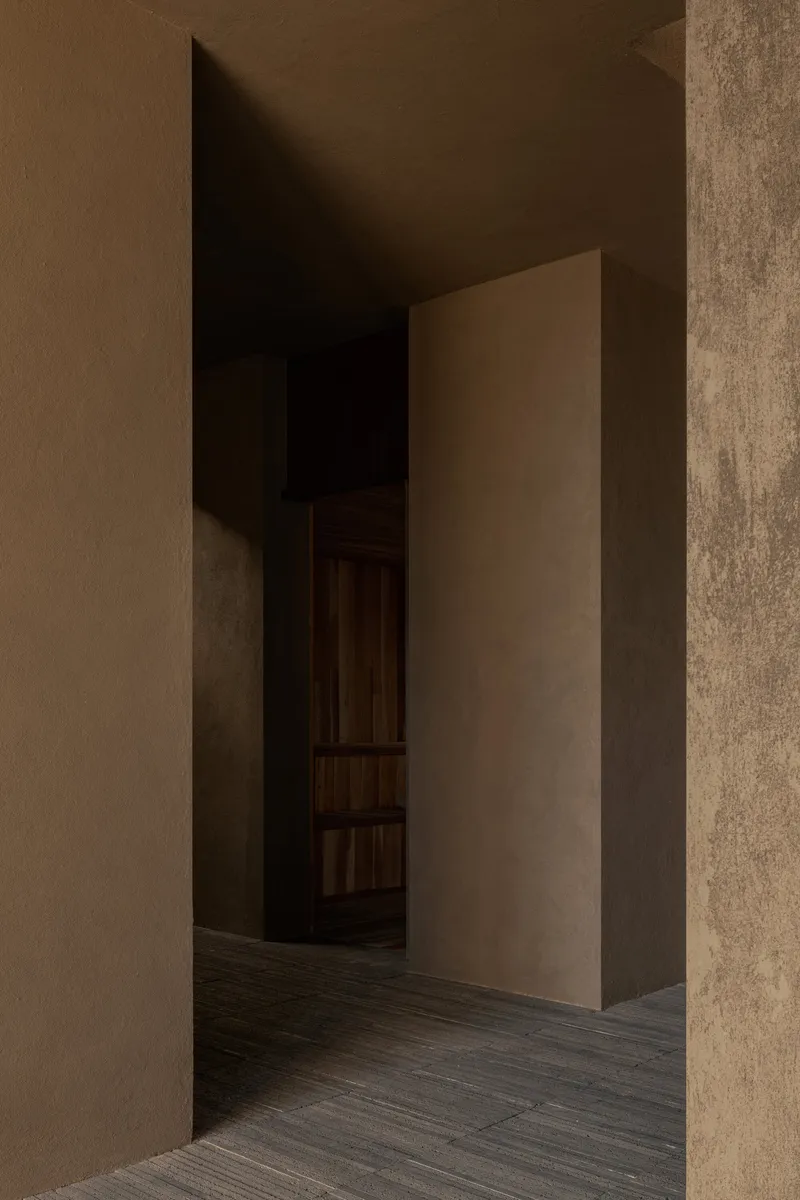
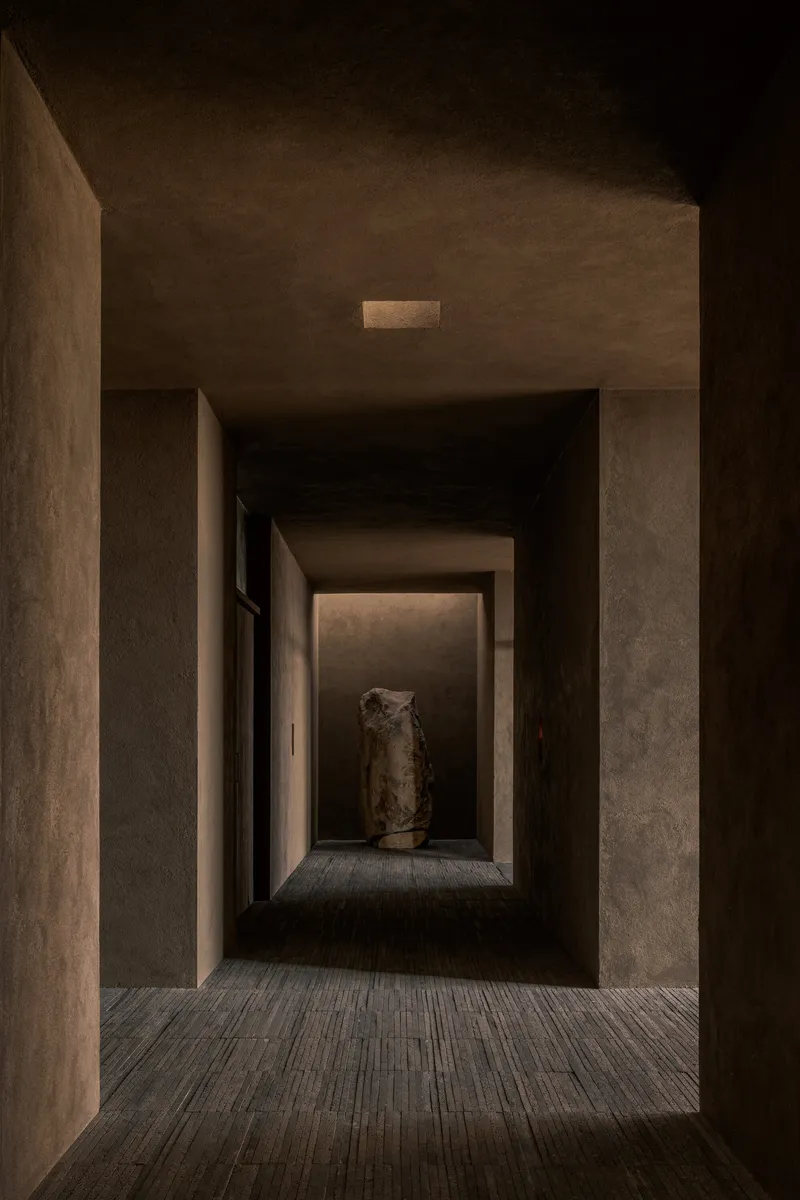
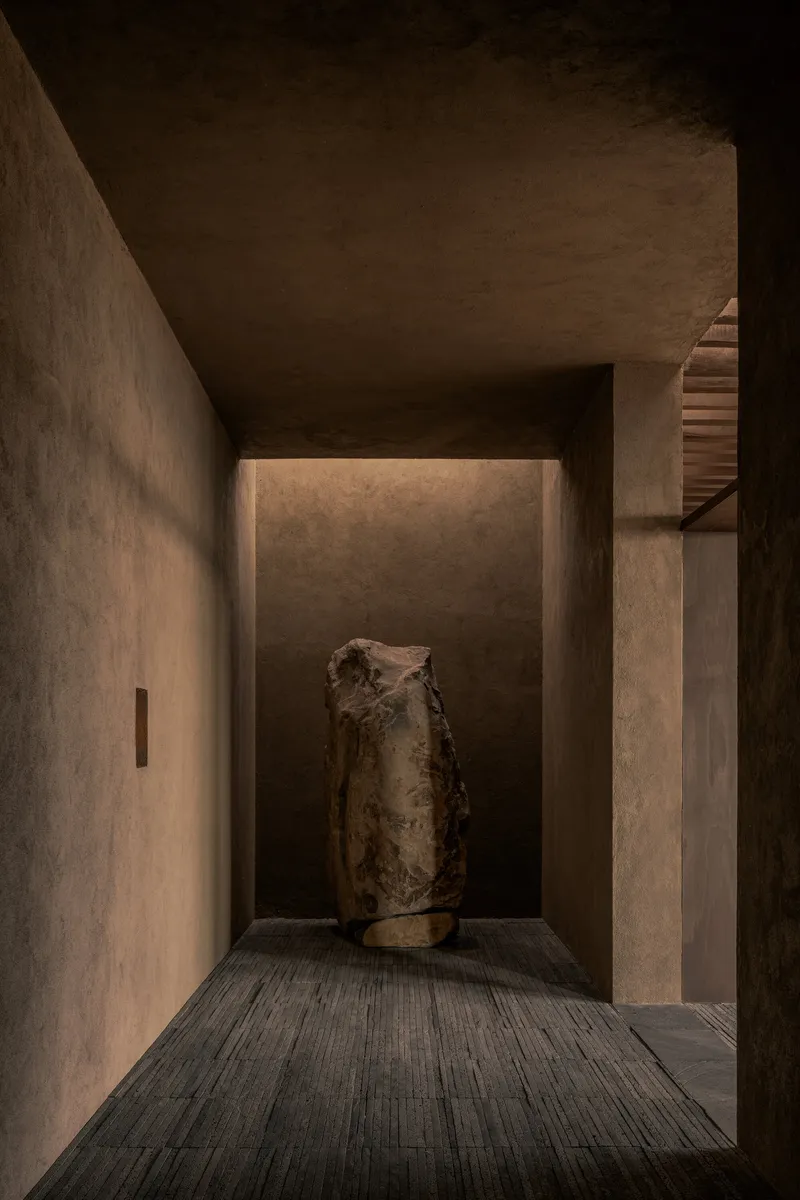
Throughout the building, narrow corridors punctuated by illuminated niches operate as connective tissue between the major rooms. Textured plaster walls close in around you, and a freestanding partition in warm ambient light creates a sense of mystery about what lies ahead. A ceramic vessel displayed at the end of one timber-decked passage is backlit like a relic, elevating an ordinary object to something contemplative.
The niche is the project's recurring motif. It appears at multiple scales: as a recessed alcove for a vessel, as a framed doorway revealing the next room, as a slot in the sauna wall that frames a sliver of landscape. Each one compresses your field of vision, forcing you to look at one thing with intention. In a world saturated with panoramic windows and open-plan grandeur, this deliberate restriction feels radical.
Bathing as Architecture
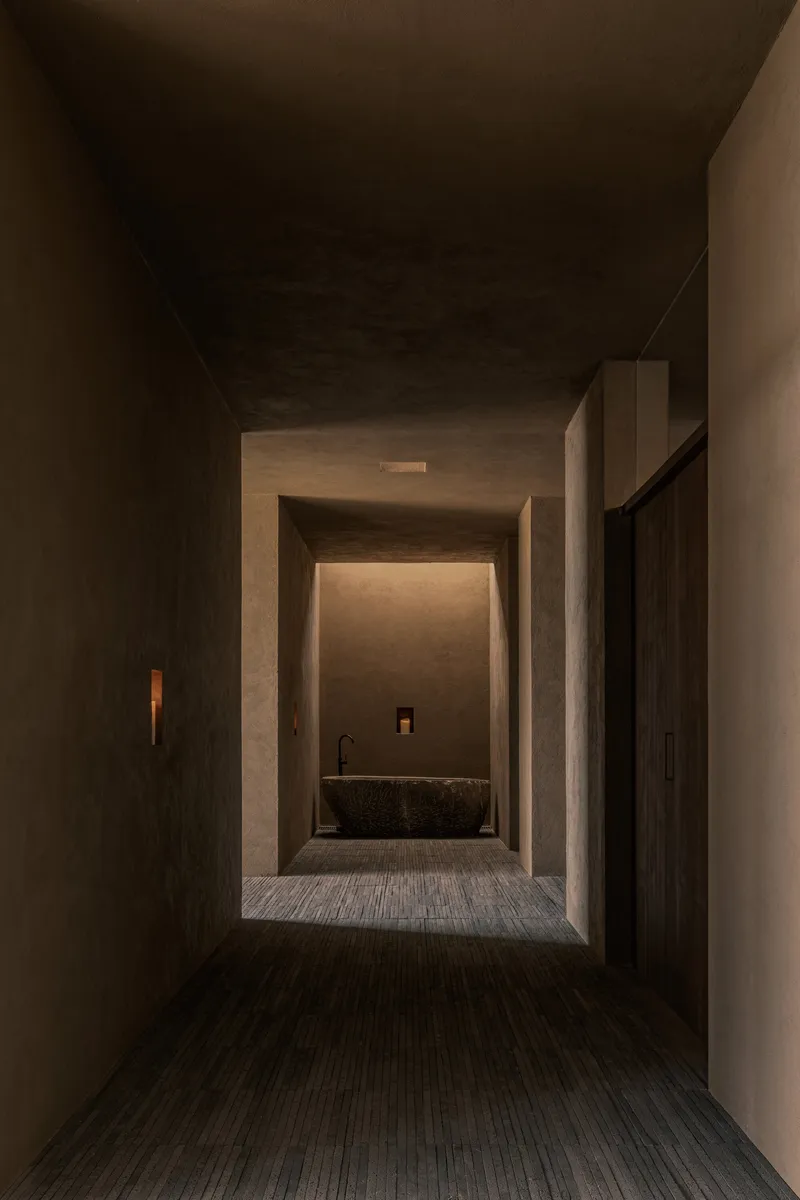
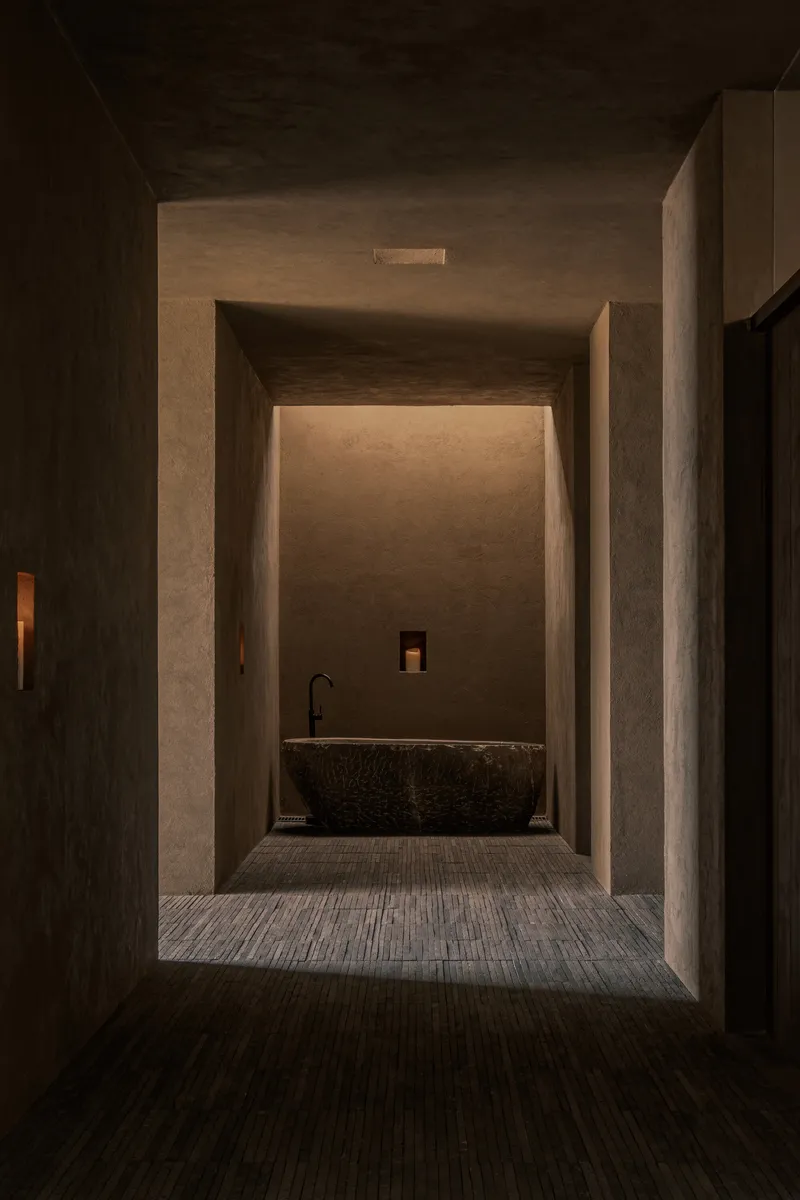

The bathing spaces demonstrate the project's commitment to atmospheric density. A sequence of framed concrete thresholds recedes toward a textured stone bathtub visible in the distance, its mass grounding the room. The tub is not placed for convenience; it is positioned as a destination, the final point in a carefully orchestrated procession. Above it, concealed ceiling lighting washes the stone basin from above, giving it the quality of an excavated artifact.
The sauna takes a different approach: timber-lined and warm, with a horizontal stone window panel that offers a controlled slit of exterior view. Tiered bench seating is simple and functional, the only space in the building where comfort is allowed to override composition. It is a necessary exhale after the precision of the corridors.
Living Spaces and the Courtyard Edge
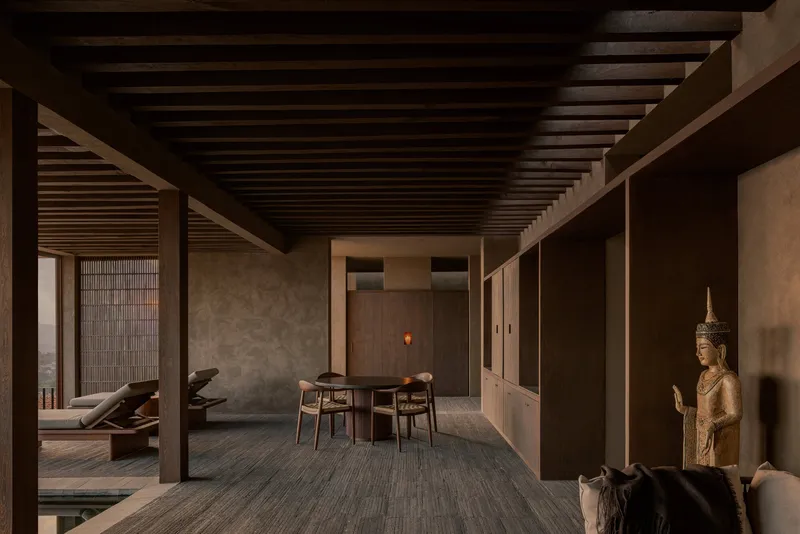

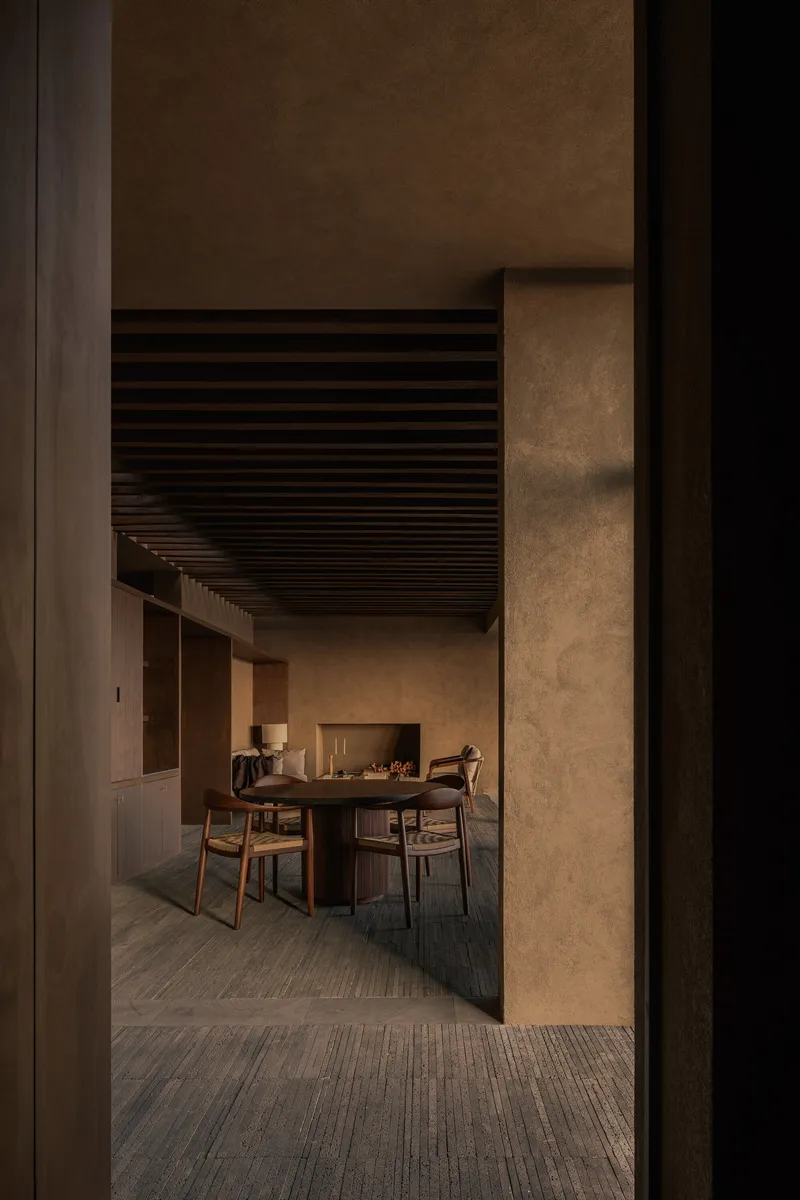
The open-plan living area connects to a courtyard pool through sliding glass doors, establishing the primary relationship between indoor and outdoor space. A Buddha sculpture sits beside the view, positioned as a threshold guardian between the domestic interior and the landscape. The sitting area includes an inset fireplace flanked by timber-framed openings that allow sight lines into adjacent rooms, ensuring that even at rest, you remain aware of the building's spatial depth.
A doorway view into the dining space reveals slatted ceilings and textured concrete walls, a material shift that signals a change in program. The architects maintain a consistent palette of timber, stone, concrete, and plaster but vary the proportions and textures room by room, so that each space has its own temperature without breaking from the whole.
Plans and Drawings

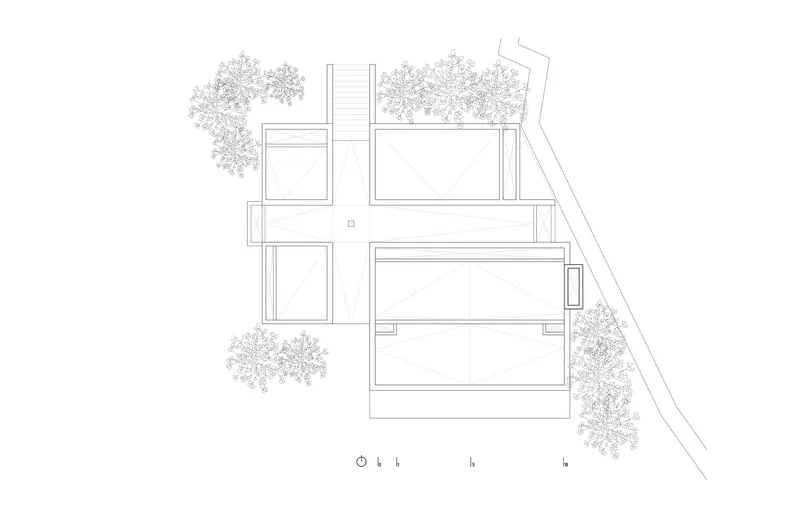
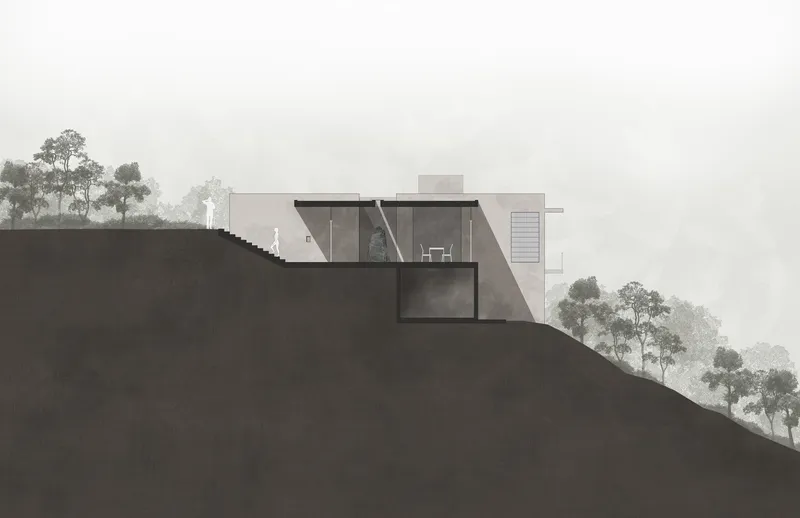
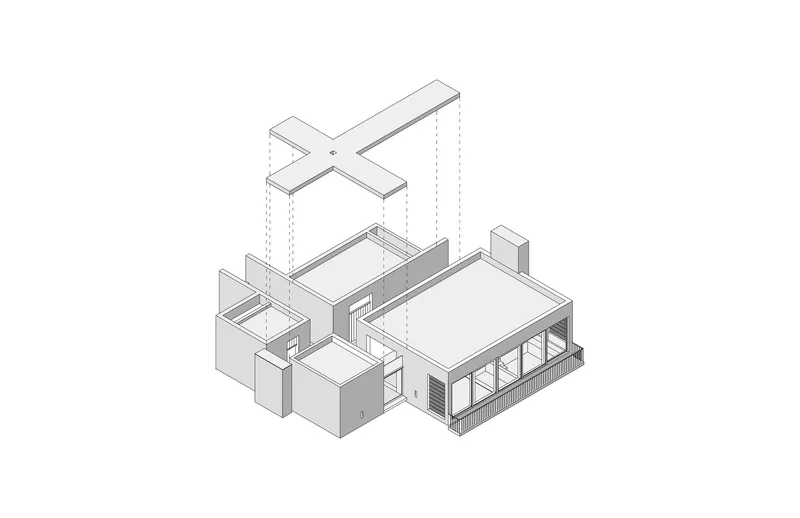
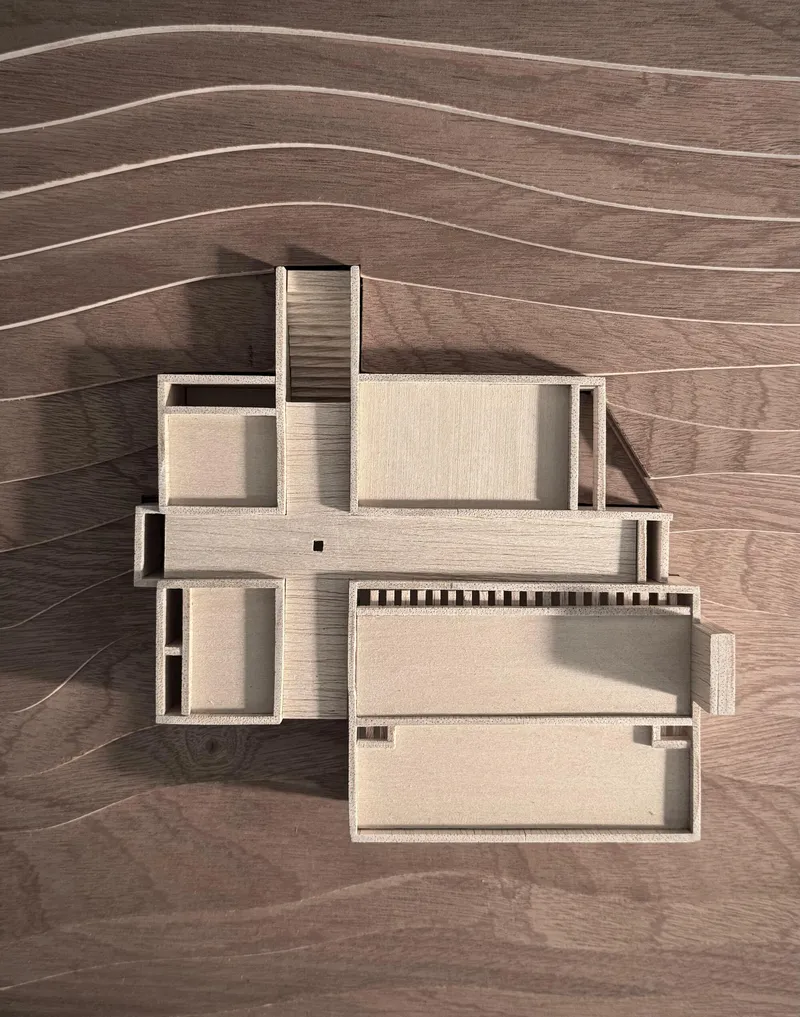
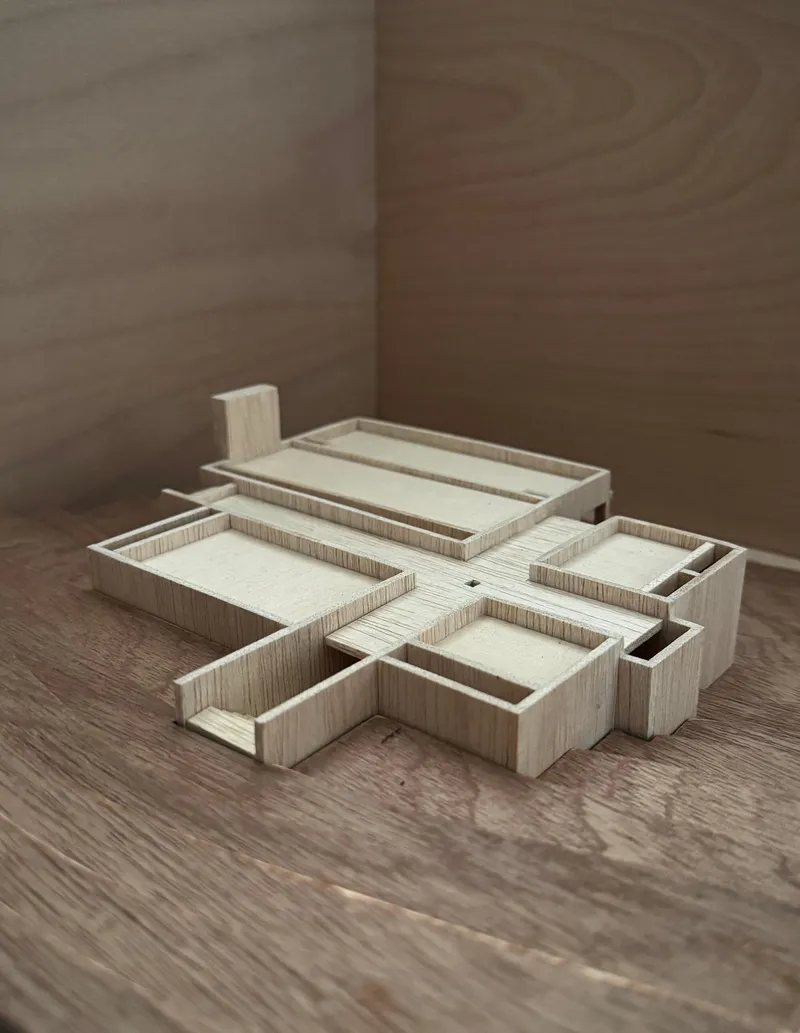
The floor plan reveals the organizational logic beneath the experiential choreography. An open living area wraps around a central staircase, with surrounding trees drawn into the composition as part of the plan rather than as backdrop. The section drawing is the most revealing: the structure is embedded into a sloped hillside, exploiting the topography to create the compressed entrance sequence at one level and the panoramic living spaces at another. The building does not sit on the landscape so much as it is threaded through it.
The axonometric drawing shows interlocking volumes capped by a cross-shaped rooftop element, clarifying the massing strategy as a set of discrete boxes that slide against one another. Two physical study models in light wood confirm that the project's formal logic was worked out in three dimensions from the start. The terraced volumes visible in the model correspond directly to the hillside section, suggesting that the topographic embedding was not an afterthought but the generative idea.
Why This Project Matters
El Retiro Spa belongs to a lineage of projects that treat wellness architecture not as luxury packaging but as spatial practice. The closest references are Japanese bathhouses and Mexican monastic traditions, both of which understand that moving through darkness before arriving at light is itself a therapeutic act. Mendiola Arregui has built a project that takes this idea seriously, calibrating every corridor width, ceiling height, and aperture size to orchestrate a bodily experience that architecture can deliver and interior design alone cannot.
At 220 square meters, the building is modest in footprint but dense in intention. Every surface, every threshold, and every niche participates in the sequence. In an era when spa architecture too often defaults to maximalist minimalism, all white surfaces and floor-to-ceiling glass, this project argues for something harder to achieve: atmosphere calibrated to the scale of the body, embedded in a specific hillside, and built to slow you down.
El Retiro Spa by Mendiola Arregui (Carlos Mendiola, Andrea Arregui). Tapalpa, Mexico. 220 m². Completed 2025. Photography by César Béjar.
About the Studio
Share Your Own Work on uni.xyz
If projects like this are the kind of work you want to make, uni.xyz is a place to publish your own, find collaborators, and enter design competitions.




Popular Articles
Popular articles from the community


The Musturak Paradise: Senior Living Architecture for a Connected Future in Temara, Morocco
The Musturak Paradise reimagines senior living architecture in Temara via private homes, social spaces, culture, community, and shared care.

Co-Life: Senior Housing Design That Reconnects Older Adults With the City
Co-Life reimagines senior housing design through healing gardens, shared streets, workshops, and a sustainable community across generations.

Co-life: Sustainable Architecture for Age-Friendly Community Living
Co-life reimagines sustainable architecture for seniors through courtyards, rammed earth, shared gardens, and spaces designed for belonging.

Riyadh For All: Intergenerational Urban Design for Active Aging in Rabat
Riyadh For All reimagines urban design in Rabat with intergenerational co-living, adaptive courtyards, and Moroccan cultural exchange today.

Similar Reads
You might also enjoy these articles

Bao Huynh Watercolor Atelier: A Serene Art Retreat in Hội An
Bao Huynh Watercolor Atelier in Hội An blends multifunctional art spaces, sustainable design, local materials, and family-friendly living in a serene environment.

Atelier Macri Concept Store Interior Design by CASE-REAL
Atelier Macri store features a "ko" counter, walnut wood details, cork displays, blending retail, gallery, and seamless customer experiences.

Manuel Vargas Izquierdo Stadium and High-Performance Sports Center: Architectural Excellence in Jalpa de Méndez
The Manuel Vargas Izquierdo Stadium blends sustainable design, inclusive sports facilities, and cultural-inspired architecture, revitalizing Jalpa de Méndez’s public spaces.

KAKR Buluh Awar Hall: Revitalizing Community and Ecology Through Bamboo Architecture
Community built bamboo hall revitalizes Buluh Awar village, empowering youth, restoring ecology, celebrating vernacular craftsmanship through sustainable architecture and culture.


Explore Residential Building Competitions
Discover active competitions in this discipline



Challenge to design a portable theatre


Challenge to design a portable music platform


Challenge to design an open learning module for the elderly


Challenge to design mud housing for contemporary communities
Comments (0)
Please login or sign up to add comments
No comments yet. Be the first to comment!