
Mentrestant Arquitectura Cooperativa Turns a Valencian Country House into a Home That Reads Its Own History
In La Pobla de Vallbona's medieval quarter, a former convent building becomes a domestic space that separates old from new with surgical clarity.


There is a particular kind of restraint required when the building you are renovating may once have been part of a convent. The walls carry weight that is both structural and cultural. In La Pobla de Vallbona, a small municipality in Valencia's Camp del Turía region, Mentrestant Arquitectura Cooperativa took on just this problem: a 20th century Valencian country house, embedded in a medieval urban fabric, whose masonry shell demanded respect but whose interior life had become obsolete. The cooperative, led by Irene Civera Balaguer, Jorge Navarro Carpio, and José Sanbartolomé Guanter, chose to make the renovation legible. Rather than blending old into new, they drew a clear material line between the two.
What makes Paqui's House worth studying is not the gesture of preservation itself, which is common enough, but the precision with which preservation and insertion are kept distinct. The original masonry walls, treated with waterproof lime mortar, announce themselves as old through their texture and irregularity. The new elements, a suspended metal staircase, timber beams and joists, teal-painted steel frames, announce themselves as deliberate additions. Nothing tries to be something it is not. The result is a house that functions as a comfortable three-bedroom home on the upper floor and an open social ground floor, while remaining honest about the centuries of use encoded in its walls.
A Threshold Between Town and Home


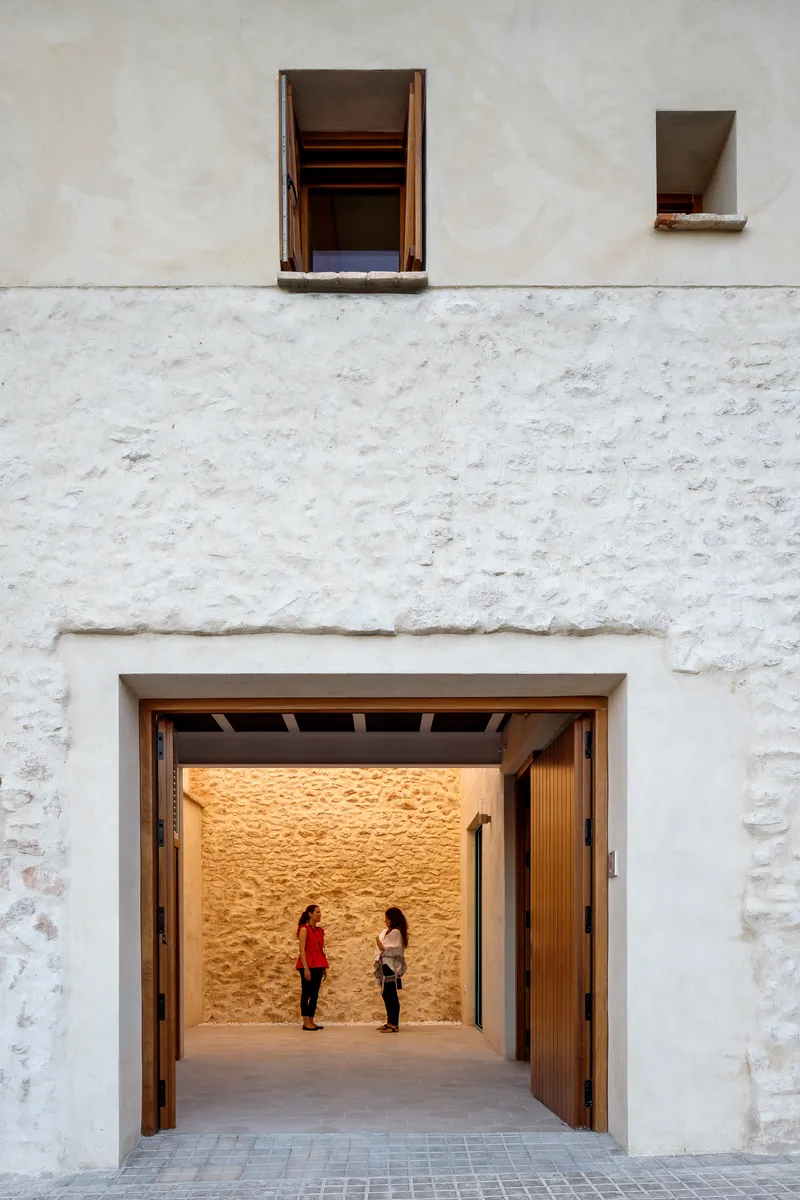
The courtyard is the project's quiet protagonist. In the original Valencian country house typology, this kind of transitional space mediated between the public street and the private interior, a decompression zone between agricultural labor and domestic life. Mentrestant retains this logic, threading visitors through a large timber gate, past exposed stone walls, and under a slatted timber ceiling that filters afternoon light into warm bars. It is not a garden or a room; it is a sequence, and it calibrates the shift from the dense medieval street outside to the calm interior ahead.
The slatted ceiling overhead is a deliberate modern insertion, lightweight and permeable, placed against the heavy stone courtyard wall without pretending to match it. The herringbone paving on the ground adds another layer of texture, one more material decision that registers as considered rather than decorative.
The Facade as Document


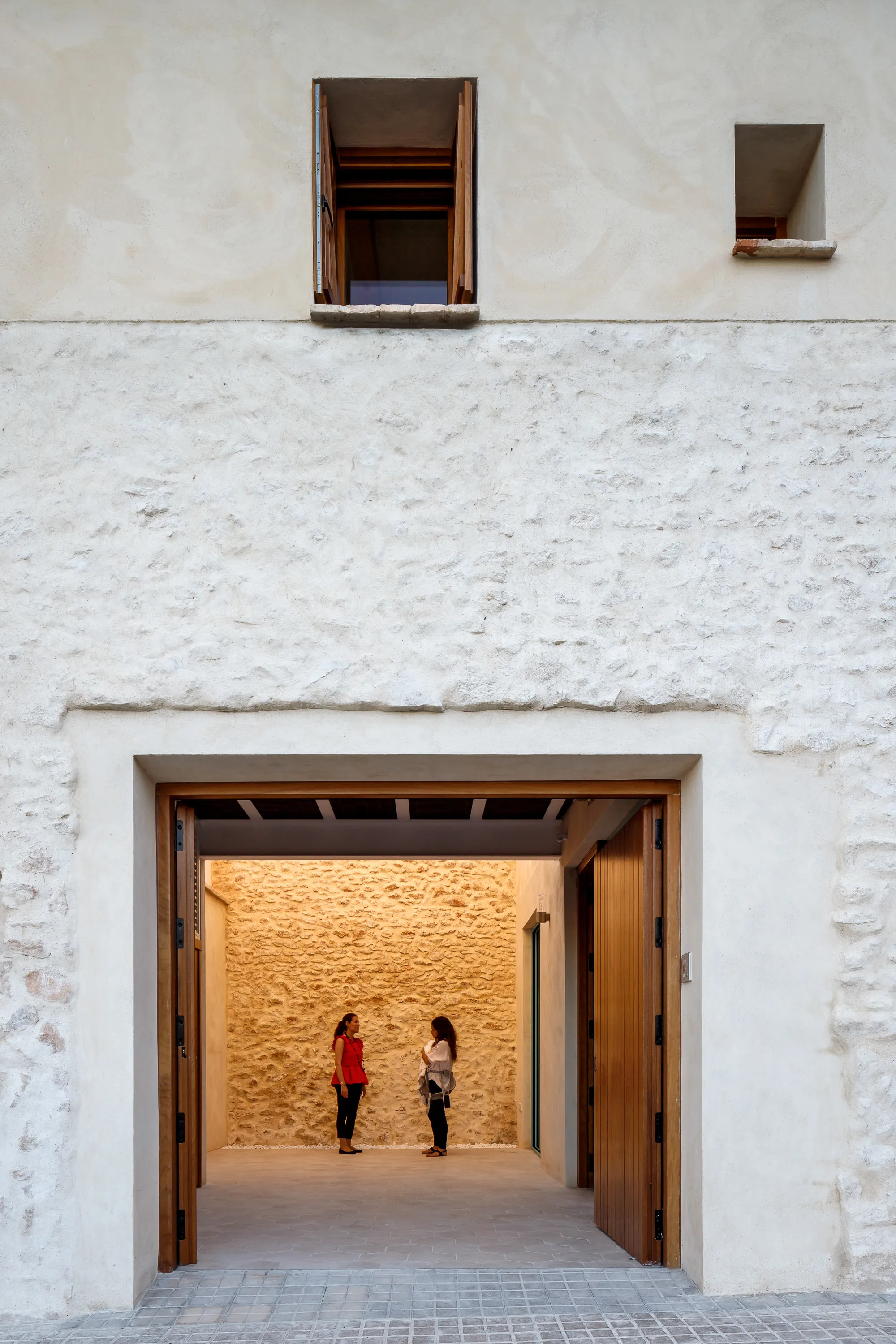
From the street, the house tells you its story in two registers. The lower portion exposes its original stone, rough and mineral, punctuated by a terracotta brick grate that ventilates the interior while referencing local masonry traditions. Above, a smooth white render covers the upper story, capped by a terracotta tile roof. The division is not decorative. It maps directly onto the building's structural reality: old load-bearing masonry below, rehabilitated living space above.
By choosing waterproof lime mortar rather than a more aggressive surface treatment, the architects allowed the stone to retain its character. The uniformity of the new facing on the upper story works precisely because the lower wall is so visibly different. Neither material needs a label. The juxtaposition does the talking.
Ground Floor: Living in the Thickness of Walls

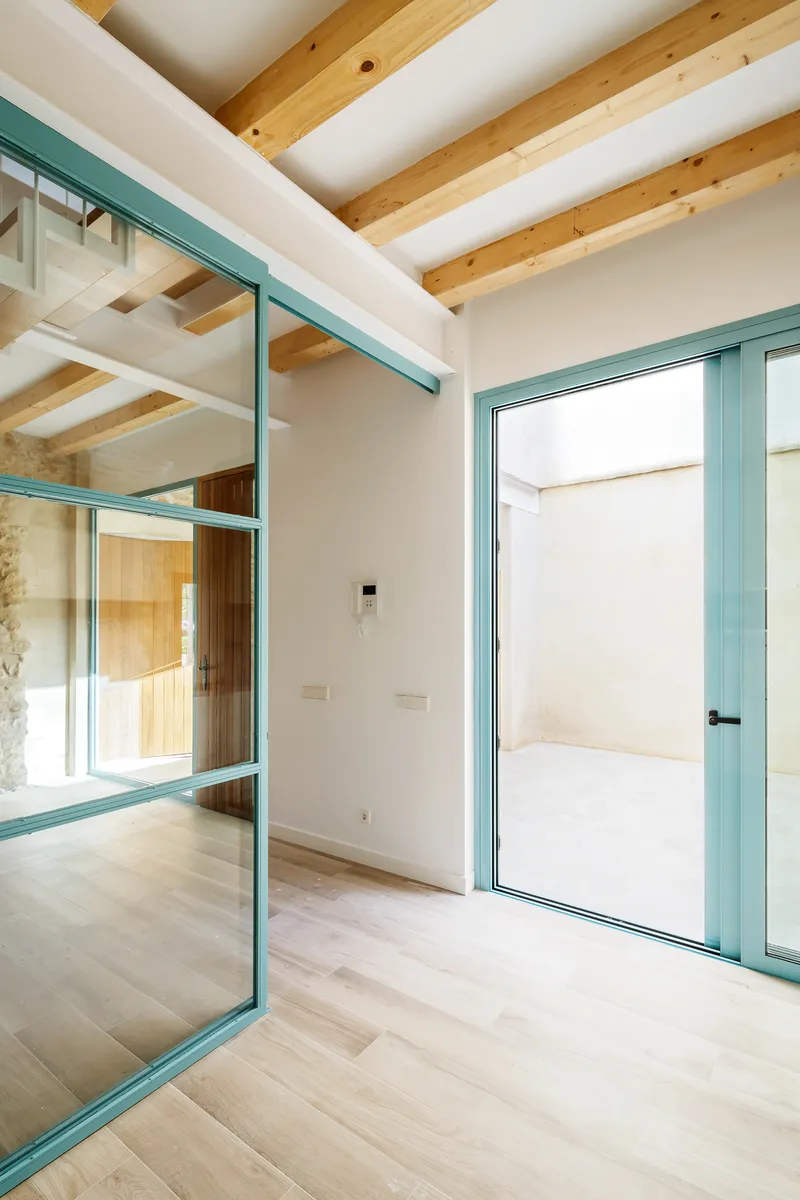
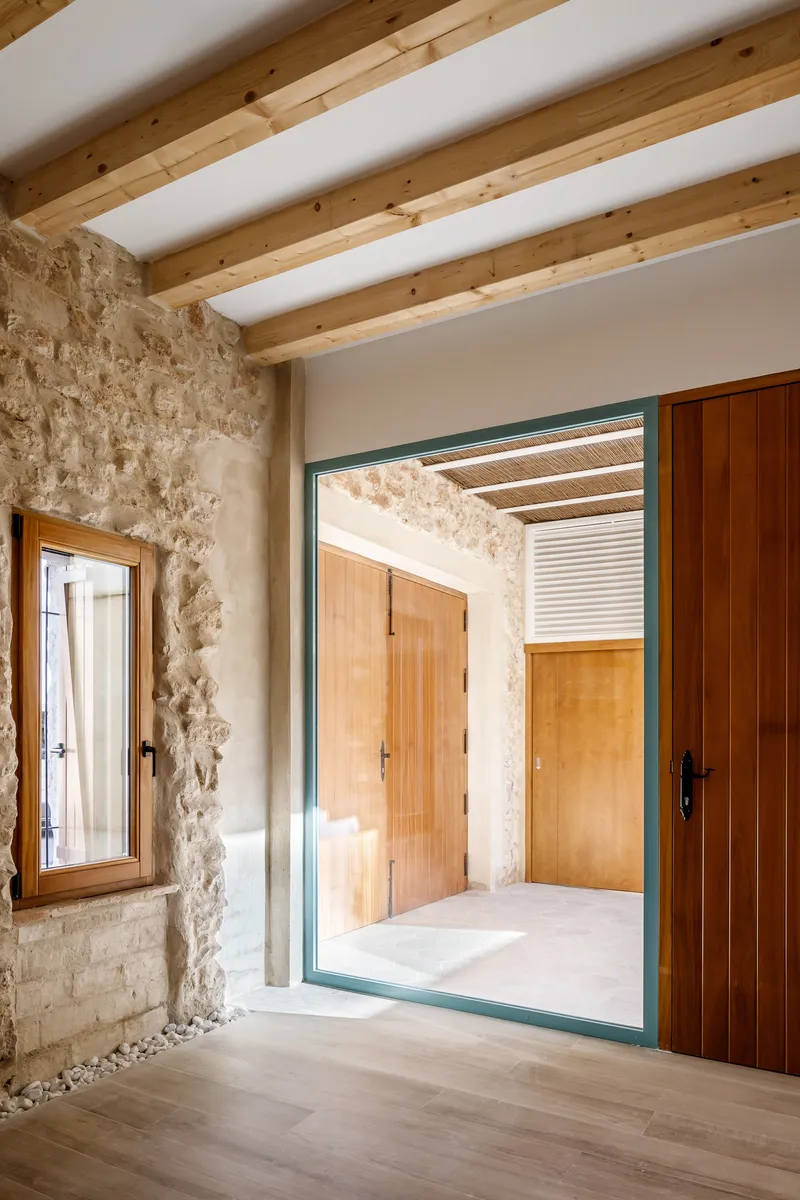
The ground floor houses the high-activity program: a living-dining room and a combined kitchen-laundry space. The original typology placed utilitarian rooms here, with the attic above reserved for storing the harvest. Mentrestant preserves the spatial proportions of this arrangement while completely reimagining the function. The kitchen, with its white cabinetry and concrete countertop, sits beneath exposed timber beams and against a stone wall that has clearly been standing since before the countertop's material was invented. The effect is neither rustic nor sleek; it is simply honest.
Throughout the ground floor, teal-framed glazing marks every new opening. It is a simple color code, almost didactic, that tells you exactly where the architects intervened. Combined with light timber flooring underfoot and the warm gray of the masonry, the palette is restricted but rich enough to feel alive.
A Staircase That Refuses to Touch the Walls

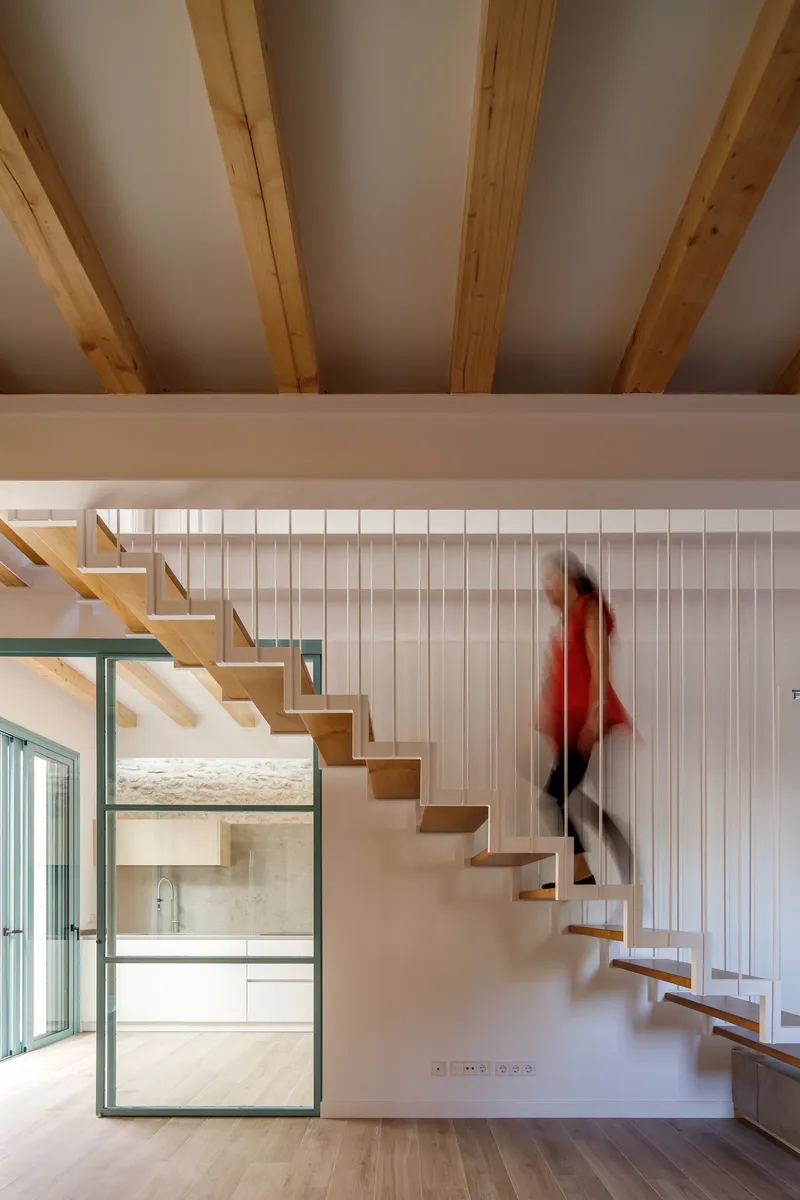

In a house dominated by thick masonry, the staircase needed to provide a counterpoint. Mentrestant's solution is a suspended metal and timber stair that floats within the plan, touching as little as possible. Open risers let light pass through. A green steel frame holds the treads in place while standing in frank contrast to the limestone wall beside it. The stair is simultaneously the lightest element in the house and one of the most engineered, a piece of furniture at architectural scale.
Watching someone ascend it, captured as a motion blur in one of the photographs, you get a sense of the proportional tension at work. The walls are thick, ancient, grounded. The staircase is thin, modern, airborne. The two share the same vertical shaft without competing. It is one of the cleanest demonstrations of old-new contrast in the entire project.
Upper Floor: Privacy Under the Pitch


The upper floor contains three bedrooms of different sizes, organized for privacy and intimacy. Where the original attic once stored grain beneath sloping ceilings, residents now sleep. The exposed timber beams running across white ceilings maintain the agricultural memory of the space without romanticizing it. A hallway landing with a white metal balustrade overlooks the stairwell below, connecting the upper floor visually to the ground level and preventing the narrow plan from feeling claustrophobic.
The bathroom is a standout detail. An exposed brick vault ceiling arches above a timber-framed horizontal window that looks out onto the courtyard. The vault is likely original or at least references the building's historic fabric, and placing it in the most utilitarian room in the house is a knowing move. It reminds you that even the smallest spaces here carry architectural weight.
Material Honesty as a Design Method

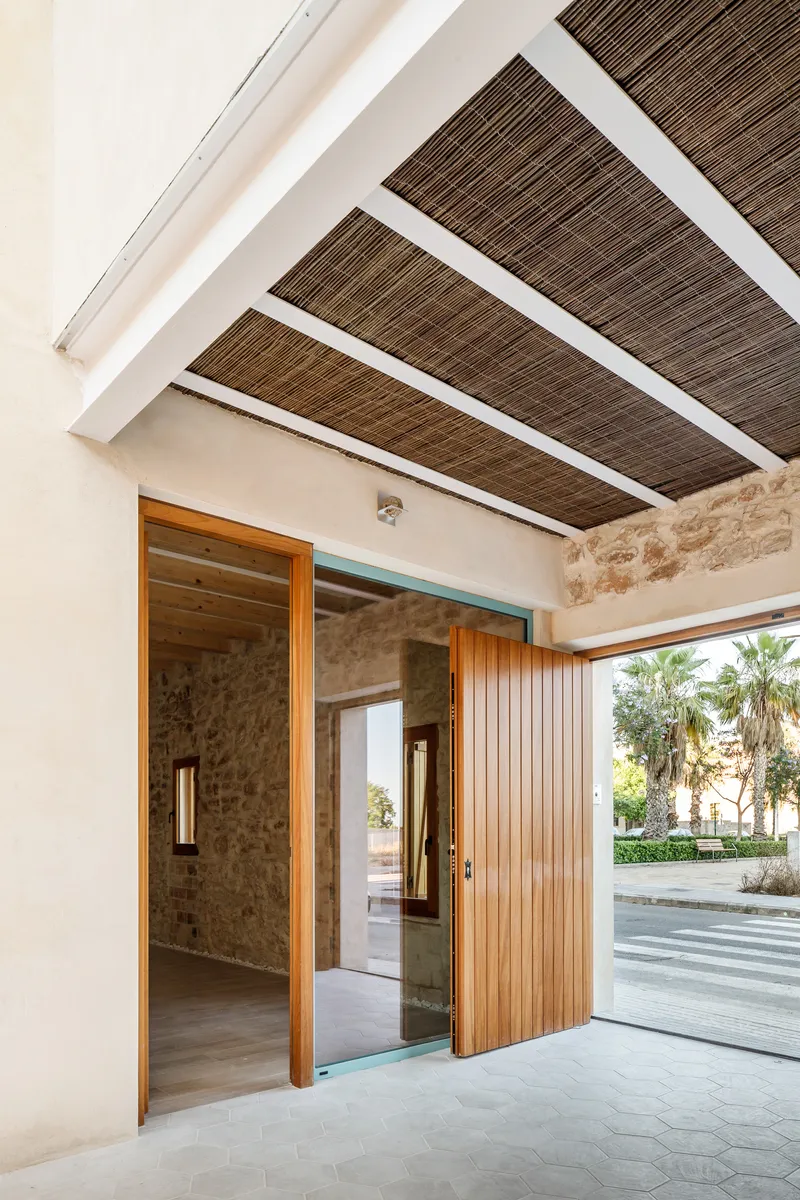

The most consistent idea running through Paqui's House is that every material should declare its era. Stone walls are stone walls. Timber beams are timber beams. Steel frames are painted a color no historic structure in the medieval quarter would recognize. This is not a new strategy, but it is executed here with unusual discipline. There is no moment where the architects try to fake patina or age a surface. The covered entry porch, with its slatted timber ceiling panels and vertical wood cladding, reads as clearly contemporary even though it sits against stone walls that are centuries older.
This legibility extends to the functional choices too. Ribbed metal floor slabs and new wooden beams create the upper floor, a construction technique that is efficient and modern, resting on masonry walls that were built with entirely different structural assumptions. The house does not just coexist with its history; it annotates it.
Plans and Drawings
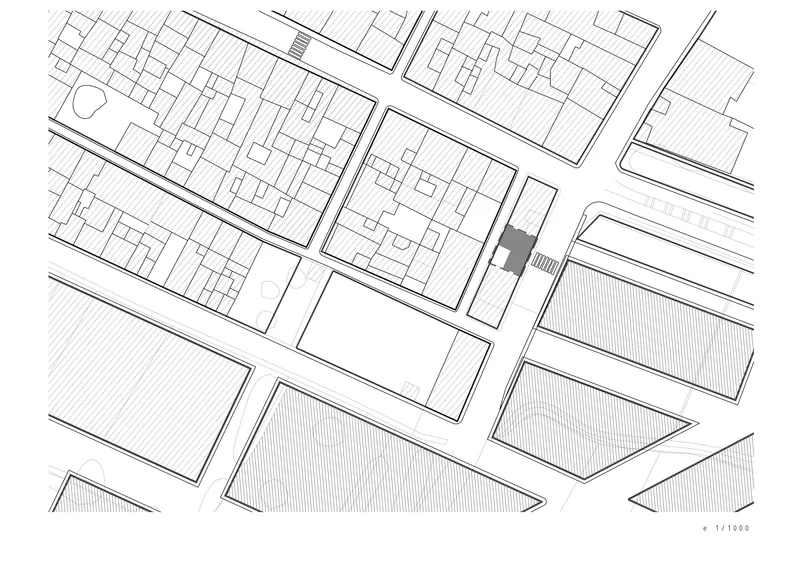


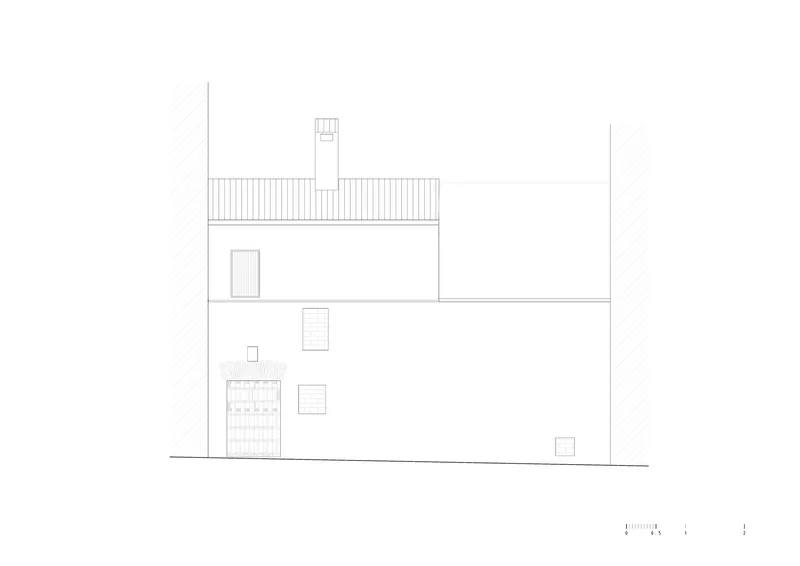

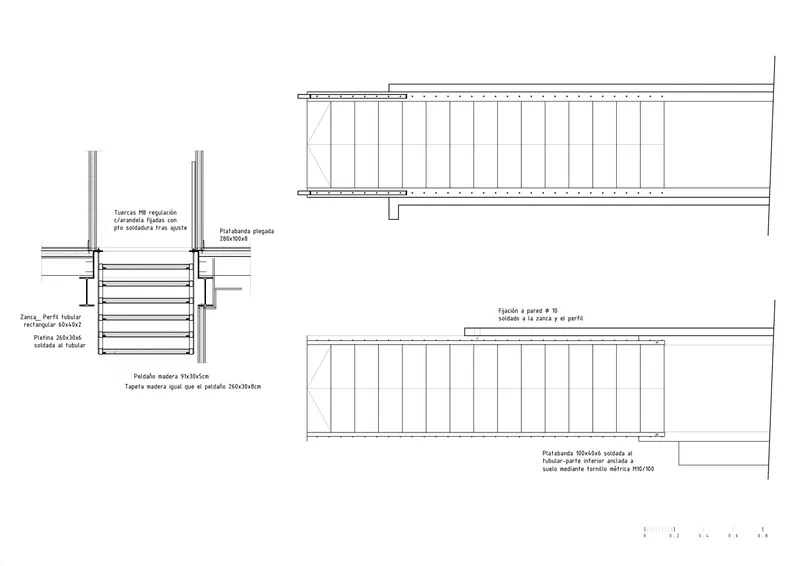
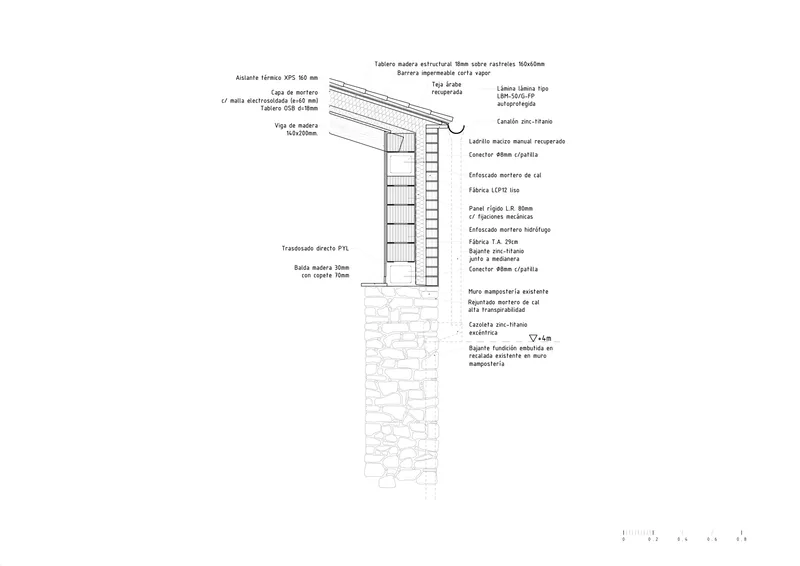
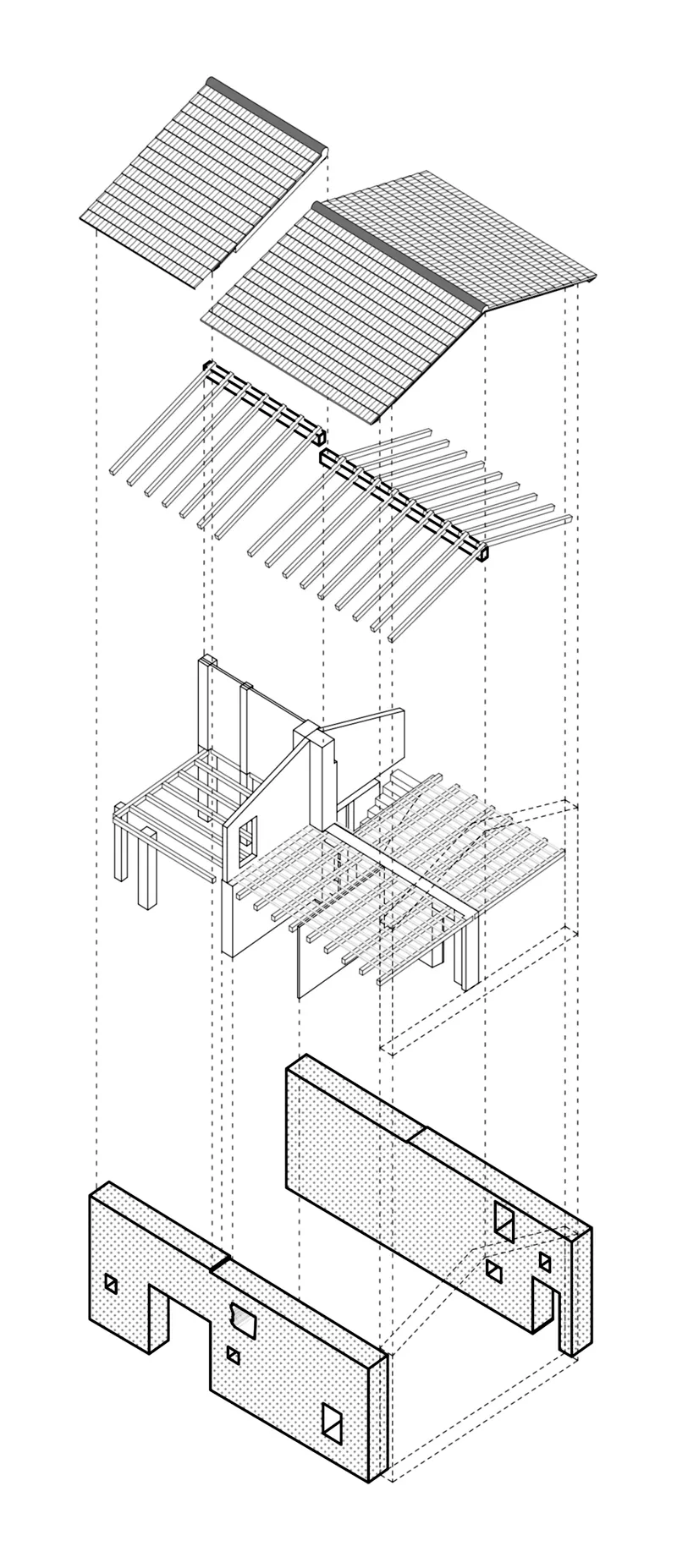
The drawings confirm what the photographs suggest. The site plan shows the building tightly woven into its urban block, sharing party walls on multiple sides. The ground floor plan reveals the courtyard's role as a spatial hinge, connecting the street entrance to the main living areas. Upstairs, the plan is compact: two bedrooms, a bathroom, and a terrace, arranged around the central staircase. The sections are particularly instructive, showing how the pitched roof and stone base create a section that reads like a geological diagram, with newer material strata layered above older ones.
The construction details are generous in their specificity. The staircase detail reveals the folded steel treads, their fixings, and the railing assembly. Wall section drawings expose the timber framing, insulation layers, and stone veneer base that constitute the envelope strategy. The exploded axonometric is the clearest summary of the project's logic: foundation, floor deck, timber frame, and roof, each drawn as a separate layer, each belonging to a different moment in the building's life.
Why This Project Matters
Paqui's House is not a trophy renovation. It does not arrive with a dramatic gesture or a headline-grabbing addition. Its value lies in the rigor of its restraint and in its refusal to treat old buildings as blank canvases. In a region where traditional Valencian country houses are either demolished for new development or preserved as museums, Mentrestant Arquitectura Cooperativa demonstrates a third option: adaptive reuse that is genuinely domestic, genuinely contemporary, and genuinely respectful of the structure it inhabits.
For architects working in historic European towns, the project offers a useful model. Keep the load-bearing shell. Insert new program with new materials. Make the difference visible. It sounds simple, but the discipline required to execute it without either sentimentality or arrogance is considerable. Mentrestant achieves both, and the house is better for it.
Paqui's House by Mentrestant Arquitectura Cooperativa (Irene Civera Balaguer, Jorge Navarro Carpio, José Sanbartolomé Guanter). La Pobla de Vallbona, Spain. Completed 2021. Photography by Alejandro Gómez Vives.
About the Studio
Share Your Own Work on uni.xyz
If projects like this are the kind of work you want to make, uni.xyz is a place to publish your own, find collaborators, and enter design competitions.



Popular Articles
Popular articles from the community


The Ocean Hive: Sustainable Architecture for a Self-Sufficient Civilization at Sea
The Ocean Hive imagines sustainable architecture at sea, where modular habitats, algae, wave power and ocean waste sustain a growing colony.

The Musturak Paradise: Senior Living Architecture for a Connected Future in Temara, Morocco
The Musturak Paradise reimagines senior living architecture in Temara via private homes, social spaces, culture, community, and shared care.

The Earth Pod: 3D Printed Homes for Resilient Refugee Communities
The Earth Pod reimagines refugee housing through 3D printed homes made from clay, combining resilience, self-sufficiency, and rapid shelter.

Co-life: Sustainable Architecture for Age-Friendly Community Living
Co-life reimagines sustainable architecture for seniors through courtyards, rammed earth, shared gardens, and spaces designed for belonging.


Similar Reads
You might also enjoy these articles

Bao Huynh Watercolor Atelier: A Serene Art Retreat in Hội An
Bao Huynh Watercolor Atelier in Hội An blends multifunctional art spaces, sustainable design, local materials, and family-friendly living in a serene environment.

Atelier Macri Concept Store Interior Design by CASE-REAL
Atelier Macri store features a "ko" counter, walnut wood details, cork displays, blending retail, gallery, and seamless customer experiences.

Manuel Vargas Izquierdo Stadium and High-Performance Sports Center: Architectural Excellence in Jalpa de Méndez
The Manuel Vargas Izquierdo Stadium blends sustainable design, inclusive sports facilities, and cultural-inspired architecture, revitalizing Jalpa de Méndez’s public spaces.

KAKR Buluh Awar Hall: Revitalizing Community and Ecology Through Bamboo Architecture
Community built bamboo hall revitalizes Buluh Awar village, empowering youth, restoring ecology, celebrating vernacular craftsmanship through sustainable architecture and culture.




Comments (0)
Please login or sign up to add comments
No comments yet. Be the first to comment!