

Mestizo Estudio Arquitectura Lifts a Timber Refuge into Ecuador's Forest Canopy
Three bamboo-clad pavilions on stilts reimagine domestic life as a dialogue between shelter and subtropical wilderness in highland Ecuador.


There is a particular kind of ambition in choosing to leave the city not for a weekend retreat but for a permanent rethinking of how a family occupies space. Hoguera de Madera, designed by Mestizo Estudio Arquitectura and led by architect Frank Espinoza Barrera, is the built result of that ambition: three linked timber pavilions raised on stilts above a sloping, stream-fed site in Ecuador's subtropical highlands. Completed in 2025 with a modest 150 square meters, the house refuses the hermetic logic of conventional domestic architecture and instead opens itself, almost recklessly, to the forest around it.
What makes the project genuinely interesting is not the tropical-timber aesthetic, which is well-trodden territory in Latin American architecture, but the structural and spatial discipline required to make three discrete volumes feel like one continuous shelter. The house reads as a campfire clearing in the canopy: a place defined less by walls than by the overhead planes of its folded roofs and the rhythm of its bamboo screens. Every decision, from the diagonal bracing to the corrugated metal cladding, serves the goal of touching the ground as lightly as possible while keeping rain, humidity, and insects at a negotiable distance.
Settling into the Slope

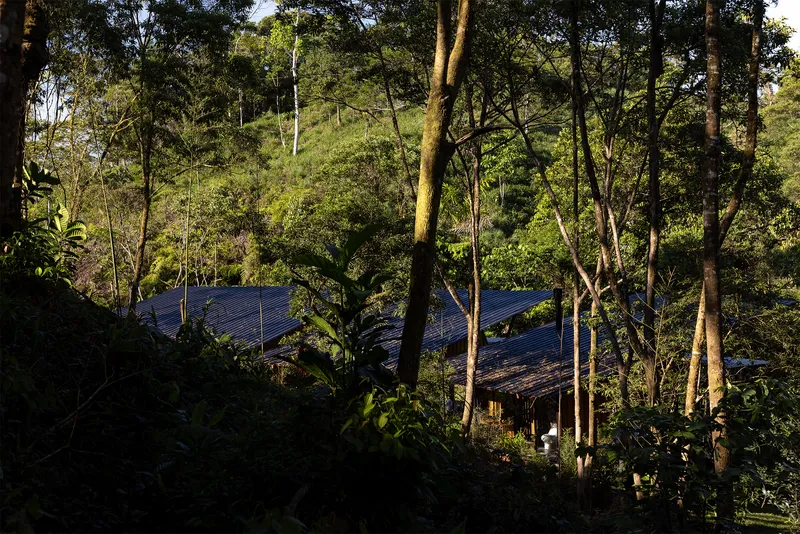

The site is steep, densely vegetated, and bisected by a small stream. Rather than clearing and leveling, Mestizo Estudio chose to distribute the program across three separate volumes that step down the hillside, each oriented slightly differently to catch light and views while minimizing tree removal. From above, the dark corrugated roofs nearly vanish beneath the eucalyptus and palm canopy, a deliberate camouflage that privileges the landscape's continuity over architectural presence.
The piloti strategy is not merely aesthetic. Raising the pavilions keeps the forest floor intact, allows water to flow unimpeded during heavy rains, and creates a ventilated underside that reduces moisture buildup in the timber structure. It also produces a surprisingly dynamic section: you approach from the hillside at roughly the same elevation as the interior floors, but once inside, you are suspended above the stream valley with nothing but air and vegetation below.
Structure as Expression

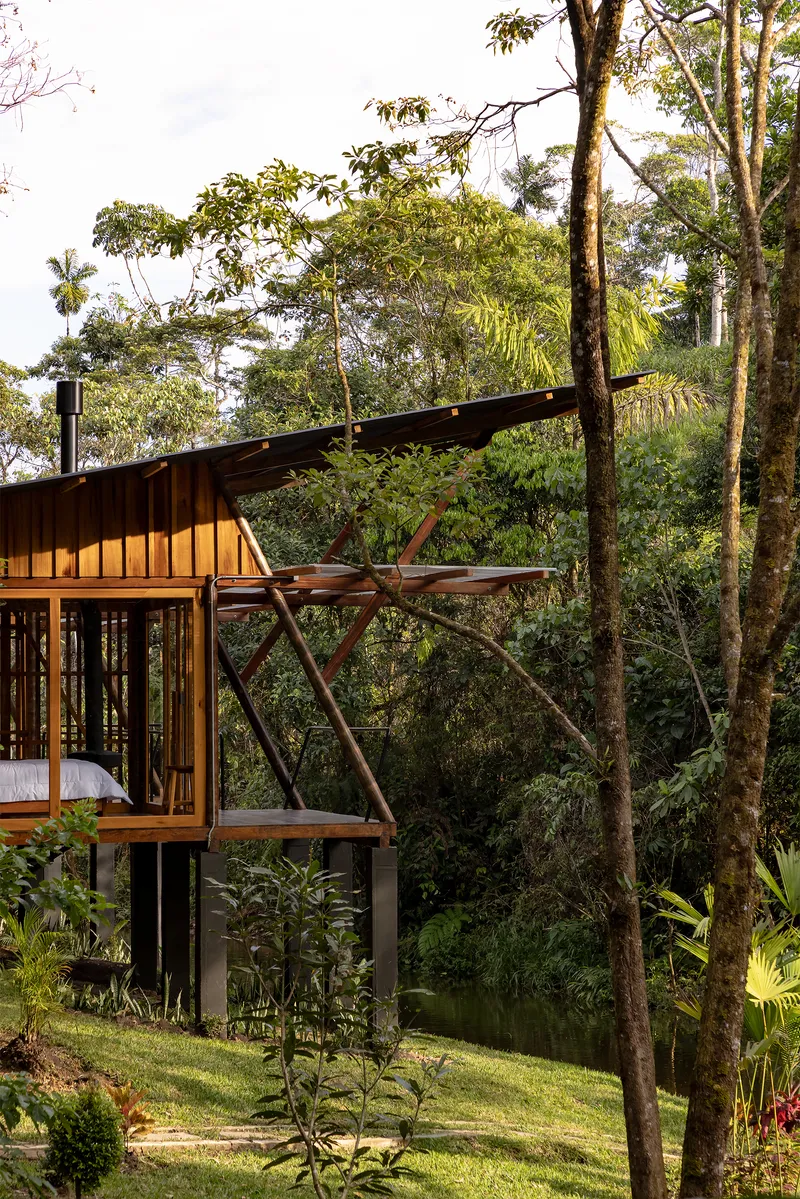

Diagonal timber braces and exposed steel bracket connections are not hidden behind finish materials; they are the architecture. The folded roof planes, each pitched at a different angle, are held aloft by a legible system of joists, purlins, and angled supports that you can trace from foundation to ridge. The corrugated metal roofing, secured with simple steel plates, reads honestly as a rain shield rather than a decorative surface.
There is a structural boldness to the cantilevered roof sections that extend well beyond the building envelope. These overhangs do double duty: they protect the bamboo screens from direct rain exposure and create shaded thresholds that blur the line between inside and outside. The diagonal bracing, visible from nearly every angle, gives the house a taut, almost tensile quality, as if the whole assembly were braced against the wind rather than simply sitting on its stilts.
Bamboo Screens and Filtered Light


The vertical bamboo and timber screens that wrap much of the facade are the building's primary interface with the outside world. They filter sunlight into sharp parallel lines across interior floors, moderate ventilation, and provide a degree of privacy without ever fully closing off the view. The effect is cinematic: the forest is always present, but it is framed and sliced into fragments that shift as you move through the house.
The twilight image of the refuge is particularly telling. With interior lights on, the screens glow like a lantern set into the hillside, inverting the daytime relationship. During the day, you look out through the screens at the forest. At night, the forest looks in at you. It is a reciprocity that few houses achieve, and it comes directly from the decision to use permeable enclosure rather than solid walls.
Living in the Open

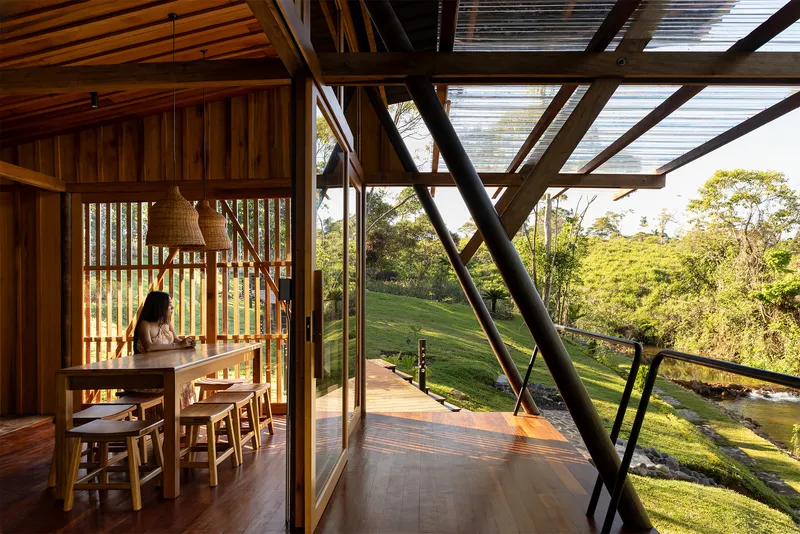
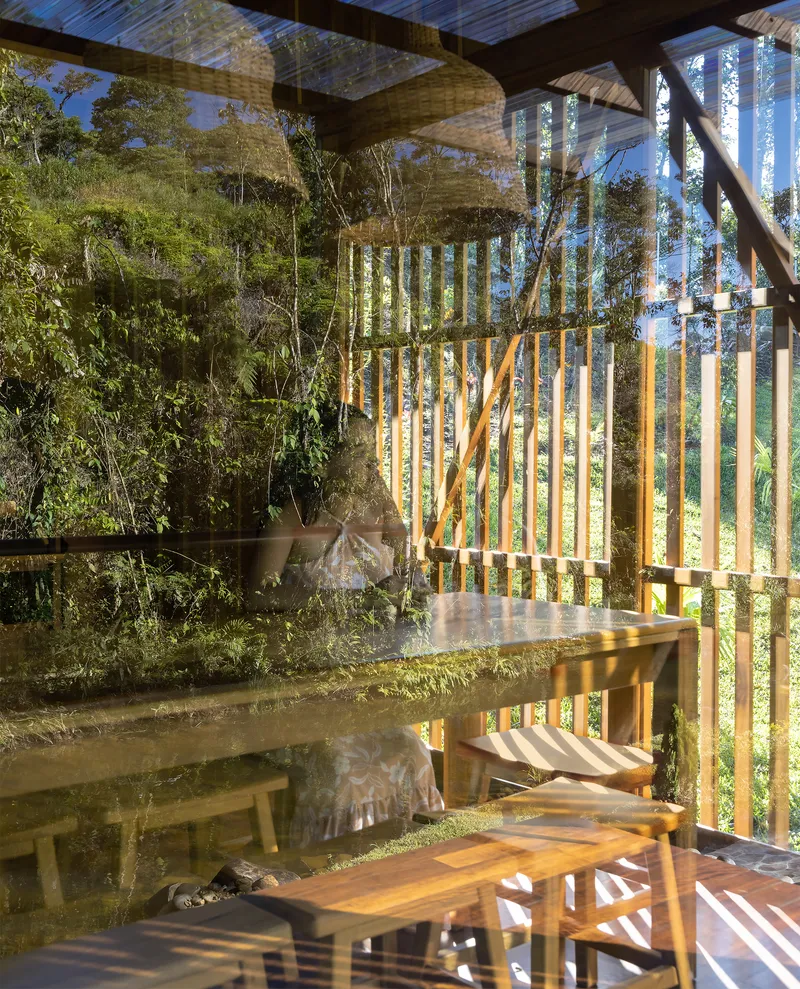
The social core of the house, a dining and living area that spans one of the pavilions, is open on nearly all sides. Timber furniture and a simple dining table sit beneath a slatted ceiling that runs the full length of the space, its rhythm echoing the vertical screens on the facades. The glazed walls that face the sloping lawn can be read as the house's most extroverted gesture: no screen, no filter, just a direct confrontation with the green hillside.
The materiality inside is restrained. Timber floors, timber walls, timber ceiling. The consistency is not monotonous because the quality of light changes so dramatically from one end of the house to the other, modulated by screen density, roof pitch, and orientation. A single room can hold warm direct sun at one corner and cool diffuse shadow at the other, all within a few meters.
Intimate Rooms and Material Details
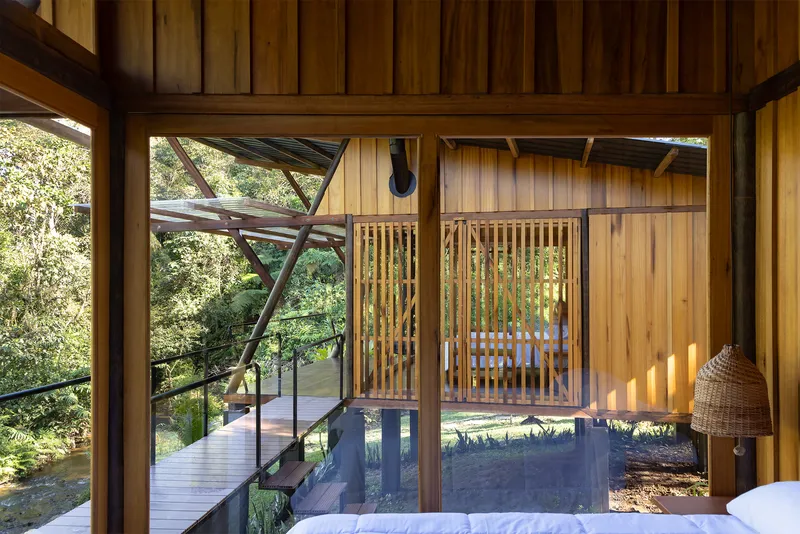
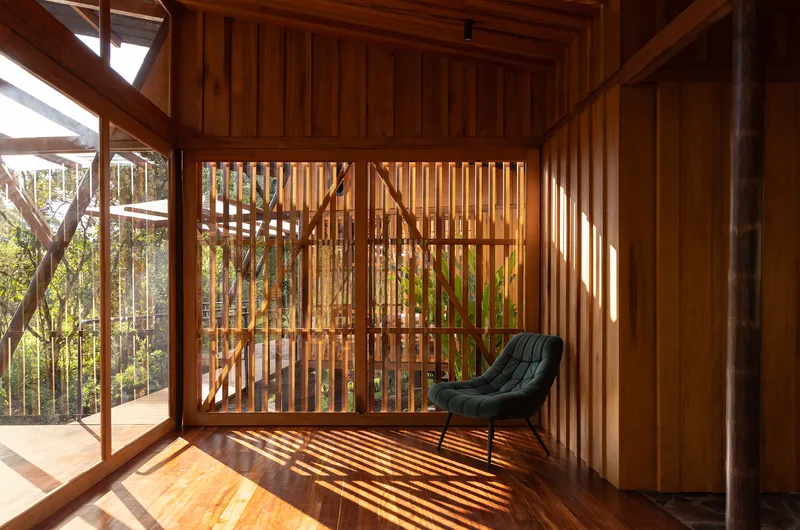

The bedrooms and bathrooms retreat from the openness of the social pavilion into more enclosed, shadow-rich spaces. The bedroom view through timber-framed glazing to the exterior walkway and diagonal bracing beyond captures the house's essential spatial move: even in the most private room, you are looking through structure, through screen, through air, to the forest. The layers are always legible.
A bathroom with a dark stone wall, timber vanity, and vessel sink beside floor-to-ceiling glass is the one moment where the material palette breaks from its all-timber rule. The stone introduces mass and coolness, a counterpoint to the warmth of the wood that feels deliberate rather than arbitrary. The woven light fixtures visible in other interior shots carry a craft sensibility that aligns with the handmade quality of the bamboo screens.
Building by Hand


Two construction images tell a story that the finished photographs cannot. Bamboo poles stacked against an earthen wall under a corrugated shed, and workers assembling roof framing by hand against the forest canopy, reveal a building process that relied on local labor and locally sourced material rather than prefabricated systems. The joinery is not CNC-cut; it is site-fitted, which explains the slight irregularities in screen spacing and brace alignment that give the finished house its handcrafted warmth.
The dusk image of the completed pavilion reflected in a pond at the base of the site is a fitting bookend to these process shots. What began as poles and purlins assembled in the rain has become a composed, luminous object hovering above the water. The gap between those two states is where architecture happens.
The Forest as Co-Author
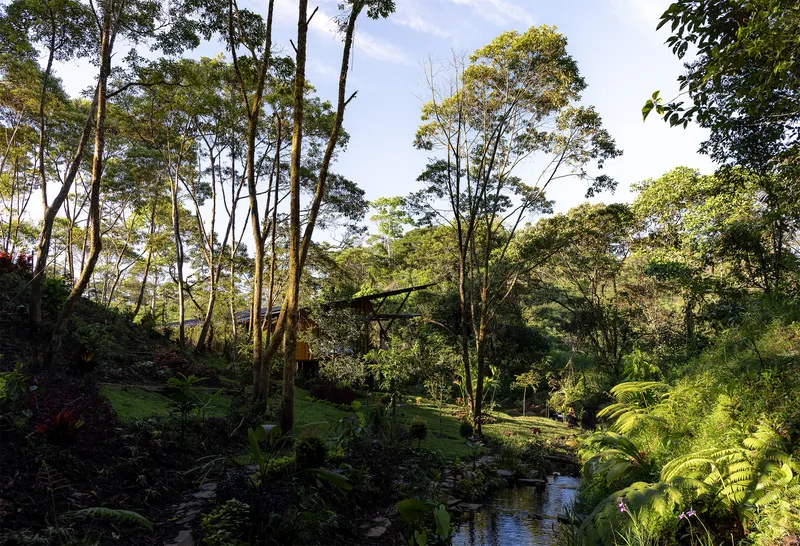
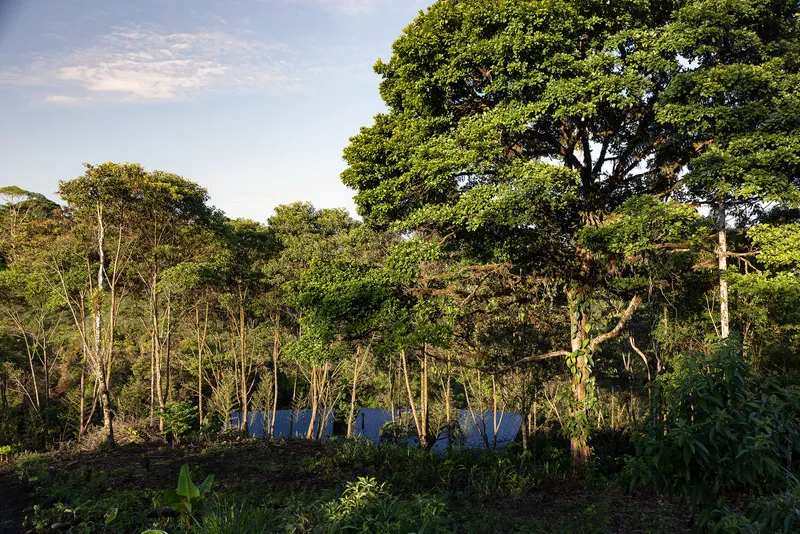

One of the strongest images in the set contains no building at all: just the dense canopy of eucalyptus, ferns, and a stream in afternoon light. Its inclusion is a statement. The forest is not a backdrop; it is the primary material condition from which every architectural decision flows. The blue corrugated roofline barely visible through the canopy in the distant view reinforces this: the house is meant to be absorbed, not to dominate.
The exterior deck and walkway that connect the pavilions function as a kind of elevated trail through the trees. Walking between the sleeping volume and the social volume is not a corridor experience; it is a canopy walk, open to rain and birdsong and the smell of damp earth. Mestizo Estudio understood that the space between the pavilions is as important as the space inside them.
Plans and Drawings

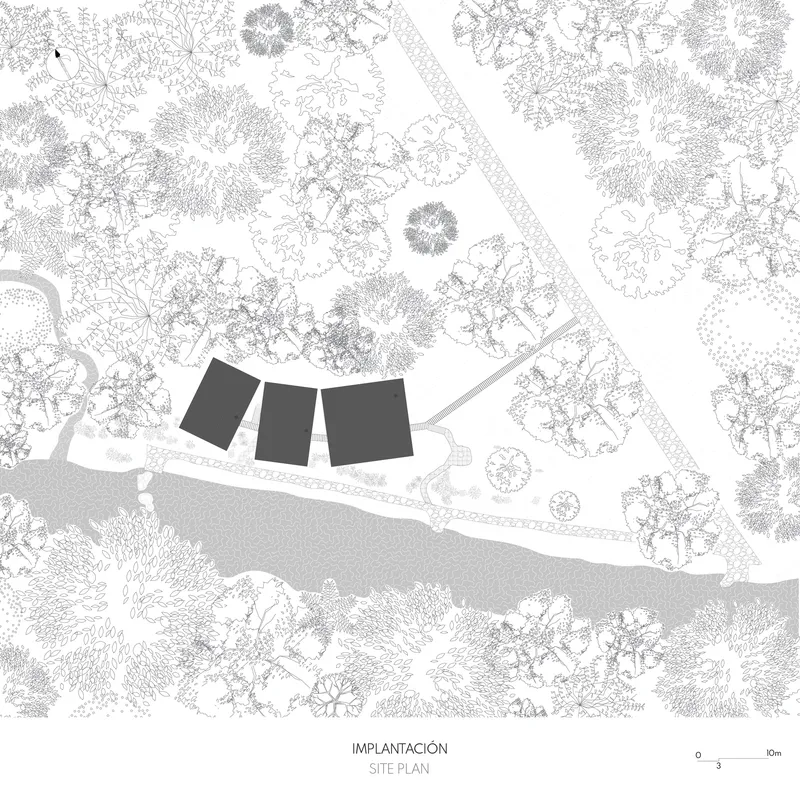



The site plans confirm the deliberate geometry: three rectangular volumes positioned among existing trees near a curved shoreline, linked by a single walkway. The floor plan reveals a clear programmatic split, with bedrooms and bathrooms in the outer pavilions and the social areas occupying the central volume. The cross section is the most instructive drawing, showing how the stilts negotiate the slope and how the roof pitches create varied interior ceiling heights.
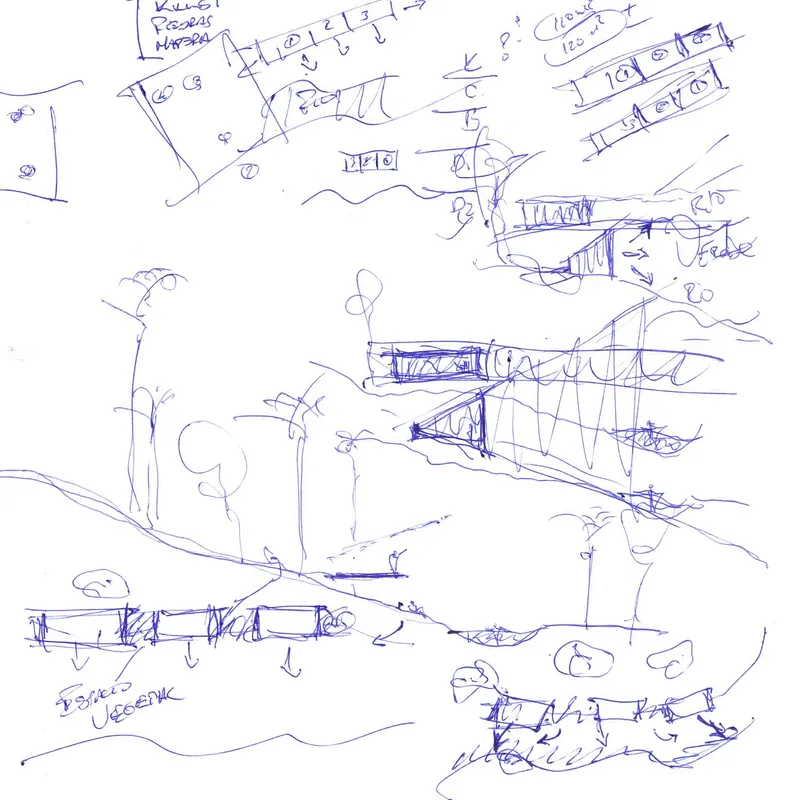
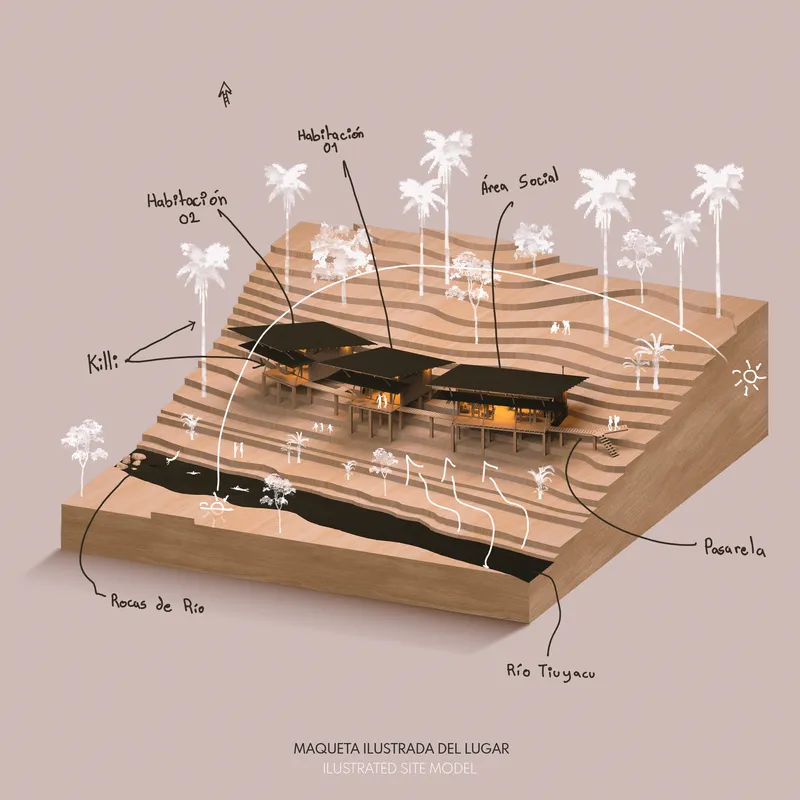
The pen sketches and physical model are worth pausing over. The sketch explores the relationship between platforms, slopes, and terraced volumes with handwritten annotations that suggest a thinking process rooted in topographic observation rather than formal composition. The layered timber model, with its miniature palm trees and river below, is a beautiful analog artifact that captures the project's ambition to build within the landscape rather than upon it.
Why This Project Matters
Hoguera de Madera matters because it demonstrates that a 150 square meter house on a difficult site does not need to be a simple box to be buildable, affordable, and structurally coherent. Mestizo Estudio split the program into three volumes not for formal novelty but because the site demanded it, and then used that fragmentation as the generator of the house's spatial richness. The result is a dwelling that feels far larger than its footprint because the forest, the stream, and the canopy are woven into every room.
More broadly, the project offers a disciplined alternative to the glass-box-in-nature trope that dominates much of contemporary residential architecture in Latin America and beyond. The bamboo screens, the corrugated roofs, the hand-assembled joinery: none of these are expensive or technologically advanced, but together they produce an architecture that is specific to its place, responsive to its climate, and genuinely moving to occupy. That combination is rarer than it should be.
Hoguera de Madera Refuge by Mestizo Estudio Arquitectura, lead architect Frank Espinoza Barrera. Ecuador. 150 m². Completed 2025. Photography by JAG Studio.
About the Studio
Share Your Own Work on uni.xyz
If projects like this are the kind of work you want to make, uni.xyz is a place to publish your own, find collaborators, and enter design competitions.


Popular Articles
Popular articles from the community


David Ortega Stacks a Two-Story Mexico City Penthouse Around a Steel Stair and a Pergola-Shaded Roof Terrace
In Colonia Roma, a 300 m² penthouse uses oak joinery, a planted steel stair and a slatted roof pergola to make a new-build apartment feel like a house.


Singing Woman: An Opera House That Performs Before the Curtain Rises
Ovidiu Cristian Pavel's conceptual opera house translates Estonia's choral identity into a sculpted waterfront landmark facing the Baltic Sea.

Aquadapt: An Underwater Habitat That Rewrites Its Rooms by the Hour
Curved modules ring the seabed while one shell shifts from breakfast room to cinema, farm and football pitch as residents' needs change.

FCC Arquitectura Expands a Portuguese Granite House with a Board-Marked Concrete Wing
In Portugal, JV House pairs a cleaned-up whitewashed and granite dwelling with a timber-shuttered concrete extension, courtyards and a garden pool.

Similar Reads
You might also enjoy these articles

LAVA Architecten Gives Vocational Education a Sawtooth-Roofed Face on a Mechelen School Campus
In Mechelen, Belgium, a 2,053 m² STEM school on a 6×6 m grid turns workshops and classrooms into rooms that can be rearranged as teaching changes.

KEMA Studio Turns a Derelict Marvila Attic into a 60 m² Lighthouse Apartment Above Lisbon
In Lisbon's Marvila district, a rebuilt roof, four skylights and two plywood volumes turn an unlivable attic into a bright home facing the Tagus.

Pixel Gardens: One Repeated Module Stacked Into a Terraced Social Housing Tower for Famagusta
Salem Bader's shortlisted housing tower builds a vertical neighbourhood from one repeated module, offsetting units to carve terraces, light and air.

Bao Huynh Watercolor Atelier: A Serene Art Retreat in Hội An
Bao Huynh Watercolor Atelier in Hội An blends multifunctional art spaces, sustainable design, local materials, and family-friendly living in a serene environment.

Explore Fuel to electricity Competitions
Discover active competitions in this discipline

Comments (0)
Please login or sign up to add comments
No comments yet. Be the first to comment!